Hubbry Logo
PanuchoPanuchoMain
Open search
Panucho
Community hub
Panucho
logo
8 pages, 0 posts
0 subscribers
Be the first to start a discussion here.
Panucho
Panucho
from Wikipedia
Panucho

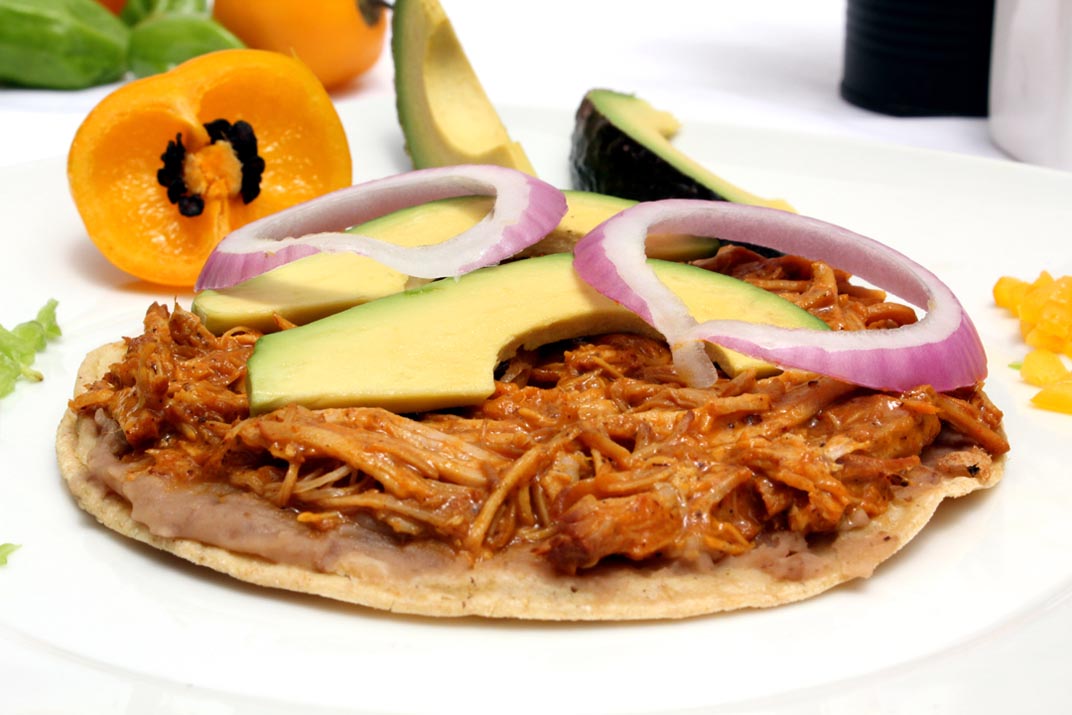
A panucho is a Mexican food specialty from the Yucatán made with a refried tortilla that is stuffed with refried black beans and topped with chopped cabbage, pulled chicken or turkey, tomato, pickled red onion, avocado, and pickled jalapeño pepper. It is occasionally topped with eggs in some variations.[1]

Panuchos are mostly sold in the evenings when parties of friends or family go out to eat. Panuchos are served at fast-food restaurants called panucherias which also serve salbutes, tostadas, tortas, and caldos. Panuchos are fried and topped to order and often served with soda.

References

[edit]
Revisions and contributorsEdit on WikipediaRead on Wikipedia
from Grokipedia
Panucho is a traditional Yucatecan , a type of originating from the . It consists of a stuffed with refried black beans, fried until crispy, and topped with (slow-cooked pulled pork), pickled red onions, lettuce, tomato, avocado, and salsa. This dish blends indigenous Mayan ingredients like and beans with Spanish-introduced meats, making it a staple of Yucatecan cuisine enjoyed as a snack or quick meal in markets and street stalls. It is distinguished from similar like salbutes by the bean stuffing. The dish originated in the mid-19th century in Mérida's La Ermita de Santa Isabel neighborhood, created by a named Don Hucho, who sold bean-stuffed sandwiches to travelers; it evolved to use corn tortillas and is named after him. Panuchos represent the fusion of Mayan, Spanish, and other culinary traditions, and remain iconic, featured at events like the annual Panucho Fair in La Ermita Park (as of 2024).

Description and Characteristics

Physical Composition

Panucho is a stuffed and fried originating from the in , classified as an , a traditional . The structure consists of a base layer formed from dough, a nixtamalized corn dough pressed into a thin, round approximately 4 to 6 inches in diameter. After initial cooking on a hot comal to puff slightly, a slit is made to create a pocket, which is filled with refried black beans, forming the inner layer. The assembled tortilla is then shallow-fried, developing an outer crispy shell while maintaining a relatively flat, round shape. Visually, panuchos exhibit a golden-brown exterior resulting from in or , providing a contrasting crisp texture to the soft filling inside. Toppings are layered atop this fried base, enhancing its handheld, snack-like form.

Flavor Profile and Texture

Panuchos exhibit a harmonious blend of flavors derived from their core components, where the earthy, creamy richness of refried black beans forms a foundational note, complemented by the tangy acidity of pickled onions. The savory depth from toppings such as shredded roasted or adds a smoky, layer, while habanero-based salsa introduces a sharp, spicy heat characteristic of Yucatecan chilies. In terms of texture, the fried shell delivers a prominent crispiness that contrasts sharply with the soft, velvety filling of the beans, creating a dynamic upon biting. Tender, juicy shreds of provide succulence, while the crunchy bite of pickled onions enhances the overall textural variety, making each panucho a study in contrasts between exterior crunch and interior tenderness. The dish achieves balance through the interplay of heat from the habanero salsa and cooling elements like creamy slices or fresh , mitigating the spice without overpowering the other flavors. This results in an overall that is lightly greasy from frying yet surprisingly airy, offering a satisfying initial crunch that yields to softer, more comforting layers inside.

History and Origins

Pre-Columbian Roots

Panucho traces its foundational elements to the ancient Mayan cuisine of the , where held sacred status as the core of daily sustenance and ritual life, dating back over 2,000 years to the Preclassic period (circa 2000 BCE–250 CE). The Mayans domesticated and cultivated extensively in their system, viewing it as a divine gift from the gods, and developed the process—cooking kernels in an alkaline solution of lime or ash—to create dough, which improved nutritional bioavailability and formed the basis for flatbreads and stuffed preparations. This technique, evidenced by microbotanical remains in ceramic vessels and colanders from Early Middle Preclassic sites (1000–400 BCE) in the , including , underscores 's centrality in proto-tortilla-like foods that prefigure panucho's structure. Indigenous ingredients like black beans (Phaseolus vulgaris, known as frijol negro) and achiote (Bixa orellana, or ) were integral to Mayan flavor profiles and preservation methods, both native to the region and incorporated into -based dishes for their nutritional and coloring properties. Black beans, a staple in the Mayan diet, were grown alongside in milpas and often mashed or cooked into fillings, providing protein complementarity in a predominantly plant-based , as indicated by archaeobotanical finds from Maya sites (250–900 CE). Achiote seeds, valued for their earthy, slightly peppery taste and vibrant red hue, were ground into pastes to season and color foods, including beverages and doughs, with residues detected in from Postclassic contexts (900–1500 CE), highlighting their role in enhancing preparations. Pre-Hispanic Mayan cooking primarily involved steaming, boiling, and griddling on ceramic comales to crisp or toast products, using dry heat over open fires, with fats from hunted game such as deer, , , and occasionally incorporated but not for . Archaeological evidence from Classic Maya sites in , including ceramic griddles (comales) and faunal remains, supports the preparation of toasted or crisped items, though techniques emerged post-contact. Excavations at Mayan ceremonial and residential sites reveal parallels to panucho's stuffed format through tamale-like preparations, where dough was filled with beans or other pastes, wrapped or folded, and cooked, serving both daily meals and rituals. Iconographic depictions in murals, ceramics, and stelae from sites like and (circa 600–1200 CE), alongside epigraphic references in hieroglyphs, confirm tamales (wa'aj in Yucatec Maya) as the primary stuffed food, often seasoned with achiote and consumed in elite banquets or offerings, providing direct precursors to filled concepts. These ancient practices evolved into the modern panucho form during the colonial era through Spanish culinary influences.

Colonial and Modern Evolution

During the Spanish colonization of the in the , European culinary practices significantly transformed local Mayan food traditions, including the precursors to panucho. Colonizers introduced pigs, which provided as a key cooking fat, enabling deep-frying techniques that were not prevalent in pre-colonial Mayan cuisine, where methods like and griddling dominated. This shift enhanced the crispiness of stuffed tortillas, evolving the dish from a simple bean-filled Mayan base into a fried with greater textural appeal. In the 19th and 20th centuries, panucho further integrated introduced meats such as and , often prepared in pibil style using achiote marinades, reflecting influences from independence movements and regional festivals that celebrated cuisine. According to local , the modern form of panucho originated around the mid-19th century in Mérida's La Ermita de Santa Isabel neighborhood, where vendor "Don Hucho" adapted bread sandwiches into bean-stuffed corn tortillas topped with shredded or for travelers along the Camino Real; the name "panucho" may derive from "Don Hucho" or the Mayan term "p’an uuch" meaning "filled." As Yucatán's henequén boom drove in Mérida during the late 19th and early 20th centuries, panucho rose as a favored and market staple, sold by vendors to a growing urban population and during festivals. In the , panucho has adapted to Yucatán's booming industry, appearing in upscale restaurants and food tours while preserving core methods in for authenticity. Modern interpretations include variations with contemporary proteins or presentations to appeal to international visitors, solidifying its status as an iconic Mérida without altering traditional assembly.

Ingredients

Core Components

The core components of panucho revolve around a simple yet essential set of ingredients that form its foundational structure in traditional Yucatecan . At the heart is the masa dough, prepared from nixtamalized corn flour (masa harina) mixed with water to create a pliable base for the tortillas. This dough is typically seasoned lightly with a pinch of salt to enhance flavor without overpowering the natural corn taste, resulting in a soft yet sturdy tortilla that can hold the filling during . The stuffing consists of refried black beans, which are cooked until tender, mashed into a creamy paste, and seasoned with salt and occasionally epazote for an aromatic herbal note. These beans serve a dual purpose: providing moisture and flavor while acting as a barrier to prevent the from becoming soggy when fried, ensuring the panucho's characteristic crisp exterior. In traditional recipes, black beans are preferred for their earthy depth, distinguishing panuchos from similar . Lard, or manteca de cerdo, is indispensable for , imparting a rich, golden crispiness and subtle savory richness that defines the panucho's texture. This is heated to a high temperature for quick , allowing the stuffed tortillas to puff slightly and develop a light, airy interior contrasted by a crunchy shell. can substitute in modern variations, but remains the authentic choice for its flavor-enhancing properties. In terms of quantities for a traditional batch yielding 4-6 panuchos, recipes commonly call for about 2 cups of harina mixed with sufficient water to form the , alongside ½-1 cup of prepared refried black beans for stuffing, and enough to submerge the tortillas during frying. These proportions emphasize efficiency and authenticity, with adjustments made based on consistency. Toppings, while common, are non-essential additions that build upon these core elements.

Toppings and Accompaniments

Panuchos are traditionally topped with shredded meat, most notably cochinita pibil, a slow-cooked pork shoulder marinated in achiote paste and sour orange juice, which yields tender, flavorful shreds with an earthy tang and vibrant red hue from the annatto seeds. This preparation, rooted in Mayan techniques, infuses the pork with citrus acidity and mild spice, creating a juicy contrast to the crispy bean-filled tortilla base. A chicken alternative, pollo pibil, follows the same marination and slow-cooking process, offering a lighter yet equally aromatic protein option for panuchos. Complementing the meat, pickled red onions known as cebolla morada provide a sharp, tangy crunch, prepared by thinly slicing red onions and marinating them in juice (or a substitute including ), often with spices such as dried , , , and , which turns them a striking and heightens their acidity to cut through the dish's richness. This accompaniment, essential to Yucatecan flavor profiles, adds a bright, herbaceous note that enhances the overall balance without overpowering the core elements. Sliced avocado contributes a creamy, buttery texture, sourced from the region's abundant local varieties that offer subtle nuttiness and freshness to mellow the heat and savoriness of other toppings. Typically arranged in thin layers atop the meat and onions, it introduces a cooling element that unifies the panucho's diverse flavors. Finally, habanero salsa, often known as Xni Pec, delivers intense spiciness, crafted by finely chopping or dicing habanero chilies with tomatoes, red onions, and cilantro, then mixing with sour orange or lime juice for a fresh, fiery, citrusy kick that defines the dish's bold identity. Often served fresh to allow customization of heat levels, this vibrant condiment ties together the tangy, creamy, and savory components while emphasizing the peninsula's love for potent chilies.

Preparation Methods

Tortilla Preparation

The preparation of the tortilla forms the foundational step in making panuchos, relying on traditional dough derived from nixtamalized corn. To begin, nixtamalized corn flour (masa harina) is combined with warm water and a small amount of salt in a mixing bowl, typically in proportions of about 2 cups flour to 1¼ cups water for a standard batch yielding 12 to 15 . The ingredients are stirred until a cohesive mass forms, then kneaded by hand for 5 to 10 minutes until the dough achieves a smooth, pliable, and non-sticky consistency that holds together without cracking—essential for even forming and cooking. Once the dough is ready, it is divided into equal portions, often golf ball-sized (about 1½ ounces each), and rolled into balls that are kept covered with a damp cloth to prevent drying. Each ball is then pressed into a thin round using a lined with or , resulting in discs approximately 4 to 5 inches in diameter and 1/8 inch thick; if a press is unavailable, the balls can be patted and rolled out by hand to the same dimensions. To prepare the tortillas for stuffing, they are briefly cooked on a hot, dry comal or cast-iron over medium heat for about 1 minute per side until lightly speckled and beginning to puff. A third flip allows gentle pressing with a clean kitchen towel to enhance the puffing, cooking for an additional 15 to 30 seconds until lightly golden—this partial cooking creates a natural pocket without fully crisping the . With the tortilla still hot, a small slit is carefully made about ½ inch from one edge using a knife or the tip of a , forming a 2-inch opening to access the interior pocket. Approximately 1 to 2 tablespoons of warm refried black beans are then spooned inside, taking care to distribute evenly without overfilling to avoid leakage during subsequent steps; the edges are gently folded or pressed together to seal the filling securely. The stuffed are allowed to rest for about 5 minutes, which helps the dough firm up and the seal hold, prior to .

Frying and Assembly

The frying process begins by heating in a large skillet or deep pan to approximately 350°F (175°C), ensuring the fat is hot enough to crisp the exterior without absorbing excess oil. The prepared stuffed are added in batches and fried for 1 to 2 minutes per side, or until they achieve a golden brown color and puff slightly, creating the characteristic crunchy shell that encases the . This step is crucial for developing the panucho's texture, with the heat causing the tortilla to inflate and seal the filling inside. Once fried, the panuchos are immediately transferred to a plate lined with paper towels to drain any excess , which prevents sogginess and preserves the crispiness during assembly. This draining step typically takes just a few moments, allowing the panuchos to cool slightly while remaining warm. follows directly after draining to maintain optimal heat and texture contrast. Each panucho is topped with a generous portion of warmed shredded meat, such as , followed by pickled red onions, sliced , and a spoonful of salsa, which integrate the flavors while the shell stays hot. Panuchos are served immediately at a hot , emphasizing the juxtaposition of the crispy fried against the warm, juicy fillings.

Variations

Regional Adaptations

In the , panuchos are most traditionally prepared in the state of , where they feature toppings of —a slow-roasted marinated in achiote paste and citrus—alongside shredded lettuce, pickled red onions, and a fiery salsa for added heat. These versions are ubiquitous in Mérida's bustling markets, such as the Lucas de Gálvez market, where street vendors serve them as a quintessential during evening gatherings or Sunday cochinita feasts. Along the coastal regions of the , panuchos adapt to the Gulf's abundant , incorporating toppings like seasoned or on the bean-stuffed , which introduces a briny contrast to the dish's crispy base and reflects the region's maritime culinary influences. This variation is commonly enjoyed in areas like and , where it aligns with the more elaborate presentations typical of the region's night markets and . In neighboring , panuchos diverge from the standard by substituting with alternative stews, such as butter-sautéed shrimp with or shredded chicken and beef, emphasizing local proteins while maintaining the fried and bean core. These adaptations highlight Campeche's coastal and inland preferences, often served with parboiled purple onions to balance the flavors in rural and urban settings alike.

Modern Interpretations

In contemporary culinary scenes, panuchos have seen innovative vegetarian adaptations, particularly in urban centers like , where eateries have replaced traditional meat toppings with plant-based alternatives such as mushrooms, , or plant-based cheeses since the early 2010s. Pioneering vegan restaurants like Los Loosers, established in 2011 in the Roma Norte neighborhood, offer panuchos featuring fermented mushrooms and , drawing on Yucatecan roots while catering to health-conscious and ethical diners; these versions maintain the crispy and bean filling but emphasize fresh, local produce for a lighter profile as of 2025. Such adaptations reflect broader trends in , where vegan has proliferated, with establishments innovating on to include vegetable-forward toppings like grilled or cashew-based "queso fresco" to appeal to diverse urban palates. Fusion interpretations of panuchos have emerged in U.S.-based Mexican restaurants, incorporating Asian influences, particularly post-2020 amid rising Korean-Mexican culinary crossovers. This trend aligns with the growth of food trucks and casual eateries experimenting with global flavors, making panuchos more accessible and exciting for American audiences seeking inventive . Health-conscious modifications to panuchos have gained traction in the , with recipes promoting over deep-frying and the use of to reduce fat content while preserving texture and flavor. Wellness-oriented cookbooks and online tutorials highlight oven- tortillas brushed lightly with at around 400°F (200°C), resulting in a crisp exterior without excess oil absorption, often paired with nutrient-dense toppings like or fresh salsa for balanced meals. These adaptations appeal to global audiences prioritizing lower-calorie versions of fried , maintaining the dish's cultural essence through simple substitutions. Commercial availability of panuchos has expanded since the mid-2010s, with pre-made and frozen options appearing in and marketplaces, facilitating preparation. Vacuum-packed or frozen kits for panuchos, complete with pre-cooked fillings, are sold through platforms like , allowing consumers to assemble and fry (or bake) quickly; these products, originating from producers, have made the dish more convenient for urban households and communities.

Cultural Role

Place in Yucatecan Cuisine

Panucho exemplifies the Mayan-Mexican fusion characteristic of Yucatecan cuisine, blending indigenous techniques with Spanish influences through its use of shared ingredients such as achiote paste and sour orange juice, which are also central to dishes like and salbutes. In this culinary tradition, achiote provides the vibrant red color and earthy flavor, while sour orange adds a tangy acidity, creating a cohesive flavor profile across and main courses that highlights the region's pre-Hispanic roots adapted over centuries. As a quintessential , panucho holds a prominent place in Yucatecan culture, where it stands alongside other portable snacks like empanadas and marquesitas, offering quick, flavorful bites that embody the casual, communal eating style prevalent in markets and vendors across Mérida and beyond. These , including the bean-stuffed and fried panucho topped with shredded meat, pickled onions, and fresh toppings, reflect the ingenuity of using simple, everyday components to create satisfying handheld foods that fuel daily life and social gatherings. The dish underscores the reliance on local staples in Yucatecan cooking, particularly endemic crops like peppers, which deliver intense , and traditions surrounding xnipec salsa—a fiery condiment made with habaneros, onions, and sour orange that frequently accompanies panuchos to enhance their bold profile. Through its emphasis on native black beans for the stuffing and heirloom corn for the tortillas, panucho contributes to the preservation of Yucatán's , promoting the continued cultivation of these milpa-grown varieties that form the backbone of the region's culinary heritage and support sustainable farming practices.

Consumption and Traditions

Panuchos are a staple of Yucatecan , commonly sold by vendors in bustling markets such as Mérida's Lucas de Gálvez, where they are enjoyed as a quick meal or appetizer during daily routines. These crispy provide a convenient, flavorful option for locals and visitors navigating the market's vibrant atmosphere, often consumed on the go amid the sounds of vendors and the aroma of fresh preparations. In everyday consumption, panuchos are frequently paired with refreshing beverages like or agua de chaya, enhancing their savory profile with cooling, mildly sweet notes that complement the dish's textures. They are particularly popular during the midday comida, serving as a light yet satisfying choice in the heat of Yucatán's . Panuchos hold a significant role in Yucatecan festivals and local traditions, appearing in events such as the annual Feria del Panucho held in La Ermita Park, Mérida, which celebrates the dish through tastings, music, and community gatherings as of its 6th edition on November 22, 2025. They also feature in fiestas in Kanasín—known as the "capital of the panucho"—fostering social bonds through feasting alongside music and dance. At home, panuchos are often prepared for family gatherings, offering a hands-on way to connect over shared meals and reinforcing cultural ties. emphasizes eating them by hand to fully appreciate the contrast of the crunchy exterior and soft filling, a practice that aligns with broader Yucatecan traditions of tactile enjoyment in informal settings.

References

Add your contribution
Related Hubs
User Avatar
No comments yet.