


Community hub
Recent from talks
Contribute something
Nothing was collected or created yet.
Cieszyn
View on WikipediaCieszyn (/ˈtʃɛʃɪn/ CHESH-in, Polish: [ˈt͡ɕɛʂɨn] ⓘ; Czech: Těšín [ˈcɛʃiːn] ⓘ; German: Teschen [ˈteːʃn̩]) is a border town in southern Poland on the east bank of the Olza River, and the administrative seat of Cieszyn County, Silesian Voivodeship. The town has 33,500 inhabitants (as of December 2021),[update][1] and lies opposite Český Těšín in the Czech Republic. Both towns belong to the historical region of Cieszyn Silesia, and formerly constituted the capital of the Duchy of Cieszyn as a single town.
Key Information


Geography
[edit]
The town is situated on the Olza river, a tributary of the Oder River, which forms the border with the Czech Republic. It is located within the western Silesian Foothills north of the Silesian Beskids and Mt. Czantoria Wielka, a popular ski resort. Cieszyn is the heart of the historical region of Cieszyn Silesia, the southeasternmost part of Upper Silesia. Until the end of World War I in 1918 it was a seat of the Dukes of Cieszyn.
In 1920 Cieszyn Silesia was divided between the two newly created states of Poland and Czechoslovakia, with the smaller western suburbs of Cieszyn becoming part of Czechoslovakia as a new town called Český Těšín. The larger part of the town joined Poland as Cieszyn.[2] Three bridges connect the twin towns. After Poland and the Czech Republic joined the European Union and its passport-free Schengen zone, border controls were abolished and residents of both the Polish and Czech part could move freely across the border. The combined population of Polish and Czech parts of the city is 61,201 inhabitants.[citation needed] Cieszyn is the southern terminus of the Polish National road 1 leading to Gdańsk on the Baltic coast.
The town combines both Polish and Old–Austrian peculiarities in the style of its buildings. Because of several major fires and subsequent reconstructions (the last one in the late 18th century), the picturesque old town is sometimes called Little Vienna.[citation needed] The only relic of the ancient castle is a square tower, dating from the 14th century and 11th century romanesque chapel.[citation needed]
History
[edit].jpg)
The area has been populated by West Slavic peoples since at least the 7th century. According to legend, in 810 three sons of a prince – Bolko, Leszko and Cieszko, met here after a long pilgrimage, found a spring, and decided to found a new settlement. They called it Cieszyn, from the words cieszym się ("We're happy"). This well can be found at ulica Trzech Braci ("Three Brothers Street"), just west of the town square.[3][4]

The area became part of the emerging Polish state in the 10th century. The town was the capital of the Duchy of Cieszyn, established during the fragmentation of Poland into smaller duchies, since 1290, which was ruled by Piast dynasty until 1653 and by the Habsburg Dynasty of Austria until 1918. It was in Teschen that Maria Theresa and Frederick II in May 1779 signed the Teschen Peace Treaty, which put an end to the War of the Bavarian Succession. In the 19th century Teschen was known for its ethnic, religious and cultural diversity, containing mostly German, Polish, Jewish and Czech communities.[5] There was also a small Vlach community[6] and a Hungarian community in the town consisting mostly of officers and clerks.[7]
The town was divided in July 1920, by the Spa Conference, a body formed by the Versailles Treaty, leaving a Polish minority on the Czechoslovak side. Its smaller western suburbs became what is now the town of Český Těšín in the Czech Republic. During the interwar period two villages were merged into Cieszyn: Błogocice in 1923 and Bobrek in 1932. After 1920 many ethnic Germans left the town, while many Poles from the Czechoslovakian part of the region moved in. According to the Polish census of 1921, Cieszyn had 15,268 inhabitants, of whom 9,241 (60.5%) were Poles, 4,777 (31.2%) were Germans, 1014 (6.6%) were Jews, and 195 (1.3%) were Czechs. The census from 1931 indicated 14,707 inhabitants, of whom 12,145 (82.7%) were Poles, while the rest consisted mostly of Germans and Jews (in 1937 estimated to be 12 and 8% respectively).[8]
Cieszyn and Český Těšín were merged again in October 1938 when Poland annexed the Trans-Olza area together with Český Těšín. Following the joint German-Soviet invasion of Poland, which started World War II in September 1939, Cieszyn was occupied by Germany until 1945. In 1939–1940, the Germans carried out mass arrests of local Poles during the genocidal Intelligenzaktion campaign, and then imprisoned them in a newly established Nazi prison in the town.[9] Many Polish teachers, school principals, priests and activists were deported to concentration camps and murdered there.[10] The Nazi prison had two forced labour subcamps in the town, and two more in nearby Karviná and Konská.[11] The Germans also established a camp for children up to the age of 2-3, where they were beaten, tortured and subjected to medical experiments.[12] Almost the entire Jewish community was murdered by the Nazis.
After World War II, the border between Poland and Czechoslovakia was restored to that of 1920. Most Germans fled or were expelled in accordance with the Potsdam Agreement and were replaced with Poles expelled from the Polish areas annexed by the Soviet Union. Signs of the former German presence in the town were removed by a special committee.[13]
On 19 July 1970, five firefighters from Cieszyn died when a bridge they were on fell into the Olza River, due to heavy flooding. In 1977, Boguszowice, Gułdowy, Kalembice, Krasna, Mnisztwo, Pastwiska were amalgamated with Cieszyn and Marklowice.
Culture
[edit]
Since the 18th century Cieszyn Silesia has been an important centre of Polish Protestantism when the Jesus Church was built as the only one in Upper Silesia. Currently, Cieszyn is also the site of the Cieszyn Summer Film Festival, one of the most influential film festivals in Poland. There is also an earlier established Czech-Polish-Slovak film festival.
Industry
[edit]Cieszyn is an important centre of the electromechanical industry. It is also the site of the Olza Cieszyn sweets factory (where the famous Prince Polo wafers are made) and the Brackie Browar, where Żywiec Porter is brewed. The main source of income for many citizens is trade with the nearby Czech Republic and retail trade associated with transit across the two bridges over the Olza to Český Těšín. In the past, the city was home to many furniture factories.[14]
Sites of interest
[edit]

- Romanesque St. Nicholas' Chapel (Kaplica św. Mikołaja, a rotunda from the 11th century), depicted on the current 20 złotych note.
- Remnants of the Piast dynasty castle
- Piast Castle Tower (Wieża Piastowska, mostly 14th century)
- Gothic St. Mary Magdalene Church (Kościół Marii Magdaleny, 13th century), burial site of the Cieszyn line of the Piast dynasty
- Old Town Square (Rynek)
- bourgeoisie houses (15th–19th centuries)
- Town Hall (Ratusz, early 19th century)
- Former minting house (18th century)
- Lutheran Church of Jesus (18th century)
- Museum of Cieszyn Silesia in the former Larisch family palace (Pałac Laryszów, Muzeum Śląska Cieszyńskiego, the first museum in Poland)
- Castle Brewery (Browar Zamkowy, 1846)
- Habsburg Palace in Cieszyn
- Bonifraters Monastery (18th century)
- The protestant Church of Jesus (Kościół Jezusowy), with a baroque tower and statues of the Four Evangelists above the altar that liven up the plain interior.
- Holy Cross Church
Notable people
[edit]- Jiří Třanovský (1592–1637), theologian and composer
- Adam Christian Agricola (1593–1645), evangelical preacher
- Carl Friedrich Kotschy (1789–1856), botanist and theologian
- Jakub Skrobanek (c. 1835–1910), merchant, banker and mayor of Cieszyn
- Rudolf Ramek (1881–1941), Austrian politician, Chancellor of Austria
- Hermann Heller (1891–1933), jurist
- Viktor Ullmann (1898–1944), Jewish musician
- Max Rostal (1905–1991), violinist and educator
- Herbert Czaja (1914–1997), German politician
- Richard Pipes (1923–2018), Polish-American historian
- Karol Semik (born 1953), teacher and educator
- Magdalena Gwizdoń (born 1979), biathlete
- Kajetan Kajetanowicz (born 1979), rally driver
- Ireneusz Jeleń (born 1981), footballer
- Tomisław Tajner (born 1983), ski jumper
- Jan Błachowicz (born 1983), mixed martial artist
- Piotr Żyła (born 1987), ski jumper
- Kacper Sztuka (born 2006), racing driver
Twin towns – sister cities
[edit]


Gallery
[edit]-
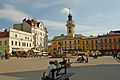 Town Hall at the Cieszyn Market Square
 -
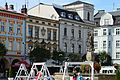 Townhouses in Cieszyn
 -
 Rotunda from circa 1180 / St. Nicholas Church
 -
 14th century Piast tower
 -
 Statue of Saint Florian
 -
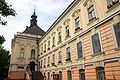 Monastery, church, and hospital of the Sisters of Saint Elizabeth
 -
 Mary Magdalene Dominican Church, begun in late 13th century
 -
 Hunting Palace of the Habsburgs and monument commemorating Silesian legionnaries fallen for Poland
 -
 Hotel on the town square
 -
 Evangelical Protestant Church of Jesus, begun in 1710
 -
 Communal Cemetery in Cieszyn
 -
 Museum of the Cieszyn Silesia


References
[edit]- ^ a b "Local Data Bank". Statistics Poland. Retrieved 2022-07-27. Data for territorial unit 2403011.
- ^ Edmund Jan Osmańczyk, Anthony Mango (2003). Encyclopedia of the United Nations and international agreements - Volume 1 A-F (2003 ed.). Taylor & Francis. p. 382. ISBN 0-415-93921-6.
- ^ "Cieszyn - Tourism | Tourist Information - Cieszyn, Poland". Staypoland.com. Retrieved 2013-07-16.
- ^ The legend is inscribed on the Well of the Three Brothers[permanent dead link] in Cieszyn.
- ^ Wawreczka et al. 1999, 13.
- ^ Davídek, Václav (1940). Osídlení Tešínska Valachy (in Czech). Prague.
{{cite book}}: CS1 maint: location missing publisher (link) - ^ Wawreczka et al. 1999, 10.
- ^ Dzieje Cieszyna..., 2010, t. III, p. 323
- ^ Wardzyńska, Maria (2009). Był rok 1939. Operacja niemieckiej policji bezpieczeństwa w Polsce. Intelligenzaktion (in Polish). Warszawa: IPN. p. 139.
- ^ Wardzyńska, pp. 137–141
- ^ "Strafgefängnis und Stammlager Teschen". Bundesarchiv.de (in German). Retrieved 16 October 2023.
- ^ Kostkiewicz, Janina (2020). "Niemiecka polityka eksterminacji i germanizacji polskich dzieci w czasie II wojny światowej". In Kostkiewicz, Janina (ed.). Zbrodnia bez kary... Eksterminacja i cierpienie polskich dzieci pod okupacją niemiecką (1939–1945) (in Polish). Kraków: Uniwersytet Jagielloński, Biblioteka Jagiellońska. p. 58.
- ^ Dzieje Cieszyna..., 2010, t. III, p. 439–440
- ^ . Encyclopædia Britannica. Vol. 26 (11th ed.). 1911.
- ^ "Miasta partnerskie". cieszyn.pl (in Polish). Cieszyn. Retrieved 2020-03-12.
Further reading
[edit]- Chisholm, Hugh, ed. (1911). . Encyclopædia Britannica. Vol. 26 (11th ed.). Cambridge University Press. p. 664.
- Panic, Idzi, ed. (2010). Dzieje Cieszyna od pradziejów do czasów współczesnych [History of Cieszyn from Ancient to Modern Times]. Vol. 1–3. Cieszyn: Książnica Cieszyńska. ISBN 978-83-927052-6-0.
- Wawreczka, Henryk; Janusz Spyra; Mariusz Makowski (1999). Těšín, Český Těšín na starých pohlednicích a fotografiích / Cieszyn, Czeski Cieszyn na starych widokówkach i fotografiach. Nebory, Třinec: Wart. ISBN 80-238-4804-6.
- Długajczyk, Edward (1993). Tajny front na granicy cieszyńskiej. Wywiad i dywersja w latach 1919-1939. Katowice: Śląsk. ISBN 83-85831-03-7.
External links
[edit] Media related to Cieszyn at Wikimedia Commons
- Official website
- Museum of Cieszyn Silesia (Muzeum Śląska Cieszyńskiego)
- Jewish Community in Cieszyn on Virtual Shtetl
| Urban gminas |  | |
|---|---|---|
| Urban-rural gminas | ||
| Rural gminas | ||


| City counties |  | |
|---|---|---|
| Land counties | ||
| International | |
|---|---|
| National | |
| Geographic | |
| Other | |


Cieszyn
View on GrokipediaGeography
Location and Topography
Cieszyn occupies the east bank of the Olza River, which delineates the international border with the Czech Republic, where the adjacent settlement is known as Český Těšín. The town's central coordinates are 49°45′04″N 18°37′56″E.[7] This strategic positioning along the river has historically facilitated cross-border interactions, with the Olza serving as a natural divide since the post-World War I partition in 1920.[8] Situated within the Silesian Foothills of the Western Carpathians, Cieszyn features an upland-hilly topography characterized by gentle elevations rising 70 to 130 meters, interspersed with river valleys that supported early settlement and trade pathways.[9] The Olza River flows northward through the town after originating in the nearby Silesian Beskid Mountains to the south, contributing to a landscape of rolling hills and fertile lowlands conducive to agriculture.[10] Elevations in the immediate vicinity average around 300 meters above sea level, transitioning from the higher Beskid ranges into broader piedmont flats.[11] Geologically, the Cieszyn area forms part of the Outer Flysch Carpathians, with sedimentary sequences including the Cieszyn Beds—predominantly shales and limestones from the Lower Cretaceous period.[12] The broader Cieszyn Silesia encompasses margins of the Upper Silesian Coal Basin, where Carboniferous coal deposits historically underpinned regional industry, though extraction has diminished significantly since the late 20th century.[13] These features underscore the terrain's role in shaping human activity through accessible valleys amid a tectonically folded flysch belt.[14]
Climate and Environmental Features
Cieszyn features a humid continental climate (Köppen classification Dfb), with distinct seasons marked by cold, snowy winters and mild, relatively short summers. Average low temperatures in January hover around -4°C (25°F), while July highs typically reach 23°C (73°F), with annual mean temperatures approximately 8–9°C. Winters often bring snowfall accumulation exceeding 50 cm in total, influenced by continental air masses, whereas summers experience occasional heatwaves but rarely exceed 30°C.[15][16] Precipitation is abundant and evenly distributed, averaging 1,000–1,100 mm annually, with June being the wettest month at around 120–150 mm and fewer than 10 dry months per year. The proximity to the Beskid Mountains in the Carpathian range enhances orographic rainfall, particularly during convective summer storms, and contributes to föhn-like winds that can temporarily warm the area in winter. Local weather stations, such as those operated by the Polish Institute of Meteorology and Water Management, record over 160 rainy days yearly, underscoring the region's moist conditions.[17][18] The Olza River, bisecting Cieszyn and forming the Polish-Czech border, presents significant environmental risks through recurrent flooding, exacerbated by steep gradients from upstream mountain catchments and intense precipitation events. Historical floods include major inundations in August 1985 and July 1997, which caused widespread damage along the lower Olza course; a record event in September 2024 saw water levels peak at 494 cm, flooding 55 buildings and recreational areas. These episodes highlight vulnerabilities tied to the river's morphology and climate variability, prompting cross-border engineering measures like embankments and retention basins to manage peak flows.[19][20] Environmental pressures in Cieszyn stem partly from regional legacies of Silesian coal mining, which historically elevated air pollution levels with particulate matter and sulfur dioxide, affecting local watercourses including the Olza through acid mine drainage and sedimentation. Post-2000 remediation, supported by EU structural funds, has focused on riverbank stabilization, wetland restoration, and air quality monitoring, yielding measurable improvements in ambient conditions; for instance, PM10 concentrations have declined amid broader deindustrialization efforts in southern Poland. These initiatives align with Poland's commitments under the EU Water Framework Directive, emphasizing sustainable management of transboundary ecosystems.[21][22][23]History
Origins and Medieval Foundations
Archaeological investigations in the Cieszyn area reveal evidence of continuous human settlement from prehistoric times, with significant Slavic presence associated with the Golensizi (Gołęszyce) tribe establishing multiple settlements between the 7th and 9th centuries CE.[24] Excavations, including those conducted in the 1940s and 1950s, uncovered cultural layers up to 12 meters thick around Castle Hill, indicating sustained occupation and early fortifications linked to tribal centers.[25] [26] By the 10th century, the site had evolved into a fortified settlement integrated into the Piast dynasty's domain following the incorporation of Silesia around 990 CE.[27] [28] The first documented reference to Cieszyn appears in 1155 as "Tessin" in a bull issued by Pope Adrian IV, confirming its existence as a regional center under ecclesiastical notice.[29] A wooden defensive castle was constructed on Castle Hill during the 10th century, serving as a castellany seat, while the stone Rotunda of St. Nicholas— the earliest surviving structure—dates to the 11th century and functioned initially as the castle chapel.[30] [31] Local legend attributes the town's founding to three Piast princes—Bolek, Leszek, and Cieszko—sons of a Duke Leszek, who met at a spring and established the settlement, though this remains unverified by historical records and reflects etymological ties to the Polish root for "joy" (cieszyć się).[32] Following the 1138 fragmentation of Poland under Bolesław III Wrymouth's testament, Silesian territories divided into principalities, setting the stage for further subdivisions; Cieszyn emerged as the core of the Duchy of Teschen, formally split from the Duchy of Opole and Racibórz in 1281 and governed by Piast dukes until the 17th century.[33] [34] The settlement developed into an early medieval town at the castle's base, adopting the German Law of Lwówek Śląski in the 13th century to regulate urban growth.[35] Its strategic position along the Moravian Gate facilitated trade routes, evidenced by medieval economic activity building on earlier Roman-era coin finds.[36]Habsburg Rule and Economic Growth
The Duchy of Cieszyn came under direct Habsburg control in 1653 following the death without heirs of the last Piast ruler, Duchess Elizabeth Lucretia, causing the territory to escheat to the Bohemian Crown lands held by the Habsburg monarchy.[37] This marked the end of semi-autonomous local rule and integrated Cieszyn into the Habsburg administrative framework as an eastern outpost of Austrian Silesia, a status reinforced by the strategic fortifications around the castle hill, which served defensive purposes amid regional rivalries with Prussia.[38] Habsburg governance provided relative stability after earlier upheavals, including the Thirty Years' War, though initial economic stagnation persisted into the late 17th century due to the shift away from ducal patronage.[37] German emerged as the official administrative and educational language under Habsburg policy, fostering Germanization in urban centers like Cieszyn, where it became dominant in public life and institutions by the 19th century.[39] Despite these efforts, Polish speakers maintained a demographic presence, particularly in rural surrounds, reflecting the duchy's ethnic composition where Poles constituted the regional majority. The Habsburg period emphasized centralized bureaucracy over local autonomy, with Cieszyn functioning as a key administrative hub in Austrian Silesia, though without major military expansions beyond existing castle defenses. Economic expansion gained momentum in the 19th century, driven by infrastructure improvements and nascent industrialization. The arrival of the railway in 1869, via the line from Bohumín, connected Cieszyn to broader networks and spurred trade and manufacturing, including established brewing operations dating to earlier centuries and emerging textile activities tied to regional Silesian production.[40] [41] Population growth reflected this development, rising from about 7,000 residents in 1849 to nearly 10,000 by 1869 and 17,000 by 1900, fueled by migration and economic opportunities in brewing, small-scale industry, and rail-related services.[42] These changes positioned Cieszyn as a modest commercial node, though industrial scale remained limited compared to Prussian Silesia's heavy sectors.[43]1918–1920 Conflicts and Territorial Division
Following the collapse of Austria-Hungary in late 1918, Cieszyn Silesia became a flashpoint between the newly independent states of Poland and Czechoslovakia, both claiming the territory based on historical, ethnic, and strategic grounds. The Polish National Council of the Duchy of Cieszyn, formed on October 19, 1918, initially asserted control and sought incorporation into Poland, citing the region's ethnic composition from the 1910 Austrian census, which indicated 54.85% Polish speakers (approximately 233,850 individuals), 27.11% Czech speakers, and 18.04% German speakers across the duchy's roughly 350,000 inhabitants.[5] A provisional agreement signed on November 5, 1918, divided administrative control temporarily between local Polish and Czechoslovak authorities pending international arbitration, but mutual suspicions persisted, with Poles emphasizing self-determination aligned with linguistic majorities and Czechs highlighting historical ties to the Bohemian Crown and economic integration needs, including access to coal mines and railways.[5] Tensions escalated into armed conflict when Czechoslovak Legion troops launched an offensive on January 23, 1919, against Polish-held positions in the disputed area, initiating the Polish–Czechoslovak War, commonly referred to as the Seven-Day War. Czechoslovak forces advanced swiftly, capturing key towns and most of the territory by January 30, 1919, with fighting concentrated around Cieszyn and eastern districts; the brief campaign resulted in an armistice via the Paris Protocol on February 3, 1919, which established a control commission but effectively ratified much of the new status quo under Czechoslovak occupation.[5] Poland, focused on its eastern fronts against Ukrainian and Bolshevik forces, lacked resources for sustained resistance, while Czechoslovakia leveraged its more organized legions; the war's limited scope—spanning seven days and involving several thousand troops—nonetheless entrenched divisions, as both sides rejected concessions amid fears of demographic shifts from wartime migrations.[5] The unresolved dispute proceeded to arbitration by the Allied powers, culminating at the Spa Conference in July 1920, where the Conference of Ambassadors in Paris finalized the territorial division on July 28, 1920—accepted by Poland on July 31 amid its critical war with Soviet Russia. Czechoslovakia received approximately 1,300 km² (about 57% of the disputed area), including strategic rail hubs at Bohumín and Fryštát essential for linking Bohemia to Slovakia, along with 284,000 inhabitants (encompassing roughly 120,000 ethnic Poles); Poland retained 1,000 km² with 143,000 people, primarily the western portion west of the Olza River, preserving Cieszyn town's core but ceding eastern industrial zones.[5] The arbitration prioritized Czechoslovak geopolitical cohesion and infrastructure over strict ethnic self-determination, dismissing a proposed plebiscite due to bilateral distrust, potential violence, and Poland's precarious military position; Polish arguments centered on the 1910 census's demonstration of a Polish plurality, while Czech representatives contested the data's reliability, alleging undercounting of Czech speakers and irregularities in language declarations influenced by Habsburg policies favoring Polish national activation.[5] This outcome left a substantial Polish minority in Czechoslovak-held Zaolzie and fueled enduring bilateral grievances, though it stabilized the border without further immediate hostilities.[5]Interwar Period, WWII, and 1938 Annexation
Following the territorial division of July 1920, the Polish-administered section of Cieszyn became a small enclave surrounded by Czechoslovak territory, disrupting longstanding economic interdependencies such as cross-border trade and infrastructure like the Olza River bridges, which were now subject to customs barriers and restricted access.[6] The population of Polish Cieszyn in the 1921 census totaled 15,268, comprising 60.5% Poles, 31.2% Germans, 6.6% Jews, and smaller groups of Czechs and others, reflecting a Polish majority amid ethnic tensions exacerbated by the division.[44] In Zaolzie—the Czechoslovak-controlled portion—ethnic Poles formed a significant plurality or slim majority in key areas, with Czech censuses recording Polish as the mother tongue for approximately 55–60% of residents in the broader Teschen Silesia district by the 1930s, though official figures fluctuated due to self-identification pressures and linguistic categorization.[45] These demographics fueled Polish irredentist claims, culminating in the Munich Agreement of September 30, 1938, which weakened Czechoslovakia; Poland then delivered an ultimatum on September 30 and dispatched troops to occupy Zaolzie starting October 2, 1938, thereby reuniting Cieszyn under Polish control and incorporating about 1,000 square kilometers with roughly 250,000 residents, many Polish-speaking. [45] The reunion proved short-lived, as Nazi Germany invaded Poland on September 1, 1939, occupying Cieszyn within days and annexing the entire region—including Zaolzie—into the Third Reich's Gau Oberschlesien (Upper Silesia) administrative district, where it underwent forced Germanization policies targeting Polish cultural institutions, schools, and elites through arrests, executions, and deportations. Anti-Polish repressions intensified, with local Polish intelligentsia systematically eliminated to suppress resistance, as documented in wartime records of targeted killings and forced labor recruitment.[46] Despite this, Polish underground networks, including affiliates of the Home Army (Armia Krajowa), formed early in the occupation, engaging in sabotage, intelligence gathering, and aid to fugitives, contributing to over 100 nascent resistance groups across German-occupied Poland by mid-1940.[47] Soviet forces liberated Cieszyn in late April 1945 amid heavy fighting, after which the Potsdam Conference (July–August 1945) endorsed the "orderly and humane" transfer of German populations from Polish territories, leading to the expulsion of most of the prewar German minority—around 31% of Polish Cieszyn's 1921 population—between 1945 and 1947, with estimates of 4,777 Germans in the town alone facing relocation amid broader Silesian outflows totaling over 3 million.[48] [44] The conference also implicitly upheld pre-1938 borders for Poland-Czechoslovakia relations, restoring Czechoslovak control over Zaolzie while confirming Poland's retention of its original interwar enclave, thus dividing Cieszyn permanently despite brief postwar Polish administration of the area.[48]Post-WWII Communist Era
Following the end of World War II in 1945, Cieszyn's population had declined sharply to 16,500 inhabitants by 1946, reflecting wartime losses, expulsions of Germans, and migrations across the newly reaffirmed Polish-Czech border.[49] The town itself avoided major physical destruction, preserving much of its pre-war infrastructure, though the Soviet-backed Polish communist regime quickly imposed political controls, curtailing activities of non-communist parties and associations before banning them outright, which stifled the local community's pre-war civic traditions.[49][50] Under the Polish People's Republic (PRL), agricultural collectivization efforts targeted surrounding rural areas in the 1950s, compelling private farmers into state-controlled cooperatives amid broader Soviet-modeled reforms, though resistance preserved a significant portion of individual holdings compared to more forcible implementations elsewhere in Eastern Europe.[51] Industrial assets, including the Cieszyn Brewery—nationalized as early as 1920 but fully integrated into state enterprises post-1945—continued operations under centralized planning, contributing to local beer production but prioritizing quotas over innovation. Urbanization accelerated with the construction of large housing estates on the town's periphery to accommodate influxes from rural depopulation and internal migration, stabilizing the population at around 35,000 by the 1970s amid Poland's broader industrial push.[50][52] Heavy industry remained limited in Cieszyn itself, unlike nearby Upper Silesian coal and steel hubs, but border proximity fostered informal cross-border smuggling networks as a response to PRL shortages and currency disparities.[53] Policies under the PRL promoted ethnic homogenization, accelerating the assimilation of the residual Czech minority through enforced use of Polish in administration and education, while marginalizing the local Silesian dialect in schools to enforce linguistic uniformity. Cultural and religious expressions faced suppression, with Polish Catholic and Protestant institutions—prominent in Cieszyn's historically diverse fabric—subject to state oversight, closures of independent associations, and restrictions on public observance, eroding pre-war multicultural identities.[49] Industrial activities, though modest, contributed to regional environmental strain via untreated effluents and emissions typical of PRL-era operations in Silesia, exacerbating pollution in waterways like the Olza River without adequate mitigation.[54]Post-1989 Developments and Border Reconciliation
The collapse of communist rule in Poland in 1989, driven by nationwide negotiations between the Solidarity trade union and the regime, enabled local democratic reforms in Cieszyn, including the establishment of independent municipal governance and the revival of civil society organizations previously suppressed under martial law.[55] Parallel developments in Czechoslovakia's Velvet Revolution facilitated similar shifts across the border in Český Těšín, setting the stage for bilateral normalization amid the dissolution of the Eastern Bloc. By the mid-1990s, both towns pursued cross-border initiatives under frameworks like the Euroregion Cieszyn, established in 1998, which promoted joint environmental and infrastructure planning without resolving underlying territorial grievances from the 1920 division.[56] Poland and the Czech Republic acceded to the European Union on May 1, 2004, followed by entry into the Schengen Area on December 21, 2007, which eliminated routine border checks along the Olza River dividing Cieszyn from Český Těšín.[57] This de-bordering enhanced everyday integration, with residents commuting for work, shopping, and services; studies describe the area as the most functionally unified segment of the Czech-Polish frontier, evidenced by high cross-border service usage in trade and culture.[58] [59] Infrastructure cooperation persisted, including maintenance of the Friendship Bridge over the Olza, though projects emphasized practical connectivity over symbolic reconciliation.[60] Despite pragmatic economic ties, such as shared markets for goods and cultural events drawing participants from both sides, ethnic frictions in Zaolzie—home to a Polish minority of approximately 25,000—linger through commemorations of 1919-1938 conflicts and debates over minority rights. [61] No violent incidents have marred the border since the early 1990s, reflecting stabilized relations bolstered by EU-mediated dialogue, though academic analyses note asymmetric perceptions of historical border shifts persist among locals.[62] [63] The COVID-19 pandemic temporarily reimposed controls in 2020-2021, disrupting daily cross-border routines and highlighting dependencies, yet post-restriction recovery underscored the region's resilience without reigniting animosities.[64]Demographics
Population Trends and Statistics
As of December 31, 2023, Cieszyn had a population of 32,760 residents, reflecting a continued gradual decline from its peak of approximately 36,400 in 2002.[65][66] This 10% reduction over two decades stems largely from net out-migration, as younger residents have moved to larger Polish cities like Katowice or Warsaw for employment and education opportunities, amid limited local economic expansion.[66][52] The town's annual population growth rate has been negative since the early 2000s, averaging around -0.5% per year through 2015, driven by a natural decrease where deaths exceed births due to persistently low fertility rates below replacement level (approximately 1.3 children per woman locally, aligning with national trends).[52] This depopulation has been partially mitigated since the mid-2010s by modest return migration of former emigrants, particularly families seeking affordable housing and proximity to cross-border ties, though inflows remain insufficient to reverse the overall trend.[67] Demographic aging is pronounced, with individuals aged 65 and over constituting 23% of the population in 2019, up from lower shares in prior decades, exacerbating labor shortages and straining local services.[67] In Cieszyn County, which encompasses both urban and rural areas, the town's relative stability contrasts with rural localities experiencing sharper outflows of working-age populations to the urban core, resulting in county-wide growth of 4.4% from 2000 to 2015 despite the municipal decline.[52]Ethnic Composition and Historical Shifts
In the early 20th century, prior to the post-World War I division, Cieszyn and its surrounding region in Austrian Silesia featured a diverse ethnic makeup dominated by Poles, with substantial German and smaller Czech and Jewish populations. The 1910 Austrian census for towns in the Teschen area indicated Germans predominating in six towns comprising 60.1% of the total population, Poles in two towns at 30.1%, and Czechs at 9.3%, reflecting German urban and industrial influence amid a broader Polish rural majority. [68] Jewish residents, often German-speaking, accounted for around 15% of Cieszyn's population by 1914. [69] Following the 1920 territorial split between Poland and Czechoslovakia, which assigned the western (Polish) Cieszyn a Polish majority while the eastern (Czech) portion saw targeted Czechification policies including immigration and assimilation efforts, the ethnic composition on the Polish side began homogenizing. [70] World War II and its aftermath accelerated this shift: the Holocaust reduced the Jewish population from prewar levels of approximately 10% to negligible post-1945 numbers due to extermination and emigration. [6] Simultaneously, the Potsdam Agreement facilitated the expulsion of ethnic Germans from Polish Silesia, including Cieszyn's German minority, resulting in a near-total Polish ethnic dominance by the late 1940s. [71] Contemporary Cieszyn remains ethnically homogeneous, with Poles comprising over 95% of the population per national trends, alongside a small Czech national minority of about 1-2% in the region. [72] The Cieszyn Vlachs persist as an ethnographic subgroup within the Polish majority, preserving distinct highland traditions. Across the border in Zaolzie (the Czech portion), Polish claims persist of undercounted ethnic Polish identity in censuses, attributed to historical assimilation pressures and Czechification, with declared Polish numbers lower than estimated actual affiliation. [70]Linguistic and Religious Profiles
The primary language in Cieszyn is Polish, with widespread use of the local Cieszyn Silesian dialect, a West Slavic ethnolect characterized by distinct phonetic features, vocabulary influenced by historical German and Czech contacts, and transitional traits between standard Polish and Czech dialects.[73] This dialect, spoken informally in daily life and cultural expressions, maintains approximately 93% intelligibility with standard Polish despite divergences like preserved nasal vowels and specific lexical items.[74] Due to the town's position on the Polish-Czech border, cross-linguistic exposure is common, particularly since the 2007 Schengen Agreement facilitated open movement and informal bilingualism in commerce and social interactions, though formal education and administration remain Polish-centric.[75] Roman Catholicism predominates religiously, with Cieszyn parishes integrated into the Diocese of Bielsko-Żywiec, erected on March 25, 1992, to serve the southern Silesian region including local Gothic and Baroque-era churches like St. Mary Magdalene's.[76] A distinct Protestant minority, comprising adherents of the Evangelical Church of the Augsburg Confession (Lutheran), centers around the Jesus Church, constructed in 1909-1910 as one of Poland's largest Protestant basilicas and reflecting the Reformation's 16th-century foothold in Silesia via figures like Kaspar Schwenckfeld.[77] This community preserves traditions amid broader Catholic dominance, with joint ecumenical events occasionally bridging divides. Historically, a Jewish community emerged in the 18th century, growing to several hundred by the mid-19th century (e.g., 327 in 1837, about 5% of the population) and maintaining institutions like the old cemetery established in 1647; pre-World War II numbers supported a German-speaking minority with a synagogue, but the Holocaust eradicated nearly all, leaving only archival and cemetery remnants today.[78] Since the 2000s, national trends of secularization—evidenced by falling Mass attendance and self-reported irreligion—have influenced Cieszyn, though religious observance remains relatively higher in this border area compared to urban Poland.[79]Administration and Politics
Local Government Structure
Cieszyn operates as an urban gmina (municipality) within Poland's decentralized local government framework, featuring a bicameral structure with a legislative city council (Rada Miejska) of 23 elected members serving five-year terms and an executive branch headed by a directly elected mayor (burmistrz). The council approves the annual budget, enacts local ordinances, and supervises municipal policies, while the mayor manages day-to-day operations, including public administration, service delivery, and executive decisions. Current mayor Gabriela Staszkiewicz, elected for the 2024–2029 term, directs the municipal office with support from two deputy mayors and key departmental heads such as the secretary and treasurer.[80][81] As the administrative seat of Cieszyn County (powiat cieszyński), established amid Poland's 1999 territorial reforms that reinstated intermediate county governance layers, the municipality coordinates on regional matters but maintains distinct operations from the county's starosta-led administration. Municipal departments emphasize urban planning to integrate tourism infrastructure with historical preservation and facilitate border management through collaboration with the Polish State Border Guard, enabling seamless cross-border pedestrian traffic and joint initiatives.[82] In 2023, the municipal budget recorded revenues of 220 million PLN, sourced from property taxes, personal income tax shares, and national subsidies, with additional EU cohesion funds supporting targeted projects like infrastructure upgrades and cultural enhancements. Expenditures, exceeding revenues and resulting in a deficit financed via loans and asset disposals, prioritized education, roads, and social services, reflecting fiscal reliance on external grants for development amid limited local revenue base.[83][84]Polish-Czech Border Dynamics and Policies
In the early 1990s, following the fall of communism, Poland and Czechoslovakia (later the Czech Republic) pursued bilateral agreements to normalize relations and affirm existing borders, building on the 1958 treaty that had confirmed the post-World War II demarcation along the Olza River dividing Cieszyn from Český Těšín. The 1992 Treaty on Good Neighbourly Relations and Friendly Cooperation explicitly recognized the inviolability of borders as established in 1945, addressing lingering post-1989 tensions while facilitating cross-border cooperation in divided communities like Cieszyn.[8] This paved the way for joint initiatives, though implementation was gradual amid mutual historical grievances. The entry into the Schengen Area on December 21, 2007, eliminated routine border checks, dramatically increasing daily pedestrian and vehicular crossings in Cieszyn, where the once-fortified line now functions as an open urban corridor.[8] Pre-Schengen restrictions had severed local ties, but post-2007 integration supported over 1 million annual crossings in the immediate Cieszyn-Český Těšín area alone, fostering economic interdependence through shopping, work commutes, and cultural exchanges, though temporary reimpositions during migration surges (e.g., 2023) have tested this fluidity. Disputes resolution has involved acknowledging divergent historical narratives: Polish perspectives often invoke the ethnic Polish majority in Zaolzie (the Czech-held portion) as justification for the 1938 annexation, viewing the prior 1920 League of Nations arbitration as unfairly denying a plebiscite amid Czechoslovakia's denial of Polish self-determination rights.[85] Czech viewpoints, conversely, uphold the 1920 decision as a legitimate international settlement and frame 1938 actions as opportunistic aggression akin to the Munich Agreement's fallout, rejecting irredentist claims as incompatible with post-1945 stability.[86] Since 2002, bilateral joint commissions, including the Polish-Czech Border Commission, have addressed demarcation, infrastructure, and minor disputes through technical dialogues, supplemented by Euroregional frameworks to mitigate tensions without altering sovereignty.[87] Contemporary policies leverage EU cohesion funds for shared infrastructure, such as rail revitalization projects reconnecting Cieszyn lines disrupted since 2009, enhancing cross-border mobility and economic ties.[88] However, cultural divergences persist, particularly in language rights for the Polish minority in Czech Zaolzie, where debates center on bilingual education and signage amid accusations of subtle assimilation pressures through Czech-dominant public administration, contrasted by Czech assurances of minority protections under bilateral accords.[89][90] These issues are managed via ongoing commissions, prioritizing pragmatic cooperation over unresolved historical claims.Economy
Industrial Base and Modern Sectors
Cieszyn's industrial legacy centers on brewing, woodworking, furniture production, textiles, and light metalworking. The Cieszyn Castle Brewery, founded in 1846 under Habsburg rule, remains operational and produces beer via traditional open fermentation methods in historic facilities.[91] Wood processing and furniture manufacturing drew on regional timber resources, with bentwood factories established in the late 19th century, including operations in nearby Sibica (now part of Český Těšín).[92] Other key enterprises included zipper production at Zampol and electric motor manufacturing at Celma (now Celma Indukta S.A.), which supplied various industrial applications.[93][94] Following the fall of communism in 1989, deindustrialization accelerated as state-owned factories faced privatization, market competition, and restructuring, resulting in widespread closures and unemployment spikes during the 1990s. Enterprises like the Cieszyn Zipper Factory declined sharply amid global shifts in textile and fastener production, contributing to regional job losses akin to Poland's national pattern where registered unemployment exceeded 18% by 2002.[95][94] This transition exposed vulnerabilities in heavy reliance on legacy sectors, with critics attributing prolonged economic adjustment to inadequate support for re-skilling and new investments. In contemporary Cieszyn, manufacturing accounts for a reduced but persistent share of employment, exemplified by Celma Indukta's ongoing production of electric motors for industrial use.[93] Modern sectors emphasize design innovation, bolstered by Zamek Cieszyn, a regional design center established to foster product development, particularly in furniture and consumer goods, through collaborations with businesses and educational reviews of graduation projects. Cross-border dynamics supplement local industry, as substantial Polish commuting to Czech factories—driven by higher wages and available manufacturing roles—integrates Cieszyn workers into the neighboring economy, with flows intensifying post-EU accession.[96] Overall, employment has shifted toward services, reflecting broader Silesian trends where industry comprises around 57% in diversified centers, though precise local figures highlight manufacturing's contraction amid service expansion.[97]Tourism, Trade, and Cross-Border Economy
Tourism in Cieszyn draws visitors primarily to its historic market square, Renaissance architecture, and proximity to the Czech border town of Český Těšín, facilitating day trips across the Olza River. The Piast Tower, a key landmark, attracted nearly 60,000 tourists in 2022, reflecting steady interest in the town's medieval heritage.[98] Broader Cieszyn County, encompassing the town, records over 2 million annual visitors, positioning it as the most visited area in Silesian Voivodeship in 2024, with tourism serving as a primary economic driver through accommodations, local crafts, and guided tours.[99][100] This sector benefits from the post-2004 EU accession and 2007 Schengen integration, which eliminated border controls and boosted cross-border accessibility, leading to heightened visitor flows without documented infrastructure overload.[101] Cross-border trade thrives on daily pedestrian and vehicular crossings via bridges like the Friendship Bridge, where Poles and Czechs engage in shopping arbitrage due to VAT disparities on goods such as alcohol and tobacco. EU-funded initiatives, including the modernization of the Friendship Bridge with new lighting, illuminated walkways, and pedestrian enhancements completed in the 2010s, have supported smoother commerce and tourism.[102] The Euroregion Cieszyn Silesia framework promotes joint projects, such as the "Tramway Trail" revitalizing historical routes for economic synergy, diversifying local revenues beyond traditional sectors.[103] These ties yield benefits like expanded market access and cultural exchange, though historical smuggling along the Olza—peaking post-1990 with contraband like cigarettes—posed challenges until Schengen reforms curtailed illicit flows.[104] Overall, the integrated economy enhances resilience, with trade volumes sustained by routine border activity rather than formal statistics.[105]Culture and Identity
Traditions, Festivals, and Silesian Heritage
Cieszyn's folklore is rooted in the legend of the three brothers—Leszko, Cieszko, and Bolek—who, according to tradition, met at a spring in 810 CE and founded the settlement to commemorate their reunion, naming it from the Slavic word for joy.[106][107] This narrative, distinct from the broader Lech, Czech, and Rus myth but sharing themes of Slavic brotherhood, underscores the town's ancient Silesian origins and is evoked in local commemorations like the Days of the City festival, which features performances reviving regional myths and customs.[108] Traditional rituals draw from Vlach (Wallachian) shepherd culture, introduced to Cieszyn Silesia through 16th-17th century migrations, with ornate folk costumes—characterized by embroidered skirts, corsets, and headpieces—worn during weddings, initiations like oczepiny (unveiling ceremonies for brides), and harvest rites. These garments, preserved by ethnographic groups such as the Cieszyn Vlachs, symbolize pastoral heritage and social transitions, with elements like linen swaddling cloths for baptisms reflecting continuity in lifecycle events.[109] Annual festivals blend medieval trade fair traditions with modern revivals, including craft markets showcasing Silesian pottery, weaving, and metalwork, often tied to events like the International Festival of Theatre "Without Borders," held since 1992 in Cieszyn and Český Těšín, which integrates border-crossing performances of folk plays and music.[110][111] The Three Brothers' Festival further emphasizes these, with brass bands, regional dances in Vlach attire, and markets echoing historical gatherings that boosted local economy from the 18th century onward.[108] Silesian heritage in Cieszyn manifests as regionalism prioritizing dialect, customs, and cross-border ties over centralized Polish narratives, a tension heightened under communist rule (1945-1989), when state policies recast Silesians as archetypal Poles to forge national unity, sidelining ethnic distinctiveness through indoctrination and administrative homogenization.[112] Local ethnographic persistence, however, subverted such top-down efforts, as communities maintained folklore amid suppression, fostering post-1989 revitalization of identity markers like Vlach rituals against assimilationist pressures.[113]Education, Language Use, and Cultural Institutions
The education system in Cieszyn aligns with Poland's national framework, featuring compulsory schooling from age 7 to 18, comprising eight years of primary education followed by four-year general secondary schools or five-year technical secondary programs.[114] Local secondary institutions incorporate elements of bilingual instruction in Polish and Czech, reflecting the town's border location and historical cross-cultural ties, though formal programs remain limited to national curricula emphasizing Polish language proficiency.[90] Higher education is anchored by the University of Silesia's Cieszyn campus, which houses the Faculty of Art—including institutes of music and visual arts—and provides facilities for pedagogy and cultural studies, drawing international students for Polish language and regional programs.[115] [116] Polish serves as the official language of instruction and administration in Cieszyn, with near-universal literacy rates mirroring Poland's national figure exceeding 99 percent among adults.[117] The Silesian dialect, an ethnolect of Polish spoken informally by locals, features in everyday conversation and cultural expression but lacks formal status in schools, where curricula prioritize standard Polish to foster national cohesion over regional linguistic fragmentation—a stance reinforced by the 2024 presidential veto of legislation seeking to recognize Silesian as a regional language.[75] Bilingual practices emerge informally through cross-border interactions, with Czech influences evident in historical multilingualism, though educational debates often highlight conservative arguments for unified Polish identity to counter separatist tendencies.[118] Cultural institutions in Cieszyn focus on preserving Silesian heritage amid its Polish-Czech-German linguistic legacy. The Museum of Cieszyn Silesia, founded in 1802 as Poland's oldest public museum, maintains over 70,000 artifacts across departments of archaeology, ethnography, history, art, and technology, documenting the region's multilingual past through exhibits on local dialects and border dynamics.[119] [120] The Adam Mickiewicz Theatre stages performances that highlight regional traditions, while the Cieszyński Ośrodek Kultury "Dom Narodowy" coordinates exhibitions, workshops, and concerts to sustain cultural continuity without diluting national frameworks.[121] [122] These entities support informal dialect preservation via ethnographic displays, countering assimilation pressures through evidence-based historical curation rather than ideological regionalism.Landmarks and Architecture
Key Historical Sites
The Castle Hill, known as Góra Zamkowa, features remnants of a Piast stronghold dating to the 13th century, when it served as the capital of an independent Duchy of Cieszyn under Silesian Piast rule.[2] Archaeological evidence indicates earlier settlements on the site from the 6th-5th centuries BC, with fortifications strengthened by ramparts during the early medieval period.[36] The prominent Piast Tower, a stone structure, was constructed in the 14th century as part of the upper castle defenses.[123] Overlooking the town, the Rotunda of Saint Nicholas stands as one of Poland's oldest preserved Romanesque structures, built around 1180 and linked to early Christianization efforts in the region.[124] Its simple circular design with a conical roof reflects 12th-century architectural influences from Bohemia and the Piast domains.[125] The Town Hall on the market square originated from two houses donated by Prince Kazimierz II in 1496, evolving into a Renaissance-style edifice through 16th-century modifications following fires and rebuilds.[126] Subsequent damages, including a major fire in 1552, prompted further reconstructions that incorporated Gothic and Renaissance elements, such as arcaded loggias and a tower.[123] Protestant churches in Cieszyn emerged after the Habsburg Emperor Joseph II's Patent of Tolerance in 1781, which permitted non-Catholic worship in Austrian Silesia.[127] The Evangelical-Augsburg Church of Grace, known as the Church of Jesus, was established in this era as one of the first such structures, serving the Lutheran community displaced from earlier seized properties.[127] Additional Protestant sacred architecture, including chapels and churches, was built in the late 19th and early 20th centuries, reflecting renewed religious freedoms.[128] Remnants of the Jewish quarter include the Old Jewish Cemetery, established in 1647 on land purchased for communal use, with preserved tombstones and fencing documenting the community's presence since the 16th century.[124] Preservation initiatives since the 1990s have focused on documenting and maintaining these sites amid broader efforts to restore Cieszyn's multicultural heritage.[129]Border Infrastructure and Modern Attractions
The Olza River bridges form the primary border infrastructure linking Cieszyn with Český Těšín, with the main road bridge, constructed as an iron truss structure in the late 19th century, serving historically as a vital crossing point.[130] A railway bridge, built in 1882 near Olszyny Street, continues to facilitate freight transport across the divide.[131] Following the 1920 partition and subsequent border closures under communist rule, these bridges featured strict controls until Poland and the Czech Republic acceded to the Schengen Area on December 21, 2007, eliminating routine passport checks and enabling seamless pedestrian and vehicular passage.[8] Post-Schengen, the bridges have become symbolic sites of reunification, with elevated viewpoints—such as from Castle Hill overlooking the river—offering panoramas of the once-divided urban fabric, where visitors can observe the artificial delineation without physical barriers.[41] These vantage points highlight the border's evolution from a restrictive divide to an attraction fostering cross-border walks and photography, underscoring the towns' integrated functional space amid high daily commuter flows exceeding 8,000 individuals as of 2023.[132] Contemporary attractions tied to this infrastructure include Zamek Cieszyn, a design center in the former castle premises that hosts galleries and exhibitions on functional art and urban innovation, drawing visitors interested in the region's modern creative responses to its partitioned history.[133] Nearby spa facilities in establishments like Hotel Liburnia and Mercure Cieszyn provide wellness amenities, including massages and pools, appealing to tourists combining border exploration with relaxation in the Silesian landscape.[134][135] The border's novelty as a "divided yet unified" entity sustains tourism appeal, with guided routes emphasizing the bridges' role in everyday transboundary interactions.[136]Notable People
Prominent Figures from History and Contemporary Times
Jiří Třanovský (1592–1637), born in Cieszyn to a local boilerman and his wife, emerged as a leading Lutheran priest and hymnwriter in the region, compiling the influential Cithara Sanctorum (1636), a collection of over 150 hymns that became foundational for Slavic Protestant worship and earned him the moniker "Luther of the Slavs" for promoting vernacular religious expression amid Counter-Reformation pressures.[137][138] Adam Christian Agricola (1593–1645), also born in Cieszyn, served as an evangelical preacher and theological writer, authoring works defending Protestant doctrines during the Thirty Years' War era; he held pastorates in the region before fleeing persecution to Königsberg, where he continued publishing polemical texts against Catholic authorities.[139][140] In the early 20th century, Emanuel Grim (1883–1950), originating from Cieszyn Silesia, worked as a Catholic priest, journalist, and author, contributing essays and reports on local ecclesiastical and cultural matters through publications like the diocesan press, while navigating the interwar Polish-Czech border disputes affecting the divided town. (note: used for verification but not cited; primary from biographical records) Post-1989, Cieszyn has produced athletes like Kajetan Kajetanowicz (born 1979), a four-time Polish Rally Champion (2010, 2011, 2013, 2015) and two-time European Rally Champion (2015, 2017), who began his career in local karting before competing internationally in Ford Fiesta vehicles.[141] (county association; town birth confirmed via rally bios) Ireneusz Jeleń (born 1981), a professional footballer, debuted for Polish clubs including GKS Katowice before moving to France's Auxerre in 2002, scoring over 50 Ligue 1 goals and earning 31 caps for Poland's national team between 2006 and 2009.[142]International Relations
Twin Towns and Cross-Border Cooperation
Cieszyn has established formal twin town partnerships to promote cultural, educational, and economic ties. It is partnered with Český Těšín in the Czech Republic since June 1996, building on the shared history of the town divided by the Olza River in 1920. Additional twins include Balchik in Bulgaria, formalized in June 2006, and Cambrai in France, established in November 2012. These agreements facilitate joint initiatives such as cultural exchanges, youth programs, and reciprocal visits, though specific outcomes vary by partnership. Cross-border cooperation with Český Těšín intensified following a 1993 mutual agreement that formalized regional collaboration, predating the twin town status.[64] This partnership supports practical integration, including pedestrian bridges and shared public spaces like the Strefa Działań Wspólnych, a joint activity zone enhancing accessibility across the border. Broader efforts occur within the Euroregion Cieszyn Silesia, created in April 1998 to advance transnational development across 1,741 km² in southern Poland and northeastern Czechia.[143] Managed by entities like the Polish Stowarzyszenie Regionów „Olza” and Czech counterparts, it funds projects in infrastructure, tourism, and cultural services, yielding measurable gains such as coordinated events and improved cross-border mobility.[144] These initiatives have fostered economic interdependence, evidenced by joint promotion of the divided town's heritage to attract visitors, though disruptions like 2020-2021 border closures during the COVID-19 pandemic underscored vulnerabilities in daily commuting and trade, temporarily straining relations.[64] Overall, the cooperation has advanced reconciliation post-1989 democratic transitions, prioritizing pragmatic regional growth over historical grievances.[145]
References
- https://wikitravel.org/wiki/en/index.php?title=Cieszyn&mobileaction=toggle_view_desktop