Hubbry Logo
Circular chessCircular chessMain
Open search
Circular chess
Community hub
Circular chess
logo
8 pages, 0 posts
0 subscribers
Be the first to start a discussion here.
Circular chess
Circular chess
from Wikipedia
Circular chess
Modern circular chess
Years active10th century AD to present
GenresAbstract strategy game
Chess variant
Players2
Setup time~1 minute
Playing timeMay vary from 10 minutes (informal or Blitz games) to several hours (tournament)
ChanceNone
SkillsStrategy, tactics

Circular chess is a chess variant played using the standard set of pieces on a circular board consisting of four rings, each of sixteen squares. This is topologically equivalent to playing on the curved surface of a cylinder.

History

[edit]

The Chronicles of nearly a thousand years of "The Persians, Arabs, Byzantines and other people who were playing chess does have described various forms, movements, rules that have given them to the game and their peculiarities and placing the pieces in a circular board... ".[citation needed] In fact, documents in the British Library and elsewhere suggest that circular chess was played in Persia as early as the 10th century AD, and further references are found in India, Persia.[citation needed]

The great Arab scholar of origin Yemeni Ibnal-Khatibis who documented the creation of the chess circle, found in a manuscript 618 in Constantinople, the capital of the Byzantine Empire, describing a round chess circular called Rumi, a chess tournament Arabstyle, published in Al-Andalus and is also attributed to Abu Ali Ibn al-Murci Rashiq (died in 694), the invention of a chess move, documented by historian and scholar Ibn Al-Jatiba who leaves testimony Circular Chess.[citation needed] Everything indicates that chess move is of Persian origin and Arabic and then adopted and played by the Byzantine Empire.[citation needed]

Historical rules are in sources that are little-known in the West, such as Muhammad ibn Mahmud Amuli's 'Treasury of the Sciences',[citation needed] so when, in 1983, Lincoln historian David Reynolds came across a reference to the game being played in the Middle Ages and set about attempting to revive interest in it, he chose to draw up a new set of rules, based around those of orthodox chess.[citation needed] Since that time, the older rules of circular chess have become far better known. Abu Faisal Sergio Tapia, international and geopolitical analyst and expert over Middle East in various media of the Arab and Islamic world, who notes that Circular Chess - in all its beauty, in all its game-style it is the art of placing the parts in strategic positions from the start on two fronts, and expresses the true sense of the Persians and Arabs of the time chess. It is a circular board where the rings represent the universal knowledge, God, faith, creation, harmony of tactics, the ancient wisdom, the DNA of chess in the history of mankind. And likewise the Islamic style abstract pieces are the oldest chronologically in chess. The Circular Chess known as "al-Muddawara", "ar Rumiya" or "the Byzantine chess".[1]

Historical circular chess

[edit]

Rules

[edit]
Representation of the starting position for historical circular chess
Starting position for historical circular chess

One set of rules for medieval circular chess is from the Persian author Muhammad ibn Mahmud Amuli's 'Treasury of the Sciences' (1325).[citation needed]

In this version, called shatranj al-muddawara (circular chess) or shatranj ar-Rūmīya (Roman or Byzantine chess), the game uses a board with four concentric rings, each split into 16 spaces. The Board contains 64 squares.

With an algebraic notation in the round board, in letters of 4 rings ABCD and every space with a number from 1 to 16. A game of chess is played between two players; each has 16 pieces, white, and black opponents of calls. The purpose of Circular Chess is to position their chess pieces in order to checkmate the opponent's king, ending the game.

The game uses the same pieces as shatranj. The king and the counselor on the inner ring, next to each other. The next ring has the elephants, the next ring has the knights, and the last ring has the rooks. A single row of 4 pawns flanks each side of the central pieces. The king of one side "faces" the counselor of the other (a shorter path is between the king of one side and the counselor of the other than between the kings of the two sides).

Movement is the same as shatranj, except that, if two pawns from the same side, going in opposite directions, end up being blocked by each other, the opponent may remove both pieces, which does not use the opponent's turn. As there is no back row, there is no promotion. A stalemate is a victory for the stalemating player. A bare king is a loss for the player who only has the king left unless, in the next turn, the player can also impose a bare king, at which point the game is a draw.

Citadel chess

[edit]

A variant of this game attested by Muhammad ibn Mahmud Amuli has two "citadel" spaces in the centre of the board and a different starting setup. In the citadel game, if a king reaches the citadel, a draw is forced.

Representation of the starting position for citadel chess
Starting position for citadel chess

Modern circular chess

[edit]

Rules

[edit]
Representation of the starting position for modern circular chess
Starting position (inverted) for modern circular chess

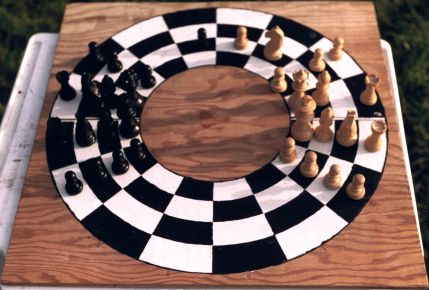
The starting position is essentially obtained from that of orthodox chess by cutting the board in half and bending the two halves to join at the ends. Two lines are marked on opposite sides of the board, and each set of pieces is positioned so as to straddle this line. The king and queen start on the innermost ring, with, as is the case in square chess, the queen on a square of the same colour; the bishops start in the second ring from the centre, the knights on the third and the rooks on the outermost ring. The pawns are positioned in front of the pieces.

The moves of the pieces are identical to those in orthodox chess; a queen or rook may, if it is not obstructed, move any distance round a ring, except that the "null move" of moving a piece all the way round the board and back to its original square is not permitted. A pawn is promoted after moving six squares from its initial position, to the square immediately before the opponent's starting line. Castling and en passant captures are not permitted. Announcing a check is not obligatory, and "snaffling" (winning the game immediately by capturing the opponent's king after he either moved into or failed to move out of check) is allowed – and has on more than one occasion decided a world championship game.

Theory

[edit]

Orthodox chess generally assigns the pieces relative values of 9 points for a queen, 5 for a rook, 3 for a bishop or knight, and 1 for a pawn; although no attempt has been made to assign specific values for circular chess, it is certain that the same values do not hold. The values of the queen and rook are considerably augmented by their greater range – with two rooks or a queen and rook unobstructed on the same ring being especially powerful – while those of the bishop and knight are diminished; for example, on an 8×8 board two minor pieces are held to be stronger than one rook, but on a circular board the rook is considerably stronger. This can be easily seen by just counting the number of squares an unobstructed piece is able to attack on an orthodox and a circular board: the queen, rook, bishop, and knight can attack 27, 14, 13, and 8 squares respectively on an orthodox board, while on a circular board the counts are instead 24, 18, 6, and 6. The minor pieces can, however, pose a significant danger value, as their moves are more difficult to visualise on the circular board and even strong players often fail to notice a threat.

One of the major differences between orthodox and circular chess in practice is in the opening. In orthodox chess, opening theory has developed over several centuries, and the use of computer analysis has resulted in top level games frequently not deviating from known theory until the 20th move or beyond; in circular chess, there is virtually no opening theory, and consequently players are "on their own" from the first move. In orthodox chess, advancing the king's or queen's pawn are generally considered the best opening moves, as doing so attacks two key central squares, opens a diagonal to enable the development of a bishop, and, in the case of the king's pawn, the queen also. On a circular board these advantages are negated, as a king's or queen's pawn only attacks one square, and its advance only opens one square for the bishop. Some players advance the central pawns first anyway, while others prefer to advance the rooks' pawns in order to open lines of attack for the more powerful pieces; it is not known which move, if any, is objectively best.

The different geometry of the square and circular boards creates considerable differences in endgame theory: three of the four "basic checkmates" on a square board (those with king and rook,[citation needed] king and two bishops, or king and bishop and knight against a lone king) rely on forcing the defending king into the corner of the board, and thus are impossible on a circular board since it doesn't have corners. The "basic mates" in circular chess are thus those with king and queen, king and rook and minor piece,[citation needed] or king and three minor pieces against a lone king. The greater tendency towards drawn endgames often results in the defender playing on in a position which would be considered cause for resignation on a square board. In one particular endgame, however, the circular board favours the attacker: with king and pawn against king, there is no stalemate defence (since it is impossible for the king to be trapped against a side of the board that the pawn is moving towards) and thus the only way for the defending king to draw is to capture the pawn before it can be either defended or promoted (otherwise the endgame is always a win).

World Championship

[edit]

After experimenting with various possible layouts for the game, Reynolds decided on that pictured above, constructed a board and introduced the game to other players in Lincoln; it caught on, and in 1996, the Circular Chess Society was formed, with the aim of popularising circular chess, primarily by organising a tournament. Since it was not known to be played competitively anywhere else, its claim to the status of world championship was not contested, and thus it became. The inaugural tournament was held in the Tap and Spile public house in Lincoln in 1996; it was played as a knockout, with Lincoln player Rob Stevens beating Nottinghamshire's Mark Spink in the final. Subsequently, the tournament has been held at different venues in Lincoln, usually under the Swiss system, and has been dominated by two players: Peterborough engineer Francis Bowers and Dutch businessman Herman Kok, who between them won eight of the following ten tournaments. Bowers took the title from 1997 to 1999, and remains not just the only player to have won the tournament three years in succession, but the only one to win on more than two occasions; Kok broke the sequence with victory in the 2000 tournament, before Bowers won again in 2001.

The 2002 World Championship, staged in Bishop Edward King House in Lincoln and sponsored by the Duke William Hotel, saw the only instance to date of the participation in the tournament of a player widely known outside the world of circular chess: David Howell, then aged 11 and having recently gained national publicity by becoming the youngest player to avoid defeat (at standard chess) against a reigning world champion, with a draw in the final game of his match against Vladimir Kramnik (having lost the other three games). Howell won the tournament, scoring a maximum 5 points after beating Bowers in the final round, although he commented afterwards "This is the first time I have played in a circular chess contest and it was difficult. Circular chess is a lot harder to play than square chess. Every time you or your opponent makes a move, you have to think about what is happening on the other side of the board." Kok finished runner-up with 4+12 points.

The 2003 tournament was again held in Bishop Edward King House; sponsorship for it and the four subsequent tournaments came from Lindum Group. Howell did not return to defend his title (and has not played in the tournament since); Bowers gained his fifth title with victory over Kok in the last round to complete a 5/5 score, and Lincolnshire player David Carew, with 4+12, finished second. Bowers repeated the feat the following year, again finishing with a win against Kok; Nottinghamshire's Mike Clark was the runner-up, with Stevens third and Kok and Carew among a group of six players in joint fourth place.

In 2005, the Society gained extra publicity for the tournament by securing the chapter house of Lincoln Cathedral as the venue, only the day after the filming of The Da Vinci Code there had been completed (the cathedral was used to film scenes which, in the book, take place in Westminster Abbey, since the abbey had refused Columbia Pictures permission to film there); much of the film set was (and is) still in place. The draw for the first round of the tournament was conducted by Councillor Steve Allnutt, the Deputy Mayor of Lincoln, and Mrs Chris Noble, the City Sheriff; the two guests accepted an invitation to try the game for themselves, with the Sheriff emerging as the winner. In contrast to previous tournaments, the 2005 championship was held over four rounds rather than five; in the first Stevens drew with Bowers, to end the latter's run of ten consecutive wins in the tournament and leave Kok the favourite to take the title again. At the halfway point there were four players with maximum points – Kok, Hertfordshire's John Beasley, and tournament newcomers David Stamp and Michael Jones, both of Lincolnshire – with Bowers on 1+12 after surviving a scare to "snaffle" Carew in the second round. Kok beat Beasley in the third round, while Stamp and Jones remained in contention after both winning; Bowers also won, although, since the top four players would be drawn against each other in the final round, his chances of retaining his title were remote, relying on him winning his own game and the other being drawn to force a three-way playoff. The draw for the final round pitted Kok against Jones and Bowers against Stamp – in each case an experienced player against a tournament newcomer. The former game looked to be heading in Kok's favour before he blundered in time trouble and eventually lost on time, leaving Jones on 4/4 and Stamp needing to beat Bowers to force a tiebreak; he could only draw, so Jones finished the outright champion and Stamp runner-up with 312. Bowers, Herman Kok, his son Robbie, Beasley and Clark tied for third place with 3 points each.

The 2006 World Championship was held at Lincoln Castle, and was dedicated to regular competitor Charles Vermes of Derbyshire, who had died shortly before. The first round brought no surprise results – the only two of the main contenders to be drawn together were Clark and Stevens, with Clark emerging the winner; Jones, Herman Kok and Bowers all won. Clark beat Jones in the second round, at which point there remained five players on maximum points: Clark, Kok, Bowers, Lincolnshire's Richard Kidals and Ian Lewis of Cardiff. Lewis lost his third-round game to tournament founder Reynolds, but the other four leaders all won, ensuring the need for a tiebreak unless one of the last round games was drawn; Kok beat Clark and Bowers beat Kidals to give them both the maximum 4 points, so the expected tiebreak game ensued. The game was close throughout, with Bowers eventually losing on time to give Kok the title – only the second player, after Bowers himself, to claim it more than once.

The 2007 World Championship was held at The Tap & Spile in Lincoln, with Kevin McCarthy lifting the title after remaining unbeaten in his first ever tournament under Circular Rules, including a win against the legendary Herman Kok, who had taught him the rules only a fortnight previously.

The 2011 World Championship was also held at The Tap & Spile in Lincoln, with newcomer Nigel Payne, previously a Welsh All Valleys Champion (Under-15 category), claiming the title.

See also

[edit]

References

[edit]
[edit]
Revisions and contributorsEdit on WikipediaRead on Wikipedia
from Grokipedia
Circular chess is a variant of chess played on a circular board composed of four concentric rings, each containing sixteen squares for a total of sixty-four squares, utilizing the standard sixteen pieces per player from orthodox chess and rules adapted to the board's geometry. The game's origins trace back to the , when Arab historian described a form of round chess, known as Byzantine chess or zatrikion, in his 947 work Muruj adh-dhahab wa ma'adin al-jawhar (Meadows of Gold and Mines of Gems), attributing it to players in the . This historical variant featured medieval piece movements, such as the fers (predecessor to the queen) moving one square diagonally and the (predecessor to the ) leaping two squares diagonally, with pawns unable to promote and removed upon head-on collision. Evidence of its play appears in Persian and European manuscripts from the medieval period, including references by Muhammad ibn Mahmud Amuli in the . In 1983, British historian and chess enthusiast David Reynolds rediscovered and revived circular chess after encountering an illustration of a circular board in Joseph Strutt's 1801 book Sports and Pastimes of the People of . Reynolds adapted to align with modern international chess standards, introducing the contemporary setup where pieces start in a circular arrangement mirroring the standard chessboard's ranks and files, with white's forces on the outer ring and black's on the inner ring opposite. This Lincoln variant, named after the English city where it was first demonstrated, eliminates due to the lack of fixed edges, allows pawns an initial two-square advance, prohibits captures, and permits pawn promotion upon reaching the opponent's back rank (the ring with the opponent's starting pieces). Piece movements remain fundamentally the same as in orthodox chess—kings one square in any direction, queens any number along ranks, files, or diagonals, rooks along ranks and files, bishops diagonally, knights in an L-shape, and pawns forward one square (or two initially)—but the circular prevents pieces like queens and rooks from returning to their exact starting positions in a single move and eliminates corner advantages, profoundly impacting strategy by creating endless files and ranks. Notable differences from standard chess include the bishops' potentially shortened ranges on the curved board and the pawns' outward-facing promotion path, which can lead to dynamic endgames where king and pawn versus king often results in a draw. Circular chess gained organized play through the British Chess Variants Society, with the first World Circular Chess Championship held in 1991 in , and subsequent annual events rotating locations while crowning champions under standardized variant rules. The variant's popularity persists among enthusiasts for its strategic depth, with resources like the Variant Chess magazine documenting tournaments and theoretical analyses since the 1990s.

Overview

Board and Setup

The board in modern circular chess consists of four concentric rings, each divided into 16 squares, forming an annular structure with a total of 64 squares and no corners or fixed edges. This ring-shaped layout arranges squares radially, eliminating traditional board boundaries and allowing pieces to potentially circumnavigate the entire board in certain directions. Files are labeled a through p in a manner around the rings, while ranks are numbered 1 through 4 from the outermost ring inward, providing a adapted from standard chess to accommodate the circular . The absence of edges due to the circular design means that movements along files or ranks wrap around seamlessly, fundamentally altering path possibilities compared to square boards. The initial setup closely mirrors that of orthodox chess, adapted to the circular format. White's eight pawns are placed on , files a through h, while white's major and minor pieces are positioned on rank 2, files a through h, in the standard back rank configuration: rooks on a2 and h2, knights on b2 and g2, bishops on c2 and f2, queen on d2, and on e2. Black's eight pawns are placed on rank 3, files i through p, with black's pieces on rank 4, files i through p, in a mirrored : rooks on i4 and p4, knights on j4 and o4, bishops on k4 and n4, queen on l4, and king on m4. This placement ensures across the board's diameter, positioning the two kings opposite each other.

Objective and Basic Concepts

Circular chess shares the core objective of standard chess but adapted to its unique geometry: to the opponent's by placing it under inescapable attack from one's own pieces. This requires strategic positioning on a circular board, where the absence of edges alters traditional tactics, such as endless loops for sliding pieces. The game proceeds in a turn-based manner, with players alternating moves between and black; , as the starting player, always moves first. Each turn consists of one legal move for a single piece, following adapted orthodox chess rules, emphasizing control over the board's concentric rings and spokes. Central to understanding circular chess are key concepts like the "," which describes the full loop encircling the board along any ring, enabling rooks and to traverse unlimited distances if unobstructed. "Radial files" refer to the 16 vertical alignments radiating outward from the board's , serving as pathways for pawn advances and piece maneuvers akin to files in conventional chess. Pawns advance radially toward the opponent's side and cannot promote until they have moved six squares forward from their initial position, typically reaching the promotion zone near the foe's baseline. Victory is achieved primarily through , but also via opponent or time expiration in clock-controlled games. Draws may result from mutual agreement, of the same position, or passage of 50 consecutive moves without a capture or pawn advance. These conditions mirror standard chess but account for the variant's infinite-loop potential, preventing perpetual circling without progress.

Rules of Modern Circular Chess

Piece Movements

In circular chess, piece movements generally follow the directions of orthodox chess but are adapted to the board's annular , consisting of four concentric rings with sixteen squares each and no edges or corners. This allows sliding pieces like rooks and to travel indefinitely around a ring or radially across rings until obstructed, while knights and pawns execute jumps or short moves that account for the curved layout. The board's even distribution of sixty-four squares ensures bishops remain confined to squares of the same color, with thirty-two and thirty-two squares overall. The moves one square in any direction—orthogonally along its ring or radially to an adjacent ring, or diagonally combining both—provided the destination is unoccupied or occupied by an opponent's piece. Due to the absence of board edges, the king's mobility is slightly enhanced in open positions, as it cannot be confined by borders, but it remains limited to adjacent squares without wrapping around the entire board in a single move. Capturing occurs by moving to the square occupied by an opponent's piece and replacing it, placing the enemy in check if the move attacks it while it is unprotected. The queen combines the powers of the rook and , moving any number of squares orthogonally (along a ring circumferentially or radially across rings) or diagonally (spiraling around the rings while shifting radially), unobstructed by friendly pieces. Unlike in standard chess, a queen can circumnavigate the entire board along the outermost ring in one move if clear, potentially returning near its starting position but prohibited from ending exactly on the origin square to prevent null moves. This adaptation makes the queen exceptionally powerful for controlling long, looping paths. Capturing follows the standard replacement rule. Rooks move any number of squares orthogonally, either circumferentially along a single ring or radially inward/outward across multiple rings, stopping before a friendly piece or capturing an enemy by replacement. The lack of edges allows rooks to traverse the full of a ring—sixteen squares—in a single move if unobstructed, significantly increasing their range compared to a square board and making them more valuable strategically. They cannot end on their starting square. Bishops move any number of squares diagonally, which on the circular board translates to paths that curve around the rings while shifting at a time, always remaining on squares of the same color. Their mobility is somewhat restricted by the board's curvature, as diagonal lines form shorter loops than orthogonal ones, but they can still cover extensive spiraling routes without edge interference. Capturing is by replacement on the target square. Knights move in an L-shape: two squares along a ring (or radially) followed by one square , or one square followed by two, jumping over intervening pieces regardless of occupation. This leap is unaffected by the circular layout in terms of blocking, though the alters possible landing spots, often providing more options than on a square board due to the continuous rings. They capture by landing on and replacing an opponent's piece. Pawns advance one square forward along their ring in the direction toward the opponent's setup (circumferentially for toward the inner rings' opponent side, and vice versa for black), with an initial option to move two squares if unobstructed. They capture by moving one square diagonally forward, which shifts to an adjacent ring. The circular means pawns continue in their fixed direction around the board without reversing, and the absence of edges prevents side captures off the board. Promotion occurs upon reaching the promotion square on the pawn's starting ring after exactly six forward moves, at which point it may be exchanged for a queen, rook, , or of the same color. Capturing mechanics remain replacement-based without special rules like .

Special Rules and Winning Conditions

In modern circular chess, castling is prohibited due to the board's , which removes the traditional distinction between kingside and queenside positions and eliminates fixed edges for rook placement. The capture is also not permitted. Pawn promotion occurs uniformly when a pawn reaches the promotion square on its starting ring after exactly six forward moves from its starting position, at which point it may be exchanged for a queen, rook, , or of the same color. Victory is achieved through or opponent resignation. Draws are declared by agreement, of the position, the (no captures or pawn moves in fifty consecutive turns), or insufficient material to deliver . , in which the player to move has no legal options but their is not under attack, results in a draw.

Historical Development

Origins and Early Forms

Circular chess, a variant of the ancient game shatranj, first emerges in historical records during the 10th century, primarily associated with the Byzantine Empire and Persian cultural spheres. The earliest documented reference appears in the work of the Arab historian and geographer Al-Mas'ūdī (c. 896–956 CE), who in his Murūj al-dhahab wa maʿādin al-jawhar (The Meadows of Gold and Mines of Gems, completed around 943 CE) describes a form of chess known as shatranj ar-rūmīya (Byzantine shatranj) or zatrikion in Greek, played on a circular board. This account highlights the game's popularity among Byzantine players, portraying it as a strategic diversion that reflected the empire's intellectual and recreational pursuits, with possible transmission from Persian shatranj traditions via trade and conquest routes following the Arab invasions of the 7th century. Al-Mas'ūdī attributes an earlier version of the game to the 9th century, when the scholar Siwar al-Harrani is said to have presented a circular variant to Tahir b. al-Husain (d. 822 CE). Evidence of the game's spread points to its play in Persia, the , and regions of , where it adapted elements of earlier board games but innovated with a round layout to emphasize fluid, non-linear strategies. Manuscripts from the period, including those preserved in the such as the Cotton MS (late 13th century, though referencing earlier traditions), suggest circular shatranj was known in Persia by the 10th century, with diagrams illustrating concentric ring boards divided into 64 squares for piece placement. Later Persian texts explicitly name it shatranj al-mudawwara (circular shatranj), underscoring its roots in Sassanid-era gaming culture while distinguishing it from standard square-board variants. These sources indicate the game circulated through Islamic scholarly networks, with possible influences from pre-Islamic round board games in the region, though direct precursors remain unconfirmed. The cultural role of circular chess in these early contexts appears tied to its symbolic representation of and tactical maneuvering, akin to military formations in Persian and Byzantine warfare, as inferred from contemporary descriptions of strategic play. By the , references in Vatican MS Lat. 1960 (c. 1350 CE) show defensive arrangements on circular boards, but the variant began to wane as square-board evolved into more standardized forms across . Its decline accelerated in the with the emergence of modern chess rules in and the broader Islamic world, where linear board designs favored rapid development and overshadowed circular adaptations.

Medieval Documentation and Rules

The Persian scholar Muhammad ibn Mahmud al-Amuli documented circular chess in his encyclopedic work Nafāʾis al-funūn fī sharāʾiʿ al-ʿulūm (Treasury of the Sciences), composed between 1335 and 1342, providing one of the earliest detailed descriptions of its rules and board configuration. This account builds briefly on earlier 10th-century Persian references to round variants of shatranj. The board features four concentric rings, each divided into 16 squares for a total of 64 positions, resembling the modern circular design but with distinct labeling of files and ranks to accommodate the radial structure. The pieces follow the standard set: the king (), (counselor, moving one square diagonally), (elephant, leaping two squares diagonally), (faras, in an L-shape), rukh (rook, moving any number of squares orthogonally), and pawn (baidaq). Notably absent are the powerful queen and the modern , reflecting the game's roots in pre-European chess . Key rules diverge from standard shatranj in several ways, emphasizing the circular topology's impact on play. is a win for the player who stalemates the opponent. Capturing all of the opponent's non-king pieces results in a win ( rule), unless the opponent can immediately capture all of one's own non-king pieces on their next turn, in which case the game is drawn. Pawns advance one square forward (radially inward) and capture diagonally, but they do not promote upon reaching the inner ring and lack the option for an initial two-square advance. Al-Amuli's description indicates that circular chess circulated among and scholarly communities in medieval Persia, where it served as both and exercise, with surviving manuscripts occasionally including diagrams to depict the board setup and piece placements.

Variants

Other Circular Variants

Improved Circular Chess, introduced in the early as a refinement to earlier circular variants, modifies the traditional setup by replacing the with a crooked bishop (which moves like a but in a bent path) and the queen with a crooked queen (combining rook and crooked movements) on a standard 4x16 circular board. This adjustment aims to enhance piece mobility and balance in the circular , where straight-line pieces like can dominate due to unlimited radial paths. Regarding pawn promotion, the variant addresses the challenge of full board in race-style play by allowing promotion after approximately 6 to 13 advances, depending on the pawn's starting position relative to the opponent's baseline, preventing excessively long pawn journeys that could stall games. Cylindrical chess, a distinct from full circular variants, employs an board that wraps only horizontally—like a —allowing pieces to move off one edge and reappear on the opposite side without vertical wrapping. This creates infinite files but finite ranks, altering bishop and queen paths to form continuous loops around the board while preserving standard chess rules for , en passant, and promotion on the eighth rank. Unlike fully circular boards, cylindrical chess maintains a linear front for pawns, reducing flank vulnerabilities but complicating endgames, such as rook-and- checkmates against a lone , which become impossible without additional pieces due to the lack of board edges. Three-player circular chess expands the game to accommodate three participants on a 96-square round board, typically hexagonal in layout with a central void and moats separating player territories, using three sets of standard pieces adjusted for color and positioning. Players take turns in sequence (e.g., , , ), with the objective to opponents while forming temporary alliances, and pawns promote upon reaching an enemy's baseline after navigating the expanded . The larger board increases strategic depth, emphasizing multi-front defense and piece coordination across curved paths, though it introduces complexities like neutral zones that pieces cannot occupy. Digital adaptations of circular chess have emerged in video games, notably Circular Chess 2.0, a 2023 developed by Green Lemon Games that reworks the core mechanics on a ring-shaped board to improve balance, particularly for AI opponents. The devlog highlights fixes for fairness issues, such as uneven piece mobility in circular paths and AI tendencies to exploit radial advantages, resulting in more equitable multiplayer and single-player modes with adjustable difficulty. These implementations often incorporate modern features like undo moves and tutorials to make the variant accessible beyond physical boards. Among rare historical variants, Byzantine round Shatranj—also known as Zatrikion—represents an early circular form from the 10th-century , played on a round board divided into four concentric rings of 16 squares each, using pieces like the (limited ) and (leaping ). This variant, derived from Persian influences, featured pawns advancing toward the center or outer rings without promotion, and kings positioned on inner circles for defensive centrality, though some manuscript descriptions suggest flexibility in ring counts for regional play. Computer analyses confirm its solvability under rules, with white holding a slight advantage in the standard four-ring setup.

Modern Revival and Competitions

Standardization and Popularization

Circular chess experienced a significant revival in 1983 when British historian David Reynolds encountered a historical depiction of a circular board in Joseph Strutt's 1801 book Sports and Pastimes of the People of England and sought to reconstruct the game. Reynolds adapted the ancient Shatranj-inspired rules to modern FIDE-standard pieces and a standardized 64-square circular board consisting of four concentric rings, thereby bridging medieval origins with contemporary play. To codify these rules and promote the variant, Reynolds and enthusiasts formed the UK-based Circular Chess Society in 1996, which published diagrams, issued newsletters, and disseminated standardized rule sets through variant chess publications. The society's efforts included detailed notations and visual aids to address the challenges of representing circular geometry in print. Popularization accelerated in the 1990s with Reynolds's 1996 publication Circular Chess, which outlined rules and strategies, alongside the availability of commercial circular boards from specialty manufacturers. Online resources emerged in the late 1990s via dedicated websites, further aiding dissemination within chess variant communities. The variant gained traction in broader chess variant circles, such as those documented on The Chess Variant Pages, but received no official title despite acknowledgment as a recognized form of chess play. Growth was somewhat limited by the necessity for custom boards, though post-2000s online platforms like Jocly and mobile apps introduced accessible digital play, mitigating physical barriers.

World Championships and Notable Events

The first World Circular Chess Championship was held in 1996 in Lincoln, United Kingdom, organized by the newly formed Circular Chess Society to promote the variant. These annual over-the-board tournaments, typically featuring time controls akin to those in standard chess such as 30 minutes per player for shorter formats, took place in historic Lincoln venues including , , and The Tap and Spile pub. The events attracted a dedicated but small field of players, often numbering around 20-30 competitors in a Swiss or round-robin system. Francis Bowers dominated the early championships, securing five titles between 1997 and 2004, including consecutive wins in 1997, 1998, and 1999, as well as victories in 2001 and 2004. David Howell claimed the 2002 title, marking a notable achievement for the young British player during the event's inclusion as a discipline in the that year. Michael Jones won in 2005 at , becoming the youngest champion at age 19. took the 2007 crown unbeaten in his debut appearance at The Tap and Spile, while Nigel Payne emerged victorious in 2011, also at The Tap and Spile, as a newcomer with prior success in regional standard chess. The championships continued annually through at least 2011, fostering a community around the variant despite limited participation. However, no major official events have occurred since, attributed to declining interest and organizational challenges within the Circular Chess Society. As of 2025, circular chess sees sporadic online tournaments, such as the 2024 Circular Chess Championship qualifiers and matches hosted on platforms like start.gg, but no unified world title has been contested. The variant occasionally appears in broader mind sports or festivals, though without dedicated world-level competition.

Strategy and Theory

Piece Values and Mobility

In circular chess, the relative values of pieces deviate from orthodox chess due to the board's geometry, which eliminates edges and introduces looped files and rings that alter movement efficiencies. The queen remains the most powerful piece, as its combined rook- and bishop-like movements allow it to dominate extended radial paths across rings and circumferential routes around the board, unhindered by board boundaries. The rook is notably strong, excelling on open rings where it can traverse entire circumferences or multiple rings without edge obstructions, providing greater control than in standard chess—approximately 20-30% more on average due to infinite file loops. Bishops, however, are weaker, constrained by color-binding on fixed diagonals and the curved nature of the board, which limits their sweeping potential compared to knights. Knights are the least effective major pieces, with awkward L-shaped jumps disrupted by the ring structure; those positioned centrally on inner rings gain better access to targets, though overall mobility is reduced relative to square boards. Pawns retain their standard role, but promotion opportunities are rarer owing to the uniform fixed distance across rings and lack of edge-supported passed pawns. The king exhibits enhanced central mobility without traditional edge safety issues, as the circular layout removes vulnerable borders and allows more fluid evasion paths. Overall, piece loses prominence unlike in square chess, where edges amplify imbalances; mobility assessments approximate orthodox formulas but require adjustments for looped paths, emphasizing circumferential control for sliders like rooks and .

Openings, Middlegame, and Endgames

In circular chess, openings lack the extensive theory developed in orthodox chess, with play emphasizing immediate tactical flexibility due to the board's , which discourages rigid memorized lines. The middlegame in circular chess prioritizes piece exchanges to clear paths along the rings, enabling rooks and to exert influence over extended lines that wrap around the board. King safety is maintained through radial positioning rather than traditional , as the absence of edges alters defensive priorities and makes central placement more viable for evasion. Knights face challenges in executing forks due to the curved board's impact on their L-shaped paths, reducing their tactical potency compared to linear boards. Rooks and queens gain prominence through "ring control," where dominating a full concentric ring restricts opponent mobility and facilitates attacks. Endgames are notably draw-prone, particularly without pawns, since the lack of corners eliminates standard opposition tactics and simplifies king escapes. Configurations like king and pawn versus king frequently result in draws, as pawns advance radially without the linear promotion races of orthodox chess, and there are no traditional passed pawns to force breakthroughs. In contrast, queen endgames tend to be decisive owing to the ample space for checks and the queen's enhanced mobility across rings. Perpetual checks are more readily achievable due to the board's endless loops, often leading to stalemates or repetitions. Computer analyses indicate limited game databases, with simulated matches showing draw rates around 34% overall, rising higher in pawnless endgames due to symmetric defenses.

References

Add your contribution
Related Hubs
User Avatar
No comments yet.