Hubbry Logo
Classical groupClassical groupMain
Open search
Classical group
Community hub
Classical group
logo
8 pages, 0 posts
0 subscribers
Be the first to start a discussion here.
Classical group
Classical group
from Wikipedia

In mathematics, the classical groups are defined as the special linear groups over the reals , the complex numbers and the quaternions together with special[1] automorphism groups of symmetric or skew-symmetric bilinear forms and Hermitian or skew-Hermitian sesquilinear forms defined on real, complex and quaternionic finite-dimensional vector spaces.[2] Of these, the complex classical Lie groups are four infinite families of Lie groups that together with the exceptional groups exhaust the classification of simple Lie groups. The compact classical groups are compact real forms of the complex classical groups. The finite analogues of the classical groups are the classical groups of Lie type. The term "classical group" was coined by Hermann Weyl, it being the title of his 1939 monograph The Classical Groups.[3]

The classical groups form the deepest and most useful part of the subject of linear Lie groups.[4] Most types of classical groups find application in classical and modern physics. A few examples are the following. The rotation group SO(3) is a symmetry of Euclidean space and all fundamental laws of physics, the Lorentz group O(3,1) is a symmetry group of spacetime of special relativity. The special unitary group SU(3) is the symmetry group of quantum chromodynamics and the symplectic group Sp(m) finds application in Hamiltonian mechanics and quantum mechanical versions of it.

The classical groups

[edit]

The classical groups are exactly the general linear groups over ℝ, ℂ and ℍ together with the automorphism groups of non-degenerate forms discussed below.[5] These groups are usually additionally restricted to the subgroups whose elements have determinant 1, so that their centers are discrete. The classical groups, with the determinant 1 condition, are listed in the table below. In the sequel, the determinant 1 condition is not used consistently in the interest of greater generality.

Name Group Field Form Maximal
compact subgroup
Lie
algebra
Root system
Special linear SL(n, ℝ) SO(n)
Complex special linear SL(n, ℂ) SU(n) Complex Am, n = m + 1
Quaternionic special linear SL(n, ℍ) =
SU(2n)
Sp(n)
(Indefinite) special orthogonal SO(p, q) Symmetric S(O(p) × O(q))
Complex special orthogonal SO(n, ℂ) Symmetric SO(n) Complex
Symplectic Sp(n, ℝ) Skew-symmetric U(n)
Complex symplectic Sp(n, ℂ) Skew-symmetric Sp(n) Complex Cm, n = 2m
(Indefinite) special unitary SU(p, q) Hermitian S(U(p) × U(q))
(Indefinite) quaternionic unitary Sp(p, q) Hermitian Sp(p) × Sp(q)
Quaternionic orthogonal SO(2n) Skew-Hermitian SO(2n) Caution! The correct one may be a unitary group.

The complex classical groups are SL(n, ℂ), SO(n, ℂ) and Sp(n, ℂ). A group is complex according to whether its Lie algebra is complex. The real classical groups refers to all of the classical groups since any Lie algebra is a real algebra. The compact classical groups are the compact real forms of the complex classical groups. These are, in turn, SU(n), SO(n) and Sp(n). One characterization of the compact real form is in terms of the Lie algebra g. If g = u + iu, the complexification of u, and if the connected group K generated by {exp(X): Xu} is compact, then K is a compact real form.[6]

The classical groups can uniformly be characterized in a different way using real forms. The classical groups (here with the determinant 1 condition, but this is not necessary) are the following:

The complex linear algebraic groups SL(n, ℂ), SO(n, ℂ), and Sp(n, ℂ) together with their real forms.[7]

For instance, SO(2n) is a real form of SO(2n, ℂ), SU(p, q) is a real form of SL(n, ℂ), and SL(n, ℍ) is a real form of SL(2n, ℂ). Without the determinant 1 condition, replace the special linear groups with the corresponding general linear groups in the characterization. The algebraic groups in question are Lie groups, but the "algebraic" qualifier is needed to get the right notion of "real form".

Bilinear and sesquilinear forms

[edit]

The classical groups are defined in terms of forms defined on Rn, Cn, and Hn, where R and C are the fields of the real and complex numbers. The quaternions, H, do not constitute a field because multiplication does not commute; they form a division ring or a skew field or non-commutative field. However, it is still possible to define matrix quaternionic groups. For this reason, a vector space V is allowed to be defined over R, C, as well as H below. In the case of H, V is a right vector space to make possible the representation of the group action as matrix multiplication from the left, just as for R and C.[8]

A form φ: V × VF on some finite-dimensional right vector space over F = R, C, or H is bilinear if

and if

It is called sesquilinear if

and if

These conventions are chosen because they work in all cases considered. An automorphism of φ is a map Α in the set of linear operators on V such that

The set of all automorphisms of φ form a group, it is called the automorphism group of φ, denoted Aut(φ). This leads to a preliminary definition of a classical group:

A classical group is a group that preserves a bilinear or sesquilinear form on finite-dimensional vector spaces over R, C or H.

This definition has some redundancy. In the case of F = R, bilinear is equivalent to sesquilinear. In the case of F = H, there are no non-zero bilinear forms.[9]

Symmetric, skew-symmetric, Hermitian, and skew-Hermitian forms

[edit]

A form is symmetric if

It is skew-symmetric if

It is Hermitian if
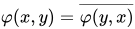
Finally, it is skew-Hermitian if

A bilinear form φ is uniquely a sum of a symmetric form and a skew-symmetric form. A transformation preserving φ preserves both parts separately. The groups preserving symmetric and skew-symmetric forms can thus be studied separately. The same applies, mutatis mutandis, to Hermitian and skew-Hermitian forms. For this reason, for the purposes of classification, only purely symmetric, skew-symmetric, Hermitian, or skew-Hermitian forms are considered. The normal forms of the forms correspond to specific suitable choices of bases. These are bases giving the following normal forms in coordinates:

The j in the skew-Hermitian form is the third basis element in the basis (1, i, j, k) for H. Proof of existence of these bases and Sylvester's law of inertia, the independence of the number of plus- and minus-signs, p and q, in the symmetric and Hermitian forms, as well as the presence or absence of the fields in each expression, can be found in Rossmann (2002) or Goodman & Wallach (2009). The pair (p, q), and sometimes pq, is called the signature of the form.

Explanation of occurrence of the fields R, C, H: There are no nontrivial bilinear forms over H. In the symmetric bilinear case, only forms over R have a signature. In other words, a complex bilinear form with "signature" (p, q) can, by a change of basis, be reduced to a form where all signs are "+" in the above expression, whereas this is impossible in the real case, in which pq is independent of the basis when put into this form. However, Hermitian forms have basis-independent signature in both the complex and the quaternionic case. (The real case reduces to the symmetric case.) A skew-Hermitian form on a complex vector space is rendered Hermitian by multiplication by i, so in this case, only H is interesting.

Automorphism groups

[edit]
Hermann Weyl, the author of The Classical Groups. Weyl made substantial contributions to the representation theory of the classical groups.

The first section presents the general framework. The other sections exhaust the qualitatively different cases that arise as automorphism groups of bilinear and sesquilinear forms on finite-dimensional vector spaces over R, C and H.

Aut(φ) – the automorphism group

[edit]

Assume that φ is a non-degenerate form on a finite-dimensional vector space V over R, C or H. The automorphism group is defined, based on condition (1), as

Every AMn(V) has an adjoint Aφ with respect to φ defined by

Using this definition in condition (1), the automorphism group is seen to be given by

Fix a basis for V. In terms of this basis, put

where ξi, ηj are the components of x, y. This is appropriate for the bilinear forms. Sesquilinear forms have similar expressions and are treated separately later. In matrix notation one finds
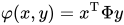
and

from (2) where Φ is the matrix (φij). The non-degeneracy condition means precisely that Φ is invertible, so the adjoint always exists. Aut(φ) expressed with this becomes

The Lie algebra aut(φ) of the automorphism groups can be written down immediately. Abstractly, Xaut(φ) if and only if

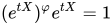
for all t, corresponding to the condition in (3) under the exponential mapping of Lie algebras, so that

or in a basis

as is seen using the power series expansion of the exponential mapping and the linearity of the involved operations. Conversely, suppose that Xaut(φ). Then, using the above result, φ(Xx, y) = φ(x, Xφy) = −φ(x, Xy). Thus the Lie algebra can be characterized without reference to a basis, or the adjoint, as

The normal form for φ will be given for each classical group below. From that normal form, the matrix Φ can be read off directly. Consequently, expressions for the adjoint and the Lie algebras can be obtained using formulas (4) and (5). This is demonstrated below in most of the non-trivial cases.

Bilinear case

[edit]

When the form is symmetric, Aut(φ) is called O(φ). When it is skew-symmetric then Aut(φ) is called Sp(φ). This applies to the real and the complex cases. The quaternionic case is empty since no nonzero bilinear forms exists on quaternionic vector spaces.[12]

Real case

[edit]

The real case breaks up into two cases, the symmetric and the antisymmetric forms that should be treated separately.

O(p, q) and O(n) – the orthogonal groups
[edit]

If φ is symmetric and the vector space is real, a basis may be chosen so that

The number of plus and minus-signs is independent of the particular basis.[13] In the case V = Rn one writes O(φ) = O(p, q) where p is the number of plus signs and q is the number of minus-signs, p + q = n. If q = 0 the notation is O(n). The matrix Φ is in this case
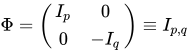
after reordering the basis if necessary. The adjoint operation (4) then becomes

which reduces to the usual transpose when p or q is 0. The Lie algebra is found using equation (5) and a suitable ansatz (this is detailed for the case of Sp(m, R) below),

and the group according to (3) is given by

The groups O(p, q) and O(q, p) are isomorphic through the map

For example, the Lie algebra of the Lorentz group could be written as

Naturally, it is possible to rearrange so that the q-block is the upper left (or any other block). Here the "time component" end up as the fourth coordinate in a physical interpretation, and not the first as may be more common.

Sp(m, R) – the real symplectic group
[edit]

If φ is skew-symmetric and the vector space is real, there is a basis giving

where n = 2m. For Aut(φ) one writes Sp(φ) = Sp(V) In case V = Rn = R2m one writes Sp(m, R) or Sp(2m, R). From the normal form one reads off
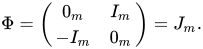
By making the ansatz
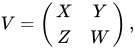
where X, Y, Z, W are m-dimensional matrices and considering (5),

one finds the Lie algebra of Sp(m, R),

and the group is given by

Complex case

[edit]

Like in the real case, there are two cases, the symmetric and the antisymmetric case that each yield a family of classical groups.

O(n, C) – the complex orthogonal group
[edit]

If case φ is symmetric and the vector space is complex, a basis

with only plus-signs can be used. The automorphism group is in the case of V = Cn called O(n, C). The Lie algebra is simply a special case of that for o(p, q),

and the group is given by

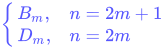
In terms of classification of simple Lie algebras, the so(n) are split into two classes, those with n odd with root system Bn and n even with root system Dn.

Sp(m, C) – the complex symplectic group
[edit]

For φ skew-symmetric and the vector space complex, the same formula,

applies as in the real case. For Aut(φ) one writes Sp(φ) = Sp(V). In the case one writes Sp(m, ) or Sp(2m, ). The Lie algebra parallels that of sp(m, ),

and the group is given by

Sesquilinear case

[edit]

In the sesquilinear case, one makes a slightly different approach for the form in terms of a basis,

The other expressions that get modified are


[14]

The real case, of course, provides nothing new. The complex and the quaternionic case will be considered below.

Complex case

[edit]

From a qualitative point of view, consideration of skew-Hermitian forms (up to isomorphism) provide no new groups; multiplication by i renders a skew-Hermitian form Hermitian, and vice versa. Thus only the Hermitian case needs to be considered.

U(p, q) and U(n) – the unitary groups
[edit]

A non-degenerate hermitian form has the normal form

As in the bilinear case, the signature (p, q) is independent of the basis. The automorphism group is denoted U(V), or, in the case of V = Cn, U(p, q). If q = 0 the notation is U(n). In this case, Φ takes the form
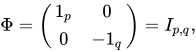
and the Lie algebra is given by

The group is given by

where g is a general n x n complex matrix and is defined as the conjugate transpose of g, what physicists call .

As a comparison, a Unitary matrix U(n) is defined as

We note that is the same as

Quaternionic case

[edit]

The space Hn is considered as a right vector space over H. This way, A(vh) = (Av)h for a quaternion h, a quaternion column vector v and quaternion matrix A. If Hn were a left vector space over H, then matrix multiplication from the right on row vectors would be required to maintain linearity. This does not correspond to the usual linear operation of a group on a vector space when a basis is given, which is matrix multiplication from the left on column vectors. Thus V is henceforth a right vector space over H. Even so, care must be taken due to the non-commutative nature of H. The (mostly obvious) details are skipped because complex representations will be used.

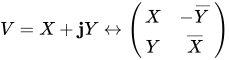
When dealing with quaternionic groups it is convenient to represent quaternions using complex 2×2-matrices,

With this representation, quaternionic multiplication becomes matrix multiplication and quaternionic conjugation becomes taking the Hermitian adjoint. Moreover, if a quaternion according to the complex encoding q = x + jy is given as a column vector (x, y)T, then multiplication from the left by a matrix representation of a quaternion produces a new column vector representing the correct quaternion. This representation differs slightly from a more common representation found in the quaternion article. The more common convention would force multiplication from the right on a row matrix to achieve the same thing.

Incidentally, the representation above makes it clear that the group of unit quaternions (αα + ββ = 1 = det Q) is isomorphic to SU(2).

Quaternionic n×n-matrices can, by obvious extension, be represented by 2n×2n block-matrices of complex numbers.[16] If one agrees to represent a quaternionic n×1 column vector by a 2n×1 column vector with complex numbers according to the encoding of above, with the upper n numbers being the αi and the lower n the βi, then a quaternionic n×n-matrix becomes a complex 2n×2n-matrix exactly of the form given above, but now with α and β n×n-matrices. More formally

A matrix T ∈ GL(2n, C) has the form displayed in (8) if and only if JnT = TJn. With these identifications,

The space Mn(H) ⊂ M2n(C) is a real algebra, but it is not a complex subspace of M2n(C). Multiplication (from the left) by i in Mn(H) using entry-wise quaternionic multiplication and then mapping to the image in M2n(C) yields a different result than multiplying entry-wise by i directly in M2n(C). The quaternionic multiplication rules give i(X + jY) = (iX) + j(−iY) where the new X and Y are inside the parentheses.

The action of the quaternionic matrices on quaternionic vectors is now represented by complex quantities, but otherwise it is the same as for "ordinary" matrices and vectors. The quaternionic groups are thus embedded in M2n(C) where n is the dimension of the quaternionic matrices.

The determinant of a quaternionic matrix is defined in this representation as being the ordinary complex determinant of its representative matrix. The non-commutative nature of quaternionic multiplication would, in the quaternionic representation of matrices, be ambiguous. The way Mn(H) is embedded in M2n(C) is not unique, but all such embeddings are related through gAgA−1, g ∈ GL(2n, C) for A ∈ O(2n, C), leaving the determinant unaffected.[17] The name of SL(n, H) in this complex guise is SU(2n).

As opposed to in the case of C, both the Hermitian and the skew-Hermitian case bring in something new when H is considered, so these cases are considered separately.

GL(n, H) and SL(n, H)
[edit]

Under the identification above,

Its Lie algebra gl(n, H) is the set of all matrices in the image of the mapping Mn(H) ↔ M2n(C) of above,

The quaternionic special linear group is given by

where the determinant is taken on the matrices in C2n. Alternatively, one can define this as the kernel of the Dieudonné determinant . The Lie algebra is

Sp(p, q) – the quaternionic unitary group
[edit]

As above in the complex case, the normal form is

and the number of plus-signs is independent of basis. When V = Hn with this form, Sp(φ) = Sp(p, q). The reason for the notation is that the group can be represented, using the above prescription, as a subgroup of Sp(n, C) preserving a complex-hermitian form of signature (2p, 2q)[18] If p or q = 0 the group is denoted U(n, H). It is sometimes called the hyperunitary group.

In quaternionic notation,
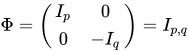
meaning that quaternionic matrices of the form

will satisfy

see the section about u(p, q). Caution needs to be exercised when dealing with quaternionic matrix multiplication, but here only I and -I are involved and these commute with every quaternion matrix. Now apply prescription (8) to each block,

and the relations in (9) will be satisfied if

The Lie algebra becomes

The group is given by

Returning to the normal form of φ(w, z) for Sp(p, q), make the substitutions wu + jv and zx + jy with u, v, x, y ∈ Cn. Then

viewed as a H-valued form on C2n.[19] Thus the elements of Sp(p, q), viewed as linear transformations of C2n, preserve both a Hermitian form of signature (2p, 2q) and a non-degenerate skew-symmetric form. Both forms take purely complex values and due to the prefactor of j of the second form, they are separately conserved. This means that

and this explains both the name of the group and the notation.

O(2n) = O(n, H)- quaternionic orthogonal group
[edit]

The normal form for a skew-hermitian form is given by

where j is the third basis quaternion in the ordered listing (1, i, j, k). In this case, Aut(φ) = O(2n) may be realized, using the complex matrix encoding of above, as a subgroup of O(2n, C) which preserves a non-degenerate complex skew-hermitian form of signature (n, n).[20] From the normal form one sees that in quaternionic notation
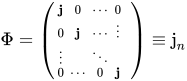
and from (6) follows that

for Vo(2n). Now put

according to prescription (8). The same prescription yields for Φ,
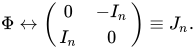
Now the last condition in (9) in complex notation reads

The Lie algebra becomes

and the group is given by

The group SO(2n) can be characterized as

[21]

where the map θ: GL(2n, C) → GL(2n, C) is defined by g ↦ −J2ngJ2n.

Also, the form determining the group can be viewed as a H-valued form on C2n.[22] Make the substitutions xw1 + iw2 and yz1 + iz2 in the expression for the form. Then

The form φ1 is Hermitian (while the first form on the left hand side is skew-Hermitian) of signature (n, n). The signature is made evident by a change of basis from (e, f) to ((e + if)/2, (eif)/2) where e, f are the first and last n basis vectors respectively. The second form, φ2 is symmetric positive definite. Thus, due to the factor j, O(2n) preserves both separately and it may be concluded that

and the notation "O" is explained.

Classical groups over general fields or algebras

[edit]

Classical groups, more broadly considered in algebra, provide particularly interesting matrix groups. When the field F of coefficients of the matrix group is either real number or complex numbers, these groups are just the classical Lie groups. When the ground field is a finite field, then the classical groups are groups of Lie type. These groups play an important role in the classification of finite simple groups. Also, one may consider classical groups over a unital associative algebra R over F; where R = H (an algebra over reals) represents an important case. For the sake of generality the article will refer to groups over R, where R may be the ground field F itself.

Considering their abstract group theory, many linear groups have a "special" subgroup, usually consisting of the elements of determinant 1 over the ground field, and most of them have associated "projective" quotients, which are the quotients by the center of the group. For orthogonal groups in characteristic 2 "S" has a different meaning.

The word "general" in front of a group name usually means that the group is allowed to multiply some sort of form by a constant, rather than leaving it fixed. The subscript n usually indicates the dimension of the module on which the group is acting; it is a vector space if R = F. Caveat: this notation clashes somewhat with the n of Dynkin diagrams, which is the rank.

General and special linear groups

[edit]

The general linear group GLn(R) is the group of all R-linear automorphisms of Rn. There is a subgroup: the special linear group SLn(R), and their quotients: the projective general linear group PGLn(R) = GLn(R)/Z(GLn(R)) and the projective special linear group PSLn(R) = SLn(R)/Z(SLn(R)). The projective special linear group PSLn(F) over a field F is simple for n ≥ 2, except for the two cases when n = 2 and the field has order[clarification needed] 2 or 3.

Unitary groups

[edit]

The unitary group Un(R) is a group preserving a sesquilinear form on a module. There is a subgroup, the special unitary group SUn(R) and their quotients the projective unitary group PUn(R) = Un(R)/Z(Un(R)) and the projective special unitary group PSUn(R) = SUn(R)/Z(SUn(R))

Symplectic groups

[edit]

The symplectic group Sp2n(R) preserves a skew symmetric form on a module. It has a quotient, the projective symplectic group PSp2n(R). The general symplectic group GSp2n(R) consists of the automorphisms of a module multiplying a skew symmetric form by some invertible scalar. The projective symplectic group PSp2n(Fq) over a finite field is simple for n ≥ 1, except for the cases of PSp2 over the fields of two and three elements.

Orthogonal groups

[edit]

The orthogonal group On(R) preserves a non-degenerate quadratic form on a module. There is a subgroup, the special orthogonal group SOn(R) and quotients, the projective orthogonal group POn(R), and the projective special orthogonal group PSOn(R). In characteristic 2 the determinant is always 1, so the special orthogonal group is often defined as the subgroup of elements of Dickson invariant 1.

There is a nameless group often denoted by Ωn(R) consisting of the elements of the orthogonal group of elements of spinor norm 1, with corresponding subgroup and quotient groups SΩn(R), PΩn(R), PSΩn(R). (For positive definite quadratic forms over the reals, the group Ω happens to be the same as the orthogonal group, but in general it is smaller.) There is also a double cover of Ωn(R), called the pin group Pinn(R), and it has a subgroup called the spin group Spinn(R). The general orthogonal group GOn(R) consists of the automorphisms of a module multiplying a quadratic form by some invertible scalar.

Notational conventions

[edit]

Contrast with exceptional Lie groups

[edit]

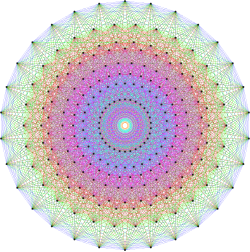
Contrasting with the classical Lie groups are the exceptional Lie groups, G2, F4, E6, E7, E8, which share their abstract properties, but not their familiarity.[23] These were only discovered around 1890 in the classification of the simple Lie algebras over the complex numbers by Wilhelm Killing and Élie Cartan.

Notes

[edit]

References

[edit]
Revisions and contributorsEdit on WikipediaRead on Wikipedia
from Grokipedia
In mathematics, classical groups are the finite-dimensional Lie groups consisting of invertible matrices over the real numbers R\mathbb{R}, complex numbers C\mathbb{C}, or quaternions H\mathbb{H} that preserve a non-degenerate bilinear, Hermitian, or quadratic form on a vector space. These groups, which include the general linear group GL(n,F)(n, F), orthogonal group O(n,F)(n, F), symplectic group Sp(n,F)(n, F), and unitary group U(n)(n)—along with their special subgroups of determinant 1—form the core of the classical families and were collectively termed "the classical groups" by Hermann Weyl in his 1939 monograph of the same name. The general linear group GL(n,F)(n, F) comprises all invertible n×nn \times n matrices over the field FF, serving as the ambient group for the others, with dimension n2n^2 (or 2n22n^2 over C\mathbb{C} as a real Lie group). Orthogonal groups O(n)(n) preserve the standard Euclidean inner product, satisfying gTg=Ig^T g = I, and have Lie algebra o(n)\mathfrak{o}(n) of skew-symmetric matrices with dimension n(n1)/2n(n-1)/2; their special versions SO(n)(n) form the connected component of the identity. Symplectic groups Sp(n)(n), defined over R\mathbb{R} or H\mathbb{H}, preserve a skew-symmetric bilinear form via gTJg=Jg^T J g = J (where JJ is the standard symplectic matrix), yielding dimensions 2n2+n2n^2 + n and playing a key role in Hamiltonian mechanics. Unitary groups U(n)(n) over C\mathbb{C} maintain the Hermitian inner product with gg=Ig^\dagger g = I (where \dagger denotes the conjugate transpose), possessing Lie algebra u(n)\mathfrak{u}(n) of dimension n2n^2, while the special unitary group SU(n)(n) has dimension n21n^2 - 1 and is simple for n2n \geq 2. These groups exhibit inclusions, such as O(n(n \subset U(n)(n) \subset Sp(n)(n), reflecting their preservation of structured inner products, and they underpin much of modern , physics, and . Beyond the real and complex cases emphasized by Weyl, the theory extends to finite fields Fq\mathbb{F}_q, where analogous groups like PSL(n,q)(n, q), PSU(n,q)(n, q), and PSp(2m,q)(2m, q) are non-abelian simple groups (with specified exceptions for small dimensions) and classify many finite simple groups via the Chevalley classification. Their study reveals deep connections to , , and random matrix ensembles, with quaternionic variants like GL(n,H)(n, \mathbb{H}) adding further richness to the framework.

Introduction and Overview

Definition and motivation

Classical groups are subgroups of the general linear group GL(n,K)\mathrm{GL}(n, K) consisting of matrices that preserve a non-degenerate bilinear or sesquilinear form ϕ\phi on a vector space VV over a field KK or division ring, such as the reals R\mathbb{R}, complexes C\mathbb{C}, or quaternions H\mathbb{H}. These forms are algebraic structures that generalize inner products, and the classical groups comprise the automorphisms that leave such forms invariant under linear transformations. The motivation for studying classical groups stems from their role as symmetry groups associated with key geometric and algebraic structures: orthogonal groups preserve quadratic forms, which encode distances and angles in Euclidean spaces; symplectic groups preserve non-degenerate alternating bilinear forms, which relate to volume preservation in phase spaces; and unitary groups preserve Hermitian forms, maintaining inner products in complex settings. These preservations ensure that essential properties like , symplectic structure, or unitarity remain unchanged, making classical groups fundamental in linear algebra, , and , with applications in physics for modeling symmetries of physical systems. A basic example is the O(n,R)O(n, \mathbb{R}), which consists of real n×nn \times n matrices AA preserving the standard xTy\mathbf{x}^T \mathbf{y} on Rn\mathbb{R}^n. The preservation condition for a represented by a matrix ϕ\phi is given by ATϕA=ϕ,A^T \phi A = \phi, where AA is the matrix of the transformation; for the standard over R\mathbb{R}, ϕ=In\phi = I_n, this simplifies to ATA=InA^T A = I_n.

Historical development

The historical development of classical groups emerged from studies in and the theory of equations during the late 18th and early 19th centuries. Joseph-Louis Lagrange's investigations in the 1770s into quadratic forms and the transformations preserving them in the context of and laid foundational ideas for orthogonal transformations, though without an explicit group-theoretic framework. Similarly, Augustin-Louis Cauchy's work in the 1810s and 1840s on permutations and their compositions introduced systematic treatments of finite transformation groups, influencing the abstract structures later embodied in classical groups. A pivotal advancement came in 1872 with Felix Klein's , which proposed classifying geometries according to the groups of transformations preserving their fundamental properties, thereby elevating transformation groups—including projective, affine, and orthogonal types—to central objects of study and highlighting their role in unifying diverse geometric theories. In the 1890s and early 1910s, advanced the integration of classical groups into the emerging theory of Lie groups through his classification of simple Lie algebras in his 1894 doctoral thesis, delineating the classical series (types A, B, C, and D) that correspond to the special linear, odd orthogonal, symplectic, and even orthogonal groups, respectively, and establishing their structural foundations. Twentieth-century progress included Claude Chevalley's work in the 1940s on algebraic groups, which generalized classical groups to arbitrary fields, including finite ones, enabling their application beyond real and complex numbers. Jean Dieudonné's treatises in the 1940s, particularly on linear groups and their geometric interpretations, standardized nomenclature and axiomatic treatments of classical groups within modern algebra. coined the term "classical groups" in his 1939 monograph to denote these fundamental types in contrast to exceptional groups, synthesizing earlier with representation-theoretic insights.

Bilinear and Sesquilinear Forms

Bilinear forms over fields

A bilinear form on a vector space VV over a field KK is a function ϕ:V×VK\phi: V \times V \to K that is linear in each argument separately. With respect to a basis of VV, such a form is represented by a matrix BB such that ϕ(x,y)=xTBy\phi(x, y) = x^T B y for column vectors x,yVx, y \in V. A bilinear form is non-degenerate if its representing matrix BB has nonzero , or equivalently, if ϕ(x,y)=0\phi(x, y) = 0 for all yVy \in V implies x=0x = 0. Over fields of characteristic not equal to 2, non-degenerate bilinear forms are classified into symmetric forms, where B=BTB = B^T, and skew-symmetric forms, where B=BTB = -B^T. For example, the standard symmetric bilinear form on KnK^n is given by the InI_n, so ϕ(x,y)=xTy\phi(x, y) = x^T y, which is non-degenerate. The standard symplectic form on K2nK^{2n} uses the block matrix J=(0InIn0),J = \begin{pmatrix} 0 & I_n \\ -I_n & 0 \end{pmatrix}, yielding a skew-symmetric, non-degenerate form ϕ(x,y)=xTJy\phi(x, y) = x^T J y. Two bilinear forms with matrices BB and BB' are equivalent (or congruent) if there exists an invertible matrix PP such that PTBP=BP^T B P = B', preserving the type (symmetric or skew-symmetric) and non-degeneracy. Over fields like the reals or complexes, congruence classes of non-degenerate symmetric forms are determined by signatures or diagonal entries up to scaling.

Sesquilinear forms over division rings

A sesquilinear form on a VV over a KK equipped with an involution σ:KK\sigma: K \to K (satisfying σ(a+b)=σ(a)+σ(b)\sigma(a + b) = \sigma(a) + \sigma(b), σ(ab)=σ(b)σ(a)\sigma(ab) = \sigma(b)\sigma(a), and σ2=id\sigma^2 = \mathrm{id}) is a ϕ:V×VK\phi: V \times V \to K that is linear in the first argument and σ\sigma-antilinear (conjugate-linear) in the second argument. Specifically, for all x,y,zVx, y, z \in V and a,bKa, b \in K, ϕ(ax+by,z)=aϕ(x,z)+bϕ(y,z),ϕ(x,ay+bz)=ϕ(x,y)σ(a)+ϕ(x,z)σ(b).\phi(ax + by, z) = a \phi(x, z) + b \phi(y, z), \quad \phi(x, ay + bz) = \phi(x, y) \sigma(a) + \phi(x, z) \sigma(b). This generalizes bilinear forms, where σ\sigma is the identity map, to settings involving non-trivial involutions such as complex conjugation on C\mathbb{C} or the standard conjugation on the quaternions H\mathbb{H}. Sesquilinear forms are classified as Hermitian if they satisfy ϕ(y,x)=σ(ϕ(x,y))\phi(y, x) = \sigma(\phi(x, y)) for all x,yVx, y \in V, or skew-Hermitian if ϕ(y,x)=σ(ϕ(x,y))\phi(y, x) = -\sigma(\phi(x, y)). Hermitian forms are reflexive, meaning ϕ(x,y)=0\phi(x, y) = 0 for all yVy \in V implies ϕ(z,x)=0\phi(z, x) = 0 for all zVz \in V, and they play a central role in defining unitary structures over C\mathbb{C} and H\mathbb{H}. Skew-Hermitian forms, in contrast, satisfy ϕ(x,x)=0\phi(x, x) = 0 for all xVx \in V and are associated with symplectic-like geometries in these settings. With respect to a basis of VV, a sesquilinear form ϕ\phi is represented by a matrix HKn×nH \in K^{n \times n} such that for column vectors x,yKnx, y \in K^n, ϕ(x,y)=xHy,\phi(x, y) = x^* H y, where x=xTx^* = \overline{x}^T denotes the conjugate transpose (with entries conjugated via σ\sigma and then transposed). For Hermitian forms, HH satisfies H=HH^* = H; for skew-Hermitian forms, H=HH^* = -H. A linear transformation AGL(V)A \in \mathrm{GL}(V) preserves the form if ϕ(Ax,Ay)=ϕ(x,y)\phi(Ax, Ay) = \phi(x, y) for all x,yVx, y \in V, which translates to the matrix equation AHA=H.A^* H A = H. This congruence condition defines the associated classical group. A standard example over C\mathbb{C} (with σ(z)=z\sigma(z) = \overline{z}) is the Hermitian form on Cn\mathbb{C}^n given by ϕ(x,y)=xy=i=1nxiyi\phi(x, y) = x^* y = \sum_{i=1}^n \overline{x_i} y_i, represented by the identity matrix H=InH = I_n. Over the quaternions H\mathbb{H} (with standard conjugation σ(q)=q=abicjdk\sigma(q) = \overline{q} = a - bi - cj - dk for q=a+bi+cj+dkq = a + bi + cj + dk, a,b,c,dRa,b,c,d \in \mathbb{R}), the analogous standard Hermitian form on Hn\mathbb{H}^n is ϕ(x,y)=xy=i=1nxiyi\phi(x, y) = x^* y = \sum_{i=1}^n \overline{x_i} y_i, again with H=InH = I_n, though non-commutativity requires right vector space structure and careful handling of scalar multiplications from the right. These forms underpin the quaternionic unitary groups and their applications in geometry and physics.

Automorphism Groups of Forms

Real bilinear case

In the real bilinear case, the automorphism group of a nondegenerate ϕ:V×VR\phi: V \times V \to \mathbb{R} on a finite-dimensional real VV is the set Aut(ϕ)={AGL(V)ϕ(Av,Aw)=ϕ(v,w) v,wV}\operatorname{Aut}(\phi) = \{ A \in \operatorname{GL}(V) \mid \phi(Av, Aw) = \phi(v, w) \ \forall v, w \in V \}. With respect to a basis in which ϕ\phi is represented by a matrix BB, this condition becomes ABA=BA^\top B A = B. For a symmetric bilinear form, where ϕ(v,w)=ϕ(w,v)\phi(v, w) = \phi(w, v), the matrix BB is symmetric, and the automorphism group is the real orthogonal group O(n,R)O(n, \mathbb{R}), consisting of all n×nn \times n real matrices AA satisfying AA=IA^\top A = I. The special orthogonal group SO(n,R)SO(n, \mathbb{R}) is the index-2 subgroup of matrices in O(n,R)O(n, \mathbb{R}) with determinant 1. For a skew-symmetric (alternating) bilinear form, where ϕ(v,w)=ϕ(w,v)\phi(v, w) = -\phi(w, v) and thus ϕ(v,v)=0\phi(v, v) = 0, nondegeneracy over R\mathbb{R} requires that dimV=2m\dim V = 2m is even. In this case, up to congruence, the form is represented by the standard symplectic matrix J=(0ImIm0),J = \begin{pmatrix} 0 & I_m \\ -I_m & 0 \end{pmatrix}, and the automorphism group is the real symplectic group Sp(2m,R)\operatorname{Sp}(2m, \mathbb{R}), defined by matrices AA satisfying AJA=JA^\top J A = J. Every such AA has determinant 1.

Complex bilinear and sesquilinear cases

Over the complex numbers C\mathbb{C}, non-degenerate symmetric bilinear forms on an nn-dimensional are all equivalent and can be represented by the InI_n via congruence transformations in a suitable basis. The preserving such a form is the complex O(n,C)O(n, \mathbb{C}), consisting of matrices AGL(n,C)A \in GL(n, \mathbb{C}) satisfying ATA=InA^T A = I_n. Sesquilinear forms over C\mathbb{C} involve complex conjugation in one argument, and the Hermitian case—where the form satisfies ω(v,w)=ω(w,v)\omega(v, w) = \overline{\omega(w, v)}—is preserved by the U(n)U(n). For the standard Hermitian form represented by H=InH = I_n, the preserving condition is AHA=HA^* H A = H, or equivalently AA=InA^* A = I_n when H=InH = I_n, where AA^* denotes the . This group captures the structure of isometries for positive definite Hermitian forms, analogous to the in the real case but accounting for the sesquilinear nature. Skew-Hermitian sesquilinear forms, satisfying ω(v,w)=ω(w,v)\omega(v, w) = -\overline{\omega(w, v)}, are closely related to the Hermitian case; multiplying the form by ii yields a Hermitian form, so their automorphism group is isomorphic to U(n)U(n). The preserving matrices satisfy a similar conjugate-transpose condition adjusted for the skew symmetry. In the bilinear category over C\mathbb{C}, non-degenerate skew-symmetric forms exist only on even-dimensional spaces of dimension 2m2m and are all equivalent, representable in a symplectic basis by the block-diagonal matrix with mm copies of (0110)\begin{pmatrix} 0 & 1 \\ -1 & 0 \end{pmatrix}. The automorphism group is the complex symplectic group Sp(2m,C)Sp(2m, \mathbb{C}), comprising matrices AA such that ATJA=JA^T J A = J, where JJ is the standard skew-symmetric matrix.

Quaternionic sesquilinear case

In the quaternionic case, sesquilinear forms are defined on finite-dimensional vector spaces over the division ring of H\mathbb{H}, where the involution is given by the standard quaternion conjugation, denoted by ^*. A ϕ:V×VH\phi: V \times V \to \mathbb{H} is linear in the first argument and semilinear in the second with respect to this conjugation, typically represented in matrix terms as ϕ(x,y)=xHy\phi(x, y) = x^* H y for a fixed non-degenerate HMn(H)H \in M_n(\mathbb{H}) with entries satisfying hij=hjih_{ij}^* = h_{ji}. The of such a form consists of invertible linear transformations AGL(n,H)A \in \mathrm{GL}(n, \mathbb{H}) that preserve the form, satisfying the condition AHA=HA^* H A = H. In the Hermitian case, where the form is the standard Hermitian form ϕ(x,y)=xy=i=1nxˉiyi\phi(x, y) = x^* y = \sum_{i=1}^n \bar{x}_i y_i (corresponding to H=InH = I_n), the is the quaternionic Sp(n,H)\mathrm{Sp}(n, \mathbb{H}), also known as the unitary quaternionic group. This compact real has real dimension n(2n+1)n(2n + 1) and consists of quaternionic matrices AA such that A=A1A^* = A^{-1}. Quaternionic classical groups like Sp(n,H)\mathrm{Sp}(n, \mathbb{H}) embed into complex classical groups of double the via the identification of H\mathbb{H} with a of M2(C)M_2(\mathbb{C}), yielding the Sp(n,H)USp(2n)\mathrm{Sp}(n, \mathbb{H}) \cong \mathrm{USp}(2n), where USp(2n)\mathrm{USp}(2n) is the compact real form of the complex Sp(2n,C)\mathrm{Sp}(2n, \mathbb{C}) intersected with the U(2n)\mathrm{U}(2n). The over H\mathbb{H} is defined using the Dieudonné determinant, which is multiplicative and takes values in the positive reals R>0\mathbb{R}_{>0}. In particular, Sp(n,H)SL(n,H)\mathrm{Sp}(n, \mathbb{H}) \subset \mathrm{SL}(n, \mathbb{H}). Vector spaces over H\mathbb{H} of quaternionic dimension nn have real dimension 4n4n, which is even, reflecting the underlying structure of H\mathbb{H} as a 4-dimensional real and enabling the embedding into even-dimensional complex spaces.

Specific Classical Groups

Orthogonal groups

The O(p,q,K)O(p, q, K) over a field KK consists of all invertible linear transformations of a of dimension p+qp+q over KK that preserve a non-degenerate of signature (p,q)(p, q), where the form is represented by the G=diag(Ip,Iq)G = \operatorname{diag}(I_p, -I_q). In matrix terms, it is the of GL(p+q,K)\mathrm{GL}(p+q, K) satisfying AGA=GA^\top G A = G. These groups arise as the groups of such quadratic forms. Over the real numbers, the definite orthogonal group O(n,R)O(n, \mathbb{R}) preserves the standard positive definite form i=1nxi2\sum_{i=1}^n x_i^2, while the indefinite group O(p,q)O(p, q) with p+q=np + q = n and p,q1p, q \geq 1 preserves a form of (p,q)(p, q), such as i=1pxi2i=1qxi2\sum_{i=1}^p x_i^2 - \sum_{i=1}^q x_i^2. The group O(p,q)O(p, q) has four connected components when p,q1p, q \geq 1, distinguished by the signs of the and the action on the positive cone. The special orthogonal group SO(p,q)SO(p, q), consisting of elements with 1, has two connected components, with the identity component SO+(p,q)SO^+(p, q) being the connected group of orientation-preserving isometries. Over the complex numbers, all non-degenerate symmetric bilinear forms on an nn-dimensional space are equivalent up to , yielding a unique orthogonal group O(n,C)O(n, \mathbb{C}) that preserves the standard form i=1nxi2\sum_{i=1}^n x_i^2. This group has two connected components, with the special orthogonal subgroup SO(n,C)SO(n, \mathbb{C}) connected; split forms over C\mathbb{C} reduce to this standard case due to the equivalence of forms. The natural (defining) representation of an is known as the reflection representation, as the group is generated by reflections across hyperplanes orthogonal to roots of the quadratic form. The associated to the of the so(p,q)\mathfrak{so}(p, q) (or its ) is the hyperoctahedral group, the signed (Z/2Z)Sn/2(\mathbb{Z}/2\mathbb{Z}) \wr S_{ \lfloor n/2 \rfloor } acting by permutations and sign changes on coordinates. Over finite fields Fq\mathbb{F}_q with qq odd, the order of the O(n,q)O(n, q) depends on the dimension nn and the type of the . For odd dimension n=2m+1n = 2m+1, O(2m+1,q)=2qm2i=1m(q2i1)|O(2m+1, q)| = 2 q^{m^2} \prod_{i=1}^m (q^{2i} - 1). For even dimension n=2mn = 2m, there are two non-isomorphic types: the plus type O+(2m,q)O^+(2m, q) with Witt index mm has order 2qm(m1)(qm1)i=1m1(q2i1)2 q^{m(m-1)} (q^m - 1) \prod_{i=1}^{m-1} (q^{2i} - 1), while the minus type O(2m,q)O^-(2m, q) with Witt index m1m-1 has order 2qm(m1)(qm+1)i=1m1(q2i1)2 q^{m(m-1)} (q^m + 1) \prod_{i=1}^{m-1} (q^{2i} - 1). These formulas reflect the structure involving a factor of 2 from the and products over Gaussian factors adjusted for the orthogonal case.

Symplectic groups

The symplectic groups arise as the automorphism groups preserving a non-degenerate skew-symmetric on a of even dimension. For a field KK of characteristic not 2, the Sp(2n,K)\mathrm{Sp}(2n, K) consists of all invertible linear transformations AGL(2n,K)A \in \mathrm{GL}(2n, K) satisfying AJA=JA^\top J A = J, where JJ is the standard block skew-symmetric matrix (0InIn0)\begin{pmatrix} 0 & I_n \\ -I_n & 0 \end{pmatrix} with InI_n the n×nn \times n . This condition ensures that the transformation preserves the associated symplectic form ω(u,v)=uJv\omega(u, v) = u^\top J v. A key property of Sp(2n,K)\mathrm{Sp}(2n, K) is that it is always connected when K=RK = \mathbb{R} or C\mathbb{C}. Moreover, every matrix in the group has determinant 1 automatically, as follows from the relation det(AJA)=det(J)\det(A^\top J A) = \det(J), which simplifies to det(A)2=1\det(A)^2 = 1 and positivity in the real or complex case. Over R\mathbb{R}, Sp(2n,R)\mathrm{Sp}(2n, \mathbb{R}) admits a compact realization as its intersection with the U(2n)\mathrm{U}(2n), yielding the compact symplectic group Sp(n)\mathrm{Sp}(n) of n(2n+1)n(2n+1). In contrast, over C\mathbb{C}, Sp(2n,C)\mathrm{Sp}(2n, \mathbb{C}) is a , meaning its sp(2n,C)\mathfrak{sp}(2n, \mathbb{C}) is simple and the group has no nontrivial connected normal subgroups. The preservation of the symplectic form ω\omega implies that elements of Sp(2n,K)\mathrm{Sp}(2n, K) also preserve the induced on the space, given by ωnn!\frac{\omega^n}{n!}, which provides a orientation and measure in . For paths in Sp(2n,R)\mathrm{Sp}(2n, \mathbb{R}), the Maslov index serves as a topological invariant, counting the number of intersections with the Maslov cycle (the set of singular Lagrangian subspaces) in a homotopy-invariant manner, with applications in and spectral flow. Over finite fields Fq\mathbb{F}_q with qq odd, the order of Sp(2n,q)\mathrm{Sp}(2n, q) is qn2i=1n(q2i1)q^{n^2} \prod_{i=1}^n (q^{2i} - 1), reflecting the structure of isotropic subspaces and bases adapted to the form. This contrasts with orthogonal groups, which preserve symmetric forms and generally have different cardinality formulas.

Unitary groups

The unitary groups are the automorphism groups preserving non-degenerate Hermitian s on complex vector spaces. A Hermitian on a complex vector space VV of n=p+qn = p + q is a map B:V×VCB: V \times V \to \mathbb{C} satisfying B(ay+bz,w)=aB(y,w)+bB(z,w)B(ay + bz, w) = a B(y,w) + b B(z,w) for a,bCa,b \in \mathbb{C} and y,z,wVy,z,w \in V, and B(v,w)=B(w,v)B(v,w) = \overline{B(w,v)} for all v,wVv,w \in V, where the bar denotes complex conjugation. Such forms admit a Gram matrix G=diag(Ip,Iq)G = \operatorname{diag}(I_p, -I_q) in a suitable basis, with pp positive and qq negative eigenvalues determining the signature. The indefinite unitary group U(p,q)U(p,q) consists of all invertible linear transformations AGL(p+q,C)A \in \mathrm{GL}(p+q, \mathbb{C}) such that AGA=GA^* G A = G, where AA^* denotes the of AA. For the definite case q=0q=0, the standard U(n)U(n) comprises matrices AGL(n,C)A \in \mathrm{GL}(n, \mathbb{C}) satisfying AA=InA^* A = I_n, preserving the positive definite Hermitian form with G=InG = I_n. The SU(n)SU(n) is the kernel of the map det:U(n)U(1)\det: U(n) \to U(1), consisting of elements with detA=1\det A = 1. Over the quaternions H\mathbb{H}, the quaternionic unitary group U(n,H)U(n, \mathbb{H}) (also denoted Sp(n)\mathrm{Sp}(n)) preserves a on Hn\mathbb{H}^n, defined analogously as matrices AGL(n,H)A \in \mathrm{GL}(n, \mathbb{H}) satisfying AA=InA^* A = I_n, where ^* involves quaternionic conjugation. This group embeds into U(2n,C)U(2n, \mathbb{C}) via the standard identification of H\mathbb{H} with a of M2(C)\mathbb{M}_2(\mathbb{C}). As real Lie groups, the definite unitary groups U(n)U(n) and SU(n)SU(n) are compact, arising as closed subgroups of GL(n,C)\mathrm{GL}(n, \mathbb{C}) with finite volume in the Euclidean topology. The fundamental group of U(n)U(n) is Z\mathbb{Z} for n1n \geq 1, arising from the fibration SU(n)U(n)U(1)SU(n) \to U(n) \to U(1) where SU(n)SU(n) is simply connected for n2n \geq 2 and U(1)S1U(1) \simeq S^1 has π1Z\pi_1 \cong \mathbb{Z}. Indefinite unitary groups U(p,q)U(p,q) with p,q>0p,q > 0 appear in physics as preservers of pseudo-Hermitian metrics, enabling unitary evolution for non-Hermitian Hamiltonians with real spectra in PT-symmetric quantum mechanics.

Generalizations and Variations

Over finite fields

Classical groups over finite fields extend the definitions from infinite fields to the discrete setting of finite fields Fq\mathbb{F}_q, where qq is a , adapting idea of preserving non-degenerate bilinear or sesquilinear forms. These groups arise as the groups of vector spaces equipped with such forms, with the finite field characteristic affecting the existence and structure of the groups; for instance, orthogonal groups require adjustments for even and odd characteristics, while symplectic groups are uniformly defined. The theory was pioneered by Eugene Dickson in his 1901 work on linear groups over finite fields, providing explicit classifications and order formulas that remain foundational. For orthogonal groups over Fq\mathbb{F}_q, the notation Oϵ(n,q)O^\epsilon(n, q) distinguishes types based on the ϵ=+\epsilon = + or - of the , applicable for both odd qq (where the Witt index determines the type) and even qq (where the form's depend on the field's characteristic 2). These groups preserve non-degenerate symmetric bilinear forms associated with quadratic forms, and their orders were computed by Dickson as O+(2m+1,q)=2qm2i=1m(q2i1)|O^+(2m+1, q)| = 2q^{m^2} \prod_{i=1}^m (q^{2i} - 1) for odd dimension and positive type, with analogous formulas for other cases reflecting the field's and the form's . In even characteristic, additional care is needed for hyperbolic and elliptic forms, but the groups remain finite analogs of the indefinite orthogonal groups over the reals. Dickson's computations highlight how the orders grow polynomially with qnq^n, underscoring their role in combinatorial . Symplectic groups Sp(2n,q)Sp(2n, q) over Fq\mathbb{F}_q for n1n \geq 1 are defined uniformly for any qq, preserving non-degenerate alternating bilinear forms on 2n2n-dimensional spaces, and exist without the parity restrictions seen in orthogonal cases. As finite Chevalley groups of type CnC_n, they provide a direct analog to the infinite-dimensional symplectic groups, with the order given by Sp(2n,q)=qn2i=1n(q2i1)|Sp(2n, q)| = q^{n^2} \prod_{i=1}^n (q^{2i} - 1), a derived from the structure of the and contributions in Chevalley's 1955 classification of simple groups over finite fields. This explicit cardinality facilitates their study in and enumeration of symplectic subspaces. Unitary groups U(n,q)U(n, q) operate over the extension field Fq2\mathbb{F}_{q^2}, preserving non-degenerate Hermitian sesquilinear forms with respect to the Frobenius involution xxqx \mapsto x^q, which ensures the form's anti-linearity. Defined for any qq, these groups generalize the complex unitary groups and form Chevalley groups of type An1A_{n-1} twisted by the , with orders computable via similar products involving cyclotomic polynomials. Their construction relies on the field's quadratic extension to support the involution, distinguishing them from purely bilinear cases. These finite classical groups, as part of the Chevalley series, play crucial roles in applications such as finite geometries—where they act as collineation groups on projective spaces—and coding theory, exemplified by orthogonal codes derived from quadratic residues over Fq\mathbb{F}_q that achieve optimal error-correcting properties in communication systems. For instance, simplex codes from orthogonal geometries provide high-rate constructions with minimal distance tied to the group's order.

Over rings and algebras

Classical groups can be generalized to act over commutative rings with identity, such as the integers Z\mathbb{Z}, where they form arithmetic subgroups of the corresponding algebraic groups defined over Q\mathbb{Q}. These are subgroups commensurable with G(Z)G(\mathbb{Z}) for a linear algebraic group GG over Q\mathbb{Q}, preserving non-degenerate forms on free Z\mathbb{Z}-modules of finite rank. Prominent examples include the special linear group SL(n,Z)SL(n, \mathbb{Z}), consisting of n×nn \times n integer matrices with determinant 1, and the symplectic group Sp(2n,Z)Sp(2n, \mathbb{Z}), the subgroup of SL(2n,Z)SL(2n, \mathbb{Z}) preserving a standard skew-symmetric bilinear form. Orthogonal groups over Z\mathbb{Z} are defined similarly for integral quadratic forms, acting on Zn\mathbb{Z}^n to preserve a symmetric bilinear form given by a Gram matrix with integer entries, such as the indefinite form associated with signature (r,s)(r, s) where r+s=nr + s = n. Arithmetic subgroups like SL(n,Z)SL(n, \mathbb{Z}) and Sp(2n,Z)Sp(2n, \mathbb{Z}) for n2n \geq 2 are finitely generated and finitely presented, and they possess congruence subgroups of finite index, defined as kernels of reduction homomorphisms modulo a positive integer mm, such as Γ(m)={ASL(n,Z)AIn(modm)}\Gamma(m) = \{ A \in SL(n, \mathbb{Z}) \mid A \equiv I_n \pmod{m} \}. For these groups, the congruence subgroup property holds when the rank is sufficiently high (e.g., SL(n,Z)SL(n, \mathbb{Z}) for n3n \geq 3), meaning every finite-index subgroup contains a congruence subgroup, though SL(2,Z)SL(2, \mathbb{Z}) provides a counterexample with non-congruence finite-index subgroups. Preservation of the form modulo mm requires ATBAB(modm)A^T B A \equiv B \pmod{m}, where BB is the matrix of the bilinear form. The special linear group SL(2,Z)SL(2, \mathbb{Z}) further exhibits finiteness properties, such as having only finitely many subgroups of a given finite index and a virtual free structure with torsion-free subgroups of finite index. Steinberg groups provide a key construction over rings, serving as universal central extensions of the elementary subgroup E(R)E(R), which is generated by elementary transvections in SL(n,R)SL(n, R) for a commutative ring RR. For instance, the Steinberg group St(n,R)St(n, R) maps onto E(n,R)E(n, R) with kernel related to the second algebraic K-group K2(R)K_2(R), and under conditions like n3n \geq 3 and RR having no residue field of characteristic 2, it is the universal central extension. This extends to other classical types, such as symplectic Steinberg groups over rings. Beyond fields, classical groups are primarily defined over the real division algebras R\mathbb{R}, C\mathbb{C}, and the quaternions H\mathbb{H}, where they preserve corresponding bilinear, sesquilinear, or quaternionic forms. Attempts to extend to higher normed division algebras, such as the , fail to yield classical groups and instead produce exceptional groups like G2G_2 or F4F_4, due to the non-associativity of O\mathbb{O}.

Notational conventions

In the study of classical groups, the general linear group over a field KK is denoted GL(n,K)GL(n, K), consisting of all invertible n×nn \times n matrices with entries in KK, while the special linear group SL(n,K)SL(n, K) is the kernel of the map from GL(n,K)GL(n, K) to the of KK. The O(n,K)O(n, K) preserves a non-degenerate on a of dimension nn over KK, and its special subgroup of one elements is SO(n,K)SO(n, K). For symplectic groups, the standard notation is Sp(2n,K)Sp(2n, K), reflecting the even dimension 2n2n required to preserve a non-degenerate alternating , which arises naturally from pairs in a symplectic basis; an alternative but less common notation is Sp(n,K)Sp(n, K), though the 2n2n-dimensional convention emphasizes the underlying structure. The U(n,K)U(n, K) preserves a non-degenerate Hermitian form on a over KK equipped with an involutory . For indefinite forms over the real numbers, the orthogonal group of signature (p,q)(p, q) with p+q=np + q = n is denoted O(p,q)O(p, q), comprising matrices gg satisfying gTIp,qg=Ip,qg^T I_{p,q} g = I_{p,q} where Ip,qI_{p,q} is the diagonal matrix with pp entries of +1+1 and qq entries of 1-1; the corresponding special group is SO(p,q)=O(p,q)SL(n,R)SO(p, q) = O(p, q) \cap SL(n, \mathbb{R}). Similarly, the indefinite unitary group U(p,q)U(p, q) over the complex numbers preserves a Hermitian form of signature (p,q)(p, q), defined by matrices gg with gIp,qg=Ip,qg^* I_{p,q} g = I_{p,q} where gg^* is the conjugate transpose, and SU(p,q)=U(p,q)SL(n,C)SU(p, q) = U(p, q) \cap SL(n, \mathbb{C}). The indefinite symplectic group Sp(p,q)Sp(p, q) arises in contexts preserving sesquilinear forms of mixed signature over quaternions or related structures, though its notation is less uniform than for orthogonal and unitary cases. Over finite fields Fq\mathbb{F}_q where qq is a , the notations follow the general , such as GL(n,q)GL(n, q), SL(n,q)SL(n, q), O(n,q)O(n, q), Sp(2n,q)Sp(2n, q), and U(n,q)U(n, q) for unitary groups over Fq2\mathbb{F}_{q^2}. In Chevalley notation, which classifies finite groups of Lie type via Dynkin diagrams, the projective PSL(n,q)PSL(n, q) is denoted 1An1(q)^1A_{n-1}(q) or simply An1(q)A_{n-1}(q); the projective special unitary group PSU(n,q)PSU(n, q) is 2An1(q)^2A_{n-1}(q); the projective symplectic group PSp(2n,q)PSp(2n, q) is Cn(q)C_n(q); and orthogonal groups appear as Bm(q)B_m(q) for odd dimension 2m+12m+1, Dm(q)D_m(q) for even dimension 2m2m with plus type, and 2Dm(q)^2D_m(q) for twisted even cases. Variations include the compact real form of the , often denoted USp(2n)USp(2n) or Sp(n)Sp(n), which is the of U(2n)U(2n) with the complex Sp(2n,C)Sp(2n, \mathbb{C}) and consists of 2n×2n2n \times 2n unitary matrices preserving the standard symplectic form with 1. For quaternionic structures, the over the s H\mathbb{H} is denoted Sp(n,H)Sp(n, \mathbb{H}) or simply Sp(n)Sp(n), representing the group of quaternionic unitary transformations preserving a positive definite Hermitian form on Hn\mathbb{H}^n, which is isomorphic to the compact real of 4n4n. These notations address inconsistencies in the literature by standardizing symbols across algebraic, geometric, and Lie theoretic contexts, with the 2n2n for symplectic groups underscoring the pairing inherent to the preserved form.

Relation to Lie Theory

Classical Lie groups

The classical Lie groups consist primarily of the matrix groups that preserve certain bilinear or sesquilinear forms, serving as fundamental examples in over the real numbers R\mathbb{R} or complex numbers C\mathbb{C}. The O(n)O(n) comprises n×nn \times n real matrices AA satisfying ATA=IA^T A = I, where II is the , thus preserving the standard Euclidean inner product. Similarly, the U(n)U(n) consists of n×nn \times n complex matrices AA with AA=IA^\dagger A = I, where \dagger denotes the conjugate transpose, preserving the Hermitian inner product. The symplectic group Sp(n)Sp(n) (often denoted Sp(2n,R)Sp(2n, \mathbb{R}) for the real case) includes 2n×2n2n \times 2n real matrices AA satisfying ATJA=JA^T J A = J, where J=(0InIn0)J = \begin{pmatrix} 0 & I_n \\ -I_n & 0 \end{pmatrix} is the standard symplectic matrix, preserving a nondegenerate skew-symmetric bilinear form. These groups, along with their special subgroups like SO(n)SO(n), SU(n)SU(n), and Sp(n,C)Sp(n, \mathbb{C}), represent the complex classical Lie groups and their real forms, embedded as closed subgroups of GL(n,R)GL(n, \mathbb{R}) or GL(n,C)GL(n, \mathbb{C}). The associated Lie algebras capture the infinitesimal structure of these groups via the tangent space at the identity. The Lie algebra so(n,R)\mathfrak{so}(n, \mathbb{R}) of O(n)O(n) consists of n×nn \times n real skew-symmetric matrices, i.e., those AA with AT=AA^T = -A. For U(n)U(n), the Lie algebra u(n)\mathfrak{u}(n) comprises skew-Hermitian matrices AA satisfying A=AA^\dagger = -A, while the special unitary Lie algebra su(n)\mathfrak{su}(n) restricts to those with trace zero. The symplectic Lie algebra sp(n,R)\mathfrak{sp}(n, \mathbb{R}) (dimension n(2n+1)n(2n+1)) consists of 2n×2n2n \times 2n real matrices AA satisfying ATJ+JA=0A^T J + J A = 0. These Lie algebras are realized as subalgebras of gl(n,R)\mathfrak{gl}(n, \mathbb{R}) or gl(n,C)\mathfrak{gl}(n, \mathbb{C}), with the Lie bracket given by the matrix commutator [X,Y]=XYYX[X, Y] = XY - YX. In the Killing-Cartan classification of simple Lie algebras over C\mathbb{C}, the classical types correspond to the series An1=sl(n,C)A_{n-1} = \mathfrak{sl}(n, \mathbb{C}) (special linear), Bn=so(2n+1,C)B_n = \mathfrak{so}(2n+1, \mathbb{C}) and Dn=so(2n,C)D_n = \mathfrak{so}(2n, \mathbb{C}) (odd- and even-dimensional orthogonal), and Cn=sp(2n,C)C_n = \mathfrak{sp}(2n, \mathbb{C}) (symplectic), derived from their root systems and Dynkin diagrams. These four infinite families encompass the majority of finite-dimensional simple Lie algebras, excluding only the five exceptional types G2,F4,E6,E7,E8G_2, F_4, E_6, E_7, E_8. The classification, established by Wilhelm Killing and refined by Élie Cartan, relies on the structure of Cartan subalgebras and root decompositions. A key distinction in real forms arises between compact and non-compact variants, reflecting the signature of the preserved form. The compact forms include SO(n)SO(n), SU(n)SU(n), and USp(2n)USp(2n) (the compact real form of sp(2n,C)\mathfrak{sp}(2n, \mathbb{C}), consisting of 2n×2n2n \times 2n unitary matrices commuting with JJ), which are bounded and have negative-definite . In contrast, non-compact forms like SO(p,q)SO(p,q) (with p+q=np+q=n) preserve indefinite quadratic forms of (p,q)(p,q) and exhibit , with split real forms corresponding to maximal non-compactness. These properties underpin applications in and .

Contrast with exceptional Lie groups

While the classical Lie groups arise as the groups preserving non-degenerate bilinear, sesquilinear, or Hermitian forms on vector spaces over the real numbers R\mathbb{R}, complex numbers C\mathbb{C}, or quaternions H\mathbb{H}, the exceptional Lie groups do not originate from such form-preserving actions in a straightforward manner. The exceptional simple finite-dimensional Lie groups are G2G_2, F4F_4, E6E_6, E7E_7, and E8E_8, which stand apart from the infinite families of classical groups (series AnA_n, BnB_n, CnC_n, DnD_n) due to their unique structural properties. Unlike classical groups, which admit natural matrix representations tied to over division algebras up to quaternions, exceptional groups often require more exotic constructions, such as derivations or automorphisms involving the , the unique non-associative of dimension 8. A key structural distinction appears in their Dynkin diagrams, which encode the root systems and Cartan matrices of the corresponding Lie algebras: the classical series feature linear chains (with a simple fork for DnD_n), reflecting their association with symmetric or skew-symmetric forms, whereas the exceptional diagrams exhibit more intricate branching patterns, such as the triple branch in E8E_8 or the short-long root distinction in G2G_2. Dimensionally, the exceptional groups culminate in E8E_8 with Lie algebra dimension 248, the largest among finite simple Lie algebras, in contrast to the classical series, which extend to arbitrarily high dimensions (e.g., dimso(n)=n(n1)/2\dim \mathfrak{so}(n) = n(n-1)/2 grows without bound as nn \to \infty). Regarding representations, classical groups possess fundamental representations that are inherently tensorial, derived from the standard vector representation and its exterior or symmetric powers, whereas exceptional groups have minimal irreducible representations of non-tensorial nature, such as the 27-dimensional representation for E6E_6, which cannot be realized as a subspace of tensor powers of a single vector space in the classical sense. Historically, the exceptional Lie groups were first identified by in the 1880s through his classification of simple Lie algebras over the complex numbers, but provided the definitive classification and explicit in his 1894 doctoral thesis, solidifying their existence beyond the classical families. Cartan's later work in the , particularly on systems of invariants under group actions, further illuminated the representational peculiarities of these groups, distinguishing them from the form-based origins of classical .

References

Add your contribution
Related Hubs
User Avatar
No comments yet.