Hubbry Logo
search
logo
1547239

Clay modeling

logo
Community Hub0 Subscribers
Read side by side
from Wikipedia
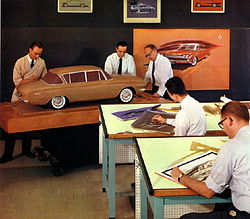
An example of full scale clay modeling (left) and completed automobile (right).

Clay modeling (or clay model making) for automobile prototypes was first introduced in the 1930s by automobile designer Harley Earl, head of the General Motors styling studio (known initially as the Art and Color Section, and later as the Design and Styling Department).[1]

Industrial plasticine, or "clay", which is used for this purpose, is a malleable material that can be easily shaped, thus enabling designers to create models to visualize a product. Clay modeling was soon adopted throughout the industry and remains in use today.[citation needed]

References

[edit]
[edit]
Revisions and contributorsEdit on WikipediaRead on Wikipedia
from Grokipedia
Clay modeling is a fundamental sculptural technique that involves shaping malleable clay into three-dimensional forms through additive processes, such as building up material with hands and tools, to create expressive artworks ranging from small figurines to large-scale installations.[1] This method leverages clay's plasticity, allowing artists to add, subtract, and refine shapes intuitively, often serving as a preliminary stage for works in more permanent materials like marble or bronze.[2] Widely practiced across cultures, clay modeling encompasses applications in fine art, ceramics, education, and even therapeutic practices, emphasizing its versatility and tactile appeal.[3] The history of clay modeling traces back to prehistoric eras, with evidence of fired clay figurines appearing as early as the Jōmon period in Japan around 14,000–400 BCE, where small humanoid and animal forms known as dogū were crafted for ritual purposes.[4] In Mesoamerica, Tlatilco culture produced ceramic figurines circa 1200–600 BCE, depicting stylized human figures that reflect social and spiritual roles.[5] By the Neolithic period in Europe and the Near East, anthropomorphic clay figures emerged around 7000–5000 BCE, often symbolizing fertility or protective magic, as seen in assemblages from sites like Ain Ghazal.[6] During the Renaissance and Baroque periods, European masters elevated clay modeling to a sophisticated preparatory art; Gian Lorenzo Bernini (1598–1680) created dynamic terracotta bozzetti—rapid sketches in clay—to plan his monumental sculptures, capturing movement through loose, gestural marks.[7] Similarly, Neoclassical sculptor Antonio Canova (1757–1822) used clay for bozzetti and refined modelli, building forms with fingers and tools like knives and chisels before translating them to marble.[8] Key techniques in clay modeling include hand-building methods such as coiling, slab construction, and pinching, often supported by armatures like wire frameworks to prevent collapse in larger works.[1] Artists select clay types based on scale and finish—grogged clay for durability in big pieces, finer porcelain paperclay for delicate details—then manipulate it through smearing, stabbing, scraping, and rolling to achieve texture and proportion.[8] Once modeled, pieces may be air-dried, kiln-fired into terracotta for permanence, or cast in plaster as intermediates for final carving, a process that demands precise measurement and collaboration in studio settings.[2] In contemporary practice, clay modeling remains vital for its immediacy and accessibility, influencing ceramic sculpture, stop-motion animation, and industrial design while adapting to modern innovations like digital scanning for hybrid workflows.[9] Its therapeutic value also persists, as the tactile engagement with clay supports emotional expression and developmental growth in art therapy contexts.[3]

History

Origins and early uses

The earliest evidence of clay modeling dates to the Upper Paleolithic period in Europe, where fired clay figurines represent some of the first known attempts at three-dimensional human representation. One of the most prominent examples is the Venus of Dolní Věstonice, a small statuette discovered in the Czech Republic and dated to approximately 29,000–25,000 BCE, crafted from clay mixed with bone ash and subjected to low-temperature firing in open hearths.[10] This artifact, along with similar fragments from the same Gravettian site, demonstrates early experimentation with clay's moldable properties to create symbolic female forms, likely for ritual or fertility purposes.[11] In East Asia, the Jōmon period in Japan (ca. 14,000–400 BCE) produced small humanoid and animal clay figurines known as dogū, often fired and used in ritual contexts.[4] These abstract forms, featuring exaggerated features, highlight early cultural uses of clay for spiritual expression. By the Neolithic period in the Near East, anthropomorphic clay figures emerged around 7000–5000 BCE at sites like Ain Ghazal in Jordan, symbolizing fertility or protective magic through stylized human representations.[6] By around 3000 BCE, clay modeling had evolved into more structured practices in ancient Mesopotamia and Egypt, serving both utilitarian and ceremonial functions. In Mesopotamia, during the Uruk period and early third millennium BCE, terracotta figurines depicting deities, animals, and humans were produced as votive offerings and ritual objects, often placed in temples or households to invoke protection or fertility; examples include small nude female figures symbolizing mother goddesses found at sites like Tell Asmar.[12] In contemporary Egypt, during the Predynastic and Early Dynastic periods (circa 4000–3000 BCE), clay was used to model anthropomorphic figurines for burial contexts, as well as prototypes for pottery vessels and small-scale architectural representations in funerary settings, reflecting clay's role in preparing for the afterlife and testing forms before permanent stone or metalwork. These applications highlight clay's accessibility and pliability, enabling widespread adoption across social strata for prototyping and symbolic expression.[13] In Mesoamerica, the Tlatilco culture produced ceramic figurines circa 1200–600 BCE, depicting stylized human figures that reflect social and spiritual roles.[5] In Greek and Roman antiquity, from approximately 500 BCE to 500 CE, clay modeling advanced in artistic and performative contexts, producing detailed terracotta votive figures and anatomical studies. Greek artisans created terracotta ex-votos, such as body-part models offered at healing sanctuaries like the Asklepieion at Corinth, to represent afflicted areas and petition divine intervention; these ranged from eyes and limbs to full torsos, showcasing precise modeling techniques for realistic proportions.[14] Roman adaptations included similar anatomical terracottas and theatrical masks molded in clay for use in plays or as funerary offerings, with examples from sites like Pompeii illustrating stylized facial features for dramatic effect. Terracotta votive figures, often depicting worshippers or deities, were mass-produced in molds and dedicated at temples, underscoring clay's versatility in bridging everyday devotion and professional artistry.[15] Among indigenous cultures of the Americas, clay modeling predating European contact in the 15th–16th centuries CE involved hand-building techniques like coiling to form figurative pottery and standalone figures, particularly in the Southwest and Mississippi Valley regions. Pre-Columbian Native American potters, such as those of the Ancestral Puebloan and Mississippian traditions, used coil construction to create effigy vessels and anthropomorphic figurines depicting humans, animals, or spirits, often for ceremonial use in rituals or burials; notable examples include coiled clay figures from Hohokam sites in Arizona (circa 300–1500 CE) symbolizing community myths.[16] This method's reliance on clay's pliability facilitated organic shaping without wheels, allowing for intricate details in pre-contact artistic traditions that emphasized cultural narratives over utility. Throughout these early periods, clay's fundamental pliability served as a prerequisite for human experimentation in three-dimensional form-making, laying the groundwork for later refinements.

Renaissance to Enlightenment

During the Renaissance and Baroque periods, European artists elevated clay modeling as a preparatory technique for sculpture. Gian Lorenzo Bernini (1598–1680) created dynamic terracotta bozzetti—rapid sketches in clay—to plan his monumental sculptures, capturing movement through loose, gestural marks.[7] Similarly, in the Neoclassical era, Antonio Canova (1757–1822) used clay for bozzetti and refined modelli, building forms with fingers and tools like knives and chisels before translating them to marble.[8] These practices underscored clay's role in iterative design and anatomical study.

Modern developments

In the late 19th century, the Arts and Crafts movement sparked a revival of traditional handcraft techniques, emphasizing handmade processes over industrialization and extending to clay modeling in sculpture as a means to restore authenticity and expressiveness in artistic creation.[17] This period saw sculptors like Auguste Rodin increasingly rely on clay for preliminary models, marking a shift from earlier wax-based methods to clay's greater malleability for capturing dynamic human forms; for instance, in the 1880s, Rodin used clay extensively while developing major works such as The Gates of Hell, allowing for iterative refinements before casting in bronze or plaster.[18] Following World War II, advancements in synthetic materials transformed clay modeling by introducing polymer clays and non-firing options that maintained pliability without requiring kilns, thus broadening accessibility for detailed, durable work in both art and media.[19] The 1950s marked a notable rise in plasticine—a non-hardening modeling clay—as a staple for animation, exemplified by Art Clokey's Gumby series, which popularized its use for creating flexible, reusable characters in stop-motion television.[20] The 1960s further solidified claymation as a distinct animation genre, with early experiments by future studios like Aardman Animations—founded by Peter Lord and David Sproxton through late-1960s school projects—paving the way for innovative plasticine-based storytelling that gained prominence in the ensuing decades.[21][20] Entering the early 20th century, clay modeling integrated with emerging animation technologies, particularly stop-motion techniques pioneered by Willis H. O'Brien, who in the 1910s created innovative clay-modeled figures like dinosaurs for short films such as The Dinosaur and the Missing Link (1915), demonstrating clay's potential for lifelike movement through incremental posing.[22] This laid the groundwork for larger productions, including O'Brien's dinosaur models in the 1925 film The Lost World, where clay armatures enabled complex animations of prehistoric creatures integrated into live-action sequences.[22] By the late 20th century, digital technologies began hybridizing traditional clay modeling with computer-generated imagery, as seen in the 1990s production of Jurassic Park, where Industrial Light & Magic (ILM) employed 3D scanning to digitize clay maquettes crafted by Stan Winston Studio, such as the T. rex model, enabling seamless blends of physical models and CGI dinosaurs.[23]

Materials and tools

Types of clay

Clay modeling encompasses a variety of clays, each with distinct properties that influence their workability, durability, and suitability for different projects. Traditional ceramic clays require firing in a kiln to achieve permanence, while non-firing options like oil-based and polymer clays offer flexibility for sculpting without heat treatment beyond baking. Air-dry clays provide another convenient category, hardening through natural evaporation without any thermal process. These materials are selected based on factors such as plasticity, shrinkage, and firing requirements, allowing modelers to achieve everything from coarse forms to intricate details.[24] Natural earthenware clay is a low-fire option characterized by its porosity and reddish-brown color after firing, making it highly malleable and ideal for beginners due to its forgiving nature during molding. It remains soft and absorbent post-firing unless glazed, requiring temperatures of 900–1100°C for durability, though it can crack if not properly prepared. This clay's ease of use stems from its coarse particle size and high iron content, which contribute to its warm tone and lower vitrification point compared to other ceramics. Variants like grogged earthenware incorporate fired clay particles (grog) to reduce shrinkage, improve even drying, and add a textured "tooth" for sculptural work, particularly in larger pieces.[24][25][26][27] Stoneware clay, in contrast, is a mid-to-high-fire material that vitrifies into a strong, non-porous body, often appearing grayish before and after firing due to its mineral composition. It exhibits lower plasticity than earthenware but excels at retaining fine details, with firing temperatures ranging from 1100–1300°C that enhance its granite-like texture and mechanical strength. This makes it suitable for functional models that demand robustness without excessive fragility; grog additions are common in stoneware for sculpture to enhance stability.[28][24][27] Porcelain clay represents a high-fire category, prized for its white, translucent finish when fired, though it poses challenges in modeling owing to significant shrinkage—up to 15%—and reduced plasticity from its fine kaolin base. Firing occurs at 1200–1400°C to achieve full vitrification, resulting in a dense, impermeable surface ideal for precise prototypes where aesthetic purity is key. Its high refinement demands careful handling to mitigate warping during drying and firing. Paper clay variants, blending porcelain with cellulose fibers, offer lighter weight, greater crack resistance, and suitability for detailed, large-scale modeling while air-drying without firing.[29][26][30] Air-dry clays are water-based materials that harden at room temperature over 24–72 hours, depending on thickness and humidity, making them accessible for beginners and projects without access to kilns or ovens. They are lightweight and easy to paint but less durable than fired ceramics, often used for prototypes, crafts, and educational purposes. Examples include DAS modeling clay for smooth finishes and Crayola Model Magic for soft, colorful sculpting.[31] Oil-based clays, such as plasticine or Chavant formulations, provide non-drying, reusable alternatives that require no firing, maintaining flexibility indefinitely through their wax and oil binders. These clays are available in sulfur-free variants, like Chavant NSP, to prevent inhibition when used with platinum-cure silicones in mold making, and they can be softened with heat for detailed sculpting. Their non-hardening nature allows endless rework, though they may attract dust over time.[32][33] Polymer clays, exemplified by brands like Sculpey and Fimo, are synthetic, oven-bake materials that remain pliable when raw due to PVC and plasticizer content, hardening into a durable, lightweight form without a kiln. Baking occurs at low temperatures around 130°C for 15–30 minutes per ¼ inch of thickness, yielding vibrant colors and flexibility for jewelry or miniatures. Unlike traditional clays, they do not air-dry and can be conditioned by kneading to incorporate color evenly.[34] As of 2025, the modeling clay market has seen increased availability of eco-friendly options, such as plant-based or recycled-material formulations, emphasizing non-toxicity and sustainability for educational and artistic use. For instance, Crayola introduced eco-based non-toxic modeling clay in 2023, expanding to multiple countries.[35] Preparation of clays is essential to ensure workability and prevent defects; wedging involves kneading the clay against a surface to remove air bubbles and homogenize moisture, reducing the risk of explosions during firing. Slaking allows dried scraps to disintegrate in water for reuse, creating a slurry that can be sieved and reformed, while consistent moisture control—typically 20–25% water content—prevents cracking by avoiding rapid drying or overly wet states. These steps apply across clay types, with natural clays benefiting most from wedging on absorbent surfaces like plaster to regulate humidity.[36][37]

Essential tools and equipment

Clay modeling requires a range of essential tools and equipment to manipulate, support, and refine the material effectively, with selections often depending on the clay's plasticity and the project's scale. Basic hand tools facilitate initial shaping and detailing, while specialized items like armatures provide structural integrity, and workspace elements ensure consistent working conditions. Finishing and safety gear further enhance precision and protect the artist, underscoring the importance of quality materials compatible with various clay types such as oil-based or water-based formulations.[38][39] Hand tools form the foundation of clay work, enabling precise control over form and texture. Wooden ribs, typically made from hardwood like mahogany, are indispensable for smoothing and contouring surfaces by scraping away excess clay without gouging.[40] Wire-end tools, featuring sharpened wire loops at one or both ends, excel at cutting and slicing clay cleanly, ideal for separating pieces or creating incisions. Loop tools, with their adjustable wire loops of varying sizes, are used for hollowing out interiors or carving channels, preventing structural weaknesses in thicker sections. Material choices matter: steel tools suit firmer clays for durability and sharp edges, while rubber or silicone variants prevent tearing in softer, more pliable types.[41][38] For larger models, armatures provide internal support to bear the clay's weight and resist deformation during construction. These wire skeletons, often constructed from aluminum or galvanized steel, mimic the subject's anatomy to distribute load evenly and prevent collapse as the clay dries. Recommended wire gauges range from 12 to 16 for human-figure armatures, balancing flexibility for posing with sufficient rigidity for stability; thicker 12-gauge wire supports broader structures, while 14-16 gauge suffices for finer limbs. Armatures are typically wrapped with foil or mesh before clay application to create a textured base for adhesion.[42][43] A well-equipped workspace optimizes efficiency and clay consistency. Turntables, or lazy Susans, allow 360-degree rotation for even access to all sides of a model without repositioning. Modeling stands with adjustable heights and clamps secure armatures or bases at ergonomic levels, reducing strain during extended sessions. Maintaining a humidity-controlled environment, ideally 50-70% relative humidity, is crucial to preserve clay plasticity and prevent premature cracking; this can be achieved with humidifiers, sealed storage, or damp boxes.[44][45][46] Finishing tools refine the model's appearance and accuracy post-shaping. Sponges, both natural sea sponges and synthetic varieties, blend seams and apply water or slip for seamless surfaces. Needles or pin tools, often with fine metal points, incise details like textures or markings with minimal disturbance to surrounding clay. Calipers measure proportions precisely, transferring dimensions from references to ensure symmetry in features like facial structure or limb lengths.[47][48][49] Safety equipment mitigates health risks from clay particulates and additives. Dust masks, such as NIOSH-approved N95 respirators, are essential when handling dry clay or sanding to filter silica dust and prevent respiratory irritation. Gloves, preferably nitrile for oil-based clays or latex for water-based, protect skin from drying additives like glycerin or chemical hardeners that can cause dermatitis.[50][51][52] Proper tool maintenance extends usability and ensures clean work. After sessions with oil-based clays, tools should be wiped with a soft cloth and cleaned using solvents like mineral spirits to remove residues without corroding metal parts; water-based tools rinse easily under running water followed by drying to prevent rust. Regular sharpening of blades and oiling of wooden handles preserve functionality across projects.[53][54]

Techniques

Basic modeling methods

Basic modeling methods begin with the process of blocking out, where artists establish the rough overall form of the sculpture through either additive or subtractive approaches. In the additive method, clay is built up around an armature or core structure using simple geometric shapes such as spheres, cylinders, or blocks to approximate the desired mass and volume. This initial massing helps maintain structural integrity and allows for proportional planning before finer details are added. Subtractive techniques involve carving away excess clay from a larger lump once it reaches a firm but workable consistency, refining the basic contours while preserving the core form. These methods ensure the sculpture's stability from the outset, particularly for larger pieces where uneven weight distribution could lead to collapse. Once the basic form is blocked out, building techniques such as pinching, coiling, and slab construction are employed to construct hollow or solid elements. The pinch method is ideal for creating small, hollow forms like bowls, busts, or animal figures, starting with a ball of soft clay that is gradually thinned and shaped by inserting the thumb into the center and pinching the walls evenly between fingers and thumb while rotating the piece. This technique produces walls typically 0.5–1 cm thick, promoting even drying and reducing the risk of cracking in lightweight structures. The slab method involves rolling out clay into flat sheets of even thickness, usually 0.5–1 cm, using a rolling pin or slab roller on a canvas-covered surface to prevent sticking, then cutting the slabs with knives or templates and assembling them by scoring and slipping edges for secure joins, suitable for creating angular forms, tiles, or box-like structures.[39] For larger sculptures, the coil method involves rolling clay into rope-like coils about 1–2 cm in diameter, stacking them spirally or linearly onto the base, and joining each layer by scoring the contact surfaces with a tool to create shallow grooves, then applying slip—a liquid mixture of clay and water—to act as adhesive before compressing the seams.[39] These joins must be blended immediately to avoid weak points, allowing for the construction of robust, scalable forms up to several feet in height. Surface refinement follows construction to achieve a smooth, cohesive appearance and uniform thickness, essential for both aesthetic and structural reasons. Seams from coils or attachments are blended using fingers, sponges, or wooden ribs moistened with water to lift a thin slip that fills imperfections, ensuring walls maintain an even thickness of 1–2 cm to support weight without sagging or cracking during drying.[55] For figurative sculptures, proportions are established early using guidelines like grids or calipers to measure key ratios, such as the adult human figure's head-to-body proportion of approximately 1:8 (eight heads tall), which aids in achieving balanced anatomy and realistic scale. As the clay model progresses, managing drying stages is crucial to prevent warping or fractures. The leather-hard stage, where the clay is firm yet still slightly damp to the touch, is optimal for carving details or making adjustments, as it holds shape while allowing tool work without crumbling.[56] Bone-dry clay, fully dehydrated and pale in color, precedes firing but is brittle and unsuitable for manipulation. To promote even drying and minimize stress cracks, especially in thicker sections, the piece should be loosely covered with plastic sheeting, such as dry-cleaner bags, to retain humidity and slow the process over several days.[57]

Advanced shaping and finishing

Advanced shaping and finishing in clay modeling involve refined techniques to add surface detail, create durable replicas, harden the material, and maintain structural integrity, often applied after initial form-building to achieve professional results. These methods enhance the aesthetic and functional qualities of models, particularly in sculptural or prototyping contexts where realism and longevity are essential. Texturing techniques provide depth and realism to clay surfaces by manipulating texture through impression or incision. Artists impress patterns using stamps carved from bisque-fired clay rods or linoleum blocks, which are rolled or pressed into wet clay to create repeating motifs like geometric designs or organic forms.[58] Rolling fabrics such as burlap or lace over slabs transfers intricate weaves, adding subtle roughness suitable for environmental details.[59] Incising lines with fine tools, including cross-hatching to simulate skin folds, builds tonal variation and three-dimensionality, especially effective for figurative realism where overlapping strokes mimic natural creases.[60] Mold-making from finished clay models enables the production of multiple casts without repeated sculpting, using flexible materials like alginate for quick impressions or silicone for durable, detailed reproductions. The process begins by applying a release agent, such as petroleum jelly, to the model to prevent adhesion, followed by pouring the alginate or silicone over the surface and allowing it to cure.[61] Once demolded, the negative mold captures fine details and can be filled with resin, plaster, or additional clay to yield identical copies, ideal for prototyping or editioning.[62] For ceramic clays, firing and glazing transform fragile models into permanent works through controlled heat treatment. Bisque firing, the initial low-heat stage at 900–1000°C, drives out moisture and organics, creating a porous bisqueware that accepts glaze without bubbling.[63] Glaze, a glassy coating, is then applied by brushing, dipping, or spraying, followed by high-fire glazing up to 1300°C to fuse it into a vitreous surface.[64] During these stages, clay undergoes linear shrinkage of 10–15%, necessitating scale adjustments in initial modeling to account for dimensional changes.[65] Non-fired clays, particularly oil-based varieties like plastiline, require preservation methods to protect against dust and environmental degradation without altering their flexibility. Sealing with artist-grade varnish or beeswax creates a barrier that prevents surface contamination while maintaining pliability for potential rework.[66] Storage in airtight containers, such as sealed plastic bins kept in a cool, dry environment, minimizes oil migration and debris accumulation, ensuring long-term usability.[67] Troubleshooting common issues like cracks during drying or handling involves targeted repairs to restore integrity. Vinegar slips, made by mixing clay powder with white vinegar to form a thick, adhesive paste, effectively mend cracks in leather-hard or dry clay by reactivating particles for strong bonds.[68] Reinforcing with fiber additives, such as paper pulp blended into slip at a 1:1 ratio with clay, adds tensile strength to vulnerable areas, reducing future fracturing in larger models.[69]

Applications

In art and sculpture

Clay modeling has long served as a foundational technique in sculpture, particularly for creating preliminary maquettes or bozzetti that allow artists to explore form, proportion, and composition before committing to more permanent materials. These small-scale clay models, often rough and expressive, enable sculptors to refine ideas tactilely, capturing dynamic poses and anatomical details that inform larger works. For instance, Michelangelo Buonarroti employed clay bozzetti during the Renaissance to plan his monumental sculptures, including the David (1501–1504), where a 12-inch clay model guided the carving of the 18-foot marble figure, facilitating precise scaling and anatomical accuracy.[70][71] In fine art, clay's malleability supports the transition from initial sketches to final casts, most notably through the lost-wax casting process, where clay positives form the basis for durable bronze sculptures. Artists model in clay to create a detailed prototype, from which a wax layer is applied, encased in investment material, and melted out to leave a mold for molten bronze; this method, dating back millennia, preserves the clay's intricate textures while yielding enduring works like ancient Greek bronzes or modern editions.[72][73] The tactile responsiveness of clay—its ability to be pinched, smoothed, or incised—lends itself to conveying emotion in figurative sculpture, as seen in mid-20th-century works where initial clay explorations informed abstracted human forms, emphasizing tension and movement through subtle surface manipulations.[74] Contemporary sculptors continue to harness clay modeling for hyper-realistic expressions, often as a starting point for life-sized figures that evoke profound psychological depth. Australian-born artist Ron Mueck, for example, begins with clay maquettes to meticulously detail skin textures and poses before molding and casting in silicone or resin, as in his seminal work Dead Dad (1996–1997), a shrunken silicone figure of his deceased father that captures vulnerability and mortality with uncanny precision.[75] Such pieces highlight clay's role in bridging conceptual ideation and visceral realism, allowing artists to iterate on emotional narratives before final fabrication.[76] Clay models and sculptures hold significant place in gallery and museum contexts, preserving both preparatory studies and finished works that illustrate artistic processes. Institutions like the Victoria and Albert Museum maintain extensive collections of terracotta and unfired clay bozzetti, including 16th-century models by Giambologna, such as his River God (c. 1580), which demonstrate rapid clay assembly for outlining dynamic forms, and 17th-century terracotta sketches attributed to Gian Lorenzo Bernini, like Time and Death (c. 1638–1639), valued for their raw expressiveness.[77][78][79] These holdings underscore clay's enduring utility in art, from ephemeral sketches to fired ceramics that stand as independent sculptures.

In animation and film

Clay modeling has been integral to stop-motion animation since the early 20th century, where physical figures are sculpted from malleable clay or plasticine and incrementally adjusted to simulate movement. In this technique, animators create armatured puppets—internal wire skeletons providing structural support and allowing precise manipulation—typically featuring multiple ball-and-socket joints for flexibility in limbs, torso, and head to mimic natural poses.[80][81] Each subtle adjustment is photographed frame by frame, with sequences played back at 12 to 24 frames per second to produce fluid motion, though professional productions often target 24 frames for cinematic quality.[82][83] Iconic studios like Aardman Animations have elevated clay modeling in stop-motion through their use of plasticine for characters in the Wallace & Gromit series, beginning with A Grand Day Out in 1989. These puppets employ specialized rigging with ball-and-socket armatures to enable complex movements, such as Gromit's expressive facial animations and Wallace's inventive gestures, all crafted from non-hardening plasticine for easy reshaping during production.[84][81] Aardman's approach emphasizes handmade durability, with plasticine formulations selected for their pliability and color retention under studio lighting.[85] Modern applications often blend traditional clay modeling with digital enhancements, as seen in Laika's 2009 film Coraline, where hand-sculpted clay puppets were scanned using 3D photography to generate digital models for CGI integration, including facial expressions and environmental extensions.[86][87] This hybrid method allowed for seamless transitions between physical sets and computer-generated elements, such as the Other Mother's morphing face, while preserving the tactile authenticity of stop-motion.[88] Similarly, ParaNorman (2012) combined clay puppets with visual effects for rig removal, set extensions, and supernatural elements like ghosts, marking an evolution in VFX-assisted clay animation.[89][90] Producing clay stop-motion films presents challenges, particularly in maintaining lighting consistency across thousands of frames to avoid visible flicker, often addressed through digital monitoring of color temperature and intensity.[91] Set construction must match the puppets' scale—commonly 1:6 for human figures—to create immersive environments, using materials like foam, wood, and scaled props for stability during prolonged shoots.[92] These demands highlight the labor-intensive nature of the medium, evolving from early silent-era experiments in the 1910s, such as rudimentary clay figure shorts, to sophisticated hybrids today.[93]

In design and prototyping

Clay modeling plays a pivotal role in automotive design, where full-scale models are constructed over foam bucks to prototype car bodies. This technique, pioneered by Harley Earl at General Motors in the 1930s, involves milling rough shapes from foam armatures and then hand-refining them with layers of industrial clay for precise contouring.[94][95] Widely adopted across the industry, including by Ford, these models allow designers to evaluate aerodynamics, proportions, and aesthetics before committing to digital or metal tooling.[96] In product prototyping for consumer goods, clay modeling facilitates rapid ideation and ergonomic testing by enabling designers to sculpt tangible forms that mimic final product handling. This approach is particularly valuable for complex curves and human-scale interactions, where physical manipulation reveals usability issues more intuitively than sketches or CAD renders.[97] Educational applications of clay modeling emphasize tactile learning to teach three-dimensional visualization, a practice rooted in early 20th-century curricula. Maria Montessori incorporated clay work in her methods from the 1900s onward, using it to develop fine motor skills and spatial awareness through self-directed manipulation of forms.[98] In modern classrooms, this extends to engineering and design programs, where students build models to grasp concepts like volume and symmetry, fostering conceptual understanding over rote memorization.[99] The forgiving nature of clay supports ergonomics and rapid iteration in prototyping, as it allows easy additions, subtractions, or reshaping without permanent damage, accelerating design cycles. Once refined, these physical models are often digitized through 3D scanning to create accurate CAD files for further simulation and manufacturing.[100] This hybrid workflow bridges analog intuition with digital precision, reducing time to prototype validation while maintaining focus on user-centered adjustments.[101] Precision tools, like calipers and surfacing blades, aid in achieving consistent tolerances during these processes.[102]

Notable practitioners and works

Key artists and sculptors

Auguste Rodin (1840–1917) revolutionized clay modeling by pioneering expressive clay sketches that captured the immediacy of human emotion and movement, often leaving surfaces textured with fingerprints to convey vitality and the artist's direct touch.[103] His 1880 clay model for The Thinker, originally conceived as part of The Gates of Hell, exemplified this approach, emphasizing raw, unfinished forms over polished completion to evoke psychological depth.[104] Rodin's "non-finito" technique, which preserved the clay's primal, incomplete state, influenced modern sculpture by prioritizing authenticity and process over idealized finish, as seen in his terracotta and plaster works where tool marks and organic textures remained visible.[105] Camille Claudel (1864–1943) emerged as a pioneering female sculptor in the late 19th century, overcoming significant gender barriers in a male-dominated field that restricted women's access to life models and professional recognition.[106] Beginning as Auguste Rodin's student in 1884, she developed her own distinctive sculptural modeling style, focusing on dynamic, sensual forms in clay that explored themes of intimacy and motion.[107] Her The Waltz (series begun in the 1880s), modeled in clay and later cast in bronze, depicts an embracing couple in fluid, twisting poses, showcasing her innovative use of drapery and anatomy to suggest emotional entanglement and breaking free from conventional gender roles in art.[108] Ron Mueck (b. 1958) has advanced hyperrealistic clay modeling through meticulous, life-sized (and larger) figures that blend technical precision with emotional intensity, starting with detailed clay maquettes to achieve uncanny realism.[109] In his 1999 sculpture Boy, begun as a 40 cm clay maquette and scaled to nearly 5 meters tall using mixed media like silicone, fiberglass, and human hair, Mueck captured the vulnerability of a crouching child with hyper-detailed skin textures and proportions that distort scale for psychological impact.[109] This work exemplifies his contribution to contemporary sculpture, where clay's malleability allows for probing explorations of human fragility beyond mere imitation.[76] Yinka Shonibare (b. 1962), a British-Nigerian artist, incorporates clay modeling in multimedia installations exploring postcolonial themes, such as his 2010 series Nelson's Ship in a Bottle, where clay elements simulate historical rigging and forms to critique empire and identity.[110] Nick Park (b. 1958), a key figure at Aardman Animations since joining in 1985, innovated clay puppet design for stop-motion animation, creating durable yet expressive plasticine figures that retain visible fingerprints for added character and tactility.[111] He introduced Shaun the Sheep in 1995's A Close Shave, a Wallace & Gromit short, where the character's simple, woolly clay form and articulated limbs advanced puppetry techniques for fluid, humorous movement in animation.[112] Park's designs emphasized modular construction and material flexibility, enabling complex narratives while preserving the handmade authenticity of clay modeling in film.[111]

Iconic examples in media

One landmark in clay modeling's application to animation is the 1993 short film The Wrong Trousers from the Wallace & Gromit series, produced by Aardman Animations. The film utilized plasticine models for its characters, including Wallace and Gromit, allowing animators to manipulate subtle expressions through the malleable material's tactile properties, such as thumbprints and marks that emphasized the handmade aesthetic.[113][114] To facilitate complex actions like the iconic train chase sequence, production techniques incorporated replacement animation with interchangeable mouth shapes and other parts on the puppets, enabling precise control over movements in stop-motion sequences.[115] The film won the Academy Award for Best Animated Short Film in 1994, highlighting clay modeling's effectiveness in creating engaging, character-driven narratives.[116] An industrial application of clay modeling appears in mid-20th-century automotive design, where full-scale clay prototypes were refined for aerodynamics. Designers sculpted and iteratively modified clay models to test airflow and shape, directly shaping production vehicles.[117] Laika Studios' Coraline (2009) blended traditional clay modeling with modern technology in its stop-motion production, creating puppets from sculpted clay originals that served as bases for 3D-printed replacement faces. Over 6,300 unique facial expressions were produced via 3D printing from these clay sculpts, allowing animators to swap parts for nuanced emotions across the film's 100-minute runtime and enabling more than 207,000 possible combinations for character animation.[88][118][119] These projects illustrate clay modeling's enduring impact in media, popularizing the technique through innovative adaptations and large-scale productions; for instance, the Wallace & Gromit feature The Curse of the Were-Rabbit (2005) required 43 Gromit puppets and 35 Wallace models, alongside 2.8 tonnes of plasticine, to generate footage at three seconds per day.[120]

References

User Avatar
No comments yet.