


Community hub
Recent from talks
Contribute something
Nothing was collected or created yet.
Assembly language
View on Wikipedia
| Assembly language | |
|---|---|
 | |
| Paradigm | Imperative, unstructured, often metaprogramming (through macros), certain assemblers are structured or object-oriented |
| First appeared | 1947 |
| Typing discipline | None |
| Filename extensions | .asm, .s, .S, .inc, .wla, .SRC as well as several others depending on the assembler |
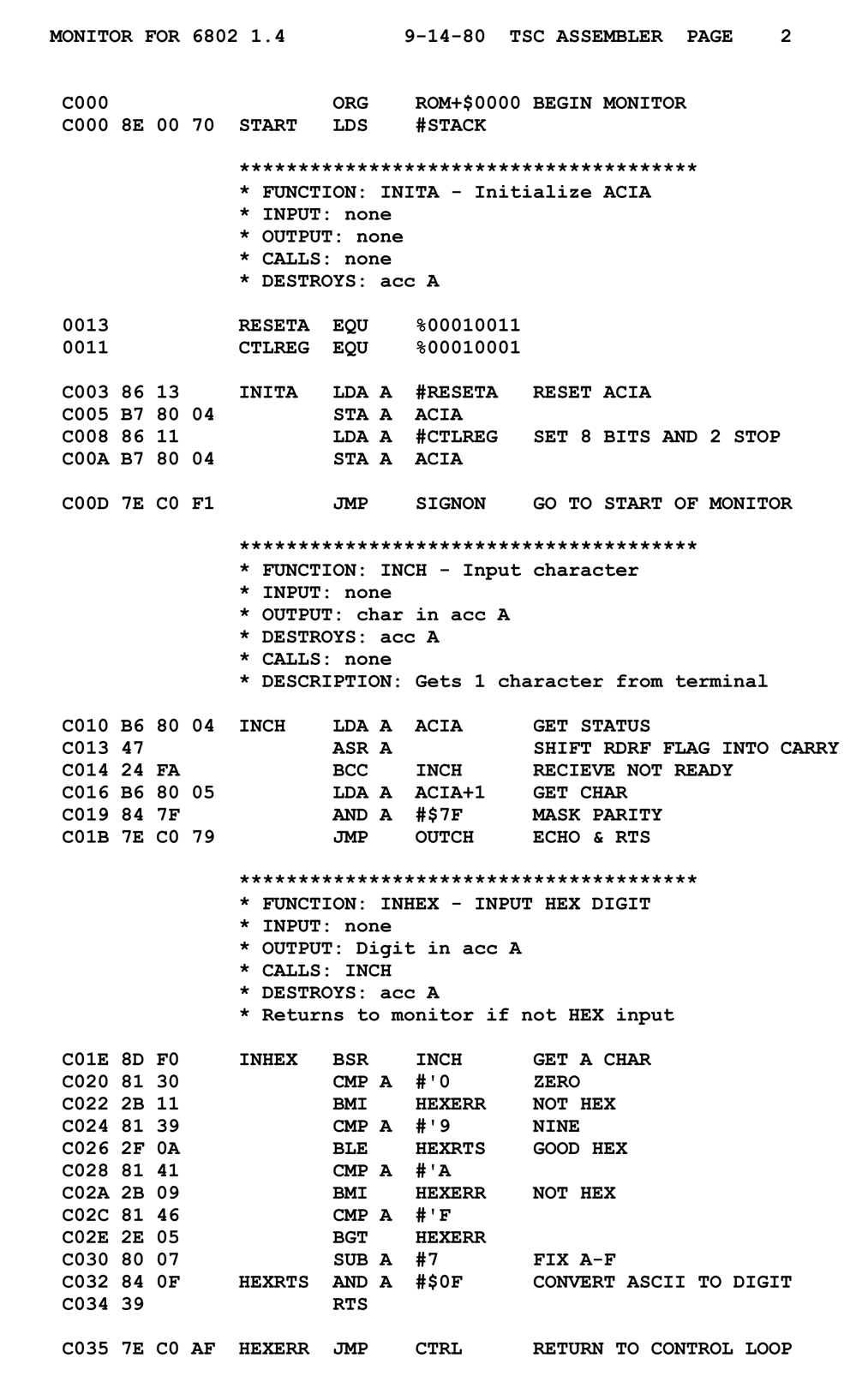
In computing, assembly language (alternatively assembler language[1] or symbolic machine code),[2][3][4] often referred to simply as assembly and commonly abbreviated as ASM or asm, is any low-level programming language with a very strong correspondence between the instructions in the language and the architecture's machine code instructions.[5] Assembly language usually has one statement per machine code instruction (1:1), but constants, comments, assembler directives,[6] symbolic labels of, e.g., memory locations, registers, and macros[7][1] are generally also supported.
The first assembly code in which a language is used to represent machine code instructions is found in Kathleen and Andrew Donald Booth's 1947 work, Coding for A.R.C..[8] Assembly code is converted into executable machine code by a utility program referred to as an assembler. The term "assembler" is generally attributed to Wilkes, Wheeler and Gill in their 1951 book The Preparation of Programs for an Electronic Digital Computer,[9] who, however, used the term to mean "a program that assembles another program consisting of several sections into a single program".[10] The conversion process is referred to as assembly, as in assembling the source code. The computational step when an assembler is processing a program is called assembly time.
Because assembly depends on the machine code instructions, each assembly language[nb 1] is specific to a particular computer architecture such as x86 or ARM.[11][12][13]
Sometimes there is more than one assembler for the same architecture, and sometimes an assembler is specific to an operating system or to particular operating systems. Most assembly languages do not provide specific syntax for operating system calls, and most assembly languages can be used universally with any operating system,[nb 2] as the language provides access to all the real capabilities of the processor, upon which all system call mechanisms ultimately rest. In contrast to assembly languages, most high-level programming languages are generally portable across multiple architectures but require interpreting or compiling, much more complicated tasks than assembling.
In the first decades of computing, it was commonplace for both systems programming and application programming to take place entirely in assembly language. While still irreplaceable for some purposes, the majority of programming is now conducted in higher-level interpreted and compiled languages. In "No Silver Bullet", Fred Brooks summarised the effects of the switch away from assembly language programming: "Surely the most powerful stroke for software productivity, reliability, and simplicity has been the progressive use of high-level languages for programming. Most observers credit that development with at least a factor of five in productivity, and with concomitant gains in reliability, simplicity, and comprehensibility."[14]
Today, it is typical to use small amounts of assembly language code within larger systems implemented in a higher-level language, for performance reasons or to interact directly with hardware in ways unsupported by the higher-level language. For instance, just under 2% of version 4.9 of the Linux kernel source code is written in assembly; more than 97% is written in C.[15]
Assembly language syntax
[edit]Assembly language uses a mnemonic to represent, e.g., each low-level machine instruction or opcode, each directive, typically also each architectural register, flag, etc. Some of the mnemonics may be built-in and some user-defined. Many operations require one or more operands in order to form a complete instruction. Most assemblers permit named constants, registers, and labels for program and memory locations, and can calculate expressions for operands. Thus, programmers are freed from tedious repetitive calculations and assembler programs are much more readable than machine code. Depending on the architecture, these elements may also be combined for specific instructions or addressing modes using offsets or other data as well as fixed addresses. Many assemblers offer additional mechanisms to facilitate program development, to control the assembly process, and to aid debugging.
Some are column oriented, with specific fields in specific columns; this was very common for machines using punched cards in the 1950s and early 1960s. Some assemblers have free-form syntax, with fields separated by delimiters, e.g., punctuation, white space. Some assemblers are hybrid, with, e.g., labels, in a specific column and other fields separated by delimiters; this became more common than column-oriented syntax in the 1960s.
Terminology
[edit]- A macro assembler is an assembler that includes a macroinstruction facility so that (parameterized) assembly language text can be represented by a name, and that name can be used to insert the expanded text into other code.
- Open code refers to any assembler input outside of a macro definition.
- A cross assembler (see also cross compiler) is an assembler that is run on a computer or operating system (the host system) of a different type from the system on which the resulting code is to run (the target system). Cross-assembling facilitates the development of programs for systems that do not have the resources to support software development, such as an embedded system or a microcontroller. In such a case, the resulting object code must be transferred to the target system, via read-only memory (ROM, EPROM, etc.), a programmer (when the read-only memory is integrated in the device, as in microcontrollers), or a data link using either an exact bit-by-bit copy of the object code or a text-based representation of that code (such as Intel hex or Motorola S-record).
- A high-level assembler is a program that provides language abstractions more often associated with high-level languages, such as advanced control structures (IF/THEN/ELSE, DO CASE, etc.) and high-level abstract data types, including structures/records, unions, classes, and sets.
- A microassembler is a program that helps prepare a microprogram to control the low level operation of a computer.
- A meta-assembler is "a program that accepts the syntactic and semantic description of an assembly language, and generates an assembler for that language",[16] or that accepts an assembler source file along with such a description and assembles the source file in accordance with that description. "Meta-Symbol" assemblers for the SDS 9 Series and SDS Sigma series of computers are meta-assemblers.[17] Sperry Univac also provided a Meta-Assembler for the UNIVAC 1100/2200 series.[18]
- inline assembler (or embedded assembler) is assembler code contained within a high-level language program.[19] This is most often used in systems programs which need direct access to the hardware.
Key concepts
[edit]Assembler
[edit]An assembler program creates object code by translating combinations of mnemonics and syntax for operations and addressing modes into their numerical equivalents. This representation typically includes an operation code ("opcode") as well as other control bits and data. The assembler also calculates constant expressions and resolves symbolic names for memory locations and other entities.[20] The use of symbolic references is a key feature of assemblers, saving tedious calculations and manual address updates after program modifications. Most assemblers also include macro facilities for performing textual substitution – e.g., to generate common short sequences of instructions as inline, instead of called subroutines.
Some assemblers may also be able to perform some simple types of instruction set-specific optimizations. One concrete example of this may be the ubiquitous x86 assemblers from various vendors. Called jump-sizing,[20] most of them are able to perform jump-instruction replacements (long jumps replaced by short or relative jumps) in any number of passes, on request. Others may even do simple rearrangement or insertion of instructions, such as some assemblers for RISC architectures that can help optimize a sensible instruction scheduling to exploit the CPU pipeline as efficiently as possible.[21]
Assemblers have been available since the 1950s, as the first step above machine language and before high-level programming languages such as Fortran, Algol, COBOL and Lisp. There have also been several classes of translators and semi-automatic code generators with properties similar to both assembly and high-level languages, with Speedcode as perhaps one of the better-known examples.
There may be several assemblers with different syntax for a particular CPU or instruction set architecture. For instance, an instruction to add memory data to a register in a x86-family processor might be add eax,[ebx], in original Intel syntax, whereas this would be written addl (%ebx),%eax in the AT&T syntax used by the GNU Assembler. Despite different appearances, different syntactic forms generally generate the same numeric machine code. A single assembler may also have different modes in order to support variations in syntactic forms as well as their exact semantic interpretations (such as FASM-syntax, TASM-syntax, ideal mode, etc., in the special case of x86 assembly programming).
Number of passes
[edit]There are two types of assemblers based on how many passes through the source are needed (how many times the assembler reads the source) to produce the object file.
- One-pass assemblers process the source code once. For symbols used before they are defined, the assembler will emit "errata" after the eventual definition, telling the linker or the loader to patch the locations where the as yet undefined symbols had been used.
- Multi-pass assemblers create a table with all symbols and their values in the first passes, then use the table in later passes to generate code.
In both cases, the assembler must be able to determine the size of each instruction on the initial passes in order to calculate the addresses of subsequent symbols. This means that if the size of an operation referring to an operand defined later depends on the type or distance of the operand, the assembler will make a pessimistic estimate when first encountering the operation, and if necessary, pad it with one or more "no-operation" instructions in a later pass or the errata. In an assembler with peephole optimization, addresses may be recalculated between passes to allow replacing pessimistic code with code tailored to the exact distance from the target.
The original reason for the use of one-pass assemblers was memory size and speed of assembly – often a second pass would require storing the symbol table in memory (to handle forward references), rewinding and rereading the program source on tape, or rereading a deck of cards or punched paper tape. Later computers with much larger memories (especially disc storage), had the space to perform all necessary processing without such re-reading. The advantage of the multi-pass assembler is that the absence of errata makes the linking process (or the program load if the assembler directly produces executable code) faster.[22]
Example: in the following code snippet, a one-pass assembler would be able to determine the address of the backward reference BKWD when assembling statement S2, but would not be able to determine the address of the forward reference FWD when assembling the branch statement S1; indeed, FWD may be undefined. A two-pass assembler would determine both addresses in pass 1, so they would be known when generating code in pass 2.
S1   B    FWD
  ...
FWD   EQU *
  ...
BKWD  EQU *
  ...
S2    B   BKWD
High-level assemblers
[edit]More sophisticated high-level assemblers provide language abstractions such as:
- High-level procedure/function declarations and invocations
- Advanced control structures (IF/THEN/ELSE, SWITCH)
- High-level abstract data types, including structures/records, unions, classes, and sets
- Sophisticated macro processing (although available on ordinary assemblers since the late 1950s for, e.g., the IBM 700 series and IBM 7000 series, and since the 1960s for IBM System/360 (S/360), amongst other machines)
- Object-oriented programming features such as classes, objects, abstraction, polymorphism, and inheritance[23]
See Language design below for more details.
Assembly language
[edit]A program written in assembly language consists of a series of mnemonic processor instructions and meta-statements (known variously as declarative operations, directives, pseudo-instructions, pseudo-operations and pseudo-ops), comments and data. Assembly language instructions usually consist of an opcode mnemonic followed by an operand, which might be a list of data, arguments or parameters.[24] Some instructions may be "implied", which means the data upon which the instruction operates is implicitly defined by the instruction itself—such an instruction does not take an operand. The resulting statement is translated by an assembler into machine language instructions that can be loaded into memory and executed.
For example, the instruction below tells an x86/IA-32 processor to move an immediate 8-bit value into a register. The binary code for this instruction is 10110 followed by a 3-bit identifier for which register to use. The identifier for the AL register is 000, so the following machine code loads the AL register with the data 01100001.[24]
10110000 01100001
This binary computer code can be made more human-readable by expressing it in hexadecimal as follows.
B0 61
Here, B0 means "Move a copy of the following value into AL", and 61 is a hexadecimal representation of the value 01100001, which is 97 in decimal. Assembly language for the 8086 family provides the mnemonic MOV (an abbreviation of move) for instructions such as this, so the machine code above can be written as follows in assembly language, complete with an explanatory comment if required, after the semicolon. This is much easier to read and to remember.
MOV AL, 61h ; Load AL with 97 decimal (61 hex)
In some assembly languages (including this one) the same mnemonic, such as MOV, may be used for a family of related instructions for loading, copying and moving data, whether these are immediate values, values in registers, or memory locations pointed to by values in registers or by immediate (a.k.a. direct) addresses. Other assemblers may use separate opcode mnemonics such as L for "move memory to register", ST for "move register to memory", LR for "move register to register", MVI for "move immediate operand to memory", etc.
If the same mnemonic is used for different instructions, that means that the mnemonic corresponds to several different binary instruction codes, excluding data (e.g. the 61h in this example), depending on the operands that follow the mnemonic. For example, for the x86/IA-32 CPUs, the Intel assembly language syntax MOV AL, AH represents an instruction that moves the contents of register AH into register AL. The[nb 3] hexadecimal form of this instruction is:
88 E0
The first byte, 88h, identifies a move between a byte-sized register and either another register or memory, and the second byte, E0h, is encoded (with three bit-fields) to specify that both operands are registers, the source is AH, and the destination is AL.
In a case like this where the same mnemonic can represent more than one binary instruction, the assembler determines which instruction to generate by examining the operands. In the first example, the operand 61h is a valid hexadecimal numeric constant and is not a valid register name, so only the B0 instruction can be applicable. In the second example, the operand AH is a valid register name and not a valid numeric constant (hexadecimal, decimal, octal, or binary), so only the 88 instruction can be applicable.
Assembly languages are always designed so that this sort of lack of ambiguity is universally enforced by their syntax. For example, in the Intel x86 assembly language, a hexadecimal constant must start with a numeral digit, so that the hexadecimal number 'A' (equal to decimal ten) would be written as 0Ah or 0AH, not AH, specifically so that it cannot appear to be the name of register AH. (The same rule also prevents ambiguity with the names of registers BH, CH, and DH, as well as with any user-defined symbol that ends with the letter H and otherwise contains only characters that are hexadecimal digits, such as the word "BEACH".)
Returning to the original example, while the x86 opcode 10110000 (B0) copies an 8-bit value into the AL register, 10110001 (B1) moves it into CL and 10110010 (B2) does so into DL. Assembly language examples for these follow.[24]
MOV AL, 1h        ; Load AL with immediate value 1
MOV CL, 2h        ; Load CL with immediate value 2
MOV DL, 3h        ; Load DL with immediate value 3
The syntax of MOV can also be more complex as the following examples show.[25]
MOV EAX, [EBX]	  ; Move the 4 bytes in memory at the address contained in EBX into EAX
MOV [ESI+EAX], CL ; Move the contents of CL into the byte at address ESI+EAX
MOV DS, DX        ; Move the contents of DX into segment register DS
In each case, the MOV mnemonic is translated directly into one of the opcodes 88-8C, 8E, A0-A3, B0-BF, C6 or C7 by an assembler, and the programmer normally does not have to know or remember which.[24]
Transforming assembly language into machine code is the job of an assembler, and the reverse can at least partially be achieved by a disassembler. Unlike high-level languages, there is a one-to-one correspondence between many simple assembly statements and machine language instructions. However, in some cases, an assembler may provide pseudoinstructions (essentially macros) which expand into several machine language instructions to provide commonly needed functionality. For example, for a machine that lacks a "branch if greater or equal" instruction, an assembler may provide a pseudoinstruction that expands to the machine's "set if less than" and "branch if zero (on the result of the set instruction)". Most full-featured assemblers also provide a rich macro language (discussed below) which is used by vendors and programmers to generate more complex code and data sequences. Since the information about pseudoinstructions and macros defined in the assembler environment is not present in the object program, a disassembler cannot reconstruct the macro and pseudoinstruction invocations but can only disassemble the actual machine instructions that the assembler generated from those abstract assembly-language entities. Likewise, since comments in the assembly language source file are ignored by the assembler and have no effect on the object code it generates, a disassembler is always completely unable to recover source comments.
Each computer architecture has its own machine language. Computers differ in the number and type of operations they support, in the different sizes and numbers of registers, and in the representations of data in storage. While most general-purpose computers are able to carry out essentially the same functionality, the ways they do so differ; the corresponding assembly languages reflect these differences.
Multiple sets of mnemonics or assembly-language syntax may exist for a single instruction set, typically instantiated in different assembler programs. In these cases, the most popular one is usually that supplied by the CPU manufacturer and used in its documentation.
Two examples of CPUs that have two different sets of mnemonics are the Intel 8080 family and the Intel 8086/8088. Because Intel claimed copyright on its assembly language mnemonics (on each page of their documentation published in the 1970s and early 1980s, at least), some companies that independently produced CPUs compatible with Intel instruction sets invented their own mnemonics. The Zilog Z80 CPU, an enhancement of the Intel 8080A, supports all the 8080A instructions plus many more; Zilog invented an entirely new assembly language, not only for the new instructions but also for all of the 8080A instructions. For example, where Intel uses the mnemonics MOV, MVI, LDA, STA, LXI, LDAX, STAX, LHLD, and SHLD for various data transfer instructions, the Z80 assembly language uses the mnemonic LD for all of them. A similar case is the NEC V20 and V30 CPUs, enhanced copies of the Intel 8086 and 8088, respectively. Like Zilog with the Z80, NEC invented new mnemonics for all of the 8086 and 8088 instructions, to avoid accusations of infringement of Intel's copyright. (It is questionable whether such copyrights can be valid, and later CPU companies such as AMD[nb 4] and Cyrix republished Intel's x86/IA-32 instruction mnemonics exactly with neither permission nor legal penalty.) It is doubtful whether in practice many people who programmed the V20 and V30 actually wrote in NEC's assembly language rather than Intel's; since any two assembly languages for the same instruction set architecture are isomorphic (somewhat like English and Pig Latin), there is no requirement to use a manufacturer's own published assembly language with that manufacturer's products.
"Hello, world!" on x86 Linux
[edit]In 32-bit assembly language for Linux on an x86 processor, "Hello, world!" can be printed like this.
section	.text
   global _start

_start:
   mov	edx,len     ; length of string, third argument to write()
   mov	ecx,msg     ; address of string, second argument to write()
   mov	ebx,1       ; file descriptor (standard output), first argument to write()
   mov	eax,4       ; system call number for write()
   int	0x80        ; system call trap

   mov	ebx,0       ; exit code, first argument to exit()
   mov	eax,1       ; system call number for exit()
   int	0x80        ; system call trap

section	.data
msg db 'Hello, world!', 0xa
len equ $ - msg
Language design
[edit]Basic elements
[edit]There is a large degree of diversity in the way the authors of assemblers categorize statements and in the nomenclature that they use. In particular, some describe anything other than a machine mnemonic or extended mnemonic as a pseudo-operation (pseudo-op). A typical assembly language consists of 3 types of instruction statements that are used to define program operations:
- Opcode mnemonics
- Data definitions
- Assembly directives
Opcode mnemonics and extended mnemonics
[edit]Instructions (statements) in assembly language are generally very simple, unlike those in high-level languages. Generally, a mnemonic is a symbolic name for a single executable machine language instruction (an opcode), and there is at least one opcode mnemonic defined for each machine language instruction. Each instruction typically consists of an operation or opcode plus zero or more operands. Most instructions refer to a single value or a pair of values. Operands can be immediate (value coded in the instruction itself), registers specified in the instruction or implied, or the addresses of data located elsewhere in storage. This is determined by the underlying processor architecture: the assembler merely reflects how this architecture works. Extended mnemonics are often used to specify a combination of an opcode with a specific operand, e.g., the System/360 assemblers use B as an extended mnemonic for BC with a mask of 15 and NOP ("NO OPeration" – do nothing for one step) for BC with a mask of 0.
Extended mnemonics are often used to support specialized uses of instructions, often for purposes not obvious from the instruction name. For example, many CPU's do not have an explicit NOP instruction, but do have instructions that can be used for the purpose. In 8086 CPUs the instruction xchg ax,ax is used for nop, with nop being a pseudo-opcode to encode the instruction xchg ax,ax. Some disassemblers recognize this and will decode the xchg ax,ax instruction as nop. Similarly, IBM assemblers for System/360 and System/370 use the extended mnemonics NOP and NOPR for BC and BCR with zero masks. For the SPARC architecture, these are known as synthetic instructions.[26]
Some assemblers also support simple built-in macro-instructions that generate two or more machine instructions. For instance, with some Z80 assemblers the instruction ld hl,bc is recognized to generate ld l,c followed by ld h,b.[27] These are sometimes known as pseudo-opcodes.
Mnemonics are arbitrary symbols; in 1985 the IEEE published Standard 694 for a uniform set of mnemonics to be used by all assemblers.[28] The standard has since been withdrawn.
Data directives
[edit]There are instructions used to define data elements to hold data and variables. They define the type of data, the length and the alignment of data. These instructions can also define whether the data is available to outside programs (programs assembled separately) or only to the program in which the data section is defined. Some assemblers classify these as pseudo-ops.
Assembly directives
[edit]Assembly directives, also called pseudo-opcodes, pseudo-operations or pseudo-ops, are commands given to an assembler "directing it to perform operations other than assembling instructions".[20] Directives affect how the assembler operates and "may affect the object code, the symbol table, the listing file, and the values of internal assembler parameters". Sometimes the term pseudo-opcode is reserved for directives that generate object code, such as those that generate data.[29]
The names of pseudo-ops often start with a dot to distinguish them from machine instructions. Pseudo-ops can make the assembly of the program dependent on parameters input by a programmer, so that one program can be assembled in different ways, perhaps for different applications. Or, a pseudo-op can be used to manipulate presentation of a program to make it easier to read and maintain. Another common use of pseudo-ops is to reserve storage areas for run-time data and optionally initialize their contents to known values.
Symbolic assemblers let programmers associate arbitrary names (labels or symbols) with memory locations and various constants. Usually, every constant and variable is given a name so instructions can reference those locations by name, thus promoting self-documenting code. In executable code, the name of each subroutine is associated with its entry point, so any calls to a subroutine can use its name. Inside subroutines, GOTO destinations are given labels. Some assemblers support local symbols which are often lexically distinct from normal symbols (e.g., the use of "10$" as a GOTO destination).
Some assemblers, such as NASM, provide flexible symbol management, letting programmers manage different namespaces, automatically calculate offsets within data structures, and assign labels that refer to literal values or the result of simple computations performed by the assembler. Labels can also be used to initialize constants and variables with relocatable addresses.
Assembly languages, like most other computer languages, allow comments to be added to program source code that will be ignored during assembly. Judicious commenting is essential in assembly language programs, as the meaning and purpose of a sequence of binary machine instructions can be difficult to determine. The "raw" (uncommented) assembly language generated by compilers or disassemblers is quite difficult to read when changes must be made.
Macros
[edit]Many assemblers support predefined macros, and others support programmer-defined (and repeatedly re-definable) macros involving sequences of text lines in which variables and constants are embedded. The macro definition is most commonly[nb 5] a mixture of assembler statements, e.g., directives, symbolic machine instructions, and templates for assembler statements. This sequence of text lines may include opcodes or directives. Once a macro has been defined its name may be used in place of a mnemonic. When the assembler processes such a statement, it replaces the statement with the text lines associated with that macro, then processes them as if they existed in the source code file (including, in some assemblers, expansion of any macros existing in the replacement text). Macros in this sense date to IBM autocoders of the 1950s.[30]
Macro assemblers typically have directives to, e.g., define macros, define variables, set variables to the result of an arithmetic, logical or string expression, iterate, conditionally generate code. Some of those directives may be restricted to use within a macro definition, e.g., MEXIT in HLASM, while others may be permitted within open code (outside macro definitions), e.g., AIF and COPY in HLASM.
In assembly language, the term "macro" represents a more comprehensive concept than it does in some other contexts, such as the pre-processor in the C programming language, where its #define directive typically is used to create short single line macros. Assembler macro instructions, like macros in PL/I and some other languages, can be lengthy "programs" by themselves, executed by interpretation by the assembler during assembly.
Since macros can have 'short' names but expand to several or indeed many lines of code, they can be used to make assembly language programs appear to be far shorter, requiring fewer lines of source code, as with higher level languages. They can also be used to add higher levels of structure to assembly programs, optionally introduce embedded debugging code via parameters and other similar features.
Macro assemblers often allow macros to take parameters. Some assemblers include quite sophisticated macro languages, incorporating such high-level language elements as optional parameters, symbolic variables, conditionals, string manipulation, and arithmetic operations, all usable during the execution of a given macro, and allowing macros to save context or exchange information. Thus a macro might generate numerous assembly language instructions or data definitions, based on the macro arguments. This could be used to generate record-style data structures or "unrolled" loops, for example, or could generate entire algorithms based on complex parameters. For instance, a "sort" macro could accept the specification of a complex sort key and generate code crafted for that specific key, not needing the run-time tests that would be required for a general procedure interpreting the specification. An organization using assembly language that has been heavily extended using such a macro suite can be considered to be working in a higher-level language since such programmers are not working with a computer's lowest-level conceptual elements. Underlining this point, macros were used to implement an early virtual machine in SNOBOL4 (1967), which was written in the SNOBOL Implementation Language (SIL), an assembly language for a virtual machine. The target machine would translate this to its native code using a macro assembler.[31] This allowed a high degree of portability for the time.
Macros were used to customize large scale software systems for specific customers in the mainframe era and were also used by customer personnel to satisfy their employers' needs by making specific versions of manufacturer operating systems. This was done, for example, by systems programmers working with IBM's Conversational Monitor System / Virtual Machine (VM/CMS) and with IBM's "real time transaction processing" add-ons, Customer Information Control System CICS, and ACP/TPF, the airline/financial system that began in the 1970s and still runs many large computer reservation systems (CRS) and credit card systems today.
It is also possible to use solely the macro processing abilities of an assembler to generate code written in completely different languages, for example, to generate a version of a program in COBOL using a pure macro assembler program containing lines of COBOL code inside assembly time operators instructing the assembler to generate arbitrary code. IBM OS/360 uses macros to perform system generation. The user specifies options by coding a series of assembler macros. Assembling these macros generates a job stream to build the system, including job control language and utility control statements.
This is because, as was realized in the 1960s, the concept of "macro processing" is independent of the concept of "assembly", the former being in modern terms more word processing, text processing, than generating object code. The concept of macro processing appeared, and appears, in the C programming language, which supports "preprocessor instructions" to set variables, and make conditional tests on their values. Unlike certain previous macro processors inside assemblers, the C preprocessor is not Turing-complete because it lacks the ability to either loop or "go to", the latter allowing programs to loop.
Despite the power of macro processing, it fell into disuse in many high level languages (major exceptions being C, C++ and PL/I) while remaining a perennial for assemblers.
Macro parameter substitution is strictly by name: at macro processing time, the value of a parameter is textually substituted for its name. The most famous class of bugs resulting was the use of a parameter that itself was an expression and not a simple name when the macro writer expected a name. In the macro:
foo: macro a
load a*b
the intention was that the caller would provide the name of a variable, and the "global" variable or constant b would be used to multiply "a". If foo is called with the parameter a-c, the macro expansion of load a-c*b occurs. To avoid any possible ambiguity, users of macro processors can parenthesize formal parameters inside macro definitions, or callers can parenthesize the input parameters.[32]
Support for structured programming
[edit]Packages of macros have been written providing structured programming elements to encode execution flow. The earliest example of this approach was in the Concept-14 macro set,[33] originally proposed by Harlan Mills (March 1970), and implemented by Marvin Kessler at IBM's Federal Systems Division, which provided IF/ELSE/ENDIF and similar control flow blocks for OS/360 assembler programs. This was a way to reduce or eliminate the use of GOTO operations in assembly code, one of the main factors causing spaghetti code in assembly language. This approach was widely accepted in the early 1980s (the latter days of large-scale assembly language use). IBM's High Level Assembler Toolkit[34] includes such a macro package.
Another design was A-Natural,[35] a "stream-oriented" assembler for 8080/Z80 processors from Whitesmiths Ltd. (developers of the Unix-like Idris operating system, and what was reported to be the first commercial C compiler). The language was classified as an assembler because it worked with raw machine elements such as opcodes, registers, and memory references; but it incorporated an expression syntax to indicate execution order. Parentheses and other special symbols, along with block-oriented structured programming constructs, controlled the sequence of the generated instructions. A-natural was built as the object language of a C compiler, rather than for hand-coding, but its logical syntax won some fans.
There has been little apparent demand for more sophisticated assemblers since the decline of large-scale assembly language development.[36] In spite of that, they are still being developed and applied in cases where resource constraints or peculiarities in the target system's architecture prevent the effective use of higher-level languages.[37]
Assemblers with a strong macro engine allow structured programming via macros, such as the switch macro provided with the Masm32 package (this code is a complete program):
include \masm32\include\masm32rt.inc	; use the Masm32 library

.code
demomain:
  REPEAT 20
	switch rv(nrandom, 9)	; generate a number between 0 and 8
	mov ecx, 7
	case 0
		print "case 0"
	case ecx				; in contrast to most other programming languages,
		print "case 7"		; the Masm32 switch allows "variable cases"
	case 1 .. 3
		.if eax==1
			print "case 1"
		.elseif eax==2
			print "case 2"
		.else
			print "cases 1 to 3: other"
		.endif
	case 4, 6, 8
		print "cases 4, 6 or 8"
	default
		mov ebx, 19		     ; print 20 stars
		.Repeat
			print "*"
			dec ebx
		.Until Sign?		 ; loop until the sign flag is set
	endsw
	print chr$(13, 10)
  ENDM
  exit
end demomain
Use of assembly language
[edit]When the stored-program computer was introduced, programs were written in machine code, and loaded into the computer from punched paper tape or toggled directly into memory from console switches.[citation needed] Kathleen Booth "is credited with inventing assembly language"[38][39] based on theoretical work she began in 1947, while working on the ARC2 at Birkbeck, University of London, following consultation by Andrew Booth (later her husband) with mathematician John von Neumann and physicist Herman Goldstine at the Institute for Advanced Study.[39][40]
In late 1948, the Electronic Delay Storage Automatic Calculator (EDSAC) had an assembler (named "initial orders") integrated into its bootstrap program. It used one-letter mnemonics developed by David Wheeler, who is credited by the IEEE Computer Society as the creator of the first "assembler".[20][41][42] Reports on the EDSAC introduced the term "assembly" for the process of combining fields into an instruction word.[43] SOAP (Symbolic Optimal Assembly Program) was an assembly language for the IBM 650 computer written by Stan Poley in 1955.[44]
Assembly languages eliminated much of the error-prone, tedious, and time-consuming first-generation programming needed with the earliest computers, freeing programmers from tedium such as remembering numeric codes and calculating addresses. They were once widely used for all sorts of programming. By the late 1950s their use had largely been supplanted by higher-level languages in the search for improved programming productivity.[45] Today, assembly language is still used for direct hardware manipulation, access to specialized processor instructions, or to address critical performance issues.[46] Typical uses are device drivers, low-level embedded systems, and real-time systems (see § Current usage).
Numerous programs were written entirely in assembly language. The Burroughs MCP (1961) was the first computer for which an operating system was not developed entirely in assembly language; it was written in Executive Systems Problem Oriented Language (ESPOL), an Algol dialect. Many commercial applications were written in assembly language as well, including a large amount of the IBM mainframe software developed by large corporations. COBOL, FORTRAN and some PL/I eventually displaced assembly language, although a number of large organizations retained assembly-language application infrastructures well into the 1990s.
Assembly language was the primary development language for 8-bit home computers such as the Apple II, Atari 8-bit computers, ZX Spectrum, and Commodore 64. Interpreted BASIC on these systems did not offer maximum execution speed and full use of facilities to take full advantage of the available hardware. Assembly language was the default choice for programming 8-bit consoles such as the Atari 2600 and Nintendo Entertainment System.
Key software for IBM PC compatibles such as MS-DOS, Turbo Pascal, and the Lotus 1-2-3 spreadsheet was written in assembly language. As computer speed grew exponentially, assembly language became a tool for speeding up parts of programs, such as the rendering of Doom, rather than a dominant development language. In the 1990s, assembly language was used to maximise performance from systems such as the Sega Saturn,[47] and as the primary language for arcade hardware using the TMS34010 integrated CPU/GPU such as Mortal Kombat and NBA Jam.
Current usage
[edit]There has been debate over the usefulness and performance of assembly language relative to high-level languages.[48]
Although assembly language has specific niche uses where it is important (see below), there are other tools for optimization.[49]
As of July 2017[update], the TIOBE index of programming language popularity ranks assembly language at 11, ahead of Visual Basic, for example.[50] Assembler can be used to optimize for speed or optimize for size. In the case of speed optimization, modern optimizing compilers are claimed[51] to render high-level languages into code that can run as fast as hand-written assembly, despite some counter-examples.[52][53][54] The complexity of modern processors and memory sub-systems makes effective optimization increasingly difficult for compilers and assembly programmers alike.[55][56] Increasing processor performance has meant that most CPUs sit idle most of the time,[57] with delays caused by predictable bottlenecks such as cache misses, I/O operations and paging, making raw code execution speed a non-issue for many programmers.
There are still certain computer programming domains in which the use of assembly programming is more common:
- Writing code for systems with older processors[clarification needed] that have limited high-level language options such as the Atari 2600, Commodore 64, and graphing calculators.[58] Programs for these computers of the 1970s and 1980s are often written in the context of demoscene or retrogaming subcultures.
- Code that must interact directly with the hardware, for example in device drivers and interrupt handlers.
- In an embedded processor or DSP, high-repetition interrupts require the shortest number of cycles per interrupt, such as an interrupt that occurs 1000 or 10000 times a second.
- Programs that need to use processor-specific instructions not implemented in a compiler. A common example is the bitwise rotation instruction at the core of many encryption algorithms, as well as querying the parity of a byte or the 4-bit carry of an addition.
- Stand-alone executables that are required to execute without recourse to the run-time components or libraries associated with a high-level language, such as the firmware for telephones, automobile fuel and ignition systems, air-conditioning control systems, and security systems.
- Programs with performance-sensitive inner loops, where assembly language provides optimization opportunities that are difficult to achieve in a high-level language. For example, linear algebra with BLAS[52][59] or discrete cosine transformation (e.g. SIMD assembly version from x264[60]).
- Programs that create vectorized functions for programs in higher-level languages such as C. In the higher-level language this is sometimes aided by compiler intrinsic functions which map directly to SIMD mnemonics, but nevertheless result in a one-to-one assembly conversion specific for the given vector processor.
- Real-time programs such as simulations, flight navigation systems, and medical equipment. For example, in a fly-by-wire system, telemetry must be interpreted and acted upon within strict time constraints. Such systems must eliminate sources of unpredictable delays, which may be created by interpreted languages, automatic garbage collection, paging operations, or preemptive multitasking. Choosing assembly or lower-level languages for such systems gives programmers greater visibility and control over processing details.
- Cryptographic algorithms that must always take strictly the same time to execute, preventing timing attacks.
- Video encoders and decoders such as rav1e (an encoder for AV1)[61] and dav1d (the reference decoder for AV1)[62] contain assembly to leverage AVX2 and ARM Neon instructions when available.
- Modify and extend legacy code written for IBM mainframe computers.[63][64]
- Situations where complete control over the environment is required, in extremely high-security situations where nothing can be taken for granted.
- Computer viruses, bootloaders, certain device drivers, or other items very close to the hardware or low-level operating system.
- Instruction set simulators for monitoring, tracing and debugging where additional overhead is kept to a minimum.
- Situations where no high-level language exists, on a new or specialized processor for which no cross compiler is available.
- Reverse engineering and modifying program files such as:
- existing binaries that may or may not have originally been written in a high-level language, for example when trying to recreate programs for which source code is not available or has been lost, or cracking copy protection of proprietary software.
- Video games (also termed ROM hacking), which is possible via several methods. The most widely employed method is altering program code at the assembly language level.
Assembly language is still taught in most computer science and electronic engineering programs. Although few programmers today regularly work with assembly language as a tool, the underlying concepts remain important. Such fundamental topics as binary arithmetic, memory allocation, stack processing, character set encoding, interrupt processing, and compiler design would be hard to study in detail without a grasp of how a computer operates at the hardware level. Since a computer's behaviour is fundamentally defined by its instruction set, the logical way to learn such concepts is to study an assembly language. Most modern computers have similar instruction sets. Therefore, studying a single assembly language is sufficient to learn the basic concepts, recognize situations where the use of assembly language might be appropriate, and to see how efficient executable code can be created from high-level languages.[23]
Typical applications
[edit]- Assembly language is typically used in a system's boot code, the low-level code that initializes and tests the system hardware prior to booting the operating system and is often stored in ROM. (BIOS on IBM-compatible PC systems and CP/M is an example.)
- Assembly language is often used for low-level code, for instance for operating system kernels, which cannot rely on the availability of pre-existing system calls and must indeed implement them for the particular processor architecture on which the system will be running.
- Some compilers translate high-level languages into assembly first before fully compiling, allowing the assembly code to be viewed for debugging and optimization purposes.
- Some compilers for relatively low-level languages, such as Pascal or C, allow the programmer to embed assembly language directly in the source code (so called inline assembly). Programs using such facilities can then construct abstractions using different assembly language on each hardware platform. The system's portable code can then use these processor-specific components through a uniform interface.
- Assembly language is useful in reverse engineering. Many programs are distributed only in machine code form which is straightforward to translate into assembly language by a disassembler, but more difficult to translate into a higher-level language through a decompiler. Tools such as the Interactive Disassembler make extensive use of disassembly for such a purpose. This technique is used by hackers to crack commercial software, and competitors to produce software with similar results from competing companies.
- Assembly language is used to enhance speed of execution, especially in early personal computers with limited processing power and RAM.
- Assemblers can be used to generate blocks of data, with no high-level language overhead, from formatted and commented source code, to be used by other code.[65][66]
See also
[edit]
- Compiler – Software that translates code from one programming language to another
- Comparison of assemblers
- Disassembler – Computer program to translate machine language into assembly language
- Hexadecimal – Base-16 numeric representation
- Information Processing Language – Early programming language for lists
- Instruction set architecture – Model that describes the programmable interface of a computer processor
- Little man computer – Instructional model of a computer
- Nibble – Four-bit unit of binary data
- Typed assembly language
Notes
[edit]- ^ Other than meta-assemblers
- ^ However, that does not mean that the assembler programs implementing those languages are universal.
- ^ This is one of two redundant forms of this instruction that operate identically. The 8086 and several other CPUs from the late 1970s/early 1980s have redundancies in their instruction sets, because it was simpler for engineers to design these CPUs (to fit on silicon chips of limited sizes) with the redundant codes than to eliminate them (see don't-care terms). Each assembler will typically generate only one of two or more redundant instruction encodings, but a disassembler will usually recognize any of them.
- ^ AMD manufactured second-source Intel 8086, 8088, and 80286 CPUs, and perhaps 8080A and 8085A CPUs, under license from Intel, but starting with the 80386, Intel refused to share their x86 CPU designs with anyone—AMD sued about this for breach of contract—and AMD designed, made, and sold 32-bit and 64-bit x86-family CPUs without Intel's help or endorsement.
- ^ In 7070 Autocoder, a macro definition is a 7070 macro generator program that the assembler calls; Autocoder provides special macros for macro generators to use.
References
[edit]- ^ a b "Assembler language". High Level Assembler for z/OS & z/VM & z/VSE Language Reference Version 1 Release 6. IBM. 2014 [1990]. SC26-4940-06.
- ^ "Assembly: Review" (PDF). Computer Science and Engineering. College of Engineering, Ohio State University. 2016. Archived (PDF) from the original on 2020-03-24. Retrieved 2020-03-24.
- ^ Archer, Benjamin (November 2016). Assembly Language For Students. North Charleston, South Carolina, US: CreateSpace Independent Publishing. ISBN 978-1-5403-7071-6.
Assembly language may also be called symbolic machine code.
- ^ Streib, James T. (2020). "Guide to Assembly Language". Undergraduate Topics in Computer Science. Cham: Springer International Publishing. doi:10.1007/978-3-030-35639-2. ISBN 978-3-030-35638-5. ISSN 1863-7310. S2CID 195930813.
Programming in assembly language has the same benefits as programming in machine language, except it is easier.
- ^ Saxon, James A.; Plette, William S. (1962). Programming the IBM 1401, a self-instructional programmed manual. Englewood Cliffs, New Jersey, US: Prentice-Hall. LCCN 62-20615. (NB. Use of the term assembly program.)
- ^ Kornelis, A. F. (2010) [2003]. "High Level Assembler – Opcodes overview, Assembler Directives". Archived from the original on 2020-03-24. Retrieved 2020-03-24.
- ^ "Macro instructions". High Level Assembler for z/OS & z/VM & z/VSE Language Reference Version 1 Release 6. IBM. 2014 [1990]. SC26-4940-06.
- ^ Booth, Andrew D; Britten, Kathleen HV (1947). Coding for A.R.C. (PDF). Institute for Advanced Study, Princeton. Retrieved 2022-11-04.
- ^ Wilkes, Maurice Vincent; Wheeler, David John; Gill, Stanley J. (1951). The preparation of programs for an electronic digital computer (Reprint 1982 ed.). Tomash Publishers. ISBN 978-0-93822803-5. OCLC 313593586.
{{cite book}}: ISBN / Date incompatibility (help) - ^ Fairhead, Harry (2017-11-16). "History of Computer Languages - The Classical Decade, 1950s". I Programmer. Archived from the original on 2020-01-02. Retrieved 2020-03-06.
- ^ "How do assembly languages depend on operating systems?". Stack Exchange. Stack Exchange Inc. 2011-07-28. Archived from the original on 2020-03-24. Retrieved 2020-03-24. (NB. System calls often vary, e.g. for MVS vs. VSE vs. VM/CMS; the binary/executable formats for different operating systems may also vary.)
- ^ Austerlitz, Howard (2003). "Computer Programming Languages". Data Acquisition Techniques Using PCs. Elsevier. pp. 326–360. doi:10.1016/b978-012068377-2/50013-9. ISBN 9780120683772.
Assembly language (or Assembler) is a compiled, low-level computer language. It is processor-dependent since it basically translates the Assembler's mnemonics directly into the commands a particular CPU understands, on a one-to-one basis. These Assembler mnemonics are the instruction set for that processor.
- ^ Carnes, Beau (2022-04-27). "Learn Assembly Language Programming with ARM". freeCodeCamp.org. Retrieved 2022-06-21.
Assembly language is often specific to a particular computer architecture so there are multiple types of assembly languages. ARM is an increasingly popular assembly language.
- ^ Brooks, Frederick P. (1986). "No Silver Bullet—Essence and Accident in Software Engineering". Proceedings of the IFIP Tenth World Computing Conference. pp. 1069–1076.
- ^ Anguiano, Ricardo. "linux kernel mainline 4.9 sloccount.txt". Gist. Retrieved 2022-05-04.
- ^ Daintith, John, ed. (2019). "meta-assembler". A Dictionary of Computing. Archived from the original on 2020-03-24. Retrieved 2020-03-24.
- ^ Xerox Data Systems (Oct 1975). Xerox Meta-Symbol Sigma 5-9 Computers Language and Operations Reference Manual (PDF). p. vi. Archived (PDF) from the original on 2022-10-09. Retrieved 2020-06-07.
Used as a meta-assembler, it enables the user to design his own programming languages and to generate processors for such languages with a minimum of effort.
- ^ Sperry Univac Computer Systems (1977). Sperry Univac Computer Systems Meta-Assembler (MASM) Programmer Reference (PDF). Archived (PDF) from the original on 2022-10-09. Retrieved 2020-06-07.
- ^ "How to Use Inline Assembly Language in C Code". gnu.org. Retrieved 2020-11-05.
- ^ a b c d Salomon, David (February 1993) [1992]. Written at California State University, Northridge, California, US. Chivers, Ian D. (ed.). Assemblers and Loaders (PDF). Ellis Horwood Series In Computers And Their Applications (1 ed.). Chicester, West Sussex, UK: Ellis Horwood Limited / Simon & Schuster International Group. pp. 7, 237–238. ISBN 0-13-052564-2. Archived (PDF) from the original on 2020-03-23. Retrieved 2008-10-01. (xiv+294+4 pages)
- ^ Finlayson, Ian; Davis, Brandon; Gavin, Peter; Uh, Gang-Ryung; Whalley, David; Själander, Magnus; Tyson, Gary (2013). "Improving processor efficiency by statically pipelining instructions". Proceedings of the 14th ACM SIGPLAN/SIGBED conference on Languages, compilers and tools for embedded systems. pp. 33–44. doi:10.1145/2465554.2465559. ISBN 9781450320856. S2CID 8015812.
- ^ Beck, Leland L. (1996). "2". System Software: An Introduction to Systems Programming. Addison Wesley.
- ^ a b Hyde, Randall (September 2003) [1996-09-30]. "Foreword ("Why would anyone learn this stuff?") / Chapter 12 – Classes and Objects". The Art of Assembly Language (2 ed.). No Starch Press. ISBN 1-886411-97-2. Archived from the original on 2010-05-06. Retrieved 2020-06-22. Errata: [1] (928 pages) [2][3]
- ^ a b c d Intel Architecture Software Developer's Manual, Volume 2: Instruction Set Reference (PDF). Vol. 2. Intel Corporation. 1999. Archived from the original (PDF) on 2009-06-11. Retrieved 2010-11-18.
- ^ Ferrari, Adam; Batson, Alan; Lack, Mike; Jones, Anita (2018-11-19) [Spring 2006]. Evans, David (ed.). "x86 Assembly Guide". Computer Science CS216: Program and Data Representation. University of Virginia. Archived from the original on 2020-03-24. Retrieved 2010-11-18.
- ^ "The SPARC Architecture Manual, Version 8" (PDF). SPARC International. 1992. Archived from the original (PDF) on 2011-12-10. Retrieved 2011-12-10.
- ^ Moxham, James (1996). "ZINT Z80 Interpreter". Z80 Op Codes for ZINT. Archived from the original on 2020-03-24. Retrieved 2013-07-21.
- ^ IEEE Std 694-1985: IEEE Standard for Microprocessor Assembly Language. IEEE Computer Society. 1985. ISBN 0-7381-2752-3. OCLC 1415906564.
- ^ Hyde, Randall. "Chapter 8. MASM: Directives & Pseudo-Opcodes" (PDF). The Art of Computer Programming. Archived (PDF) from the original on 2020-03-24. Retrieved 2011-03-19.
- ^ 1401 Autocoder System, Program #1401-AU-037, Version 3, Modification Level 11 (PDF). 1965-12-07. Retrieved 2024-01-21.
The following minor restriction or limitation is in effect with regard to the use of 1401 Autocoder when coding macro instructions ...
- ^ Griswold, Ralph E. (1972). "Chapter 1". The Macro Implementation of SNOBOL4. San Francisco, California, US: W. H. Freeman and Company. ISBN 0-7167-0447-1.
- ^ "Macros (C/C++), MSDN Library for Visual Studio 2008". Microsoft Corp. 2012-11-16. Archived from the original on 2020-03-24. Retrieved 2010-06-22.
- ^ Kessler, Marvin M. (1970-12-18). "*Concept* Report 14 - Implementation of Macros To Permit Structured Programming in OS/360". MVS Software: Concept 14 Macros. Gaithersburg, Maryland, US: International Business Machines Corporation. Archived from the original on 2020-03-24. Retrieved 2009-05-25.
- ^ "High Level Assembler Toolkit Feature Increases Programmer Productivity". Announcement Letters. IBM. 1995-12-12. A95-1432. Archived from the original on 2023-03-07.
- ^ Whitesmiths Ltd (1980-07-15). A-Natural Language Reference Manual.
- ^ "assembly language: Definition and Much More from Answers.com". answers.com. Archived from the original on 2009-06-08. Retrieved 2008-06-19.
- ^ Provinciano, Brian (2005-04-17). "NESHLA: The High Level, Open Source, 6502 Assembler for the Nintendo Entertainment System". Archived from the original on 2020-03-24. Retrieved 2020-03-24.
- ^ Dufresne, Steven (2018-08-21). "Kathleen Booth: Assembling Early Computers While Inventing Assembly". Archived from the original on 2020-03-24. Retrieved 2019-02-10.
- ^ a b Booth, Andrew Donald; Britten, Kathleen Hylda Valerie (September 1947) [August 1947]. General considerations in the design of an all purpose electronic digital computer (PDF) (2 ed.). The Institute for Advanced Study, Princeton, New Jersey, US: Birkbeck College, London. Archived (PDF) from the original on 2020-03-24. Retrieved 2019-02-10.
The non-original ideas, contained in the following text, have been derived from a number of sources, ... It is felt, however, that acknowledgement should be made to Prof. John von Neumann and to Dr. Herman Goldstein for many fruitful discussions ...
- ^ Campbell-Kelly, Martin (April 1982). "The Development of Computer Programming in Britain (1945 to 1955)". IEEE Annals of the History of Computing. 4 (2): 121–139. doi:10.1109/MAHC.1982.10016. S2CID 14861159.
- ^ Campbell-Kelly, Martin (1980). "Programming the EDSAC: Early Programming Activity at the University of Cambridge". IEEE Annals of the History of Computing. 2 (1): 7–36. doi:10.1109/MAHC.1980.10009.
- ^ "1985 Computer Pioneer Award 'For assembly language programming' David Wheeler". 2018-03-27.
- ^ Wilkes, Maurice Vincent (1949). "The EDSAC – an Electronic Calculating Machine". Journal of Scientific Instruments. 26 (12): 385–391. Bibcode:1949JScI...26..385W. doi:10.1088/0950-7671/26/12/301.
- ^ da Cruz, Frank (2019-05-17). "The IBM 650 Magnetic Drum Calculator". Computing History - A Chronology of Computing. Columbia University. Archived from the original on 2020-02-15. Retrieved 2012-01-17.
- ^ Abell, John C. "Oct. 15, 1956: Fortran Forever Changes Computing's Fortunes". Wired. ISSN 1059-1028. Retrieved 2024-03-02.
- ^ Collen, Morris F. (March–April 1994). "The Origins of Informatics". Journal of the American Medical Informatics Association. 1 (2): 96–97. doi:10.1136/jamia.1994.95236152. PMC 116189. PMID 7719803.
- ^ Pettus, Sam (2008-01-10). "SegaBase Volume 6 - Saturn". Archived from the original on 2008-07-13. Retrieved 2008-07-25.
- ^ Kauler, Barry (1997-01-09). Windows Assembly Language and Systems Programming: 16- and 32-Bit Low-Level Programming for the PC and Windows. CRC Press. ISBN 978-1-48227572-8. Retrieved 2020-03-24.
Always the debate rages about the applicability of assembly language in our modern programming world.
- ^ Hsieh, Paul (2020-03-24) [2016, 1996]. "Programming Optimization". Archived from the original on 2020-03-24. Retrieved 2020-03-24.
... design changes tend to affect performance more than ... one should not skip straight to assembly language until ...
- ^ "TIOBE Index". TIOBE Software. Archived from the original on 2020-03-24. Retrieved 2020-03-24.
- ^ Rusling, David A. (1999) [1996]. "Chapter 2 Software Basics". The Linux Kernel. Archived from the original on 2020-03-24. Retrieved 2012-03-11.
- ^ a b Markoff, John Gregory (2005-11-28). "Writing the Fastest Code, by Hand, for Fun: A Human Computer Keeps Speeding Up Chips". The New York Times. Seattle, Washington, US. Archived from the original on 2020-03-23. Retrieved 2010-03-04.
- ^ "Bit-field-badness". hardwarebug.org. 2010-01-30. Archived from the original on 2010-02-05. Retrieved 2010-03-04.
- ^ "GCC makes a mess". hardwarebug.org. 2009-05-13. Archived from the original on 2010-03-16. Retrieved 2010-03-04.
- ^ Hyde, Randall. "The Great Debate". Archived from the original on 2008-06-16. Retrieved 2008-07-03.
- ^ "Code sourcery fails again". hardwarebug.org. 2010-01-30. Archived from the original on 2010-04-02. Retrieved 2010-03-04.
- ^ Click, Cliff; Goetz, Brian. "A Crash Course in Modern Hardware". Archived from the original on 2020-03-24. Retrieved 2014-05-01.
- ^ "68K Programming in Fargo II". Archived from the original on 2008-07-02. Retrieved 2008-07-03.
- ^ "BLAS Benchmark-August2008". eigen.tuxfamily.org. 2008-08-01. Archived from the original on 2020-03-24. Retrieved 2010-03-04.
- ^ "x264.git/common/x86/dct-32.asm". git.videolan.org. 2010-09-29. Archived from the original on 2012-03-04. Retrieved 2010-09-29.
- ^ "rav1e/README.md at v0.6.3". GitHub. Archived from the original on 2023-02-22. Retrieved 2023-02-21.
- ^ "README.md · 1.1.0 · VideoLAN / dav1d". 2023-02-13. Archived from the original on 2023-02-22. Retrieved 2023-02-21.
- ^ Bosworth, Edward (2016). "Chapter 1 – Why Study Assembly Language". www.edwardbosworth.com. Archived from the original on 2020-03-24. Retrieved 2016-06-01.
- ^ "z/OS Version 2 Release 3 DFSMS Macro Instructions for Data Sets" (PDF). IBM. 2019-02-15. Archived (PDF) from the original on 2021-06-25. Retrieved 2021-09-14.
- ^ Paul, Matthias R. (2001) [1996], "Specification and reference documentation for NECPINW", NECPINW.CPI - DOS code page switching driver for NEC Pinwriters (2.08 ed.), FILESPEC.TXT, NECPINW.ASM, EUROFONT.INC from NECPI208.ZIP, archived from the original on 2017-09-10, retrieved 2013-04-22
- ^ Paul, Matthias R. (2002-05-13). "[fd-dev] mkeyb". freedos-dev. Archived from the original on 2018-09-10. Retrieved 2018-09-10.
Further reading
[edit]- Bartlett, Jonathan (2004). Programming from the Ground Up - An introduction to programming using linux assembly language. Bartlett Publishing. ISBN 0-9752838-4-7. Archived from the original on 2020-03-24. Retrieved 2020-03-24. [4]
- Britton, Robert (2003). MIPS Assembly Language Programming. Prentice Hall. ISBN 0-13-142044-5.
- Calingaert, Peter (1979) [1978-11-05]. Written at University of North Carolina at Chapel Hill. Horowitz, Ellis (ed.). Assemblers, Compilers, and Program Translation. Computer software engineering series (1st printing, 1st ed.). Potomac, Maryland, US: Computer Science Press, Inc. ISBN 0-914894-23-4. ISSN 0888-2088. LCCN 78-21905. Retrieved 2020-03-20. (2+xiv+270+6 pages)
- Duntemann, Jeff (2000). Assembly Language Step-by-Step. Wiley. ISBN 0-471-37523-3.
- Hyde, Randall (2010). The Art of Assembly Language (2nd ed.). No Starch Press. ISBN 978-1593272074.
- Jorgensen, Ed. "x86-64 Assembly Language Programming with Ubuntu" (PDF).
- Kann, Charles W. (2015). "Introduction to MIPS Assembly Language Programming". Archived from the original on 2020-03-24. Retrieved 2020-03-24.
- Kann, Charles W. (2021). "Introduction to Assembly Language Programming: From Soup to Nuts: ARM Edition". Open Educational Resources.
- Norton, Peter; Socha, John (1986). Peter Norton's Assembly Language Book for the IBM PC. New York, US: Brady Books.
- Singer, Michael (1980). PDP-11. Assembler Language Programming and Machine Organization. New York, US: John Wiley & Sons.
- Sweetman, Dominic (1999). See MIPS Run. Morgan Kaufmann Publishers. ISBN 1-55860-410-3.
- Waldron, John (1998). Introduction to RISC Assembly Language Programming. Addison Wesley. ISBN 0-201-39828-1.
- "ASM Community Book". 2009. Archived from the original on 2013-05-30. Retrieved 2013-05-30. ("An online book full of helpful ASM info, tutorials and code examples" by the ASM Community, archived at the internet archive.)
External links
[edit] Definitions from Wiktionary
 Media from Commons
 News from Wikinews
 Textbooks from Wikibooks
 Resources from Wikiversity


- Assembly Language and Learning Assembly Language pages on WikiWikiWeb
- Assembly Language Programming Examples
| International | |
|---|---|
| National | |
| Other | |

Assembly language
View on GrokipediaIntroduction
Definition and characteristics
Assembly language is a low-level programming language that serves as a symbolic representation of a computer's machine code, employing mnemonics to denote processor instructions, along with symbols for operands and labels to facilitate human readability.[10] Unlike machine code, which consists of raw binary instructions directly executable by the hardware, assembly language requires translation into binary form via an assembler program before execution.[11] This translation process bridges the gap between human-understandable notation and the processor's native binary format, maintaining a close correspondence to the underlying hardware operations.[12] Fundamental characteristics of assembly language include its platform-specific nature, where code is tailored to a particular computer's instruction set architecture (ISA), such as x86, ARM, or RISC-V, limiting portability across different hardware.[13] It exhibits a one-to-one mapping between its instructions and machine-level operations, providing minimal abstraction from the hardware and enabling direct access to CPU registers, memory locations, and peripheral devices.[10] Additionally, assembly language lacks built-in automatic memory management, requiring programmers to manually allocate, deallocate, and manage memory to prevent issues like leaks or overflows.[14] The primary advantages of assembly language stem from its efficiency and precision, allowing developers to achieve optimal performance through fine-grained control over CPU cycles, memory usage, and hardware resources, which is essential for system software, embedded systems, and performance-critical applications.[15] However, these benefits come with significant disadvantages, including high verbosity that results in longer, more repetitive code; increased susceptibility to errors due to the absence of high-level safety features; and inherent non-portability, as programs must be rewritten for different ISAs.[16] Assembly language is intrinsically tied to computer architecture, as its syntax and capabilities are defined by the specific ISA of the target processor, which outlines the available instructions, addressing modes, and data types supported by the hardware.[17] This close alignment ensures that assembly code can fully exploit architectural features but also underscores its dependence on evolving hardware designs.[18]Historical development
The origins of assembly language trace back to 1947, when Kathleen Booth developed the first assembly language, known as "Contracted Notation," for the Automatic Relay Computer (ARC) at Birkbeck College in London.[19] This innovation allowed programmers to use symbolic representations instead of raw binary machine code, marking a pivotal step in software development for early computers.[5] Assembly language saw widespread adoption in the 1950s with machines like the EDSAC, where David Wheeler created the first practical assembler in 1950 to simplify programming. Similarly, the UNIVAC I introduced the C-10 assembler in 1949, enabling alphanumeric instructions for commercial computing tasks.[20] In the 1960s, assembly languages standardized alongside major hardware architectures, exemplified by IBM's Basic Assembly Language (BAL) for the System/360 mainframe series launched in 1964.[21] This era was heavily influenced by the von Neumann architecture, which emphasized stored programs and unified memory for instructions and data, shaping assembly designs to directly map to sequential instruction execution and memory addressing.[22] The architecture's focus on a central processing unit fetching instructions from memory directly informed the linear, mnemonic-based structure of assembly code prevalent in these systems.[23] The 1970s and 1980s brought expansions driven by the microprocessor revolution, with dedicated assemblers emerging for chips like the Intel 8080 (introduced in 1974) and Zilog Z80 (1976), facilitating personal computing and embedded applications. Macro assemblers gained prominence during this period, allowing code reuse through predefined instruction sequences, as seen in tools for 8080-compatible systems that reduced repetition in low-level programming.[24] These developments supported the growing complexity of software for microcomputers, bridging manual coding with higher abstraction. From the 1990s onward, assembly languages adapted to the rise of RISC architectures, with ARM—initially developed in the 1980s by Acorn Computers—proliferating in the 1990s through mobile devices and embedded systems after ARM Ltd.'s formation in 1990.[25] Open-source assemblers like the Netwide Assembler (NASM), released in 1996, provided portable tools for x86 development, emphasizing modularity and Intel syntax support.[26] The GNU Assembler (GAS), integrated into the GNU Binutils since the late 1980s, became a standard for cross-platform assembly, particularly in Unix-like environments. Key innovations included cross-assemblers, which emerged in the 1970s to generate code for target machines on different host systems, such as the 1975 MOS Cross-Assembler for mainframes targeting microprocessors.[27] Syntax variations also arose, notably for x86, where Intel syntax (source-to-destination order) contrasted with AT&T syntax (prefixes and destination-to-source order), originating from AT&T's 1978 Unix port to the 8086.[28] Hardware advancements, guided by Moore's Law's exponential transistor growth since 1965, increased instruction set complexity, demanding richer assembly features for performance optimization.[29] Instruction set architecture (ISA) evolutions, like the x86-64 extension introduced by AMD in 2003, extended 32-bit x86 to 64 bits while preserving backward compatibility, complicating assembly with new registers and addressing modes.[30] These changes reflected broader shifts toward scalable, high-performance computing.Core Components
Syntax fundamentals
Assembly language employs a line-based structure, where each instruction or directive typically occupies a single line consisting of an optional label, a mnemonic (representing the opcode), zero or more operands, and an optional comment.[31] Whitespace, such as spaces or tabs, is generally ignored except to separate tokens, allowing flexible indentation for readability.[31] Comments begin with a semicolon (;) in many assemblers, including those for x86, and extend to the end of the line, providing explanatory notes without affecting execution.[32] Operands in assembly instructions specify the data or locations involved in the operation and support various addressing modes to access memory or registers efficiently. Common addressing modes include immediate, where a constant value is embedded directly in the instruction (e.g.,MOV AX, 10); register, targeting CPU registers (e.g., MOV AX, BX); direct, using an absolute memory address (e.g., MOV AX, [1000h]); indirect, dereferencing a register as a pointer (e.g., MOV AX, [BX]); and indexed or based-indexed, combining registers with offsets or scales for array-like access. In x86 syntax, complex addressing often uses the form [base + index * scale + displacement], where base and index are registers, scale is 1, 2, 4, or 8, and displacement is an optional constant, enabling efficient computation of effective addresses.[33][34]
Labels serve as symbolic names for memory locations or jump targets, defined by placing an identifier followed by a colon at the start of a line (e.g., loop: ), and referenced elsewhere in the code. The assembler resolves these symbols during its passes, supporting both forward and backward references to maintain program flow without hard-coded addresses.[31] Case sensitivity for labels and symbols varies by assembler; for instance, Microsoft's MASM treats identifiers as case-insensitive by default, mapping them to uppercase internally unless the casemap:none directive is used.
Pseudo-operations, also known as directives, are non-executable commands to the assembler for tasks like defining data sections, allocating storage, or organizing code, without generating machine code themselves (e.g., .data to begin a data segment). These provide essential structure, such as reserving space or including external files, and their syntax often starts with a dot or specific keyword depending on the assembler.[35]
Common syntax pitfalls arise from architectural and assembler variations, particularly operand order mismatches; for example, Intel syntax places the destination before the source (e.g., mov dest, src), while AT&T syntax reverses this (e.g., mov src, dest), leading to errors when porting code between conventions. Other frequent issues include omitting brackets for memory operands in indirect modes or incorrect scaling in indexed addressing, which can result in invalid effective addresses or assembler rejection.[36]
Instruction set and mnemonics
Assembly language instructions are encoded using mnemonic symbols that serve as human-readable abbreviations for the processor's binary opcodes, allowing programmers to specify machine operations without directly manipulating bit patterns. These mnemonics typically follow a simple format where the operation is named, followed by operands that indicate the data sources and destinations. For instance, in x86 assembly, the mnemonicMOV represents a data transfer operation, while ADD denotes arithmetic addition, each mapping to specific binary encodings defined in the processor's instruction set architecture.[37][38]
Extended mnemonics provide assembler-specific shorthands for more complex or frequently used operations, enhancing code readability without altering the underlying machine code. In Intel's x86 architecture, the LEA (Load Effective Address) mnemonic computes and loads a memory address into a register without accessing the memory location itself, as in LEA EAX, [EBX + 4]. Similarly, assemblers may support redundant or simplified mnemonics, such as CMOVA for conditional moves, to accommodate common conditional logic patterns. In ARM architectures, condition codes can be suffixed to mnemonics, like ADDEQ for addition only if the zero flag is set, reflecting the RISC design's emphasis on conditional execution.[38][37][39]
Operands in assembly instructions vary by type and size, including registers (e.g., %rax in x86-64 or r0 in ARM), immediate constants (e.g., $5), and memory addresses (e.g., [r1] or M[EBX]). Size specifiers such as byte (8-bit, often denoted as B), word (16-bit, W), doubleword (32-bit, D), or quadword (64-bit, Q) qualify the operand width, ensuring compatibility with the processor's data paths; for example, MOV AL, 10 moves a byte value into the low byte of the EAX register. These formats support diverse addressing modes, from direct register access to scaled-indexed memory references like table[ESI*4] in x86.[40][38][37]
Instructions are categorized by function to organize the processor's capabilities: data movement handles transfers and stack operations (e.g., MOV, PUSH, POP, LDR, STR); arithmetic and logical operations perform computations (e.g., ADD, SUB, IMUL, AND, ORR); control flow manages program execution (e.g., JMP, CALL, RET, B, BL); and string operations facilitate block processing (e.g., MOVS, CMPS in x86). These categories reflect the instruction set's design goals, with x86's CISC approach offering complex, variable-length instructions like multi-operand arithmetic, while ARM's RISC simplicity uses fixed 32-bit encodings for most operations, prioritizing efficiency in load/store architectures.[37][39][40]
Architecture-specific variations highlight trade-offs in complexity and performance; x86 supports a vast array of instructions with multiple addressing modes, enabling dense code but complicating decoding, whereas ARM employs a streamlined set with pseudo-instructions—assembler-generated sequences for common tasks like MOV r0, #0 expanding to a load immediate if needed—to simplify programming without hardware overhead. Assemblers translate these mnemonics into machine code by mapping them to opcode bytes, incorporating operand details into the instruction stream; for example, ADD EAX, EBX in x86 might encode as a single byte opcode followed by register fields, while ARM's ADD r0, r1, r2 fits into a 32-bit word with bit fields for registers and operation type.[37][39][38]
Assembly Process
Assembler functionality
An assembler is a specialized program that translates human-readable assembly language source code, consisting of mnemonic instructions and symbolic addresses, into machine-readable binary object code or executable files suitable for execution by a specific processor architecture.[41] This translation enables programmers to work with more intuitive representations while producing the low-level instructions required by hardware.[42] The core translation process begins with lexical analysis, where the assembler scans the source file to identify and tokenize elements such as labels, opcodes, operands, and comments, ignoring whitespace and annotations.[43] It then constructs a symbol table during an initial pass, associating user-defined labels with memory addresses by incrementing a location counter for each instruction or data declaration.[43] In subsequent processing, the assembler performs opcode lookup to map mnemonic instructions (e.g., "ADD" to its binary equivalent) and handles relocation by generating records that mark address-dependent references for later adjustment by a linker, ensuring correct positioning in memory.[44][45] Assemblers typically produce relocatable object files in standardized formats such as ELF (Executable and Linking Format) for Unix-like systems or COFF (Common Object File Format) for certain Windows and older Unix environments, which include sections for code (text), initialized data, uninitialized data (BSS), symbol tables, and relocation information.[46][47] These files often contain unresolved symbols—references to external functions or variables defined in other modules—that require a separate linking step to resolve and produce a final executable.[48] Assemblers are classified as native, which run on and target the same host processor and operating system, or cross-assemblers, which execute on a host machine to generate code for a different target architecture, facilitating development for embedded systems or diverse platforms.[49][50] During assembly, error handling detects issues such as syntax errors (e.g., invalid instruction formats or unrecognized mnemonics), undefined symbols (references to non-existent labels), and range violations (operands exceeding processor limits, like constants beyond 16 bits).[51] The assembler reports these in listing or log files, halting output generation unless configured otherwise, to ensure code integrity before linking.[51] A notable historical example is IBM's Macro Assembler for System/360 mainframes, introduced in the 1960s, which extended basic assembly with macro definitions to simplify repetitive coding tasks in early computing environments.Multi-pass assembly and optimization
Multi-pass assemblers process the source code multiple times to resolve symbol dependencies and generate optimized machine code, contrasting with single-pass assemblers that attempt to produce output in one scan but are limited in handling forward references—symbols used before their definition—often requiring all definitions to precede uses or using complex temporary storage like linked lists in the symbol table.[52] Single-pass designs, such as load-and-go assemblers, prioritize speed for immediate execution but restrict programming flexibility, as unresolved symbols must be tracked recursively with dependency lists, making them unsuitable for programs with interleaved definitions and references.[52] In contrast, the typical two-pass process enables forward references by separating symbol resolution from code generation.[53] In the first pass of a two-pass assembler, the source is scanned to build the symbol table (SYMTAB), recording each symbol's name, its defining expression (which may include undefined symbols), the count of unresolved components, and lists of dependent references; addresses are calculated provisionally, often assuming fixed-length instructions, and the location counter is updated to assign memory locations.[52] The second pass then traverses the source again, substituting resolved symbol values from the SYMTAB into instructions and emitting the final machine code, including object code, relocation information, and external symbol references for later linking.[53] This separation allows equitable code layout, where symbols can be referenced before definition without backpatching.[54] While the primary focus of multi-pass assembly is symbol resolution and code generation, some assemblers incorporate basic optimizations, such as shortening branches when targets are nearby after address resolution. More comprehensive techniques, like peephole optimization and dead code elimination, are typically performed by compilers or linkers.[55] Complex assemblers may employ three or more passes, such as an initial pass for macro expansion to inline definitions before symbol resolution, followed by standard passes for addressing and code generation, or additional passes to produce detailed listings with expanded source and error diagnostics.[56] These extra passes handle intricate features like nested macros or conditional assembly, ensuring complete resolution in large programs.[57] The trade-offs of multi-pass approaches include increased compilation time due to repeated source scans and memory usage for intermediate structures like the SYMTAB, but they enable advanced features such as forward references and optimizations that single-pass systems cannot support without significant complexity.[52] In memory-constrained environments, overlay structures allow passes to reuse code segments, mitigating overhead.[52] Assemblers interface with linkers by outputting object files containing machine code segments, symbol tables with global and external references, and relocation directives, enabling the linker to perform inter-module optimizations like resolving cross-file symbols, merging sections, and applying whole-program dead code elimination across multiple object files.[55] This integration supports link-time optimization (LTO), where unresolved references from assembly are finalized, potentially shortening branches or removing unused code at the executable level.[58]Advanced Features
Directives and data declarations
In assembly language programming, directives are non-executable instructions that provide metadata to the assembler, directing it on how to organize code, allocate memory, and process the source file without generating machine code themselves. These directives are essential for defining data structures, managing program sections, and controlling assembly behavior, allowing programmers to specify initialization, alignment, and conditional inclusion at compile time.[59] Data directives allocate and initialize memory locations with specific values or expressions. Common examples include DB (define byte), which reserves one byte and initializes it with an 8-bit value; DW (define word), which reserves two bytes for a 16-bit value on x86 systems; and DD (define doubleword), which reserves four bytes for a 32-bit value. These can be used to declare constants, strings, or arrays, such asmessage DB 'Hello', 0 for a null-terminated string or value DW 42 for a signed or unsigned integer. In Microsoft Macro Assembler (MASM), these directives support expressions, duplicates via the DUP operator (e.g., array [DD](/page/.dd) 10 DUP(0) for ten zero-initialized doublewords), and type specifiers like BYTE PTR for explicit sizing. The GNU Assembler (GAS) uses similar pseudo-operations like .byte, .word, and .long, which function equivalently but follow AT&T syntax conventions.[60]
Section directives divide the program into logical segments for code, initialized data, and uninitialized data, facilitating linker organization and memory mapping. In MASM, .DATA designates the initialized data segment for variables with explicit values; .CODE specifies the executable code segment; and .BSS or .DATA? allocates uninitialized data that the operating system zeros at runtime, such as buffers or counters. For instance, .DATA followed by data directives places variables in read-write memory, while .CODE contains instructions. GAS employs .data for initialized data, .text for code (defaulting if unspecified), and .bss for uninitialized space, with .section allowing custom ELF sections. These directives ensure proper separation, as uninitialized sections like .bss reduce executable size by omitting zero bytes from the file.[59]
Alignment and reservation directives optimize memory access by padding or allocating space without initialization. The ALIGN directive in MASM pads the current location to a multiple of a specified power-of-two boundary (e.g., ALIGN 4 for 4-byte alignment), improving performance for data fetches on x86 processors by aligning to cache lines or instruction boundaries. In GAS, .align achieves the same, taking a logarithm value (e.g., .align 2 for 4-byte alignment). For reserving space, NASM-style directives like RESB (reserve byte), RESW (reserve word), and RESD (reserve doubleword) allocate uninitialized memory without values (e.g., buffer RESB 1024 for 1KB), commonly used in .bss sections; MASM equivalents involve LABEL and size operators or .DATA? with DUP(?), while GAS uses .space or .zero for zero-filling reservations. These prevent overlap and support efficient structure packing.[61]
Include and conditional directives enable modularization and selective assembly. The INCLUDE directive in MASM inserts the contents of another file at the current position (e.g., INCLUDE myfile.inc for macros or constants), supporting library reuse. GAS uses .include similarly. Conditional directives like IF, ELSE, and ENDIF in MASM evaluate expressions at assembly time to include or skip blocks (e.g., IF DEBUG EQU 1 followed by debug code and ENDIF), with ELSEIF for multiple conditions; these support up to 1,024 nesting levels and operators like EQ or LT. GAS provides .if, .else, and .endif for absolute value conditionals, often paired with macros for portability. Such constructs allow environment-specific builds without separate source files.[62]
The END directive marks the conclusion of the source file, signaling the assembler to stop processing and optionally specifying an entry point label (e.g., END main). In MASM, it terminates assembly and resolves forward references; omitting it defaults to file end. GAS uses .end for the same purpose, ignoring content beyond it. This ensures complete symbol resolution before linking.[63]
Architecture variations highlight assembler-specific syntax, particularly for x86. MASM (Intel syntax) uses uppercase directives like DB and .DATA, emphasizing Windows conventions with segment registers, while GAS (AT&T syntax by default) prefers lowercase .byte and .data, supporting ELF formats and cross-platform portability via Intel syntax flags. For example, data initialization in MASM might use comma-separated values post-directive, whereas GAS inverts operand order in instructions but aligns directive usage closely. These differences require syntax adjustments for portability, with tools like NASM bridging gaps through Intel-compatible pseudo-ops.[64][65]
Macros and metaprogramming
In assembly language, macros serve as reusable code templates that enable programmers to abstract repetitive instruction sequences into parameterized blocks, facilitating code reuse without runtime overhead. These constructs originated in early assemblers of the 1950s, where they provided a means to simplify complex operations beyond basic instruction encoding.[24] During the assembly process, macros undergo textual substitution, where the assembler replaces each macro invocation with the expanded body, substituting actual arguments for formal parameters before further processing. This expansion occurs at compile time, ensuring no additional execution cost but requiring careful management to avoid unintended side effects from repeated code generation.[66] Macro definition syntax varies by assembler but generally involves delimiters to enclose the body and mechanisms for parameter handling. In the Microsoft Macro Assembler (MASM), a macro is defined with theMACRO directive followed by the name and optional parameters marked as required (:REQ), optional with defaults (:=value), or variable-length (:VARARG), and terminated by ENDM; for instance, parameters allow flexible invocation like mymacro arg1, arg2 := default.[66] Similarly, the Netwide Assembler (NASM) uses %macro name num_params to declare a multi-line macro with positional parameters accessed via %1, %2, etc., ending with %endmacro; local labels within expansions employ the %$ prefix to prevent conflicts across multiple invocations.[67] Parameter substitution supports concatenation and type checking in advanced cases, enabling macros to generate architecture-specific code tailored to inputs.
The primary benefits of macros include reducing boilerplate for common patterns, such as implementing loops, conditionals, or hardware-specific routines like interrupt handling, which minimizes errors from manual code duplication and enhances maintainability.[68] For example, a simple macro for saving and restoring registers in an interrupt handler can abstract the sequence:
SAVE_REGS MACRO
    push eax
    push ebx
    push ecx
ENDM

RESTORE_REGS MACRO
    pop ecx
    pop ebx
    pop eax
ENDM
SAVE_REGS MACRO
    push eax
    push ebx
    push ecx
ENDM

RESTORE_REGS MACRO
    pop ecx
    pop ebx
    pop eax
ENDM
SAVE_REGS at handler entry and RESTORE_REGS at exit, expanding to the full pushes/pops during assembly.[66] In NASM, an equivalent might use %macro save_regs 0 with the body, invoked without parameters for fixed sequences.[67]
Despite these advantages, macros have limitations, including the absence of runtime evaluation—expansions are purely static, precluding dynamic behavior—and potential code bloat from inlining large or frequently used blocks, which can increase program size without proportional performance gains.[69] Debugging expanded code is also challenging, as errors manifest in the generated assembly rather than the macro source. Advanced metaprogramming extends macros with features like conditional expansion via directives (e.g., %if in NASM for parameter-based branching) and recursion, where a macro invokes itself to generate iterative structures, though overuse risks infinite loops or excessive expansion. These capabilities integrate with assembler directives for scoping but remain focused on compile-time code generation rather than data declarations.[67]
Programming Techniques
Low-level control and hardware interaction
Assembly language provides programmers with direct access to CPU registers, allowing manipulation of general-purpose registers (such as EAX, EBX, ECX, and EDX in x86 architecture), segment registers (like CS, DS, ES, FS, GS, and SS), and special registers (including the FLAGS register for status bits). This low-level control enables efficient data processing without the overhead of higher-level abstractions, as registers serve as high-speed storage locations integral to instruction execution. For instance, in x86, the MOV instruction can transfer data between general-purpose registers or load values from memory into them, optimizing arithmetic and logical operations. Memory models in assembly vary by architecture, with x86 supporting both flat and segmented addressing schemes to manage memory access. In a flat memory model, common in modern 32-bit and 64-bit protected modes, the entire address space is treated as a linear array, simplifying load and store operations via instructions like MOV, which directly reference absolute addresses without segment involvement. Segmented addressing, used in real mode or older protected modes, divides memory into segments defined by segment registers, where effective addresses are calculated as segment base plus offset, allowing instructions such as LEA (Load Effective Address) to compute and store these addresses for indirect access. This segmentation historically enabled larger address spaces beyond 16-bit limitations but introduced complexity in pointer arithmetic. Load/store instructions like MOV, PUSH, and POP handle data transfer between registers and memory, ensuring precise control over caching and alignment to avoid performance penalties.[70][71] Interrupt handling in assembly facilitates responsive system design by invoking handlers for both software and hardware events. The INT instruction in x86 generates software interrupts, specifying a vector number (0-255) to trigger a predefined routine, often used for system calls or error conditions, with the processor saving the current state on the stack before jumping to the handler. Hardware interrupts, triggered by external devices via interrupt controllers like the PIC or APIC, rely on the Interrupt Descriptor Table (IDT), a kernel-maintained array of 256 entries where each descriptor points to an interrupt service routine (ISR) including its segment, offset, and privilege level. Setting up the IDT involves loading the IDTR register with LIDT, enabling the CPU to vector interrupts to appropriate handlers while preserving context through automatic stack operations. This mechanism ensures timely responses in operating systems and device drivers.[72][73] I/O operations in assembly allow direct communication with peripherals through port-mapped I/O (PMIO) and memory-mapped I/O (MMIO). In x86 PMIO, the IN and OUT instructions access a separate 16-bit or 32-bit I/O address space, reading from or writing to device ports (e.g., IN AL, DX to input a byte from port DX into AL), which is isolated from main memory to prevent conflicts. MMIO, conversely, maps device registers into the physical address space, enabling standard memory instructions like MOV to interact with hardware as if it were RAM, such as writing configuration data to a GPU's control registers at a specific address. This approach is prevalent in modern systems for high-speed devices like network cards, offering faster access without dedicated I/O instructions but requiring careful address management to avoid interference with system memory.[74] Atomic operations in assembly ensure thread-safe modifications in multi-threaded environments by preventing concurrent access issues. In x86, the LOCK prefix, applied to read-modify-write instructions like ADD, XCHG, or CMPXCHG, serializes execution by locking the memory bus or cache line, guaranteeing that the operation completes without interruption from other cores. For example, LOCK XADD exchanges and adds values atomically, supporting synchronization primitives like spinlocks or counters in parallel programming. This hardware-level atomicity is essential for maintaining data consistency in shared memory systems, with minimal overhead in cache-coherent multiprocessors.[75] The performance implications of assembly's low-level control are particularly pronounced in real-time systems, where cycle-accurate manipulation of instructions and hardware states ensures predictable timing and minimal latency. By directly specifying register usage and avoiding compiler-generated overhead, assembly code can achieve deterministic execution times, critical for embedded applications like automotive controllers or avionics, where worst-case response must meet strict deadlines. Studies on execution-time analysis highlight how assembly's fine-grained control reduces variability in instruction cycles, enabling optimizations that high-level languages cannot match without inline assembly extensions.[76][77]Integration with structured programming
Assembly language, traditionally viewed as unstructured due to its reliance on unconditional jumps, can integrate structured programming paradigms through specific instructions and assembler directives that promote modularity and readability. Subroutines and procedures form a foundational element, enabling code reuse and hierarchical organization akin to functions in higher-level languages. The CALL instruction in x86 assembly pushes the return address onto the stack and transfers control to the subroutine, while the RET instruction pops this address to resume execution at the caller. Stack frame management, essential for handling local variables and parameters in nested calls, employs PUSH to store data such as registers or arguments onto the stack before entering the subroutine, and POP to retrieve them upon return, ensuring proper preservation of the caller's state. This mechanism supports recursion and nesting, as the stack's last-in-first-out nature automatically manages multiple return addresses without overwriting prior ones. Local labels and scoping mechanisms further enhance structured code by limiting symbol visibility, reducing naming conflicts in complex programs. In the GNU Assembler (GAS), used by GCC for inline assembly, local labels can be defined using a number followed by a colon (e.g., 1:) and referenced with 'b' for backward or 'f' for forward jumps (e.g., 1b), or with a .L prefix (e.g., .Llabel:), providing local scoping to avoid global name conflicts and facilitating clean implementation of nested control structures.[78] Assemblers such as ARM's also support numeric local labels (0-99) that reset per section, allowing scoped branching within procedures while maintaining isolation from outer scopes. Conditional assembly directives provide compile-time branching, mirroring if-else logic to selectively include code based on constants or symbols, thus supporting platform-specific or debug variants without runtime overhead. In ARM's armclang assembler, the.if expression directive assembles the following block if the expression is non-zero, with .elseif, .else, and .endif handling alternatives and termination; modifiers like .ifeq or .ifdef refine conditions for equality or symbol existence, enabling nested conditionals limited only by memory. Similar directives in other assemblers, such as MASM's IF, ELSE, and ENDIF, evaluate expressions at assembly time to generate tailored object code.
Loop constructs in assembly typically involve manual implementation using comparison instructions followed by conditional jumps, but macros can abstract these into higher-level forms like FOR or DO loops. A basic loop uses CMP to compare a counter against a limit, followed by conditional jumps like JLE (jump if less or equal) or JMP for unconditional repetition, with the loop body in between; for example, decrementing ECX and using LOOP jumps back until zero. Macro-based loops, as in MASM's looping macros, define structures like ForLp var, start, end to generate unique labels and handle initialization, increment, and exit conditions automatically, simplifying nested iterations while expanding to low-level JMP and CMP sequences.
Data structures such as arrays and records are declared using assembler directives, with indexing instructions enabling efficient access for structured data manipulation. Arrays are defined via directives like db (define byte) or dw (define word) followed by element counts, e.g., reserving contiguous memory; access occurs through indexed addressing modes, such as [base + index * scale] in x86, where LEA loads the base address and arithmetic computes offsets for elements. Records, akin to structs, use STRUCT and ENDS to group fields of varying types, with offsets accessed via dot notation like [base].field, promoting organized handling of composite data without manual byte calculations.
High-level assemblers (HLA) extend syntax to incorporate structured constructs directly, bridging assembly with high-level readability. HLA, developed by Randall Hyde, supports IF-THEN-ELSE statements that expand to conditional jumps, e.g., if (condition) then <<statements>> else <<else statements>> endif, where the condition is evaluated via comparison macros and branches handle flow. Tools like Flat Assembler (FASM) provide macro-based extensions for similar syntax, such as the if macro generating appropriate JMP/ conditional instructions for THEN/ELSE/ENDIF blocks, allowing developers to write modular code while retaining low-level control. These features, including WHILE and FOR loops in HLA, facilitate maintainable programs without sacrificing performance.
Practical Examples
Basic program structure
A basic assembly program follows a structured layout to define data, executable instructions, and termination procedures, ensuring compatibility with the target operating system's executable format. The program begins at a designated entry point, initializes necessary data, executes the instruction sequence, and ends with a system call to exit gracefully. This structure is assembler-specific but commonly uses sections like.data for initialized variables and .text for code in tools such as NASM.
For an introductory "Hello, world!" example on x86-64 Linux, the program uses the sys_write system call (number 1) to output a string to stdout and sys_exit (number 60) to terminate. The code is assembled with NASM using the command nasm -f elf64 hello.asm followed by linking with ld -s -o hello hello.o. Here is the full NASM source code:
global _start

section .data
    msg db 'Hello, world!', 10
    len equ $ - msg

section .text
_start:
    mov rax, 1      ; sys_write
    mov rdi, 1      ; stdout
    mov rsi, msg    ; message address
    mov rdx, len    ; message length
    syscall

    mov rax, 60     ; sys_exit
    mov rdi, 0      ; [exit status](/page/Exit_status)
    syscall
global _start

section .data
    msg db 'Hello, world!', 10
    len equ $ - msg

section .text
_start:
    mov rax, 1      ; sys_write
    mov rdi, 1      ; stdout
    mov rsi, msg    ; message address
    mov rdx, len    ; message length
    syscall

    mov rax, 60     ; sys_exit
    mov rdi, 0      ; [exit status](/page/Exit_status)
    syscall
_start, places the string in the .data section with its length computed via the $ symbol (current address), loads registers for the syscall arguments per the x86-64 ABI (RAX for syscall number, RDI/RSI/RDX for parameters), invokes the syscall, and exits. The .data section initializes the string, while .text holds the code sequence.[79]
Once assembled into an ELF executable, the program's binary can be viewed via disassembly tools like objdump -d hello, revealing machine code in a hex dump format alongside assembly mnemonics. For instance, the mov rax, 1 instruction appears as 48 c7 c0 01 00 00 00 in hex, followed by the mnemonic, showing the 64-bit immediate value encoding. This view aids in verifying the assembled output, with addresses, opcodes, and operands aligned for readability.[80]
Variations exist across executable formats; a minimal DOS .COM program, which loads as a flat binary at offset 0x100, omits sections and uses 16-bit interrupts for simplicity. An example in NASM for DOS (assembled with nasm -f bin hello.com) is:
org 100h
mov dx, msg
mov ah, 9
int 21h
mov ah, 4Ch
int 21h
msg db 'Hello, World!', 13, 10, '$'
org 100h
mov dx, msg
mov ah, 9
int 21h
mov ah, 4Ch
int 21h
msg db 'Hello, World!', 13, 10, '$'
break _start halts at the entry point, and disassemble _start shows the instruction listing. Assembler-generated listings, produced via NASM's -l option (e.g., nasm -f elf64 hello.asm -l hello.lst), provide side-by-side source and hex output for tracing assembly. Stepping with stepi executes one instruction at a time, allowing inspection of registers like RAX post-syscall.[82][83]
To extend the base example, loops can repeat actions using counters and conditional jumps. For a loop printing the message 5 times, initialize a counter in RCX, use loop or cmp/jl for iteration, and syscall within the body:
; ... (data section as before)

_start:
    mov rcx, 5      ; loop counter
loop_start:
    ; sys_write code here (mov rax,1; etc.; syscall)
    dec rcx
    jnz loop_start  ; jump if not zero

    ; sys_exit
; ... (data section as before)

_start:
    mov rcx, 5      ; loop counter
loop_start:
    ; sys_write code here (mov rax,1; etc.; syscall)
    dec rcx
    jnz loop_start  ; jump if not zero

    ; sys_exit
cmp rcx, 3; jg extra before the loop end, with extra: labeling the branch target for the additional syscall. These additions maintain the linear flow while introducing control structures.
Cross-platform considerations
Assembly language code must account for significant variations across instruction set architectures (ISAs), which directly affect portability. For instance, x86 employs a Complex Instruction Set Computing (CISC) design with a rich set of instructions that can perform complex operations in a single cycle, such as multiplication or data movement combined with addressing modes, simplifying some assembly routines but increasing hardware complexity.[84] In contrast, ARM uses a Reduced Instruction Set Computing (RISC) approach with simpler, fixed-length instructions that often require multiple steps for equivalent operations, pushing more logic to the programmer or compiler and emphasizing load/store paradigms for memory access.[84] These differences necessitate rewriting core logic when porting code, as x86's variable-length instructions and extensive registers contrast with ARM's uniform 32-bit instructions and condition flags integrated into operations. Additionally, endianness plays a critical role in data handling; x86 is strictly little-endian, storing the least significant byte first, while ARM processors are bi-endian but default to little-endian in most implementations, requiring explicit byte-swapping routines (e.g., via BSWAP on x86 or REV on ARM) for multi-byte data like integers or floats when interfacing with big-endian sources such as network protocols.[85] Operating system-specific aspects further complicate cross-platform assembly, particularly in system call interfaces. On Linux for x86, traditional 32-bit system calls use the INT 0x80 instruction to invoke kernel services, passing the syscall number in EAX and arguments in registers like EBX, ECX, and EDX, though this legacy method is inefficient due to interrupt overhead and has been superseded by faster alternatives like SYSCALL on x86-64 or VDSO mappings.[86] Windows, however, abstracts system interactions through the Win32 API, where assembly code typically calls high-level functions from user-mode libraries (e.g., kernel32.dll) using the standard calling convention (parameters on stack or registers, return in EAX), rather than direct syscalls, as the underlying NT kernel syscalls are undocumented and version-specific to prevent instability.[87] This divergence means Linux assembly often embeds raw syscall numbers and register setups, while Windows requires linking to API stubs, demanding separate code paths for each OS even on the same ISA. Toolchain portability addresses these ISA and OS variances through cross-assemblers, which generate object code for target architectures from a host machine. The LLVM integrated assembler, embedded in Clang and llvm-mc, exemplifies this by supporting multiple targets including x86, ARM, MIPS, PowerPC, and RISC-V, using a unified MCStreamer interface to emit machine code directly without external tools, thus enabling seamless cross-compilation workflows.[88] For example, developers can assemble ARM code on an x86 host by specifying the target triple (e.g., armv7-linux-gnueabihf), reducing dependency on platform-specific assemblers like GAS or MASM. Abstraction layers mitigate low-level differences by embedding assembly within higher-level languages. Inline assembly in C/C++ allows platform-specific optimizations while maintaining a portable outer structure, using compiler intrinsics or conditional compilation (e.g., #ifdef x86_64 for x86 code and #ifdef arm for ARM equivalents) to select the appropriate dialect, such as GCC's extended asm syntax or MSVC's __asm blocks.[89] This hybrid approach preserves functionality across ISAs by isolating assembly to critical sections, like SIMD operations, and relying on the compiler for the rest, though it requires careful management to avoid architecture-specific assumptions in data layouts. Standards efforts promote interoperability via intermediate representations that abstract hardware details. LLVM IR serves as a key example, providing a type-safe, Static Single Assignment (SSA)-based language that represents code in a platform-agnostic form, allowing frontends to generate IR from source and backends to lower it to target-specific assembly without rewriting the core logic.[90] This facilitates portability by enabling optimizations at the IR level before ISA-specific emission, supporting diverse targets through modular passes. A case study in porting illustrates these challenges: consider adapting a simple x86 loop to sum an array of integers to MIPS. On x86 (little-endian, CISC), the routine might use a single MOV instruction with scaled indexing for array access and an ADD with auto-increment, leveraging EAX for accumulation and ECX for the loop counter, terminating via a conditional JMP.[91] Porting to MIPS (RISC, bi-endian but typically little-endian configured) requires decomposing into discrete load/store operations—using LW/SW for memory, ADDI for increments, and BEQ for branching—while adjusting register conventions (e.g., $t0 for temps instead of EAX) and ensuring endianness alignment for multi-byte loads, often doubling the instruction count but simplifying pipelining.[92] Such adaptations highlight the need for manual verification of data integrity and performance trade-offs during migration.Modern Usage
Current applications
Assembly language remains essential in embedded systems, particularly for firmware development on microcontrollers such as AVR chips used in IoT devices, where real-time constraints demand precise control over hardware resources to ensure low latency and efficient power usage.[93][94] In these environments, assembly enables direct manipulation of registers and interrupts, optimizing performance in resource-constrained settings like sensors and actuators.[95] In operating systems, assembly is integral to kernel components requiring low-level hardware interaction. For instance, Linux's context switching mechanism, implemented in files likeswitch_to under architecture-specific assembly (e.g., x86_64), saves and restores process states to enable multitasking with minimal overhead.[96] Similarly, Windows drivers often incorporate assembly for performance-sensitive operations, such as dedicated assembly files in the Windows Driver Kit to handle hardware interrupts and direct memory access on x64 architectures.[97]
Performance-critical applications leverage assembly for optimizations that higher-level languages cannot achieve efficiently. In game engines like Unity, SIMD instructions—often hand-tuned in assembly or via intrinsics in Burst compiler—accelerate vector computations for graphics and physics simulations, improving frame rates in real-time rendering. Cryptography libraries, such as OpenSSL, employ architecture-specific assembly implementations for algorithms like AES, yielding significant speedups through CPU-specific instructions like AES-NI.[98][99]
Reverse engineering relies heavily on assembly language, as tools like IDA Pro disassemble binaries into assembly code to facilitate malware analysis, allowing experts to identify obfuscated behaviors, dynamic imports, and control flows in malicious software.[100][101]
Legacy maintenance in sectors like aerospace and finance continues to demand assembly expertise for updating code on aging hardware. In aerospace, flight control systems from legacy aircraft often require assembly modifications to comply with certification standards while preserving reliability.[102] In finance, institutions maintain assembly-based mainframe code for transaction processing, as seen in the U.S. IRS's Individual Master File system, which uses 1960s-era assembly for core tax operations.[103][104]
Overall, assembly is used extensively by 6.9% of developers as of the 2025 Stack Overflow Developer Survey, persisting in embedded projects for critical low-level tasks according to industry trends.[105]
Evolution and future trends
Assembly language has undergone significant evolution in recent years, driven by advancements in open standards and web technologies. The introduction of WebAssembly in 2017 marked a pivotal development, establishing a binary instruction format for a stack-based virtual machine that serves as a portable compilation target for high-level languages, enabling efficient, assembly-like code execution directly in web browsers without plugins.[106] Ongoing advancements, such as proposals for WebAssembly 2.0 as of mid-2025, continue to enhance its capabilities for low-level web computing.[107] This standard facilitates near-native performance for client-side applications, integrating seamlessly with JavaScript and web APIs, and has spurred innovations in cross-platform low-level programming. Complementing this, the RISC-V Instruction Set Architecture (ISA), first developed in 2010 at the University of California, Berkeley, has seen widespread adoption as an open, royalty-free standard.[108] Its modular design allows for extensible assembly instructions tailored to diverse hardware, fostering collaborative development through RISC-V International and enabling cost-effective processor implementations across embedded systems and beyond, including growing use in edge AI applications.[109] Tooling for assembly programming has advanced with better integration into modern high-level languages and AI support. Rust provides stable inline assembly via theasm! macro, allowing developers to embed architecture-specific instructions directly within safe Rust code for performance-critical sections, a feature stabilized in Rust 1.56 in 2021.[110] Similarly, Go incorporates a dedicated assembler into its compiler toolchain, enabling seamless mixing of Go code with platform-specific assembly for optimization, as outlined in the language's official documentation.[111] AI-assisted tools, such as GitHub Copilot, have extended to low-level code generation, including assembly for x86 and ARM, demonstrated in practical applications by 2023 to accelerate development of systems software.[112]
Emerging hardware paradigms are influencing assembly language by necessitating custom low-level interfaces. In quantum computing, specialized languages like Twist, developed by MIT in 2022, provide low-level control over quantum operations and entanglement verification, bridging the gap between high-level abstractions and hardware-specific instructions.[113] For neuromorphic computing, which emulates brain-like processing, frameworks such as Lava offer modular low-level programming for edge AI, while languages like Converge enable declarative specification of spiking neural networks on neuromorphic chips.[114] [115] Meanwhile, ARM's architecture maintains dominance in mobile devices, powering the vast majority of smartphone processors and driving optimized assembly for power-efficient embedded applications.[116]
Despite these advances, factors like just-in-time (JIT) compilers in virtual machines (e.g., JavaScript engines and .NET) have reduced the demand for handwritten assembly by automatically generating optimized machine code at runtime, shifting focus to higher abstractions in general-purpose software.[117] However, assembly experiences resurgence in AI accelerators, where manual tuning of vector instructions yields critical performance gains in tensor operations on GPUs and specialized hardware. Future trends point toward domain-specific assembly variants for GPUs and TPUs, incorporating extensions for parallel compute kernels, as seen in compiler frameworks targeting ML workflows.[118] Standardization efforts via LLVM's intermediate representation enhance portability, allowing assembly-like code to target multiple backends without architecture-specific rewrites.
A key challenge is the widening skill gap, as high-level languages like Python and JavaScript dominate developer ecosystems—for instance, JavaScript is used by 66% of developers according to the 2025 Stack Overflow Developer Survey—leaving fewer experts in assembly amid rising abstractions and AI tools.[105] This trend underscores the need for targeted education to sustain low-level expertise in niche domains like embedded systems and hardware optimization.