Hubbry Logo
Cornelio SaavedraCornelio SaavedraMain
Open search
Cornelio Saavedra
Community hub
Cornelio Saavedra
logo
8 pages, 0 posts
0 subscribers
Be the first to start a discussion here.
Cornelio Saavedra
Cornelio Saavedra
from Wikipedia

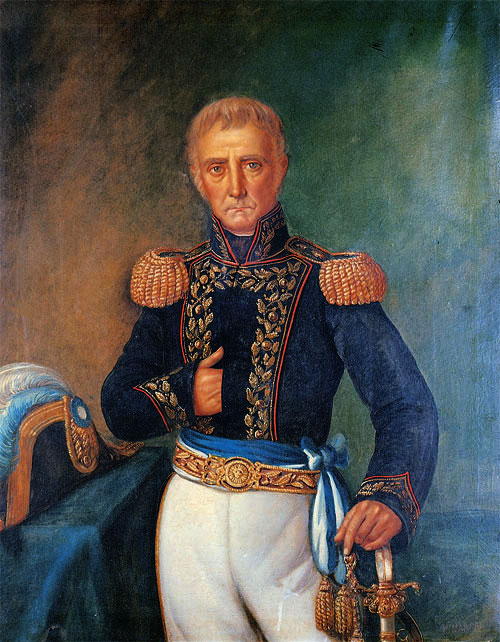
Cornelio Judas Tadeo de Saavedra y Rodríguez (September 15, 1759 – March 29, 1829) was an Argentine military officer and statesman. He was instrumental in the May Revolution, the first step of Argentina's independence from Spain, and became the first head of state of the autonomous country that would become Argentina when he was appointed president of the Primera Junta.

Key Information

Saavedra was the first commanding officer of the Regiment of Patricians created after the ill-fated British invasions of the River Plate. The increased militarization of the city and the relaxation of the system of castas allowed him, as other criollo peoples, to become a prominent figure in local politics. His intervention was decisive to thwart the Mutiny of Álzaga and allow viceroy Santiago de Liniers to stay in power. Although he supported the establishment of a Junta similar those created in Spain during the Peninsular War, he desired that criollos had an important role in it (the mutiny of Álzaga was promoted by peninsulars). He advised against rushed actions as well, and as his regiment was crucial in any action against the viceroy, he denied his help until it was a good strategic moment to do so. The opportunity came in May 1810, and the May Revolution successfully ousted the viceroy.

Saavedra was appointed president of the Primera Junta, which took government after it. The local politics were soon divided between him and the secretary Mariano Moreno. Saavedra wanted gradual changes, while Moreno promoted more radical ones. Saavedra encouraged the expansion of the Junta with deputies from the other provinces; this left Moreno in a minority, and he resigned. A later rebellion made on behalf of Saavedra forced the remaining supporters of Moreno to resign as well. He left the presidency after the defeat of the first Upper Peru campaign, and headed to lead the Army of the North. His absence was exploited by political opponents, who established the First Triumvirate and issued an arrest warrant against Saavedra. Saavedra stayed in exile until 1818, when all the charges against him were dropped.[3]

Biography

[edit]

Early life

[edit]

Saavedra was born at the hacienda "La Fombera", located in the town of Otuyo, near the former Imperial City of Potosí. The city was part of the Spanish Viceroyalty of Peru by that time, but would be annexed into the Viceroyalty of the Río de la Plata some years later. His father was Santiago Felipe de Saavedra y Palma, a native of Buenos Aires, whose ancestry reached to Hernando Arias de Saavedra.[4] His mother was María Teresa Rodríguez Michel, a native of the Villa Imperial de Potosi. Santiago had left Buenos Aires and married María. They were a wealthy family, with many sons, Cornelio being the last one.[5] The family moved to Buenos Aires in 1767. There, during his adolescence, Cornelio attended the Real Colegio de San Carlos. The school was only for the elite, and to attend it was required to be allowed by the viceroy, know reading and writing, be at least ten years old, be a legitimate son and have certified limpieza de sangre; Saavedra met all the requirements.[6] He studied philosophy and Latin Grammar between 1773 and 1776. However, he could not graduate due to overwhelming duties in the management of the family ranch. Unlike other rich youths of the time, he did not go to university.[7]

In 1788, he married Maria Francisca Cabrera y Saavedra, his cousin. Francisca was rich, and it is likely that it was an arranged marriage.[7] They had three sons, Diego, Mariano and Manuel. Francisca died in 1798. Saavedra began his political career in 1797, working at the Buenos Aires Cabildo, assuming various administrative roles. By then, the city had become the capital of the Viceroyalty of the Rio de la Plata. His first political appointment was as fourth alderman, and third alderman the following year.[8] In 1801, he was appointed Mayor of First Vote. That same year he married his second wife, Doña Saturnina Otárola del Rivero. In 1805, he was appointed to the position of Grain manager, within a local governmental body that dealt with the provision of wheat and other cereals in the city. It is considered that Saavedra supported the proposals of Manuel Belgrano at the Commerce Consulate of Buenos Aires, which promoted agriculture, education and industrialization, but there is no definitive evidence of it.[9]

British invasions

[edit]
William Carr Beresford surrenders to Santiago de Liniers during the British invasions of the River Plate.

Buenos Aires was involved in the British invasions of the River Plate in 1806, when a British expeditionary force led by William Carr Beresford captured the city. Saavedra was still a civilian by then. Santiago de Liniers organized a force in Montevideo to re-capture Buenos Aires, and Saavedra was among the civilians that joined Liniers, despite the lack of military instruction.[10] His role in this battle was a minor one.[11] Liniers successfully re-captured Buenos Aires, and organized the city's defences against a possible British counter-attack. All the male population of the city aged from 16 to 50 was drafted into the military, and divided in battalions by casta or origin. The largest one was the Regiment of Patricians, made up of volunteer infantrymen born in Buenos Aires.[12] The regiment was composed of three infantry battalions, commanded by Esteban Romero, Domingo Urien and Manuel Belgrano, who would later pass that command to Juan José Viamonte. Each battalion could elect their own leaders, including their commander, and the Regiment of Patricians elected Saavedra.[13]

The British launched another invasion in 1807 led by John Whitelocke. Saavedra marched to Montevideo, but was informed at Colonia del Sacramento of the capture of the city of British, who intended to use it as a staging point for their planned invasion of Buenos Aires. To frustrate further British operations, Saavedra ordered the withdrawal of all military hardware from Colonia, considered indefensible at that point, and mobilized those troops and equipment to Buenos Aires to fortify the city.[14] The renewed attack to Buenos Aires took place shortly afterwards, the British force consisting of 8,000 soldiers and 18 cannons—significantly more than the 1,565 men and 8 cannons used for the first invasion attempt. After defeating local forces at the pens of Miserere, the British entered the city of Buenos Aires on July 5.[15]

The British encountered an extremely hostile population, prepared to resist to the degree that even women, children and slaves voluntarily participated in the defense. The headquarters of the Regiment of Patricians were located at the Real Colegio de San Carlos, where Saavedra and Juan José Viamonte repulsed a British column under the command of Denis Pack and Henry Cadogan, composed of numerous infantrymen and a cannon. Pack subsequently united his remaining troops with Craufurd's men and made a last stand inside the Santo Domingo convent. Cadogan took the nearby house of Pedro Medrano, and fired at the Spanish from the rooftop before Pack and Cadogan's men were finally overwhelmed by local troops. Finally, Whitelocke surrendered, pledging to withdraw all British forces from Montevideo, which brought the second invasion to an end.[16]

The victory against the British brought forth great changes in the politics of Buenos Aires. The viceroy Sobremonte was discredited by his management of the conflict, and the Cabildo increased its influence; as such, it removed the viceroy and appointed Liniers as replacement, an unprecedented action. The local criollos, who had limited chances of social promotion in the system of castas, got such a chance with the increased influence of the militias. Cornelio Saavedra, head of the biggest criollo militia, thus became a highly influential man in the politics of Buenos Aires.[17] He resented the weak support from the Spanish monarchy to the war effort, compared with the strong one received from the cabildos of other cities in the Americas. As a result, he was loyal to the new viceroy, of French ancestry, considering him to be less subject to the internal disputes of the House of Bourbon.[18]

The mutiny of Álzaga

[edit]

The outbreak of the Peninsular War in Spain and the capture of the King Ferdinand VII by the French generated a political crisis in the Spanish colonies in America. The first project to maintain the monarchy was the short-lived Carlotism, which sought to crown Carlota Joaquina as regent. This project was supported by criollos like Manuel Belgrano and Juan José Castelli, but whether Saavedra supported it is disputed.[19] The Carlotism was abandoned soon afterwards, and the people sought other projects.

Martín de Álzaga sought to depose the viceroy Liniers. By defeating his mutiny, Saavedra increased his political power.

Francisco Javier de Elío established a Junta in Montevideo, similar to the ones established in Spain during the war, and his ally in Buenos Aires, Martín de Álzaga, sought to do a similar thing. The Mutiny of Álzaga took place on January 1, 1809. He accused Liniers of trying to appoint loyal members to the Cabildo, and gathered a small demonstration to request his resignation. The rebels, backed by some peninsular militias, occupied the Plaza. Liniers was about to resign, to prevent further conflicts.[20]

Cornelio Saavedra, who was aware of the conspiracy, considered it a plot by peninsulars to secure political power over the criollo peoples.[21] He marched with the Regiment of Patricians swiftly to the Plaza, and thwarted the mutiny. There was no violence in the operation, as the criollos forced the rebels to give up just by the sheer force of numbers. Thus, Liniers stayed in office as viceroy. All the heads of the mutiny were sentenced to prison at Carmen de Patagones, and the militias that took part in it were dissolved. The only peninsular militias remaining were those of Andaluces and Montañeses, who did not join the mutiny; criollos obtained the military command, and the political power of Saavedra increased even more.[22]

A few months later, the Junta of Seville appointed a new Viceroy, Baltasar Hidalgo de Cisneros. Some patriots proposed a self-coup to keep Liniers in power and resist the new viceroy, but Saavedra and Liniers himself did not accept it and the transition was performed without problems. Although Saavedra supported the plans of the criollos to seize power, he warned about taking rushed measures, considering that the ideal time to do so would be when the Napoleonic forces achieved a decisive advantage in the Spanish conflict. Until then, he forced the other revolutionaries to stay quiet by denying the help of his regiment. His usual quote was "Peasants and gentlemen, it is not yet time – let the figs ripen, and then we'll eat them."[23] Although he was sometimes suspected of sympathy for Cisneros for his reluctance to take action against him, he maintained his strategy.[24] Saavedra's political moderation may have been influenced by his previous career in the Cabildo.[25]

The May Revolution

[edit]
The open cabildo, by Juan Manuel Blanes, during Saavedra's speech.

The chance expected by Saavedra came in May 1810, when two British ships arrived with the latest news of the Peninsular War. The previous January Seville was invaded, the Junta of Seville ceased working, and some members took refuge at Cadiz and Leon, the last undefeated Spanish provinces. The complete Spanish defeat seemed imminent. The viceroy tried to conceal the information by seizing all newspapers, but some of them were leaked into the possession of the revolutionaries. Colonel Viamonte called Saavedra and informed him of the news, requesting once again his military support.[26] Saavedra agreed that it was a good context to proceed, and gave his famous answer: "Gentlemen: now I say it is not only time, but we must not waste a single hour."[27]

Cisneros called Saavedra and Martín Rodríguez, and requested their military support in the case of a popular rebellion. They refused to give such support, and Saavedra argued that Cisneros should resign because the Junta of Seville that had appointed him did not exist anymore.[28] As a result, Cisneros gave in to the request of Juan José Castelli: to celebrate an open cabildo, an extraordinary meeting of the noteworthy peoples of the city, and discuss the situation. The next day an armed mob, led by Antonio Beruti and Domingo French, occupied the Plaza to demand the making of the open cabildo, doubting that Cisneros would actually allow it. Saavedra addressed the crowd and assured them that the Regiment of Patricians supported their claims.

The open cabildo was held on May 22. The people discussed if Cisneros should stay in power and, in the case he was removed from office, which type of government should be established. Saavedra stayed silent for the most part, awaiting his turn to speak. The most important speakers were Bishop Benito Lué y Riega, Juan José Castelli, Ruiz Huidobro, Manuel Genaro Villota, Juan José Paso and Juan Nepomuceno de Sola, among others. Saavedra was the last one to speak, and suggested that the political control should be delegated to the Cabildo until the formation of a governing Junta, in the manner and form that the Cabildo deemed appropriate. In his speech, he pointed out the phrase: "(...) "And there be no doubt that it is the people that confers the authority or command."[29] This statement was in line with the Retroversion of the sovereignty to the people, a political concept formulated by Castelli, stating that in the absence of the rightful governor the sovereignty returned to the peoples, who had then the power to give it to someone else. Castelli aligned his position with Saavedra's, becoming the common position which was eventually passed with 87 votes.[30]

However, the Cabildo appointed a Junta headed by Cisneros, who would stay in power, even if under a new office. Saavedra was appointed to this Junta, as well as Castelli and two peninsulars. They made the oath of office, but the Junta was received with strong popular unrest, as it was perceived as going contrary to the result of the open cabildo. By the night, Saavedra and Castelli resigned, convincing Cisneros to do the same.

Depiction of the events of May 25
The people gathered in front of the Buenos Aires Cabildo

The Cabildo rejected Cisneros' resignation, and ordered the military to control the crowd and enforce the resolution of the previous day. The commanders pointed out that if they did so, their soldiers would mutiny. As the demonstration overran some sections of the cabildo, Cisneros' resignation was finally accepted. The members of the new Junta were the result of a document with hundreds of signatures, drafted among the people in the plaza. Cornelio Saavedra was the president of this Junta. He rejected this at first, fearing that he may be suspected of promoting the revolution for personal interest,[31][32] but finally accepted at Cisneros' request. As the Junta was established on May 25, the other cities were invited to send deputies to a constituent assembly to discuss the type of government; on May 27, they were invited to send deputies to join the Junta. Both invitations were contradictory, but the consequences would take place some months later.[33]

The precise authorship of the aforementioned document is unclear, and so is the origin of the composition of the Junta. Saavedra said in his memoirs that it was "the people", without being more precise. As he protested being appointed president, he could not be part of the negotiations (Manuel Belgrano and Mariano Moreno, other members, are reported to have been appointed without their consent as well). It could not have been the Regiments of Patricians either: the Junta was not a military junta (only two of nine members were military), and the regiment would not have appointed Moreno, whose rivalry with Saavedra was known.[34] A common accepted theory considers it to be a balance between Carlotists and Alzaguists.[35]

The presidency of the Junta was the result of the high influence of the militias in general and Saavedra in particular in the local politics. From that time on, he spent most of his time at the fort of Buenos Aires, managing the government with Moreno, Belgrano and Castelli. It is likely that he left his business for this.[36]

The Primera Junta

[edit]
Lithography of the members of the Primera Junta, with Saavedra in the middle.

Cornelio Saavedra was aware that the Junta would be resisted by factions still loyal to the old authorities. It was resisted locally by the Cabildo and the Royal Audiencia; the nearby plazas of Montevideo and Paraguay did not recognize it; and Santiago de Liniers organized a counter-revolution at Córdoba.[37] During this early period, the Junta worked united against the royalist threats. Mariano Moreno, the secretary of war, drafted the decrees and regulations to deal with royalists. First, a decree ordered punishment for anyone attempting to generate disputes, and for those concealing conspiracies against the Junta or other people.[38] The Royal Audiencia swore loyalty to the Regency Council, in defiance to the Junta, so they were summoned, along with former viceroy Cisneros, and exiled to Spain with the pretext that there was a threat to their lives. The Junta appointed new members for the Audiencia loyal to the revolution.[39] Moreno organized as well the Paraguay campaign and the First Upper Peru campaign, to the plazas that resisted the Junta. The second one, headed by Francisco Ortiz de Ocampo, would move to Córdoba and attack the counter-revolution; before marching to Upper Peru. Ocampo's initial orders were to capture the counter-revolutionary leaders and send them to Buenos Aires, so that they could be judged.[40] When the counter-revolution became stronger Moreno called the Junta and proposed that the enemy leaders should be shot as soon as they were captured instead of brought to trial. The new orders were carried out by Juan José Castelli.[41] Cornelio Saavedra supported all these measures.[42][43][44]

However, as time passed, Saavedra and Moreno distanced from each other. There was some initial distrust in the Junta towards Saavedra, but it was just the result of his desire for honours and privileges rather than an actual power struggle.[45] When the initial difficulties were solved, Saavedra promoted an indulgent policy, while Moreno insisted on taking radical measures. For instance, the Junta discovered on October 16 that some members of the Cabildo secretly swore loyalty to the Regency Council. Moreno proposed executing them as a deterrent, and Saavedra replied that the government should promote leniency, and rejected the use of the Regiment of Patricians to carry out such executions. Saavedra prevailed, and the plotting members of the Cabildo were exiled instead of executed.[46] Overall, Moreno was supported by "The Star" regiment, the other members of the Junta, and the activists of the May Revolution; Saavedra was supported by the merchants, the loyals to the old regime that saw him as a lesser evil, and the Regiment of Patricians, which was the largest one.[47]

Mariano Moreno, secretary of war of the Primera Junta.

To counter the power of Saavedra, Moreno sought to modify the military balance of power by reforming the promotion rules. Up until that point, the sons of officials were automatically granted the status of cadet and were promoted just by seniority; Moreno arranged that promotions were earned by military merits instead. However, in the short run this measure worked against him, as it antagonised members of the military who got promoted precisely because of such rules.[48]

Saavedra thought that the victory at the battle of Suipacha strengthened his perspective, as the Junta would have defeated its enemies.[49] He considered that Moreno's animosity was rooted in the aforementioned mutiny of Álzaga, as Moreno took part in it.[50] The victory was celebrated at the barracks of the Patricians, where the officer Anastasio Duarte, who was drunk, made a toast to Saavedra, as if he was America’s king. Moreno drafted the Honours Suppression decree when he knew about it, which suppressed the ceremonies and privileges of the president of the Junta inherited from the former office of viceroy. However, Saavedra signed it without complaint.[51] The Regiment of Patricians resented Moreno because of this,[52] but Saavedra considered that it was a disproportionated response to a trivial issue.

The arrival of the deputies called months ago generated disputes about the role they should have. Mariano Moreno supported the May 25 invitation, and wrote at the Gazeta de Buenos Ayres newspaper that the deputies should create a constituent assembly. Most of them, however, were aligned with the more moderated style of Saavedra. Led by Gregorio Funes from Córdoba, they requested to join the Junta, as told in the second invitation.[53] Saavedra and Funes thought that, with this change, Moreno would be left in a minority group, unable to advance his more radical measures.[54]

The deputies and the Junta met on December 18, to decide what to do. Funes, who was close to Saavedra, argued that Buenos Aires had no right to appoint national authorities by itself and expect obedience from the provinces. The nine deputies voted for their incorporation, as did Larrea, Azcuénaga, Matheu and Alberti, founding members of the Junta. Saavedra declared that the incorporation was not fully legal, but that he supported it for public convenience. Only Juan José Paso voted with Moreno against the incorporation of the deputies. Left in a minority within the Junta, Moreno resigned. He was appointed to a diplomatic mission in Europe, but died in high seas, in unclear circumstances.[55] Some historians consider that Saavedra plotted to murder Moreno, others that it was a negligence of the captain, and others that it was because of Moreno's frail health.[56]

The Junta Grande

[edit]

With the new members, the Junta was renamed as Junta Grande. Cornelio Saavedra, who continued being president, had a clear control of it, together with Gregorio Funes. Although Moreno was no longer part of the Junta, his former supporters still plotted against Saavedra, meeting at the "Café de Marcos". They accused Funes and Saavedra of being carlotists.[57] The regiment of Domingo French attempted to mutiny, but they were discovered and defeated. It is unknown if Moreno was involved in this attempted mutiny or not.[58]

The dispute was finally settled by the Revolution of the shoreline dwellers. The mayors Tomás Grigera and Joaquín Campana, supporters of Saavedra, led the "shoreline dwellers" (Spanish: orilleros, poor people living in the outskirts of Buenos Aires) to the Plaza, along with the Regiment of Patricians, and demanded the resignation of the morenists Hipólito Vieytes, Azcuénaga, Larrea and Rodríguez Peña, appointing the Saavedrists Juan Alagón, Atanasio Gutiérrez, Feliciano Chiclana and Campana as their replacements. It was requested as well that the government should not change its political style without voting it first. However, although the revolution was done in support of Saavedra, Saavedra denied having any involvement in it, and condemned it in his autobiography.[59]

Saavedra began to lose political power from this point. The decree of Mariano Moreno that changed the military promotions, which was never derogated, began to bear fruit, even if Moreno was not in the Junta anymore. The army became more professional, and less based on militias. Many of the new military authorities opposed Saavedra. The political crisis increased with the unfavourable military outcomes of the war: Belgrano was defeated at the Paraguay campaign, Castelli at the Upper Peru campaign, and the capture of Montevideo became increasingly difficult with the intervention of Portuguese troops supporting it. The many members of the Junta made the internal work difficult, as all measures were discussed by all members, hindering the swift reactions needed by the war. Saavedra left Buenos Aires at this point, and headed to the Upper Peru, to take command of the Army of the North. He thought that he could be of greater help as a military leader than facing the political struggles of Buenos Aires.[60]

Economy under Saavedra

[edit]

The economic policiey of Saavedra got in some aspect compared to perónist ones, due the "similar" state intervention in the economy.[61]

Fall and persecution

[edit]

Saavedra was warned by fellow members of the Junta, military leaders and even the Cabildo that if he left Buenos Aires, the government would be prone to fall into a political crisis. He left anyway, convinced that he would be able to reorganize the Army of the North. The warnings were justified; shortly after his departure, the Junta was turned into a legislative power, while the executive would be managed by the First Triumvirate. This arrangement lasted for a short time, then the Junta was abolished.[62] The Regiment of Patricians made a mutiny against the triumvirate, but failed.

Saavedra received the news eight days after arriving in Salta. He was informed that he was deposed as president of the Junta, and that he should hand the command of the Army of the North to Juan Martín de Pueyrredón. Trying to avoid returning to Buenos Aires, he requested to be relocated at Tucumán or Mendoza. He was allowed to stay at the later city, rejoining his wife and children. The press of Buenos Aires was very harsh about him, so the Triumvirate asked the governor to capture Saavedra and send him to Luján, near Buenos Aires. The order, however, was never carried out because the triumvirate was deposed by the Revolution of October 8, 1812, and replaced by the Second Triumvirate.[63]

The appointment of the supreme director Gervasio Antonio de Posadas fostered further hostilities towards Saavedra. Posadas was among the people banished in 1811, and made him a trial of residence as a revenge. Saavedra, defended by Juan de la Rosa Alba, was accused of organizing the 1811 revolution, along with Campana. The sentence ruled that Saavedra should be exiled, but he avoided it by crossing the Andes with his son and seeking political asylum at Chile. Juan José Paso requested the extradition of Saavedra, but the Chilean supreme director Francisco de la Lastra denied it. Saavedra did not stay in Chile for long; a huge royalist attack to Chile (which would end in the Disaster of Rancagua and the royalist reconquest of Chile) made him cross the Andes again and seek refuge at Mendoza, along with Chilean expatriates. José de San Martín, ruling Mendoza at the time, allowed him to settle in San Juan.[64]

Saavedra settled in San Juan in 1814. He had a new son, Pedro Cornelio, and maintained a simple life growing grapes. He awaited the final decision of Posadas, but the supreme director had a political crisis at the time. The Spanish king Ferdinand VII had returned to the throne and demanded the colonies to return to their former organization, the royalists at Upper Peru were still a threat, and José Gervasio Artigas opposed Buenos Aires as well, because of its high centralism. As a result, Carlos María de Alvear became the new supreme director, who would decide the final fate of Cornelio Saavedra.[65]

Last years

[edit]
Tomb of Cornelio Saavedra at the La Recoleta Cemetery.

Alvear ordered Saavedra to move immediately to Buenos Aires, to close the case. He arrived to the city in time, and Alvear was sympathetic to his situation. However, Alvear was forced to resign a few days later, before being able to rule the case. The Buenos Aires Cabildo, the interim government, restored Saavedra's military rank and honours, but the rule was abolished by Ignacio Álvarez Thomas, the following supreme director. He moved then to the countryside, to live with his brother Luis. He kept requesting to the government the restoration of his rank.[66]

Finally, the supreme director Juan Martín de Pueyrredón appointed a commission to discuss the case of Saavedra. By this time, the Congress of Tucumán had made the Argentine Declaration of Independence a couple of years before. The commission restored Saavedra with the military rank of brigadier, and ordered the payment of all the wages he did not receive during the time he was demoted. A second commission ratified the ruling. The payment was not enough to compensate Saavedra's losses, but he considered it a token of his restored prestige. He was appointed then to help with the protection of the frontier with the natives at Luján.[67]

Angered with the passivity of Buenos Aires during the Luso-Brazilian invasion of the Banda Oriental, Francisco Ramírez from Entre Ríos and Estanislao López from Santa Fe joined forces against the city. Saavedra fled to Montevideo, fearing that Buenos Aires would be obliterated if defeated. Ramírez and López won the battle of Cepeda, but the city was not destroyed, so Saavedra returned. He retired in 1822, and lived with his family in the countryside.[68] He offered his services at the beginning of the War of Brazil, despite being 65 years old, but Balcarce declined the offer. He wrote his memoirs, Memoria autógrafa, in 1828.[69]

He died on March 29, 1829. He was taken to the cemetery by his sons. There was no state funeral at the time, because Juan Lavalle made a coup against the governor Manuel Dorrego and executed him, starting a period of civil war. Lavalle was defeated by Juan Manuel de Rosas, who was appointed governor. Once he restored peace, Rosas made a state funeral for Saavedra, on January 13, 1830.[69]

Legacy

[edit]
Bust of Cornelio Saavedra at the Casa Rosada.

As president of the first government body created after the May Revolution, Saavedra is considered the first ruler of Argentina. However, as the Spanish juntas were not a presidential system, Saavedra was not the first President of Argentina; that office would be created a decade afterwards. The Casa Rosada, official residence of the President of Argentina, holds a bust of Saavedra at the Hall of busts.

The Regiment of Patricians is still an active unit of the Argentine Army, currently as an air assault infantry. It is also the custodian of the Buenos Aires Cabildo, the welcoming party for visiting foreign dignitaries to Argentina and the escort and honor guard battalion for the City Government of Buenos Aires. As of September 22, 2010, the regiment's headquarters building has been declared as a National Historical Monument by the Argentine government, on the occasion of the country's bicentennial year.

The historiography of Cornelio Saavedra is closely related to that of Mariano Moreno. As Saavedra had a conflict with him in the Junta, the perspectives towards him complement those about Moreno. The first liberal historians praised Moreno as the leader of the Revolution and a great historical man; Saavedra was treated either as a weak man overwhelmed by Moreno, or as a counter-revolutionary. This perspective did not acknowledge that Saavedra, as head of the Regiment of Patricians, was the most popular and influential man of the city since before the Revolution, and that he was reported to be staunch, cunning and ruthless.[70]

Subsequently, revisionist authors would formulate accusations against Moreno, depicting him as a British agent and a man of mere theoretical European ideas without a strong relation with the South American context. Saavedra is depicted instead as a popular caudillo, a predecessor of José de San Martín and Juan Manuel de Rosas. This perspective did not acknowledge that the wealthy citizens were aligned with Saavedra against Moreno, that Saavedra himself was wealthy and aristocratic, and that the 1811 revolution made no requests of a social nature, save for the removal of Morenist forces from the Junta.[71]

Descendants

[edit]

Among his most prominent descendants must be mentioned his son Mariano Saavedra, twice governor of the Province of Buenos Aires between 1862 and 1865, his grandson Cornelio Saavedra Rodríguez, Chilean military officer in charge of the Occupation of Araucania, and his great-grandson Carlos Saavedra Lamas, politician and diplomat, Nobel Prize for Peace in 1936.[72]

The Saavedra neighbourhood was founded in honor of his nephew Luis María Saavedra, a prominent businessman of the late nineteenth-century.[73]

A descendant of his brother Luis Gonzaga Saavedra, León Ibáñez Saavedra, fathered Matilde Ibáñez Tálice, First Lady of Uruguay (1947–1951) and mother of Uruguayan President Jorge Batlle Ibáñez (2000–2005). [74]

References

[edit]

Bibliography

[edit]
[edit]
Revisions and contributorsEdit on WikipediaRead on Wikipedia
from Grokipedia
Cornelio Judas Tadeo de Saavedra (15 September 1759 – 29 March 1829) was a military officer and statesman born in the Viceroyalty of Peru who rose to prominence in Buenos Aires as commander of the Regiment of Patricians, leading its defense during the British invasions of the Río de la Plata in 1806 and 1807. He played a pivotal role in the May Revolution of 1810 by leveraging his military influence to support the deposition of the Spanish viceroy, resulting in his election as president of the Primera Junta, the first independent governing body of the United Provinces of the Río de la Plata. Saavedra's leadership emphasized military preparedness, provincial inclusion in governance, and measured steps toward rather than immediate republican radicalism, which positioned him as a counterweight to more revolutionary figures like Mariano Moreno and contributed to early factional strife within the junta. These tensions culminated in his replacement amid internal power struggles by 1811, after which he commanded expeditionary forces before retiring from active politics, dying in relative obscurity amid ongoing civil conflicts. His tenure laid foundational precedents for executive authority in post-colonial , though historiographical debates often contrast his with ideals of swift .

Early Life and Formative Experiences

Birth, Family Background, and Education

Cornelio Judas Tadeo Saavedra was born on September 15, 1759, at the La Fombera hacienda in the Otuyo canton, near in (modern-day ), then part of the of the . His father, Santiago Felipe de Saavedra y Palma, was a merchant and hacendado originally from who had relocated to for business opportunities, while his mother, María Teresa Rodríguez Michel, was a native of the region. The family endured severe hardships due to the extreme high-altitude climate and economic instability of , a silver-mining center plagued by declining production and social disparities in the late colonial era. Saavedra's early family life reflected criollo roots, with his father's origins linking him to the Río de la Plata's commercial networks, though the household remained modest amid Potosí's volatile mining economy. He was baptized with indigenous assistance, as his godmother was Pascuala, an indigenous woman who served as . Limited records indicate no siblings of prominence, and the family's relocation patterns—tied to paternal trade—exposed Saavedra to both Andean and porteño influences from youth. Saavedra pursued formal education at the Real Colegio de San Carlos in , demonstrating particular interest in amid a curriculum emphasizing and preparatory studies. This institution, established for elite colonial youth, provided foundational knowledge in , , and , though Saavedra's exposure was curtailed by his early entry into and militia service around age 18, reflecting practical constraints over extended scholarly pursuits.

Entry into Military and Civic Life

Saavedra, having completed his in , pursued a career in and , establishing himself as a prosperous landowner and trader by the late . He amassed considerable wealth through estancias and mercantile activities, which positioned him among the criollo class in the city. His entry into military life occurred amid the crisis of the first of the in June 1806, when Viceroy Liniers rallied local forces to recapture from William Beresford's occupation. Lacking formal military training, Saavedra volunteered his services and leveraged his social standing to recruit and organize a new unit known as the Regiment of Patricians (Regimiento de Patricios), composed primarily of urban criollo militiamen designated as vecinos fijos. Appointed its first commander on August 11, 1806, Saavedra transformed this ad hoc group into a disciplined force, marking the inception of his military command and his emergence as a key defender of the viceroyalty. This military role intertwined with , as Saavedra's leadership of the Patricians elevated his influence within ' cabildo and criollo networks, fostering a power base that blended armed authority with political maneuvering. The regiment's formation reflected broader civic mobilization, where merchants like Saavedra shifted from economic pursuits to public defense, anticipating further threats from the impending in 1807. His command persisted post-invasions, institutionalizing the militia as a permanent criollo and solidifying his transition to a dual military-civic figure.

Pre-Revolutionary Military Engagements

Participation in the British Invasions of 1806-1807

In response to the British capture of on June 27, 1806, by approximately 1,600 troops under Brigadier General William , Cornelio Saavedra, a and militia captain, contributed to local resistance efforts amid the occupation that lasted until August 12. Joining volunteers in the expedition organized by Santiago de Liniers from , Saavedra participated in the reconquest force that advanced on the city, exploiting British vulnerabilities through guerrilla tactics and to force Beresford's surrender. This irregular defense highlighted the effectiveness of creole-led militias over regular Spanish troops, as the British, outnumbered and logistically strained, evacuated after 46 days of control. Following the reconquest, Saavedra was instrumental in formalizing urban militias into permanent units, elected on , 1806, as commander of the First Battalion of the Legion of Patricians—a creole volunteer comprising porteño artisans, merchants, and laborers totaling around 1,100 men initially. These forces emphasized rapid mobilization and familiarity with Buenos Aires's terrain, addressing the viceregal army's prior inadequacies exposed by the invasion's speed and the Spanish command's disarray. Saavedra's leadership fostered discipline among untrained recruits, integrating them into defensive preparations that bolstered local confidence in against European threats. During the second British expedition in 1807, commanded by Lieutenant General John Whitelocke with over 10,000 troops landing at Ensenada on June 28, Saavedra directed the Patricios in the pivotal defense of Buenos Aires. Despite initial hesitation amid reports of British naval superiority, he committed his battalion to street-level engagements on July 4–5, where militiamen used barricades, house-to-house fighting, and enfilading fire to inflict heavy casualties—estimated at over 2,000 British losses against fewer than 700 defenders killed. The Patricios' tenacity, under Saavedra's orders to hold key positions like the Miserere and Retiro areas, contributed causally to Whitelocke's capitulation and withdrawal, as superior numbers failed against determined local resistance rooted in terrain knowledge and popular mobilization. This episode elevated Saavedra's stature, demonstrating how militia autonomy could counter professional armies through asymmetric tactics rather than conventional maneuvers.

Role in the Álzaga Mutiny of 1809

On January 1, 1809, Martín de Álzaga, a prominent and regidor, orchestrated an uprising in aimed at deposing Santiago de Liniers and installing a provisional junta modeled after recent Spanish responses to Napoleon's invasion. The plot drew support from Spanish military units and members, who marched on the viceregal fort to demand Liniers' resignation and present a preselected junta roster excluding the . Cornelio Saavedra, serving as lieutenant colonel and commander of the Regiment of Patricios—a criollo he had helped organize following the British invasions of 1806–1807—mobilized approximately 400 troops to counter the mutineers. Positioned around the , Saavedra's forces surrounded , directed cannons toward the building, and vowed to defend Liniers against the insurgents, thereby halting the advance and compelling Álzaga's supporters to disperse without bloodshed. This decisive action preserved Liniers' viceregal authority, though Saavedra reportedly extracted concessions, such as appointments for militia officers, in exchange for his intervention. Saavedra's loyalty to the during the reflected his pragmatic stance favoring institutional continuity amid uncertainty over Spanish governance, distinguishing him from more autonomist criollos while bolstering his influence within ' military circles. The event underscored the growing leverage of urban militias like the Patricios, which Saavedra leveraged to check peninsular dominance without yet endorsing full rupture from .

Leadership in the May Revolution

Mobilization of Forces and Key Decisions

As commander of the Regiment of Patricians, a fixed unit established during the British invasions of 1806–1807, Cornelio Saavedra wielded substantial military authority in by 1810, with the regiment comprising creole officers and urban recruits loyal to local interests. On May 22, 1810, during the Abierto convened to address the political crisis following news of VII's deposition, Saavedra proposed that assume provisional command until a governing junta could be formed in the name of the captive king, a decision reflecting his strategy to legitimize the power shift under monarchical pretense while sidelining the . This motion garnered support, voting 155 to 69 in favor of removing Baltasar Hidalgo de Cisneros, though the Cabildo's subsequent delay in announcing results and attempt to reinstate him escalated tensions. By , with failing to publish the Cabildo Abierto's outcome by nightfall on and stalling further, Saavedra demanded clarification, signaling military readiness to enforce the assembly's will. As crowds gathered in the amid impasse, Saavedra mobilized his regiment's support, intervening to calm agitators by committing armed backing to the patriots' demands for a new junta, thereby tipping the balance against royalist resistance without direct confrontation. This mobilization of approximately 600 Patricians, coordinated with other militia leaders after strategic meetings on , provided the coercive leverage needed to compel 's acquiescence. Saavedra's pivotal decisions emphasized orderly transition over radical upheaval: aligning forces with criollo elites like Juan José Castelli while preserving institutional continuity, rejecting immediate to avert counter-revolutionary backlash, and positioning the military as guarantor of the junta's authority. These actions culminated in the Primera Junta's formation that evening, with Saavedra elected president, secretaries Mariano Moreno and Juan José Paso appointed, and vocalists including Manuel Alberti and Miguel de Azcuénaga. His restraint ensured the revolution's initial success by framing it as fidelity to , masking independence and enabling subsequent governance without alienating moderate factions.

Establishment and Presidency of the Primera Junta (1810)

Following the open cabildo of May 22, 1810, where the of attempted to reinstate Baltasar Hidalgo de Cisneros despite widespread criollo opposition, popular unrest escalated. Armed urban militias, commanded by Cornelio Saavedra as of the of Patricios, assembled around the Cabildo, exerting pressure that compelled Cisneros's resignation on May 24. This mobilization, reflecting Saavedra's influence among the lower classes and military ranks, ensured the transition to local governance without violence. On May 25, 1810, the was formally constituted as the provisional government of the Viceroyalty of the , ostensibly in the name of the deposed King but effectively asserting autonomy from Spanish authority. Saavedra was unanimously elected president due to his demonstrated leadership in suppressing prior loyalist resistance and commanding the patriotic forces that backed the revolution. The body included vocal members such as Manuel Alberti, Miguel de Azcuénaga, , Juan José Castelli, Juan Larrea, Domingo Matheu, with Mariano Moreno and Juan José Paso serving as secretaries. This composition balanced military, commercial, and intellectual elements, with Saavedra's presidency anchoring the more pragmatic, Buenos Aires-centric approach. During his presidency in 1810, Saavedra directed the Junta's initial consolidation of power, including the issuance of the first Gaceta de on June 7 to publicize decrees and foster unity. He oversaw administrative appointments, such as naming Belgrano and Castelli to lead expeditions northward to secure provinces and counter royalist threats, reflecting a strategy prioritizing military defense over radical reforms. Tensions emerged between Saavedra's conservative inclinations—favoring gradual change and support—and the more revolutionary visions of figures like Moreno, yet the Junta maintained cohesion through 1810, expanding influence by inviting provincial deputies while suppressing dissent in . Saavedra's role emphasized causal stability, leveraging his regiment's loyalty to deter counter-revolutions amid uncertain loyalty from interior regions.

Governance of the Primera Junta

Internal Political Dynamics and Conflicts

The governance of the , established on May 25, 1810, rapidly fractured along ideological and personal lines, pitting the conservative faction aligned with President Cornelio Saavedra against the radical group led by Secretary Mariano Moreno. Saavedristas, drawing support from the urban militia and merchants favoring stability, prioritized military consolidation and nominal loyalty to the deposed King to legitimize the regime while avoiding European intervention; they viewed radical shifts as risking anarchy amid ongoing threats from royalist forces. In contrast, morenistas, comprising intellectuals and lawyers influenced by Enlightenment thinkers like Rousseau, pushed for immediate rupture with Spanish absolutism, including unrestricted , abolition of commercial monopolies, and aggressive suppression of internal dissent through measures like a proposed public safety tribunal. Tensions escalated following the disastrous Battle of Huaqui on July 20, 1810, where an expeditionary force under Juan José Castelli—a morenista ally—suffered a decisive defeat against troops in , resulting in over 1,000 patriot casualties and the retreat of revolutionary forces. Saavedristas attributed the loss to the radicals' hasty military adventurism without sufficient preparation or coordination, eroding Moreno's influence and fueling accusations of incompetence; this setback, combined with logistical failures in provisioning the army, shifted blame toward the junta's more aggressive policymakers. Moreno's Gaceta de Buenos Ayres, launched November 7, 1810, intensified the divide by publishing polemics that critiqued conservative hesitancy and advocated Jacobin-style purges, prompting Saavedra to leverage his command of the Patricios Regiment to counterbalance perceived radical overreach. By late 1810, policy disputes over and the treatment of provincial deputies—initially excluded from the Buenos Aires-centric junta—crystallized the rift, as morenistas resisted diluting their influence while saavedristas sought broader legitimacy to stabilize . On December 6, 1810, Moreno tendered his after losing a key vote to incorporate nine provincial representatives, which empowered moderates and isolated radicals; this maneuver, orchestrated to preempt unrest, effectively sidelined morenista agendas like expanded executive powers. The resulting Junta Grande, formalized December 18, 1810, with 19 members including the newcomers, marked the conservatives' tactical victory, though it presaged further instability by amplifying factional vetoes and delaying decisive action against royalists.

Economic Policies and Administrative Reforms

The Primera Junta, presided over by Cornelio Saavedra from May 25, 1810, prioritized economic stabilization amid the disruptions caused by the British invasions of 1806–1807 and the collapse of Spanish mercantilist controls. A policy was the endorsement and formalization of , reversing the colonial monopoly on commerce with . This measure, effectively allowing imports from Britain and other neutral powers, led to a surge in foreign goods entering , with improving dramatically—by approximately 400% in the immediate post-independence period—due to increased export revenues from hides, , and other primary products. Saavedra's pragmatic approach emphasized gradual to benefit local merchants and landowners, contrasting with Secretary Mariano Moreno's advocacy for state-directed interventions, such as nationalizing mines and imposing , which were largely sidelined to avoid alienating provincial elites reliant on export markets. Administrative reforms under Saavedra focused on decentralizing and rationalizing colonial bureaucracy to enhance governance efficiency and fiscal control. The Junta restructured key institutions, including the Real Hacienda (royal treasury), by appointing new intendants and auditors to oversee revenue collection from customs duties, which had risen sharply post-trade opening, generating funds for military expeditions. Decrees in mid-1810 abolished obsolete viceregal offices, such as certain audiencias, and established specialized departments for finance, war, and interior affairs, streamlining decision-making while integrating militia oversight under Saavedra's military background. These changes aimed to curb corruption in tax farming and promote accountability, though implementation faced resistance from entrenched colonial officials. Tensions over reform pace contributed to internal divisions, as Saavedra vetoed more sweeping proposals—like Moreno's Plan Económico for centralized planning and import substitution—favoring policies that preserved property rights and encouraged private initiative in and ranching to offset import dependency. By late 1810, these measures had stabilized currency circulation, reducing reliance on depreciated Spanish bills of exchange, but fiscal strains from military spending persisted, foreshadowing the expansion to the Junta Grande.

Military Directives and Upper Peru Campaign

The Primera Junta, presided over by Cornelio Saavedra, responded to revolutionary uprisings in —such as those in on May 16, 1810, and —by issuing directives for an auxiliary military expedition to provide support against royalist forces and extend control northward. On , 1810, the Junta appointed Colonel Francisco Ortiz de Ocampo to command a force of about 1,150 men, including from and Tucumán, with orders to march from Jujuy, link with local insurgents, and secure key passes like those at Cotagaita and Santiago de Cotagaita while avoiding overextension into inhospitable terrain. These directives prioritized logistical caution, emphasizing supply lines from and Jujuy, the recruitment of indigenous and auxiliaries, and the dissemination of proclamations affirming loyalty to to legitimize the intervention as defensive rather than separatist. As the expedition progressed, the Junta supplemented Ocampo's command with Juan José Castelli as political chief, dispatching him on July 22, 1810, with explicit instructions to "conquer the will of the people" through moderate , judicial reforms, and alliances with local elites rather than coercive occupation. Castelli's orders, signed under Saavedra's , directed the establishment of provisional juntas in liberated areas, the abolition of certain tribute taxes to win indigenous support, and coordination to repel advances from royalist strongholds in and , while prohibiting reprisals against non-combatants to foster voluntary adhesion. Saavedra, reflecting his experience from the British invasions, advocated in Junta deliberations for measured advances to preserve forces, countering pressures from radicals like Mariano Moreno for bolder offensives that risked overcommitment without adequate or . The campaign yielded early tactical victories, including Ocampo's defeat of at Cotagaita on October 27, 1810, and Suipacha on November 7, 1810, allowing penetration into and the occupation of by early 1811. However, strategic flaws in the directives—such as underestimating Andean altitudes' impact on troops acclimated to conditions, insufficient reserves against reinforcements from , and Castelli's independent executions of Spanish officers like the Marquis of Casa Vallecilla—contributed to the decisive rout at Huaqui on August 20, 1811, where patriot forces numbering around 3,000 suffered heavy losses to a better-equipped of 7,000 under General José Manuel de Goyeneche. The failure exposed limitations in the Junta's northern strategy, prompting Saavedra's temporary assumption of field command in the Army of the North later in 1811 to reorganize defenses at Tucumán.

Transition to the Junta Grande and Ouster

Expansion of the Junta and Dilution of Power

The initiated the process of expansion in response to demands from interior provinces for representation, aiming to enhance the government's legitimacy beyond dominance. Cornelio Saavedra, as president, supported inviting deputies from these regions to incorporate provincial voices and counter the influence of radical factions within the original junta. This move aligned with Saavedra's pragmatic strategy to foster unity and dilute the sway of figures like Mariano Moreno, whose centralizing policies had sparked internal conflict. On December 18, 1810, immediately following Moreno's resignation—pressured by Saavedra and arriving deputies—the reorganized into the Junta Grande. The expansion added nine new deputies representing provinces such as Mendoza, Santa Fe, , , , Tucumán, Tarija, Catamarca, and Jujuy, transforming the body from five principal voting members to a larger assembly of 14 vocales plus secretaries. Saavedra retained the , but the influx of provincial representatives, often more conservative and locally oriented, shifted the balance toward a collegial structure less amenable to swift executive decisions. This dilution of power manifested in slowed deliberation and increased factionalism, as the enlarged junta required consensus among diverse interests, undermining the Primera Junta's prior efficiency. While the change neutralized radical dominance and promoted a semblance of federal representation, it fragmented authority, complicating responses to military and administrative challenges. Saavedra's initial control waned as provincial deputies asserted autonomy, foreshadowing governance inertia that persisted until the Junta Grande's dissolution in September 1811.

Accusations, Resignation, and Immediate Aftermath

As military setbacks mounted in the campaign, particularly following the defeat at Huaqui on June 20, 1811, critics within the radical faction intensified accusations against Saavedra, portraying him as overly conservative, resistant to swift declarations, and inclined toward restoring monarchical elements under a Spanish rather than pursuing full republican rupture. These charges, amplified by porteño intellectuals and military officers aligned with morenista ideals, framed Saavedra's pragmatic governance as authoritarian stagnation that prioritized military hierarchy and provincial appeasement over aggressive reform, though such claims often lacked direct evidence beyond partisan and were countered by Saavedra's documented emphasis on unified command to avert . On August 26, 1811, the Junta Grande dispatched Saavedra northward to assume command of the Ejército Auxiliar del Alto Perú, aiming to reorganize forces after successive losses; his absence from immediately empowered opponents, who leveraged influence to orchestrate the junta's dissolution on September 22, 1811, replacing it with the Primer Triunvirato comprising Feliciano Chiclana, Manuel de Sarratea, and Juan José Paso. Informed of the ouster upon reaching eight days later, Saavedra found himself stripped of both presidency and military authority without formal trial, an action the new triumvirate justified as necessary for executive efficiency amid crisis, though it effectively sidelined his federalist-leaning supporters. In the ensuing weeks, the Triumvirato initiated judicial proceedings against Saavedra, confining him to internal exile first in San Juan under governor Saturnino Sarassa, then Mendoza, while confiscating properties and barring political activity; these measures reflected radical fears of Saavedra rallying militia loyalists, such as the Regiment of Patricios, whose December 6, 1811, explicitly demanded his reinstatement and Manuel Belgrano's resignation before being quelled with executions. The immediate fallout consolidated centralist control in , dissolving provincial juntas by December 23, 1811, but sowed seeds of federalist resentment that persisted into future civil strife, with Saavedra's removal marking the triumph of unitary over conciliatory revolutionary strains.

Later Career, Persecution, and Death

Attempts at Political Revival

On December 6, 1811, elements within the Regiment of Patricians, under Saavedra's former command, initiated a in known as the Motín de las Trenzas, explicitly demanding his political restoration and the resignation of as head of the Army of the North. The rebels, primarily soldiers and subofficers loyal to Saavedra's conservative leadership style, protested recent military setbacks and perceived overreach by radical factions in the government, framing their action as a defense of order and experienced command against inexperienced reforms. The uprising escalated overnight into December 7, with mutineers seizing arms from the Cuartel de las Temporalidades and clashing with loyalist forces; government troops, reinforced by other regiments, quelled the by dawn, executing approximately 20 leaders on the spot and displaying their severed heads publicly to deter further dissent. This suppression highlighted the fragility of post-junta authority but failed to reinstate Saavedra, instead intensifying accusations against him and prompting his continued exile to San Juan, where he faced ongoing surveillance and property restrictions. Supporters' advocacy persisted through legal channels amid shifting regimes; following the 1815 Revolution of May, the Cabildo issued a provisional pardon, restoring Saavedra's military honors retroactive to 1811 without immediate political office. By 1816, backing from facilitated his initial return to , though formal charges lingered until their dismissal in 1818 under Director Supremo Juan Martín de Pueyrredón, allowing limited administrative roles like chief of the army general staff rather than executive power. These rehabilitations reflected pragmatic alliances prioritizing stability over radical purges but yielded no substantive revival of Saavedra's influence, as dominant factions viewed his return to prominence as a risk to centralized authority.

Exile, Return, and Final Years (1811-1829)

Following his removal from the presidency of the Junta Grande in August 1811, Saavedra was initially ordered to reside in San Juan in September of that year, accompanied by his ten-year-old son Agustín, amid accusations of and with Spanish interests leveled by radical factions. Fearing further persecution and an unfair trial, he fled across the to shortly thereafter, where he settled in and lived in exile for approximately three years, navigating precarious conditions exacerbated by the royalist victory at in , which heightened risks for independence sympathizers. In 1814, Saavedra sought permission to return to Argentine territory, receiving approval from , who authorized his residence in San Juan to legitimize his presence while under scrutiny. He remained there until 1816, when San Martín's influence facilitated his escorted transfer to for formal proceedings, including a juicio de residencia initiated by the Asamblea del Año XIII to investigate his tenure. The 1815 revolution of temporarily restored his , but subsequent orders from Director Supremo Carlos María de Alvear's interim government under Feliciano Antonio Chiclana y Álvarez Thomas confined him to the rural district of Arrecifes in . Rehabilitation came in 1818 through the Congreso de Tucumán, which exonerated Saavedra of all charges, retroactively confirmed his rank as effective January 14, 1811, awarded him back pay and indemnity, and appointed him , though active duties were limited by ongoing political instability. He retired from public service in 1822, retreating to his in Zárate to manage estates amid economic recovery efforts, and in 1825 volunteered his services for the war against but was declined owing to his age of 66. Saavedra died in on March 29, 1829, at approximately 8:00 p.m., at the age of 69, reportedly from a heart attack; Governor Juan José Viamonte ordered his remains transferred to the Cementerio de la Recoleta with military honors shortly after, recognizing his foundational role despite prior vilification.

Ideology and Strategic Approach

Conservative and Pragmatic Principles

Cornelio Saavedra embodied a conservative approach to the revolutionary process, prioritizing the maintenance of social hierarchies, military discipline, and institutional stability over sweeping ideological transformations. As commander of the Patrician Regiment and later president of the formed on May 25, 1810, he viewed the upheaval as an opportunity for criollo within a framework of continuity, nominally upholding loyalty to the imprisoned Spanish King to legitimize the regime and mitigate risks of counter-revolutionary backlash or internal chaos. This stance reflected his belief that radical disruptions, such as those proposed by figures like Mariano Moreno, threatened the established order of property rights, influence, and elite authority, which he saw as essential bulwarks against anarchy. Saavedra's manifested in his strategic emphasis on consensus-building and provincial inclusion to sustain amid factional tensions. He championed the expansion of the into the Junta Grande on December 18, 1810, incorporating deputies from interior provinces to broaden representation and dilute the influence of radicals, thereby fostering a more inclusive yet decentralized authority structure that aligned with emerging sentiments. This move, while criticized by centralists for weakening executive efficiency, underscored his realistic assessment that unilateral impositions from the capital risked alienating regional powers and jeopardizing military campaigns, as evidenced by his personal assumption of command over the Army of the North in to address operational failures pragmatically rather than through ideological fiat. His principles favored evolutionary over precipitate , advocating for a or viceregal restoration under local control to preserve administrative continuity and economic ties, as articulated in his address to the Patricios Regiment amid British invasions, where he stressed disciplined loyalty to legitimate authority while preparing for . This cautious realism extended to restraining popular excesses, such as during the 1809 conflicts with British loyalists, where he quelled unrest through and force to avert broader instability, prioritizing long-term viability over short-term revolutionary fervor.

Views on Monarchy, Autonomy, and Federalism

Saavedra espoused conservative principles that emphasized stability and gradual reform over abrupt republican experimentation. He initially aligned with autonomist sentiments during the of 1810, advocating for within the framework of loyalty to the under , whom he viewed as the legitimate sovereign displaced by Napoleonic influence. This position, shared by the he presided over from May 25, 1810, masked independence as fidelity to , allowing criollo elites to consolidate power without immediate confrontation with forces elsewhere in the empire. Regarding , Saavedra's did not reject the institution outright; he supported its retention as a stabilizing force, provided it accommodated local and provincial interests, contrasting with more radical factions pushing for outright . His in the junta reflected a preference for monarchical legitimacy to unify disparate regions against external threats, as evidenced by official proclamations invoking VII's authority until formal declarations in 1816. While not explicitly advocating a new American , his resistance to jacobinist excesses suggests openness to constitutional variants that preserved hierarchical order. On , Saavedra championed decentralized governance by expanding the into the Junta Grande on December 18, 1810, incorporating deputies from interior provinces such as , , and Tucumán to counterbalance ' centrality. This move, driven by his emphasis on provincial representation, prefigured federalist arrangements by distributing authority and mitigating porteño dominance, though it ultimately fragmented executive cohesion and contributed to his ouster in 1811. Historians note this as a foundational step toward Argentina's federal traditions, prioritizing regional consensus over unitarian centralization favored by later rivals.

Controversies and Rivalries

Clash with Radical Factions and Mariano Moreno

The Primera Junta, established on May 25, 1810, quickly divided into conservative and radical factions, with Cornelio Saavedra representing the former's emphasis on gradual reform and institutional stability, while Mariano Moreno embodied the latter's push for sweeping ideological changes. Saavedra, as president and military leader, prioritized maintaining order among local elites and incorporating provincial representatives to legitimize the government and prevent unrest, viewing radical disruptions as threats to cohesion in a society still tied to colonial structures. In contrast, Moreno, serving as secretary of government and war, drew from Enlightenment and Jacobin influences to advocate aggressive measures, including free trade policies, suppression of monastic orders, and summary executions of perceived counter-revolutionaries to dismantle Spanish loyalism decisively. Tensions escalated over governance and policy execution, particularly regarding and opposition handling. Moreno utilized La Gazeta de Buenos Ayres, which he effectively controlled, to promote radical ideas and criticize conservative hesitancy, prompting Saavedra and allies to accuse him of overreach and personal ambition that undermined collective authority. A pivotal dispute arose in late 1810 with the arrival of provincial deputies on December 8; Saavedra supported integrating them directly into an expanded executive Junta to dilute porteño dominance and foster provincial buy-in, whereas Moreno and his supporters, including Juan José Paso initially, insisted on forming a separate to draft a , fearing executive bloating would stall revolutionary momentum. The formation of the Junta Grande on December 18, 1810, with 17 additional members favoring moderation, marginalized the morenista faction and intensified personal animosities, as Saavedra's bloc leveraged military influence to check Moreno's initiatives, such as unchecked wartime requisitions. Moreno tendered his on December 6, 1810, citing and health concerns, but faced rejection amid threats of popular unrest from his supporters; to avert crisis, the Junta appointed him envoy to Britain on December 20, dispatching him on January 24, 1811, where he died at sea on March 19, 1811, under disputed circumstances that fueled morenista narratives of . This ouster reflected Saavedra's strategic realism in prioritizing factional balance over ideological purity, averting immediate collapse but presaging broader federalist-unitarian divides in Argentine politics.

Debates Over Loyalty and Revolutionary Commitment

Saavedra's leadership of the from May 25, 1810, to his resignation on August 18, 1811, sparked immediate debates among contemporaries about the depth of his commitment to revolutionary ideals, particularly from radical factions aligned with Mariano Moreno. These critics, known as Morenistas, argued that Saavedra's insistence on formal declarations of loyalty to the captive Spanish King undermined genuine efforts, portraying it as a pretext for maintaining colonial structures under a criollo elite rather than pursuing republican rupture. Saavedra countered in his memoirs that such fidelity was a strategic necessity to legitimize the junta's authority against peninsular loyalists and prevent a unified Spanish counteroffensive, emphasizing that premature declarations could have doomed the movement by alienating moderate criollos and provoking internal collapse. These tensions manifested in policy clashes, such as Saavedra's resistance to aggressive economic reforms and expeditions that Morenistas championed to accelerate separation from , leading to accusations that his military background and preference for order prioritized personal power over transformative change. For instance, during the junta's expansion in December 1810, Saavedra advocated including provincial representatives to dilute porteño radicalism, which radicals interpreted as diluting revolutionary momentum in favor of conservative provincial interests potentially sympathetic to monarchical restoration. Saavedra's own correspondence, including a June 27, 1811, letter to Juan José Viamonte, revealed private frustrations with radical impatience, defending his cautious approach as essential for sustaining popular support amid fears of reconquest. Historiographical assessments have perpetuated these debates, with some scholars viewing Saavedra's as evidence of limited zeal—evidenced by his initial reluctance to depose Baltasar Hidalgo de Cisneros outright in May 1810—while others credit it with providing the stability needed for the revolution's survival against threats. Later accusations of royalist sympathies resurfaced during his 1820 persecution under the Directory, where he was charged with conspiring against the government, though acquittals in 1818 and his memoirs framed these as politically motivated smears by unitarian rivals exaggerating his monarchical leanings to discredit alternatives. This duality—pragmatic loyalty masking deeper aims versus verging on betrayal—remains central to evaluations of Saavedra's , underscoring the causal tension between institutional caution and ideological fervor in early Argentine .

Legacy and Historiographical Assessment

Achievements in Stability and Institution-Building

Cornelio Saavedra served as the first president of the , Argentina's inaugural autonomous government formed on May 25, 1810, following the that ousted Spanish viceregal authority. This body represented a critical institution-building milestone, transitioning administrative control to local creole elites while preserving essential governance structures to avert chaos. Under Saavedra's leadership, the Junta coordinated initial expeditions, such as Manuel Belgrano's Army of the North dispatched to in June 1810, establishing frameworks for national defense and territorial assertion without immediate full , which could have invited destabilizing foreign intervention. Saavedra's conservative orientation prioritized gradual reform over radical upheaval, fostering relative stability in amid factional tensions. By advocating provincial representation within the Junta's deliberations, he promoted inclusive decision-making that mitigated porteño dominance and prefigured principles, helping to sustain cohesion in the Río de la Plata's nascent polity. His command of the Regiment of Patricians, honed during the 1806–1807 British invasions, enforced and public order, suppressing potential counter-revolutionary plots and internal dissent. In April 1811, Saavedra orchestrated the removal of radical influences, including the resignation of Mariano Moreno the prior December, consolidating moderate control and enabling policy continuity. Though his tenure ended amid subsequent power struggles, these actions underscored his role in anchoring early revolutionary governance against ideological extremes, contributing to the endurance of provisional institutions until more formalized structures emerged.

Criticisms of Conservatism and Missed Opportunities

Saavedra's conservative orientation, emphasizing social stability and gradual reform over radical upheaval, drew sharp rebukes from contemporaries and later historians aligned with liberal or revolutionary narratives. Radicals like Mariano Moreno criticized Saavedra for prioritizing the preservation of existing hierarchies, including the retention of Spanish officials and merchants in positions of influence, which they viewed as a of the May Revolution's emancipatory potential. This stance manifested in Saavedra's opposition to Moreno's proposals for , the abolition of monopolies, and the swift expulsion of peninsular Spaniards, measures Moreno deemed essential for breaking colonial economic chains and fostering . Saavedra, in turn, labeled Moreno a dangerous "Robespierre," fearing that such reforms would incite anarchy akin to the French Revolution's excesses, thereby justifying the 1811 purge that sidelined radical voices and contributed to Moreno's mysterious death at sea. Critics argue that Saavedra's pragmatism missed critical opportunities to consolidate revolutionary gains, particularly by delaying a decisive break from monarchical legitimacy and failing to forge a unified national front. Under his leadership, the (1810–1811) pursued autonomy in the name of rather than outright , a cautious approach that preserved legal continuity with but alienated potential allies in other provinces and invited royalist counteroffensives, such as the 1811 Luso-Brazilian invasions and setbacks in . The expansion to the Junta Grande in December 1810, intended to broaden representation, instead diluted executive authority by incorporating provincial delegates and conservative landowners, leading to paralysis and the eventual 1811 Revolución de Abril that ousted Saavedra. Historians contend this federalist-leaning inclusivity sowed discord, exacerbating regional rivalries and postponing formal until 1816, during which time internal fractures weakened Argentina's position against external threats. Further assessments highlight Saavedra's underutilization of military momentum post-May , where initial volunteer militias under his command repelled British forces but failed to translate into aggressive campaigns that could have secured the viceroyalty early. By favoring order over expansionist zeal, Saavedra's tenure is faulted for not capitalizing on the power vacuum left by Napoleon's invasion of , allowing conservative cabildos in the interior to resist ' dominance and perpetuate a fragmented prone to civil strife. While some revisionist scholars defend this as realistic institution-building amid elite divisions, dominant historiographical critiques portray it as a pivotal shortfall that entrenched , delaying centralized governance and economic modernization until decades later.

Influence on Argentine Federalism and Modern Interpretations

Saavedra's advocacy for incorporating provincial deputies into the governing juntas during the early independence period marked a foundational step toward Argentine . As president of the in 1810, he supported expanding its membership to include representatives from interior provinces, diluting the influence of radicals like Mariano Moreno and promoting a more balanced representation that foreshadowed federal structures. This maneuver, enacted in December 1810 with the formation of the Junta Grande comprising 20 additional provincial delegates, emphasized provincial over centralized porteño control, aligning with conservative principles that prioritized local interests and gradual institutional development. This approach influenced subsequent movements by establishing a precedent for power-sharing between and the provinces, countering unitarian tendencies that sought a strong central authority modeled on revolutionary . Saavedra's pragmatic resistance to radical centralization helped avert immediate fragmentation but sowed seeds for the -unitarian conflicts of the , where his supporters evolved into advocates for loose confederations preserving provincial . Historians note that his in the juntas laid groundwork for the federal pacts that characterized Argentina's early national organization, influencing figures like who later embodied porteño federalism. In modern historiography, Saavedra's federalist leanings are interpreted as a bulwark against ideological excess, with revisionist scholars crediting him for institutional stability amid revolutionary chaos, though traditional narratives—often shaped by unitarian biases in 19th-century academia—portray him as obstructive to full independence. Recent analyses, drawing on primary documents from the juntas, reframe his conservatism as causal realism: prioritizing viable governance over abstract reforms, which prevented the over-centralization that plagued other Latin American republics. Critics, however, argue his provincial inclusions masked Buenos Aires dominance, delaying a unified constitution until 1853, yet empirical evidence from junta proceedings substantiates his role in fostering the federal equilibrium essential to Argentina's eventual constitutional framework. This duality persists in contemporary debates, where Saavedra symbolizes pragmatic federalism amid polarized interpretations favoring either radical innovation or ordered evolution.

References

Add your contribution
Related Hubs
User Avatar
No comments yet.