


Community hub
Recent from talks
Contribute something
Nothing was collected or created yet.
Cortaderia jubata
View on Wikipedia
| Cortaderia jubata | |
|---|---|

| |
Scientific classification 
| |
| Kingdom: | Plantae |
| Clade: | Tracheophytes |
| Clade: | Angiosperms |
| Clade: | Monocots |
| Clade: | Commelinids |
| Order: | Poales |
| Family: | Poaceae |
| Genus: | Cortaderia |
| Species: | C. jubata
|
| Binomial name | |
| Cortaderia jubata | |
| Synonyms | |
|
Cortaderia atacamensis | |
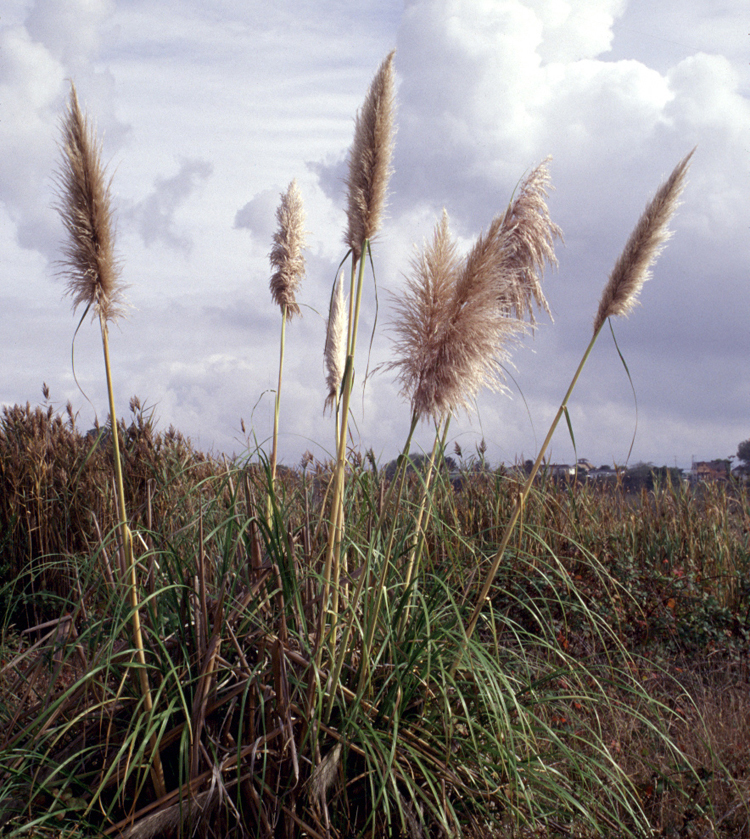
Cortaderia jubata is a species of grass known by several common names, including purple pampas grass and Andean pampas grass. It is similar to its more widespread relative, the pampas grass C. selloana, but it can get quite a bit taller, approaching seven meters in height at maximum.
This grass is native to the northern Andes but it is well-known elsewhere as an invasive species noxious weed. This grass has only pistillate parts, that is, all individuals are female. It reproduces by apomixis, in which embryos develop without fertilization.
Description
[edit]This pampas grass, Cortaderia jubata, has long, thin, razor-edged leaves forming a large bunch grass tussock from which the eye-catching inflorescences arise. At the top of a stem several meters in height is an inflorescence of plumelike spikelets. These panicles are pink or purplish when new and they gradually turn cream or white. Each inflorescence is packed full of fruits which develop despite the plant's having never been fertilized. Each plant produces millions of seeds per year. They disperse easily by several methods, including wind, water, and soil transport.
Invasive species
[edit]New Zealand
[edit]In New Zealand C. jubata is listed on the National Pest Plant Accord prohibiting it from sale, and commercial propagation and distribution.[1]
United States
[edit]Cortaderia jubata grows well in the conditions provided by the cool, moist California coast, where it was presumably an introduced species as an attractive ornamental plant.[2] It is a common weed of Redwood National and State Parks, the Central Coast region, and Big Sur, as well as other coastal hillsides and roadsides throughout the state. The plant competes with native vegetation, interferes with the natural scenery of the unique ecosystems and habitats (i.e. redwood and coastal sage scrub), harbors pest species such as rats, and produces large amounts of dry foliage which is a wildfire hazard.
European Union
[edit]The plant features on the list of invasive alien species of Union concern.[3] This means that it cannot be traded anymore.[4]
Invasion biology
[edit]C. jubata is morphologically similar to the related invasive plant, C. selloana.[5] The invasion success of both is most strongly limited by mammalian herbivory.[5][6]
References
[edit]- ^ "National Pest Plant Accord 2008" (PDF). 2008. Archived from the original (PDF) on 2008-10-15. Retrieved 2009-01-26.
- ^ Stephenson, John R.; Calcarone, Gina M. (1999). "Factors Influencing Ecosystem Integrity". Southern California Mountains and Foothills Assessment: Habitat and Species Conservation Issues. General Technical Report GTR-PSW-172. Forest Service, United States Department of Agriculture. p. 82.
- ^ "List of invasive alien species of European concern". June 2021. Archived from the original on 2017-07-29.
- ^ "European Regulation on IAS". June 2021. Archived from the original on 2015-09-10.
- ^ a b Levine, Jonathan M.; Adler, Peter B.; Yelenik, Stephanie G. (2004). "A meta-analysis of biotic resistance to exotic plant invasions". Ecology Letters. 7 (10): 975–989. doi:10.1111/j.1461-0248.2004.00657.x. S2CID 85852363.
- ^ Lambrinos, John G. (2002). "The Variable Invasive Success of Cortaderia Species in a Complex Landscape". Ecology. 83 (2): 518–529. doi:10.1890/0012-9658(2002)083[0518:TVISOC]2.0.CO;2. ISSN 0012-9658. S2CID 86181848.
External links
[edit]
Cortaderia jubata
View on GrokipediaCortaderia jubata (Lem.) Stapf, commonly known as pink pampas grass or jubata grass, is a large, tufted perennial grass in the Poaceae family characterized by dense basal rosettes of sharply serrated, bright green leaves up to 2 meters long and tall, plume-like inflorescences reaching 6 to 7 meters in height, primarily producing purplish or pinkish female flowers.[1][2]
Native to the Andean slopes of Ecuador, Peru, Bolivia, and northern Argentina, where it inhabits montane grasslands and forest edges at elevations of 1,000 to 3,500 meters, C. jubata was introduced to Europe in the late 19th century as an ornamental plant and subsequently spread to regions like California, Hawaii, and parts of Australia and South Africa.[2][3]
Outside its native range, it exhibits aggressive invasive behavior, forming dense monospecific stands that outcompete native vegetation through prolific seed production—up to 100,000 wind-dispersed seeds per inflorescence—and rapid growth, leading to significant ecological disruptions including altered fire regimes, reduced biodiversity in coastal scrub and riparian habitats, and increased fuel loads that exacerbate wildfire intensity.[2][4][5]
Listed as a noxious weed in multiple jurisdictions, including California, Hawaii, and Oregon, control measures emphasize mechanical removal, herbicide application, and prevention of seed set, though its persistence via root crowns and soil seed banks poses ongoing management challenges.[3][5][6]
Taxonomy
Classification
Cortaderia jubata is a species in the grass family Poaceae, subfamily Danthonioideae, tribe Danthonieae, and genus Cortaderia.[7] The genus Cortaderia comprises approximately 20 species, all native to South America as wild plants.[3] The species is formally named Cortaderia jubata (Lem.) Stapf, with the basionym attributed to Lemoine and the combination to Stapf. Within the genus, C. jubata is distinguished from the closely related C. selloana primarily by its reproductive mode and cytological features; C. jubata exhibits facultative apomixis, resulting in predominantly female populations that produce viable seeds parthenogenetically without requiring male gametes, whereas C. selloana is dioecious with separate male and female plants.[8][9] This apomictic strategy correlates with a higher chromosome number of 2n = 108 in C. jubata, compared to 2n = 72 in C. selloana, as confirmed by cytogenetic analyses.[3][8] Empirical studies on natural and introduced populations underscore this genetic uniformity in C. jubata due to apomixis, with seeds genetically identical to the maternal parent.[9]Etymology and synonyms
The genus name Cortaderia derives from the Argentine Spanish term cortadera, meaning "cutter," in reference to the sharp, serrated edges of the leaves that can cut skin.[10][11] The specific epithet jubata originates from the Latin jubatus, meaning "maned" or "crested," alluding to the feathery, plume-like inflorescence that resembles a mane.[12] The species was first described as Gynerium jubatum by Victor Lemoine in 1879 and later transferred to Cortaderia by Otto Stapf, who validly published it in Curtis's Botanical Magazine in 1898 (tab. 7607).[13][12] A junior synonym is Cortaderia atacamensis (Macloskie) Parodi, based on material from the Atacama region, though C. jubata is the accepted name in major floras.[2] Common names include purple pampas grass, pink pampas grass, jubata grass, and Andean pampas grass, the latter reflecting its native Andean distribution.[10][14] These names often overlap with those of Cortaderia selloana in horticultural trade, leading to misidentification; C. jubata plumes tend toward pinkish-purple tones, distinguishing it from the silvery-white of C. selloana.[15][16]Description
Morphology
Cortaderia jubata is a robust perennial grass forming dense basal tussocks up to 1.5 m in diameter. Culms are erect, 2-4 m tall, and 3-6 mm in diameter, with glabrous internodes and brown nodes. Leaves are primarily basal, bright green, linear, and numerous, reaching 1-2 m in length and 4-12 mm in width; blades are flat to conduplicate, stiff, glabrous, with sharply serrated margins capable of inflicting cuts, and pubescent sheaths lacking auricles; ligules measure 1-2 mm long.[3][17][18] The inflorescence consists of a single, terminal, densely contracted ovate panicle, 30-60 cm long and 10-15 cm wide, with primary branches 20-30 cm long; it emerges from subtending leaves on long peduncles and nods under its weight. Panicles feature silky female florets, initially deep violet to purple, maturing to pinkish then creamy white or tan, with persistent plumes that remain intact through winter in temperate climates. Plants produce only morphologically female spikelets, each 14-18 mm long with numerous florets.[3][4][10] Morphological characteristics exhibit low variation across populations, with consistent tussock form, leaf dimensions, and inflorescence color as documented in herbarium specimens; height may reach up to 7 m in optimal conditions but averages 3-4 m.[19][20][17]Reproduction and phenology
Cortaderia jubata reproduces primarily through seeds produced via agamospermous apomixis, an asexual process in which unfertilized female flowers develop viable embryos genetically identical to the parent plant.[8] All individuals are functionally female, lacking male flowers and relying on apospory where nucellar cells form unreduced embryo sacs.[21] This mechanism enables high reproductive output without pollinators or genetic recombination.[4] A single large plant can produce over one million seeds annually, with individual inflorescences yielding up to 100,000 lightweight, plumed seeds adapted for wind dispersal.[22] Seed viability persists for 9–12 months under field conditions, though only 20–30% achieve sufficient size for optimal germination.[23][24] Seedling establishment dominates population expansion, as evidenced by prolific first-year flowering and clonal seedling proliferation.[8] Vegetative reproduction occurs infrequently via fragmented tillers or short rhizomes that root in moist soils, but lacks the scale of seed-based spread.[22] Clumps expand slowly through basal tillering rather than aggressive rhizomatous growth.[25] Phenologically, inflorescences emerge from late July to September in Mediterranean climates like California, with plumes maturing into October and capable of flowering twice per season in vigorous plants.[8][3] This timing aligns with dry-season onset in native Andean habitats, facilitating seed release before winter rains, though introduced populations may initiate blooming earlier relative to co-occurring congeners.[26]Native range and ecology
Geographic distribution
Cortaderia jubata is native to the Andean regions of South America, spanning Ecuador, Peru, Bolivia, northern Argentina, and possibly Chile.[3][2] In Argentina, it occurs in the provinces of Catamarca, Jujuy, La Rioja, and Tucumán.[3] The species is distributed along the Andean cordillera, primarily in montane zones.[9] Within its native range, C. jubata grows at elevations typically between 2000 and 3900 meters, with some records indicating a narrower band of 2800 to 3400 meters.[27][9] This high-altitude distribution aligns with the species' occurrence in upper montane grasslands and shrublands of the Andes.[22]Habitat and ecological role
_Cortaderia jubata occurs natively in montane regions of the Andes across Peru, Bolivia, Ecuador, and northern Argentina, primarily at elevations between 2,000 and 3,900 meters. It favors disturbed habitats such as eroded banks, cliffs, road cuts, and areas along mountain streams, where it benefits from moderate moisture availability during the growing season. The species establishes on diverse substrates including rocky outcrops of shale, serpentine, quartz diorite, sand, and clay, demonstrating tolerance for nutrient-poor soils as long as light exposure and summer precipitation are adequate; its deep root system enables drought tolerance, but it avoids persistently waterlogged conditions.[3][28][29] In native Andean ecosystems, C. jubata forms persistent tussocks that occupy open grasslands and shrubland margins, competing with surrounding vegetation through shading from its height (up to 3 meters) and effective colonization of bare soil via wind-dispersed seeds. This pioneer strategy allows it to integrate into dynamic, disturbance-prone environments without achieving unchecked dominance, as local herbivores, competitors, and environmental constraints maintain ecological balance—factors often absent in introduced ranges. Observational accounts note its occurrence in grassland valleys of tropical to cool temperate mountainous zones, underscoring coexistence driven by site-specific moisture and substrate variability rather than suppression of associates.[28][5]Introduction history
Pathways of spread
Cortaderia jubata was initially dispersed through human-mediated ornamental horticulture in the late 19th century, primarily as a garden plant valued for its striking inflorescences. It was first cultivated in Europe, with records of trials in France and Ireland dating to the 1890s, and subsequent plantings in the United Kingdom.[30][31] These introductions involved seed and plant material traded among botanical gardens and nurseries, facilitating establishment beyond its native Andean range in South America.[32] Following early ornamental use, intentional plantings for practical purposes contributed to further spread in the early 20th century. In New Zealand and Australia, C. jubata was sown post-1900 for livestock forage during dry periods and for soil stabilization on erosion-prone slopes, leveraging its tussock-forming growth habit.[3][33] Similar applications occurred in California, where it served as supplemental cattle feed and windbreak material, though these efforts often led to unintended escapes from cultivated sites.[4] Once established, secondary dispersal occurs mainly via wind, which carries lightweight, plumed seeds over distances of several kilometers, though this vector is subordinate to initial human transport.[9] Bird-mediated spread is negligible, with no verified records attributing significant long-distance movement to avian vectors in introduced ranges; human activities, including contaminated equipment and road corridors, amplify local propagation.[32][5]Early cultivation records
Cortaderia jubata gained early traction in horticulture for its ornamental appeal, particularly its pinkish-purple plumes that flowered more rapidly than related species like Cortaderia selloana, making it attractive for nursery propagation and sales. In New Zealand, the species was introduced in the 1930s as a garden plant and subsequently promoted for practical uses, including shelterbelts to protect livestock and as supplementary fodder for cattle during the 1950s, with government-endorsed trials evaluating its growth on various soils like coastal sands and pumice.[34][35] In California, cultivation records trace back to at least the mid-20th century, with the plant valued in landscaping for its tall, feathery inflorescences and promoted through nursery trade; it was also trialed as forage for cattle, as documented in agronomic studies from 1949.[28] By the 1960s, commercial availability supported widespread adoption in coastal regions, though initial escapes were noted in disturbed sites like cut-over redwood forests in Humboldt County, providing early empirical evidence of its propensity to naturalize beyond plantings.[36] Horticultural imports to Hawaii in the early 1960s, primarily via ornamental trade channels, included germplasm trials that facilitated its establishment; these efforts preceded widespread recognition of escapes, with the species naturalizing soon after due to prolific asexual seed production viable without pollination.[37][38] Pre-1980s endorsements in regions like New Zealand and Australia similarly highlighted its utility for erosion control and windbreaks, reflecting a rationale centered on rapid establishment and low maintenance in open landscapes.[4] By the 1990s, accumulated observations of persistent escapes from these early plantings prompted reevaluation, though initial cultivation emphasized its aesthetic and functional benefits over potential risks.[19]Uses and economic value
Ornamental applications
Cortaderia jubata is valued in ornamental horticulture for its bold, fountain-like growth habit, featuring long, arching leaves that form dense clumps up to 6 feet wide and 10-13 feet tall, crowned by showy, silky pinkish-purple plumes emerging from late summer to fall.[39] These plumes, which can add 2-3 feet to the plant's height, provide dramatic visual interest and texture in large-scale landscapes, particularly in coastal or Mediterranean-style gardens where its fast growth and hardiness enhance aesthetic appeal.[39] [33] The species exhibits notable drought tolerance once established, making it suitable for xeriscaping in temperate and subtropical regions with mild winters, such as coastal California, where it thrives in full sun and well-drained soils without frequent irrigation.[33] Its persistent dried foliage and plumes offer winter structure and seed heads that attract birds, adding seasonal versatility to plantings.[26] Additionally, the plant's height and density serve as an effective privacy screen in expansive gardens or along boundaries, deterring access with its sharp-edged leaves.[40] Introduced commercially to the United States in the late 1800s, C. jubata saw use in landscaping for its vigorous performance, with nurseries favoring it for rapid maturation in containers prior to widespread restrictions.[39] [26] However, named cultivars remain rare, with most applications relying on seed-propagated stock, which limits genetic diversity in cultivated specimens and has contributed to its decline in the trade following sales bans in regions like California since the early 2000s.[41]Practical benefits like erosion control
Cortaderia jubata's fibrous root system and dense tussock growth enable soil stabilization on slopes and disturbed terrains, contributing to erosion control in human-modified landscapes.[3] Historical plantings for land protection have demonstrated reduced soil loss in sites with high erosion risk, such as coastal dunes and roadside embankments, where rapid establishment outpaces many native species under initial disturbance conditions.[3] In Australia and South Africa, introductions of Cortaderia species, including C. jubata, targeted shelter belts and erosion mitigation around industrial sites, leveraging the plant's tolerance for poor soils and ability to bind substrates with roots extending over 1 meter deep.[3] Early evaluations in introduced ranges assessed C. jubata for livestock forage and windbreak shelter, though its coarse foliage and high silica content result in low palatability, limiting consumption to under 10% of available biomass in grazing trials compared to preferred grasses.[42] Quantifiable benefits include documented reductions in gully erosion rates by up to 50% in pre-invasion plantings on mine tailings, where the species' quick colonization—achieving 2-3 meters height within two years—provided interim cover absent slower natives.[3] In short-term applications on degraded lands, these traits offer causal advantages for rapid stabilization over native alternatives, which often fail to compete in nutrient-poor, exposed settings without supplemental intervention.[3]Introduced ranges and invasiveness
Regional distributions
Cortaderia jubata has established in multiple non-native regions, particularly in coastal and montane habitats conducive to its growth. In the United States, it is most prevalent along the California coast, with the earliest herbarium record from 1963 in San Luis Obispo County, followed by rapid spread into disturbed sites, dunes, and fog-moderated inland areas up to elevations exceeding 1,000 meters. Occurrences are less extensive in Oregon, where it is listed as noxious, and in Washington, with initial escaped records documented in King County in 2001. In Hawaii, naturalized populations occur on islands including Maui and formerly on Hawaiʻi Island, where eradication was achieved in 2020 after detections spanning at least 13 years; it remains on the state noxious weed list. In Oceania, C. jubata is naturalized on New Zealand's North Island and northern South Island, stemming from ornamental plantings, and is now banned from sale, propagation, and distribution under national regulations. In Australia, it naturalizes as an environmental weed in New South Wales, Victoria, Tasmania, and Western Australia, favoring similar coastal conditions, while in South Australia it holds alert status as a declared species requiring eradication upon detection. In Africa, C. jubata is invasive in South Africa, classified as Category 1b under the National Environmental Management: Biodiversity Act (NEMBA), mandating control by landowners where present. Despite ornamental trials in Europe dating to the early 1800s, no widespread establishment has occurred in the European Union, with only isolated, non-self-sustaining occurrences reported; it remains unlisted as an invasive alien of EU concern but under monitoring for potential spread. Verified presences in other Pacific islands are sparse, though risks are noted in suitable climates. Distribution mapping by Cal-IPC highlights dense coastal infestations in California, while CABI records emphasize montane and riparian preferences across introduced ranges.Factors enabling invasion
Cortaderia jubata exhibits exceptional reproductive capacity that facilitates its invasive spread. All individuals are female and reproduce via agamospermous apomixis, enabling the asexual production of viable seeds without fertilization or male plants, resulting in genetically uniform offspring that maintain invasive traits.[4][23] Individual plants produce up to one million seeds per inflorescence, with plumes adapted for long-distance wind dispersal, potentially carrying seeds over 50 km.[43][44] Seeds lack primary dormancy and remain viable for approximately 9-12 months in the field, allowing rapid establishment upon dispersal.[23][45] The species demonstrates broad physiological tolerances that enable colonization of diverse and disturbed environments. It thrives in a wide range of soils, including nutrient-poor and sandy substrates, and tolerates varying moisture levels from low to high, as well as partial shade to full sun exposure.[4][46] Its pioneering nature allows rapid growth and outcompetition of native vegetation in disturbed sites, such as bare ground created by erosion or mechanical activity, where seedling establishment is fastest.[47] Adapted to USDA hardiness zones 7-10, it persists in cool temperate to subtropical climates but benefits from human-mediated disturbances like roadsides and forestry operations, which are limited in its native Andean range and thus enhance invasion potential in introduced areas.[5][3] Empirical distribution models indicate that warming climates could expand suitable habitats, predicting increased invasion risk through enhanced germination and survival under projected temperature rises.[33] These factors collectively confer a high propagule pressure and competitive edge, independent of biotic interactions prevalent in native ecosystems.[3]Ecological and environmental impacts
Effects on native biodiversity
Cortaderia jubata establishes dense monospecific stands exceeding 75% cover in coastal habitats, displacing native vegetation by eliminating understory layers and outcompeting for light, water, and nutrients.[48] In California chaparral ecosystems, invasions reduce native shrub species richness, transforming diverse shrublands into structurally simplified perennial grasslands lacking native woody undergrowth.[5] This displacement extends to ground covers, forbs, and grasses, with the invader's tussock-forming growth suppressing native seedling germination and establishment primarily through shading and physical exclusion.[5][4] Quantified observations in invaded California sites reveal C. jubata cover averaging 27% in chaparral, with progressive increases documented from 3% to 16% over nine years, correlating to native shrub cover declining from 80% to 62%.[5] While shrub diversity diminishes, herbaceous layer richness may rise due to disturbance-tolerant natives and other non-natives filling gaps, though overall native biodiversity declines as the invader dominates niches previously occupied by coastal scrub species.[5] In preserves and dunes, low-density patches expand to form persistent monocultures, threatening long-term native persistence by altering competitive dynamics and resource availability.[4][2] The grass experiences minimal herbivory owing to silica-reinforced leaves and serrated edges, conferring a competitive edge over palatable natives susceptible to grazing, further facilitating displacement in grasslands and scrub.[5] Such invasions reduce habitat structural complexity, potentially limiting niches for native pollinators and seed dispersers reliant on diverse understories.[5]Fire and other ecosystem risks
The dry inflorescences and persistent dead foliage of Cortaderia jubata contribute to elevated flammability, acting as ladder fuels that facilitate fire spread and increase flame heights in invaded coastal scrub and chaparral ecosystems. In California, stands of the grass have been documented to heighten fire intensity by producing substantial volumes of fine, dry biomass that ignites readily and sustains crown fires, deviating from the surface fires typical in uninvaded native shrublands. Empirical assessments assign C. jubata a high weed fire risk score of 0.72, reflecting its capacity to exacerbate wildfire hazards in Mediterranean-type vegetation. [49] [50] [48] Post-fire, C. jubata exhibits resilience through basal resprouting from protected meristems, enabling rapid re-establishment and dominance in burned sites where native perennials regenerate more slowly. This persistence impedes recovery of fire-adapted natives in coastal habitats, such as those supporting coast redwood (Sequoia sempervirens), by preempting space and resources during critical recolonization windows, though pre-invasion fire baselines remain poorly quantified to assess net regime alteration. Such traits mirror fire tolerance in some native bunchgrasses, suggesting that while C. jubata amplifies fuel continuity, its impacts may partly overlap with inherent ecosystem dynamics rather than introducing wholly novel risks. [51] [52] Other potential ecosystem risks, such as allelopathy via chemical inhibition of native seed germination, lack direct empirical confirmation for C. jubata, with assessments finding no substantive evidence despite broader hypotheses in invasive grass literature. Hydrological alterations in invaded wetlands appear negligible, with minimal documented effects on water retention or flow compared to competitive displacement. [5]Management and control
Mechanical and chemical methods
Mechanical control of Cortaderia jubata primarily involves manual excavation of the entire root crown using tools such as shovels, mattocks, or pulaskis to disrupt basal meristems and prevent resprouting.[53][9] This approach is suitable for seedlings or small, accessible stands, where pulling or digging achieves complete removal if roots are fully extracted and allowed to desiccate.[53] However, it proves labor-intensive and ineffective for dense or large infestations due to the plant's extensive root systems and the risk of fragment regrowth if crowns remain intact.[54][9] Chemical methods rely on systemic herbicides, with glyphosate offering the most consistent results through foliar applications at 2% v/v for spot treatments or 8-10% v/v for low-volume sprays, applied in early summer prior to flowering or in fall to target actively growing tissue.[53][54] Field trials demonstrate ≥88% control rates with these glyphosate techniques, outperforming alternatives like sethoxydim, which showed negligible efficacy.[54] Imazapyr, applied at 2-4% v/v or via cut-stump at 50%, provides variable foliar control but reduces regrowth to 19% in stump trials compared to 49% for glyphosate, though its slow action (up to 1-2 years) and higher cost limit routine use.[53][55] Integrated approaches, such as cutting plumes pre-flowering to curb seed dispersal followed by herbicide application to regrowth or stumps, yield higher success for established plants by combining mechanical disruption with chemical translocation to meristems.[53][9] Despite these methods' efficacy in trials—evidenced by substantial reductions in accessible California coastal sites—persistent seed banks and potential resprouting demand repeated treatments over multiple years, with non-target effects on native vegetation requiring careful site-specific application.[54][55] Labor costs remain high for mechanical components, but chemical integration proves cost-effective for larger stands, as validated in UC Davis evaluations and analogous eradications in Hawaii's managed programs.[53][56]Biological and regulatory approaches
Cortaderia jubata is designated as a state noxious weed in California under 3 CCR Section 4500, prohibiting its sale, transport, or cultivation without permits.[2] In Hawaii, it appears on the state noxious weed list, rendering sale and inter-island transport illegal, with interagency efforts coordinated by the Hawaii Invasive Species Council to enforce restrictions and monitor spread.[49] Oregon classifies it as a 'B' listed noxious weed, targeting regionally abundant species of economic importance for control on public lands, though private property enforcement remains voluntary.[31] New Zealand lists it as a noxious weed, with bans on propagation and sale aimed at preventing further establishment, yet illegal trade in dried inflorescences persists due to weak enforcement.[53] These regulatory measures prioritize prevention through trade restrictions, as empirical assessments indicate that proactive bans reduce long-term invasion costs compared to post-establishment eradication, which can exceed prevention expenses by factors of 10 to 100 in similar grass invasions.[5] However, enforcement challenges undermine efficacy; for instance, ornamental demand sustains underground markets, and jurisdictional gaps between agencies hinder uniform compliance. Biological control efforts have yielded no approved agents for C. jubata, primarily due to host-specificity risks—potential non-target effects on native grasses or congeners like C. selloana complicate releases. Surveys in native South American ranges have identified candidate insects and pathogens, such as planthoppers and gall midges, but field trials in New Zealand and elsewhere found insufficient specificity or impact for approval.[58][31] Ongoing research emphasizes pre-release testing, yet limited funding and ecological uncertainties have stalled progress, leaving biocontrol unviable as a standalone strategy.[59] Debates surrounding regulations highlight tensions between ecological prevention and property rights; bans impose economic losses on nurseries reliant on ornamental sales, with U.S. assessments noting regulatory hurdles due to C. jubata's prior economic value in horticulture.[60] Critics argue that overreach in private land mandates disregards cost-benefit analyses favoring voluntary compliance, as forced removals yield marginal invasion reductions relative to market disruptions.[61] Proponents counter that unaddressed ornamental trade perpetuates infestations, with data from regulated regions showing slower spread rates post-ban implementation despite imperfect enforcement.[62]Ongoing research and debates
Recent studies on impacts
A 2017 genetic study of Cortaderia jubata populations in New Zealand revealed higher levels of genetic variation than previously estimated, despite the species' predominant apomictic reproduction, which produces genetically identical seeds via agamospermy without fertilization; this variation, detected through comparative analysis with prior surveys, suggests potential implications for invasion dynamics and biocontrol strategies, as clonal propagation alone would predict uniformity.[63] Apomixis dominance facilitates rapid spread, with field observations confirming high seed viability and dispersal distances up to 50 km, contributing to invasion rates deemed "quite high" by expert assessment in regions like California and New Zealand.[64][33] Climate suitability models indicate potential expansion under warming scenarios, with C. jubata projected to establish in broader European bioregions including Atlantic, Mediterranean, and Steppic zones, implying similar risks in coastal California and New Zealand where it already occupies disturbed habitats; however, empirical spread data post-2010 remains sparse, focusing more on qualitative observations than quantified rates.[33] Field trials on control efficacy, such as mechanical excavation, demonstrate effective removal of tussocks but highlight labor-intensive requirements and challenges in preventing resprouting from rhizomes, with no large-scale post-2010 trials quantifying long-term suppression rates.[54] Verifiable gaps persist in understanding long-term native biodiversity recovery following C. jubata removal, as post-2010 studies lack longitudinal data on ecosystem restoration; earlier observations noted native perennial emergence after eradication, but sustained monitoring is absent, underscoring uncertainty in causal links between removal and full habitat rebound.[9] These limitations emphasize the need for targeted empirical research prioritizing quantifiable metrics over anecdotal reports.Controversies over regulation and utility
The ornamental appeal of Cortaderia jubata, prized for its tall, feathery pinkish-purple plumes used in landscaping and dried floral arrangements, has clashed with regulatory efforts to curb its spread as an invasive species. In regions like California, where it infests coastal slopes and dunes, authorities such as the California Department of Fish and Wildlife have placed it on "Don't Plant Me" lists to discourage sales and propagation, though outright bans remain limited compared to stricter prohibitions elsewhere, such as South Africa's classification of it as a grade 1 invasive requiring eradication. Horticultural advocates argue that such measures overlook viable managed cultivation, including sterile hybrids or contained plantings, and impose undue restrictions on a plant with historical commercial value in the nursery trade, while critics from environmental groups contend that even ornamental use fuels seed dispersal, with one plant capable of producing over 1 million wind-blown seeds annually.[2][3][65] Economic debates center on the high costs of control—estimated within California's broader $82 million annual expenditure on invasive plants—versus potential utilities like erosion stabilization on steep bluffs, where C. jubata's dense tussocks have been noted to reduce soil loss more rapidly than some native alternatives in initial plantings. Property owners face significant burdens, including manual or chemical removal expenses that can exceed $0.28 per mature plant for large-scale treatments, often without reimbursement, prompting pushback that regulations prioritize ecological alarmism over practical landowner rights and the plant's past role in land rehabilitation projects. Environmentalists, citing dense infestations that exclude natives and heighten fire risks, advocate for mandatory eradication to avert long-term ecosystem degradation, whereas proponents of utility highlight insufficient baseline data on pre-invasion biodiversity to substantiate claims of irreversible "catastrophe," suggesting targeted management could balance benefits without blanket prohibitions.[66][67][3] Public perception surveys reveal divided views, with some respondents in invaded areas viewing C. jubata primarily as an attractive garden feature unaware of its invasiveness, fueling debates over education versus prohibition as the primary regulatory tool. In France, fines up to €150,000 for possession underscore aggressive enforcement, yet analogous tensions arise in the U.S., where horticulturists critique native grass substitutes as less effective for quick erosion control on disturbed sites, arguing that empirical evidence of widespread ecological collapse remains anecdotal without rigorous pre-establishment monitoring. These controversies underscore a broader causal tension: while invasion risks are empirically linked to seed longevity and vegetative spread, the net societal cost of forgoing utilities—such as in forage or windbreak applications—warrants scrutiny against potentially overstated doomsday narratives from advocacy-driven sources.[68][69][3]References
- https://www.[researchgate](/page/ResearchGate).net/publication/376679429_Cortaderia_selloana_an_example_of_aggressive_invaders_that_affect_human_health_yet_to_be_included_in_binding_international_invasive_catalogues