Hubbry Logo
CortaderiaCortaderiaMain
Open search
Cortaderia
Community hub
Cortaderia
logo
8 pages, 0 posts
0 subscribers
Be the first to start a discussion here.
Cortaderia
Cortaderia
from Wikipedia

Cortaderia
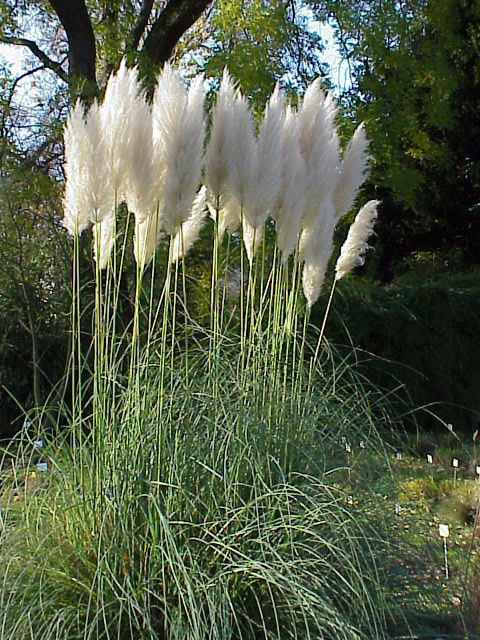
Cortaderia selloana
pampas grass
Scientific classification Edit this classification
Kingdom: Plantae
Clade: Tracheophytes
Clade: Angiosperms
Clade: Monocots
Clade: Commelinids
Order: Poales
Family: Poaceae
Subfamily: Danthonioideae
Tribe: Danthonieae
Genus: Cortaderia
Stapf[1][2]
Type species
Cortaderia argentea
(Nees) Stapf
Synonyms[3]
  • Lamprothyrsus Pilg
  • Moorea Lem.

Cortaderia is a genus of plants in the Poaceae or grass family of plants.[4][5]

All current species included in the Cortaderia genus are native to South and Central America, ranging from the Patagonia region of southern Chile and Argentina, to Costa Rica.[4][5] For many years, five species native to New Zealand were included in the genus, but since 2011 these have been since reclassified into the genus Austroderia containing only species native to New Zealand.[6][7]

Etymology

[edit]

The common name pampas grass, though strictly referring to C. selloana, is frequently applied to all species in the genus, as well as the five former members reclassied into the genus Austroderia (sometimes also to species of Erianthus and Saccharum ravennae). The name of the genus is derived from the Argentine Spanish word cortadera, which in turn refers to the sharp serrations on the leaves.[8] Cortaderia jubata and C. rudiuscula produce copious seed asexually.[9]

Description

[edit]

Cortaderia species are perennial grasses, characterised by robust culms and feathery inflorescent plumes held high above the foliage.Some species are relatively short, forming rounded hedgehog-like clumps less than 0.5 m tall, but many species, including Cortaderia selloana and Cortaderia jubata form wide tussocks, up to 4 m tall. Rhizomes or stolons are rare but some species, particularly the taller species, can form tussocks almost as wide as their height.[10][11][12]

Across South America, the genus is a major component of the C3 temperate grasslands, from Tierra del Fuego in the far south, north to Venezuela (with some species extending to Costa Rica). They can be found from the Serro do Mar Atlantic coastal mountains near Rio de Janeiro to the Andes in Ecuador. At the southern extreme, species naturally grow at sea level, and in the Andes, certain species can be found growing up to 4500 m at the equator, where they make up a major component of paramo habitat.[10][12]

Cultivation

[edit]

Horticulture

[edit]

Several species of Cortaderia have been extensively planted in gardens or cultivated landscapes around the world, particularly Cortaderia selloana, having been planted as an ornamental garden plant outside of South America since the 19th century.[13][14]

Many varieties or selections of Cortaderia selloana are or have been available, including variegated, silver leaved and dwarf varieties. The following varieties have received an Award of Garden Merit (AGM) by the Royal Horticultural Society (RHS): 'Silver Feather',[15] 'Pumila',[16] 'Patagonia',[17] 'Montrosa',[18] 'Evita',[19] 'Aureolineata',[20] and 'Sunningdale Silver'.[21]

Non-ornamental uses

[edit]

Cortaderia jubata, and to a lesser extent Cortaderia selloana, can be used as green forage during dry summer months being able to be grazed to 30-50cm of the plant's base and be used as a substitute for hay, with plants having been used in the past for forage in New Zealand and California.[22][23][24][25][26] Both species have also been used as a means of erosion control and planted as a windbreak and to provide shelter.[9][27][25][26]

As invasive species

[edit]

Cortaderia selloana and Cortaderia jubata are considered invasive species in several disjunct parts of the world, capable of forming dense, often impenetrable, stands, and can damage grazing lands, interfere with afforested areas, affect visibility on roads and hinder access to certain natural areas, such as the margins of streams.[25][26] In parts of the world with high forest or bush fire risk, the build up and slow decomposition of leaf litter and standing dead leaves produce large amounts of flammable material and increase fire-related hazards.[27][25][26]

In regions where either species is considered invasive, plants are able to rapidly colonize areas, including grassland plains, dunes, sparse shrublands and riverine habitats, particularly those that have been disturbed or altered by humans in the past, such as disused farmland or afforested land.[25][26]

Cortaderia selloana is considered invasive on the Atlantic coast of Europe across an 'Atlantic arc' ranging from Portugal to France, particularly in the Cantabria province of Spain.[26][28][29] In California, it is recorded as having colonized land in at least 19 counties.[30] It also occurs in many Micronesian islands, South Africa and Hawaiian islands, being classed as a noxious species in New Zealand and some states of Australia.[26] It is one of the emerging invasive species with the greatest potential range in South Africa, Lesotho and Swaziland, especially in grasslands.[26][31]

Cordateria jubata, has similarly escaped from cultivation and become problematic especially in Australia, South Africa, New Zealand and parts of the United States. C. jubata is listed as a noxious weed in California, Hawaii and Oregon, and as a grade 1 invasive species in South Africa.[25][9]

List of Cortaderia species

[edit]
Currently accepted species[3]
Formerly included species[3]

see Austroderia Chionochloa Chusquea Phragmites

References

[edit]
[edit]
Revisions and contributorsEdit on WikipediaRead on Wikipedia
from Grokipedia
is a of approximately 25 of C3 tussock grasses in the Danthonioideae of the family, native primarily to the temperate and tropical-alpine regions of , with a few endemic to . The plants form dense clumps with robust, erect culms often exceeding 2 meters in height, topped by large, plumose that serve for wind-dispersed propagation, and leaves that are tough, linear, and sharply serrated along the margins. The most economically significant , , originates from riverine and damp habitats in , , , and , where it grows in sandy soils with ample moisture and sunlight. Introduced globally as an ornamental for its tall, silvery-white plumes used in and floral arrangements, it has established invasive populations in coastal dunes, bluffs, riparian zones, and disturbed areas across regions including , , and , where it outcompetes native through high output—up to 100,000 seeds per plant annually—and rapid clonal growth. This invasiveness, coupled with physical hazards from razor-sharp leaves and silica-reinforced blades that cause lacerations, has led to widespread eradication efforts, though control remains challenging due to the plant's tolerance for , drought, and poor soils once established. Related such as , native to Andean regions of , exhibit analogous ecological impacts in invaded Mediterranean climates, further underscoring the genus's potential for disrupting and altering regimes.

Taxonomy

Etymology

The genus name Cortaderia originates from the Argentine Spanish word cortadera, which translates to "cutter" and refers to the sharp, serrated leaf margins capable of inflicting cuts on skin. This term derives from the Spanish cortar ("to cut"), ultimately tracing back to Latin curtare ("to shorten"). The name was formalized in New Latin as Cortaderia by Stapf in 1897, with the -ia suffix typical for botanical denoting a collective group of sharing the referenced trait. Local indigenous names in , such as cola de zorro ("fox tail") in some regions, further highlight the plant's distinctive plume-like inflorescences but do not influence the scientific nomenclature.

Classification and Phylogeny

Cortaderia is classified in the family , subfamily Danthonioideae, and tribe Danthonieae. The genus comprises C3 tussock grasses primarily native to , with the name established by Stapf in 1897 to include large tussocks similar to C. selloana, previously treated under other genera. Phylogenetic analyses indicate that Cortaderia, in its current circumscription, forms a monophyletic group most closely allied to the "danthonioid" clade within Danthonioideae. Earlier molecular studies using and nuclear DNA sequences suggested , largely due to the inclusion of species now segregated into genera such as Austroderia ( taxa) and Chimaerochloa (New Guinean taxa), as well as the incorporation of South American Lamprothyrsus species into Cortaderia. A comprehensive 2017 revision recognizes 17 , organized into five informal groups based on morphological traits, , and supported by prior phylogenetic : the Selloana group (e.g., C. selloana, C. araucana), Lamprothyrsus group (e.g., C. hieronymi), Egmontiana group (e.g., C. egmontiana), Nitida group (e.g., C. nitida), and Bifida group (e.g., C. bifida). While these groupings align with available molecular evidence from studies such as Barker et al. (2003) and Pirie et al. (2009), the full phylogeny of the genus remains incompletely resolved due to limited sampling.

List of Species

The genus Cortaderia comprises 17 accepted , all native to except for one endemic, according to a 2017 synoptic taxonomic revision that delineates them based on morphological, anatomical, and distributional evidence.
  • C. araucana Stapf (southern Andean region)
  • C. selloana (Schult. & Schult. f.) Asch. & Graebn. (, , to ; gynodioecious, with subspecies selloana and jubata)
  • C. speciosa (Nees & Meyen) Stapf (Puna desert regions of , , ; apomictic)
  • C. hieronymi (Kuntze) N.P. Barker & H.P. Linder (central and northern to ; apomictic, long filiform awns)
  • C. egmontiana (Roem. & Schult.) M. Lyle ex Connor (southern , including ; compact inflorescences)
  • C. modesta (Döll) Hack. (eastern ; awnless lemmas)
  • C. vaginata Swallen (southern ; glabrous lemmas)
  • C. nitida (Kunth) Pilg. (, ; tall tussocks)
  • C. boliviensis M. Lyle ()
  • C. sericantha (Steud.) Hitchc. (; villous leaves)
  • C. pungens Swallen (; pungent leaves)
  • C. echinata H.P. Linder (; cushion-forming)
  • C. bifida Pilg. (, )
  • C. planifolia Swallen (; flat leaves)
  • C. hapalotricha (Pilg.) Conert (, )
  • C. columbiana (Pilg.) Pilg. (, )
  • C. roraimensis (N.E. Br.) Pilg. (; species)

Botanical Description

Morphology

Species of Cortaderia are perennial, C3 tussock-forming grasses in the Danthonioideae, typically developing dense clumps from short rhizomes or basal crowns. They exhibit caespitose growth habits, with erect culms arising from basal leaf rosettes and reaching heights of 1.5 to 4 meters. Leaves are primarily basal, numerous, and rigid, measuring 50-200 cm long and 3-8 mm wide, with blades that are flat to inrolled, tapering to stiff points. Margins bear sharp, silica-reinforced serrations capable of lacerating , while the upper surface near the may feature short hairs; sheaths overlap to form a persistent, fibrous crown that fractures with age. Inflorescences consist of terminal, panicle-like structures, 30-90 cm long, erect to slightly nodding, with densely crowded branches bearing silvery-purple to spikelets. Spikelets, 5-7 mm in length, contain two florets: the lower fertile and the upper reduced or staminate; many are dioecious, with producing fluffier plumes due to persistent lemma hairs aiding . Glumes are keeled and awn-tipped, lemmas 5-veined and short-awned, and anthers measure 2.5-3.5 mm in fertile florets. Fruits are glabrous caryopses, 1-1.5 mm long, enclosed within persistent paleas; dispersal is facilitated by the plume's structure, though viable production varies by sex and environmental factors.

Reproduction

Cortaderia exhibit diverse reproductive strategies, including hermaphroditism, , gynodioecy, and across the genus. predominates, characterized by -pollinated inflorescences that produce copious lightweight adapted for long-distance dispersal. In C. selloana, the most studied , plants are functionally : individuals lack stamens and produce seed-bearing ovaries, while hermaphroditic plants generate and limited viable , requiring cross-pollination from hermaphrodites for optimal seed set. Female C. selloana plants can produce up to 50 panicles per mature clump, with each yielding 100,000 or more , enabling a single clump to generate over one million annually. feature plumose lemmas with fine hairs that facilitate anemochory, allowing dispersal distances of up to 20 miles under favorable wind conditions. occurs rapidly upon disturbance or exposure to moisture, though remain viable for only a short period and do not form persistent banks. Vegetative propagation occurs via tiller fragmentation or basal shoot production, particularly in disturbed soils with adequate moisture, but remains secondary to seed-based spread in natural settings. In cultivation, division of mature clumps is the primary method for , bypassing . Apomictic reproduction, observed in some congeners like C. jubata, produces clonal seeds without fertilization, enhancing invasiveness by maintaining genetic uniformity.

Distribution and Habitat

Native Range

The genus Cortaderia comprises approximately 25 species endemic to , with distributions extending from the Andean regions of and in the north to the of southern and in the south, including the . Species occupy a latitudinal range from about 5°N to 55°S, encompassing tropical montane zones, subtropical lowlands, and temperate plains. Native occurrences are documented across multiple countries, including (northeastern, northwestern, and southern provinces), , (northern, southern, and southeastern regions), (central and northern areas), , , , , and . For instance, C. selloana, the most widespread species, is recorded in , , , and , while C. jubata ranges through , , , , northern , and northwestern . In native habitats, Cortaderia species thrive in open, disturbed, or semi-natural ecosystems such as grasslands, Andean slopes at elevations up to 4,000 meters, coastal sand dunes, riverbanks, and scrublands, typically on well-drained soils from to 1,900 meters or higher. These grasses often form dense stands in fertile regions, contributing to the structure of communities adapted to seasonal flooding and fire regimes.

Introduced and Naturalized Range

, the most widely introduced species in the genus, has established naturalized populations across multiple continents following its ornamental planting in the . It is naturalized in parts of , including , , , and the archipelago, as well as in , , , Georgia, and . In , it has become established in , where it was first introduced in 1848, and occurs sporadically in other regions like . Cortaderia jubata, native to the Andean regions, has a more restricted introduced range but is notably invasive in coastal California, favoring dunes, bluffs, and disturbed sites influenced by fog. It is also listed as a noxious weed in Oregon, Hawaii, and Washington State, with populations in riparian and forestry areas. Other Cortaderia species remain largely confined to their native South American habitats, with limited evidence of elsewhere; introductions of species like C. rudiuscula or C. pilosa are rare and typically fail to establish self-sustaining populations outside cultivation. In regions like the , C. selloana was first recorded wild in 1925 after cultivation since 1848, but populations remain localized and not broadly naturalized.

Ecology

Life Cycle and Growth

species are long-lived grasses forming dense tussocks through tillering and limited rhizomatous spread, with individual genets persisting up to 15 years. exhibit rapid overall growth, achieving heights of 2–4 m and widths of 1–2 m in mature clumps. Vegetative development relies on basal production and extension, with leaves reaching 60–200 cm in length and featuring sharp, serrulate margins. The life cycle begins with seed germination, which occurs readily without under optimal conditions of 20–30°C and adequate , yielding germination rates up to 100%. establish quickly, with heights increasing 1–2 m in the first year on disturbed, well-lit sites, tolerating stress where 66% survive 41 days without water. Initial seedling growth is slow for some subspecies but accelerates with resource availability, transitioning to robust tussock formation via short lateral rhizomes extending up to 6 m. Reproductive phenology features flowering from late June to August in temperate invaded ranges, producing large panicles up to 1 m long with approximately 1,000 spikelets per . Female plants, predominant in many populations, mature seeds 3–4 weeks post-flowering, yielding up to 400,000 viable seeds per plant, though viability declines sharply within . Growth rates vary with environmental factors, including disturbance and nutrient levels, with cutting or herbivory reducing leaf extension and reproductive output through trade-offs in . persistence allows repeated flowering cycles, often annually after maturation, supporting population expansion primarily via recruitment rather than extensive clonal .

Interactions with Ecosystems

In its native range across temperate , including the of , , southern , and , Cortaderia selloana integrates into and ecosystems, where it occupies disturbed sites and contributes to vegetation structure through tall, tussock-forming growth that may aid via extensive rhizomes. Empirical data on specific biotic interactions remain sparse, but the species coexists with native herbivores and supports regional without evidence of dominance-driven exclusion, as natural enemies such as regulate populations. In introduced and naturalized regions, such as , , and , C. selloana exhibits antagonistic interactions that disrupt dynamics. It forms dense monocultures that outcompete native for light, , and nutrients, suppressing local diversity by up to 50-70% in invaded patches according to field surveys in Mediterranean climates. This reduction cascades to lower overall , as the grass's prolific production—up to 1 million viable seeds per annually, dispersible over several kilometers—facilitates rapid of open habitats, altering successional trajectories and excluding early-seral natives. The modifies abiotic processes, notably regimes, by accumulating high of dry, flammable foliage that serves as ladder fuel, intensifying spread and frequency in invaded grasslands; simulations indicate it can increase heights and post- invasion success under disturbance. interactions involve potential shifts in properties like retention and microbial communities due to accumulation, though causal mechanisms require further verification beyond correlative studies. Faunal interactions are largely negative in non-native ecosystems, with sharp, silica-reinforced leaf margins deterring herbivory and posing injury risks to , including birds and small mammals, while reducing suitable nesting or foraging habitat through habitat homogenization. Food web alterations occur as native pollinators and decomposers face diminished resources, contributing to C. selloana's high global impact score (ranked top among assessed alien grasses for ecological disruption). No significant positive interactions, such as mutualistic associations, have been documented in invaded areas, underscoring its role as a transformer species.

Invasive Characteristics and Empirical Impacts

Cortaderia selloana exhibits invasive traits including prolific seed production, with individual plants capable of generating up to 1 million wind-dispersed annually, and high rates of 69-79%. These enable rapid of disturbed sites such as roadsides, dunes, and riparian zones, while vegetative spread via rhizomes and tillering forms dense monocultures that outcompete native through superior acquisition, including elevated water and use efficiencies under nutrient-limited conditions. The reproduces within its first year and tolerates a broad range of environmental stressors, including drought, frost, and poor soils, facilitating persistence and expansion in both natural and anthropogenic habitats. Empirically, C. selloana invasions reduce native plant species richness, diversity, and cover by displacing established communities and altering soil nutrient dynamics, as documented in Mediterranean ecosystems where invaded sites show decreased availability and shifts in microbial activity. It achieves the highest overall ecological impact score among invasive alien grasses in comparative assessments, primarily through competitive exclusion and modification. Dense stands increase hazards by accumulating flammable dead foliage, which ignites readily and supports high-intensity fires, while the plant's post-fire resilience—recovering nearly full within two years—exacerbates fuel loads in subsequent cycles, particularly in coastal and ecoregions. These effects threaten hotspots, including habitats in , by homogenizing vegetation structure and disrupting ecosystem processes like nutrient cycling and corridors.

Human Interactions

Historical Introduction and Cultivation

Cortaderia selloana, the most widely cultivated species in the genus, is native to the Andean regions of , including parts of , , and . It was first introduced to European around the mid-19th century by James Tweedie, a Scottish botanist and plant collector based in , who shipped specimens to Britain circa 1840–1850 for ornamental purposes. Cultivation in began by 1848, initially in nurseries and gardens, with the plant valued for its tall, feathery plumes and . By the late 19th century, C. selloana had spread to other temperate regions, including , where nurserymen introduced it to , in 1848 for commercial plume production and landscaping. In , it arrived as an ornamental and fodder plant during the 1800s, while in , cultivation started in 1925 but remained limited to gardens initially. Early adopters prized its architectural form and adaptability to coastal and Mediterranean climates, though naturalization beyond cultivation sites was not widely documented until the 1920s in places like Britain and . Cultivation of Cortaderia , particularly C. selloana, typically involves vegetative to control spread and select for female , which produce non-viable seeds and thus reduce invasiveness risks; methods include dividing established tussocks in early spring or fall, where rhizomes are separated into sections with and shoots. is possible via fresh seeds in well-drained, sandy under full sun, with favored at temperatures of 20–25°C, though this risks producing hermaphroditic capable of seeding. thrive in USDA zones 7–10, requiring minimal watering once established, neutral to slightly acidic 5.5–7.5), and occasional fertilization with balanced nutrients in spring; they form dense clumps up to 3–4 meters tall, with plumes emerging in late summer. from immature inflorescences using growth regulators has also been employed commercially for uniform stock production.

Ornamental and Economic Uses

Cortaderia selloana is extensively utilized in ornamental landscaping for its tall, arching form and large, feathery plumes, which provide visual interest, texture contrast, and height in gardens, parks, and public spaces. It serves as a specimen plant or focal point, often planted against backdrops to highlight its silvery-white or pinkish inflorescences that emerge in late summer and persist into winter. The dried plumes are harvested for use in floral arrangements and decorative displays, contributing to its popularity in horticulture since the Victorian era. Additionally, its dense growth makes it suitable for privacy screens, windbreaks, and erosion control on slopes, though its size—reaching 3-6 meters in height—limits it to large-scale applications. Economically, C. selloana has been commercially cultivated primarily for ornamental purposes, with production beginning in in 1874 near , where nurserymen propagated it for plume and sales. Fibers extracted from its leaves have been used traditionally for , yielding a material suitable for coarse papers due to the plant's lignocellulosic content. Emerging research explores its fibers as reinforcements in composites, such as or wood-plastic materials, leveraging properties like high tensile strength and thermal stability, though these applications remain experimental rather than scaled commercially. In its native South American range, limited use has been noted, but its low nutritional value and sharp leaves restrict viability. Overall, economic value derives mainly from ornamental trade, with fiber uses secondary and constrained by the ' invasive tendencies in non-native regions.

Non-Ornamental Applications

The leaves of provide a coarse used in , harvested in autumn by cutting into pieces, soaking, boiling into pulp, and forming sheets. This exhibits lightweight properties and adequate tensile strength, with chemical analyses revealing content around 40-50% suitable for composite reinforcement or basic production. Cultivation for this purpose occurs sporadically in regions where the plant grows abundantly, though commercial scale remains limited due to processing challenges and competition from wood pulps. Due to its tall, dense tussock form reaching 3-4 meters, C. selloana serves in non-ornamental barrier and plantings, stabilizing against wind in medians, industrial sites, and large-scale landscapes. Its and foliage density contribute to these functions, though sharp margins limit broader adoption. In native South American ranges, the has been noted for occasional fodder use in feeding, supplemented by other grasses to mitigate injury from silica-rich, serrated leaves. Emerging applications for invasive stands include conversion to via hydrothermal processes, enabling energy recovery during eradication efforts, with trials demonstrating seed inactivation at 100°C while yielding combustible residues.

Controversies and Management

Debates on Invasiveness

The invasiveness of Cortaderia selloana is subject to debate concerning the species' variable ecological effects across regions and the proportionality of strict regulatory responses relative to documented harms. Empirical studies confirm its capacity to form dense monocultures that suppress native , alter properties, and heighten hazards in Mediterranean climates, such as , where it displaces vegetation in riparian zones and roadsides. However, critics argue that impacts are often concentrated in disturbed or anthropogenically influenced sites rather than pristine ecosystems, potentially overstating threats to intact when establishment relies on prior degradation. A key point of contention arises from regional discrepancies in spread dynamics. In , a study spanning 2002–2013 documented 241 planted stands and 853 naturalized populations across 600 km², yet fewer than 15% of naturalized individuals encroached into natural habitats, primarily at edges of reed beds, with no significant expansion into core native areas over the decade. This limited dispersal from urban sources—despite massive ornamental introductions—suggests that climatic or competitive factors may constrain invasiveness in some temperate zones, prompting questions about universal risk assessments that extrapolate from high-impact locales like or . Regulatory debates intensify around bans, such as France's prohibition since 2017, which carries fines up to €150,000 for possession or sale, justified by precautionary concerns over but contested for ignoring context-specific evidence of containment. Similarly, while proposed for the European Union's invasive alien list, C. selloana remains excluded as of 2024, reflecting ongoing evaluation of its transboundary risks versus localized data showing persistence without ecosystem-wide dominance in parts of . Public surveys among environmentally aware respondents in and indicate widespread recognition of invasiveness (over 80% awareness), yet continued private cultivation highlights tensions between ecological caution and ornamental utility, with some viewing bans as disproportionate given viable sterile cultivars or low seed viability in certain conditions. These discussions underscore causal factors like wind-dispersed seeds (up to 100,000 per plume) enabling opportunistic of disturbed soils, but empirical studies reveal limits in competitive native settings, fueling arguments for targeted management over broad prohibitions. Proponents of stringent controls cite global impact scores ranking C. selloana highly among aliens for combined environmental and socioeconomic effects, while skeptics emphasize the need for region-specific metrics to avoid conflating presence with harm.

Control Strategies and Costs

Mechanical control involves hand-pulling or uprooting small plants and seedlings, using tools such as shovels or mattocks to remove the entire and prevent resprouting; this method is labor-intensive but effective for isolated infestations under 1,000 m². For larger stands, excavators or backhoes can uproot and bury plants, particularly in accessible areas, though soil disturbance risks promoting germination and requires follow-up monitoring. Cutting inflorescences before seed set reduces spread, often combined with basal removal using chainsaws, but does not kill mature plants without root excision. by like or sheep suppresses young shoots in pastures but offers limited long-term control in natural areas due to incomplete eradication. Chemical control primarily relies on foliar-applied , with at 2-3% v/v solution (or 2-3.3 qt/acre broadcast) providing the most consistent results when applied post-flowering in late summer or fall, targeting actively growing foliage. (0.45-0.9% a.e.) and fluazifop (0.5-1% a.i.) offer alternatives but show variable efficacy, often requiring multiple applications over 1-2 years. Integrated approaches, such as initial mechanical cutting to reduce followed by treatment after regrowth (e.g., at 20 cm height), minimize chemical volumes and enhance kill rates while lowering environmental persistence. Aerial or gunspray applications using or are used in for remote sites like cliffs or islands, though access limits scalability. No established biological controls exist, though hydrothermal treatments (hot water or ) serve as adjuncts to weaken plants before primary methods. Costs vary by infestation density, site accessibility, and method; manual uprooting ranges from €2,500 to €23,000 per hectare in dense European stands, driven by labor demands. Herbicide applications, such as glyphosate, cost approximately $250 per acre ($617/ha) including materials and contractor fees in California, with chemical inputs alone at $100-250/ha plus moderate labor. In New Zealand conservation areas, integrated control on the estate reaches NZD 4,000-6,000/ha ($2,500-3,750 USD), reflecting high logistical expenses for steep terrains. Early intervention on seedlings reduces expenses to $65-260/ha in Australia, underscoring that delayed action escalates costs through expanded monitoring, restoration, and lost productivity in pastures or forests. Eradication efforts, as in Hawaiʻi Island over 13 years ending in 2020, demand sustained investment but yield long-term savings by halting further invasion. Overall, damage from unchecked spread exceeds management outlays by an order of magnitude, prioritizing prevention.

References

Add your contribution
Related Hubs
User Avatar
No comments yet.