Hubbry Logo
County of EdessaCounty of EdessaMain
Open search
County of Edessa
Community hub
County of Edessa
logo
8 pages, 0 posts
0 subscribers
Be the first to start a discussion here.
County of Edessa
County of Edessa
from Wikipedia

The County of Edessa (Latin: Comitatus Edessanus) was a 12th-century Crusader state in Upper Mesopotamia.[1] Its seat was the city of Edessa (modern Şanlıurfa, Turkey).

Key Information

In the late Byzantine period, Edessa became the centre of intellectual life within the Syriac Orthodox Church. As such it also became the centre for the translation of Ancient Greek philosophy into Syriac, which provided a stepping stone for the subsequent translations into Arabic. When the crusades arrived, it was still important enough to tempt a side-expedition after the siege of Antioch.

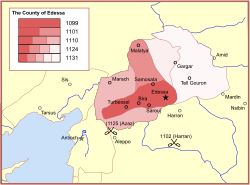
Baldwin of Boulogne, the first count of Edessa, became king of Jerusalem, and subsequent counts were his cousins. Unlike the other Crusader states, the county was landlocked. It was remote from the other states and was not on particularly good terms with its closest neighbor, the Principality of Antioch. Half of the county, including its capital, was located east of the Euphrates, far to the east, rendering it particularly vulnerable. The west part of the Euphrates was controlled from the stronghold of Turbessel. The eastern border of Edessa was the Tigris, but the County may not have extended quite that far.

The fall of Edessa in 1144 was the first major setback for Outremer and provoked the Second Crusade. All the later Crusades, however, were troubled by strategic uncertainties and disagreements. The Second Crusade did not even try to recover Edessa, calculating it to be strategically better to take Damascus. But the campaign failed and Edessa was lost for the Christians.

History of Edessa

[edit]

Founding

[edit]

In 1098, Baldwin of Boulogne left the main Crusading army, which was travelling south towards Antioch and Jerusalem. He went first south into Cilicia, then east to Edessa, where he convinced its lord, Thoros, to adopt him as son and heir. He also married Thoros' daughter, Arda of Armenia, who eventually became the first queen of Jerusalem. Thoros was a Christian of Armenian origin but of Greek Orthodox religion and largely disliked by his Armenian Apostolic subjects, which led to his removal from power in March 1098. Different sources claim he was assassinated or abdicated, and it is debated whether Baldwin played a role in this. Nonetheless, Baldwin succeeded Thoros as ruler, taking the title of count (having been Count of Verdun as a vassal of his brother in Europe).

In 1100, Baldwin became King of Jerusalem when his brother, Godfrey of Bouillon, died. The County of Edessa passed to his cousin Baldwin of Bourcq. He was joined by Joscelin of Courtenay, who became lord of the fortress of Turbessel on the Euphrates, an important outpost against the Seljuk Turks.

The Frankish lords formed a good rapport with their Armenian subjects, and there were frequent intermarriages; the first three counts all married Armenians. Count Baldwin's wife had died in Marash in 1097, and after he succeeded to Edessa he married Arda, a granddaughter of the Armenian Roupenid Prince Constantine. Baldwin of Bourcq married Morphia, a daughter of Gabriel of Melitene, and Joscelin of Courtenay married a daughter of Constantine.

Conflicts with Muslim neighbours

[edit]

Baldwin II quickly became involved in the affairs of northern Assyria and Asia Minor. He helped secure the ransom of Bohemond I of Antioch from the Danishmends in 1103, and, with Antioch, attacked the Byzantine Empire in Cilicia in 1104. Later in 1104, Edessa was attacked by Mosul, and both Baldwin and Joscelin were taken prisoner after their defeat at the Battle of Harran. Bohemond's cousin Tancred became regent in Edessa (although Richard of Salerno actually governed the territory), until Baldwin and Joscelin were ransomed in 1108. Baldwin had to fight to regain control of the city; Tancred was eventually defeated, though Baldwin had to ally with some of the local Muslim rulers.

Baldwin II became King of Jerusalem (also as Baldwin II) when Baldwin I died in 1118. Although Eustace of Boulogne had a better claim as the late Baldwin's brother, he was in France and did not want the title. Edessa was given to Joscelin in 1119. Joscelin was taken prisoner once again in 1122; when Baldwin came to rescue him, he too was captured, and Jerusalem was left without its king. Joscelin escaped in 1123, and obtained Baldwin's release the next year.

Fall of the county

[edit]

Joscelin was gravely injured during a siege in 1131 and was succeeded by his son Joscelin II. By this time, Zengi had united Aleppo and Mosul and began to threaten Edessa. Meanwhile, Joscelin II paid little attention to the security of his county, and argued with the counts of Tripoli who then refused to come to his aid. Zengi besieged the city in 1144, capturing it on 24 December that year. Joscelin continued to rule his lands west of the Euphrates, and he also managed to take advantage of the death of Zengi in September 1146 to regain and briefly hold his old capital. The city was again lost in November, and Joscelin barely escaped. In 1150 he was captured by Zengi's son Nur ad-Din, and was kept a prisoner in Aleppo until he died in 1159. His wife sold Turbessel and what was left of the county to the Byzantine Emperor Manuel I Comnenus, but these lands were conquered by Nur ad-Din and the Sultan of Rum within a year. Edessa was the first Crusader state to be created, and also the first to be lost.

Population and demographics

[edit]
A political map of the Near East in 1135. Crusader states are marked with a red cross.

Edessa was one of the largest of the Crusader states in terms of territory but had one of the smallest populations. Edessa itself had about 10,000 inhabitants. The rest of the county consisted mostly of fortresses. The county's territory extended from Antioch in the west to across the Euphrates in the east at its greatest extent. It also often occupied land as far north as Armenia proper. To the south and east were the powerful Muslim cities of Aleppo and Mosul, and the Jazira (northern Iraq). The inhabitants were mostly Assyrian Orthodox and Armenian Orthodox Christians,[2] with some Greek Orthodox Christians and Arab Muslims. Although the numbers of Latins always remained small, there was a Roman Catholic archbishop. The fall of the city was the catalyst for the Second Crusade in 1146.

Government

[edit]

Counts of Edessa

[edit]

Lordship of Turbessel

[edit]

Turbessel was firstly the lordship of Joscelin I when he was not yet the count of Edessa. It controlled the area west of the Euphrates, and held the border against Antioch. It then was a special holding of Courtenay counts of Edessa, and again became their seat after the loss of the city of Edessa. It was sold with the remaining parts of the county to the Byzantines just before it was conquered by Muslims. After the sale, the wife and family of Joscelin II moved with the proceeds to the Kingdom of Jerusalem, near Acre.

Officers

[edit]

Church

[edit]

See also

[edit]

References

[edit]
Revisions and contributorsEdit on WikipediaRead on Wikipedia
from Grokipedia
The County of Edessa was a Crusader state founded in 1098 during the in , with its capital at the ancient city of (modern Şanlıurfa, ), marking the initial Latin territorial establishment in the . Baldwin of Boulogne, a key leader in the Crusade, acquired control through an arrangement with the local Armenian ruler Thoros, who adopted him as heir before his suspicious death, allowing Baldwin to consolidate power as the first count. This landlocked principality served as a strategic buffer against Muslim forces from the east, protecting southern like the and the Kingdom of Jerusalem, while governing a diverse populace of , Orthodox , Jacobites, and Muslims under feudal Latin administration. Succeeding rulers, including Baldwin of Bourcq (1100–1118) and Joscelin I of Courtenay (1118–1131), expanded the county's territory and fortified its defenses, enhancing its role in regional trade routes and military campaigns against Seljuk and Turkmen threats. The county's significance lay in its position as a frontier outpost that absorbed initial shocks from Islamic reconquest efforts, but internal divisions and overextension weakened it; under Joscelin II, fell to the Imad al-Din of and on December 24, 1144, after a brief exploiting the count's absence. This event, the first major loss of a Crusader capital, precipitated the Second Crusade as European powers responded to the threat, though failed relief efforts led to the county's remnants being overrun by Zengi's son Nur ad-Din by 1151, extinguishing Latin rule in the region.

Establishment

Founding under Baldwin I (1098–1100)

During the , Baldwin of Boulogne, younger brother of , separated from the main Crusader army in late 1097 to exploit opportunities in northern , arriving near in February 1098 with a small force of knights. Edessa, under the rule of the Armenian Orthodox leader Thoros, faced constant threats from Seljuk Turks and internal ethnic tensions between its Armenian population and Thoros's Greek Orthodox administration. Seeking military aid, Thoros invited Baldwin, formed an alliance, and adopted him as son and heir through a local Armenian custom of blood brotherhood to legitimize Frankish support. Thoros's unpopularity among the Armenian populace, exacerbated by his perceived favoritism toward Greek elements, led to his assassination on March 9, 1098, amid a riot or plot in which Baldwin's role remains debated but likely opportunistic given the rapid power transition. Baldwin promptly seized control of the citadel, proclaimed himself count, and secured the city by distributing lands to his Frankish followers while retaining Armenian nobles in advisory roles to maintain local stability. This establishment marked the County of Edessa as the first Crusader polity, independent of Bohemond's Principality of Antioch and predating the Kingdom of Jerusalem, founded on pragmatic seizure of a power vacuum rather than direct conquest from the main Crusade. Baldwin reinforced Edessa's defenses and initiated minor campaigns to protect its environs, such as capturing nearby Turbessel earlier in 1098 to control river crossings, thereby consolidating a buffer against Turkish incursions without overextending his limited resources before departing for in 1100. The county's early viability rested on alliances with indigenous , who provided administrative continuity and troops, underscoring Baldwin's adaptive governance amid ethnic diversity and existential threats.

Territorial Expansion under Baldwin II (1100–1118)

Following his ransom and return in 1108, Baldwin II reasserted control over Edessa, compelling Tancred of Antioch to relinquish the county after a period of regency during Baldwin's captivity from 1104 to 1108. He promptly initiated military campaigns eastward to consolidate and extend Frankish holdings along the Euphrates River, exploiting divisions among local Muslim emirs weakened by internecine conflicts and the aftermath of the First Crusade. In 1110, Baldwin recovered Samosata and other territories east of the previously lost or contested, securing key fortresses that anchored the county's frontier defenses. By 1113, he seized Turbessel from his Joscelin I, citing alleged , thereby centralizing control over prosperous riverine assets vital for and . Further advances in 1116 and 1117 targeted Armenian lordships in the region, including captures that incorporated diverse holdings up to the approximate borders of modern southeastern , enhancing the county's strategic depth against Turkish incursions. Baldwin's expansions relied on pragmatic , including his marriage to Arda, an Armenian noblewoman, to forge alliances with local Christian potentates and legitimize territorial claims amid vacuums. Relations with the involved tense negotiations over nominal suzerainty, yet Baldwin maneuvered to maintain while occasionally coordinating against common Muslim foes, reflecting a realist approach to balancing Frankish independence with broader Christian interests in . These efforts marked the county's zenith in extent before Baldwin's elevation to the throne of Jerusalem in 1118.

Governance

Counts and Succession

The County of Edessa was established under Baldwin I of Boulogne, who assumed control in February 1098 after being summoned by the Armenian ruler Thoros and subsequently consolidating power through adoption and military means. Baldwin I, a cousin of and experienced crusader, governed until 1100, when he departed to claim the throne of , designating his cousin Baldwin of Bourcq as successor. This transition marked the initial dynastic link between Edessa and , with Baldwin II of Bourcq ruling from 1100 to 1118 while expanding defenses amid regional threats.
CountReignBackground and Key Events
Baldwin I of Boulogne1098–1100Founder from House of Boulogne; transitioned to kingship, passing county to cousin.
Baldwin II of Bourcq1100–1118Cousin of Baldwin I from House of Rethel/Bourcq; captured at in 1104, leading to Tancred's regency until 1108 ransom; ascended throne in 1118, granting to Joscelin I.
Joscelin I of Courtenay1119–1131From ; prior lord of Turbessel and ally of Baldwin II; multiple captivities including 1122, ransomed through aid; died from 1131 siege wounds.
Joscelin II1131–1146 (nominal)Son of Joscelin I; inherited amid declining stability; lost to Zengi in 1144 siege, briefly recaptured outer city in 1146 post-Zengi's assassination but failed to hold citadel.
Succession relied on kinship ties within Frankish nobility, often cousins or direct heirs, reinforcing alliances with —evident in Baldwin II's elevation and Joscelin I's appointment as reward for loyalty. Regencies filled leadership voids, such as Tancred's oversight from 1104 to 1108 during Baldwin II's captivity by , preserving continuity but highlighting vulnerabilities to external pressures. Baldwin II's 1118 departure for , prioritizing the kingdom's throne, shifted to less centralized rule under Joscelin I, whose frequent ransoms—facilitated by and Antioch—drained resources and exposed defensive gaps. Joscelin II's nominal tenure post-1144 underscored how absenteeism and dynastic distractions eroded the county's autonomy, culminating in its absorption by Muslim forces.

Feudal Administration and Officers

The County of Edessa imported a Frankish feudal , with the at the apex delegating authority to lords, castellans, and officers responsible for territorial defense and local governance. Key positions included constables, such as Hervé in May 1134 and Roger in 1141, who oversaw cavalry and fortifications, alongside castellans like Martinus of Turbessel in 1134 managing castle-based lordships. Land was granted as fiefs to knights and nobles in exchange for , mirroring Western European customs but scaled to the county's limited resources. To bolster control amid a sparse Frankish settler population—estimated at only a few hundred knights reliant on native auxiliaries—counts integrated Armenian and Syrian elites as vassals through strategic marriages and territorial concessions. Baldwin I wed Arda, daughter of Armenian lord Taphnuz, in 1098; Baldwin II married Morfia, daughter of Gabriel of Melitene, around 1101; and Joscelin I took Beatrice, daughter of Armenian lord Constantine, between 1100 and 1104, forging alliances that incorporated local nobles into the feudal pyramid. Vassals such as the lords of Marash and Kaisun (including Geoffroy "the Monk" until 1124 and Baudouin until 1146) held fiefs east of the , providing levies while retaining semi-autonomous authority under countly oversight. This hybrid system arose from causal pressures of demographic scarcity: with insufficient Western immigrants to staff a pure Latin administration, counts like Baldwin II acquired domains such as Rabun, Kaisun, and Gargar from Armenian lords between 1116 and 1117, adapting feudal oaths to include indigenous military contributions and reducing vulnerability to Turkish incursions. Other families, including those of Coris (Barrigan in 1134) and Hatab (Mahuis in 1134), exemplified this delegation, where fief-holders balanced loyalty to the count with local customs, though it fostered tensions evident in the county's rapid collapse after 1144.

Subsidiary Territories like Turbessel

Turbessel, located west of the River, functioned as a primary subsidiary lordship within the County of Edessa, granting its holder strategic control over key crossings and surrounding territories. Originally held by vassals such as Joscelin of Courtenay from approximately 1115, it buffered the core Edessan lands against incursions from and provided a base for military operations. This allowed the counts to delegate defense of peripheral zones while maintaining feudal oversight, though vassals exercised significant local in administration and . Subsidiary outposts like Rawandan, Samosata, and Kaisun extended the county's defensive and economic reach, often acquired through conquest from local Muslim emirs or alliances with Armenian lords between 1100 and 1120. Samosata, captured in expeditions around 1100, secured the upper valley for agriculture and tolls on routes, while Kaisun under lords of Marash added mountain strongholds for scouting and raiding. These holdings fostered resilience by distributing resources and manpower, yet their semi-independent status occasionally strained loyalties during succession disputes or when counts were captured, as vassals prioritized familial claims over centralized authority. Following the 1144 fall of to Zengi, Turbessel emerged as a critical refuge, enabling Joscelin II to administer remnants of the county until its loss in 1150, thereby extending Frankish presence in the region despite the capital's collapse. This reliance on peripheral lordships underscored the system's dual role in survival—offering fallback positions and economic sustainment through fertile lands and river access—while highlighting vulnerabilities from fragmented command structures amid intensifying Turkish pressures.

Military History

Conflicts with Turkish Powers (1098–1130s)

In 1110, Mawdud ibn Altuntash, of acting on orders from Seljuk Sultan Muhammad I Tapar, led a major invasion against the County of Edessa, besieging the capital and aiming to exploit local Armenian dissidents, but the assault was repelled through the use of fortified city defenses and internal divisions among Muslim forces that prevented a sustained effort. This marked the first of annual Seljuk campaigns from 1110 to 1115, with Edessan forces under Baldwin II leveraging elevated positions and rapid reinforcements to hold key strongholds like Turbessel against superior numbers. Bursuq bin Bursuq, dispatched from as supreme Seljuk commander, invaded the county in early 1115 with a large coalition from and the Jazira, initially threatening before shifting toward ; Edessan and allied Antiochene troops, despite being outnumbered, contributed to his decisive defeat at the Battle of Sarmin on August 14, 1115, through coordinated heavy cavalry charges that disrupted Turkish archery formations. Subsequent Artuqid incursions, such as those led by of in 1123–1124, saw Edessan forces under Baldwin II recapture prisoners like Joscelin I after tactical ambushes and the exploitation of Balak's overextension, culminating in Balak's death at the hands of locals during a pursuit. Edessan strategy emphasized border security via punitive raids into Seljuk and Artuqid territories, including strikes on and in the 1110s–1120s, where small, mobile Frankish-Armenian contingents inflicted attrition on supply lines and garrisons, compensating for demographic disadvantages by avoiding pitched battles in open terrain. These operations, often numbering 200–500 knights supported by local levies, secured buffer zones east of the and disrupted Turkish unification efforts. By engaging northern Turkish emirs like the of Diyarbakir and , Edessa functioned as a forward deterrent, absorbing jihadist momentum—estimated at tens of thousands in combined expeditions—and preventing southward convergence on Antioch or , as evidenced by the diversion of forces from and that might otherwise have reinforced Damascus-based threats.

Alliances, Defenses, and Internal Vulnerabilities

The County of Edessa forged key alliances with local Armenian lords to secure its northern flanks, exemplified by the 1098 adoption of Baldwin I of Boulogne as heir by the Armenian ruler Thoros, which facilitated the county's establishment through joint efforts against Seljuk forces. Intermarriages between Frankish counts and , including Baldwin I's union with Arda and subsequent counts' ties, bolstered military cooperation and administrative integration, with Armenians providing essential cavalry and local knowledge amid Frankish manpower shortages. Relations with the remained tense due to Emperor Alexios I Komnenos's assertions of suzerainty over crusader territories via oaths sworn during the , though pragmatic homage was paid by Baldwin II to in 1139 for temporary protection against Turkish incursions. Temporary truces with Muslim emirs, such as the 1108 pact involving Jawli of allying with Edessan forces and Armenian leaders against rival Muslim factions, allowed brief respites but underscored the county's opportunistic diplomacy rather than enduring pacts. Defensive strategies centered on maintaining pre-existing Byzantine fortifications, including Edessa's double-walled circuit and on a commanding plateau, which were repaired and garrisoned by crusaders to withstand sieges, supplemented by the River as a for eastern outposts like Samosata and Turbessel. Key subsidiary castles, such as Rawandan and Kaisun, formed a network of forward defenses manned primarily by native Armenian and Syriac troops, as Frankish settlers numbered fewer than 1,000 knights by the 1130s, necessitating heavy reliance on local levies for sustained operations. These structures deterred raids from and until unified assaults overwhelmed isolated garrisons, as seen in the 1144 fall when Zengi's forces exploited undermanned walls during winter floods that undermined outer defenses. Internal vulnerabilities arose from aristocratic factionalism, including the 1112 imprisonment of Joscelin I by Baldwin II over territorial and succession disputes in Turbessel, which diverted resources from frontier threats and eroded cohesion among vassals like those in Marash. Low Frankish birth rates and high emigration back to Europe limited demographic reinforcement, leaving the county overextended across 4,000 square miles with sparse Latin settlements, while kings of Jerusalem prioritized southern fronts, providing minimal aid—evident in Raymond of Antioch's 1144 refusal to relieve Edessa, citing internal Antiochene quarrels. This neglect, compounded by feuds, fostered causal overextension: fragmented leadership failed to consolidate gains, enabling Zengi's opportunistic unification of Muslim forces to breach defenses that isolated diplomacy and native dependencies could not indefinitely sustain.

Siege and Fall to Zengi (1144)

In late November 1144, , the of and , exploited the absence of Count Joscelin II by launching a surprise on . Joscelin had departed with the majority of the county's forces to support his Ortoqid allies against threats from , leaving the city defended by a small under the command of the and local officials. This leadership lapse severely compromised Edessa's defenses, as no immediate reinforcements arrived from neighboring like Antioch or , highlighting internal divisions and strategic misjudgments rather than an inevitable weakening of the county's military position. Zengi's army encircled the city on November 28, employing sappers to undermine the outer walls over the following weeks. By December 24, the breaches allowed his troops to storm the defenses, resulting in a chaotic sack. Frankish soldiers and residents unable to reach the citadel were systematically massacred, while many Armenians and other non-Latin Christians faced enslavement or flight. The violence led to significant population losses, with contemporary accounts describing thousands trampled or suffocated in the ensuing panic, contributing to an estimated depletion of around 10,000 inhabitants from the urban center. In the immediate aftermath, Zengi secured as a base, bridging his northern and southern territories and advancing a unified Muslim front against the Crusaders. Joscelin, operating from Turbessel, attempted relief during the siege but withdrew upon assessing Zengi's overwhelming numbers, later launching partial recovery efforts that recaptured outer districts in October 1146 following Zengi's assassination; however, the citadel remained under Zengid control due to the absence of allied Crusader support. The catastrophe prompted Pope Eugenius III to preach the Second Crusade in late December 1145, framing the loss as a call to restore the fallen county.

Society and Economy

Population Composition and Demographics

The County of Edessa maintained one of the smallest populations among the , with settlement concentrated in the capital city and scattered fortresses rather than extensive rural development. Edessa itself housed approximately 10,000 inhabitants, underscoring the county's demographic fragility amid its expansive but thinly populated territory. This limited populace, reliant on native manpower rather than large-scale Latin colonization, contributed to defensive weaknesses against sustained Turkish assaults. Ethnic composition was dominated by indigenous groups, with and Syrian Jacobites (Syriac Orthodox ) comprising the vast majority of residents in both urban and rural settings. Rural peasants were primarily Syriac , supplemented by pockets of living under protections following the Frankish conquest. Urban areas exhibited greater diversity, incorporating residual Muslim communities alongside the Christian majority. Frankish settlers formed a tiny minority, limited to a small cadre of nobles and their retainers—numbering no more than a few dozen knightly families at any given time—due to scant immigration from . This demographic imbalance necessitated alliances and intermarriages with , providing short-term loyalty benefits but exposing the county to risks from native ambivalence; during the 1144 fall to Zengi, Armenian and Syrian inhabitants were largely spared plunder and , while Franks suffered targeted violence, highlighting underlying fissures in cohesion.

Economic Base and Trade

The County of Edessa's economic foundation rested on in the fertile plains surrounding the city, supported by from the River and its tributaries like the Balikh, which enabled cultivation of grains, olives, and fruits. These lands, extending east and west of the , provided essential food supplies amid ongoing regional demands, though production was vulnerable to raids and climatic variability. supplemented this in the higher, drier terrains, where herding of sheep and goats yielded , , and , reflecting the mixed subsistence patterns of . Trade contributed modestly through the county's position astride overland routes connecting and to northern and , where counts levied tolls on passing caravans carrying textiles, metals, and agricultural goods. Castles such as those at Turbessel and Rawandan served as key nodes for collecting these duties and taxing local production, channeling revenues to sustain governance. However, incessant conflicts with Seljuk forces disrupted these exchanges, limiting access to broader commerce in luxury items like spices, which flowed more readily through coastal outlets. Persistent fiscal pressures exacerbated economic fragility, notably the 1108 ransom of Count Baldwin II from Turkish captivity, which required 30,000 bezants raised through extraordinary levies and loans, straining agrarian revenues and necessitating reliance on Armenian allies for support. Ongoing payments to mercenaries and fortifications further depleted resources, fostering a cycle of indebtedness that undermined long-term stability without offsetting gains from transit trade.

Religious Composition

Dominant Christian Sects and Latin Influence

The County of Edessa's Christian population was predominantly composed of Armenian Orthodox and Jacobite (Syriac Orthodox) communities, who formed the vast majority of inhabitants prior to and during Latin rule. These non-Chalcedonian groups maintained their distinct liturgical traditions and hierarchies, with Jacobites emphasizing Miaphysite and Armenians adhering to their national church structure, often seeking Latin protection against Seljuk threats without yielding ecclesiastical autonomy. Following the Frankish conquest in 1098, Latin rulers established an archbishopric in Edessa to overlay Roman Catholic authority, appointing Latin prelates such as Hugh, who served as by 1144 and coordinated defenses alongside Eastern bishops. This introduced Latin rite practices in key sites, including the , though without supplanting local sees; Armenian and Jacobite bishops, like John and Basil bar Shumna, operated independently during crises such as the 1144 . Doctrinal schisms—rooted in the Council of Chalcedon's rejection by Orientals, disputes, and liturgical variances—fostered underlying tensions, yet pragmatic coexistence prevailed, with shared processions and no documented forced conversions or aggressive Latinization. Edessa's prestige as a Christian center derived partly from its association with the legendary Mandylion, a cloth bearing Christ's imprinted face, venerated there until its transfer to in 944, which underscored the city's relic-based sanctity even under crusader rule. Counts like Baldwin II patronized institutions to bolster legitimacy among locals, intermarrying with Armenian elites and invoking Edessa's holy heritage, though Latin missionary efforts remained limited amid resistance from entrenched Eastern rites. This patronage aligned with broader Frankish strategies for stability rather than doctrinal uniformity, reflecting the county's role as a outpost where pluralism served defensive cohesion over hegemony.

Muslim and Other Minorities

The Muslim inhabitants of the County of Edessa, mainly and Turks who had remained after the 1098 establishment of Frankish rule, functioned as a taxed minority providing economic revenue and occasional military support as auxiliaries. Under a policy of "rough tolerance," mosques were permitted to operate, and Islamic practices were allowed provided they did not challenge Christian authority, though proselytism was prohibited and conversion to Christianity was incentivized through tax relief and social integration. This approach prioritized administrative utility over ideological eradication, as wholesale expulsion would have depopulated rural areas critical for agriculture and defense against Seljuk incursions. Jewish communities, concentrated in Edessa's urban markets for and , numbered in the low hundreds and enjoyed comparable protected status, paying poll taxes while retaining communal in civil matters under rabbinical law. No evidence indicates systematic pogroms or forced baptisms targeting during the county's tenure (1098–1144), distinguishing Edessa's frontier pragmatism from more volatile episodes in . Zoroastrian, pagan, or other non-Abrahamic remnants were insignificant, comprising at most scattered individuals absorbed from pre-Islamic Persian influences without distinct communal organization. Relations between communities involved uneasy coexistence, with and benefiting from Frankish protection against nomadic raiders but facing heightened scrutiny amid jihadist appeals from and ; revolts were absent, yet post-siege reprisals, such as after the 1110 recovery of Tell Bashir, occasionally involved targeted killings of suspected fifth columnists rather than blanket expulsions. This dynamic sustained demographic stability until Zengi's 1144 conquest, which reversed tolerances by massacring or enslaving non-Muslims.

Legacy and Assessments

Role in Broader Crusader Defense

The County of Edessa served as the northernmost Crusader state, functioning as a strategic buffer that absorbed military pressures from Turkish emirs in and , thereby shielding the and the Kingdom of from coordinated northern incursions. Established in February 1098 following the Crusaders' capture of the city, engaged in near-constant conflicts with local Muslim powers, including the and Danishmends, which fragmented Turkish efforts and prevented unified assaults on southern Frankish territories until the rise of Zengi in the 1120s. This frontline role diverted resources and attention of Muslim forces away from more vulnerable coastal and southern states, maintaining relative stability in Antioch and for decades. Edessan rulers contributed troops and leadership to broader Crusader field armies, exemplified by Joscelin I's participation in relief efforts and campaigns supporting Antioch against Aleppo-based threats in the 1110s and 1120s. For instance, alliances between Edessa and Antioch enabled joint operations, such as Bohemond I's attacks on Aleppo bolstered by Edessan forces, which checked expansions by figures like of . These interventions helped preserve Antioch's eastern frontiers, allowing it to focus defenses westward. The county's persistence despite demographic disadvantages—relying on a small Frankish elite amid Armenian and Syriac majorities—demonstrated empirical resilience, holding against jihadist pressures for 46 years from 1098 to 1144. The fall of Edessa to Zengi on December 24, 1144, eliminated this buffer, enabling his forces to consolidate gains and threaten Antioch directly, which precipitated the Second Crusade as European powers responded to the first major loss of a Crusader capital. Without Edessa's absorptive capacity, subsequent Crusader defenses in the north faltered, contributing to strategic vulnerabilities exposed in the crusade's failures at in 1148. This quantified the county's defensive value: its absence accelerated the erosion of Outremer's northern flank against increasingly unified Muslim opposition.

Reasons for Failure and Modern Re-evaluations

The County of Edessa's fall in 1144 stemmed primarily from its exposed geographical position, which facilitated encirclement by Muslim forces under Zengi while hindering reinforcement from southern . Located over 400 kilometers northeast of , Edessa's isolation prevented the from providing effective aid during the siege; although Queen Melisende assembled a relief army, Prince Raymond of Antioch declined to cooperate, and the distance rendered intervention impractical. This logistical vulnerability was exacerbated by Count Joscelin II's decision to deploy most of his forces—comprising a mix of and local Armenian contingents—away from the city in alliance with the against , leaving defenses reliant on insufficient native garrisons susceptible to internal discord and betrayal. Such dependencies arose not from structural "colonial" deficiencies but from the demographic reality of a small Frankish elite outnumbered by regional populations, necessitating integration of local manpower amid chronic manpower shortages across Outremer. Following the city's capture on , 1144, remnants of the county persisted under Joscelin II's control in rural strongholds until 1150, demonstrating that total collapse was not inevitable absent sustained pressure. Joscelin briefly recaptured in 1146, only for Nur ad-Din to raze it, but fortified sites like Turbessel held out longer, underscoring the defensive potential of Crusader engineering when backed by resources. Archaeological investigations of at (ancient ) reveal substantial Crusader-era fortifications, including walls and towers adapted from earlier structures, which proved resilient in prior conflicts but required ongoing maintenance and reinforcement against siege tactics like —employed decisively by Zengi. These material remains affirm that, with adequate support from or Antioch, peripheral defenses could have been viable, highlighting political neglect over inherent frailty as a key causal factor. Modern scholarship has reevaluated Edessa's demise as a of opportunistic by Zengi—exploiting a momentary Frankish absence—rather than emblematic of broader Crusader fragility, shifting focus from moralistic decline narratives to realist assessments of and adaptive strategies. Historians emphasize the county's 46-year against expansionist Turkic and forces, attributing its loss to specific contingencies like divided alliances and supply strains, not predestined weakness. This perspective critiques earlier portrayals of Edessa as a mere "fragile outpost," instead positioning it as a model of resilient warfare that delayed Zengid unification efforts, though some academic traditions underplay such tenacity in favor of emphasizing Muslim revivals. Archaeological and tactical analyses further support views of Crusader fortifications and hybrid forces as effective counters to jihadist momentum when not undermined by isolation.

References

Add your contribution
Related Hubs
User Avatar
No comments yet.