Recent from talks
Nothing was collected or created yet.
Crust punk
View on Wikipedia
| Crust punk | |
|---|---|
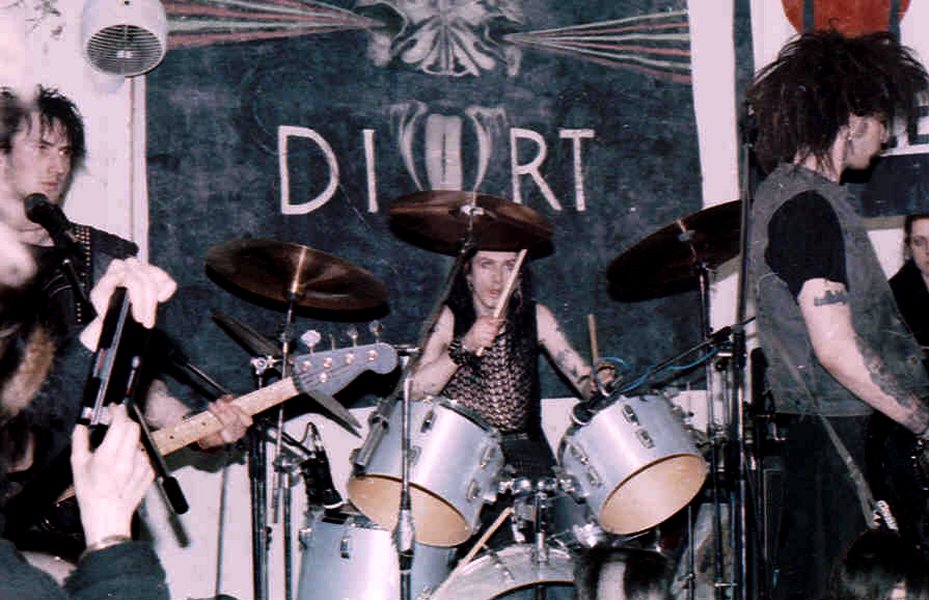
Crust punk band Antisect performing in 1985 | |
| Other names |
|
| Stylistic origins | |
| Cultural origins | Early 1980s, England |
| Derivative forms | Grindcore,[5] red and anarchist black metal |
| Subgenres | |
| neo-crust | |
| Fusion genres | |
| Blackened crust, crack rock steady, crustcore | |
| Regional scenes | |
| Other topics | |
Crust punk (also known as stenchcore or simply crust) is a fusion genre of anarcho-punk and extreme metal that originated in the early to mid-1980s in England. Originally, the genre was primarily mid-tempo, making use of metal riffs in a stripped-down anarcho-punk context, however many later bands pushed the genre to be more grandiose, faster or more melodic. Often songs are political, discussing environmentalism, anarchism, anti-capitalism, feminism and animal rights.
The genre originated in the early to mid-1980s with Amebix and Antisect, bands active in the anarcho-punk scene who began to incorporate the influence of heavy metal bands such as Hellhammer, Motörhead and Trouble. The influence of these bands led to the genre's first wave with Hellbastard, Deviated Instinct and Concrete Sox. By the late 1980s, the genre had begun to merge with hardcore punk, typified by Electro Hippies, Extreme Noise Terror and Doom. During the 1990s, this sound was continued by Swedish and Japanese bands including Skitsystem, Driller Killer, Disclose and Gloom, while other areas brought in outside influences such as Dystopia with sludge metal, His Hero is Gone with powerviolence, Choking Victim with ska and Disrupt with grindcore. During the 2000s, the most prominent sound in the genre was the neo-crust style of Tragedy, Fall of Efrafa and From Ashes Rise, which pushed the genre into more metal-influenced but also melodic and post-rock-inspired territory. At the same time, Swedish bands like Disfear and Wolfbrigade were also pushing crust punk into an increasingly melodic direction, through the incorporation of elements of melodic death metal.
Characteristics
[edit]Metal lyrics were so dumb, so far removed from daily life. Venom were going on about Satan... and bikes... and Satan... and women... and Satan... I'd switch on the TV and know I was going to see hundreds of people dying because there'd been an earthquake in the third world... and all these people starving to death while military expenditure still increased... That was — and still is — the reality of it. The whole heavy metal thing is... well, bullshit basically."[6]
Lyrics
[edit]Crust punk lyrics generally discuss real-world issues as a means of activism. In particular, they discuss political and social themes such as class struggle, environmentalism, anarchism, and anti-capitalism.[7] Sometimes these themes are hyperbolised to the point of discussing the apocalypse, religious control and nuclear destruction. Many bands also discussed feminism, animal rights and veganism or vegetarianism.[8] In contrast, Amebix's lyrics sometimes discussed mysticism and Gnosticism.[9]
Instrumentation
[edit]
Crust punk is a derivative form of anarcho-punk, mixed with metal riffs.[1] The overall musical sound was described by SFGate writer Loolwa Khazzoom as being "stripped down".[10] Drumming is typically done at high speed, with D-beats sometimes being used.[3] In Sober Living for the Revolution: Hardcore Punk, Straight Edge, and Radical Politics, author Gabriel Kuhn referred to the genre as a "blend of 1977 British punk, roots culture and black metal", with the genre often taking influence from death metal, grindcore and powerviolence.[11]
Etymology
[edit]
The original name for the crust punk genre was "stenchcore", in reference to Deviated Instinct's 1986 demo Terminal Filth Stenchcore.[1] In a 2007 interview with 3PRQ, the band's vocalist and guitarist Rob Middleton stated "We came up with the 'stenchcore' tag on our demo as kind of a joke as there were so many ridiculous 'cores' going about at the time and people used to comment on our general dishevelment." This term has stayed in use, however has developed from referring to the genre as a whole, to mean the particular mid–tempo, early extreme metal-influence sound of crust punk's first wave such as Deviated Instinct, Amebix and Antisect.[12]
The term "crust" was coined by Hellbastard on their 1986 Ripper Crust demo.[1] This name was derived from the "crusty" appearance of the genre's practitioning bands.[11] Punk historian Ian Glasper states, in his book Trapped in a Scene, "Rippercrust [sic] is widely regarded as the first time the word 'crust' was used in the punk context, and hence the specific starting point of the whole crust punk genre, although some would attribute that accolade to the likes of Disorder, Chaos UK, and Amebix several years earlier."[13] In the same book, he quoted the group's vocalist and guitarist Malcolm "Scruff" Lewty "A lot of people say we started the crust punk genre, but whatever. If they wanna say that, I don't mind, but I'm certainly no Malcolm McLaren, saying I invented something I didn't."[13]
History
[edit]Precursors
[edit]The most prominent influences upon crust punk were Crass and Discharge. Crass introduced the genre's anarchist ideology and its tattered, militaristic aesthetic, while Discharge introduced its apocalyptic themes and influence from heavy metal, particularly Motörhead.[14] Other metal bands to include the style included Hellhammer and Trouble.[1]
1980s
[edit]
Crust punk was established by the bands Amebix and Antisect, who both growing out of the anarcho-punk scene and made use of dark, morbid and post-apocalyptic imagery. Amebix had begun their career playing a style more indebted to Killing Joke, while Antisect began playing simply anarcho-hardcore punk. Amebix first embraced metal influences on their 1983 album No Sanctuary, while Antisect did so on their 1985 EP Out from the Void. These releases were the earliest crust punk releases, with Amebix's subsequent album Arise (1985) codifying the sound of the genre.[1] However, Amebix also brought a wider scope of influences than most other bands in the genre, particularly post-punk bands including Public Image Ltd., Bauhaus, Joy Division and especially Killing Joke.[9] Soon, the first wave of crust punk bands was solidified with the formations of Hellbastard, Deviated Instinct and Concrete Sox.[1] This early wave of the genre was closely related to the nascent extreme metal scene, with the members of Amebix and Hellhammer even being in the same tape trading circles, influencing one another.[15]
In the following years, the genre spread to other countries. The largest of these was the Swedish crust punk and d-beat scene which early on produced Anti Cimex and Agnoni, who both quickly toured the United Kingdom.[16] From this scene soon originated the Swedish death metal scene, which would be brought to prominence by Entombed.[17]
American crust punk began in New York City, in the mid-1980s, with the work of Nausea. The group emerged from the Lower East Side squat scene and New York hardcore,[18] living with Roger Miret of Agnostic Front.[19] The early work of Neurosis, from San Francisco, also borrowed from Amebix, and inaugurated crust punk on the West Coast.[20][21] Disrupt (Boston),[22] Antischism (South Carolina), Misery and Destroy (Minneapolis) were also significant U.S. crust groups.[1]
In the late 1980s, bands including Doom, Excrement of War, Electro Hippies and Extreme Noise Terror began to merge crust punk with the sound of UK hardcore punk, creating the crustcore subgenre. Felix Havoc described Extreme Noise Terror's segment of the "Earslaughter" split album with Chaos UK as the first album in the genre.[1]
1990s
[edit]
In 1994, Orange County, California's Dystopia released their debut album Human = Garbage which merged sludge crust punk and sludge metal.[23] An important American crust punk band was Aus Rotten[24] from Pittsburgh, Pennsylvania. Crust punk also flourished in Minneapolis, shepherded by the Profane Existence label.[25] In this period, the ethos of crust punk became particularly codified, with vegetarianism, feminism, and sometimes straight edge being prescribed by many of the figures in the scene.[25] The powerviolence scene associated with Slap-a-Ham Records was in close proximity to crust punk, particularly in the case of Man Is the Bastard and Dropdead.[26] Prominent crust punk groups (Driller Killer, Totalitär, Skitsystem, Wolfbrigade, and Disfear) also emerged from Sweden, which had always had a strong D-beat scene. Many of these groups developed in parallel with the much more commercial Scandinavian death metal scene.[27]
During this time, crust became prominent in the American South, where Prank Records and CrimethInc. acted as focal points of the scene. The most well-known representative of Southern crust was His Hero Is Gone,[3][28] whose early material incorporate elements of powerviolence and experimental music. By the band's final album The Plot Sickens (1998), they had begun to incorporate influence from the Japanese hardcore style burning spirits, to create a more grandiose and melodic take on crust punk. This sound was then continued by three of the members' subsequent band Tragedy. At the same time, in Spain bands such as Hongo, Das Plague and Ekkaia were merging crust punk with elements of screamo, creating a fusion genre which at the time was called "emo crust".[29]
2000s
[edit]In the early 2000s, the Spanish emo crust genre and Tragedy–His Hero Is Gone melodic crust style began to merge, leading to the beginning of the neo-crust subgenre. During the mid–2000s, this became the most prominent style in the crust scene, producing subsequent acts such as Fall of Efrafa and From Ashes Rise.[29] Soon, bands such as Trap Them emerged, incorporating increasing elements of hardcore and death metal.[30] By the end of the decade, many international crust punk bands had shifted their style to favour black metal influences.[29] In 2017, Bandcamp Daily wrote that Fluff Fest, held in Czechia since 2000, has become a "summer ritual" for many European crust fans.[31]
Subgenres
[edit]Crack rock steady
[edit]Crack rock steady is a punk rock fusion-genre, which combines elements of crust punk and ska punk.[32] Lyrics often focus on themes such as drug-use, religion,[33] politics[34] and social issues.[32] Other genres sometimes incorporated in conjunction with the style include hardcore punk[33] and heavy metal.[35] Notable bands within the genre include Choking Victim, Leftöver Crack, Morning Glory and Star Fucking Hipsters.[33]
Crustcore
[edit]
Crustcore (also known as crusty hardcore), is a sub-genre of crust punk that takes influence from hardcore punk and sometimes thrashcore. Crustcore bands include Extreme Noise Terror, Doom, Disrupt,[1] early Wolfbrigade,[36] Neurosis,[37] Baptists,[38] Discharge[39] and Filth.[40]
Neo crust
[edit]Neo crust is a genre that merges crust punk with elements of various extreme music styles including black metal, screamo, post-rock, hardcore punk,[41] death metal, sludge metal and doom metal.[42] Unlike most other punk–metal fusion genres, neo-crust's sound is neither distinctively rooted in punk or metal; instead, it frequently shifts between the two, disregarding genre boundaries.[42] It is often dark, heavy, and melodic.[42] The genre makes use of a melancholic tone and a post-civilization aesthetic, often including dead trees and barren landscapes, as well as poetic band names and lyrics. Some bands, such as Cwill and Remains of the Day even incorporate violins into their music.[29]
The style originated as a amalgamation of two separate sounds that began concurrently in the late 1990s: the screamo influenced "emo crust" style of Spanish bands Hongo, Das Plague, Ekkaia, Madame Germen and Blünt; and the melodic crust sound of later His Hero is Gone and early Tragedy, which was influenced by the Japanese hardcore style burning spirits. By 2002, Ekkaia and Tragedy had toured together, and subsequently adopted elements of each other's styles. This style was soon termed neo-crust by Alerta Antifascista records founder Timo Nehmtow, and saw widespread popularity in the punk scene during the mid–2000s. By the end of the decade, the sound had decline in popularity.[29]
Notable bands include His Hero is Gone, Tragedy,[43] Fall of Efrafa[42] and From Ashes Rise.[44]
Crasher crust
[edit]Crasher crust is a genre that originated in Japan. It blends d-beat, crust and a huge emphasis on noise elements. Often utilising both fuzz and distorted guitars, reliance on crash cymbals for drumming and raw recording.[45] Acid are pioneered the genre,[46] and Gloom coined its name. Some bands include Gloom, Zyanose, Lebenden Toten, Scene Death Terror and Zodiak.[45]
Legacy
[edit]Black metal
[edit]Crust punk and black metal evolved alongside one another, with the members of early crust band Amebix and first-wave black metal band Hellhammer tape trading with one another.[15] Thus, pioneering black metal bands such as Hellhammer, Bathory and Mayhem were inspired by crust punk,[47] and early crust punk bands such as Sacrilege, Amebix and Antisect were influenced by Hellhammer and Celtic Frost.[1]
Blackened crust
[edit]
Crust punk was affected by a second wave of black metal in the 1990s, with some bands emphasising these black metal elements. Iskra are probably the most obvious example of second-wave black metal-influenced crust punk;[48] Iskra coined their own phrase "blackened crust" to describe their new style. The Japanese group Gallhammer also fused crust punk with black metal[49] while the English band Fukpig merge elements of crust punk, black metal, and grindcore.[50][51] Germany's Downfall of Gaia mix crustgrind and black metal, along with elements of sludge metal, doom metal and post-metal.[52] North Carolina's Young and in the Way have been playing blackened crust since their formation in 2009.[53] In addition, Norwegian band Darkthrone have incorporated crust punk traits in their mid-to-late 2000s material. As Daniel Ekeroth wrote in 2008,
In a very ironic paradox, black metal and crust punk have recently started to embrace one another. Members of Darkthrone and Satyricon have lately claimed that they love punk, while among crusties, black metal is the latest fashion. In fact, the latest album by crust punk band Skitsystem sounds very black metal--while the latest black metal opus by Darkthrone sounds very punk! This would have been unimaginable in the early 90s.
— [54]
Red and anarchist black metal
[edit]Red and anarchist black metal (also known as RABM or anarchist black metal)[55][56][57] is a subgenre that melds black metal with anarchist crust punk, promoting ideologies such as anarchism, environmentalism, or Marxism.[58][59][60][61] Artists labelled RABM include Iskra, Panopticon, Skagos,[61][62] Storm of Sedition,[55] Not A Cost,[55] Black Kronstadt,[55] and Vidargangr.[57]
Grindcore
[edit]Crust punk led to the development of the grindcore genre, by bands including Extreme Noise Terror, Napalm Death and Carcass.[5] However, Pete Hurley, the guitarist for the group, declared that he had no interest in being remembered as a pioneer of this style: "'grindcore' was a legendarily stupid term coined by a hyperactive kid from the West Midlands, and it had nothing to do with us whatsoever. ENT were, are, and — I suspect — always will be a hardcore punk band... not a grindcore band, a stenchcore band, a trampcore band, or any other sub-sub-sub-core genre-defining term you can come up with."[63] This early crust punk-leaning grindcore sound is sometimes dubbed "crustgrind".[5]
Culture
[edit]Crust punks are associated with a DIY-oriented branch of punk garb. Similar to anarcho-punk, most clothing is black in colour. Denim jackets and hooded sweatshirts with sewn-on patches, or vests covered in studs, spikes and band patches are characteristic elements of the crust punk style of dress or pants covered in band patches.[64] Crust punks also sometimes wear dreadlocks and piercings.[11] Julian "Leggo" Kilsby of Deviated Instinct describes crust as "a punk-y biker look, more akin to Mad Max. Mad Max 2 is the crustiest film ever made!"[65]
Members of the sub-culture are generally outspokenly political, possessing anarchist and anti-consumerist views.[11]
See also
[edit]References
[edit]- ^ a b c d e f g h i j k Von Havoc, Felix (1 January 1984). "Rise of Crust". Profane Existence. Archived from the original on 15 June 2008. Retrieved 16 June 2008.
- ^ "A History Of Metal – Punk Special: Crust Punk".
{{cite journal}}: Cite journal requires|journal=(help) - ^ a b c Peter Jandreus, The Encyclopedia of Swedish Punk 1977–1987, Stockholm: Premium Publishing, 2008, p. 11.
- ^ Popoff, Martin (2017). Speed Metal.
- ^ a b c "In Grind We Crust", p. 46.
- ^ Glasper 2009, 183."
- ^ Hustle, Jac. Punk Loud Guitars, Louder Statements. 29 September 2023.
Lyrically, crust punk is deeply rooted in political and social themes. Songs address a wide array of issues, including environmental degradation, anti-authoritarianism, class struggle, and anti-capitalism. The lyrics are often confrontational and provocative, reflecting a desire to challenge the status quo and provoke thought and action. Crust punk is a genre that thrives on chaos, both musically and thematically, using its sonic ferocity as a vehicle for activism.
- ^ Sfetcu, Nicolae. American Music.
Lyrics to crust songs tend to be dark, and based around politics and current events and even some human emotion; topics such as nuclear destruction, environmentalism, racial equality, squatting, non-conformity, apocalypse, abolishing sexism, animal rights, veganism/vegetarianism, religious control, death (and/or escaping life) and anarchism are common.
- ^ a b Glasper 2006. "Amebix." p. 198-201.
- ^ Loolwa Khazzoom (11 March 2005). "Livermore: All's well with the Bay Area punk scene say members of the Sick". Sfgate. Retrieved 1 August 2010.
- ^ a b c d Kuhn, Gabriel (2010). Sober Living for the Revolution: Hardcore Punk, Straight Edge, and Radical Politics. PM Press. p. 16. ISBN 9781604860511.
- ^ Conspiracy, D. I. Y. (27 June 2023). "What is Stenchcore? | DIY Conspiracy". Retrieved 28 September 2025.
- ^ a b Glasper 2009, 185
- ^ Pearson, David (2021). Rebel Music in the Triumphant Empire Punk Rock in the 1990s United States. ISBN 9780197534885.
Crass laid an ideological (anarchist), political, and aesthetic foundation for subsequent bands that sought to make punk a conscious political rebellion. But its peace- punk style would soon be usurped by a crucial development in punk's history: its crossover with heavy metal... Waksman cites British band Motörhead, whose Overkill album was released in that year, as the first punk/metal crossover to be recognized as such, largely because audiences at its performances were drawn from fans of the two genres... Perhaps the most significant band in this regard was Discharge, whose 1982 album Hear Nothing See Nothing Say Nothing became one of the most important reference points for 1990s political punk.
- ^ a b Hobson, Rich. "The 12 heaviest punk albums of all time". Metal Hammer. Retrieved 30 December 2024.
- ^ Ekeroth, Daniel (29 July 2008). Swedish Death Metal. BAZILLION POINTS. p. 24.
Digby Pearson of Earache Records recalls the wave of transformation: "Like most guys from the old days, I started out as a massive fan of UK crust punk and American hardcore. Sweden was famous for their many crust bands early on, and I got every tape with every band from Fredda Holmgren at CBR. When I started to promote gigs, it was natural for me to bring over a couple Swedish bands. So I did a UK tour with Anti Cimex and the somewhat thrashier Agoni.
- ^ O'Neill, Andrew (13 July 2017). A History of Heavy Metal. Headline.
Extreme metal in Sweden started with Bathory, but extreme music in Sweden started with crust punk. The d-beat sound of Discharge found a massive fanbase in Sweden and d-beat as a genre is pretty much propped up entirely by the relatively small population of that country. But the d-beat scene is nothing compared to the insane bands-per-capita output of Swedish death metal, much of which grew out of that fertile punk scene. They found their stars in Entombed
- ^ Init 5, 25 September 2007. [1] Access date: 18 June 2008.
- ^ John John Jesse interview, Hoard Magazine, June 2005. "John John Jesse interview – HOARD MAGAZINE". Archived from the original on 21 September 2008. Retrieved 12 October 2009. Access date: 18 June 2008
- ^ Adam Louie, Mastodon, Neurosis show review, Prefix magazine, 29 January 2008 [2] Access date: 18 June 2008
- ^ Anthony Bartkewicz, Decibel Magazine No. 31, May 2007. [3] Access date: 18 June 2008
- ^ Nick Mangel, Disrupt LP review, Maximum Rock'n'Roll #301, June 2008, record reviews section.
- ^ Pratt, Greg. "DYSTOPIA – HUMAN = GARBAGE". Brave Words & Bloody Knuckles. Retrieved 24 September 2023.
- ^ "Hopper, Justin (1 February 2007). "Crust-punks Behind Enemy Lines release One Nation Under The Iron Fist of God". Pittsburgh City Paper. Retrieved 28 August 2009.
- ^ a b "In Grind We Crust", p. 51.
- ^ "Powerviolence: The Dysfunctional Family of Bllleeeeaaauuurrrgghhh!!." Terrorizer no. 172. July 2008. p. 36-37.
- ^ Ekeroth, p. 107, 266.
- ^ Andrew Childers, "Kick in the South: A Look Back at Prank Records and the Southern Crust Scene." 5 April 2008. [4] Access date: 21 June 2008
- ^ a b c d e "Neocrust". Retrieved 30 December 2024.
- ^ PESSARO, FRED. "STREAM NEOLITHIC'S KILLER NEW DEATH-CRUST SPLIT WITH MARTYRDÖD". Retrieved 31 December 2024.
- ^ Sanna, Jacopo (20 September 2017). "The Sincere and Vibrant World of the Czech DIY Scene". Bandcamp. Retrieved 7 October 2017.
- ^ a b "14 Bush-era political artworks that stood the test of time". The A.V. Club. 23 January 2017. Retrieved 3 January 2019.
- ^ a b c GENTILE, JOHN (12 September 2015). "Sonic Reducer: Crack Rock Steady". Retrieved 3 January 2019.
- ^ MOSES, JEFF. "Leftover Crack Doesn't Just Talk About Being Punk". Phoenix New Times. Retrieved 3 January 2019.
- ^ VERDUCCI, RICHARD (8 October 2010). "Scott Sturgeon (Leftover Crack/Star F*cking Hipsters)". Retrieved 3 January 2019.
- ^ LUEDTKE, CHRISTOPHER (15 May 2017). "Album Review: WOLFBRIGADE Run With The Hunted". Metal Injection. Retrieved 2 January 2019.
- ^ Kelly, Kim (14 August 2015). "Thrash 'n burn: why 1985 was metal's defining year". TheGuardian.com. Retrieved 2 January 2019.
- ^ Adams, Gregory. "Ladyhawk Celebrate 10th Anniversary with "Decade of Passive Aggression" Canadian Tour, Outline New Album Possibilities". Exclaim!. Retrieved 2 January 2019.
- ^ Adams, Gregory. "Discharge Sign with Nuclear Blast for First Album in 8 Years". Exclaim!. Retrieved 2 January 2019.
- ^ Breihan, Tom (30 October 2013). "White Fence – "Today's Lesson" (Filth Cover)". Retrieved 2 January 2019.
- ^ Kelly, Kim (31 March 2016). "Ancst's Anti-Fascist Agenda Bleeds into the Urgent Black Metal Crust of Their New Album 'Moloch'". Vice Media. Retrieved 16 February 2022.
- ^ a b c d Tiernan, Jake (20 November 2015). "Starter Kit: Neo Crust". Retrieved 16 February 2022.
- ^ Silva, Thiago "Índio" (19 September 2018). "10 bandas de metal extremo pra você que é esquerdista". Vice Media. Retrieved 16 February 2022.
- ^ "Neo-Crust". 16 March 2021. Retrieved 16 February 2022.
- ^ a b https://diyconspiracy.net/terms/crasher-crust/ [bare URL]
- ^ https://diyconspiracy.net/life-interview/ [bare URL]
- ^ Patterson, Dayal (2013). Black Metal: Evolution of the Cult. Port Townsend: Feral House. p. 249. ISBN 9781936239757.
Just as earlier bands such as Venom, Bathory, Hellhammer, and Mayhem took inspiration from hardcore and crust punk alongside extreme metal, so have more contemporary groups such as Japan's Gallhammer, Canada's Iskra, and Sweden's Martyrdöd.
- ^ Iskra Interviews Archived 15 June 2006 at the Wayback Machine.
- ^ "Hard of Hearing", Terrorizer no. 171, June 2008, p. 56.
- ^ "Fukpig". Supersonic Festival. 22 October 2010. Retrieved 24 March 2019.
- ^ "C: Do you think that FUKPIG has founded a style of his own? Misery: Nah its just d-beat crust, with added horror C: and then What difference to FUKPIG from the rest of the bands? Misery: We add more black metal / horror influences, but are still inspired by the same things C: Is Necro-Punk your style? Misery: Yeah, necro in the black metal style playing crust punk, so yeah Necro Punk." Interview: Fukpig Archived 10 November 2013 at the Wayback Machine
- ^ Weber, Austin (4 December 2014). "Downfall of Gaia: "Aeon Unveils the Thrones of Decay"". No Clean Singing. Retrieved 20 October 2016.
- ^ Zorgdrager, Bradley. "Young and in the Way When Life Comes to Death". Exclaim!. Retrieved 19 July 2018.
- ^ Ekeroth, p. 258.
- ^ a b c d "Canadian Crust Punks Storm of Sedition Go Off the Grid on Their Furious New 'Decivilize' LP". NOISEY. April 2016. Retrieved 10 May 2016.
- ^ "Skagos: Anarchic Album Review | Pitchfork". pitchfork.com. Retrieved 10 May 2016.
- ^ a b Berto. "Review Vidargangr – A World That has To Be Opposed". Lords of Metal. Retrieved 10 May 2016.
- ^ "De Zwaarste Metalgids: 66 metalgenres in één zin uitgelegd". Studio Brussel (in German). Retrieved 20 February 2021.
- ^ Gevorgyan, Elen. "Music, Ideology and How They Interact: A Journey from Sacred Music to Black Metal" (PDF). American University of Armenia. Retrieved 20 February 2021.
- ^ Nonjon, Adrien (2019). Black Metal Theory Symposium Program. University of Ljubljana. Retrieved 20 February 2021.
- ^ a b "If It Ain't Got No Blastbeat, It's Not My Revolution: Panopticon". PopMatters. 19 July 2012. Retrieved 10 May 2016.
- ^ "Skagos: Anarchic Album Review – Pitchfork". pitchfork.com.
- ^ Glasper 2009, 279
- ^ Kevin Stewart-Panko, "I Saw Disfear Three Times in Three Days", Decibel, no. 46, August 2008, p. 22.
- ^ Glasper 2009, 287
Further reading
[edit]- Ekeroth, Daniel (2008). Swedish Death Metal. Bazillion Points Books. ISBN 978-0-9796163-1-0
- Glasper, Ian (2004). Burning Britain: The History of UK Punk 1980–1984. Cherry Red Books. ISBN 1-901447-24-3
- Glasper, Ian (2006). The Day the Country Died: A History of Anarcho Punk 1980 to 1984. Cherry Red Books. ISBN 1-901447-70-7
- Glasper, Ian (2009). Trapped in a Scene: UK Hardcore 1985–1989. Cherry Red Books. ISBN 978-1-901447-61-3
- "In Grind We Crust", Terrorizer #181, March 2009, p. 46, 51.
- Mudian, Albert (2000). Choosing Death: The Improbable History of Death Metal and Grindcore. Feral House. ISBN 1-932595-04-X
- Profane Existence (1997). Making Punk a Threat Again: Profane Existence: Best Cuts 1989–1993. Loincloth. ASIN: B000J2M8GS
Crust punk
View on GrokipediaMusical characteristics
Instrumentation and production
Crust punk employs a standard rock instrumentation of electric guitars, bass guitar, drums, and vocals, but with modifications emphasizing heaviness and abrasion derived from hardcore punk and early heavy metal. Guitars are typically detuned—often to drop D or lower tunings such as C standard—to produce deep, grinding riffs that prioritize mid-tempo chugging and minor chord progressions over intricate solos or complex structures.[4][5] These riffs frequently draw from D-beat rhythms, characterized by a distinctive drum pattern originating in Discharge's style, featuring a driving snare on beats 2 and 4 with bass drum accents creating a relentless, militaristic pulse.[1] Bass lines mirror the guitars' simplicity, providing a thick low-end foundation that reinforces the genre's bass-heavy sonic profile.[6] Drumming in crust punk favors primitive, aggressive patterns that alternate between fast hardcore blasts and slower, doom-influenced tempos, eschewing technical fills in favor of raw propulsion and endurance suited to the music's ideological intensity.[7] Vocal delivery often involves dual vocalists alternating between high-pitched, screeching screams reminiscent of anarcho-punk and deeper guttural growls influenced by metal, layered to create a chaotic, confrontational wall of sound that exceeds standard punk shouting.[6] Bands like Amebix, formed in 1982, incorporated slower, sludge-like elements into this framework, using extended mid-tempo sections with sustained distortion to evoke a heavier, more oppressive atmosphere contrasting faster punk velocities.[8] Production techniques in crust punk emphasize low-fidelity recording methods, typically executed in DIY home studios or cassette demos, to amplify the music's unpolished aggression and reject commercial polish. This lo-fi approach—featuring minimal mixing, heavy saturation, and intentional sonic murk—preserves the raw, abrasive timbre, as exemplified in Amebix's 1985 album Arise, where underproduction enhances the atmospheric dread without compromising the core punk drive.[9] Such methods, reliant on basic analog equipment and avoiding multitrack overdubs, align with the subgenre's ethos of accessibility and anti-establishment autonomy, resulting in recordings that sound intentionally degraded yet viscerally immediate.[1]Lyrics and vocal style
Crust punk lyrics center on themes of anti-authoritarianism, environmental degradation, militarism, poverty, and class struggle, presented through stark, declarative statements that prioritize direct confrontation over poetic abstraction. Bands like Antisect, in tracks from their 1985 album Peace Is Better Than a Place in History, employ slogan-like phrasing such as "where the chances of equality are crushed by the vested interests of those who seek a short term gain," emphasizing systemic oppression without metaphorical embellishment.[10] These lyrics reflect responses to real-world conditions, including the socioeconomic fallout from UK policies under Margaret Thatcher from 1979 to 1990, which included deregulation and privatization leading to heightened unemployment rates peaking at 11.9% in 1984 and widespread urban decay, prompting anti-capitalist critiques in the genre's early output.[11][12] Vocal delivery in crust punk rejects melodic structures typical of other punk variants, favoring harsh, high-pitched shouts and screams that overlap to amplify urgency and collective rage. This style, evident in Antisect's recordings where multiple voices layer aggressively to simulate chaotic protest, evokes despair and immediacy rather than tuneful expression, aligning with the genre's DIY ethos and aversion to commercial polish.[10] Such techniques draw from anarcho-punk precedents but intensify with metallic raspiness, ensuring lyrics' raw content pierces through dense instrumentation without reliance on harmony.[6]Terminology and origins of the name
Etymology and early usage
The term "crust" entered punk lexicon through British band Hellbastard's 1986 demo Ripper Crust, marking the first documented application to describe a gritty, metal-infused punk sound and the disheveled appearance of its adherents.[13] This naming evoked the raw, distorted guitar tones likened to a "crusty" texture, alongside the societal underclass imagery of practitioners who adopted squat living, eschewed conventional hygiene, and projected a vagrant ethos amid economic hardship in 1980s Britain.[1] Earlier iterations of the style were labeled "stenchcore," coined by Deviated Instinct via their 1986 demo Terminal Filth Stenchcore, directly alluding to the pervasive body odors from unwashed lifestyles in punk squats and communal dwellings.[14] This alternative moniker, disseminated through mid-1980s UK fanzines, tape trading, and underground networks, underscored the olfactory stereotypes tied to anarcho-punk's DIY rejection of bourgeois norms, distinguishing the hybrid metal-punk aggression from purer, less abrasive anarcho variants.[15][1] Crust punk's terminology thus differentiated it from general punk by emphasizing a heavier, filth-infused sonic and cultural identity over melodic or polished subgenres like pop-punk, rooting the name in both auditory filth and the visceral realities of marginalized punk existence.[1]Historical development
Precursors in punk and metal
The precursors to crust punk emerged from the intersection of late-1970s anarcho-punk's ideological intensity and early-1980s metal's sonic heaviness, laying the groundwork for crust's hybrid aggression and thematic depth. Anarcho-punk bands such as Crass, formed in Essex in 1977, emphasized do-it-yourself (DIY) production ethics, pacifism, and critiques of state authority through raw, dual-vocal arrangements and confrontational lyrics on albums like The Feeding of the 5000 (1978), influencing crust's commitment to autonomous, anti-capitalist expression.[16][17] Complementing this, Discharge—also originating in 1977 in Stoke-on-Trent—pioneered the D-beat drumming pattern, characterized by a relentless, Motörhead-inspired "dun-dun-dun" gallop paired with shouted vocals decrying war and social decay on EPs such as Decontrol (1980) and Why (1981), which provided the rhythmic propulsion central to crust's later drive.[18][1] Metal elements contributed the genre's downtuned, riff-heavy texture, diverging from punk's typical velocity. Black Sabbath's Birmingham-rooted doom riffs, evident in 1970s releases like Master of Reality (1971) with their sludgy, minor-key ostinatos and occult-tinged atmospheres, offered a template for the oppressive tonal weight that crust bands would amplify to evoke industrial despair.[19] Early thrash acts like Venom, formed in Newcastle in 1979 and releasing Welcome to Hell in 1981, fused punk's speed with Sabbath-esque heaviness and satirical extremity, enabling crust's departure from standard punk's cleaner guitars toward a murkier, metallic grind.[1] These influences converged in the UK's second-wave punk milieu, where metal's sonic density met punk's urgency to forge crust's signature filth-laden sound.[2] This synthesis was catalyzed by post-1973 oil crisis economic malaise, which spiked UK unemployment to over 2.5 million by 1981—equating to roughly 11% of the workforce—and bred widespread disillusionment among youth, as documented in punk fanzines railing against joblessness and Thatcherite policies.[20] Such zines, circulating from 1977 onward, articulated causal links between systemic failures and personal alienation, mirroring precursor bands' lyrics on exploitation and fostering the anti-authoritarian ethos that crust would inherit, unfiltered by institutional narratives of progress.[21]Formation in the 1980s UK scene
Crust punk crystallized in the mid-1980s United Kingdom as an evolution within the anarcho-punk scene, where bands began integrating elements of heavy metal's aggression and sludge into punk's raw speed and political urgency.[1] Formed in 1981, Amebix emerged as a pioneering act, releasing their debut EP Who's the Enemy in 1982 and developing a sound characterized by downtuned guitars and dystopian themes amid the socio-economic hardships of the Thatcher era, including rising unemployment rates that reached 11.9% by 1984.[22] Similarly, Antisect, active from 1980, contributed to this fusion by blending anarcho-punk's fast tempos with metallic riffs, as heard in their 1985 album In Darkness There Is No Choice, which solidified the genre's embryonic style.[23] A pivotal moment came with Amebix's Arise! album, released on September 14, 1985, via Alternative Tentacles, which is widely regarded as establishing the core crust aesthetic through its heavy, sludgy production and integration of crust's signature misanthropic intensity with punk's DIY ethos.[24] This period saw the scene coalesce around urban squats in cities like Leeds and Bristol, serving as venues for gigs and communal living that fostered the genre's anti-establishment networks, though documentation of specific squat-based events remains largely anecdotal from participant accounts.[22] Bands rejected mainstream distribution, opting instead for cassette tape-trading and small-run releases on independent labels, which limited exposure but reinforced the DIY principle central to crust's rejection of commercialism.[25] Empirical indicators of the scene's marginal status include negligible chart performance—Amebix's releases, for instance, sold in the low thousands primarily through punk mail-order networks—and reliance on fanzine coverage rather than major media, reflecting isolation from broader audiences despite the era's punk revival.[26] By 1986-1987, this underground infrastructure had enabled a loose collective of acts, including early contributions from Hellbastard, to perform at squat parties and benefit gigs protesting social policies, though the scene's growth was constrained by police crackdowns on squatting communities and economic barriers to recording.[8]International spread and 1990s evolution
During the early 1990s, crust punk gained traction in the United States through bands like Disrupt, which formed in Lynn, Massachusetts, in 1987 and remained active until 1993, blending crust's metallic aggression with emerging grindcore influences amid the mainstream rise of grunge.[27] Other formative American acts, including Nausea and Misery, contributed to a burgeoning scene that emphasized DIY ethics and anti-authoritarian themes, often performing in underground venues despite limited commercial visibility.[8] This adaptation persisted in parallel with broader punk subcultures, such as powerviolence events at venues like 924 Gilman Street in Berkeley, where festivals including the inaugural Fiesta Grande in 1993 featured overlapping acts that amplified crust's raw intensity.[28] Labels played a pivotal role in the genre's international dissemination before widespread internet access in the mid-1990s, with Profane Existence, established in Minneapolis in 1989, distributing cassettes and records globally to support anarchist and hardcore communities.[29] The label's focus on extreme punk and metal releases facilitated cross-border exchanges, enabling bands outside the UK to access and reinterpret crust's stenchcore sound through mail-order networks. This period also coincided with post-Cold War disillusionment following the Soviet Union's dissolution in 1991, which reinforced crust's critiques of state power and capitalism in diverse locales. Stylistically, 1990s crust evolved toward faster tempos and grind-infused ferocity, as exemplified by Disrupt's "crusty hardcore" approach that integrated metallic grinding with punk's speed, diverging from earlier UK iterations.[30] In Japan, bands like LIFE, formed in Tokyo in 1991, embodied this shift through "crasher crust" characterized by relentless pacing and anti-war lyrics, reflecting local punk traditions amid global ideological flux.[31] These refinements prioritized visceral aggression over prior emphases on mid-tempo dirges, fostering subvariants that prioritized sonic extremity while maintaining crust's core fusion of anarcho-punk and metal.2000s revival and contemporary status
The 2000s marked a revival for crust punk, driven by sustained touring from established acts such as Tragedy, which announced North American dates in May and June 2006 alongside bands like Forward and Warhead.[32] Formed in 1999, Tragedy maintained activity through the decade, releasing material and performing sporadically into the 2010s, including a 2012 tour.[33] The emergence of online platforms facilitated this resurgence; MySpace, launched in 2003, enabled underground bands to connect with fans globally, while Bandcamp, starting in 2008, provided direct sales and distribution for DIY releases, sustaining niche scenes without mainstream infrastructure. Festivals played a key role in keeping crust punk alive, with events like Obscene Extreme—originating in 1992 but expanding in the 2000s—regularly featuring crust, grindcore, and punk acts, drawing international attendees to its Czech Republic edition focused on extreme music.[34] In Sweden, ongoing punk and d-beat activity, including chaotic hardcore events, supported local persistence, as seen in recent iterations like Chaos Fest editions in Stockholm through 2025.[35] Bands such as Wolfbrigade, reformed in 2007 after a 2004 hiatus, exemplified continuity, issuing albums and EPs into the 2020s, including a 2025 30th-anniversary digital release of early 2000s material.[36] Contemporary crust punk remains a marginal genre, with recent European releases like those cataloged on specialized sites indicating steady but limited output from 2023 onward, including full-lengths from acts blending crust with hardcore elements.[37] U.S.-based tours by veteran bands underscore ongoing grassroots efforts, though the scene's appeal stays confined to dedicated subcultures rather than broader audiences, evidenced by its absence from high-streaming mainstream punk variants like pop-punk. This endurance aligns with punk's historical pattern of thriving amid economic downturns, such as the 2008 recession, where anti-system sentiments fuel raw, unpolished expressions over commercial viability.[38]Subgenres and stylistic variations
Crustcore and stenchcore
Crustcore and stenchcore denote variants of crust punk that emphasize punk-driven mid-tempo D-beat rhythms over pronounced metal elements, coupled with intentionally lo-fi production yielding a raw, "dirty" sonic texture often derived from DIY recordings in squats and informal venues. The term "stenchcore" emerged in the late 1980s, as evidenced by Deviated Instinct's 1986 demo Terminal Filth Stenchcore, highlighting the genre's affinity for unpolished, visceral aesthetics tied to anarcho-punk squats.[1][15] Crustcore similarly prioritizes straightforward punk structures, distinguishing it from crust styles incorporating elaborate metal riffing or shredding solos. Exemplary bands include Doom, whose output from 1987 to 1992 featured mid-tempo D-beat crust centered on repetitive, driving beats and minimalistic arrangements that underscored punk aggression without metal virtuosity.[39] Similarly, Sacrilege's early 1980s work, such as the 1985 album Behind the Realms of Madness, adhered to simpler compositional frameworks, eschewing guitar solos in favor of dense, chugging riffs and shouted vocals to maintain punk immediacy over technical display.[40] These elements reinforced a sonic ethos rooted in anti-commercial rebellion, with production choices amplifying the perceived filth and urgency of squat-based recording environments. This punk-dominant approach in crustcore and stenchcore has empirically sustained the subculture's 1980s origins—marked by DIY ethics and aversion to mainstream co-optation—confining its dissemination to niche underground networks rather than broader commercial circuits, as reflected in persistent limited releases and venue-specific performances.[15] While metal fusions elsewhere diluted such purity, these variants' adherence to lo-fi grit and structural restraint preserved ideological fidelity to early crust's causal links between sound, lifestyle, and resistance, evidenced by enduring fan citations of original UK demos over polished revivals.[1]Neo-crust and crasher crust
Neo-crust developed in the late 1990s American hardcore punk scene as a fusion of traditional crust elements with melodic and atmospheric influences drawn from emo, screamo, and sludge, exemplified by bands such as His Hero Is Gone, which formed in Memphis, Tennessee, in 1995 and released albums featuring heavily distorted guitars, dual vocals, and introspective lyrical themes until disbanding around 1999.[41][42] This style incorporated slower, more dynamic structures compared to earlier crustcore, often emphasizing emotional depth and post-hardcore riffing over unrelenting speed, as heard in tracks with brooding builds and melodic leads that contrasted the raw aggression of 1980s UK precursors.[41] In contrast, crasher crust, emerging prominently in the 1990s and peaking in the 2000s through Japanese acts like LIFE—formed in Tokyo in 1991—prioritized chaotic noise, extreme distortion, and relentless fast-paced drumming with heavy crash cymbal emphasis, creating a wall-of-sound effect that obscured individual notes in favor of immersive harshness.[43][31] Bands in this vein, including Zyanose and Gloom, produced short, high-intensity tracks typically under two minutes, fostering mosh-pit energy in underground venues and squats, differing from the longer, epic compositions of 1980s crust like Amebix's multi-minute dirges.[44] This substyle's raw, protest-oriented fury positioned it as a polar opposite to neo-crust's melodic tendencies, maintaining a closer fidelity to crust's origins in stench and abrasion while amplifying speed and sonic overload.[45] Critics within punk communities have argued that neo-crust's incorporation of atmospheric and emo-like elements dilutes the genre's foundational "stenchcore" grit, shifting focus from visceral filth to more accessible, riff-driven compositions that align with broader 1990s hardcore evolutions, though proponents counter that it revitalized crust amid punk's mainstream commercialization by adding emotional layers without abandoning DIY ethos.[41] Crasher crust, however, faced less such backlash for its uncompromising noise, though its niche Japanese roots limited widespread adoption outside dedicated squat circuits in Europe and North America.[46]Fusions with grindcore and black metal
Grindcrust, also known as crust grind or grindy crust, represents a hybrid style merging crust punk's characteristic D-beat rhythms, raw production, and political lyricism with grindcore's blast beats, microsong structures typically under one minute, and heightened aggression.[47] This fusion emerged in the mid-1980s UK scene, with bands like Hellbastard pioneering elements through their 1986 demo Ripper Crust, which combined thrashy crust riffs with proto-grind intensity and is credited with archetype-ing the crust sound while incorporating crossover thrash and early grind ferocity.[13] Later examples include the Australian band Captain Cleanoff, active from 1997 to 2013, whose discography emphasized short, chaotic tracks blending crust's stenchy distortion with grindcore's noisecore brevity.[48] Blackened crust extends crust punk into black metal territory by integrating tremolo-picked riffs, atmospheric frostiness, and themes of desolation alongside D-beat propulsion and anarchist ethos, often evoking a "red and black" (anarchist black metal) aesthetic.[49] The term originated with Victoria, British Columbia's Black Kronstadt in the 1990s, but gained prominence in the 2000s through bands like Iskra, formed in 2002, which fused crust punk origins with thrash black metal's speed and anti-capitalist fury across albums such as their self-titled debut (2004) and Bureval (2009).[50] Swedish outfit Martyrdöd, established in 1999, further exemplified this by layering black metal's haunting soundscapes and Bathory-esque influences over metallic käng crust in releases like Hexhammaren (2019), maintaining crust's raw edge while appealing to crossover audiences in niche crust and black metal circuits.[51] These fusions have documented presence in specialized metal databases and compilations, yet their extremity limits broader punk appeal compared to traditional crust, confining impact primarily to underground extreme music enthusiasts seeking intensified sonic violence.[49][13]Ideology and associated culture
Core political beliefs and influences
![Antisect performing in 1985][float-right]Crust punk's political foundations are rooted in anarchism, emphasizing opposition to state authority, capitalism, and hierarchical structures, as articulated in the genre's lyrical content and associated fanzines from the early 1980s UK scene. Influenced by Crass's advocacy for pacifism and direct action, crust adherents promoted dismantling power through non-violent resistance and self-organized alternatives to institutional systems.[52][53] This critique extended to anti-capitalist stances, viewing economic exploitation as a core driver of social ills, with bands like Antisect and Discharge addressing worker disenfranchisement and environmental degradation in their output.[54] Predominant beliefs include staunch anti-fascism and solidarity with proletarian struggles, often expressed through calls for immediate, grassroots intervention against perceived oppressive policies. In the 1980s, amid UK unemployment surpassing 3 million by 1982, crust-aligned protests and direct actions sought to challenge Thatcher-era neoliberalism, yet historical data indicate limited causal efficacy, with rates peaking above 11% in 1984 before declining due to macroeconomic shifts rather than activist pressure.[2][55] Empirical outcomes underscore a disconnect between ideological fervor and policy alteration, as punk interventions failed to measurably reverse structural unemployment trends.[56] While uniformity in left-anarchist rhetoric prevails, crust encompasses diverse interpretations, including individualist strains rejecting collectivist impositions in favor of personal autonomy within anti-authoritarian frameworks. This contrasts with dominant communal emphases, as some participants prioritize egoist anarchism over obligatory solidarity, reflecting punk's broader rejection of dogmatic conformity.[57] Such variance highlights the genre's ideological pluralism, though empirical adherence often aligns more with visceral anti-system sentiment than rigorous theoretical consistency.[53]
