Hubbry Logo
HeadbangingHeadbangingMain
Open search
Headbanging
Community hub
Headbanging
logo
8 pages, 0 posts
0 subscribers
Be the first to start a discussion here.
Headbanging
Headbanging
from Wikipedia
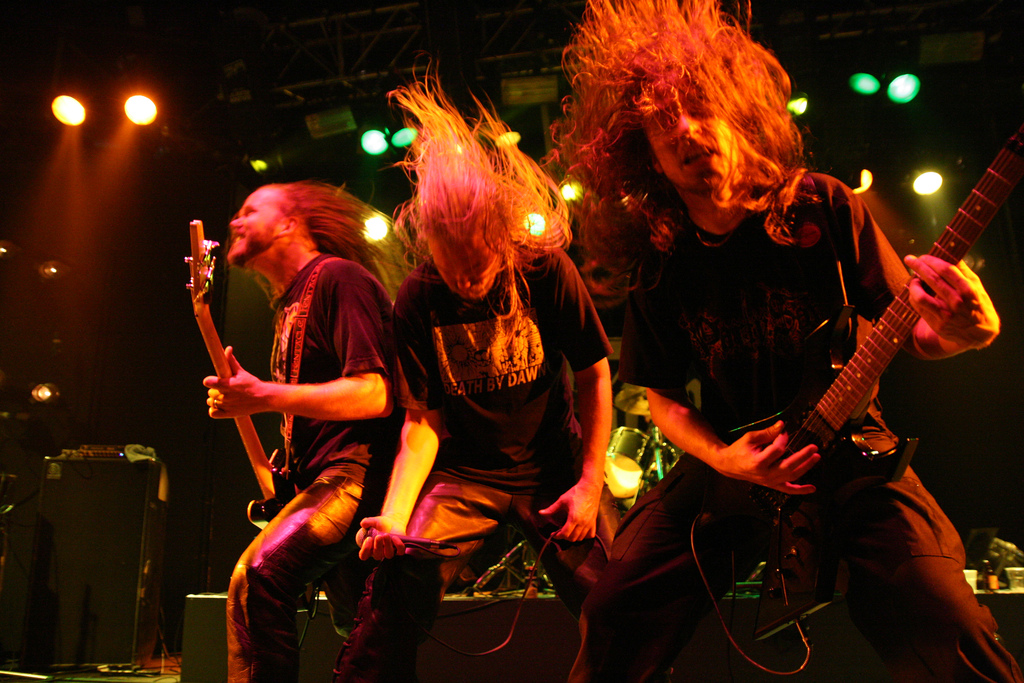
Dutch death metal band Asphyx headbanging during a performance in 2007

Headbanging is the act of violently shaking one's head in rhythm with music. It is common in rock, punk, heavy metal and dubstep, where headbanging is often used by musicians on stage.[1] Headbanging is also common in traditional Islamic Sufi music traditions such as Qawwali in the Indian subcontinent and Iran.

History

[edit]
Illustrative video of headbanging

Sufi music

[edit]

Headbanging has been common in Islamic devotional Sufi music traditions dating back centuries, such as the Indian subcontinent's 600-year-old Qawwali tradition,[2][3] and among dervishes in Iran's Kurdistan Province.[4] Qawwali performances, particularly at Sufi shrines in the Indian subcontinent, usually in honour of Allah, Islamic prophets, or Sufi saints, often have performers and spectators induced into a trance-like state and headbanging in a manner similar to metal and rock concerts.[5][6][7] A popular song often performed by Sufis and fakirs in the Indian subcontinent is the 600-year-old "Dama Dam Mast Qalandar" (in honour of 13th-century Sufi saint Lal Shahbaz Qalandar), which often has performers and spectators rapidly headbanging to the beats of naukat drum sounds.[3]

The most well-known Qawwali performer in modern times is late Pakistani singer Nusrat Fateh Ali Khan, whose performances often induced trance-like headbanging experiences in the late 20th century.[2] Khan's popularity in the Indian subcontinent led to the emergence of fusion genres such as Sufi rock and techno qawwali in South Asian popular music (Pakistani pop, Indi-pop, Bollywood music and British-Asian music) in the 1990s which combine the traditional trance-like zikr headbanging of Qawwali with elements of modern rock, techno or dance music, which has occasionally been met with criticism and controversy from traditional Sufi and Qawwali circles.[8]

Rock music

[edit]

The origin of the term "headbanging" is contested. It is possible that the term "headbanger" was coined during Led Zeppelin's first US tour in 1969.[9] During a show at the Boston Tea Party concert venue, audience members in the first row were banging their heads against the stage in rhythm with the music.

Furthermore, concert footage of Led Zeppelin performing at the Royal Albert Hall January 9, 1970, on the Led Zeppelin DVD released in 2003, the front row can be seen headbanging throughout the performance.[10]

However, an instance of headbanging prior to the alleged coining of the term can be seen during Cream's Farewell Concert in November 1968, also at the Royal Albert Hall. Specifically during the performance of Sunshine of Your Love, front row audience members with particularly large amounts of hair are seen quickly bobbing their heads to the music in a fashion typically associated with modern headbanging.[11]

Ozzy Osbourne and Geezer Butler of Black Sabbath are among the first documented headbangers, as it is possible to see in footage of their gig in Paris, 1970.[12]

In the early 1970s, Status Quo was one of the first hard rock bands to headbang on stage.[13][14]

Lemmy from Motörhead, however, said in an interview on the documentary The Decline of Western Civilization II: The Metal Years, that the term "Headbanger" may have originated in the band's name, as in "Motorheadbanger".

The practice itself and its association with the rock genre was popularized by guitarist Angus Young of the band AC/DC.[15][unreliable source?]

Early televised performances in the 1950s of Jerry Lee Lewis depict young male fans who had grown their hair in the fashion of Lewis, where his front locks would fall in front of his face. Lewis would continuously flip his hair back away from his face, prompting the fans to mimic the movement in rapid repetition in a fashion resembling headbanging.

Dave Tyo of Bipolar demonstrating the 'whiplash' technique at CBGB in New York City

Parrots

[edit]

At least one parrot, a cockatoo named Snowball, developed the habit of headbanging to music, causing something of an Internet sensation.[16] Scientists were intrigued, as untrained dancing among animals is rare.[17]

Health issues

[edit]

In the mid-1980s, Metallica bassist Cliff Burton complained repeatedly about neck pain associated with his almost constant and heavy headbanging during concerts or even rehearsals.[18] In 2005, Evanescence guitarist Terry Balsamo incurred a stroke which doctors postulated may have been caused by frequent headbanging.[19] In 2007, Irish singer and former Moloko vocalist Róisín Murphy suffered an eye injury during a performance of her song "Primitive" when she headbanged into a chair on stage.[20]

In 2009, Slayer bassist/vocalist Tom Araya began experiencing spinal problems due to his aggressive form of headbanging, and had to undergo anterior cervical discectomy and fusion. After recuperating from the surgery, he can no longer headbang.[21][22] In 2011, Megadeth guitarist Dave Mustaine said that his neck and spine condition, known as spinal stenosis, was caused by many years of headbanging.[23] That same year, Stone Sour drummer Roy Mayorga suffered a stroke as a result of his frequent headbanging while drumming. The event led to him having to re-learn how to play drums.[24] Slipknot sampler Craig Jones once suffered from whiplash after an extended case of powerful headbanging.[citation needed]

Several case reports can be found in the medical literature which connect excessive headbanging to aneurysms and hematomas within the brain and damage to the arteries in the neck which supply the brain. More specifically, cases with damage to the basilar artery,[25][26] the carotid artery[27] and the vertebral artery[28] have been reported. Several case reports also associated headbanging with subdural hematoma,[29][30] sometimes fatal,[31] and mediastinal emphysema similar to shaken baby syndrome.[32] An observational study comparing headbanging to non-headbanging teenagers in a dance marathon concluded that the activity is associated with pain in varying parts of the body, most notably the neck, where it manifests as whiplash.[33]

See also

[edit]

References

[edit]
Revisions and contributorsEdit on WikipediaRead on Wikipedia
from Grokipedia
Headbanging is a vigorous form of dance and audience participation characterized by rapid, rhythmic shaking or nodding of the head in synchronization with fast-paced music, most prominently associated with heavy metal, , and related genres. It typically involves circular or up-and-down motions of the head and neck, often at high speeds matching the beat of the music, and serves as an expressive outlet for fans' energy and excitement during concerts or while listening to recordings. Its modern form emerged in Western during the late and . Early instances include performer Chuck Berry's energetic stage antics in 1958 and audience reactions at Cream's 1968 farewell concert to "," as well as drummer Paul Whaley's head-bobbing during Blue Cheer's 1968 appearance on . Headbanging gained prominence in the heavy metal scene of the early 1970s, popularized by bands such as Led Zeppelin—where fans were noted shaking their heads during a 1969 concert—and Black Sabbath, with vocalist incorporating it into performances of songs like "" in 1970. It further evolved through the 1970s and 1980s via acts like AC/DC's and Twisted Sister's , becoming a staple of metal subgenres including , thrash, and later , while also adapting to electronic genres like in the 2000s. While generally viewed as a harmless expression of musical passion, headbanging carries potential risks due to the forceful and deceleration of the head, which can strain the and . Documented injuries include whiplash, , odontoid neck fractures, mediastinal , and —a type of bleed—as seen in a 2013 case where a 50-year-old man required after headbanging to Motörhead's high-tempo music. Biomechanical analyses indicate that at an average heavy metal tempo of 146 beats per minute, head movements exceeding 75 degrees pose a risk of mild , with greater ranges or speeds increasing the likelihood of neck strain or more severe trauma, though such incidents remain rare and often underreported.

Definition and Etymology

Definition

Headbanging is the vigorous, rhythmic shaking of one's head in with fast-paced music, typically featuring forward-and-backward or circular motions that align with the beat. This physical expression serves as a form of or participation, often described as a "vicious " emblematic of intense musical energy. Unlike , which entails aggressive pushing and slamming into others in a crowd, or pogoing, characterized by vertical jumping, headbanging emphasizes isolated or collective head movements without requiring bodily contact. It can be performed individually, allowing personal immersion in the music, or collectively in a group setting where participants synchronize their motions. Headbanging commonly occurs at live s and music festivals, as well as during personal listening sessions, particularly within genres such as heavy metal, punk, hardcore, and electronic bass music like .

The term "headbanging" originated as a compound word in English rock during the late , formed by combining "head," denoting the body part involved in the motion, with "banging," evoking the forceful, rhythmic impact of shaking or striking in time with music. This linguistic construction descriptively captured the vigorous physical response of audiences to intense rock performances, evolving from broader associated with energetic music scenes. The word's formation reflects the era's informal in music subcultures, where actions were named directly from observed behaviors without formal etymological precedent. The records the earliest use of the verb "headbang" in 1966. Although oral usage may trace back earlier, the first documented printed appearance of "headbanger"—referring to a fan or performer engaging in the activity—occurred in 1977, as recorded in standard dictionaries. The term gained prominence in music journalism through descriptions of audience reactions at high-energy shows, with anecdotal accounts linking its popularization to Led Zeppelin's 1969 U.S. tour, particularly a performance at the Boston Tea Party venue where front-row fans reportedly banged their heads against the stage in enthusiasm. This event is often credited with coining "headbanger" in live music contexts, though precise journalistic records from that year remain elusive. In heavy metal communities, "headbanging" became the dominant terminology for the act, while "headbanger" specifically denotes enthusiasts or musicians known for it. Variations in slang emerged regionally and subculturally, though "headbanging" standardized globally; some niche groups used descriptive alternatives, but no widespread regional like "donkey" has been consistently attested in credible historical sources.

History

Pre-Modern and Non-Western Origins

Headbanging-like movements have precedents in various pre-modern practices, where vigorous, rhythmic body motions served to induce ecstatic trances and . In the 13th-century of Sufi whirling dervishes, founded by followers of the poet in , , the sema ceremony involved participants whirling in circular patterns to the accompaniment of and , with the head inclined as part of the full-body rotation to symbolize union with the divine and achieve altered states of consciousness. This ecstatic dance, codified in the , emphasized continuous motion to transcend the self. Similar practices appear in ancient shamanistic traditions of and Native American cultures, where rhythmic drumming induced trance states through synchronized body movements to mimic animal spirits or channel otherworldly energies. Siberian shamans, for instance, danced vigorously while beating frame made from hide to enter altered consciousness and facilitate or ceremonies. In Native American contexts, such as among Plains tribes, shamans used steady drum beats during rituals to synchronize participants' movements, leading to visionary experiences. In African and ritual dances, particularly , possessions by loa spirits during ceremonies featured convulsive body movements synchronized to intense percussive rhythms from drums and rattles, marking the arrival of the and enabling communal or . These manifestations, observed in 18th- and 19th-century accounts of Vodou practices derived from West African traditions, involved the possessed individual's body moving erratically as the loa "mounted" the body, blurring the boundaries between human and divine. Such movements underscored the ecstatic nature of the rite, where physical intensity amplified spiritual connection.

Emergence in Western Rock Music

Headbanging emerged as a distinctive form of audience participation in Western rock music during the mid-to-late 1950s and 1960s, particularly at high-energy concerts by pioneering bands and performers. Early instances include Chuck Berry's 1958 performance of "Johnny B. Goode" in France, where his bassist was observed headbanging, and Jerry Lee Lewis's energetic head-nodding during 1950s shows to manage his hair. By 1968, fans were documented headbanging at Cream's farewell concert during "Sunshine of Your Love," and drummer Paul Whaley head-bobbed during Blue Cheer's appearance on American Bandstand. The practice gained further traction with Led Zeppelin's explosive live shows; during their January 1969 residency at the venue in , front-row audience members were seen banging their heads against the stage and walls in sync with the band's heavy riffs, a phenomenon guitarist later described as unprecedented in his experience. Lemmy Kilmister, bassist and frontman of , claimed in interviews that his band popularized or even "invented" headbanging during their 1970s performances, emphasizing its role in amplifying the visceral energy of shows. By 1969, headbanging gained momentum at major psychedelic and festivals, transforming from isolated reactions into a collective ritual. At the Woodstock Music and Art Fair that August, sets by The Who and fueled widespread participation, with the band's high-energy performance of "I'm Going Home" contributing to audience immersion, while bassist headbanged furiously onstage. This era's festivals, blending high-volume amplification and improvisational energy, accelerated headbanging's adoption, bridging individual mimicry to communal expression in the evolving rock subculture.

Evolution in Heavy Metal and Other Genres

In the 1980s, headbanging evolved into a more intense and communal expression within thrash metal, driven by bands like Metallica and Slayer, whose faster tempos and aggressive rhythms transformed it from individual displays into a core element of mosh pits symbolizing raw aggression and fan devotion. This shift was evident in the burgeoning thrash scene, where live performances encouraged vigorous head movements amid circle pits and stage dives, fostering a sense of collective energy at underground venues. Headbanging found parallel adoption in the punk and hardcore scenes of the 1980s, particularly in Washington, D.C.'s straight edge movement, where it complemented the high-energy, substance-free ethos of bands like Minor Threat. In these environments, it manifested as part of chaotic mosh pits that emphasized physical release without intoxication, spreading from D.C. hardcore shows to broader punk circuits and influencing variants like the "hardcore dancing" style. By the 1990s, headbanging spread globally, notably in Japan's scene, where bands such as and incorporated it into theatrical performances featuring elaborate costumes and heavy metal influences, with audiences engaging in synchronized "wildly manic hair swinging" to amplify the visual and auditory spectacle. This era marked visual kei's commercial peak, blending headbanging with gender-bending aesthetics to create immersive live experiences that drew millions in album sales. The late 1990s and early 2000s saw headbanging intensify in through acts like , whose high-octane tracks such as "" incited frenzied mosh pits with headbang-inducing riffs. Extending into electronic genres, headbanging became a staple in 2000s dubstep and EDM raves, where the subgenre's heavy bass drops prompted aggressive head movements akin to metal traditions, evolving from underground influences into a defining feature of American crowds. This adaptation highlighted headbanging's versatility, bridging metal's aggression with electronic intensity in festival settings.

Techniques and Variations

Basic Mechanics

Headbanging involves a rhythmic forward-backward nodding of the head, driven primarily by the contraction and relaxation of the neck muscles, including the sternocleidomastoid and , which facilitate flexion and extension of the cervical spine. This motion occurs mainly in the , with the angular displacement of the head approximating a sinusoidal pattern around the axis of rotation at the T1-C7 joint, and a typical radius of rotation measuring approximately 174 mm. The movement is synchronized to the downbeats of , often aligning with every beat or every second beat in heavy metal tracks, which commonly feature tempos ranging from 130 to 180 beats per minute. Biomechanically, the core execution relies on the cervical spine's natural , which allows for up to 60.4° of flexion and 69.9° of extension, enabling head displacements from 45° to 120° depending on the intensity. The up-down style represents the standard form, where the head and upper torso move in unison to generate , with the arms frequently positioned to aid balance—such as placing hands on the knees—or to add emphasis through pumping or flailing motions that complement the rhythm. Effective performance requires maintaining proper posture to support the repetitive motion, including standing with feet shoulder-width apart, knees slightly bent to absorb impact and stabilize the lower body, and engaging muscles to keep the upright while extending the with the lifted and chest forward. This foundational stance ensures the motion originates from the upper body without compromising stability, allowing sustained synchronization with at tempos around 146 beats per minute on average.

Common Styles and Movements

Headbanging encompasses a variety of styles that vary in motion, intensity, and synchronization with , often tailored to the and energy of specific genres within rock and metal. These movements typically build on fundamental neck flexion and but emphasize stylistic flair for expression during live performances or listening. One prominent style is the , characterized by a circular swinging motion of the head and arms, creating a helicopter-like that generates through the hair and body. This technique gained popularity in the through acts like W.A.S.P., with frontman incorporating it into energetic stage routines, and later became a staple in and scenes for its compatibility with fast, aggressive breakdowns. Bands such as , with vocalist George "Corpsegrinder" Fisher, further amplified its visibility in by executing rapid windmills during high-tempo passages. The up-and-down style involves vertical bobbing of the head, aligning with the pulse of slower, heavier riffs to produce a rhythmic, piston-like motion. This form is particularly common in , where deliberate tempos around 60-90 beats per minute allow for controlled, emphatic nods that emphasize the genre's weighty atmosphere, as seen in performances by bands like Electric Wizard. In contrast, side-to-side variations feature lateral head swings, often whipping hair across the face, and suit the syncopated grooves of , enabling dancers to lock into mid-tempo riffs from acts like without excessive vertical strain. Exaggerated headbanging integrates additional gestures, such as strumming, to heighten performative energy in nu-metal. Synchronized group headbanging, meanwhile, occurs in settings, where audiences or band members coordinate motions—often windmills or up-and-down bobs—in unison to amplify communal intensity, exemplified by multiple performers executing collective windmills at events like Loud As Hell Open Air.

Cultural and Social Impact

Role in Music Subcultures

Headbanging serves as a potent symbol of and camaraderie within heavy metal fandom, embodying the genre's defiant ethos against mainstream norms and fostering a sense of shared identity among participants. This energetic practice, often performed vigorously to the music's intense rhythms, reinforces the subculture's exclusionary yet tight-knit community, where fans express alienation from societal expectations through collective physical exertion. At major events like the festival, the world's largest heavy metal gathering, headbanging unites thousands of attendees in a ritualistic display of passion, creating an atmosphere of communal celebration that transcends individual differences. Such gatherings amplify headbanging's role in building solidarity, as fans synchronize their movements to demonstrate devotion to the music and bands, often amid massive crowds that enhance the collective experience. Historically associated with male dominance in heavy metal scenes, headbanging has seen increasing female participation in the , challenging traditional hierarchies. Women who engage in headbanging or related activities like often earn respect by aligning with the subculture's masculine-coded physicality, thereby gaining acceptance as authentic members and contributing to a gradual shift toward greater inclusivity. This evolution reflects broader changes in the scene, where female fans and performers are progressively recognized, though the practice remains predominantly male-led. Within these communities, headbanging integrates into rituals such as circle pits—circular mosh formations where participants run and thrash in unison—to signal unwavering devotion to bands and strengthen social bonds. These pits operate under an unspoken code of , including aiding those who fall and excluding aggressive outsiders, which promotes a paradoxical of safety and brotherhood amid the chaos. By participating, fans not only affirm their commitment to the but also cultivate lasting camaraderie, turning concerts into affirming spaces for identity expression. Headbanging has been prominently featured in films as a symbol of rock enthusiasm and excess. In the 1984 mockumentary , directed by , the fictional heavy metal band Spinal Tap satirizes the genre's over-the-top performances and mishaps as part of the comedic portrayal of rock stardom. Similarly, the 1992 comedy includes an iconic scene where protagonists and Garth Algar, played by and , vigorously headbang in their car while lip-syncing to Queen's "," a sequence filmed over six to eight hours that propelled the song back to chart success and mainstreamed headbanging as a fun, relatable act of musical fandom. In music videos and video games, headbanging serves as a visual emblem of heavy metal intensity. Iron Maiden's 1980s videos, such as those for "Run to the Hills" and "The Number of the Beast," present headbanging classics that blend narrative storytelling with live performance energy, where the band's mascot Eddie and dynamic stage presence highlight the motion as integral to the genre's theatricality. Video games like the series further embed headbanging into interactive entertainment, with character animations and crowd reactions simulating the act during tracks like Quiet Riot's "(Bang Your Head) ," encouraging players to mimic the physicality of metal concerts in an '80s-themed rhythm gameplay experience. Advertisements have co-opted headbanging to convey excitement and vitality, often tying it to product energy. A 1999 Levi's Sta-Prest campaign featured the yellow puppet in a series of spots where he headbangs to beats alongside a car, rejuvenating the brand's image through the character's quirky, rhythmic appeal that resonated in . More recently, a 2019 commercial humorously depicts four metalhead friends headbanging so intensely during a that the drivers lose control, only for the car's Emergency Assist system to intervene by braking and steering to safety, underscoring headbanging's association with high-energy rock while promoting automotive safety features.

Headbanging in Animals

Observations in Parrots

One prominent instance of headbanging-like behavior in parrots involves , a male ( galerita eleonora), whose rhythmic head-bobbing to music gained widespread attention through viral videos uploaded in 2007 and popularized in 2008. In footage set to the ' song "Everybody" (at approximately 108 beats per minute), Snowball synchronizes his head movements—characterized by vigorous up-and-down bobs—to the musical beat, often incorporating foot lifts and body sways that mimic human dancing. A 2009 study in provided experimental evidence of 's ability to voluntarily entrain to , analyzing his responses to manipulated audio clips of the same song sped up or slowed down by 10% and 20% from the original of approximately 109 beats per minute. The research demonstrated that Snowball adjusted the timing of his head-bobs to match these variations, maintaining across tempos ranging from about 87 to 130 beats per minute, indicating intentional beat perception rather than random or reflexive motion. This entrainment was observed in controlled settings without from humans, highlighting the parrot's intrinsic rhythmic capability. A companion study in the same journal extended these findings to multiple vocal-mimicking parrots, confirming similar spontaneous motor to music beats. Headbanging behaviors appear common in certain parrot species, notably sulphur-crested cockatoos and African grey parrots (Psittacus erithacus), which are advanced vocal learners. In African greys, such as the renowned , entrainment to musical rhythms has been documented through head movements that align with beats, paralleling observations in cockatoos. These displays may serve social functions, including bonding and , as parrots in these species form long-term pair bonds and use imitative actions to engage with conspecifics or human companions, adapting courtship-like movements to musical stimuli.

Instances in Other Species

Headbobbing behaviors, analogous to headbanging, have been observed in various non-avian species, often in contexts of locomotion, play, or response to environmental stimuli, though these differ from the rhythmic entrainment seen in parrots. In birds such as pigeons (Columba livia) and chickens (Gallus gallus domesticus), head-bobbing occurs during walking or running as a stabilization mechanism to maintain . This rhythmic motion consists of a "thrust" phase, where the head moves forward with the body, and a "hold" phase, where the head remains stationary in space relative to the environment, compensating for body movement to prevent . Studies from the 2010s in have demonstrated that pigeons can perceive and discriminate auditory rhythms, such as meter (e.g., 8/4 vs. 3/4 time) and (e.g., 120 bpm vs. 30 bpm), using tasks where they peck to indicate detection, suggesting underlying neural mechanisms for processing periodic sounds that may intersect with their natural bobbing rhythms. However, direct entrainment of head-bobbing to auditory stimuli in lab settings has not been conclusively linked in these species, unlike in vocal-learning birds. Among mammals, head-shaking or bobbing-like movements appear in play and auditory contexts, though typically less synchronized to external rhythms than in humans. In canids, such as dogs (Canis familiaris) and wolves (Canis lupus), rapid head shaking often accompanies play behaviors, including jaw sparring or chasing, serving to build social bonds and practice motor skills without full rhythmic alignment to sounds. A 2022 study on rats (Rattus norvegicus) provided the first evidence of spontaneous beat synchronization in a non-primate mammal, where rats in a bipedal stance exhibited head-bobbing movements temporally aligned with musical beats from composers like Mozart at 120-140 bpm, tracked via motion-capture accelerometers; neural recordings showed striatal activity correlating with these movements, indicating an innate capacity for motor entrainment to auditory rhythms. In primates, rare instances of head-involved rhythmic behaviors occur during excitement; for example, captive chimpanzees (Pan troglodytes) displayed spontaneous swaying and nodding in response to piano sounds in a 2019-2020 experiment, with movements increasing significantly during auditory playback compared to silence, particularly in males, though this was more postural than vigorous headbanging. A 2025 study further demonstrated precise sensorimotor in a ( californianus) named Ronan, who bobbed her head in time with novel metronomic sounds at various tempos, performing as well as or better than human adults in maintaining beat alignment. This extends evidence of rhythmic entrainment involving head movements to marine mammals, previously trained since 2013 but retested with new stimuli. Evolutionary theories propose that these head movements in non-human animals primarily evolved for functional purposes like balance and communication, rather than aesthetic synchronization to as in humans. In birds, head-bobbing enhances via motion , aiding survival in dynamic environments, while in mammals, such actions may signal affiliation or readiness during social interactions, with any rhythmic elements emerging as byproducts of systems rather than specialized musical processing. These behaviors highlight convergent adaptations for sensory integration but remain distinct from the voluntary, culturally influenced headbanging in human contexts.

Health Considerations

Potential Injuries and Risks

Headbanging involves vigorous, repetitive oscillations of the head and , which can lead to acute injuries such as whiplash, characterized by strain to the cervical muscles, ligaments, and soft tissues from sudden acceleration-deceleration forces. Muscle strains in the and upper back are also common due to the high-velocity motions associated with typical heavy metal tempos. The motions of headbanging itself can result in mild with symptoms like and . Concussions may occur from direct collisions with other concertgoers or stage elements during crowd participation. Documented cases highlight severe acute vascular complications, including a case reported in 2014 of a 50-year-old man who developed a chronic after headbanging at a concert, requiring surgical evacuation of the bleed. Similarly, cervical artery dissections have been reported in headbangers, with rotational forces tearing the arterial walls and potentially leading to if untreated. A 2022 scoping review identified 13 cases of moderate-to-severe attributed to headbanging, underscoring its rarity but potential severity. Chronic effects from prolonged or intense headbanging include the potential for subdural hematomas in long-term enthusiasts, as biomechanical models indicate that head excursions greater than 75 degrees at 146 beats per minute can generate forces equivalent to mild brain trauma over repeated exposures. Accelerated in the cervical spine may also develop, with cases showing disc prolapse and from cumulative microtrauma weakening intervertebral structures. Individuals with pre-existing conditions face heightened risks; for example, those with are more susceptible to vertebral fractures or exacerbated spinal instability during high-intensity sessions, as the axial loading and flexion-extension stresses can overload fragile .

Prevention and Safety Measures

To minimize the risk of head and injuries during headbanging, practitioners should adjust their technique by reducing the in the head and , which lowers the forces experienced by the cervical spine. Additionally, headbanging to slower-tempo music, such as tracks below 130 beats per minute, significantly decreases the acceleration forces on the and compared to faster heavy metal rhythms exceeding 140 beats per minute. the neck muscles with gentle stretches, such as chin tucks and side tilts held for 15-30 seconds each, prior to activity can help prepare the soft tissues and reduce strain. Environmental factors play a key role in safety; avoiding overcrowded mosh pits reduces the chance of collisions that could lead to whiplash or contusions alongside headbanging motions. In extreme cases, such as during high-intensity performances, wearing protective gear like cervical collars or neck supports can stabilize the spine and mitigate impact forces. Staying hydrated by consuming regularly throughout a helps maintain muscle elasticity and prevents fatigue-related poor form that exacerbates risk. Individuals over 40 or those with pre-existing neck conditions may face heightened risks, as case reports document subdural hematomas and vertebral injuries in older adults following vigorous sessions. Research emphasizes overall moderation in frequency and intensity to avoid cumulative trauma to the head and neck structures.

References

Add your contribution
Related Hubs
User Avatar
No comments yet.