Hubbry Logo
Cusk-eelCusk-eelMain
Open search
Cusk-eel
Community hub
Cusk-eel
logo
8 pages, 0 posts
0 subscribers
Be the first to start a discussion here.
Contribute something
Cusk-eel
Cusk-eel
from Wikipedia

Cusk-eel
Temporal range: Maastrichtian–present
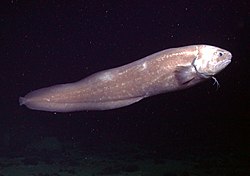
Pudgy cusk-eel (Spectrunculus grandis)
Scientific classification Edit this classification
Kingdom: Animalia
Phylum: Chordata
Class: Actinopterygii
Order: Ophidiiformes
Suborder: Ophidioidei
Family: Ophidiidae
Rafinesque, 1810
Subfamilies

See text

The cusk-eel family, Ophidiidae, is a group of marine bony fishes in the Ophidiiformes order. The scientific name is from the Greek ophis meaning "snake", and refers to their eel-like appearance. True eels diverged from other ray-finned fish during the Jurassic, while cusk-eels are part of the Percomorpha clade, along with tuna, perch, seahorses, and others.

The oldest fossil cusk-eel is Ampheristus, a highly successful genus with numerous species that existed from the Late Cretaceous (Maastrichtian) to the early Oligocene.[1][2]

Distribution

[edit]

Cusk-eels live in temperate and tropical oceans throughout the world. They live close to the sea bottom, ranging from shallow water to the hadal zone. One species, Abyssobrotula galatheae, was recorded at the bottom of the Puerto Rico Trench, making it the deepest recorded fish at 8,370 m (27,460 ft).[3][4]

Ecology

[edit]

Cusk-eels are generally very solitary in nature, but some species have been seen to associate themselves with tube worm communities.[5] Liking to be hidden when they are not foraging, they generally associate themselves within muddy bottoms, sinkholes, or larger structures that they can hide in or around, such as caves, coral crevices, or communities of bottom-dwelling invertebrates, with some parasitic species of cusk-eel actually living inside of invertebrate hosts, such as oysters, clams and sea cucumbers.[5] Cusk-eels generally feed nocturnally, preying on invertebrates, crustaceans and other small bottom-dwelling fishes.

Phylogeny

[edit]

Due to the inconsistencies in specific morphological characteristics in closely related species, attempts to use different characteristics, such as the position of pelvic fins, to classify Ophiididae into distinct families have proven highly unsatisfactory. Overall, Ophidiidae are classified based on whether or not they practice viviparity and the structures they contain that are associated with bearing life.[5]

Characteristics

[edit]

Cusk-eels are characterized by a long, slender body that is about 12–13 times as long as it is deep. The largest species, Lamprogrammus shcherbachevi, grows up to 2 m (6.6 ft) in length[citation needed], but most species are shorter than 1 m (3.3 ft). Their dorsal and anal fins are typically continuous with the caudal fin (with exception to a few species), forming a long, ribbon like fin around the posterior of the cusk-eel's body.[6] This caudal fin will often be seen to be reduced to a fleshy or bony point, especially when confluent with the dorsal and anal fins. The dorsal fin to anal fin ray ratio is approximately 1.5:1, leading to the dorsal fin typically being longer than the anal. The pectoral fins of cusk-eels are typically longer than the length of their head. Unlike true eels of the order Anguilliformes, cusk-eels have ventral fins that are developed into a forked barbel-like organ below the mouth. In true eels by contrast, the ventral fins are never well-developed and usually missing entirely.[7] Cusk-eels have large mouths relative to their heads, with the upper jaw reaching beyond the eye, and paired nostrils on either side of the head. In cusk-eels, scales are potentially absent; when present, they are small.[6]

Reproduction

[edit]

Unlike their close relatives, the viviparous brotulas of the family Bythitidae, cusk-eel species are egg-bearing, or oviparous, organisms. While the specifics of the eggs of the family Ophidiidae are unknown, they are believed to be either spawned as individual, free-floating eggs in the open water or are placed in a mucilaginous raft, which will float for several days until they hatch into cusk-eel larvae. These larvae live amongst the plankton relatively close to the water's surface[3] and are believed to control their metamorphoses into adult cusk-eels, dispersing over greater distances into less utilized habitats and reducing competition in concentrated areas.[5]

Conservation status

[edit]

While a few species are fished commercially – most notably the pink cusk-eel, Genypterus blacodes – and several species of the order Ophidiiformes are listed as vulnerable, not enough information has been gathered about Ophidiidae as a whole to determine their conservation status.

Genera

[edit]

The cusk-eel family contains about 240 species, grouped into 50 genera:[8]

Subfamily Brotulotaenilinae

Subfamily Neobythitinae

Subfamily Ophidiinae

[edit]

References

[edit]
Revisions and contributorsEdit on WikipediaRead on Wikipedia
from Grokipedia
Cusk-eels are a diverse of marine bony fishes (Ophidiidae) in the order , characterized by their elongated, serpent-like bodies, with rays typically equal to or longer than those of the anal , and the and anal fin origin positioned behind the tip of the pectoral . Scales are present on their bodies, and some species feature opercular spines, while a supramaxillary is also characteristic; larvae lack a , and pelvic fins are sometimes absent. Comprising 51 genera and 289 species, this dominates deep-sea environments but also occurs in shallow coastal waters, estuaries, and brackish habitats across the Atlantic, Indian, and Pacific Oceans. Most cusk-eels are benthopelagic or benthic, inhabiting soft bottoms from shallow tropical and subtropical regions to abyssal depths exceeding 7,000 meters, with approximately 78% of occurring below 200 meters. They are oviparous, with eggs that are often pelagic and float in gelatinous masses, and exhibit typical activity levels without parental guarding. Many species are soniferous, producing pulsed sounds for and spawning, with diel, monthly, and seasonal patterns in vocalizations documented in some coastal forms. Ecologically, cusk-eels play roles as predators of small and fishes, and as prey for larger marine species; their deep-sea diversification likely originated from shallow-water ancestors around 96 million years ago, followed by invasion of deeper zones approximately 90 million years ago. Certain , such as the red cusk-eel (Genypterus chilensis), hold commercial importance as food fish in regions like , where they support fisheries yielding thousands of tons annually and aggregate at seeps that may serve as key habitats. In the western Atlantic, species like the striped cusk-eel (Ophidion marginatum) contribute to local ecosystems and occasional fisheries, though the family as a whole is not broadly exploited due to many deep-water distributions. The first records of Ophidiidae date to the lower Tertiary Eocene, underscoring their ancient lineage.

Taxonomy and Evolution

Overview

Cusk-eels are marine bony fishes comprising the family Ophidiidae within the order , which belongs to the diverse clade of ray-finned fishes. The family is characterized by its elongate, serpentine body form that inspired the common name "cusk-eel," distinguishing it from true eels (order Anguilliformes) despite superficial similarities in shape. The scientific name Ophidiidae derives from the Greek ophis, meaning "snake," reflecting the group's slender, eel-like morphology. Currently, the family encompasses approximately 289 species distributed across 51 genera, showcasing significant taxonomic diversity. Cusk-eels exhibit broad habitat diversity, occupying environments from shallow coastal waters to the deep-sea in tropical, temperate, and polar regions of the Atlantic, Indian, and Pacific . Their evolutionary origins trace back to the , around 96 million years ago, when ancestors likely inhabited shallow marine settings before radiating into deeper habitats.

Phylogeny

The classification of cusk-eels within the order has historically been complicated by inconsistent morphological traits, such as variations in fin placement and scale patterns, prompting reliance on reproductive structures for delineation—particularly the distinction between viviparous Bythitoidei and oviparous Ophidioidei suborders. Molecular analyses have increasingly addressed these challenges, revealing in traditional groupings like Ophidiidae relative to Carapidae. A pivotal 2024 phylogenetic study, based on mitochondrial and nuclear DNA from 59 samples across 36 genera, resolved four major clades within Ophidioidei and confirmed the nesting of Carapidae inside Ophidiidae, necessitating taxonomic revisions such as elevating Brotulinae to family status and proposing the new family Acanthonidae for genera like Acanthonus and Xyelacyba. This work highlighted diversification patterns driven by repeated bathymetric shifts, with the common ancestor of Ophidioidei inferred to have occupied the as the center of origin and early radiation approximately 90.22 million years ago, coinciding with the Oceanic Anoxic Event 2 (OAE2). Within the broader clade, is an early-diverging order within Percomorpha (series Ophidiaria), part of the acanthomorph fishes, with molecular phylogenies indicating a divergence from other percomorph lineages around 96 million years ago and subsequent adaptive radiations influenced by Paleogene-Neogene climate fluctuations. These patterns underscore a dynamic evolutionary history, encompassing over 500 across roughly 116 genera today. Subfamilies within the revised Ophidiidae framework, such as Ophidiinae—defined by forward-positioned pelvic fins, chin barbels, and a slender cleithral projection—and Aphyoninae, characterized by deep-sea adaptations including reduced or absent scales and elongated bodies, illustrate specialized evolutionary trajectories tied to depth and reproductive modes.

Fossil Record

The fossil record of cusk-eels () begins in the , with the oldest known specimen represented by Pastorius methenyi, an enigmatic basal ophidiiform discovered in the Comen Formation near Trebiciano, northeastern . This fossil, dating to the early stage (approximately 80 million years ago), provides the earliest direct evidence of the order and underscores the diversification of percomorph fishes, suggesting that ophidiiforms were already present in shallow marine environments during this period. A more widespread and successful early genus is Ampheristus, known from numerous species spanning the (Maastrichtian, approximately 70–66 million years ago) to the early (approximately 34–28 million years ago). Fossils of Ampheristus, including A. americanus, have been reported from deposits in (e.g., ), , , and , indicating a global distribution during the and . This genus, considered a stem-group member of the family Ophidiidae, exemplifies the early radiation of cusk-eels following their emergence around 96 million years ago in shallow waters. The evolutionary timeline of cusk-eels reflects an initial origin in neritic habitats, followed by diversification into deeper-sea niches during the , particularly the and . Post- fossils, often from the Eocene and (e.g., Genypterus valdesensis from the of ), document this transition, with otoliths indicating adaptation to bathyal and abyssal environments. However, significant gaps persist in the fossil record due to the soft-bodied, elongate morphology of cusk-eels, which favors preservation of durable elements like otoliths over complete skeletons. This bias, evident in and deposits across the Basin, , and the , complicates reconstructions of early depth-related adaptations and phylogenetic links to modern subfamilies, though otolith-based studies reveal high diversity during the Tertiary.

Physical Characteristics

Morphology

Cusk-eels, members of the Ophidiidae, possess a slender, elongate body that is typically 12–13 times longer than deep, tapering posteriorly to facilitate streamlined movement in their environment. This serpent-like form is characteristic of the 289 in the , emphasizing their eel-like appearance without the full elongation seen in true eels. The dorsal, anal, and caudal fins are continuous, forming a long, ribbon-like structure around the posterior body that aids in and stability. In most , the ventral (pelvic) fins are modified into forked, barbel-like organs positioned on the , functioning as sensory structures equipped with receptors to detect prey and environmental cues. Cusk-eels feature a large, terminal mouth equipped with sharp, canine-like teeth in the jaws, adapted for capturing elusive prey such as small and . The head is relatively small and smooth, often bearing a supramaxillary and, in some , spines on the opercle. Scales are small, , and non-overlapping across the body, contributing to a smooth that reduces drag; in certain deep-sea , scales may be absent or reduced, with the skin appearing gelatinous and translucent. These morphological traits support their predominantly bottom-dwelling habits, enabling effective navigation over sediments.

Size and Variation

Cusk-eels display considerable variation in adult body size across the family Ophidiidae, ranging from diminutive species to exceptionally large ones. The smallest known species, Ophidion lagochila, attains a maximum standard length (SL) of just 7 cm, inhabiting shallow coastal waters. In contrast, the largest, Lamprogrammus shcherbachevi, can reach up to 193 cm SL, representing a deep-sea giant with a circumglobal distribution in bathyal zones. Most species fall between these extremes, with maximum lengths typically under 1 m SL, reflecting adaptations to diverse ecological niches from intertidal zones to abyssal depths. Body proportions vary notably among species and subfamilies, influenced by habitat depth. Shallow-water forms, such as those in the genus Ophidion, often exhibit more robust builds with greater body depth relative to length, supporting benthic lifestyles in structured environments. Deep-sea species, including many in the subfamily Neobythitinae, tend toward slender, elongate forms with proportionally longer tails and lower weight per unit length, facilitating efficient movement in low-oxygen, high-pressure conditions. These variations align with broader morphological adaptations to depth, where slender profiles reduce drag and enhance sensory capabilities in dim light. Coloration in cusk-eels is generally subdued and uniform, aiding on muddy or sandy substrates. Common hues include shades of brown, gray, or black across the body, as seen in like Spectrunculus crassus, which appears dark brown in life. Deep-water inhabitants may show paler or translucent tones, such as the of Ophidion muraenolepis ventrally, enhancing against sparse penetration. Some display subtle patterns, like basket-weave scale markings in brown, but bold contrasts are rare outside larval stages. Sexual dimorphism is present in several species, primarily manifesting in the sonic apparatus rather than external morphology, though differences in lengths occur in select cases. For instance, males of Neobythites gilli exhibit larger medial sonic muscles and slightly elongated pelvic s compared to females, linked to sound production for . In deeper-water neobythitines, such dimorphism supports species-specific acoustic signaling, with minimal overall size differences between sexes.

Distribution and Habitat

Geographic Range

Cusk-eels of the family Ophidiidae exhibit a across the Atlantic, Indian, and Pacific Oceans, inhabiting marine environments in both temperate and tropical regions worldwide. This broad range encompasses coastal shelves to open ocean basins, with representatives documented from the western North Atlantic to the eastern Pacific and from the to the waters off . The stands out as a major hotspot for Ophidiidae diversity, hosting the majority of the family's 281 species across 46 genera (as of November 2025), many of which are endemic to isolated features like seamounts and deep trenches in this region. For instance, genera such as Porogadus and Luciobrotula show high in Indo-West Pacific bathyal habitats, reflecting biogeographic patterns driven by tectonic isolation and oceanographic barriers. In contrast, the Atlantic hosts fewer species overall, with distributions often concentrated along continental margins. Latitudinal gradients in distribution reveal greater in tropical and subtropical zones, where environmental stability supports higher diversity, while populations extend poleward into subpolar areas, such as the southern waters off and . Examples include Genypterus chilensis, which ranges from northern to , demonstrating the family's ability to occupy cooler, higher-latitude habitats. This tropical peak in diversity aligns with broader patterns in marine . Due to their predominantly benthic adult phase, cusk-eels display limited long-distance migration, relying instead on pelagic larval stages for dispersal and across basins. This lifestyle contributes to the observed biogeographic structuring, with many species showing restricted ranges tied to specific continental slopes or isolated oceanic features.

Depth and Environmental Preferences

Cusk-eels (family Ophidiidae) occupy an exceptionally broad vertical range in marine environments, from shallow intertidal and neritic zones on continental shelves to bathybenthic and hadal depths exceeding 8,000 meters in oceanic trenches. This depth zonation allows the family to exploit diverse niches, with many species classified as bathybenthic dwellers in the , while others thrive in neritic shallows. For instance, the species Abyssobrotula galatheae represents the deepest-recorded member of the family, trawled from 8,370 meters in the . Preferred substrates vary across the family but commonly include soft sediments such as muddy or sandy bottoms, where many cusk-eels for shelter and . Others inhabit rocky crevices, burrows, or structured habitats like coral reefs, with some species associating with kelp beds in coastal areas. These fishes demonstrate remarkable environmental tolerances, particularly in deep-sea settings where they endure low oxygen concentrations and extreme hydrostatic pressures. Temperature preferences span a wide , from warm tropical coastal waters (around 23–28°C for many shallow species) to the cold, stable conditions of abyssal depths (near 2–4°C). Such adaptations enable cusk-eels to persist across pronounced zonation patterns, bridging shallow neritic communities with isolated bathybenthic populations.

Ecology and Behavior

Feeding Habits

Cusk-eels (family Ophidiidae) are primarily carnivorous, with diets consisting mainly of benthic invertebrates such as crustaceans (including shrimp, crabs, and amphipods), polychaete worms, and cephalopods, as well as small fishes. For instance, in the pink cusk-eel (Genypterus blacodes), stomach content analyses reveal that fish and crustaceans dominate the diet, with fish comprising the majority of assimilated biomass. Similarly, the Pacific bearded brotula (Brotula clarkae) preys heavily on decapod crustaceans and small teleosts, reflecting the family's reliance on bottom-dwelling fauna. Many cusk-eels employ nocturnal strategies, remaining hidden in burrows or caves during the day and emerging at night to hunt. Their large terminal mouths facilitate rapid prey capture, while modified pelvic fins serve as elongated sensory filaments that probe the substrate to detect hidden or nearby prey, enabling ambush tactics in low-light conditions. This behavior is evident in species like the striped cusk-eel (Ophidion marginatum), which exhibits typical nocturnal activity patterns. Trophic levels for cusk-eels typically range from 3.5 to 4.2 based on studied , positioning them as secondary to tertiary consumers that contribute to benthic dynamics by controlling populations. Ontogenetic shifts in diet are common, with juveniles targeting smaller planktonic or epibenthic items like copepods and amphipods, while adults shift toward larger benthic prey such as and larger crustaceans; for example, in G. blacodes, fish consumption increases and crustacean intake decreases with body size. Habitat depth influences prey availability, with deeper species accessing more polychaetes and cephalopods.

Social and Activity Patterns

Cusk-eels (family Ophidiidae) typically lead a solitary lifestyle, remaining hidden in burrows, crevices, or during the to avoid predators and conserve energy. This cryptic behavior is widespread across the family, with individuals emerging primarily to engage in foraging and other activities. Activity patterns vary by and , with some coastal Ophidion exhibiting both nocturnal and diurnal behaviors. Most species exhibit nocturnal or crepuscular activity patterns, with peak activity occurring shortly after sunset when they venture out from their refuges. For instance, the striped cusk-eel (Ophidion marginatum) shows distinct diel rhythms in sound production, forming brief choruses around and dawn that align with these transitional periods. In deeper waters, where penetration is minimal, activity may extend continuously but remains tied to low-light conditions, facilitating predator avoidance and prey detection. Social interactions among cusk-eels are limited, with no documented schooling behavior observed in the ; individuals generally maintain spatial separation outside of brief, context-specific encounters. Sound production plays a key role in communication, particularly in low-visibility environments, where species like those in the genus Genypterus utilize specialized sonic muscles attached to the to generate pulsed signals.

Reproduction and Development

Reproductive Modes

Cusk-eels in the Ophidiidae exhibit oviparous reproduction, characterized by and the deposition of eggs into the marine environment. Unlike some relatives in the order , such as viviparous brotulas in the suborder Bythitoidei, all known Ophidiidae species are egg-layers, with no documented within the . This mode supports their diverse habitats, from shallow coastal waters to deep-sea environments, by allowing eggs to disperse widely via ocean currents. Egg production varies across species, but details remain limited for many; eggs are generally pelagic and buoyant, either released as individual free-floating units or clustered in pelagic mucilaginous rafts that float in the water column. For instance, in the genus Genypterus, such as the black cusk-eel G. maculatus, eggs are and enclosed in gelatinous masses that facilitate flotation and protection during early development. can be high, with some females producing up to hundreds of thousands of eggs per spawning event, though exact numbers depend on body size and environmental conditions. Spawning patterns differ by latitude and species, with temperate-water cusk-eels typically reproducing seasonally—often during summer or early fall to align with optimal larval conditions—while tropical species may spawn year-round. Many species, including the striped cusk-eel Ophidion marginatum, engage in nocturnal spawning, with behaviors such as sound production occurring around sunset to minimize predation risk. These events often involve multiple spawning bouts over short periods, enabling rapid egg release in suitable conditions. Parental care is generally absent among Ophidiidae, as adults abandon eggs immediately after release, relying on the pelagic nature of the eggs and subsequent larval planktonic phase for survival. This lack of investment post-spawning is typical for broadcast spawners in open-water environments, where high egg numbers compensate for high mortality rates.

Larval Development

Cusk-eels in the family Ophidiidae primarily produce pelagic eggs encapsulated within gelatinous masses, which serve as floating rafts in the . These egg masses typically dissolve shortly after spawning, releasing the eggs into the , though in some observed cases, such as in the northern , the gelatinous matrix persists for several days post-hatching, retaining preflexion yolk-sac larvae. Hatching occurs after an of 4 to 5 days at water temperatures of 15 to 18°C, yielding larvae approximately 5 mm in length for species like the red cusk-eel (Genypterus chilensis). In other species, such as Chilara taylori, larvae hatch at around 2.5 mm and are slender with a gut extending just short of mid-body. Newly hatched larvae of cusk-eels are planktonic and occupy epipelagic habitats, exhibiting a biphasic life cycle that transitions from this dispersive phase to a demersal juvenile stage. These larvae possess compressed, ovoid to elongate bodies that are largely transparent, with features including a posteriorly displaced originating over the , an elongate first dorsal-fin ray often exceeding standard length, large fan-like pectoral fins with 26 to 31 rays, and small pelvic fins with 2 rays. Unlike true leptocephali of anguilliform eels, ophidiid larvae are shorter and lack the extreme leaf-like flattening, but they share a planktonic existence lasting weeks to months, during which they feed primarily on to support development. This pelagic duration facilitates wide dispersal, with larvae undergoing vertical migrations that influence their distribution. Metamorphosis in cusk-eel larvae occurs during the postflexion , marked by the loss of 2 to 24 anterior dorsal-fin elements and overall body elongation as they settle from the to benthic . This transition involves a vertical habitat shift, with postlarvae descending 200 to over 1,000 m to the deep-sea floor, where they adopt a more demersal lifestyle as juveniles with developed fins and elongated bodies. Growth rates during the larval phase vary by depth and environmental factors; deep-sea species experience slower development due to lower temperatures, as evidenced by δ¹⁸O profiles indicating ontogenetic shifts in thermal habitats, while food availability, particularly zooplankton density, further modulates growth.

Conservation and Human Use

Status and Threats

The conservation status of cusk-eel species (family Ophidiidae) varies widely, with the majority classified as or Least Concern by the International Union for Conservation of Nature (IUCN), reflecting limited data on many deep-sea taxa. For instance, a conservation analysis of ophidiid species along India's west coast found 21.5% categorized as , underscoring knowledge gaps for over 280 in the family. Some , such as the (Genypterus blacodes), are assessed as Vulnerable due to pressures and alterations. Few reach Endangered status, but ongoing evaluations highlight vulnerabilities in commercially targeted populations. Major threats to cusk-eels include in deep-sea operations, which inadvertently captures these benthic and benthopelagic fishes, contributing to unreported mortality. Bottom also causes by disrupting seafloor structures like sediments and biogenic features essential for cusk-eel shelter and foraging, leading to long-term degradation in continental slope and abyssal zones. Additionally, poses risks to deep-water species by altering sensory functions and prey availability, though empirical data remain sparse for ophidiids. Population trends indicate declines in intensively fished areas, such as for the (Genypterus blacodes) in southern , where stocks have fallen below sustainable levels due to . Monitoring gaps persist owing to the challenges of surveying deep habitats, limiting trend assessments for most . Recent IUCN assessments post-2021, including for Genypterus blacodes as of March 2024, reveal low abundances and emphasize the need for updated surveys to address data deficiencies and inform management.

Commercial and Ecological Importance

Cusk-eels, particularly the pink cusk-eel (Genypterus blacodes), support important commercial fisheries in the , including , , , and , where they are targeted year-round by demersal otter trawlers on continental slopes for human consumption. These fisheries value the species for its firm, white flesh, which is marketed fresh or frozen in local and regional markets. Despite their commercial value, cusk-eels frequently appear as in trawl fisheries targeting other demersal species, such as and crustaceans, leading to significant discard rates and potential waste in operations across the Atlantic and Pacific. In some regions, like the Trawl Fishery, catches constitute a minor portion of total landings, highlighting their incidental capture. Ecologically, cusk-eels serve as key predators in benthic food webs, occupying top trophic levels (approximately 4) in ecosystems like the Southwestern Atlantic, where they prey on and smaller , helping regulate community structure. Their presence in deep-sea habitats, including seeps, contributes to by interacting with chemosynthetic communities, positioning them as potential indicators of benthic . Participation in the aquarium trade is rare for cusk-eels, limited to a few small, colorful species like the yellow lycopod cusk-eel (Diancistrus fuscus), which occasionally enter marine hobbyist markets but require large tanks due to their burrowing habits. They hold significant research value in deep-sea biology, with studies on their acoustics, phylogeny, and larval adaptations providing insights into environmental responses to disturbances and dynamics.

References

Add your contribution
Related Hubs
Contribute something
User Avatar
No comments yet.