Hubbry Logo
DKW SchnellasterDKW SchnellasterMain
Open search
DKW Schnellaster
Community hub
DKW Schnellaster
logo
8 pages, 0 posts
0 subscribers
Be the first to start a discussion here.
DKW Schnellaster
DKW Schnellaster
from Wikipedia
DKW Schnellaster
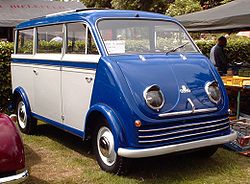
1954 DKW Schnellaster F 89 L minibus, with precursor layout to the contemporary minivan: front-wheel drive, transverse engine, flat floor, and multi-configurable seating
Overview
ManufacturerDKW Auto Union
Production1949–1962
AssemblyIngolstadt, Germany
Body and chassis
ClassLight commercial vehicle
Body stylepanel van, minibus, pickup
LayoutFWD layout
Powertrain
Engine0.7 L I2 two-stroke
0.8 L I2 two-stroke
0.9 L I3 two-stroke
Dimensions
Wheelbase2,500 mm (98.4 in) – 3,000 mm (118.1 in) (pickup)
Length3,930 mm (154.7 in) – 4,455 mm (175.4 in) (pickup)
Width1,550 mm (61.0 in) – 1,670 mm (65.7 in)
Chronology
SuccessorDKW F1000 L

The DKW Schnellaster, also known as the DKW F89 L, was a van produced by DKW from 1949 to 1962. Alongside the DKW F89 passenger car, it was the first vehicle to be manufactured by the new Auto Union conglomerate in Ingolstadt following the re-establishment of the business in West Germany. The model name Schnellaster translates from German to English as Rapid Transporter.[1]

Design

[edit]
DKW Schnellaster van

The Schnellaster is of a one box or monospace configuration featuring front wheels set forward in the passenger cabin, a short sloping aerodynamic hood, front wheel drive, transverse engine (early, two cylinder models only), flat load floor throughout with flexible seating and cargo accommodations. These same features make the Schnellaster a precursor of the modern minivan, a body configuration subsequently popularized in notable examples such as the Renault Espace, or the Chrysler Voyager/Dodge Caravan and, mechanically, of the BMC Mini plus most modern cars.[1]

The van included a trailing arm rear suspension system incorporating springs in the cross bar assembly. The modern layout featured a prewar two-cylinder 700 cc two-stroke engine of the DKW F8 rated at 20 hp (22 hp after 1952). In 1955 the van (Typ 3 ) [2] received the DKW F9's three cylinder unit with 900 cc, producing 32 hp (24 kW).

The van's layout enabled a flat loading floor only 40 cm (16 in) off the ground. It was also fitted with a large single rear door fitted to hinges on the right-hand side.

World markets

[edit]
Spanish built DKW F 1000 L van

The van was also produced in Vitoria, Spain, by subsidiary Industrias del Motor S.A. (IMOSA) from 1954. In Spain, DKW became a common term for any van, and is still used today. The Spanish subsidiary also produced a modern successor with all new bodywork, introduced in 1963 and called the DKW F1000 L. This van started with the three-cylinder 981 cc two-stroke DKW engine, but later received a Mercedes-Benz Diesel engine and was finally renamed a Mercedes-Benz in 1975.

The Finnish heavy vehicle producer Suomen Autoteollisuus assembled a series of ten Schnellasters in Karis, Finland, at the turn of November 1956. The vehicle was branded Donau-Sisu. The bodies were welded in Finland by use of fixtures delivered from West Germany. Welding of the complete body took just two hours per unit. Plans were in place for a larger scale production but it was not started because the technically archaic vehicle did not meet the needs of the potential Finnish customers.[3] One repairable Donau-Sisu has survived and saved by vintage vehicle enthusiasts at the end of 2011.[4]

Argentina

[edit]

From 1960 to 1969 the DKW van was manufactured under licence by Industrias Automotriz de Santa Fe (IASFe) in Argentina as the Auto Union Combi, Pickup, Furgón (van) and Ambulance[5] after producing the Schnellaster for 10 years. The factory had closed its doors, but Industrias Mecánicas del Estado (IAME) continued production of the DKW F1000 L as the Rastrojero Frontalito from 1969 until 1979 in single and double cab pickup and flatbed, minibus, and van versions.[6] The Frontalito F 71 received the Indenor 1948 cc XD88 diesel engine, as did so many other Rastrojero vehicles. Claimed power is 60 CV (44 kW; 59 hp) DIN.[6] In 1974 the Frontalito was updated and was now called the SM 81.[6]

See also

[edit]

References

[edit]
[edit]
Revisions and contributorsEdit on WikipediaRead on Wikipedia
from Grokipedia
The DKW Schnellaster, also known as the F89 L, was a light commercial van produced by the German manufacturer (part of ) from 1949 to 1962, featuring innovative , a transverse-mounted , and a boxy design that provided a flat floor and seating for up to eight, earning it recognition as a precursor to the modern . Introduced immediately after World War II, the Schnellaster marked the first postwar vehicle assembled by Auto Union at its new Ingolstadt facility, which would later become the headquarters for Audi, and it played a key role in reviving the company's production capabilities amid Germany's economic recovery. The name "Schnellaster" translates to "rapid transporter," reflecting its purpose as a versatile delivery vehicle, with body styles including the Kastenwagen panel van, the low-floor Tieflader pickup, and multi-seat passenger variants like the Universal. Early models were powered by a 688 cc two-cylinder two-stroke engine producing 20 hp, paired with a three-speed manual transmission and achieving a top speed of around 70 km/h (43 mph), while later iterations from 1955 onward adopted the upgraded "3=6" three-cylinder 896 cc two-stroke unit delivering 42 hp and 57 lb-ft of torque via a four-speed gearbox. The vehicle's engineering emphasized practicality and efficiency, with a 108.3-inch , hydraulic brakes, and options for electric propulsion in limited runs of about 100 units between 1955 and 1962, primarily for utility and postal services, featuring a 4.8 kW motor, 80-volt , 80-100 km range, and 40 km/h top speed. Its front-wheel-drive system, derived from prewar motorcycle technology, allowed for a low cargo floor height of just 16 inches in pickup models, enhancing loading versatility, and it was exported to markets including the , where fewer than 1,000 examples are estimated to have been sold. Today, surviving Schnellasters are rare collector's items, with restored examples like a 1955 Tieflader fetching up to $132,000 at auction, underscoring its historical importance in the evolution of compact vans and Auto Union's legacy under eventual ownership.

History and Development

Origins and Post-War Context

The Schnellaster emerged from the legacy of , a pioneering German manufacturer known for its innovative use of and front-wheel-drive technology. Founded in 1916 by Jörgen Skafte Rasmussen, initially focused on motorcycles before expanding into automobiles, becoming a leader in affordable, lightweight vehicles. In 1932, amid the , merged with , , and Wanderer to form AG, headquartered in , , which quickly became Germany's second-largest automaker. 's contributions included the F1, the world's first mass-produced front-wheel-drive car introduced in 1931 with a transverse two-cylinder , and subsequent models like the F7, a subcompact produced from 1937 to 1938 featuring a 688 cc and independent front suspension. These vehicles emphasized efficiency and simplicity, with over 250,000 units of the F-series sold in the 1930s, establishing as an innovator in economical transportation. World War II devastated Auto Union's operations, with its factories in Zschopau, Chemnitz, and Zwickau subjected to Allied bombing campaigns that severely damaged production facilities. As the war ended in 1945, Soviet forces occupied , leading to the systematic dismantling of Auto Union's plants; by 1948, approximately 80 percent of the region's automotive capacity, including Auto Union works, had been disassembled and shipped to the as reparations. This occupation rendered the original AG inoperable, and in 1948, the company was formally dissolved by East German authorities as part of efforts in the Soviet zone. The remnants of the company survived only as a spare parts supplier in the western zones, highlighting the profound industrial disruption faced by German manufacturers. The post-war revival began in West Germany with the establishment of Auto Union GmbH on September 3, 1949, in Ingolstadt, Bavaria, utilizing former military barracks for initial assembly. This new entity, free from Soviet control, resumed production using pre-war DKW designs to meet urgent needs, with the Schnellaster (F89 L) van serving as its inaugural postwar vehicle launched later that year. Financial support came from various investors, including partial ownership stakes acquired by Daimler-Benz starting in the early 1950s, which provided crucial capital for expansion amid limited resources. This re-establishment aligned with West Germany's Wirtschaftswunder, the "economic miracle" of rapid reconstruction from 1948 onward, where backlogged demand for affordable light commercial vehicles surged to support industrial rebuilding and small business recovery across a war-ravaged Europe. By prioritizing simple, versatile transporters like the Schnellaster, Auto Union addressed the era's emphasis on economical mobility for commerce and logistics.

Design and Launch

The development of the Schnellaster commenced in the late amid the challenges of post-war reconstruction, drawing heavily on pre-war DKW technology and components to accelerate the process. Engineers at the newly formed , including specialist Kurt Schwenk, prioritized a modular design that supported interchangeable body configurations, enabling production of both commercial vans and derivative passenger models. This approach allowed for efficient manufacturing using existing resources, with initial prototypes assembled in to test the front-wheel-drive layout and two-stroke powertrain adapted from earlier designs. The Schnellaster made its market debut in August 1949 as the DKW F89 L, marking GmbH's first post-war vehicle and initiating automotive production in . Positioned as a versatile light commercial truck, it featured a boxy, forward-control cab with options for , flatbed, or pickup bodies, emphasizing capacity and ease of loading for everyday utility tasks. The launch aligned with the company's establishment on September 3, 1949, and production ramped up in repurposed military facilities to meet urgent demand. The F89 L targeted small businesses, tradespeople, and artisans in , where affordable transport was essential for economic recovery. Its compact dimensions, 4.15 meters long with a 2.5-meter , and load capacity of up to 600 kg made it ideal for urban delivery and light hauling in a resource-scarce environment. Early reception highlighted the vehicle's practicality and innovative space utilization, earning praise as a reliable workhorse that facilitated post-war mobility and commerce. However, the 688 cc two-cylinder , delivering 20 hp, drew criticisms for its characteristic noise, smoke, and occasional reliability issues under heavy loads, traits common to DKW's engine philosophy. Despite these, initial sales were strong, underscoring its role in Germany's .

Evolution Through the 1950s

In 1952, the DKW Schnellaster underwent an engine upgrade that increased output from 20 horsepower to 22 horsepower, achieved through refinements in carburetion and exhaust design. This modest enhancement addressed early performance limitations while maintaining the vehicle's compact two-cylinder two-stroke powerplant, helping to sustain its market position amid post-war recovery. In 1954, an intermediate update introduced the Typ 30 with a 792 cc two-cylinder producing 30 hp. The year marked a significant evolution with the launch of the F800 series, which introduced longer variants extending up to 3,000 mm for greater cargo versatility, along with updated styling featuring rounded fenders for a more modern appearance. Concurrently, the model transitioned to an 896 cc three-cylinder , boosting power to 42 horsepower and improving overall drivability. These changes extended the Schnellaster's utility as a commercial workhorse without overhauling its core front-wheel-drive architecture. From 1956 to 1959, incremental refinements further prolonged the model's viability, including enhanced rust protection to combat in diverse European climates, an optional synchromesh gearbox for smoother shifting, and the debut of the Schnellaster Kombi as a dedicated passenger-oriented variant. These updates were necessitated by intensifying competition from the Transporter, which gained traction with its rear-engine layout and expanding dealer network, as well as broader economic pressures in that encouraged cost efficiencies through part-sharing with DKW's passenger car lineup.

Design and Engineering

Body and Chassis

The DKW Schnellaster featured a pioneering one-box body layout, characterized by a boxy, monospace that positioned the front wheels forward within the cab, creating a compact footprint with a short, sloping hood for improved and interior space efficiency. Initial models measured 3,930 mm in length, 1,550 mm in width, and 1,900 mm in height, providing a versatile platform for commercial use. This configuration enabled a flat load floor positioned just 40 cm above the ground, facilitating straightforward loading and unloading without the need for ramps in many scenarios. The employed a ladder-frame using beams and square-profiled tubes, which supported an integral cab and body for enhanced rigidity while maintaining a profile suitable for front-wheel-drive integration. Standard measured 2,500 mm, with extended options reaching up to 3,000 mm in later iterations to accommodate larger . This setup allowed for a capacity of 735–800 kg, balancing utility with the vehicle's modest output. Key loading features included a large, right-hinged rear measuring approximately 1,200 mm wide for ample access to the cargo area, with an optional left-side available on certain configurations to further streamline operations. The low sill height complemented the flat floor, while internal roof heights of around 1,575 mm in standard vans permitted semi-upright access for loading taller items, though full standing was limited without optional high-roof extensions. These elements underscored the Schnellaster's practicality as an early forward-control van. The steel body construction offered basic durability for everyday commercial demands, with straightforward panel designs that simplified repairs through replaceable sections shared with the related passenger model. However, early models suffered from minimal rust-proofing, leading to issues in harsh environments until mid-1950s facelifts introduced improved coatings and sealing for better longevity. Safety features were rudimentary, relying on the robust frame and low center of gravity from , but lacked advanced protections like reinforced cabs.

Engine and Drivetrain

The DKW Schnellaster employed two-stroke inline engines derived from pre-war DKW designs, emphasizing simplicity, low weight, and compact packaging suitable for commercial use. The initial production models from 1949 featured a 688 cc inline-two-cylinder two-stroke engine, mounted transversely under the cab floor, which delivered 20 hp at 4,000 rpm. In 1952, this engine received minor refinements, increasing output to 22 hp while maintaining the same displacement and rpm peak. From 1955 onward, the Schnellaster Typ 3 (also known as the 3=6) adopted a larger 896 cc inline-three-cylinder two-stroke engine, producing 32 hp at 4,200 rpm, which provided improved performance for heavier loads. These engines used a single carburetor for fuel delivery and required oil-mixed gasoline at a 40:1 ratio for lubrication, a common practice for two-stroke designs to ensure adequate engine protection without a separate oil system. The drivetrain configuration was a key innovation, featuring front-wheel drive with the transverse engine enabling a low, flat load floor for enhanced cargo versatility. Early models paired the engine with a three-speed manual gearbox, while from 1955, a four-speed manual transmission became standard, remaining non-synchromesh until 1956 when synchronization was introduced on higher gears. Power was transmitted via a chain final drive to the front wheels, contributing to the vehicle's compact layout and efficiency in urban delivery roles. This setup allowed top speeds of 80-90 km/h depending on the model and load, balancing the modest power outputs with practical usability. The Schnellaster's powertrain represented a pioneering application in commercial vehicles, as it was the first mass-produced to use a transversely mounted , optimizing interior space and influencing later front-wheel-drive designs in the segment. This layout, combined with the lightweight two-stroke , facilitated the vehicle's role as an affordable post-war transporter, though the smoky exhaust and characteristic two-stroke whine were notable traits.

Suspension, Brakes, and Performance

The DKW Schnellaster featured at all four wheels, a progressive design for a that contributed to its compact footprint and load-carrying capability. The front suspension utilized a transverse serving as the primary , paired with wishbones for precise wheel control and stability during urban maneuvering. At the rear, trailing arms with torsion bars provided independent wheel movement, allowing for a low loading floor while maintaining adequate ; this setup was consistent across production, though later models benefited from refined damping via Sachs shock absorbers. The system delivered approximately 140 mm of ground clearance, suitable for light off-road duties common in delivery work. Braking was handled by hydraulic drum units on all four wheels, with a 200 mm diameter typical for the era's , ensuring reliable without servo assistance—a standard limitation in post-war economy vehicles. The mechanical acted on the rear wheels only, providing secure for the front-wheel-drive layout and preventing on inclines during loading. While effective for the vehicle's modest speeds and weight, the drums required periodic adjustment to maintain consistent performance under repeated heavy loads. Performance reflected the Schnellaster's utilitarian focus, with the initial 0.7-liter enabling a top speed of about 70 km/h, while the later 0.9-liter three-cylinder variant reached up to 100 km/h and cruised comfortably at 96 km/h. was leisurely, with 0-50 km/h times around 15-20 seconds, prioritizing for loaded starts over outright speed. Fuel economy averaged 10-12 L/100 km in mixed use, influenced by the thirsty , though real-world figures varied with and terrain. The turning circle measured roughly 11 meters, enhancing maneuverability in tight city environments. Overall driving characteristics emphasized practicality over sportiness, with front-wheel drive and a low center of gravity fostering nimble handling for its class, particularly when unladen—facilitating easy navigation of narrow streets and parking. However, heavy loads could induce understeer due to the forward weight bias, and the two-stroke engine's distinctive whine and smoke added to the auditory experience, though it delivered reliable low-end pull for commercial tasks.

Variants and Models

Commercial Variants

The commercial variants of the DKW Schnellaster emphasized freight utility, leveraging the vehicle's and layout to achieve a low loading floor for efficient handling. The , designated as the Kastenwagen, was the core enclosed body type, offered in short (F89 L) and long (F800 L) forms with volumes of approximately 5 m³ for the short wheelbase to suit varying business needs. This variant supported payloads of up to 920 kg at a gross (GVW) of 1,950 kg, featuring a cargo height of 1,575 mm and a just 32 cm from the ground for straightforward loading. Access was aided by wide rear and side doors accommodating cargo lengths up to 2.8 m, while interior tie-down points secured loads and optional roof racks expanded capacity for lighter items. The pickup, or Tieflader, provided an open flatbed design with drop sides and a 850-950 kg at a GVW of 1,980-2,120 kg, including cab configurations for 2-3 occupants. Its low bed height of approximately 40 cm minimized loading effort despite prominent rear wheel arches from the independent suspension. The offered a bare frame for superstructures, favored for European delivery trucks and similar freight applications, with GVW ratings of 1,980-2,120 kg across wheelbases of 2.75 m (short) or 3 m (long) and payloads reaching 1,040 kg. This flexibility supported custom integrations while preserving the Schnellaster's core engineering advantages.

Passenger and Special-Purpose Models

The Schnellaster's passenger-oriented adaptations emphasized its one-box design and front-wheel-drive layout, which provided a spacious interior with a flat floor suitable for multiple seating configurations. The variant, often referred to as the Kombi in passenger form, was introduced in as part of the initial F89 L series and accommodated up to 8 adults in two rows of bench seats, making it ideal for group transport such as shuttles and tours. This configuration leveraged the vehicle's transverse placement to maximize cabin space, offering a precursor to modern . Seating flexibility was a hallmark of these models, with removable benches that allowed owners to reconfigure the interior for hybrid passenger and light cargo use, supporting capacities of up to 9 people including the driver when fully loaded for passengers. The design's modular approach enabled quick adjustments without tools, enhancing versatility for families, small businesses, or community services. Special-purpose adaptations extended the Schnellaster's utility into emergency and ceremonial roles. These specialized models highlighted the platform's adaptability, drawing on the base commercial body's robust construction for reliable performance in niche applications.

Electric and Experimental Versions

In the mid-1950s, developed the Schnellaster Elektro-Wagen as an electric variant of the , replacing the conventional two-stroke with an electric suited for urban and restricted-area operations. The debuted in spring 1956 at the Hanover Fair, marking an early effort in post-war to explore battery-powered commercial vehicles amid growing interest in emission-free transport. The Elektro-Wagen featured a 4.8 kW series-wound driving the front wheels, powered by two lead-acid batteries providing 80 volts and 200 ampere-hours of capacity. This setup delivered a top speed of 40 km/h and a range of up to 80 km under optimal conditions, such as steady speeds in city traffic. Production ran from 1955 to 1962, with approximately 100 units assembled primarily for specialized buyers including companies, utilities, and battery manufacturers. These electric Schnellasters found niche applications in urban delivery services, such as postal and bakery routes in , where short distances and bans on internal combustion engines—such as on the island of —made them practical. However, high production costs, limited battery range, and the era's immature charging infrastructure restricted their adoption to these specialized roles, with only two examples known to survive today. One such surviving unit, a 1956 model used on , was fully restored by Tradition in 2015 to preserve this pioneering electric commercial vehicle.

Production and Manufacturing

Facilities and Assembly

The primary manufacturing site for the DKW Schnellaster was the GmbH plant in , , where it became the first automobile produced following the company's re-establishment in the city after . Production began in 1949 at , with additional assembly at a former gun factory in starting in 1950. Assembly processes at the facility emphasized the vehicle's simple, versatile body design, which supported multiple commercial and passenger configurations through straightforward integration of the front-mounted and front-wheel-drive components. Early bodywork for passenger variants was outsourced to specialized coachbuilders, including Karosserie Drauz in for sedans and in for cabriolets and coupés, before in-house capabilities expanded to handle welding, painting, and final trimming on dedicated lines. The Schnellaster's engineering drew on modular principles, sharing stampings and elements with parallel passenger car models like the F89 Meisterklasse, which optimized material use and assembly efficiency across the lineup. Custom variants, such as minibuses and special-purpose vehicles, often required hand-finishing during final assembly to accommodate client-specific modifications. Supporting these operations was a growing workforce at the Ingolstadt plant, which peaked at over 3,700 employees by late 1958, handling everything from component fabrication to vehicle completion. Key suppliers included external body fabricators, while engines—initially the 700 cc two-cylinder two-stroke units—were sourced from the former works in (operating under IFA in the Soviet zone) until the early , after which shifted to in-house engine production in . Quality control involved basic dynamometer testing for engine performance and dedicated road loops at the Ingolstadt site for chassis and drivetrain validation, with early production challenges such as oil leaks in the two-stroke lubrication system addressed through a 1952 redesign that refined the engine's oil injection mechanism.

Production Volumes and Timeline

The DKW Schnellaster entered production in 1949 and remained in manufacture until 1962, marking a 13-year run that helped revive Auto Union GmbH after World War II. These figures pertain to production at German facilities; licensed production occurred abroad. Output gradually increased during the 1950s to meet demand during Germany's economic recovery. A significant model update occurred in 1955 with the introduction of the F800 series featuring a three-cylinder engine. Production wound down by 1962 due to intensifying competition from established rivals like 's Type 2 and Ford's Transit, alongside escalating costs associated with maintaining technology amid stricter emissions and performance expectations. The end of production coincided with shifting priorities under Daimler-Benz ownership (from 1958) and the later 1964 acquisition by , which prioritized development of four-stroke successors, such as the F1000, effectively phasing out the Schnellaster line. The model played a pivotal role in the company's financial survival and expansion.

International Markets and Adaptations

European Exports and Local Production

The DKW Schnellaster was exported to several European markets during the , though overall import volumes remained modest due to protective tariffs, local competition, and the scarcity of right-hand drive configurations for some countries. The vehicle's was often highlighted as a key advantage in promotional materials for urban delivery and small business use. Local production helped expand the model's reach within . In , subsidiary IMOSA (Industrias del Motor S.A.) began assembly in Vitoria in 1954 under license from , continuing until 1960 with approximately 18,479 units built to bypass strict import restrictions. Initial models relied on German-supplied components, but from 1955 onward, manufacturing shifted to predominantly local sourcing, producing variants such as the DKW 800S and the redesigned DKW 700P. In 1963, IMOSA launched the updated F1000 L model with a modernized body, initially powered by the familiar DKW three-cylinder before adopting a 1.8-liter four-cylinder diesel unit delivering 50 horsepower for improved torque and reliability in commercial applications.

Argentine Production and Derivatives

In Argentina, the DKW Schnellaster was produced under by Industrias Automotriz de Santa Fe (IASFe) from 1960 to 1969 at their facility in Santa Fe, where it was assembled from imported CKD into including the Combi , Furgón , Pickup , and Ambulancia . Approximately 10,000 units were built during this period. Following the closure of the IASFe plant, the tooling and design were acquired by Industrias Aeronáuticas y Mecánicas del Estado (IAME), which continued manufacturing a localized derivative from 1969 to 1979 at their Córdoba plant under the name Rastrojero Frontalito, offered in configurations such as , pickup, and microbus. The Rastrojero Frontalito featured significant local adaptations to suit Argentine conditions, including a switch from the original two-stroke gasoline engine to an Indenor XD 4.88 four-cylinder of 1,948 cc displacement, licensed from and producing approximately 52-68 hp depending on the configuration, paired with a four-speed . This powertrain upgrade enabled a higher capacity of up to 1,150 kg, making it suitable for heavier agricultural and delivery duties compared to the original Schnellaster's approximately 800 kg limit. These vehicles played a vital role in Argentina's , serving as reliable workhorses for farming operations—hauling crops over rural terrain—and urban delivery services, with production extending 17 years beyond the original German run that ended in 1962.

Other Global Adaptations

Right-hand drive conversions of the Schnellaster were produced for markets in . Small-scale CKD assembly took place in at the Moto Montaža factory. Penetration into these peripheral markets was constrained by high shipping costs and challenges associated with the , including overheating in tropical climates.

Legacy and Successors

Influence on Vehicle Design

The DKW Schnellaster introduced pioneering features in vehicle design, becoming the first production one-box van to incorporate and a transversely mounted , which maximized interior space by positioning the compactly at the front. This configuration allowed for a flat floor and versatile seating for up to eight passengers, setting a benchmark for efficient packaging in compact commercial and passenger vehicles. The design's emphasis on simplicity and functionality influenced subsequent European vans, echoing the Schnellaster's cab-forward layout to enhance load capacity and accessibility. As a precursor to the modern , the Schnellaster's innovative layout—featuring a seamless passenger compartment without a separate bay—directly informed the development of family-oriented multi-purpose vehicles. Its flat-floor design and potential for flexible seating arrangements were evident in the of 1984 and the (also known as the Dodge Caravan) introduced the same year, both of which adopted similar one-box proportions to prioritize interior volume and ease of entry. In , the Schnellaster's compact efficiency resonated with kei van designs, such as early models like the , which drew on its transverse- setup and space-optimizing principles to fit regulatory constraints while accommodating multiple occupants. This engineering approach elevated space utilization to a standard feature in multi-purpose vehicles (MPVs), enabling greater versatility for both commercial and personal use. The Schnellaster's technology left a notable legacy, with its lightweight, high-revving characteristics informing the development of subsequent models under the umbrella, which evolved into modern vehicles. DKW's expertise in two-stroke propulsion, honed through the Schnellaster, contributed to the brand's transition toward more refined powertrains, paving the way for Audi's emphasis on innovative drivetrains in . Culturally, the Schnellaster endures as a icon, symbolizing German industrial revival through its practical design and reliability. It has appeared in films such as the British drama Interlude and the German TV series (1976 episode "Augenzeuge"), often representing mid-20th-century European mobility. Restored examples are prized in collectors' circles, with rare variants fetching high prices at auctions, while preserved vehicles feature in museums, including a battery-electric 1956 model restored by Tradition for display at the museum mobile in .

Successor Models and End of Production

The DKW Schnellaster was directly succeeded by the F 1000 L model, introduced in 1963 as a modernized update produced by the Spanish subsidiary IMOSA. This successor featured refreshed styling with a taller roofline for improved interior space and retained , powered by a 1.0-liter three-cylinder delivering 40 horsepower. The F 1000 L was produced through 1965, after which production transitioned amid corporate changes. The end of the Schnellaster line in 1962 paved the way for this successor, but the broader van era concluded shortly thereafter due to Volkswagen's acquisition of GmbH on January 1, 1965, which led to the immediate termination of production and the phasing out of the brand. Stricter emission regulations increasingly targeted inefficient , while market preferences shifted toward rear-engine designs like the (T1), contributing to the obsolescence of front-engine vans. Elements of the Schnellaster's compact front-drive layout influenced later , including the LT van introduced in 1975. Today, few Schnellaster examples survive worldwide, with restored units fetching 10,000 to 20,000 euros depending on condition and originality. Their rarity stems from limited postwar production and the challenges of maintaining two-stroke mechanics, making them prized among collectors of early European commercial vehicles.

References

Add your contribution
Related Hubs
User Avatar
No comments yet.