


Community hub
Recent from talks
Contribute something
Nothing was collected or created yet.
Volkswagen Type 2
View on Wikipedia | It has been suggested that this article be split out into a new article titled Talk:Volkswagen_Type_2#Divide-unbundle_the_first_and_second_generations_page. (Discuss) (April 2024) |
| Volkswagen Type 2 | |
|---|---|
 | |
| Overview | |
| Manufacturer | Volkswagen |
| Also called |
|
| Production | November 1949[1] – present |
| Body and chassis | |
| Class | Light commercial vehicle (M) |
| Body style | |
| Layout |
|
| Platform | Volkswagen Group T platform |
| Chronology | |
| Successor | Volkswagen ID. Buzz (Type 2 RWD) |
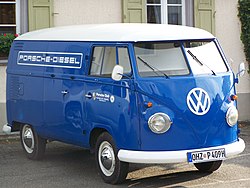
The Volkswagen Transporter, initially the Type 2,[2] is a range of light commercial vehicles, built as vans, pickups, and cab-and-chassis variants, introduced in 1950 by the German automaker Volkswagen as their second mass-production light motor vehicle series, and inspired by an idea and request from then-Netherlands-VW-importer Ben Pon.
Known officially (depending on body type) as the Transporter, Kombi or Microbus[citation needed] – or informally as the Volkswagen Station Wagon[3] (US), Bus[3] (also US), Camper (UK) or Bulli (Germany), it was initially given the factory designation 'Type 2', as it followed – and was for decades based on – the original 'Volkswagen' ("People's Car"), which became the VW factory's 'Type 1' after the post-war reboot, and mostly known, in many languages, as the "Beetle".[4]
The Volkswagen Transporter has been built in many variants. It may be best known for its panel vans, but it was also built as a small bus or minivan, with choices of up to 23 windows and either hinged or sliding side doors. From the first generation, both regular and crew-cab, as well as long- and short-bed pickups, were made, and multiple firms sprang up to manufacture varying designs of camper vans, based on VW's Transporter models, to this day.
For the first 40 years, all VW Type 2 variants were forward control, with a VW-Beetle-derived flat-four engine in the rear, and all riding on the same (initial thirty years – T1 and T2), or similar (T3),[5] 2.40 m (94 in) wheelbase as the Type 1 Beetle. As a result, all forward-control Type 2 pickups were either of standard-cab, long-bed or crew-cab, short-bed configuration, and because of the relatively high bed floor (above the rear, flat engine), most pickups came with drop sides in addition to the tailgate. In 1979, the third-generation Type 2 introduced an all-new, more square and boxy body, and in the 1980s also introduced a raised four-wheel-drive bus variant.
From the introduction of the fourth-generation Transporter in 1990, the vehicle layout changed to a more common front-engined one – no longer forward-control – and also changed from rear- to front-wheel drive, with four-wheel–drive remaining optional. From then on, the platform no longer shared technological legacy with the Beetle, and Volkswagen just called them 'Transporter', and no longer 'Type 2'. The new models, though growing a bit in length, got a significantly longer wheelbase that pushed the wheels closer to the truck's corners, noticeably reducing its front and rear overhangs, and extended-wheelbase models were also introduced.
Legacy of the Type 2
[edit]As one of the forerunners of the modern cargo and passenger vans, the Type 2 gave rise to forward control competitors in the United States in the 1960s, including the Ford Econoline, the Dodge A100, and the Chevrolet Corvair 95 Corvan – the last adapting the rear-engine configuration of the Corvair car in the same manner in which the VW Type 2 adapted the Type 1's layout.
European competition included the 1947–1981 Citroën H Van, the 1959–1980 Renault Estafette (both FF layout), the 1952–1969 semi-forward-control Bedford CA and the 1953–1965 FR layout Ford Transit. Japanese manufacturers also introduced similar vehicles, such as the Nissan Caravan, Toyota LiteAce and Subaru Sambar. Like the Beetle, the van has received numerous nicknames worldwide, including microbus, minibus,[6] and, because of its popularity in the counterculture movement of the 1960s and 1970s, hippie van and hippie bus.
Brazil contained the last factory in the world that produced the T2 series of Type 2, which ceased production on 31 December 2013, due to the introduction of more stringent safety regulations in the country.[7] This (after the 2002 termination of its T3 successor in South Africa) marked the end of the era of rear-engine Volkswagens, which originated in 1935 with their Type 1 prototypes.
History
[edit]
The concept for the Type 2 is credited to Dutch Volkswagen importer Ben Pon. It has similarities in concept to the 1920s Rumpler Tropfenwagen and 1930s Dymaxion car by Buckminster Fuller, neither of which reached production. Pon visited Wolfsburg in 1946, intending to purchase Type 1s for import to the Netherlands, where he saw a Plattenwagen, an improvised parts-mover based on the Type 1 chassis, and realized something better was possible using the stock Type 1 pan.[8] He first sketched the van in a doodle dated 23 April 1947,[9] proposing a payload of 690 kg (1,520 lb) and placing the driver at the very front.[1] The sketch is now in the Rijksmuseum.[10] Production would have to wait, however, as the factory was at capacity producing the Type 1.[1]
When capacity freed up, a prototype known internally as the Type 29 was produced in a short three months.[9] The stock Type 1 pan proved to be too weak so the prototype used a ladder chassis with unit body construction.[1] Coincidentally the wheelbase was the same as the Type 1's.[1] Engineers reused the reduction gear from the Type 82, enabling the 1.5 ton van to use a 25 hp (19 kW) flat four engine.[1]
Although the aerodynamics of the first prototypes were poor (with an initial drag coefficient of Cd=0.75),[1] engineers used the wind tunnel at the Technical University of Braunschweig to optimize the design. Simple changes such as splitting the windshield and roofline into a "vee" helped the production Type 2 achieve Cd=0.44, exceeding the Type 1's Cd=0.48.[11] Volkswagen's new chief executive officer Heinz Nordhoff (appointed 1 January 1948)[12] approved the van for production on 19 May 1949[1] and the first production model, now designated Type 2,[11] rolled off the assembly line to debut 12 November.[1] Only two models were offered: the Kombi (with two side windows and middle and rear seats that were easily removable by one person),[11] and the Commercial.[1] The Microbus was added in May 1950,[1] joined by the Deluxe Microbus in June 1951.[1] In all 9,541 Type 2s were produced in their first year of production.[11]
An ambulance model was added in December 1951 which repositioned the fuel tank in front of the transaxle, put the spare tire behind the front seat,[11] and added a "tailgate"-style rear door.[11] These features became standard on the Type 2 from 1955 to 1967.[11] 11,805 Type 2s were built in the 1951 model year.[13] These were joined by a single-cab pickup in August 1952, and it changed the least of the Type 2s until all were heavily modified in 1968.[13]

Unlike other rear engine Volkswagens, which evolved constantly over time but never saw the introduction of all-new models, the Transporter not only evolved, but was completely revised periodically with variations retrospectively referred to as versions "T1" to "T5" (a nomenclature only invented after the introduction of the front-drive T4 which replaced the T3). However, only generations T1 to T3 can be seen as directly related to the Beetle (see below for details)[citation needed].
The Type 2, along with the 1939 Citroën TUB and the 1947 Citroën H Van, are among the first 'forward control' vans in which the driver was placed above the front roadwheels. They started a trend in Europe, where the 1952 GM Bedford CA, 1958 RAF-977, 1959 Renault Estafette, 1960 BMC Morris J4, and 1960 Commer FC also used the concept. In the United States, the Corvair-based Chevrolet Corvan cargo van and Greenbrier passenger van adopted the use of the rear-engine layout of the Corvair car in the same manner that the Type 2 had used the rear-engine layout of the Type 1, using the Corvair's horizontally opposed, 6 cylinder air-cooled engine for power. Except for the Greenbrier, various 1950s–70s Fiat minivans, and the Mazda Bongo, the Type 2 remained unique in being rear-engined. This was a disadvantage for the early "barndoor" Panel Vans, which could not easily be loaded from the rear because the engine cover intruded on interior space, but generally advantageous in traction and interior noise. The Corvair pickup used a folding side panel that functioned as a ramp into the bed when opened, and was called the "Rampside". The VW "pickup" in both single and double cab versions had a bed/floor that was flat from front to back at the height of the engine compartment cover, which had the advantage of a flat load floor but at a greater height, while the Corvair "pickup" bed/floor stepped down in front of the engine compartment to a much lower load floor which worked well with the unique "Rampside" configuration for loading.
Decades after production of the Type 2 ended, Volkswagen announced in 2017 that they would be bringing an electric VW microbus out based on the new MEB platform in 2022.[14]
Variants
[edit]
The Type 2 was available as a:
- Panel van, a delivery van without side windows or rear seats.
- Double-door Panel Van, a delivery van without side windows or rear seats and cargo doors on both sides.
- High Roof Panel Van (German: Hochdach), a delivery van with raised roof.
- Kombi, from German: Kombinationskraftwagen (combination motor vehicle), with side windows and removable rear seats, both a passenger and a cargo vehicle combined.
- Bus, also called a Volkswagen Caravelle, a van with more comfortable interior reminiscent of passenger cars since the third generation.
- Lotação (share taxi), a version exclusive to Brazil, with 6 front-hinged doors for the passenger area and 4 bench-seats, catering to the supplemental public transport segment.[citation needed] Available from 1960 to 1989, in both the split-window and "clipper" (fitted with the bay-window front panel) bodystyles.
- Samba-Bus, a van with skylight windows and cloth sunroof, first generation only, also known as a Deluxe Microbus. They were marketed for touring the Alps.[15]
- Flatbed pickup truck, or Single Cab, also available with wider load bed.
- Crew cab pick-up, a flatbed truck with extended cab and two rows of seats, also called a Doka, from German: Doppelkabine.
- Westfalia camping van, "Westy", with Westfalia roof and interior. Included optional "pop up" top.
- Adventurewagen camping van, with high roof and camping units from Adventurewagen.
- Semi-camping van that can also still be used as a passenger car and transporter, sacrificing some camping comforts. "Multivan" or "Weekender", available from the third generation on.
Apart from these factory variants, there were a multitude of third-party conversions available, some of which were offered through Volkswagen dealers. They included, but were not limited to, refrigerated vans, hearses, ambulances, police vans, fire engines and ladder trucks, and camping van conversions by companies other than Westfalia. There were even 30 Klv 20 rail-going draisines built for Deutsche Bundesbahn in 1955.[16]
In South Africa, it is known as a well-loved variation of the ice cream van (first, second and third generations).
First generation (T1; 1950)
[edit]| Volkswagen Type 2 (T1) | |
|---|---|
 1966 Volkswagen Type 2 with pop-up roof | |
| Overview | |
| Manufacturer | Volkswagen |
| Production |
|
| Assembly | |
| Body and chassis | |
| Class | Light commercial vehicle/Full-size van (M) |
| Body style |
|
| Layout | RR layout |
| Platform | Volkswagen Group T1 platform |
| Powertrain | |
| Engine | |
| Dimensions | |
| Wheelbase | 2,400 mm (94.5 in) |
| Length | 4,280 mm (168.5 in) |
| Width | 1,720 mm (67.7 in) |
| Height | 1,940 mm (76.4 in) |
.jpg)

.jpg)
The first generation of the Volkswagen Type 2 with the split windshield, informally called the Microbus, Splitscreen, or Splittie among modern fans, was produced from 8 March 1950 through the end of the 1967 model year. From 1950 to 1956, the T1 (not called that at the time) was built in Wolfsburg; from 1956, it was built at the completely new Transporter factory in Hanover. Like the Beetle, the first Transporters used the 1100 Volkswagen air-cooled engine, a 1,131 cc (69.0 cu in), DIN-rated 25 PS (18.4 kW; 24.7 bhp), air-cooled flat-four-cylinder 'boxer' engine mounted in the rear. This was upgraded to the 1200 – a 1,192 cc (72.7 cu in) 30 PS (22.1 kW; 29.6 bhp) unit in 1953. A higher compression ratio became standard in 1955; while an unusual early version of the 34 PS (25.0 kW; 33.5 bhp) engine debuted exclusively on the Type 2 in 1959. Any 1959 models that retain that early engine today are rare. Since the engine was discontinued almost immediately, no spare parts were made available.
The early versions of the T1 until 1955 were often called the "Barndoor"[18][19] (retrospectively called T1a since the 1990s), owing to the enormous rear engine cover, while the later versions with a slightly modified body (the roofline above the windshield is extended), smaller engine bay, and 15" roadwheels instead of the original 16" ones are nowadays called the T1b (again, only called this since the 1990s, based on VW's retrospective T1, 2, 3, 4 etc. naming system). From the 1964 model year, when the rear door was made wider (same as on the bay-window or T2), the vehicle could be referred to as the T1c. That year also saw the introduction of an optional sliding door for the passenger/cargo area instead of the outwardly hinged doors typical of cargo vans.
In 1962, a heavy-duty Transporter was introduced as a factory option. It featured a cargo capacity of 1,000 kg (2,205 lb) instead of the previous 750 kg (1,653 lb), smaller but wider 14" roadwheels, and a 1.5 L, 42 PS (30.9 kW; 41.4 bhp) DIN engine. This was so successful that only a year later, the 750 kg, 1.2 L Transporter was discontinued. The 1963 model year introduced the 1500 engine – 1,493 cc (91.1 cu in) as standard equipment to the US market at 38 kW (52 PS; 51 bhp) DIN with an 83 mm (3.27 in) bore, 69 mm (2.72 in) stroke, and 7.8:1 compression ratio. When the Beetle received the 1.5 L engine for the 1967 model year, its power was increased to 40 kW (54 PS; 54 bhp) DIN.
German production stopped after the 1967 model year; however, the T1 still was made in Brazil until 1975, when it was modified with a 1968–79 T2-style front end, and big 1972-vintage taillights into the so-called "T1.5" and produced until 1996. The Brazilian T1s were not identical to the last German models (the T1.5 was locally produced in Brazil using the 1950s and 1960s-era stamping dies to cut down on retooling, alongside the Beetle/Fusca, where the pre-1965 body style was retained), though they sported some characteristic features of the T1a, such as the cargo doors and five-stud 205 mm (8.1 in) Pitch Circle Diameter rims. Wheel tracks varied between German and Brazilian production and with 14-inch, 15-inch and 16-inch wheel variants but commonly front track varied from 1290 mm to 1310 mm and rear track from 1370 mm to 1390 mm.

Among North American enthusiasts, it is common to refer to the different models by the number of their windows. The basic Kombi or Bus is the 11-window (a.k.a. three-window bus because of three side windows) with a split windshield, two front cabin door windows, six rear side windows, and one rear window. The DeLuxe model featured eight rear side windows and two rear corner windows, making it the 15-window (not available in Europe). Meanwhile, the sunroof DeLuxe with its additional eight small skylight windows is, accordingly, the 23-window. From the 1964 model year, with its wider rear door, the rear corner windows were discontinued, making the latter two the 13-window and 21-window respectively. The 23- and later 21-window variants each carry the nickname "Samba" or in Australia, officially "Alpine".
Samba
[edit].jpg)

The Volkswagen "Samba", officially the Kleinbus Sonderausführung (small bus, special version) and marketed as the Microbus Deluxe and Sunroof Deluxe in the United States, was the most luxurious version of the T1.[20] Volkswagen started producing Sambas in 1951; in 1952 the name in the home market was changed to Sondermodell (special model). the precise origin of the Samba nickname is unclear: sources refer to "samba cars", special train cars for dancing used by the Bundesbahn in the 1950s, while others suggest that it is an abbreviation for either Sonder-Ausführung mit besonderer Ausstattung (special version with special equipment) or for Sonnendach-Ausführung mit besonderem Armaturenbrett (sunroof version with special dashboard). The Samba name first appeared in official literature in Dutch price lists.[20]
In the US Volkswagen vans were informally identified by the window count. This particular model had 23 and later 21 windows including eight high windows in the roof. The 23 window variant also had curved windows in the rear corners.
The Samba had bi-parting doors in lieu of a sliding door, and could be ordered with a large fabric sunroof. Volkswagen advertised the Samba for making tourist trips through the Alps.
Standard paint finishes on the Samba were two-tone, usually with the upper bodywork in white. The lower bodywork carried a contrasting color, the areas separated by a decorative strip. The roof carried slightly forward of the windshield at the front, creating an integral visor. The windows had chrome tables and the van had a more comprehensive dashboard than the normal T1.
When Volkswagen started producing the successor of the T1 (the T2) the company also stopped producing the Samba, ending the Samba and the concept of a van with such a high window count.
US Chicken tax
[edit]
Certain models of the Volkswagen Type 2 played a role in a historic episode during the early 1960s known as the Chicken War. France and West Germany had placed tariffs on imports of US chicken.[21] Diplomacy failed, and in January 1964, two months after taking office, President Johnson imposed a 25% tax (almost ten times the average US tariff) on potato starch, dextrin, brandy, and light trucks. Officially, the tax targeted items imported from Europe as approximating the value of lost American chicken sales to Europe.[22]
In retrospect, audio tapes from the Johnson White House revealed a quid pro quo unrelated to chicken. In January 1964, President Johnson attempted to convince United Auto Workers' president Walter Reuther not to initiate a strike just before the 1964 election, and to support the president's civil rights platform. Reuther, in turn, wanted Johnson to respond to Volkswagen's increased shipments to the United States.[22]
The Chicken Tax directly curtailed importation of German-built Type 2s in configurations that qualified them as light trucks – that is, commercial vans (panel vans) and pickups; vans imported in passenger configuration were not affected.[22] In 1964, US imports of trucks from West Germany declined to a value of $5.7 million – about one-third the value imported in the previous year. After 1971, Volkswagen cargo vans and pickup trucks, the intended targets, practically disappeared from the US market. While post-1971 Type 2 commercial vans and single-cab and double-cab pickups can be found in the United States today, they are exceedingly rare. Any post-1971 specimen found ostensibly has had its import tariff paid. The "Chicken tax" remains in effect today, even though it is now commonly circumvented by converting passenger vehicles to utility vehicles after they have entered the United States, a form of tariff engineering. This practice is ironically exercised by Ford (for its Transit Connect van), one of the companies the tax was meant to protect.
Second generation (T2; 1967)
[edit]| Volkswagen Type 2 (T2) | |
|---|---|
_van_01.jpg) | |
| Overview | |
| Production | |
| Assembly |
|
| Body and chassis | |
| Class | Light commercial vehicle (M) |
| Body style |
|
| Layout | RR layout |
| Platform | Volkswagen Group T2 platform |
| Powertrain | |
| Engine | |
| Transmission | |
| Dimensions | |
| Wheelbase | 2,400 mm (94.5 in) |
| Length | 4,505 mm (177.4 in) |
| Width | 1,720 mm (67.7 in) |
| Height | 1,940 mm (76.4 in) |
| Chronology | |
| Successor | Volkswagen Type 2 (T3) |
In late 1967, the second generation of the Volkswagen Type 2 (T2) was introduced. It was built in West Germany until 1979. In Mexico, the Volkswagen Kombi and Panel were produced from 1970 to 1994. Early models are often called the T2a (or "Early Bay"), models after 1971 are called the T2b (or "Late Bay") and models after 1991 are called the T2c.
.jpg)
This second-generation Type 2 lost its distinctive split front windshield, and was 22.5 cm (9 in) longer and considerably heavier than its predecessor. Its common nicknames are Breadloaf and Bay-window, or Loaf and Bay for short.[23] At 1.6 L and 35 kW (48 PS; 47 bhp) DIN, the engine was also slightly larger. The battery and electrical system was upgraded to 12 volts, making it incompatible with electric accessories from the previous generation. The new model eliminated the swing axle rear suspension and transfer boxes previously used to raise ride height. Instead, half-shaft axles fitted with constant velocity joints raised ride height without the wild changes in camber of the Beetle-based swing axle suspension. The updated Bus transaxle is sought by off-road racers using air-cooled Volkswagen components.
T2b
[edit]The T2b was introduced by way of gradual change over three years. The first models featured rounded bumpers incorporating a step for use when the door was open (replaced by indented bumpers without steps on later models), front doors that opened to 90° from the body, no lip on the front guards, unique engine hatches, and crescent air intakes in the D-pillars (later models after the Type 4 engine option was offered, have squared off intakes). The 1971 Type 2 featured a new, 1.6 L engine with dual intake ports on each cylinder head and was DIN-rated at 37 kW (50 PS; 50 bhp). An important change came with the introduction of front disc brakes and new roadwheels with brake ventilation holes and flatter hubcaps. Up until 1972, front indicators are set low on the nose rather than high on either side of the fresh air grille – giving rise to their being nicknamed "Low Lights". 1972's most prominent change was a bigger engine compartment to fit the larger 1.7- to 2.0-litre engines from the Volkswagen Type 4, and a redesigned rear end which eliminated the removable rear apron and introduced the larger late tail lights. The air inlets were also enlarged to accommodate the increased cooling air needs of the larger engines.
In 1971 the 1600cc Type 1 engine as used in the Beetle, was supplemented with the 1700cc Type 4 engine – as it was originally designed for the Type 4 (411 and 412) models. European vans kept the option of upright fan Type 1 1600 engine but the 1700 Type 4 became standard for US spec models.
_vans_(2011-01-07).jpg)
_van_02.jpg)
In the Type 2, the Type 4 engine, or "pancake engine", was an option for the 1972 model year onward. This engine was standard in models destined for the US and Canada. Only with the Type 4 engine did an automatic transmission become available for the first time in the 1973 model year. Both engines were 1.7 L, DIN-rated at 49 kW (67 PS; 66 bhp) with the manual transmission and 46 kW (63 PS; 62 bhp) with the automatic. The Type 4 engine was enlarged to 1.8 L and 50 kW (68 PS; 67 bhp) DIN for the 1974 model year and again to 2.0 L and 52 kW (71 PS; 70 bhp) DIN for the 1976 model year. The two-litre option appeared in South African manufactured models during 1976, originally only in a comparably well-equipped "Executive" model.[24] The 1978 2.0 L now featured hydraulic valve lifters, eliminating the need to periodically adjust the valve clearances as on earlier models. The 1975 and later US model years received Bosch L-Jetronic electronic fuel injection as standard equipment; 1978 was the first year for electronic ignition, utilizing a hall effect sensor and digital controller, eliminating maintenance-requiring contact-breaker points. As with all Transporter engines, the focus in development was not on power, but on low-end torque. The Type 4 engines were considerably more robust and durable than the Type 1 engines, particularly in Transporter service.[citation needed]
In 1972, for the 1973 model year, exterior revisions included relocated front turn indicators, squared off and set higher in the valance, above the headlights. Also, square-profiled bumpers, which became standard until the end of the T2 in 1979, were introduced in 1973. Crash safety improved with this change because of a compressible structure behind the front bumper. This meant that the T2b was capable of meeting US safety standards for passenger cars of the time, though not required of vans. The "VW" emblem on the front valance became slightly smaller.
Later model changes were primarily mechanical. By 1974, the T2 had gained its final shape. Very late in the T2's design life, during the late 1970s, the first prototypes of Type 2 vans with four-wheel drive (4WD) were built and tested.
-
 1979 Volkswagen Type 2 (T2) "Silverfish" last-edition bus. These were a limited edition model to mark the final production of T2 models in Europe
 -
 1968 Volkswagen Type 2 (T2) Hard-Top Westfalia "Cream" bus
 -
 Brazilian Volkswagen Type 2 (T2) – 2005 Limited Edition
 -
 1977 Volkswagen Kombi Westfalia (North America)
 -
 Restored T2 models with body painted in flower power style
 -
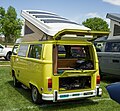 Late 70s Volkswagen T2 with Westfalia Camper Package


.JPG)


T2c
[edit]


The T2c, with a roof raised by about 10 cm (3.9 in) was built starting in the early 1990s for the Mexican, South American and Central American markets. Since 1991, the T2c has been built in México with the water-cooled 1.8 L inline four-cylinder 53 kW (72 PS; 71 bhp) carbureted engine—easily identified by the large, black front-mounted radiator—and since 1995 with the 1.6 L air-cooled engines for the Brazilian market.[citation needed]
Once production of the original Beetle ended in late 2003, the T2 was the only Volkswagen model with an air-cooled, rear-mounted boxer engine, but then the Brazilian model shifted to a water-cooled engine on 23 December 2005.[citation needed] There was a 1.6 L 50 hp (37 kW; 51 PS) water-cooled diesel engine available from 1981 to 1985, which gave fuel economy of 15 km/L to 18 km/L[25]—but gave slow performance and its insufficient cooling system led to short engine life.[citation needed]
The end of the Volkswagen air-cooled engine worldwide was marked by a Special Edition Kombi. An exclusive silver paint scheme and limited edition emblems were applied to only 200 units in late 2005, and these were sold as 2006 models.[citation needed]
Stricter emissions regulations introduced by the Brazilian government for 2006 forced a shift to a flexible-fuel water-cooled engine[citation needed] able to run on petrol or alcohol. Borrowed from the Volkswagen Gol, the engine is a rear-mounted EA-111 1.4 L 8v Total Flex 1,390 cc (84.8 cu in), 58 kW (79 PS; 78 bhp) on petrol, and 60 kW (82 PS; 80 bhp) when run on ethanol, and 124 N⋅m (91 lbf⋅ft) torque.[citation needed]

Production of the Brazilian Volkswagen Kombi ended in 2013 with a production run of 600 Last Edition vehicles.[26] A short film entitled "Os Últimos Desejos da Kombi" (English: The Kombi's Last Wishes) was made by Volkswagen Brazil to commemorate the end of production. Brazilian requirements that new cars have driver and passenger airbags and anti-lock brakes were also factors in the end of T2 production.[27][citation needed]
Azul
[edit]A T2 nicknamed Azul for its blue color survived the Palisades Fire, one of the January 2025 Southern California wildfires, and made national headlines after it was photographed amidst burnt out ruins. Volkswagen began restoring the bus in July.[28]
Third generation (T3; 1979)
[edit].jpg)
The Volkswagen Type 2 (T3), (T25 within the UK) or Vanagon in the United States, the T3 platform was introduced in 1979, and was one of the last new Volkswagen platforms to use an air-cooled engine. The Volkswagen air-cooled engine was phased out for a water-cooled boxer engine (still rear-mounted) in 1983. Compared to its predecessor the T2, the T3 was larger and heavier, with square corners replacing the rounded edges of the older models. The T3 is sometimes called "the wedge" by enthusiasts to differentiate it from earlier generations.[citation needed]
Fourth generation (T4; 1990)
[edit]
For 1990, the T4 generation was released, with the model range dropping the Type 2 name in favor of the Transporter nameplate. Over 15 years after the Golf was introduced as the replacement for the Type 1 (Beetle), the Transporter range also adopted a front-engine, front-wheel drive configuration (Syncro 4WD returned as an option). Worldwide, the model range now used water-cooled, fuel-injected engines, with inline (and later VR6) engines replacing the "wasserboxer".
Through much of the world, the T4 was marketed as the Transporter, with 3-row passenger vans known as the Caravelle; the Vanagon name was used in Japan. In the United States, the T4 was marketed as the Eurovan mid-size van for 1993 and from 1999 to 2003; from 1995 to 2005, the Eurovan served as the basis for multiple recreational vehicles marketed through the United States and Canada. Sales of the Transporter in North America ended in 2003.
Fifth generation (T5; 2003)
[edit]
The Volkswagen Transporter T5 range is the fifth generation of Volkswagen Commercial Vehicles medium-sized light commercial vehicle and people movers. Launched 6 January 2003, the T5 went into full production in April 2003, replacing the fourth generation range.[29]
Key markets for the T5 are Germany, the United Kingdom, Russia, France and Turkey. It is not sold in the US market because it is classed as a light truck, accruing the 25% chicken tax on importation. The T5 has a more aerodynamic design. The angle of the windshield and A-pillar is less; this makes for a large dashboard and small bonnet.
In June 2009, Volkswagen Commercial Vehicles announced the one-millionth T5 rolled off the production line in Hanover.[30]
T5 GP introduced in 2010. Heavily facelifted with some new power plants including the 180 bi-turbo range topper. These new engines saw the demise of the now "dirty" 5 cylinder units.
Late 2015 will see the arrival of the "Neu Sechs", the New 6. The T6 will offer further engine changes in early 2016, but will launch with the previous generation engines. The new engines will see the introduction of Ad-Blu to meet with euro 6 emission compliance. The new 6 was expected by many to be more than just a facelift.
Sixth generation (T6; 2015)
[edit]
The new T6 launched with the old Euro 5 non-AdBlue power-plants, but is offered with a Euro 6 diesel engine with 204bhp and AdBlue. Three further Euro 6 Adblue diesel power-plants with 84ps, 102ps and 150ps are also offered.
There is some debate in the community over whether the T6 is a new model, or simply a face-lift of the T5. There are obvious external changes to the nose and tailgate, while internally there is a new dash in two different versions. Volkswagen claims refinement to ride, handling and noise levels.
Volkswagen Microbus concept vehicle
[edit]
In 2001, a Volkswagen Microbus concept was created, with design cues from the T1 generation in a spirit similar to the New Beetle nostalgia movement. Volkswagen planned to start selling it in the United States market in 2007, but it was scrapped in May 2004 and replaced with a more cost-effective design to be sold worldwide.
Names and nicknames
[edit]Like the Beetle, from the beginning, the Type 2 earned many nicknames from its fans. Popular nicknames in German include VW-Bus, Bulli/Bully (a portmanteau of Bus and Lieferwagen (delivery van)),[31] Hippie-van, or simply der Bus. The Type 2 was meant to be officially named the Bully, but Heinrich Lanz, producer of the Lanz Bulldog farm tractor, intervened.[citation needed] The model was then presented as the Volkswagen Transporter and Volkswagen Kleinbus, but the Bully nickname still caught on.
The official German-language model names Transporter and Kombi (Kombinationskraftwagen, combined-use vehicle) have also caught on as nicknames. Kombi is not only the name of the passenger variant but also the Australasian and Brazilian term for the whole Type 2 family, in much the same way that they are all called VW-Bus in Germany, even the pickup truck variations. In Mexico, the German Kombi was translated as Combi and became a household word thanks to the vehicle's popularity in Mexico City's public transportation system. In Peru, where the term Combi was similarly adopted, the term Combi Asesina (Murderous Combi) is often used for buses of similar size, because of the notorious recklessness and competition of bus drivers in Lima to get passengers. In Portugal it is known as Pão-de-Forma (Breadloaf) because its design resembles a bread baked in a mold. Similarly, in Denmark, the Type 2 is referred to as Rugbrød (Rye bread). Finns dubbed it Kleinbus (mini-bus), as many taxicab companies adopted it for group transportation; the name Kleinbus has become an appellative for all passenger vans. The vehicle is also known as Kleinbus in Chile.
In the US, however, it is a VW bus, minibus, hippie-mobile, hippie bus, hippie van, "combie", Microbus, or Transporter to aficionados. The early versions produced before 1967 used a split front windshield (giving rise to the nickname "Splitty"), and their comparative rarity has led to their becoming sought after by collectors and enthusiasts. The next version, sold in the US market from 1968 to 1979, is characterised by a large, curved windshield and is commonly called a "bay-window". It was replaced by the Vanagon, of which only the Westfalia camper version has a common nickname, "Westy".
A popular nickname for the T3 was "2.6i" or "transi" in reference to the 2.6 liter Microbus/Caravelle sold in South Africa and their robust design being a popular choice for transportation of children respectively. Kombi is also a generic nickname for vans and minibuses in South Africa, Swaziland, and Zimbabwe, often used as a means of public transportation. In Nigeria it is called Danfo.
In the UK, it is known as a "Campervan". In France, it was called a "camping-car" (usually hyphenated) though this has been expanded to include other, often more specialized vehicles in more recent times.
Among VW enthusiasts in countries of the former Yugoslavia, especially in Serbia and Croatia, VW T2 bus is commonly called a "Terrorist", probably due to its cameo appearance in the Back to the Future film in which it is driven by a group of Libyan terrorists.[32][33][34]
Mexican production
[edit]
T2 production began in 1970 at the Puebla assembly factory.
Offered initially only as a nine-passenger version called the Volkswagen Combi (Kombi in Brazil), and from 1973 also its cargo van version called the Volkswagen Panel, both variants were fitted with the 1.5 L air-cooled boxer engine and four-speed manual gearbox. In 1974, the 1.6 L 44 bhp (33 kW; 45 PS) boxer engine replaced the 1.5 previous one, and production continued this way up to 1987. In 1987, the water-cooled 1.8 L 85 bhp (63 kW; 86 PS) inline four-cylinder engine replaced the air-cooled 1.6 L. This new model is recognisable by its black grille (for its engine coolant radiator), bumpers and moldings.
In 1975, Volkswagen de México ordered two specially made pickups from Germany, one single cab and one double cab, for the Puebla plant. These were evaluated for the possibility of building pickups in Mexico, and were outfitted with every option except the Arctic package, including front and rear fog lights, intermittent wipers, trip odometer, clock, bumper rubber, PVC tilt, and dual doors on the single cab storage compartment. VW de Mexico was interested in having the lights, wiring, brake systems and other parts manufactured in Mexico. Ultimately, VW de Mexico declined to produce pickups, and the pickups were sold to an Autohaus, a Volkswagen dealer in San Antonio, Texas, since they could not be sold in Mexico. By law, no German-made Volkswagens were to be sold in Mexico. These were probably the only pickups that were produced in Germany for Mexican import, and have the "ME" export code on the M-code plate. The green double cab was sold to a new owner in New York, and has been lost track of. The light gray (L345, licht grau) single cab still exists. Pickups were not manufactured in Mexico, nor were they imported into Mexico from Germany, save for these two examples.
In 1988, a luxury variant – the Volkswagen Caravelle – made its debut in the Mexican market to compete with the Nissan Ichi Van, which was available in cargo, passenger and luxury versions.
The main differences between the two are that the Caravelle was sold as an eight-passenger version, while the Combi was available as a nine-passenger version, the Caravelle was only painted in metallic colors, while the Combi was only available in non-metallic colors, and the Caravelle was fitted with an AM/FM stereo cassette sound system, tinted windows, velour upholstery, reading lights, mid and rear headrests, and wheel covers from the European T3 model.
In 1991, the 10 cm (3.9 in) higher roof made its debut in all variants, and the Combi began to be offered in eight- or nine-passenger variants. In 1991, since Mexican anti-pollution regulations required a three-way catalytic converter, a Digifant fuel injection system replaced the previous carburetor. The three variants continued without change until 1994.
In 1994, production ended in Mexico, with models being imported from Brazil. The Caravelle was discontinued, and both the Combi and the Panel were only offered in white color and finally in 2002, replaced by the T4 EuroVan Pasajeros and EuroVan Carga, passenger and cargo van in long wheelbase version, inline five-cylinder 2.5 L 115 bhp and five-speed manual gearbox imported from Germany.
Hippie van
[edit]

The VW Type 2 became popular with the counterculture of the 1960s, thanks to its ability to transport a large group of people while being cheap and easy to maintain.[35] Its design was simple yet spacious, thanks largely to the rear-mounted engine. It contrasted with the large sedans and station wagons that were normal at the time, giving the van an alternative and rebellious image. Vans were often painted with extravagant designs in bright colors, making them stand out on the road even more.[36] The "hippie van" remains iconic today, thanks to being featured on the cover of albums by musicians such as Bob Dylan and the Beach Boys,[37] and being used by fans of the Grateful Dead while following the band on tour.[38] But most iconic of all, the music festival Woodstock, which was held in the summer of 1969, saw plenty of brightly painted vans transporting excited young crowds.[39]
See also
[edit]References
[edit]- ^ a b c d e f g h i j k l Walters, p.46.
- ^ Volkswagen definitively dropped the 'Type 2' designation for the Transporters after the third of six generations.
- ^ a b Murilee Martin (15 April 2019). "1966: Early Volkswagen Bus makes a great restaurant". Autoweek. Retrieved 27 November 2023.
- ^ "History of the Volkswagen bus". Brinse.com. Archived from the original on 10 August 2011. Retrieved 19 August 2011.
- ^ The Transporter T3 of the 1980s, introduced in 1979, had a marginally longer wheelbase, but continued the same pattern for another decade.
- ^ Patinkin, Mark (28 July 2009). "1969 was the most tumultuous and normal year". Providence Journal. Archived from the original on 4 June 2011. Retrieved 11 August 2009.
- ^ a b Tisshaw, Mark (24 October 2012). "End of the road for Volkswagen camper". Autocar. Archived from the original on 27 October 2012. Retrieved 24 October 2012.
- ^ Walters, Jeff. "Type 2 Roots", in Hot VWs, 7/84, p.45.
- ^ a b Walters, p.45.
- ^ Rijksmuseum Studio: Note book with first sketch of the Volkswagen Transporter, Ben Pon, 1947, retrieved 30 August 2021
- ^ a b c d e f g Walters, p.47.
- ^ Walter, p.46.
- ^ a b Walters, p.94.
- ^ Perkins, Chris (19 August 2017). "Confirmed! Electric VW Microbus Coming". Road & Track. Retrieved 18 June 2019.
- ^ "Volkswagen camper van marks 60 years of production". BBC. 4 June 2010.
- ^ "Klv 20 Draisine, VW Bus". Eisenbahndienstfahrzeuge.de. Archived from the original on 18 July 2011. Retrieved 19 August 2011.
- ^ a b Australian Volkswagens Archived 12 July 2012 at the Wayback Machine Retrieved from www.clubvw.org.au on 7 August 2012
- ^ "VW Type 2 T1 Split Bus". The Golden Bug. Archived from the original on 5 June 2012. Retrieved 5 June 2012.
- ^ "History of the VW T1 Split Bus (Bulli)". VW Heritage. Archived from the original on 5 August 2018. Retrieved 5 August 2018.
- ^ a b Kierse, Matthias (21 April 2021). "70 years of Volkswagen Samba". Secret Classics. Archived from the original on 18 December 2022.
- ^ Dolan, Matthew (22 September 2009). "To outfox the Chicken Tax, Ford strips its own vans". The Wall Street Journal. Archived from the original on 6 August 2017. Retrieved 8 August 2017.
- ^ a b c Bradsher, Keith (30 November 1997). "Light Trucks increase profits, but foul air more than cars". The New York Times. Archived from the original on 28 July 2011. Retrieved 27 May 2010.
- ^ "Type II Volkswagen (thing)", section "Type 2/T2" Archived 17 August 2009 at the Wayback Machine (spells the term "Bread-Loaf")
- ^ English, Howard (October 1976). "Volkswagen 2000L Executive Microbus". SA Motor. Cape Town, South Africa: Scott Publications: 37.
- ^ "Home page do Volkswagen Kombi – O primeiro portal da Kombi Brasileira". Angelfire.com. Archived from the original on 18 October 2011. Retrieved 19 August 2011.
- ^ "VW Type 2 Microbus production ending with Kombi Last Edition". Auto Express. 18 August 2013. Archived from the original on 24 July 2015. Retrieved 10 June 2015.
- ^ "Os Últimos Desejos da Kombi" [Kombi's last wishes] (in Portuguese). Brazil: VW. Archived from the original on 9 October 2013. Retrieved 3 April 2014.
- ^ Rozier, Alex (2 July 2025). "Volkswagen to restore vintage bus that survived Palisades Fire". KNBC. Los Angeles: National Broadcasting Company. Retrieved 9 July 2025 – via YouTube.
- ^ "VolkswagenCommercial-Vehicles.com". Volkswagen-Commercial-Vehicles.com. 5 August 2008. Archived from the original on 22 May 2008. Retrieved 19 October 2010.
- ^ "Volkswagen Commercial Vehicles builds one millionth T5". volkswagenag.com. Volkswagen AG. 30 June 2009. Archived from the original on 20 July 2011. Retrieved 12 November 2009.
- ^ "Your car, your story – Part 4: The VW T3 - The last real Bulli". NGK. Retrieved 19 May 2022.
- ^ "VW bus nicknames throughout the world". The Late Bay. Archived from the original on 6 August 2018. Retrieved 4 September 2018.
- ^ "Legendarni kombi uskoro i na električni pogon" [The legendary van will soon be electrically powered]. Energetika Marketing (in Croatian). Croatia. Archived from the original on 6 August 2018. Retrieved 5 August 2018.
- ^ "VW Kombi odlazi u istoriju". B92. 17 August 2013. Archived from the original on 6 August 2018. Retrieved 5 August 2018.
- ^ Ebbert, Chris (17 June 2017). "The magic recipe that caused hippies to fall in love with the incredible, enduring Volkswagen van". Quartz. Archived from the original on 3 August 2018. Retrieved 6 August 2018.
- ^ Stewart, Ben (26 April 2017). "Peace, Love and the VW Bus". Popular Mechanics. US. Archived from the original on 3 August 2018. Retrieved 6 August 2018.
- ^ "VW's hippie van ends its long, strange trip". Daily Herald. US. 29 September 2013. Archived from the original on 3 August 2018. Retrieved 3 August 2018.
- ^ "VW to end production of iconic hippie bus this year". 26 September 2013. Archived from the original on 4 August 2018.
- ^ "Volkswagen Takes a Trip Back to the 1960s in Nostalgic Ad Saluting Its Free-Spirited Owners". Archived from the original on 5 August 2018. Retrieved 5 August 2018.
External links
[edit]
Volkswagen Type 2
View on GrokipediaThe Volkswagen Type 2 is a series of forward-control light commercial vehicles produced by the German automaker Volkswagen, introduced in November 1949 as the company's first van model following the Beetle (Type 1), with initial deliveries commencing in 1950.[1][2]
Conceived from a 1947 sketch by Dutch Volkswagen importer Ben Pon Sr., who envisioned a basic goods vehicle on the Beetle's mechanical underpinnings to meet post-war European demand for affordable transport, the Type 2 adopted a rear-mounted, air-cooled flat-four boxer engine—initially displacing 1,131 cc and producing 18 kW (24 hp)—driving the rear wheels via a four-speed manual transmission, while its boxy, monocoque body facilitated diverse configurations including panel vans, minibuses, pickups, and ambulances.[3][4][5]
Evolving through generations such as the T1 "Split-screen" (1950–1967) and T2 "Bay-window" (1968–1979) in Germany, with air-cooled engines growing to 1.6–2.0 liters and outputs up to 52 kW (70 hp), the model emphasized simplicity, reliability, and modularity, enabling widespread commercial adoption and aftermarket camper conversions by firms like Westfalia.[6][1][5]
Its cultural significance surged in the 1960s as an emblem of mobility and communal living, closely associated with the hippie movement, surfing, and festivals, though this image sometimes overshadowed its primary role in practical logistics and small business operations across Europe and North America.[7][4]
Production persisted in markets like Brazil into the early 2000s, with adaptations including water-cooled engines to comply with emissions standards, underscoring the design's enduring adaptability despite lacking modern safety features or power compared to contemporaries.[1][6]
Origins and Early Development
Conceptual Foundations
In the aftermath of World War II, Volkswagen focused production on the Type 1 Beetle under British military oversight at the Wolfsburg factory, but commercial vehicle demand prompted exploration of utilitarian derivatives. Dutch importer Ben Pon, seeking export opportunities, visited the facility in 1947 and noted workers adapting Beetle chassis into rudimentary flatbed trucks, known as Plattenwagen, for internal logistics, highlighting the platform's potential for cargo transport.[8] [9] On April 23, 1947, Pon sketched the foundational concept for what became the Type 2: a forward-control van with the Beetle's rear-mounted air-cooled engine, boxy enclosed body for maximum cargo space, and split windshield for driver visibility, aiming to create an affordable, versatile transporter for small businesses and deliveries.[10] [11] [12] Pon's proposal addressed postwar Europe's need for economical utility vehicles, leveraging the Beetle's proven mechanicals—rear-engine drive, torsion-beam suspension, and steel unibody elements—for simplicity in manufacturing and maintenance, while the design prioritized payload capacity over passenger comfort to fill a market gap left by larger, costlier trucks from established firms. Volkswagen engineers refined the idea amid initial skepticism from management strained by Beetle output targets, designating it Type 2 to signify its role as the second core model in the lineup.[13] [14]Prototyping and Initial Launch
The conceptual origins of the Volkswagen Type 2 trace to Dutch importer Ben Pon, who sketched a van design on April 23, 1947, during a visit to the Wolfsburg factory, inspired by improvised factory vehicles known as Plattenwagen—flatbed carriers built on Beetle chassis to transport parts amid postwar shortages.[10][15] These Plattenwagen, used from 1946 to 1970, demonstrated the Beetle platform's adaptability for utility tasks but lacked enclosed cabins and refinement for commercial production.[16] Volkswagen engineers refined Pon's idea, developing initial prototypes designated as Type 29 in 1949, which addressed aerodynamic shortcomings of early unrefined designs while retaining the rear-engine layout and air-cooled powertrain from the Type 1 Beetle.[8][1] Testing of these prototypes confirmed feasibility, leading to a production-ready model internally termed Type 2.[17] Serial production commenced on March 8, 1950, at the Wolfsburg plant, with the first Transporter rolling off the assembly line as a versatile light commercial vehicle offered in configurations including panel van, kombi passenger bus, and pickup.[18] Initial output focused on meeting European demand for affordable transport, achieving over 10,000 units by year's end despite resource constraints in occupied Germany.[19] The launch emphasized practicality, with a 1.1-liter engine producing 18 kW (24 hp) and a payload capacity of up to 900 kg, positioning it as an economical alternative to larger trucks.[20]Engineering Principles
Chassis and Structural Design
The Volkswagen Type 2's chassis design originated from prototypes in 1949, initially adapting the Type 1 Beetle's floorpan, which proved insufficiently rigid under load testing, necessitating a redesign incorporating longitudinal ladder-type frame rails integrated directly into the underbody structure for enhanced torsional stiffness and load-bearing capacity suitable for commercial applications.[21] This semi-monocoque approach welded the steel body panels to the boxed frame rails, forming a unibody-like assembly rather than a fully separate body-on-frame setup, while maintaining a 94-inch wheelbase identical to the Beetle for component compatibility and manufacturing efficiency.[22] The resulting platform supported rear-engine, rear-wheel-drive layouts, with the frame extending forward to accommodate the flat-floor design emblematic of the Transporter's versatility in van, pickup, and camper variants. Structural reinforcements included boxed sections along the rails and crossmembers at key points, such as under the engine mount and cargo floor, to distribute weight from payloads up to 1,760 pounds in early T1 models without excessive flexing, a critical factor for its intended utility role post-World War II.[21] Corrosion resistance was addressed through zinc coatings on frame components from the mid-1950s onward, though early production suffered from rust in seam welds due to inadequate galvanization.[23] In the T2 generation launched in 1967, the chassis evolved with thicker gauge steel in the integrated frame rails and additional bracing under the floorpan, yielding a unitized structure that improved crash energy absorption and handling under higher gross vehicle weights approaching 4,400 pounds, while preserving the original's modular adaptability for body variants.[24] This design prioritized simplicity and repairability, allowing frame sections to be replaced independently in restoration work, though it retained vulnerabilities to fatigue in high-mileage fleet use.[25]Powertrain and Mechanical Innovations
The Volkswagen Type 2 featured a rear-mounted, air-cooled flat-four boxer engine adapted from the Beetle platform, which provided a compact powertrain that facilitated a flat load floor across the vehicle's length by eliminating the need for a front-to-rear driveshaft tunnel.[26] This layout prioritized cargo and passenger space efficiency, with the engine's low profile contributing to a lower center of gravity compared to front-engine competitors of the era.[27] The air-cooling system, lacking a radiator or coolant hoses, enhanced simplicity and reduced maintenance complexity in operational environments like delivery services.[28] Initial production models in 1950 used a 1,131 cc engine producing 24 horsepower at 3,000 rpm and 58 Nm of torque, paired with a 4-speed manual transmission featuring a reduction gear for the heavier van body.[26] Engine displacement and output evolved incrementally: by 1953, a 1,192 cc variant delivered 30 hp; the 1955 model increased to 36 hp; and 1961 saw a 1,285 cc unit at 40 hp, with full synchronization added to the gearbox for smoother shifts.[29] In the T2 generation starting 1967, the standard engine grew to 1,584 cc, yielding 50 bhp at 4,000 rpm and 61 hp in later variants, supported by dual-port cylinder heads for improved breathing.[30] These updates addressed early criticisms of underpowered performance under load, though the air-cooled design retained inherent limitations in sustained high-output operation due to cooling constraints.[31] Mechanical innovations included torsion-bar independent front suspension and a semi-independent rear swing-axle setup derived from the Beetle, which balanced cost with adequate load-handling for up to 1,000 kg payloads.[32] The T2 introduced double-jointed constant-velocity half-shafts at the rear, reducing camber changes during suspension travel and improving stability over the T1's simpler swing axles.[33] Drivetrain gearing emphasized low-end torque for urban and highway hauling, with final-drive ratios optimized for the rear-wheel-drive configuration that placed engine weight over the drive wheels for enhanced traction on inclines or slippery surfaces.[1] Diesel options appeared experimentally in the T1 era, such as a 1.5-liter unit in 1951 producing 28 hp, but air-cooled petrol remained dominant until regulatory shifts in later generations prompted water-cooling adoption.[34]Generational Evolution
First Generation (T1; 1950–1967)
The Volkswagen Type 2 first generation, known as the T1 or Transporter, originated from a sketch by Dutch importer Ben Pon in April 1947, inspired by basic goods platforms observed at the Wolfsburg factory during a visit to procure Beetle vehicles for export to the Netherlands.[10] Pon proposed a forward-control van utilizing the Beetle's rear-mounted air-cooled engine and mechanical components for efficient cargo transport, addressing postwar demand for practical utility vehicles in Europe's recovering economy. Volkswagen engineers refined the concept through prototypes tested from late 1947, incorporating a boxy body on a separate ladder chassis to maximize load space while maintaining simplicity and low production costs. Series production commenced on March 8, 1950, at the Wolfsburg plant, with the initial model priced affordably, slightly above an export-spec Beetle, enabling broad adoption by small businesses and tradespeople.[35] By mid-June 1950, the first 1,000 units had been assembled, marking the start of a vehicle that supported Germany's economic miracle through reliable, mass-produced utility.[36] Engineering emphasized durability and modularity, with a pressed-steel ladder frame providing structural integrity independent of the body, allowing easy adaptation for various configurations. Suspension mirrored the Beetle's design, using torsion bars for independent wheel control, which contributed to a low center of gravity despite the rear-engine placement over the rear axle, enhancing stability under load. The air-cooled flat-four boxer engine, initially displacing 1,131 cc and producing 24 horsepower at 3,000 rpm, drove the rear wheels via a four-speed manual transmission, prioritizing torque for hauling over top speed, which reached approximately 50 mph unladen.[37] Engine evolution responded to demands for greater performance: a 1,192 cc version yielding 30 horsepower arrived in 1953, followed by a 1,493 cc unit delivering 36 to 42 horsepower from 1959 onward, with optional reductions for export markets facing regulatory hurdles.[31] Body styles featured a distinctive split windshield for the T1a phase until 1964, transitioning to a single-piece pane in later models, while the rounded fenders and high roofline optimized visibility and cargo volume up to 4.6 cubic meters in van form. Braking relied on mechanical drums initially, upgrading to hydraulic systems by the mid-1950s for improved safety.[26] Variants proliferated to suit commercial needs, including panel vans for enclosed cargo, kombi passenger models seating up to nine, single- and double-cab pickups, and specialized chassis for ambulances, hearses, or fire engines. Production shifted partially to Hanover in 1956 to meet rising demand, with cumulative output exceeding 1.8 million T1 units by the model's discontinuation in Germany on July 24, 1967, as the updated T2 took over.[29] Exports drove growth, with significant volumes to the United States—where it earned the "Microbus" moniker—and other European nations, comprising about one-third of Volkswagen's early output and bolstering the company's international reputation for economical, versatile transport.[38] The T1's simple construction facilitated repairs and conversions, such as Westfalia campers, fostering a legacy of adaptability amid limited material resources in postwar manufacturing.[39]Second Generation (T2; 1967–1979)
The second-generation Volkswagen Type 2, known as the T2 or Bay Window for its curved panoramic front windshield, debuted in August 1967 as a replacement for the T1, offering greater interior volume and modernized styling. The body length increased to 4.605 meters from the T1's 4.005 meters, with a wider track and updated chassis providing enhanced stability. Major mechanical advancements included ball-joint front suspension supplanting the T1's kingpin design and independent rear suspension (IRS) replacing swing axles, which improved ride comfort and reduced camber changes under load.[40][40] Initial power came from a 1.6-liter air-cooled flat-four engine (code AP) delivering 47 bhp at 4,200 rpm and 86 lb-ft of torque, paired with a four-speed manual transmission and rear-wheel drive. This setup enabled a top speed of around 80 mph for lighter variants, though payload capacities ranged from 800 to 1,000 kg depending on body style. Body configurations encompassed panel vans, passenger microbuses seating up to nine, pickups, and chassis cabs, with popular camper conversions by Westfalia featuring pop-top roofs and integrated kitchens.[40][40] Production in Germany spanned 1968 to 1979, yielding approximately 1.89 million units, with annual output peaking at 294,932 in 1972 before declining amid stricter emissions regulations and competition. Early models (1967–1972), termed T2a, retained wrap-around bumpers and compact rear lights, while 1972 introduced flared wheel arches and a 1.7-liter Type 4 engine (66 bhp). The Late Bay (T2b, 1973–1979) adopted square bumpers, elevated front indicators, larger tail lights, and front disc brakes for better stopping power, alongside engine upgrades to 1.8-liter (68 bhp) and eventually 2.0-liter (70 bhp) units.[41][42][40] By the mid-1970s, optional diesel engines appeared in some markets, such as a 1.6-liter unit producing 54 bhp, prioritizing torque for commercial use over speed. Safety and emissions compliance drove further refinements, including reinforced crumple zones and catalytic converters in later years, though the air-cooled flat-four remained core to the design. European production concluded in 1979 with the limited-edition Silverfish model, featuring special badging and trim to commemorate the end of T2 assembly in Hanover.[40][26]Third Generation (T3; 1979–2003)
The Volkswagen Type 2 third generation, designated T3 and marketed as the Transporter in Europe or Vanagon in North America, entered production in May 1979 at Volkswagen's Hannover facility in Germany. This model represented a complete redesign from the preceding T2, featuring a boxier, more angular body with increased overall dimensions—including a wider track and body—for enhanced interior space and stability, while retaining the rear-engine, cab-forward layout. The front suspension shifted to MacPherson struts, improving ride quality and handling over the T2's torsion bars, though the vehicle's greater curb weight of approximately 1,700–2,000 kg depending on configuration strained early powertrains.[43][44] Initial engines were carryover air-cooled flat-fours: a 1.6-liter unit producing 50 horsepower and a 2.0-liter variant delivering around 60–70 horsepower, both proving underpowered for the heavier chassis, with 0–100 km/h acceleration times exceeding 20 seconds in base models. In February 1981, Volkswagen introduced a 1.6-liter water-cooled inline-four diesel engine rated at 50 horsepower, sourced from the Golf lineup, offering better torque for load-hauling at the expense of refinement. Later that year, the water-cooled "Wasserboxer" flat-four replaced air-cooling in petrol variants, starting with a 1.9-liter version producing 83 horsepower via Digifant fuel injection, progressing to 2.1-liter (112 horsepower) and eventually 2.5-liter (115 horsepower) units by the late 1980s, which addressed performance deficits but introduced cooling system reliability issues in some climates.[44][45][46] A notable variant was the Syncro all-wheel-drive model, developed in collaboration with Steyr-Puch and introduced in 1985, utilizing a viscous-coupling center differential for on-demand torque distribution without driver intervention or low-range gearing, paired with raised suspension and available in 14-inch or 16-inch wheel configurations for improved ground clearance up to 210 mm. Syncro production totaled approximately 43,000 units, representing about 3.6% of overall T3 output, with features like larger brakes and reinforced chassis enabling light off-road capability suitable for camper or utility use. The Westfalia camper conversion remained available throughout the run, integrating pop-top roofs, kitchenettes, and sleeping accommodations into the T3's spacious cabin.[43][47] European production of two-wheel-drive T3s ceased in 1990 and Syncro models in 1992, with a total of roughly 1.3 million units assembled in Hannover. In South Africa, where the model was badged as the Microbus, manufacturing continued at the Uitenhage plant until mid-2002 to meet local demand, incorporating updates such as a 2.5-liter inline-five engine from Audi (producing about 115 horsepower) from 1990 onward for better performance amid stricter emissions and fuel standards. This extension marked the end of rear-engined Type 2 production globally, as subsequent generations adopted front-engine layouts.[43][48][49]Fourth Generation (T4; 1990–2003)
The fourth generation of the Volkswagen Type 2, designated T4 and also known as the Transporter, marked a significant departure from prior models by adopting a front-engine, front-wheel-drive layout with water-cooled engines, replacing the rear-mounted air-cooled powertrains of previous generations.[50] Launched in August 1990 and produced until summer 2003 at Volkswagen's Hanover plant in Germany, the T4 achieved approximately 2 million units in total production.[51] This redesign prioritized improved safety, space utilization, and modularity, featuring two wheelbase lengths—short at 2,920 mm and long at 3,320 mm—and roof heights of standard (1,940 mm) or high-top (2,430 mm).[52] Body configurations included panel vans, kombi vans with partial or full windows, passenger-oriented Caravelle and Multivan/Eurovan models seating up to nine, single- and double-cab pickups, and specialized conversions such as campers and ambulances.[50][52] Engine options at launch comprised three water-cooled petrol variants delivering 44–81 kW (60–110 hp) and two diesels, evolving over production to include a 2.0 L inline-four petrol (84 hp), 2.5 L five-cylinder petrol (110–115 hp), and 2.8 L VR6 petrol (140–204 hp, with 24-valve version from 2000 producing up to 150 kW).[53][51] Diesel engines ranged from 1.9 L naturally aspirated or turbo (61–68 hp), 2.4 L (75–78 hp), to the 2.5 L TDI introduced in 1996 (initially 88 hp, upgraded to 102 hp in 1995–1998 models and 151 hp from 1998).[50][53] The 2.5 L TDI represented Volkswagen's first turbo direct-injection diesel in a light commercial vehicle, offering up to 42 mpg efficiency.[51][53] Transmissions were primarily five-speed manuals, with automatic options available on select models; all-wheel-drive Syncro variants debuted in 1993, paired exclusively with five-cylinder engines.[51] A major facelift in 1996 introduced rear disc brakes across the range (upgrading from front discs and rear drums), revised bumpers, and a lengthened front end on VR6-equipped models to accommodate the larger engine, though short-nose versions persisted until production's end.[50][53] Suspension featured independent front struts and a semi-independent rear torsion beam, with common wear points including bushes and ball joints; power steering became standard on later models.[53] Production concluded in 2003 with the Multivan "Limited Last Edition," paving the way for the T5 successor, amid the model's reputation for versatility in commercial, passenger, and leisure applications.[51][50]Fifth Generation (T5; 2003–2015)
The fifth generation of the Volkswagen Type 2, internally designated T5 and marketed as the Transporter, represented a major redesign from prior rear-engine models, shifting to a front-engine, transverse-mounted powertrain with front-wheel drive as standard and optional four-wheel drive (4Motion).[54] Full production commenced in April 2003 at Volkswagen's Hanover facility in Germany, following a market launch in 2002, succeeding the T4 series.[55] The T5 employed a monocoque body structure on the dedicated Volkswagen Group T5 platform, offering improved crash safety, handling, and payload capacities up to 1,200 kg depending on configuration.[56] Initial engine lineup emphasized efficient diesel options, including 1.9-liter TDI inline-four units producing 84 to 105 hp and a 2.5-liter TDI five-cylinder variant delivering 130 to 174 hp, paired with five- or six-speed manual transmissions or optional five-speed automatic.[54] Petrol choices were limited to a 2.0-liter inline-four (115 hp) and a rarer 3.2-liter VR6 (235 hp) for higher-performance Multivan models.[57] Body variants encompassed short- and long-wheelbase panel vans, kombi passenger models, luxury Multivan/Caravelle shuttles with up to nine seats, chassis cabs for custom bodies, and camper conversions like the California, prioritizing modularity for commercial and leisure use.[58] A mid-cycle facelift, introduced in 2009 and dubbed T5.1, refreshed the exterior with revised front fascia, projector headlights (single or bi-xenon), and LED daytime running lights, alongside interior updates including improved materials and optional navigation.[58] Mechanically, it standardized 2.0-liter common-rail TDI diesels across 84 to 180 hp outputs for better refinement and Euro 5 compliance, with the five-cylinder phased out and dual-clutch DSG automatics expanded.[55] Production concluded in 2015 after approximately two million units, yielding strong residual values due to durable construction and versatile applications in Europe and select export markets.[59]Sixth Generation (T6/T6.1; 2015–2024)
The sixth generation of the Volkswagen Type 2, designated T6, entered production in April 2015 at Volkswagen Commercial Vehicles' Hanover plant in Germany, succeeding the T5 model with a focus on enhanced efficiency, safety features, and modular interior configurations for commercial and passenger use.[60] It retained the traditional front-engine, rear-wheel-drive layout in base form, with options for front-wheel drive and all-wheel drive (4Motion), and offered body styles including panel van, kombi, shuttle, and chassis cab variants in short- and long-wheelbase configurations measuring approximately 4,904 mm and 5,304 mm in length, respectively.[61] The design emphasized aerodynamic improvements, such as revised front bumpers and optional LED headlights, contributing to a drag coefficient reduction while maintaining payload capacities up to 1,200 kg and towing limits of 2,500 kg.[62] Powertrains centered on a 2.0-liter turbocharged diesel (TDI) engine family compliant with Euro 6 emissions standards, available in outputs ranging from 84 PS (62 kW) with 220 Nm torque for entry-level models to 150 PS (110 kW) with 340 Nm in higher trims, paired with five- or six-speed manual transmissions or a seven-speed dual-clutch automatic (DSG).[63] Petrol options were limited, with a 2.0-liter TSI producing 150 PS in select markets, but diesel dominated due to commercial demands for torque and fuel economy averaging 6-8 L/100 km.[60] The T6 introduced adaptive cruise control, front assist collision avoidance, and multi-collision braking as standard or optional, marking advancements over prior generations in active safety integration.[64] In September 2019, the T6.1 facelift was unveiled, featuring electric power-assisted steering to enable advanced driver aids like lane-keeping assist and traffic jam assist, along with updated infotainment via a 10.25-inch digital cockpit and improved interior materials for reduced noise and vibration.[61] Engine refinements included biturbo setups for 199 PS (146 kW) variants with AdBlue selective catalytic reduction for stricter emissions, and minor exterior changes such as full-LED taillights and a restyled grille.[62] The T6.1 extended wheelbase options slightly for better engine packaging, enhancing front-axle load distribution without altering core dimensions significantly.[65] Production of the T6/T6.1 concluded in late 2024 at Hanover, with over 2 million units built across the generation, paving the way for the T7's electrification emphasis amid tightening EU emissions regulations.[60] Variants like the California camper integrated pop-top roofs and kitchenettes, while commercial models supported conversions for trades with reinforced floors and optional all-wheel drive for varied terrains.[62] Reliability data from fleet operators highlighted robust diesel longevity exceeding 300,000 km with proper maintenance, though early AdBlue systems required software updates for optimal performance.[63]Seventh Generation (T7; 2024–present)
The seventh-generation Volkswagen Transporter, informally designated T7, was unveiled on August 1, 2024, at the IAA Transportation trade fair in Hanover, Germany, succeeding the T6.1 model after 74 years of the Transporter lineage. Developed in collaboration with Ford under the "Van Alliance," it shares a modified platform derived from the Ford Transit Custom, diverging from Volkswagen's prior proprietary architectures to enable shared components, reduced development costs, and expanded electrification options. Production occurs at Volkswagen's Hanover facility, with pre-orders commencing in Germany in late 2024 and initial deliveries in Europe starting early 2025; market launches in regions like South Africa and Australia follow in the second half of 2025.[66][67][68] Exterior dimensions emphasize practicality, with short-wheelbase variants measuring 5,050 mm in length, 2,032 mm in width (excluding mirrors), and up to 2,275 mm in height, while long-wheelbase models extend to 5,450 mm; load volumes reach 9.3 cubic meters in the panel van configuration, supported by a maximum payload of 1.28 tonnes for diesel variants and towing capacity up to 2.8 tonnes. The design retains the model's boxy silhouette for cargo efficiency but incorporates modernized styling, including slim LED headlights, a larger grille, and optional IQ.Light matrix LEDs. Interior enhancements feature a 13-inch digital cockpit display, optional head-up display, and improved ergonomics with flexible seating in passenger-oriented Kombi and Caravelle variants accommodating up to nine occupants. Advanced driver aids, such as adaptive cruise control and lane-keeping assist, come standard, alongside connectivity via Volkswagen's IDA online services.[69][70][71] Powertrain lineup prioritizes versatility and regulatory compliance, offering 2.0-liter TDI turbodiesel engines in 110 hp, 150 hp, or 170 hp outputs with 410 Nm torque, paired exclusively with a seven-speed DSG automatic transmission and front-wheel drive (4MOTION all-wheel drive optional on higher diesels). A plug-in hybrid variant delivers 232 hp system output from a 2.0-liter TSI petrol engine and electric motor, with approximately 50 km electric range. The e-Transporter electric model provides up to 286 hp from a 64 kWh or 79 kWh battery, achieving over 400 km WLTP range, though with reduced payload around 1 tonne. This shift reflects Volkswagen's emphasis on hybrid and battery-electric propulsion amid tightening EU emissions standards, while diesel persists for high-duty commercial applications.[72][73][74]Variants and Adaptations
Commercial and Utility Models
The Volkswagen Type 2 lineup included several commercial variants designed for cargo and utility applications, emphasizing practicality and modularity. The panel van, a core offering from the model's 1950 introduction, featured an enclosed cargo area without side or rear windows to secure loads and protect against weather, with a payload capacity of approximately 750 kg in the initial T1 generation.[75][29] These vans served diverse sectors including delivery services and trades, benefiting from the Type 2's rear-engine layout that preserved interior floor space.[76] Pickup configurations, available as single-cab and double-cab models, catered to open-load transport needs, often with drop-down side panels for accessibility. Introduced in the T1 era, these utility pickups supported construction, agriculture, and small business operations, evolving through the T2 generation with increased engine power for heavier duties.[77][78] Flatbed variants, such as the Plattenwagen, provided a chassis-cab base for custom flatbeds or specialized bodies, enhancing versatility for regional markets and export. These models, produced across early generations, prioritized load-bearing over passenger comfort, with reinforced frames to handle payloads up to the vehicle's gross weight limits.[34] Double-cab flatbeds further accommodated work crews alongside cargo, proving durable in European and overseas commercial fleets until the shift to later Transporter iterations.[77]Passenger and Leisure Conversions
The Volkswagen Type 2 Kombi variant, introduced in 1950, served as the primary passenger configuration with seating for up to nine occupants across three rows of removable bench seats, enabling flexible cargo and passenger arrangements.[79] In 1951, Volkswagen expanded passenger options with the Samba deluxe minibus, featuring 23 windows including eight skylights, two curved rear windows, and a retractable sunroof for enhanced ventilation and light, alongside chrome-trimmed interiors for a more luxurious feel.[80][81] These models retained the air-cooled flat-four engine, starting at 1,131 cc (30 hp) and upgrading to 1,192 cc by 1953.[82] Leisure conversions emerged concurrently, with camper variants introduced in 1951 to support family travel and outdoor activities, incorporating basic sleeping and living spaces on the Type 2 chassis.[13] Westfalia, a key converter, pioneered these adaptations that year, outfitting vans with integrated beds, storage, and compact living areas to enable self-sufficient camping.[83] By the second-generation T2 (1967–1979), Westfalia campers became iconic, featuring pop-top roofs for additional sleeping berths accommodating up to four, convertible rear benches, front dinettes with sinks, two-burner stoves, and optional refrigerators, all powered by engines ranging from 1.6 L (47–50 hp) to 2.0 L.[84][85] These conversions emphasized practicality, with weights around 1,300–1,500 kg and manual transmissions suited for leisurely road trips despite modest power outputs.[85] Such adaptations transformed the Type 2 into a versatile leisure vehicle, popular for its modular interiors and reliability in remote travel, though early models lacked modern amenities like onboard water systems until later refinements in the T2 era.[83] Brazilian production extended these passenger and camper variants into the 1970s and beyond, maintaining similar features with local engine adaptations for ethanol compatibility by the 2000s.[13]Regional and Special Derivatives
The Brazilian derivative of the Volkswagen Type 2, marketed as the Kombi, underwent extended production and adaptations tailored to local conditions. Initial assembly using complete knock-down kits commenced near São Paulo in 1953, with full-scale manufacturing starting in 1957 at the São Bernardo do Campo facility operated by Volkswagen do Brasil.[86] Production persisted until December 2013, far outlasting the European T2 run that concluded in 1979, due to sustained demand and incremental engineering updates rather than full redesigns.[87] Key modifications included the introduction of multipoint electronic fuel injection on the 1.6-liter engine in 1998, replacing carburetors to improve efficiency and emissions compliance, and the adoption of flex-fuel technology in 2006, enabling operation on gasoline, ethanol, or blends thereof to align with Brazil's biofuel policies.[88] Later models incorporated water-cooled inline-four engines, diverging from the original air-cooled design, while retaining the core T2 body and rear-engine layout.[89] The termination in 2013 stemmed from new federal safety mandates requiring frontal airbags and anti-lock braking systems, which proved incompatible with the aging platform without prohibitive costs; the final 600 units were sold as premium limited editions at approximately double the standard price.[86] In Mexico, the Type 2 was produced from 1970 to 1994 at Volkswagen's Puebla plant, where it was designated the Combi for passenger variants and Panel for cargo models.[6] These units closely mirrored European specifications but catered to local market preferences with options like the double-cab pickup and adaptations for rugged terrain common in regional use.[90] Following the cessation of local assembly in 1994, Mexican distribution shifted to imports from Brazilian production lines until demand waned.[91] Special derivatives encompassed purpose-built variants such as ambulances, identifiable by factory model code 271 and featuring reinforced chassis, medical equipment bays, and enhanced interior lighting.[92] Porsche engineered limited-run Type 2 conversions for service and motorsport roles, including diesel-powered buses with upgraded suspension and interiors for reliability in racing environments, as utilized by Porsche's Rennsport division.[93] These adaptations highlighted the Type 2's versatility beyond standard commercial applications, though they remained niche productions outside primary regional markets.Global Manufacturing
European Production Centers
The Volkswagen Type 2, encompassing the T1 and T2 generations, was primarily manufactured at facilities in Germany, with production centralized in Hanover-Stöcken after initial operations in Wolfsburg.[94] The first T1 Transporter entered series production at the Wolfsburg plant on March 8, 1950, yielding 8,509 units by the end of that year and accumulating 242,373 by 1952 amid rising demand.[95] This site handled early output until capacity constraints from parallel Beetle production necessitated relocation.[96] Dedicated Type 2 manufacturing shifted to the newly established Transporter plant in Hanover-Stöcken, where test production commenced on March 8, 1956, and full series production began on April 20, 1956, at an initial rate of 250 vehicles per day, soon increasing to 300.[94] By the end of 1956, the facility had assembled 62,500 units, reaching milestones of 2 million by 1968 and 5 million by 1981, with daily output peaking at 700–800 vehicles by 1962.[94] The T2 generation launched exclusively at Hanover in 1967, continuing there until European production ceased in 1979.[59] No other major European production sites assembled the T1 or T2 models, distinguishing early Type 2 manufacturing from later Transporter generations or non-European extensions that involved local assembly.[38] The Hanover plant's specialization enabled efficient scaling, producing over 10 million Transporters across generations by the early 21st century, though Type 2-specific volumes remained concentrated in the 1950s–1970s period.[97] This German-centric approach reflected Volkswagen's post-war focus on domestic capacity before broader global dispersion.[94]Non-European Facilities and Extensions
Volkswagen initiated Type 2 production in Brazil at the São Bernardo do Campo facility on September 2, 1957, initially focusing on the Kombi variant to serve local markets amid import restrictions.[87] This plant became the longest continuously producing site for the model, manufacturing over 1.5 million units until operations ceased on December 31, 2013, due to new safety regulations mandating features like airbags and ABS, which the air-cooled T2 platform could not economically accommodate.[98] [99] Brazilian adaptations included water-cooled and flex-fuel engines compatible with ethanol, extending the model's relevance in a market favoring biofuels, with the final "Last Edition" models featuring updated badging and limited production runs.[100] In South Africa, assembly of the Type 2 occurred at the Uitenhage plant, established as Volkswagen of South Africa (Pty) Ltd. in the late 1950s to support regional distribution and local content requirements.[38] Production emphasized commercial variants suited to rugged terrains, incorporating locally sourced components, though exact output volumes remain less documented compared to Brazil; the facility contributed to exports within Africa and adaptations like the Fleetline Bus, a split-screen model assembled from Brazilian kits.[101] Australia saw Type 2 assembly in Melbourne starting in the 1950s, aligning with Volkswagen's strategy for tariff-protected markets.[102] Local operations at facilities like Clayton focused on CKD (completely knocked down) kits, producing variants including panel vans and campers until the early 1960s, after which imports dominated due to economies of scale favoring European plants.[38] No significant full-scale manufacturing occurred in North America, where Type 2 models were primarily imported from Germany, though minor modifications for U.S. emissions standards were applied post-assembly.[103]Commercial and Cultural Impact
Market Performance and Sales Data
The Volkswagen Type 2 Transporter series has demonstrated robust market performance since its 1950 debut, accumulating over 12 million units in global production and sales by the early 2020s, positioning it among the most enduring and commercially successful light commercial vehicle lines.[104] Its appeal stemmed from versatility across cargo, passenger, and camper configurations, sustaining demand in Europe, North America, and emerging markets despite competition from more modern rivals. Annual sales peaked in the 1960s and 1970s amid post-war economic recovery and cultural associations with mobility and leisure, though later generations faced challenges from stricter emissions regulations and shifting preferences toward SUVs.[35] Production and sales data by generation highlight varying commercial trajectories:| Generation | Production Period (Europe) | Approximate Total Units | Key Notes |
|---|---|---|---|
| T1 (Split-window) | 1950–1967 | 1.8 million | Initial ramp-up from 8 units in 1949 to over 200,000 annually by mid-1960s; strong export demand drove early success.[105][42] |
| T2 (Bay-window) | 1967–1979 | 3.4 million (Europe); additional ~1 million in Brazil until 2013 | Peak yearly output exceeded 290,000 in 1972–1973; Brazilian extension sustained sales in South America amid local demand for affordable utility vehicles.[42][106] |
| T3 (Vanagon) | 1979–1992 | 1.3 million | Declining sales in mature markets due to dated rear-engine design; U.S. imports totaled 135,384 units from 1980–1991.[43][107] |
| T4 | 1990–2003 | ~1.5–1.8 million (estimated from annual averages) | Stabilized at ~150,000 units/year in late 1980s–1990s Europe; front-engine shift improved handling but U.S. sales remained marginal.[13] |
| T5 | 2003–2015 | 1.65 million | Consistent European commercial uptake; Multivan passenger variant bolstered family and leisure segment sales.[108] |
| T6/T6.1 | 2015–2024 | ~1–1.5 million (partial; ongoing transition to T7) | Annual production around 80,000 in 2023; electric variants introduced to address regulatory pressures, with Europe remaining core market.[109] |