
Data-flow analysis
View on Wikipedia | This section needs additional citations for verification. (February 2018) |
| Part of a series on |
| Software development |
|---|
Data-flow analysis is a technique for gathering information about the possible set of values calculated at various points in a computer program. It forms the foundation for a wide variety of compiler optimizations and program verification techniques. A program's control-flow graph (CFG) is used to determine those parts of a program to which a particular value assigned to a variable might propagate. The information gathered is often used by compilers when optimizing a program. A canonical example of a data-flow analysis is reaching definitions. Other commonly used data-flow analyses include live variable analysis, available expressions, constant propagation, and very busy expressions, each serving a distinct purpose in compiler optimization passes.
A simple way to perform data-flow analysis of programs is to set up data-flow equations for each node of the control-flow graph and solve them by repeatedly calculating the output from the input locally at each node until the whole system stabilizes, i.e., it reaches a fixpoint. The efficiency and precision of this process are significantly influenced by the design of the data-flow framework, including the direction of analysis (forward or backward), the domain of values, and the join operation used to merge information from multiple control paths.This general approach, also known as Kildall's method, was developed by Gary Kildall while teaching at the Naval Postgraduate School.[1][2][3][4][5][6][7][8]
Basic principles
[edit]Data-flow analysis is the process of collecting information about the way the variables are defined and used in the program. It attempts to obtain particular information at each point in a procedure. Usually, it is enough to obtain this information at the boundaries of basic blocks, since from that it is easy to compute the information at points in the basic block. In forward flow analysis, the exit state of a block is a function of the block's entry state. This function is the composition of the effects of the statements in the block. The entry state of a block is a function of the exit states of its predecessors. This yields a set of data-flow equations:
For each block b:


In this, is the transfer function of the block . It works on the entry state , yielding the exit state . The join operation combines the exit states of the predecessors of , yielding the entry state of .


After solving this set of equations, the entry and/or exit states of the blocks can be used to derive properties of the program at the block boundaries. The transfer function of each statement separately can be applied to get information at a point inside a basic block.
Each particular type of data-flow analysis has its own specific transfer function and join operation. Some data-flow problems require backward flow analysis. This follows the same plan, except that the transfer function is applied to the exit state yielding the entry state, and the join operation works on the entry states of the successors to yield the exit state.
The entry point (in forward flow) plays an important role: Since it has no predecessors, its entry state is well defined at the start of the analysis. For instance, the set of local variables with known values is empty. If the control-flow graph does not contain cycles (there were no explicit or implicit loops in the procedure) solving the equations is straightforward. The control-flow graph can then be topologically sorted; running in the order of this sort, the entry states can be computed at the start of each block, since all predecessors of that block have already been processed, so their exit states are available. If the control-flow graph does contain cycles, a more advanced algorithm is required.
An iterative algorithm
[edit]The most common way of solving the data-flow equations is by using an iterative algorithm. It starts with an approximation of the in-state of each block. The out-states are then computed by applying the transfer functions on the in-states. From these, the in-states are updated by applying the join operations. The latter two steps are repeated until we reach the so-called fixpoint: the situation in which the in-states (and the out-states in consequence) do not change.
A basic algorithm for solving data-flow equations is the round-robin iterative algorithm:
- for i ← 1 to N
- initialize node i
- while (sets are still changing)
- for i ← 1 to N
- recompute sets at node i
- for i ← 1 to N
Convergence
[edit]To be usable, the iterative approach should actually reach a fixpoint. This can be guaranteed by imposing constraints on the combination of the value domain of the states, the transfer functions and the join operation.
The value domain should be a partial order with finite height (i.e., there are no infinite ascending chains < < ...). The combination of the transfer function and the join operation should be monotonic with respect to this partial order. Monotonicity ensures that on each iteration the value will either stay the same or will grow larger, while finite height ensures that it cannot grow indefinitely. Thus we will ultimately reach a situation where T(x) = x for all x, which is the fixpoint.


The work list approach
[edit]It is easy to improve on the algorithm above by noticing that the in-state of a block will not change if the out-states of its predecessors don't change. Therefore, we introduce a work list: a list of blocks that still need to be processed. Whenever the out-state of a block changes, we add its successors to the work list. In each iteration, a block is removed from the work list. Its out-state is computed. If the out-state changed, the block's successors are added to the work list. For efficiency, a block should not be in the work list more than once.
The algorithm is started by putting information-generating blocks in the work list. It terminates when the work list is empty.
Ordering
[edit]The efficiency of iteratively solving data-flow equations is influenced by the order at which local nodes are visited.[9] Furthermore, it depends on whether the data-flow equations are used for forward or backward data-flow analysis over the CFG. Intuitively, in a forward flow problem, it would be fastest if all predecessors of a block have been processed before the block itself, since then the iteration will use the latest information. In the absence of loops it is possible to order the blocks in such a way that the correct out-states are computed by processing each block only once.
In the following, a few iteration orders for solving data-flow equations are discussed (a related concept to iteration order of a CFG is tree traversal of a tree).
- Random order - This iteration order is not aware whether the data-flow equations solve a forward or backward data-flow problem. Therefore, the performance is relatively poor compared to specialized iteration orders.
- Postorder - This is a typical iteration order for backward data-flow problems. In postorder iteration, a node is visited after all its successor nodes have been visited. Typically, the postorder iteration is implemented with the depth-first strategy.
- Reverse postorder - This is a typical iteration order for forward data-flow problems. In reverse-postorder iteration, a node is visited before any of its successor nodes has been visited, except when the successor is reached by a back edge. (Note that reverse postorder is not the same as preorder.)
Initialization
[edit]The initial value of the in-states is important to obtain correct and accurate results. If the results are used for compiler optimizations, they should provide conservative information, i.e. when applying the information, the program should not change semantics. The iteration of the fixpoint algorithm will take the values in the direction of the maximum element. Initializing all blocks with the maximum element is therefore not useful. At least one block starts in a state with a value less than the maximum. The details depend on the data-flow problem. If the minimum element represents totally conservative information, the results can be used safely even during the data-flow iteration. If it represents the most accurate information, fixpoint should be reached before the results can be applied.
Examples
[edit]The following are examples of properties of computer programs that can be calculated by data-flow analysis. Note that the properties calculated by data-flow analysis are typically only approximations of the real properties. This is because data-flow analysis operates on the syntactical structure of the CFG without simulating the exact control flow of the program. However, to be still useful in practice, a data-flow analysis algorithm is typically designed to calculate an upper respectively lower approximation of the real program properties.
Forward analysis
[edit]The reaching definition analysis calculates for each program point the set of definitions that may potentially reach this program point.
  if b == 4 then
     a = 5;
  else
     a = 3;
  endif

  if a < 4 then
     ...
The reaching definition of variable a at line 7 is the set of assignments a = 5 at line 2 and a = 3 at line 4.
Backward analysis
[edit]The live variable analysis calculates for each program point the variables that may be potentially read afterwards before their next write update. The result is typically used by dead code elimination to remove statements that assign to a variable whose value is not used afterwards.
The in-state of a block is the set of variables that are live at the start of it. It initially contains all variables live (contained) in the block, before the transfer function is applied and the actual contained values are computed. The transfer function of a statement is applied by killing the variables that are written within this block (remove them from the set of live variables). The out-state of a block is the set of variables that are live at the end of the block and is computed by the union of the block's successors' in-states.
Initial code:
b1: a = 3;
    b = 5;
    d = 4;
    x = 100;
    if a > b then
b2:    c = a + b;
       d = 2;
b3: endif
    c = 4;
    return b * d + c;
|
Backward analysis:
// in: {}
b1: a = 3;
    b = 5;
    d = 4;
    x = 100; //x is never being used later thus not in the out set {a,b,d}
    if a > b then
// out: {a,b,d}    //union of all (in) successors of b1 => b2: {a,b}, and b3:{b,d}

// in: {a,b}
b2: c = a + b;
    d = 2;
// out: {b,d}

// in: {b,d}
b3: endif
    c = 4;
    return b * d + c;
// out:{}
|
The in-state of b3 only contains b and d, since c has been written. The out-state of b1 is the union of the in-states of b2 and b3. The definition of c in b2 can be removed, since c is not live immediately after the statement.
Solving the data-flow equations starts with initializing all in-states and out-states to the empty set. The work list is initialized by inserting the exit point (b3) in the work list (typical for backward flow). Its computed in-state differs from the previous one, so its predecessors b1 and b2 are inserted and the process continues. The progress is summarized in the table below.
| processing | out-state | old in-state | new in-state | work list |
|---|---|---|---|---|
| b3 | {} | {} | {b,d} | (b1,b2) |
| b1 | {b,d} | {} | {} | (b2) |
| b2 | {b,d} | {} | {a,b} | (b1) |
| b1 | {a,b,d} | {} | {} | () |
Note that b1 was entered in the list before b2, which forced processing b1 twice (b1 was re-entered as predecessor of b2). Inserting b2 before b1 would have allowed earlier completion.
Initializing with the empty set is an optimistic initialization: all variables start out as dead. Note that the out-states cannot shrink from one iteration to the next, although the out-state can be smaller than the in-state. This can be seen from the fact that after the first iteration the out-state can only change by a change of the in-state. Since the in-state starts as the empty set, it can only grow in further iterations.
Other approaches
[edit]Several modern compilers use static single-assignment form as the method for analysis of variable dependencies.[10]
In 2002, Markus Mohnen described a new method of data-flow analysis that does not require the explicit construction of a data-flow graph,[11] instead relying on abstract interpretation of the program and keeping a working set of program counters. At each conditional branch, both targets are added to the working set. Each path is followed for as many instructions as possible (until end of program or until it has looped with no changes), and then removed from the set and the next program counter retrieved.
A combination of control flow analysis and data flow analysis has shown to be useful and complementary in identifying cohesive source code regions implementing functionalities of a system (e.g., features, requirements or use cases).[12]
Special classes of problems
[edit]There are a variety of special classes of dataflow problems which have efficient or general solutions.
Bit vector problems
[edit]The examples above are problems in which the data-flow value is a set, e.g. the set of reaching definitions (Using a bit for a definition position in the program), or the set of live variables. These sets can be represented efficiently as bit vectors, in which each bit represents set membership of one particular element. Using this representation, the join and transfer functions can be implemented as bitwise logical operations. The join operation is typically union or intersection, implemented by bitwise logical or and logical and. The transfer function for each block can be decomposed in so-called gen and kill sets.
As an example, in live-variable analysis, the join operation is union. The kill set is the set of variables that are written in a block, whereas the gen set is the set of variables that are read without being written first. The data-flow equations become
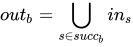

In logical operations, this reads as
out(b) = 0
for s in succ(b)
    out(b) = out(b) or in(s)
in(b) = (out(b) and not kill(b)) or gen(b)
Dataflow problems which have sets of data-flow values which can be represented as bit vectors are called bit vector problems, gen-kill problems, or locally separable problems.[13] Such problems have generic polynomial-time solutions.[14]
In addition to the reaching definitions and live variables problems mentioned above, the following problems are instances of bitvector problems:[14]
- Available expressions
- Very busy expressions
- Use-definition chains
IFDS problems
[edit]Interprocedural, finite, distributive, subset problems or IFDS problems are another class of problem with a generic polynomial-time solution.[13][15] Solutions to these problems provide context-sensitive and flow-sensitive dataflow analyses.
There are several implementations of IFDS-based dataflow analyses for popular programming languages, e.g. in the Soot[16] and WALA[17] frameworks for Java analysis.
Every bitvector problem is also an IFDS problem, but there are several significant IFDS problems that are not bitvector problems, including truly-live variables and possibly-uninitialized variables.
Sensitivities
[edit]Data-flow analysis is typically path-insensitive, though it is possible to define data-flow equations that yield a path-sensitive analysis.
- A flow-sensitive analysis takes into account the order of statements in a program. For example, a flow-insensitive pointer alias analysis may determine "variables x and y may refer to the same location", while a flow-sensitive analysis may determine "after statement 20, variables x and y may refer to the same location".
- A path-sensitive analysis computes different pieces of analysis information dependent on the predicates at conditional branch instructions. For instance, if a branch contains a condition
x>0, then on the fall-through path, the analysis would assume thatx<=0and on the target of the branch it would assume that indeedx>0holds. - A context-sensitive analysis is an interprocedural analysis that considers the calling context when analyzing the target of a function call. In particular, using context information one can jump back to the original call site, whereas without that information, the analysis information has to be propagated back to all possible call sites, potentially losing precision.
List of data-flow analyses
[edit]See also
[edit]References
[edit]- ^ Kildall, Gary Arlen (May 1972). Global expression optimization during compilation (Ph.D. dissertation). Seattle, Washington, USA: University of Washington, Computer Science Group. Thesis No. 20506, Technical Report No. 72-06-02.
- ^ Kildall, Gary Arlen (1973-10-01). "A unified approach to global program optimization" (PDF). Proceedings of the 1st annual ACM SIGACT-SIGPLAN symposium on Principles of programming languages - POPL '73. pp. 194–206. doi:10.1145/512927.512945. hdl:10945/42162. S2CID 10219496. Archived (PDF) from the original on 2017-06-29. Retrieved 2006-11-20. ([1])
- ^ Rüthing, Oliver; Knoop, Jens; Steffen, Bernhard (2003-07-31) [1999]. "Optimization: Detecting Equalities of Variables, Combining Efficiency with Precision". In Cortesi, Agostino; Filé, Gilberto (eds.). Static Analysis: 6th International Symposium, SAS'99, Venice, Italy, September 22–24, 1999, Proceedings. Lecture Notes in Computer Science. Vol. 1694 (illustrated ed.). Springer. pp. 232–247 [233]. ISBN 9783540664598. ISSN 0302-9743.
- ^ Huitt, Robert; Eubanks, Gordon; Rolander, Thomas "Tom" Alan; Laws, David; Michel, Howard E.; Halla, Brian; Wharton, John Harrison; Berg, Brian; Su, Weilian; Kildall, Scott; Kampe, Bill (2014-04-25). Laws, David (ed.). "Legacy of Gary Kildall: The CP/M IEEE Milestone Dedication" (PDF) (video transscription). Pacific Grove, California, USA: Computer History Museum. CHM Reference number: X7170.2014. Retrieved 2020-01-19.
[…] Eubanks: […] Gary […] was an inventor, he was inventive, he did things. His Ph.D. thesis proved that global flow analysis converges. […] This is a fundamental idea in computer science. […] I took a […] summer course once from a guy named Dhamdhere […] they talked about optimization for like a week and then they put a slide up and said, "Kildall's Method," this is the real story. […] that's something that no one ever thinks about. […]
[2][3] (33 pages) - ^ Kildall, Gary A. (1973). "A unified approach to global program optimization". Proceedings of the 1st annual ACM SIGACT-SIGPLAN symposium on Principles of programming languages - POPL '73. pp. 194–206. doi:10.1145/512927.512945. hdl:10945/42162.
- ^ Aho, Alfred V.; Lam, Monica S.; Sethi, Ravi; Ullman, Jeffrey D. (2006). Compilers: Principles, Techniques, and Tools (2nd ed.). Pearson. ISBN 978-0321486813.
- ^ Nielson, Flemming; Nielson, Hanne R.; Hankin, Chris (2005). Principles of Program Analysis. Springer. ISBN 978-3540654100.
- ^ Muchnick, Steven S. (1997). Advanced Compiler Design and Implementation. Morgan Kaufmann. ISBN 978-1558603202.
- ^ Cooper, Keith D.; Harvey, Timothy J.; Kennedy, Ken (2004-03-26) [November 2002]. "Iterative Data-Flow Analysis, Revisited" (PDF). PLDI 2003. ACM. TR04-432. Retrieved 2017-07-01.[permanent dead link]
- ^ "Static Single Assignment (with relevant examples)". GeeksforGeeks. 2021-10-02. Retrieved 2023-08-16.
- ^ Mohnen, Markus (2002). "A Graph—Free Approach to Data—Flow Analysis". Compiler Construction. Lecture Notes in Computer Science. Vol. 2304. pp. 185–213. doi:10.1007/3-540-45937-5_6. ISBN 978-3-540-43369-9.
- ^ Kuang, Hongyu; Mäder, Patrick; Hu, Hao; Ghabi, Achraf; Huang, LiGuo; Lü, Jian; Egyed, Alexander (2015-11-01). "Can method data dependencies support the assessment of traceability between requirements and source code?". Journal of Software: Evolution and Process. 27 (11): 838–866. doi:10.1002/smr.1736. ISSN 2047-7481. S2CID 39846438.
- ^ a b Reps, Thomas; Horwitz, Susan; Sagiv, Mooly (1995). "Precise interprocedural dataflow analysis via graph reachability". Proceedings of the 22nd ACM SIGPLAN-SIGACT symposium on Principles of programming languages - POPL '95. New York, New York, USA: ACM Press. pp. 1, 49–61. doi:10.1145/199448.199462. ISBN 0-89791692-1. S2CID 5955667.
- ^ a b Knoop, Jens; Steffen, Bernhard; Vollmer, Jürgen (1996-05-01). "Parallelism for free: efficient and optimal bitvector analyses for parallel programs". ACM Transactions on Programming Languages and Systems. 18 (3): 268–299. doi:10.1145/229542.229545. ISSN 0164-0925. S2CID 14123780.
- ^ Naeem, Nomair A.; Lhoták, Ondřej; Rodriguez, Jonathan (2010), "Practical Extensions to the IFDS Algorithm", Compiler Construction, Lecture Notes in Computer Science, vol. 6011, Berlin / Heidelberg, Germany: Springer Verlag, pp. 124–144, doi:10.1007/978-3-642-11970-5_8, ISBN 978-3-64211969-9
- ^ Bodden, Eric (2012). "Inter-procedural data-flow analysis with IFDS/IDE and Soot". Proceedings of the ACM SIGPLAN International Workshop on State of the Art in Java Program analysis. New York, New York, USA: ACM Press. pp. 3–8. doi:10.1145/2259051.2259052. ISBN 978-1-45031490-9. S2CID 3020481.
- ^ Rapoport, Marianna; Lhoták, Ondřej; Tip, Frank (2015). Precise Data Flow Analysis in the Presence of Correlated Method Calls. International Static Analysis Symposium. Lecture Notes in Computer Science. Vol. 9291. Berlin / Heidelberg, Germany: Springer Verlag. pp. 54–71. doi:10.1007/978-3-662-48288-9_4. ISBN 978-3-66248287-2.
Further reading
[edit]- Cooper, Keith D.; Torczon, Linda (2003) [2002-01-01]. Engineering a Compiler. Morgan Kaufmann. ISBN 978-1-55860-698-2.
- Muchnick, Steven Stanley (1997). Advanced Compiler Design and Implementation. Morgan Kaufmann Publishers. ISBN 978-1-55860-320-2.
- Hecht, Matthew S. (1977-05-03). Flow Analysis of Computer Programs. Programming Languages Series. Vol. 5. Elsevier North-Holland Inc. ISBN 978-0-44400210-5.
- Khedker, Uday P.; Sanyal, Amitabha; Karkare, Bageshri (2009). Data Flow Analysis: Theory and Practice. CRC Press (Taylor and Francis Group).
- Nielson, Flemming; Nielson, Hanne Riis; Hankin, Chris (2005). Principles of Program Analysis. Springer Science+Business Media.
Data-flow analysis
View on GrokipediaFundamentals
Definition and Purpose
Data-flow analysis is a static analysis technique used in compilers and program verification tools to determine the possible values that variables may hold at various points in a program without executing it.[4] This method models the program's structure as a control flow graph (CFG), which is a directed graph where nodes represent basic blocks—sequences of consecutive statements with no branches or jumps—and edges indicate possible control transfers between these blocks.[5] By propagating abstract information across the CFG, data-flow analysis tracks how data values or properties flow through the program, enabling inferences about variable states along all possible execution paths.[6] The primary purpose of data-flow analysis is to facilitate compiler optimizations that improve code efficiency and performance, such as dead code elimination, which removes unreachable or unused instructions, and register allocation, which assigns variables to processor registers based on their liveness.[7] It also supports error detection by identifying issues like uninitialized variable uses during compilation.[8] Beyond optimization, data-flow analysis underpins broader static analysis applications, including the detection of security vulnerabilities through techniques like taint tracking and bug finding in software verification tools.[4] Data-flow analysis originated in the 1960s and 1970s as part of early compiler research, pioneered by Frances E. Allen at IBM, who developed foundational techniques for analyzing control and data flows in flowchart-based programs.[9] Allen's work, including her 1970 paper on control flow analysis, laid the groundwork for extending these methods to structured programming languages, enabling global optimizations across entire programs.[10] This historical development transformed static analysis from ad hoc optimizations to a systematic framework integral to modern compilers.[11]Lattices and Abstract Domains
In data-flow analysis, lattices provide a mathematical structure to model the sets of possible program states or properties at program points, enabling the representation and combination of information in a way that supports fixed-point computations. A lattice is defined as a partially ordered set (poset) equipped with a partial order , where every pair of elements has a least upper bound (join, denoted or ) and a greatest lower bound (meet, denoted or ).[12] The join operation combines information conservatively (e.g., union of sets), while the meet operation intersects it, ensuring that the structure captures approximations of program behaviors without losing essential properties. The height of a lattice, defined as the length of the longest chain from bottom to top element, bounds the number of iterations needed for convergence in finite-height lattices, while the width, related to the size of the largest antichain, influences the complexity of representing and manipulating elements.[12] Abstract domains approximate the concrete domain of all possible program values or states, which is often infinite and intractable, by mapping it to a finite lattice that over-approximates relevant properties. This approximation is formalized through abstract interpretation, where a concretization function maps abstract elements back to concrete sets, and an abstraction function projects concrete sets onto the abstract domain, forming a Galois connection that ensures soundness (every abstract property implies a concrete one).[13] For instance, the sign domain abstracts integer values into a finite lattice with elements (where is the bottom element, negative, zero, positive, top representing any sign), ordered by implication (e.g., ), with join as the least upper bound (least precise common sign) and meet as the greatest lower bound (most precise).[13] Such domains make analysis decidable by reducing infinite state spaces to manageable finite structures, trading precision for computability.[13] Transfer functions in data-flow analysis, which model the effect of program statements on lattice elements, must be monotonic to guarantee convergence of iterative analyses. Monotonicity requires that for any lattice elements , the function satisfies , preserving the order and ensuring that information flows do not oscillate indefinitely in finite lattices.[12] This property, combined with the lattice's completeness (existence of joins and meets for all subsets), ensures the existence of least fixed points under standard fixed-point theorems.[12] A common example is the powerset lattice, used in analyses like reaching definitions, where the domain is the power set of possible definitions ordered by subset inclusion (), with union () as join to accumulate reachable facts and empty set () as bottom element.[12] This lattice captures sets of variables or definitions conservatively, where the join operation merges information from multiple control-flow paths without under-approximating possibilities.[12]Data Flow Equations
Data flow problems in compiler optimization are expressed as systems of equations over a program's control flow graph (CFG), where each node represents a basic block and edges denote possible control transfers. These equations capture the propagation of abstract information, such as variable definitions or uses, across the graph to enable optimizations like dead code elimination or constant propagation. The solutions to these equations provide a fixed-point approximation of the program's behavior in the chosen abstract domain.[14] In the general form for forward data flow analysis, the input information to a block $ B $, denoted $ \mathit{in}[B] $, is the meet (e.g., intersection for sets) of the output information from its predecessors:The output information from $ B $, denoted $ \mathit{out}[B] $, is then computed by applying a transfer function $ f_B $ to the input:
Here, $ f_B $ performs local analysis specific to the statements in $ B $, such as updating sets of reachable values.[14][10] Forward analyses accumulate information in the direction of control flow, computing outputs from inputs to track effects propagating forward. In contrast, backward analyses propagate information reversely, defining the output of $ B $ as the join (e.g., union for sets) of the inputs to its successors:
with the input derived via the transfer function:
This distinction allows backward problems, like liveness analysis, to reason about information needed after a block.[14] Transfer functions $ f_B $ encapsulate block-local computations and are often expressed in gen-kill form for bit-vector analyses, where generated ($ \mathit{gen}[B] \mathit{kill}[B] $) elements represent added or invalidated information:
More generally, these use lattice operations like difference ($ \ominus \oplus $) to ensure monotonicity. The full system comprises such constraints for all blocks in the CFG, forming a set of interdependent equations solved collectively.[14]
Core Algorithm
Iterative Fixed-Point Computation
In data-flow analysis, a fixed point represents a solution to the data flow equations where, for every basic block , the incoming information equals the meet (join) over the outgoing information from its predecessors, , and the outgoing information is obtained by applying the transfer function for , . The least fixed point is the minimal such solution with respect to the partial order of the lattice, providing the most precise approximation that satisfies the equations from below.[15] The iterative fixed-point computation approximates this solution by beginning with initial values for and across all blocks and repeatedly updating them according to the data flow equations until the values stabilize, meaning no further changes occur. In each iteration, the incoming values are recomputed as the meet of the current outgoing values from predecessors, and the outgoing values are updated via the block-specific transfer functions; this process continues until convergence to the fixed point.[15] For guaranteed convergence, the data flow framework must be monotone, meaning that the transfer functions are monotone with respect to the lattice order—if , then —and the meet operation is also monotone, ensuring that iterations produce non-decreasing (or non-increasing, depending on formulation) sequences in finite-height lattices. In such monotone systems over finite lattices, the iterative process terminates after a finite number of steps, yielding the least fixed point.[16] To compute the least fixed point via chaotic iterations—which process blocks in an arbitrary order without relying on topological sorting—the initial values are set to the bottom element for both forward and backward analyses, allowing the approximations to refine progressively through the monotone updates. This chaotic approach ensures correctness and termination under the monotonicity assumption, independent of the iteration schedule.[15]Convergence Properties
The convergence of iterative data-flow analysis algorithms relies fundamentally on the Knaster-Tarski theorem, which guarantees the existence of fixed points for monotone functions defined over complete lattices. Specifically, if $ f: L \to L $ is a monotone function on a complete lattice $ (L, \sqsubseteq) $, then the set of fixed points of $ f $ forms a complete lattice, and $ f $ has both a least fixed point (the greatest lower bound of all fixed points) and a greatest fixed point (the least upper bound of all fixed points). This theorem underpins the theoretical foundation for solving data-flow equations, as the transfer functions in data-flow frameworks are typically monotone with respect to the lattice order, ensuring that iterative applications of $ f $ will converge to these fixed points.[15] In finite lattices, which are common in practical data-flow analyses (such as bit-vector representations for reaching definitions), termination is further assured by the finite height of the lattice. The height of a lattice $ L $ is the length of the longest chain of strictly increasing elements, and since monotone iterations produce non-decreasing sequences, the process cannot exceed this height without stabilizing at a fixed point. Thus, for a lattice with $ |L| $ elements, the algorithm terminates after at most $ |L| $ iterations in the worst case, as each step ascends the partial order until no further changes occur.[16] Control flow graphs (CFGs) often contain cycles due to loops and branches, which could potentially lead to infinite propagation in non-terminating analyses. However, the monotonicity of the transfer functions ensures that information propagates around these cycles in a controlled manner, with values accumulating (via join operations) until the analysis reaches a stable fixed point where further iterations yield no changes.[15] Non-convergence can arise in analyses over infinite domains (e.g., unbounded integer intervals) or with non-monotone functions, where ascending chains may not stabilize. To mitigate this, widening operators are introduced to artificially bound the lattice height by over-approximating values after a certain number of iterations, thereby enforcing termination while preserving soundness.[16]Worklist Implementation
The worklist algorithm provides an efficient mechanism for solving data-flow equations by maintaining a queue of program nodes whose abstract states may need updating, thereby avoiding unnecessary reprocessing of unchanged nodes. It begins by initializing the abstract state for each node (typically to the bottom element of the lattice) and adding the entry node to the worklist. The algorithm then iteratively dequeues a node B, computes its new output state using the transfer function applied to its current input state, and checks the successors of B. If the propagated information (via the meet operation) changes the input state of a successor, that successor is enqueued for reprocessing. This process continues until the worklist is empty, at which point the fixed point has been reached.[16] The following pseudocode illustrates a simple forward analysis implementation, assuming a control-flow graph with nodes representing basic blocks, transfer functions , and meet operation :for each basic block B in the program:
in[B] ← ⊥ // bottom element
out[B] ← ⊥
in[entry] ← initial // initial abstract state at entry
worklist ← {entry} // initialize with entry block
while worklist ≠ ∅:
dequeue B from worklist
old_out ← out[B]
out[B] ← f_B(in[B]) // apply transfer function
if out[B] ≠ old_out: // change detected
for each successor S of B:
old_in ← in[S]
in[S] ← in[S] ⊔ out[B] // meet with propagated state
if in[S] ≠ old_in:
enqueue S to worklist
Initialization Strategies
In data-flow analysis, initialization strategies establish the starting values for data-flow facts at entry and exit points, as well as at interior program points, while node ordering determines the sequence of updates during iterative computation. These choices directly influence the efficiency of reaching the fixed point by providing a sound starting approximation that aligns with the analysis direction and lattice structure. For computing the least fixed point, initialize to the bottom element everywhere, with boundary conditions applied (e.g., in[entry] = \bot for forward; out[exit] = \bot for backward). This allows upward propagation via joins for both forward and backward analyses. Note that for analyses requiring the greatest fixed point (e.g., certain must-analyses), initialization to and downward meets may be used instead.[15] Node ordering further optimizes the process by approximating a topological traversal of the control flow graph. In forward analyses, reverse postorder—derived from a depth-first traversal where nodes are numbered in decreasing finishing times—prioritizes processing a node's predecessors before the node itself, thereby minimizing redundant propagations across forward edges. In backward analyses, postorder reverses this priority, processing successors first to efficiently propagate information upstream. Precomputing successors and predecessors, known as tabulation, constructs adjacency lists for the control flow graph prior to iteration, enabling constant-time lookups for merging data from predecessors or distributing to successors without repeated graph traversals. This step enhances overall runtime by decoupling structure computation from the fixed-point solver. The combined impact of these strategies substantially reduces the iteration count required for convergence. In directed acyclic graphs, topological ordering (a special case of reverse postorder for forward analyses) achieves the solution in a single pass, as information flows without cycles. In cyclic graphs typical of real programs, these methods limit passes to roughly the loop nesting depth plus one or two, with Knuth's study indicating an average loop nesting depth of 2.75 across Fortran programs from the 1970s.[17]Illustrative Examples
Forward Data Flow: Reaching Definitions
Reaching definitions analysis is a forward data-flow problem that determines, for each program point, the set of variable definitions that may reach it along some execution path without being overwritten.[18] A definition of variable reaches a point if there exists a path from the site of to such that no other definition of occurs on that path.[18] This analysis supports optimizations like dead code elimination and constant propagation by identifying potentially relevant prior assignments.[18] The data-flow equations for reaching definitions treat definitions as elements in a set lattice, with union as the meet operator. For a basic block , is the set of definitions generated within , and is the set of definitions of the same variables that are overwritten within . The input set to is the union of the output sets from its predecessors:1: x = 1 // d1
2: y = 2 // d2
3: if (x > 0) goto 6
4: x = 3 // d4
5: goto 7
6: y = 4 // d6
7: print x
8: if (y > 0) goto 3
- B1 (lines 1-2): gen = {d1, d2}, kill = ∅
- B2 (line 3): gen = ∅, kill = ∅
- B3 (lines 4-5): gen = {d4}, kill = {d1}
- B4 (line 6): gen = {d6}, kill = {d2}
- B5 (lines 7-8): gen = ∅, kill = ∅
Edges: B1 → B2; B2 → B3; B2 → B4; B3 → B5; B4 → B5; B5 → B2 (loop back); B5 → exit. This setup highlights branch and loop propagation.[19]
Process B2: in[B2] = {d1, d2}, out[B2] = {d1, d2}. Propagate to B3, B4.
Process B3: in[B3] = {d1, d2}, out[B3] = {d2, d4}. Propagate to B5.
Process B4: in[B4] = {d1, d2}, out[B4] = {d1, d6}. Propagate to B5.
Process B5: in[B5] = {d2, d4} ∪ {d1, d6} = {d1, d2, d4, d6}, out[B5] = {d1, d2, d4, d6}. Propagate to B2.
Reprocess B2: in[B2] = {d1, d2} ∪ {d1, d2, d4, d6} = {d1, d2, d4, d6}, out[B2] = {d1, d2, d4, d6}. Propagate to B3, B4.
Reprocess B3: in[B3] = {d1, d2, d4, d6}, out[B3] = {d2, d4, d6}. Propagate to B5 (changed).
Reprocess B4: in[B4] = {d1, d2, d4, d6}, out[B4] = {d1, d4, d6}. Propagate to B5 (changed).
Reprocess B5: in[B5] = {d2, d4, d6} ∪ {d1, d4, d6} = {d1, d2, d4, d6} (no change). No further changes. At the print x in B5, the reaching definitions for x are {d1, d4} (d1 via the branch to B4, d4 via the branch to B3). The loop causes multiple passes, propagating definitions back via B5 → B2 until convergence.[18][19]
Backward Data Flow: Live Variables
Live variable analysis is a classic backward data-flow problem in compiler optimization, aimed at identifying which variables hold useful values at each program point for purposes such as register allocation and dead code elimination. A variable is live at a program point if there exists a path from that point to a use of the variable before any redefinition occurs along that path. This analysis proceeds in the reverse direction of control flow, starting from program exits where no variables are live and propagating liveness information upward through predecessors.[20][21] For a basic block $ B $, the generator set $ \gen[B] $ contains the variables used within $ B $, while the kill set $ \kill[B] $ includes variables defined in $ B $. The core data-flow equations capture how liveness flows backward:- Block 1:
t1 = a[i]; t2 = b[i](entry point) - Block 2:
if (t1 <= t2) goto 4(branches to 3 or 4) - Block 3:
t1 = t2 - Block 4:
b[i] = t1; i = i + 1; if (i < 10) goto 1(exit via implicit return after loop)
Extensions and Variations
Alternative Algorithms
For reducible control flow graphs (CFGs), exact solutions to data-flow problems can be computed in linear time using non-iterative methods such as interval analysis, which decomposes the graph into nested intervals based on dominator relationships and propagates information top-down through the interval tree. This approach, developed by Allen and Cocke, identifies structured regions (intervals) where each interval has a single entry point, allowing data-flow facts to be computed once per interval and inherited by sub-intervals without repeated iteration over cycles.[18] By exploiting the reducibility property—where back edges connect to interval headers— the method avoids the quadratic or worse complexity of general iterative algorithms, achieving O(E) time where E is the number of edges, and provides precise results equivalent to the meet-over-all-paths solution for distributive problems like reaching definitions.[18] Path expressions offer another exact method for reducible CFGs, representing paths from the entry node as regular expressions over edge labels to solve forward or backward data-flow equations symbolically. Tarjan's algorithm decomposes the graph using the dominator tree, computes path expressions within strongly connected components via Gaussian elimination on interval matrices, and combines them bottom-up, yielding a solution in O(m α(m,n)) time for m edges and n nodes, where α is the inverse Ackermann function—nearly linear in practice.[22] This technique directly encodes transfer functions in the expressions, enabling efficient evaluation of data-flow facts at any node without enumerating all paths, and is particularly effective for analyses like constant propagation in structured code.[22] Chaotic iteration variants improve upon the standard fixed-point computation by employing non-deterministic or randomized node ordering in the worklist, potentially accelerating convergence for certain lattices and graph topologies. Introduced by Cousot and Cousot, chaotic iteration selects an arbitrary sequence of nodes for updating data-flow equations until stabilization. While guaranteed to reach the least fixed point regardless of order for monotone frameworks, these variants are practical enhancements for large-scale analyses where iteration count dominates runtime.[23] Symbolic methods leverage binary decision diagrams (BDDs) to represent and manipulate large finite domains compactly, avoiding explicit enumeration in iterative data-flow solvers. Whaley et al. integrate BDDs with Datalog rules to model relations like points-to sets, where operations such as union and intersection correspond to graph propagation, enabling fixpoint computation in time proportional to BDD node count rather than domain size.[24] For instance, in context-sensitive pointer analysis, BDDs compress exponential state spaces into compact representations, supporting scalable solutions for non-bitvector domains like aliasing in Java programs.[24] Hybrid approaches merge iterative data-flow with on-demand constraint solving to enable demand-driven analysis, computing facts only for queried program points rather than exhaustively. In SUPA, Sui et al. build a sparse value-flow graph via initial iteration, then apply backward reachability queries with strong updates—treating singleton constraints as filters—to refine results within a budget, achieving 97% of full flow-sensitive precision at 0.18 seconds per query on C/C++ benchmarks.[25] This combination reduces spurious facts by iteratively solving def-use constraints, making it suitable for targeted applications like virtual call resolution while maintaining scalability for large codebases.[25]Bit Vector Optimizations
Bit vector optimizations exploit the finite domain nature of many data-flow analyses, where sets of elements—such as program variables, definitions, or expressions—can be represented compactly using binary bits, enabling hardware-accelerated operations for efficiency. In this approach, each potential element in the domain is assigned a unique bit position in a vector, where a set bit indicates presence and a cleared bit indicates absence; the vector is typically partitioned into fixed-width words (e.g., 32 or 64 bits) to leverage processor-level parallelism in bitwise instructions. This representation is particularly suited to gen-kill style analyses, where the lattice elements are subsets of a finite universe, allowing the entire analysis to operate on these compact structures rather than explicit lists or sets. Transfer functions in bit vector analyses are implemented using predefined masks for generation (gen) and killing (kill) sets, which are themselves bit vectors marking the elements added or removed by a statement or basic block. For a forward analysis like reaching definitions, the out-set for a block is computed as the bitwise OR of the in-set with the gen mask, followed by a bitwise AND with the complement of the kill mask to remove invalidated elements; similarly, joins across predecessors use bitwise OR to union the incoming sets. These operations—OR for meet (union in forward flows), AND for intersection, and XOR or AND-NOT for differences—are executed in constant time per word, yielding significant speedups over symbolic or list-based manipulations, especially for domains with hundreds or thousands of elements. Backward analyses, such as live variables, adapt the same paradigm with reversed gen/kill roles and AND for joins. As noted in early formulations, this bit-parallel computation reduces the iterative fixed-point solver's per-iteration cost from O(n (for n elements) to O(n/w), where w is the word size.[26] A concrete example is the forward reaching definitions analysis, where the domain consists of definition sites (e.g., assignments to variables), and the goal is to determine which definitions reach each program point. Suppose a program has 64 definition sites, fitting neatly into a single 64-bit word; each bit represents whether a particular definition reaches the point. The gen set for a block containing a definition d_i is a mask with only the i-th bit set, while the kill set includes bits for all definitions of the same variable as d_i. During iteration, the in-vector for a block is the OR of out-vectors from its predecessors, and the out-vector is then (in OR gen) AND (NOT kill), all via native CPU instructions like OR, AND, and NOT on the 64-bit register—processing the entire domain in a handful of cycles per block. This bit-parallelism scales the analysis to larger programs without proportional slowdowns, as demonstrated in classical implementations where iteration over thousands of blocks completes in milliseconds. While effective, bit vector representations have limitations tied to their fixed granularity: the domain size must be known statically and bounded, as dynamic resizing is inefficient, and very large domains (e.g., millions of elements) require arrays of multiple words, increasing memory and operation counts linearly with the number of words. Operations remain fast but lose full parallelism beyond hardware word size, though modern 64-bit architectures mitigate this for domains up to thousands of elements. To handle overflows or sparse sets, hybrid approaches sometimes complement bit vectors with sparse bit maps, but pure bit vectors excel in dense, medium-sized finite domains common to intraprocedural analyses.[27] These optimizations are widely adopted in production compilers; for instance, the GNU Compiler Collection (GCC) implements per-function bit vector data-flow analysis using this framework in its optimization passes, such as for common subexpression elimination, with a generic analyzer supporting custom gen/kill masks across versions like GCC 4.3 and later. Similarly, in the LLVM infrastructure, analyses like live variables in Clang utilizellvm::BitVector to represent sets of registers or variables, enabling efficient propagation during code generation and optimization, as seen in the core analysis libraries.[28][29]
Interprocedural Frameworks (IFDS)
Interprocedural Finite Distributive Subset (IFDS) problems represent a class of data-flow analyses that extend intraprocedural techniques across procedure boundaries while maintaining scalability and precision. These problems are characterized by a finite domain of data-flow facts , where the data-flow functions map powersets of to powersets of and distribute over the meet operator, typically union or intersection depending on the analysis direction. IFDS enables the modeling of interprocedural effects, such as parameter passing and return values, without exploding the state space for every possible call context, thus avoiding the exponential cost of fully context-sensitive analyses in large programs.[30] The IFDS framework models the program as an exploded supergraph , where nodes are pairs consisting of a program point from the interprocedural control-flow graph and an element from (with 0 as a special "bottom" element). This construction captures call-return behavior through "valid paths" that respect procedure nesting, using summary edges to represent the net effect of subroutines without unrolling the call stack. The core solving mechanism is the tabulation algorithm, a dynamic programming approach that computes reachable facts by propagating along the exploded supergraph's edges, ensuring efficiency in time, where is the number of edges in the supergraph. Distributive properties allow the composition of local and summary functions to be handled modularly, making IFDS applicable to a wide range of subset-based problems.[30] A canonical example is interprocedural reaching definitions, which determines the set of variable definitions that may reach a program point across procedure calls. In this analysis, facts in represent individual definitions, and flow functions propagate sets of reaching definitions through calls by incorporating callee summaries (e.g., definitions introduced or killed within a subroutine). For instance, at a call site, the framework computes the effect of the callee on caller state via exploded paths that align entry and exit points, enabling precise tracking of definitions like those for possibly uninitialized variables without requiring full inlining. This avoids the imprecision of call-string approximations while scaling to real-world codebases.[30] Developed in the mid-1990s by Reps, Horwitz, and Sagiv, the IFDS framework has influenced subsequent interprocedural analysis techniques and is implemented in tools such as Soot, a Java optimization framework that leverages IFDS solvers for tasks like taint analysis and def-use chain construction. Its graph-reachability reduction has enabled efficient, context-sensitive analyses in production static analysis systems, with extensions appearing in post-1990s works to handle more complex domains.[30][31]Analysis Sensitivities
Flow Sensitivity
Flow-sensitive data flow analysis tracks the propagation of data facts along specific control flow paths in a program's control flow graph (CFG), accounting for the sequential order of statements and the impact of branches or loops on those facts. This approach distinguishes the effects of different execution paths, such as how an if-then-else construct alters the set of reaching definitions at a subsequent program point. In contrast, flow-insensitive analysis disregards path order, treating all statements as a commutative set and computing a single, conservative approximation for the entire procedure, which simplifies computation but sacrifices precision.[18][8] Implementation of flow-sensitive analysis typically involves iterative propagation over the CFG using fixpoint algorithms. Starting from an initial state—such as empty sets for forward analyses like reaching definitions—the algorithm applies transfer functions to each node, merging information from predecessors (for forward flow) or successors (for backward flow) until convergence. Seminal procedures, such as those using interval partitioning of the CFG, process nodes in topological order within reducible graphs to efficiently compute facts like live variables or available expressions at each point. Worklist-based variants prioritize updated nodes to reduce iterations, often representing facts with bit vectors for scalability.[18][10][8] The primary trade-off of flow-sensitive analysis is its superior precision against increased computational cost. By maintaining separate data facts per program point, it can detect path-dependent behaviors—such as branch-specific liveness in conditional code—that flow-insensitive methods over-approximate, enabling optimizations like partial redundancy elimination where path context matters. However, this requires solving equations for every CFG node and edge, leading to time and space complexity that scales with the number of program points (often quadratic in practice for flow-sensitive analyses), compared to the single-state computation of insensitive approaches (linear for simple cases but up to cubic for precise pointer analyses).[8] Flow-sensitive analyses are particularly essential for intraprocedural optimizations in compilers, where precise path information enhances code generation without excessive interprocedural overhead. They are routinely applied in tools for analyses like reaching definitions, where tracking path-specific propagations directly informs dead code elimination, though approximations are common in broader program scopes to balance precision and performance.[18][8]Context Sensitivity
Context-sensitive data-flow analysis enhances precision in interprocedural settings by tracking the calling context—such as the sequence of call sites or caller states—when propagating data-flow facts across procedure boundaries, in contrast to context-insensitive analysis, which computes a single, unified summary for each procedure regardless of how it is invoked. This approach, pioneered in the call-string method, tags data-flow facts with a history of recent call sites to distinguish invocations and avoid merging facts from unrelated contexts, thereby reducing spurious results in analyses like pointer aliasing or live variables. Key techniques for achieving context sensitivity include the full call-string approach, which maintains an unbounded history of calls but is generally impractical due to exponential growth in state space, and bounded variants like k-limiting, which restrict the call-string depth to a fixed parameter k to ensure termination at the cost of some precision loss. Selective context sensitivity applies full tracking only to critical call sites, such as those involving recursion or virtual method invocations, while using insensitive summaries elsewhere to balance precision and efficiency; this is particularly useful in demand-driven analyses where computation focuses on queried elements.[32] A representative example is context-sensitive points-to analysis, which differentiates pointer targets based on calling contexts to resolve virtual calls more accurately and eliminate spurious aliases that could arise from merging unrelated invocations.[33] For instance, in object-oriented languages like Java, this prevents over-approximating method dispatch by considering the specific caller, leading to fewer false positives in optimizations or error detection. In modern applications, such analyses power precise refactoring and code inspection in integrated development environments (IDEs), as seen in IntelliJ IDEA's data-flow engine, which employs call-context sensitivity to trace variable states across invocations for features like dead code elimination and null-dereference warnings.[34][35]Object and Field Sensitivity
In data-flow analysis for object-oriented languages, object sensitivity enhances precision by distinguishing abstract representations of objects based on their allocation sites or other distinguishing locations, rather than treating all objects of the same type as indistinguishable (object-insensitive). This approach tracks data flows separately for each unique allocation context, reducing over-approximations in analyses like points-to, where insensitive methods merge all instances of a class into a single abstract object.[36] Seminal work formalized parameterized object sensitivity, allowing the number of distinguished objects (k) to be tuned for a balance between precision and scalability in Java programs. Field sensitivity complements object sensitivity by modeling distinctions among an object's fields, treating accesses to different fields (e.g.,obj.x versus obj.y) as separate data-flow paths, in contrast to field-insensitive analyses that treat all fields uniformly. This is particularly crucial in languages like Java, where field updates can alias unexpectedly if not distinguished. Analyses often employ hybrid strategies, combining strong updates (precise overwrites that eliminate prior values for a specific field) with weak updates (conservative may-overwrites for unknown cases), to maintain soundness while improving precision in heap manipulations.[37]
A representative example appears in points-to analysis for Java, where an object-sensitive and field-sensitive approach significantly reduces false positives in aliasing queries compared to insensitive variants; for instance, it can separately track pointers to obj.fieldA and obj.fieldB allocated at different sites, avoiding spurious merges that lead to imprecise call graph construction or escape analysis. Empirical studies confirm that such sensitivities yield up to 10-20x fewer aliases in medium-sized benchmarks, enhancing downstream optimizations like devirtualization.[33]
However, these sensitivities pose scalability challenges in programs with large heaps, as the number of abstract objects and field combinations can explode exponentially, leading to high memory and time costs; for example, distinguishing thousands of allocation sites may require heuristics like context truncation or selective sensitivity. Modern extensions address this through frameworks like TVLA (Three-Valued Logic Analyzer), which uses three-valued logic to perform scalable, parametric shape analysis that inherently supports object- and field-sensitive abstractions for verification tasks in the 2020s, such as detecting heap errors in concurrent systems.[38][39]
Common Analyses and Applications
Reaching Definitions and Constant Propagation
Reaching definitions analysis identifies the set of variable assignments that may reach a given program point along some execution path, serving as a foundational forward data-flow problem in compiler optimization. This analysis computes, for each point $ p $, the set $ \mathit{in}[p] $ of definitions reaching $ p $ from its predecessors, using the equations $ \mathit{in}[p] = \bigcup_{\hat{p} \in \mathit{pred}(p)} \mathit{out}[\hat{p}] $ and $ \mathit{out}[p] = \mathit{gen}[p] \cup (\mathit{in}[p] \setminus \mathit{kill}[p]) $, where $ \mathit{gen}[p] $ includes definitions generated at $ p $ and $ \mathit{kill}[p] $ includes those invalidated by redefinitions at $ p $. In practice, reaching definitions enables dead code elimination by identifying assignments that do not reach any use of the variable, allowing their removal to reduce program size and execution time. Constant propagation extends reaching definitions by tracking definite constant values for variables across program points, formulated as a forward must-analysis to determine values invariant on all paths. The analysis uses a lattice for each variable $ v $ with elements $ \top $ (unknown), $ c $ (definite constant $ c $), and $ \bot $ (non-constant), ordered as $ \top \geq c \geq \bot $ for all constants $ c $, with meet operation $ \sqcap $ taking the greatest lower bound (e.g., intersecting constants yields the common value if identical, else $ \bot $). The transfer function $ f_p $ for point $ p $ maps input information $ m $ (a function from variables to lattice elements) to output $ m' $, preserving values for unassigned variables and evaluating assignments: for $ v = e(w_1, \dots, w_k) $, if all $ m(w_i) $ are constants, set $ m'(v) $ to the computed constant; if any is $ \bot $, set to $ \bot $; otherwise, propagate the unknown or constant as appropriate. The flow equations are then $ \mathit{in}[p] = \bigsqcap_{\hat{p} \in \mathit{pred}(p)} \mathit{out}[\hat{p}] $ and $ \mathit{out}[p] = f_p(\mathit{in}[p]) $, solved iteratively until fixed-point convergence.[14] Combining reaching definitions with constant propagation simplifies optimization by using propagated constants to refine reaching sets, enabling more precise dead code elimination and code transformation. For instance, consider the code snippet:x = 5;
if (cond) {
y = x * 2;
} else {
y = x + 3;
}
z = y;
Available Expressions and Loop-Invariant Code Motion
Available expressions analysis is a classic forward data-flow problem in compiler optimization that identifies expressions whose values are guaranteed to be computed prior to a given program point along every possible execution path, without subsequent modification of their operands. This "must" analysis uses intersection as the meet operation to ensure the property holds universally, enabling optimizations like common subexpression elimination by avoiding recomputation of redundant expressions. The framework was introduced as part of the general data-flow analysis methodology by Kildall in 1973. The analysis operates over the control-flow graph (CFG), where each node represents a basic block, and information flows forward from entry to exit. For a basic block $ B $, the sets are defined as follows: contains all expressions computed exactly once in $ B $ (assuming no side effects or multiple computations), while includes all expressions that contain at least one variable redefined in $ B $, as such redefinitions invalidate prior computations. The data-flow equations, solved iteratively until a fixed point is reached, are:Block A: temp = x + y; // gen = {x + y}, kill = empty for this expr
Block B: z = temp * 2; // no gen/kill for x+y
Block C: x = 5; // kill = all exprs with x, e.g., {x + y}
temp instead of recomputing. This analysis complements forward analyses like constant propagation by focusing on composite expressions rather than single variables, enabling more aggressive optimizations when combined.[40]
Available expressions analysis directly supports loop-invariant code motion (LICM), an optimization that hoists computations invariant across loop iterations outside the loop body to reduce execution time, particularly in performance-critical kernels. An expression qualifies as loop-invariant if it is available at the loop header (i.e., computed on all paths to the header without operand modification) and remains un-killed within the loop (no redefinitions of its operands). The analysis confirms availability at the preheader, ensuring the hoisted value is correct for all iterations. This technique is especially effective in numerical computations where repeated invariant expressions dominate runtime.[41]
For instance, consider the following loop:
a = ...;
b = ...;
while (condition) {
  x = a + b;  // expression a + b
  ... use x ...
}
print x;
a = ...;
b = ...;
x = a + b;  // hoisted
while (condition) {
  ... use x ...
}
print x;