Hubbry Logo
Dennis MorganDennis MorganMain
Open search
Dennis Morgan
Community hub
Dennis Morgan
logo
8 pages, 0 posts
0 subscribers
Be the first to start a discussion here.
Dennis Morgan
Dennis Morgan
from Wikipedia

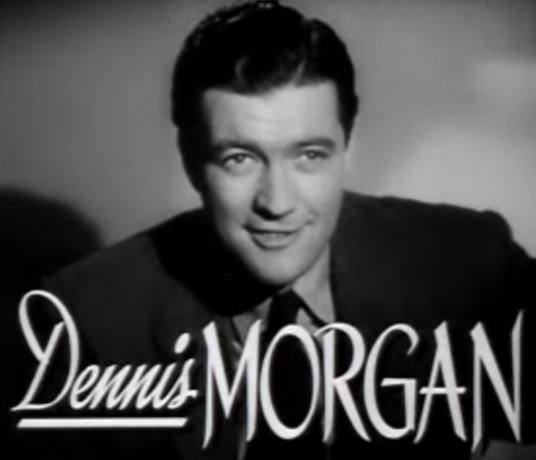
Dennis Morgan (born Earl Stanley Morner; December 20, 1908 – September 7, 1994) was an American actor-singer. He used the acting pseudonym Richard Stanley before adopting the name under which he gained his greatest fame.

Key Information

According to one obituary, he was "a twinkly-eyed handsome charmer with a shy smile and a pleasant tenor voice in carefree and inconsequential Warner Bros musicals of the forties, accompanied by Jack Carson."[1] Another said, "for all his undoubted star potential, Morgan was perhaps cast once too often as the likeable, clean-cut, easy-going but essentially uncharismatic young man who typically loses his girl to someone more sexually magnetic."[2] David Shipman said he "was comfortable, good-looking, well-mannered: the antithesis of the gritty Bogart."[3]

Life and career

[edit]

Early life

[edit]

Morgan was born in the village of Prentice in Price County, in northern Wisconsin, the son of Grace J. (née Vandusen) and Frank Edward Morner.[4] He was of Swedish descent on his father's side.[5]

Graduated from Marshfield Senior High, Marshfield WI. He enrolled at Carroll College in Waukesha, Wisconsin, as a member of the 1930 graduating class. He was awarded the Carroll College Distinguished Alumnus Award in 1983.[6]

Early career

[edit]

He joined a troupe of performers at the State Lake Theatre in Chicago, and toured the midwest in Faust. He landed a job as a featured singer in the Empire Room of the famous Palmer House hotel in Chicago.[7] He remained in Chicago as a radio announcer at the NBC Radio affiliate in Milwaukee, and went on to broadcast Green Bay Packers football games.[8]

Stanley Morner at MGM

[edit]

In 1936, after relocating to Los Angeles, Morgan began appearing in films. He signed a contract with MGM as "Stanley Morner".[9] Unbilled, he lip synced for Allan Jones singing the Irving Berlin song, A Pretty Girl is Like a Melody, in The Great Ziegfeld (1936).

He was billed as "Stanley Morner" in Suzy (1936) and could be seen in Piccadilly Jim (1936), and Old Hutch (1936). He was given supporting roles in Mama Steps Out (1937) and Song of the City (1937) but went back to small parts in Navy Blue and Gold (1937).[2]

Leading man

[edit]

Independent producer-director Victor Halperin gave the actor his first leading role (under his given name of Stanley Morner) in I Conquer the Sea (1936). He then signed with Paramount, who billed him as "Richard Stanley". He was in Men with Wings (1938), King of Alcatraz (1938), Illegal Traffic (1938), and Persons in Hiding (1939).

Warner Bros.

[edit]
Dennis Morgan and his wife Lillian Vedder at Ciro's, 1946

He went over to Warner Bros. who billed him as "Dennis Morgan". According to Shipman the studio "put him on the assembly-line with Wayne Morris, Arthur Kennedy, Jeffrey Lynn, Eddie Albert, and Ronald Reagan – likeable young lugs squiring the heroine till Bogart, Cagney, or Flynn came crashing down to sweep her up."[3]

He was given the lead in a B picture, Waterfront (1939), followed by No Place to Go (1939) and The Return of Doctor X (1939) with Humphrey Bogart.

Morgan was promoted to "A" films with The Fighting 69th (1940), supporting James Cagney and Pat O'Brien. He supported Priscilla Lane in Three Cheers for the Irish (1940) and went back to "B"s for Tear Gas Squad (1940), Flight Angels (1940), and River's End (1940).

Morgan's career received a boost when RKO borrowed him to play Ginger Rogers's love interest in Kitty Foyle (1940), a big hit.[2]

Warners put him in some comedies, Affectionately Yours (1941) and Kisses for Breakfast (1941), then a Western, Bad Men of Missouri (1941). He supported Cagney again in Captains of the Clouds (1942) and Bette Davis and Olivia de Havilland in In This Our Life (1942).

Morgan co-starred with Ann Sheridan in Wings for the Eagle (1942) and Ida Lupino in The Hard Way (1943). He had the lead in some big Warners musicals: Thank Your Lucky Stars (1943), full of cameos from Warner stars; The Desert Song (1943); Shine On, Harvest Moon (1944), with Sheridan. The latter also featured Jack Carson in a key role. He and Morgan were in The Hard Way together and would go on to be a notable team.[1]

Morgan was in The Very Thought of You (1944) and cameoed in Hollywood Canteen (1944). He had the lead in God Is My Co-Pilot (1945) and Christmas in Connecticut (1945) with Barbara Stanwyck.

Teamed with Jack Carson

[edit]

Morgan was teamed with fellow Wisconsinite Jack Carson in One More Tomorrow (1946). Warners liked them as a combination, seeing them as similar to Bing Crosby and Bob Hope at Paramount. In the words of Shipman, the films would feature "Morgan as the easy-going singer who always got the girl and Carson as the loud-mouthed but cowardly braggart-comic who was given the air. No one thought they were Hope and Crosby, least of all themselves."[3] They were reunited in Two Guys from Milwaukee (1946) and The Time, the Place and the Girl (1946).[citation needed]

Without Carson, Morgan made a Western, Cheyenne (1946), a musical My Wild Irish Rose (1947), and To the Victor (1948). In 1947, he was voted Singer of the Year.[10]

He was back with Carson for Two Guys from Texas (1948) then made One Sunday Afternoon (1948) with Janis Paige. He and Carson were in It's a Great Feeling (1949) with Doris Day. Exhibitors voted him the 21st most popular star in the US for 1948.[11]

Morgan made The Lady Takes a Sailor (1949) then Perfect Strangers (1950) with Rogers and Pretty Baby (1950) with Betsy Drake. He made a Western Raton Pass (1950), and a musical Painting the Clouds with Sunshine (1951). He supported Joan Crawford in This Woman Is Dangerous (1952).

Jack L. Warner wanted to terminate Dennis Morgan's expensive contract with Warner Bros., and assigned Morgan to Cattle Town (1952), a quickie western to be produced by B-movie specialist Bryan Foy. The director was silent-era veteran Noel M. Smith, known as a fast-and-cheap director who staged reckless action scenes. Jack Warner was certain that Morgan would refuse the strenuous assignment and break the contract, but Morgan refused to forfeit his salary. He reported for work as scheduled, made the film for Smith, and collected his customary salary. After that his contract with Warners ended. Morgan later said, "My mistake was, I stayed at one studio too long. Another mistake: I turned down early television, believing then... that people should pay to see us."[12]

Later career

[edit]
Jean Willes and Morgan (1955)

He appeared in sporadic television guest roles in the 1950s, including the ABC religion anthology series, Crossroads, in the 1955 episode "The Gambler" and as Senator-designate Fairchild in an episode of the dramatic anthology series Stage 7, titled "Press Conference" in 1955.[citation needed]

Morgan made films for Columbia's low-budget producer Sam Katzman, The Gun That Won the West (1955) and Uranium Boom (1956) and went to RKO for Pearl of the South Pacific (1956). He was cast as Dennis O'Finn in the 1958 episode "Bull in a China Shop" on Alfred Hitchcock Presents. In 1959, Morgan appeared as a regular, Dennis Chase, in eleven episodes of the crime drama, 21 Beacon Street, with Joanna Barnes and Brian Kelly.[citation needed]

Semi-retirement

[edit]

By 1956, he had retired from films but still made occasional appearances on television, such as the role of Chad Hamilton in the 1962 episode "Source of Information" of the short-lived NBC newspaper drama series, Saints and Sinners.[13] In 1963, he portrayed Dr. Clay Maitland in "The Old Man and the City" on NBC's The Dick Powell Theater. He performed with the Milwaukee Symphony and on the summer stage circuit.[14]

He returned to films with Rogue's Gallery (1967).[12] In 1968, he was cast as Dennis Roberts in the episode "Bye, Bye, Doctor" of the CBS sitcom, Petticoat Junction, and he played a cameo as a Hollywood tour guide in the all-star comedy Won Ton Ton, the Dog Who Saved Hollywood in 1976. His final screen performance was on March 1, 1980, as Steve Brian in the episode "Another Time, Another Place/Doctor Who/Gopher's Engagement" of ABC's The Love Boat.

Personal life

[edit]

Morgan married Lillian Vedder in Marshfield, Wisconsin, on September 7, 1933.[15] The couple had three children: Stanley Morner Jr., Krista Kennedy, and Jim Morner. After his retirement as an actor in the late 1960s, Morgan became a rancher in Madera County, California.[16]

On January 21, 1983, Morgan and his wife Lillian were critically injured in a car crash.[17] The station wagon they were driving in drifted off Interstate 580 southwest of Tracy, California, went over a 50-foot embankment and burst into flames. The couple were pulled from the wreckage by passers-by; they suffered critical injuries and recovered in a nearby hospital.[18]

Morgan was a staunch Republican and a member of the Sierra Vista Presbyterian Church in Oakhurst, California.[16]

Death

[edit]

After being ill with heart problems for some time, Morgan died September 7, 1994, of respiratory failure in Fresno, California.[16] Lillian died April 7, 2003.[15]

Filmography

[edit]
Morgan (billed as "Stanley Morner") appeared as the singing bridegroom in the famous "Wedding Cake" musical number in The Great Ziegfeld (1936), but the voice singing "A Pretty Girl Is Like a Melody" was that of MGM contract player Allan Jones.[19]
Morgan was billed under his given name "Stanley Morner" early in his career, such as in Mama Steps Out (1937)

Features

[edit]

Short subjects

[edit]
  • Annie Laurie (1936) as William Douglas
  • Ride, Cowboy, Ride (1939) as Dinny Logan
  • The Singing Dude (1940) as Rusty
  • March On, Marines (1940) as Bob Lansing
  • Stars on Horseback (1943) as himself (uncredited)
  • The Shining Future (1944) as himself
  • Road to Victory (1944) as himself (uncredited)
  • I Am an American (1944)[20] as himself (uncredited)
  • Screen Snapshots: Hollywood Goes to Bat (1950) as himself

Selected television appearances

[edit]

Radio

[edit]

Legacy

[edit]

Two Strike Park

[edit]

Starting in 1946, Morgan championed the cause of children with nowhere to play.[28] In 1949, as "honorary mayor" of La Crescenta, representing Two Strike Series, Inc., he "offered to donate five acres of land for the park if the County of Los Angeles would purchase two more adjoining acres to complete the initial parcel. In 1950, the Board of Supervisors responded with an additional 3.54 acres of parkland."[28]

In 1958 Morgan spearheaded the drive to establish a new public park in La Crescenta in Los Angeles County. He raised funds for the park, at 5107 Rosemont Avenue, by "organizing exhibition baseball games featuring celebrity friends and professional athletes".[29]

Morgan dedicated Two Strike Park on July 4, 1959, named for his belief that "a kid forced to play in the streets, with no place to play, already has two strikes against him".[30]

Wisconsin Hall of fame

[edit]

In 1983, Morgan, along with his film pal, Jack Carson, who had died in 1963, were inducted into the Wisconsin Performing Artists Hall of Fame.

References

[edit]
[edit]
Revisions and contributorsEdit on WikipediaRead on Wikipedia
from Grokipedia
Dennis Morgan (born Earl Stanley Morner; December 20, 1908 – September 7, 1994) was an American actor and singer best known for his leading roles in Warner Bros. musicals and light comedies during the 1940s golden age of Hollywood. Born in the small town of Prentice, Wisconsin, Morgan developed an early interest in performing arts while in high school, where he participated in acting and singing activities. After graduating from Carroll College in Waukesha, Wisconsin, he worked in lumber camps before moving to Chicago to study music and perform on radio stations. In 1936, he signed a contract with MGM and debuted in Hollywood with a small role in the film Suzy (1936); he later moved to Paramount Pictures in 1938 under the stage name Richard Stanley. His career gained momentum after Warner Bros. acquired his contract in 1939, at which point he adopted the professional name Dennis Morgan. Morgan's breakthrough came with his role as Wynnewood Strafford in the drama Kitty Foyle (1940), opposite , which established him as a rising star. He quickly became one of ' highest-paid actors, leveraging his smooth voice and matinee idol appearance in a string of musicals and romantic comedies. Key films included (1943), where he played the lead in an operetta adaptation; the holiday classic (1945), co-starring ; and My Wild Irish Rose (1947), a biography of singer Chauncey Olcott. Frequently teamed with comic foil , Morgan appeared in popular buddy comedies like Two Guys from Milwaukee (1946) and (1948), blending song, humor, and wartime escapism that resonated with audiences. As audience tastes shifted in the toward more gritty realism, Morgan's star faded, with his final major film role in the Western Cattle Town (1952); he made occasional television appearances, including the short-lived series 21 Beacon Street (1959). Retiring from acting in the late 1960s, he settled on a ranch in , where he raised cattle. Morgan was married to Lillian "Lill" Vedder from 1933 until his death, and the couple had three children: Stanley, James, and Kristin. In his later years, he became a dedicated spokesman and fundraiser for the , motivated by the 1963 death of his friend and frequent co-star from the disease. Morgan died of heart problems in a Fresno at age 85.

Life and career

Early life

Dennis Morgan was born Stanley Morner on December 20, 1908, in the rural village of Prentice, . His parents were Frank Edward Morner and Grace June Morner (née Van Dusen), who raised him in a modest family environment typical of early 20th-century Midwestern America. The family had roots in through his father's lineage, reflecting the immigrant influences common in northern communities at the time. As one of three children, Morner experienced a close-knit dynamic shaped by the hardworking ethos and community-oriented values of rural . The Morner household emphasized practicality and perseverance amid the economic challenges of the era, fostering in young Morner a grounded that later characterized his public . Growing up in Prentice, a small and farming town, he was immersed in the simplicity of small-town life, where and local traditions played central roles. Around his early teenage years, the family relocated to , approximately 50 miles southeast, where Morner attended Marshfield Senior High School. This move provided access to better educational opportunities in a slightly larger community, though still rooted in Midwestern rural culture. His initial schooling experiences in Prentice involved basic rural education, transitioning to more structured high school classes in , where he began to explore extracurricular activities. After graduating from Marshfield High School, Morner attended in Waukesha, Wisconsin, graduating in 1930. During his childhood and adolescence, Morner developed an early interest in music, participating in local performances and school groups that honed his natural singing voice. Exposure to church and community events in Prentice and Marshfield introduced him to choral singing and stage presentations, laying the foundation for his vocal talents without formal training at the time. These formative experiences in Wisconsin's heartland subtly foreshadowed his future in entertainment, though they remained part of his personal development rather than professional pursuits.

Entry into show business

In the early , following his college graduation, Stanley Morner began his professional career as a radio at WTMJ in , , where he also broadcast football games and performed as a singer. Seeking further opportunities, he relocated to to study at the American Conservatory of Music and Chicago Music College, performing in local stock theater companies and acts under his . These engagements provided his initial platform as a singer and performer, honing his stage presence amid the vibrant Midwestern entertainment scene. From 1930 to 1935, Morner expanded into radio broadcasting at stations, serving as an announcer for sports events like football games while also featuring in singing segments that showcased his voice. These roles not only supplemented his income but also refined his vocal delivery and skills, attracting attention from industry scouts. His growing reputation culminated in a that led to a contract with (MGM) in 1936 under the name Stanley Morner, marking his entry into Hollywood; his screen debut came that year in an unbilled singing appearance in The Great Ziegfeld, where he performed in the lavish production number "A Pretty Girl Is Like a Melody." By 1937, Morner transitioned to , adopting the stage name Richard Stanley to better suit the studio's branding. Under this moniker, he appeared in supporting roles, including as Paul Fowler in the comedy Mama Runs Wild, a lighthearted family tale that highlighted his emerging on-screen charm.

MGM and Paramount years

Morgan signed a contract with in 1936, using his birth name, Stanley Morner. His screen debut came that year in an unbilled appearance in Suzy, a espionage drama starring , , and , directed by George Fitzmaurice. Soon after, he secured a featured spot in the lavish musical The Great Ziegfeld, directed by Robert Z. Leonard, where he performed the baritone solo in the elaborate production number "A Pretty Girl Is Like a Melody" on a massive wedding-cake set. These early MGM assignments highlighted his vocal talents but confined him largely to peripheral roles amid the studio's star-driven hierarchy. Over the next two years at MGM, Morner appeared in several films, often in minor supporting capacities that struggled against as a generic romantic lead or singer. Notable among these were Mama Steps Out (1937), a where he played a more prominent supporting part as a manager's son, and Song of the City (1937), a modest drama emphasizing his in musical sequences. Additional credits included Navy Blue and Gold (1937), a service with Robert Young and , but persistent small-part assignments limited his visibility and fueled frustration with the studio's reluctance to promote him beyond or background singing duties. In 1938, seeking greater opportunities, Morner left MGM for , where executives rebranded him as Richard Stanley to better suit casting preferences. His tenure there, lasting until 1940, yielded eight features, primarily low-budget B-pictures that occasionally allowed him leads but rarely breakthrough exposure. A key example was I Conquer the Sea! (1936), an independent production by Chesterfield Pictures where he starred as a determined one-armed sailor opposite Steffi Duna and Douglas Walton. Other roles included the aviator Galton in the aerial drama Men with Wings (1938), co-starring and Louise Campbell, and First Mate Rogers in the prison-break thriller King of Alcatraz (1938), with and Robert Preston. Stanley's assignments often incorporated musical interludes to showcase his smooth baritone, as in Persons in Hiding (1939), a crime story with , though these remained secondary to the plots. These years were defined by professional hurdles, including repeated name alterations imposed by studio heads to align with perceived marketability—shifting from Stanley Morner to Richard Stanley without stabilizing his on-screen identity. Financial precariousness arose from sporadic employment and meager pay for bit players, compounded by the absence of a defining hit that could elevate him from supporting status. Despite sharing the lot with luminaries like during his contract there, Morgan's path involved no direct on-screen collaborations with her at that stage, underscoring his position on the fringes of the studio's ecosystem.

Rise at Warner Bros.

In 1939, Dennis Morgan signed a contract with Warner Bros., where he adopted the stage name Dennis Morgan, marking the final change from his earlier pseudonyms like Richard Stanley. His first role under this new moniker was as Dr. Mike Rhodes in the horror film (1939), a B-picture co-starring that showcased his emerging screen presence. Morgan's breakthrough came in 1940 with his portrayal of the affluent Wyn Strafford opposite in Kitty Foyle, a RKO production directed by that earned five Academy Award nominations, including Best Picture and for Rogers. This performance shifted his career toward mature romantic leads, highlighting his polished charm and baritone voice in a story of class conflict and personal sacrifice. Throughout the early 1940s, Morgan solidified his status as a reliable leading man at Warner Bros., appearing in over 15 films that often cast him in courteous, debonair roles suited to wartime escapism. Key examples include his turn as the idealistic journalist Thomas Merlin in The Great Mr. Nobody (1941), a drama about corporate ethics, and his supporting role as the steadfast Dr. Peter Kingsmill in In This Our Life (1942), opposite Bette Davis and Olivia de Havilland in a tense family melodrama directed by John Huston. These pictures, produced amid World War II, contributed to morale-boosting entertainment through light romantic and dramatic fare.

Musical collaborations

Morgan's most notable musical collaborations occurred during his tenure at Warner Bros., where he frequently partnered with fellow actor Jack Carson in a series of lighthearted musical comedies from 1944 to 1949. The duo's chemistry, with Morgan portraying the polished romantic tenor and Carson the boisterous comic foil, resonated with audiences seeking upbeat entertainment in the post-World War II era. Key films in this vein include Shine On, Harvest Moon (1944), a Technicolor biopic of vaudeville stars Nora Bayes and Jack Norworth; The Time, the Place and the Girl (1946), a colorful backstage musical featuring elaborate production numbers; Two Guys from Milwaukee (1946), a buddy comedy infused with songs; and Two Guys from Texas (1948), a Western-themed musical romp. These pairings often highlighted Morgan's smooth baritone in duets like "With Plenty of Money and You" in The Time, the Place and the Girl, showcasing their contrasting personalities in buddy dynamics that echoed popular comedy teams of the time. Beyond the Carson teamings, Morgan starred in standalone musicals that emphasized his vocal talents and romantic appeal. In My Wild Irish Rose (1947), a Technicolor biography of composer Chauncey Olcott, he performed period Irish ballads such as "Mother Machree" in solos and ensembles, drawing on his radio singing background to deliver authentic renditions. Similarly, One Sunday Afternoon (1948) featured him in nostalgic turn-of-the-century tunes, including duets that highlighted his trained range. These films exemplified ' post-war strategy to produce vibrant musicals, leveraging the format's visual splendor to attract theatergoers amid economic recovery and a boom in color film technology. Morgan's prior experience as a radio singer and announcer in and enhanced his on-screen performances, allowing him to handle live vocal tracks without in many roles. The commercial impact of these collaborations was substantial, with the seven films pairing Morgan and Carson collectively grossing over $20 million in unadjusted domestic rentals, contributing to Morgan's status as a top box-office draw. For instance, Two Guys from earned $2.5 million in U.S. rentals alone, while (1949), their final joint effort—a self-parodying musical with cameos from Warner stars—generated $2.7 million worldwide. This success, peaking in 1946–1947 when Morgan ranked among Quigley's top money-making stars, solidified his reputation in the musical genre before the studio's shift toward dramas.

Post-war decline and later roles

Following the end of , Dennis Morgan's prominence at began to fade, culminating in the studio's decision to terminate his contract in 1952 after assigning him to the low-budget Western Cattle Town, his final film for the studio. In this B-Western directed by Noel M. Smith, Morgan played the lead as a mediator between ranchers and homesteaders in post-Civil War , marking a departure from his earlier musical and romantic leads. The contract's end reflected ' shifting priorities amid declining box-office returns for Morgan's style of light entertainment, leading him to supporting roles in subsequent productions. In the freelance period from 1950 to 1956, Morgan appeared in films distributed by studios including RKO and , often in secondary or character parts that highlighted his versatility but underscored his diminished status as a . Examples include his supporting role as a officer in the Western The Gun That Won the West (1955), produced by , and as a in the adventure film Pearl of the South Pacific (1955), an RKO release set in the . His last leading role came in 1957 with , a 20th Century Fox thriller co-starring and , where he portrayed a rancher pursued by a fugitive along the Mexican border. This era contrasted sharply with his 1940s musical peak alongside , as opportunities dwindled amid Hollywood's transition from studio-bound productions. The broader changes in Hollywood during the , including the rise of and a preference for gritty realism over the era's earlier polished musicals and comedies, contributed to Morgan's fade from leading-man status. Television's growing competition eroded the audience for traditional studio musicals, relegating actors like Morgan—who excelled in upbeat, song-filled vehicles—to less prominent genres such as Westerns and adventures. Over his career, Morgan appeared in more than 50 feature , but his output declined sharply after 1949, with only about 10 releases in the following decade, reflecting both in heroic but interchangeable roles and the industry's contraction. Despite these challenges, he continued working in for financial stability, even in genres like Westerns that did not align with his strengths, until largely retiring from features in the late 1950s. Contemporary critics often viewed Morgan's clean-cut, affable persona as increasingly out of step with cinema's emphasis on depth and intensity, describing his performances as competent but lacking the edge demanded by the new wave of filmmakers.

Television transition and retirement

As his film career waned in the early , Dennis Morgan transitioned to television, making his debut with guest appearances on anthology series. He portrayed Roger Duane in the episode "Atomic Love" on in 1953. That same year, he appeared as himself on in episode 3.19. These early spots marked Morgan's entry into the medium, where he leveraged his established screen presence in shorter, dramatic formats. In 1956, Morgan guest-starred as Captain Ellison in "The Last Patriarch" on The 20th Century-Fox Hour, a role that highlighted his versatility in historical narratives. The following year, he played Jim Henderson in the suspenseful "The Secret of the Red Room" on Climax!. By 1959, Morgan took on a more prominent role, starring as Dennis Chase in the crime drama 21 Beacon Street, which aired for 26 episodes that summer. The series, set in , featured him solving cases from his upscale apartment, but it did not lead to further leading television roles. Morgan's television work became increasingly sporadic through the 1960s, reflecting a gradual shift away from performing. He appeared as Major Andrew Bowers in "The Andrew Bowers Story" on in 1963, portraying a cavalry officer aiding the wagon train. After this, his on-screen appearances dwindled, with no major credits until his final role as Steve Brian, a former flame reuniting with a nun played by , in the 1980 episode "Another Time, Another Place//Gopher's Engagement" on . This heartfelt guest spot served as his last professional acting performance. By the late , following semi-retirement from regular acting, Morgan focused on personal interests rather than the demanding schedule of television production, with only occasional guest appearances thereafter. He transitioned to ranching in , where he spent his remaining years away from the spotlight.

Personal life

Marriage and family

Dennis Morgan married Lillian Vedder on September 7, 1933, in Marshfield, , shortly after the couple relocated to together following their college graduation. They had first met during Morner's senior year of high school in Marshfield, where Vedder was a local resident. The union endured for 61 years, a rarity in Hollywood, until Morgan's death in 1994, with Lillian remaining by his side throughout his career's ups and downs. Vedder provided steadfast support, managing their household and family affairs during Morgan's extended location shoots and demanding studio schedules in the and , which enabled him to maintain professional focus amid the industry's pressures. The couple raised three children: sons Stanley Morner Jr. and James (Jim) Morner, and daughter Krista (Kristin) Kennedy. As Morgan's film career flourished at in the early 1940s, the family relocated from the Midwest to to accommodate his rising stardom, settling in the area before later moving to Madera County. Throughout their family life, Morgan and Vedder emphasized privacy and stability, eschewing the extravagant social scene and scandals that characterized many contemporaries' marriages, instead fostering a grounded environment rooted in their Midwestern upbringing. Their daughter Kristin even made a brief on-screen appearance with her father in the 1947 film My Wild Irish Rose at age eight. In later years, the couple enjoyed time with several grandchildren and one great-grandchild, continuing to prioritize close-knit family bonds over public attention.

Ranching pursuits

In 1956, Dennis Morgan shifted from urban Hollywood life to rural living by purchasing a 90-acre ranch in California's San Joaquin Valley. This move marked the beginning of his interest in ranching as a personal endeavor, funded through investments from his career earnings. After fully retiring from film in the late , Morgan immersed himself in ranch operations on the property, located in the mountains of Madera County outside Ahwahnee near Oakhurst and Fresno. He focused primarily on raising , managing the ranch hands-on without formal training in . In January 1983, Morgan faced a significant setback when he and his wife were involved in a car accident on Interstate 580 southwest of ; their vehicle veered off the road, plummeted 50 feet, and caught fire, resulting in serious head and chest injuries for Morgan. He recovered sufficiently within months to resume activities, balancing duties with sporadic acting appearances during his semi-retirement period.

Philanthropy and community involvement

Dennis Morgan was deeply committed to community welfare, particularly initiatives benefiting and veterans. In 1949, as honorary mayor of La Crescenta, California, he spearheaded the creation of Two Strike Park, a recreational facility focused on safe play spaces. Motivated by the dangers faced by children playing in streets—whom he believed already had "two strikes" against them due to limited opportunities—he donated five acres of land and organized celebrity games to raise additional funds for its development. The Los Angeles County Board of Supervisors accepted the donation, contributing 3.5 more acres and overseeing construction of playgrounds and a diamond, with the park dedicated that year to serve underprivileged and prevent accidents. During , Morgan contributed to morale-boosting efforts by participating in USO tours, entertaining troops and visiting injured servicemen as a representative of the Hollywood Victory Committee. For instance, in , he performed at Truax Field in , to support patients and military personnel. These performances reflected his dedication to veterans' causes, which extended beyond the war through ongoing community involvement. Morgan maintained ties to his alma mater, (now ), where he graduated in 1930. In 1983, he received the institution's Distinguished Alumnus Award and was inducted as the first member of the Wisconsin Performing Arts Hall of Fame, honors that underscored his lifelong support for educational and artistic endeavors rooted in his early life. Following his , his family requested memorial donations to the college, aligning with his values of giving back to formative institutions. The impact of Two Strike Park earned Morgan local recognition for fostering youth programs in La Crescenta, where the facility continues to provide accessible recreation and has been praised for reducing risks to children in underserved areas. In his later years, Morgan served as a dedicated national spokesman and fundraiser for the , inspired by the 1963 death of his friend and frequent co-star from the disease.

Death

Dennis Morgan died on September 7, 1994, at the age of 85, from at a in . He had been dealing with heart problems for some time prior to his passing. Morgan had recovered from a serious car accident in 1983, in which he and his Lillian sustained head and chest injuries after their vehicle plunged down an embankment and caught fire near . At the time of his death, Morgan was surrounded by family, including his wife of 60 years, Lillian, who was at his bedside. A private memorial service was held on September 9, 1994, at 10 a.m. at Sierra Vista Presbyterian Church in Oakhurst, California. He was interred at Oakhill Cemetery in Oakhurst, Madera County, California. Following his death, obituaries highlighted Morgan's distinguished film career and his dedication to charitable causes, particularly his role as a national spokesman and fundraiser for the after the 1963 death of his friend from the disease. Morgan and his wife had retired to a in Madera in the late 1960s, where he pursued ranching until his final years.

Media appearances

Film roles

Dennis Morgan's film career spanned over three decades, beginning with minor supporting roles in the 1930s and peaking as a leading man in productions during the 1940s, where he excelled in musicals and romantic dramas. His voice and debonair screen presence made him a staple in , often paired with co-stars like in buddy comedies. By the , his roles shifted toward character parts in lower-budget films, reflecting the changing landscape of Hollywood post-war musicals. Among his early breakthrough performances was the role of Wynnewood Strafford in Kitty Foyle (1940), where he portrayed a wealthy suitor vying for Ginger Rogers's working-class protagonist in this RKO drama exploring class divides and love triangles. At Warner Bros., Morgan transitioned to more prominent parts, including the ambitious actor Paul Collins in The Hard Way (1942), a drama directed by Vincent Sherman that highlighted his dramatic range alongside and . He also played the steadfast Peter Kingsmill in (1942), supporting in this tense family melodrama about racial injustice and moral decay. Morgan's musical talents shone in several vehicles, such as his leading role as Paul Hudson / El Khobar in (1943), a remake where he played a masked bandit leading a revolt, singing hits like "The Riff Song." In (1944), he portrayed vaudeville performer opposite as , capturing the duo's real-life partnership through song-and-dance numbers in this biographical musical. Another highlight was My Wild Irish Rose (1947), in which Morgan starred as composer Chauncey Olcott, delivering Irish-themed tunes in a lavish biopic that celebrated early 20th-century showmanship. In non-musical fare, Morgan took on heroic leads like Colonel Robert Lee Scott in God Is My Co-Pilot (1945), a war drama based on the pilot's memoir, emphasizing aerial combat and faith during . He played the charming writer Jefferson Jones in the romantic comedy Christmas in Connecticut (1945), romancing in a tale of mistaken identities and holiday hijinks. His comedic chemistry with defined films like Two Guys from Milwaukee (1946), where Morgan's sophisticated Prince Henry navigates American life as a hot dog vendor in this fish-out-of-water . The duo reprised their banter in Two Guys from Texas (1948), a musical Western spoof featuring songs and chases across the frontier. Later entries included the self-referential (1949), a musical comedy where Morgan appeared as himself, poking fun at Hollywood stardom alongside and . In (1947), he led as the titular gambler-turned-sheriff in this Western drama, showcasing his versatility beyond song. By the 1950s, roles like government agent Mike McGann in Cattle Town (1952) marked a move to supporting Westerns at , as musical demand waned. Morgan's oeuvre included approximately 50 films across his career, with his tenure (1940–1953) accounting for the bulk of his leading work—evolving from secondary romantic interests in the early 1940s to dual-genre stars by mid-decade, before settling into ensemble character roles amid the studio system's decline. Notable exclusions from exhaustive lists are his short subjects and uncredited cameos, such as in (1944). Many of his films, including Kitty Foyle and , remain available on DVD through Warner Archive and streaming platforms like Max, contributing to revivals in classic film festivals.

Radio work

Morgan began his radio career in the 1930s at station WTMJ in , , where he worked as a staff and singer following his studies at the University of and voice training at the Wisconsin Conservatory of Music. He also served as a sportscaster, broadcasting football games, which helped build his on-air presence and showcased his clear, resonant voice. As his Hollywood stardom rose in the 1940s, Morgan's radio work paralleled his film roles, with frequent guest spots on anthology programs that adapted popular movies for audio. These appearances often highlighted his vocal talents in dramatic readings, monologues, and musical segments, leveraging his for emotional depth in live or transcribed broadcasts. , a staple sponsored by , featured him in multiple hour-long adaptations, including the May 5, 1941, production of Kitty Foyle, where he reprised his film role opposite as the working-class love interest Wyn Strafford. Other Lux episodes included The Vagabond King (December 18, 1944) with , Swanee River (April 2, 1945) with , and One More Tomorrow (March 3, 1947) with . Morgan also guested extensively on Screen Guild Theater, a sustaining program produced by the and broadcast on and , appearing in more than ten episodes that promoted film talent through condensed movie scripts. Notable outings included Thank Your Lucky Stars (September 27, 1943), a variety showcase; The Very Thought of You (May 21, 1945) opposite ; Christmas in Connecticut (August 5, 1946); and One Sunday Afternoon (June 9, 1949) with . These sessions often involved co-stars from his and were typically transcribed—pre-recorded on disc for national syndication—allowing flexibility for busy actors while maintaining a live-audience feel in Hollywood studios. Overall, Morgan participated in dozens of radio broadcasts during his peak years, including promotional spots tied to film releases, which helped sustain his public profile through the decade. Into the early 1950s, as his movie leads waned, he continued radio work to bridge his career, such as a on NBC's (November 23, 1951), where his singing and banter complemented the comedy duo's style.

Television guest spots

Morgan's television career began in the 1950s with guest roles in , where he adapted his charismatic film persona to shorter dramatic formats, often exploring themes of mystery and romance. One notable appearance was in the 1955 episode "" of Stage 7, in which he portrayed a confronting a from his past that threatens his career. This role highlighted his ability to deliver nuanced performances within the constraints of production. In the late 1950s, Morgan appeared in suspense-oriented programs, including the 1958 episode "Bull in a Shop" of , playing Dennis O'Finn, a homicide entangled in a bizarre plot involving four elderly women. The episode, directed by James Neilson, showcased Morgan's suave demeanor in a thriller context, reusing elements of his earlier leading-man style from films. He expressed a for theater over television, citing the limited rehearsal time in TV as a challenge compared to the more prepared stage work, though he occasionally incorporated musical numbers in lighter episodes. During the and , Morgan's episodic work continued sporadically, with roles in popular series that benefited from the rise of color broadcasting and syndication, extending their reach to wider audiences. By the 1980s, he made a return in the season 3 finale of , portraying Steve Brian, a man reuniting with an old flame who has become a , in the 1980 episode "Another Time, Another Place//Gopher's Engagement." Over his career, Morgan amassed around 15 appearances, reflecting his enduring appeal in the medium despite his primary identification with cinema.

Recognition and legacy

Awards and honors

Morgan received notable recognition for his work in film and music during the . In , he was named Singer of the Year by the Music Trades Association, highlighting his contributions as a vocalist in musicals such as My Wild Irish Rose. He also earned Photoplay Awards for Best Performance of the Month, including wins in May 1945 for God Is My Co-Pilot and February 1948 for My Wild Irish Rose. These accolades underscored his popularity as a leading man in musicals and dramas. Several of Morgan's films received Academy Award nominations, providing indirect honors for his ensemble contributions. For instance, Kitty Foyle (1940), in which he played Wyn Stafford opposite , garnered five Oscar nominations, including Best Picture, , Best Director, Best Screenplay, and Best Sound Recording. Overall, Morgan accumulated more than five such professional honors during his active years. In 1960, Morgan was awarded a star on the in the motion pictures category, located at 1625 Vine Street. Later in his life, he received educational and regional tributes. In 1984, his alma mater, (now ), presented him with the Distinguished Alumnus Award, recognizing his achievements as a 1930 graduate known then as Stanley Morner. In 1983, he became the first inductee into the Wisconsin Performing Artists Hall of Fame, honored alongside for their impact on entertainment.

Cultural impact and assessments

Morgan's portrayal of the affable, all-American everyman in 1940s Warner Bros. films positioned him as a quintessential "nice guy" lead, offering audiences wholesome escapism amid wartime tensions and post-war recovery. In musicals such as Thank Your Lucky Stars (1943) and The Desert Song (1943), his smooth baritone voice and boyish charm contributed to morale-boosting narratives that emphasized optimism and romance, influencing the lighthearted tone of subsequent post-war musicals. His regional legacy endures in Prentice, Wisconsin, his birthplace, where his early life fosters community pride in producing a Hollywood star. Scholarly attention to Morgan remains sparse, with no comprehensive biographies or major academic studies dedicated to his career, though film histories like those on productions highlight his contributions to uplifting wartime cinema. Morgan's films enjoy renewed visibility through streaming platforms, particularly his collaborations with Jack Carson in revivals of comedies like It's a Great Feeling (1949), introducing his work to contemporary audiences and underscoring his enduring appeal in classic Hollywood revivals.

References

Add your contribution
Related Hubs
User Avatar
No comments yet.