Hubbry Logo
Description logicDescription logicMain
Open search
Description logic
Community hub
Description logic
logo
7 pages, 0 posts
0 subscribers
Be the first to start a discussion here.
Description logic
Description logic
from Wikipedia

Description logics (DL) are a family of formal knowledge representation languages. Many DLs are more expressive than propositional logic but less expressive than first-order logic. In contrast to the latter, the core reasoning problems for DLs are (usually) decidable, and efficient decision procedures have been designed and implemented for these problems. There are general, spatial, temporal, spatiotemporal, and fuzzy description logics, and each description logic features a different balance between expressive power and reasoning complexity by supporting different sets of mathematical constructors.[1]

DLs are used in artificial intelligence to describe and reason about the relevant concepts of an application domain (known as terminological knowledge). It is of particular importance in providing a logical formalism for ontologies and the Semantic Web: the Web Ontology Language (OWL) and its profiles are based on DLs. A major area of application of DLs and OWL is in biomedical informatics, where they assist in the codification of biomedical knowledge.[2] DLs and OWL are also applied in other domains, including defense, climate modeling, and large-scale industrial knowledge graphs.[3][4]

Introduction

[edit]

A DL models concepts, roles and individuals, and their relationships.

The fundamental modeling concept of a DL is the axiom—a logical statement relating roles and/or concepts.[5] This is a key difference from the frames paradigm where a frame specification declares and completely defines a class.[5]

Nomenclature

[edit]

Terminology compared to FOL and OWL

[edit]

The description logic community uses different terminology than the first-order logic (FOL) community for operationally equivalent notions; some examples are given below. The Web Ontology Language (OWL) uses again a different terminology, also given in the table below.

Synonyms
FOL OWL DL Examples
constant individual individual Mickey Mouse, Walter Elias Mouse, Paris, France, etc.
unary predicate class concept (Being a) person, a city, a country, etc.
binary predicate property role father of, located in, etc.

Naming convention

[edit]

There are many varieties of description logics and there is an informal naming convention, roughly describing the operators allowed. The expressivity is encoded in the label for a logic starting with one of the following basic logics:

Attributive language. This is the base language which allows:
  • Atomic negation (negation of concept names that do not appear on the left-hand side of axioms)
  • Concept intersection
  • Universal restrictions
  • Limited existential quantification
Frame based description language,[6] allows:
  • Concept intersection
  • Universal restrictions
  • Limited existential quantification
  • Role restriction
Existential language, allows:
  • Concept intersection
  • Existential restrictions (of full existential quantification)

Followed by any of the following extensions:

Functional properties, a special case of uniqueness quantification.
Full existential qualification (existential restrictions that have fillers other than ).
Concept union.
Complex concept negation.
Role hierarchy (subproperties: rdfs:subPropertyOf).
Limited complex role inclusion axioms; reflexivity and irreflexivity; role disjointness.
Nominals. (Enumerated classes of object value restrictions: owl:oneOf, owl:hasValue).
Inverse properties.
Cardinality restrictions (owl:cardinality, owl:maxCardinality), a special case of counting quantification
Qualified cardinality restrictions (available in OWL 2, cardinality restrictions that have fillers other than ).
Use of datatype properties, data values or data types.

Exceptions

[edit]

Some canonical DLs that do not exactly fit this convention are:

An abbreviation for with transitive roles.
A sub-language of , which is obtained by disallowing role restriction. This is equivalent to without atomic negation.
A sub-language of , which is obtained by disallowing limited existential quantification.
Alias for .[7]

Examples

[edit]

As an example, is a centrally important description logic from which comparisons with other varieties can be made. is simply with complement of any concept allowed, not just atomic concepts. is used instead of the equivalent .

A further example, the description logic is the logic plus extended cardinality restrictions, and transitive and inverse roles. The naming conventions aren't purely systematic so that the logic might be referred to as and other abbreviations are also made where possible.

The Protégé ontology editor supports . Three major biomedical informatics terminology bases, SNOMED CT, GALEN, and GO, are expressible in (with additional role properties).

OWL 2 provides the expressiveness of , OWL-DL is based on , and for OWL-Lite it is .

History

[edit]

Description logic was given its current name in the 1980s. Previous to this it was called (chronologically): terminological systems, and concept languages.

Knowledge representation

[edit]

Frames and semantic networks lack formal (logic-based) semantics.[8] DL was first introduced into knowledge representation (KR) systems to overcome this deficiency.[8]

The first DL-based KR system was KL-ONE (by Ronald J. Brachman and Schmolze, 1985). During the '80s other DL-based systems using structural subsumption algorithms[8] were developed including KRYPTON (1983), LOOM (1987), BACK (1988), K-REP (1991) and CLASSIC (1991). This approach featured DL with limited expressiveness but relatively efficient (polynomial time) reasoning.[8]

In the early '90s, the introduction of a new tableau based algorithm paradigm allowed efficient reasoning on more expressive DL.[8] DL-based systems using these algorithms — such as KRIS (1991) — show acceptable reasoning performance on typical inference problems even though the worst case complexity is no longer polynomial.[8]

From the mid '90s, reasoners were created with good practical performance on very expressive DL with high worst case complexity.[8] Examples from this period include FaCT,[9] RACER (2001), CEL (2005), and KAON 2 (2005).

DL reasoners, such as FaCT, FaCT++,[9] RACER, DLP and Pellet,[10] implement the method of analytic tableaux. KAON2 is implemented by algorithms which reduce a SHIQ(D) knowledge base to a disjunctive datalog program.

Semantic web

[edit]

The DARPA Agent Markup Language (DAML) and Ontology Inference Layer (OIL) ontology languages for the Semantic Web can be viewed as syntactic variants of DL.[11] In particular, the formal semantics and reasoning in OIL use the DL.[12] The DAML+OIL DL was developed as a submission to[13]—and formed the starting point of—the World Wide Web Consortium (W3C) Web Ontology Working Group.[14] In 2004, the Web Ontology Working Group completed its work by issuing the OWL[15] recommendation. The design of OWL is based on the family of DL[16] with OWL DL and OWL Lite based on and respectively.[16]

The W3C OWL Working Group began work in 2007 on a refinement of - and extension to - OWL.[17] In 2009, this was completed by the issuance of the OWL2 recommendation.[18] OWL2 is based on the description logic .[19] Practical experience demonstrated that OWL DL lacked several key features necessary to model complex domains.[5]

Modeling

[edit]

TBox vs Abox

[edit]

In DL, a distinction is drawn between the so-called TBox (terminological box) and the ABox (assertional box). In general, the TBox contains sentences describing concept hierarchies (i.e., relations between concepts) while the ABox contains ground sentences stating where in the hierarchy, individuals belong (i.e., relations between individuals and concepts). For example, the statement:

belongs in the TBox, while the statement:

belongs in the ABox.

Note that the TBox/ABox distinction is not significant, in the same sense that the two "kinds" of sentences are not treated differently in first-order logic (which subsumes most DL). When translated into first-order logic, a subsumption axiom like (1) is simply a conditional restriction to unary predicates (concepts) with only variables appearing in it. Clearly, a sentence of this form is not privileged or special over sentences in which only constants ("grounded" values) appear like (2).

Motivation for having Tbox and Abox

[edit]

So why was the distinction introduced? The primary reason is that the separation can be useful when describing and formulating decision-procedures for various DL. For example, a reasoner might process the TBox and ABox separately, in part because certain key inference problems are tied to one but not the other one ('classification' is related to the TBox, 'instance checking' to the ABox). Another example is that the complexity of the TBox can greatly affect the performance of a given decision-procedure for a certain DL, independently of the ABox. Thus, it is useful to have a way to talk about that specific part of the knowledge base.

The secondary reason is that the distinction can make sense from the knowledge base modeler's perspective. It is plausible to distinguish between our conception of terms/concepts in the world (class axioms in the TBox) and particular manifestations of those terms/concepts (instance assertions in the ABox). In the above example: when the hierarchy within a company is the same in every branch but the assignment to employees is different in every department (because there are other people working there), it makes sense to reuse the TBox for different branches that do not use the same ABox.

There are two features of description logic that are not shared by most other data description formalisms: DL does not make the unique name assumption (UNA) or the closed-world assumption (CWA). Not having UNA means that two concepts with different names may be allowed by some inference to be shown to be equivalent. Not having CWA, or rather having the open world assumption (OWA) means that lack of knowledge of a fact does not immediately imply knowledge of the negation of a fact.

Formal description

[edit]

Like first-order logic (FOL), a syntax defines which collections of symbols are legal expressions in a description logic, and semantics determine meaning. Unlike FOL, a DL may have several well known syntactic variants.[11]

Syntax

[edit]

The syntax of a member of the description logic family is characterized by its recursive definition, in which the constructors that can be used to form concept terms are stated. Some constructors are related to logical constructors in first-order logic (FOL) such as intersection or conjunction of concepts, union or disjunction of concepts, negation or complement of concepts, universal restriction and existential restriction. Other constructors have no corresponding construction in FOL including restrictions on roles for example, inverse, transitivity and functionality.

Notation

[edit]

Let C and D be concepts, a and b be individuals, and R be a role.

If a is R-related to b, then b is called an R-successor of a.

Conventional Notation
Symbol Description Example Read
⊤ is a special concept with every individual as an instance top
empty concept bottom
intersection or conjunction of concepts C and D
union or disjunction of concepts C or D
negation or complement of concepts not C
universal restriction all R-successors are in C
existential restriction an R-successor exists in C
Concept inclusion all C are D
Concept equivalence C is equivalent to D
Concept definition C is defined to be equal to D
Concept assertion a is a C
Role assertion a is R-related to b

The description logic ALC

[edit]

The prototypical DL Attributive Concept Language with Complements () was introduced by Manfred Schmidt-Schauß and Gert Smolka in 1991, and is the basis of many more expressive DLs.[8] The following definitions follow the treatment in Baader et al.[8]

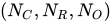
Let , and be (respectively) sets of concept names (also known as atomic concepts), role names and individual names (also known as individuals, nominals or objects). Then the ordered triple (, , ) is the signature.

Concepts
[edit]

The set of concepts is the smallest set such that:

  • The following are concepts:
    • (top is a concept)
    • (bottom is a concept)
    • Every (all atomic concepts are concepts)
  • If and are concepts and then the following are concepts:
    • (the intersection of two concepts is a concept)
    • (the union of two concepts is a concept)
    • (the complement of a concept is a concept)
    • (the universal restriction of a concept by a role is a concept)
    • (the existential restriction of a concept by a role is a concept)
Terminological axioms
[edit]

A general concept inclusion (GCI) has the form where and are concepts. Write when and . A TBox is any finite set of GCIs.

Assertional axioms
[edit]

  • A concept assertion is a statement of the form where and C is a concept.
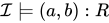
  • A role assertion is a statement of the form where and R is a role.

An ABox is a finite set of assertional axioms.

Knowledge base
[edit]

A knowledge base (KB) is an ordered pair for TBox and ABox .

Semantics

[edit]

The semantics of description logics are defined by interpreting concepts as sets of individuals and roles as sets of ordered pairs of individuals. Those individuals are typically assumed from a given domain. The semantics of non-atomic concepts and roles is then defined in terms of atomic concepts and roles. This is done by using a recursive definition similar to the syntax.

The description logic ALC

[edit]

The following definitions follow the treatment in Baader et al.[8]

A terminological interpretation over a signature consists of
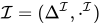
  • a non-empty set called the domain
  • a interpretation function that maps:
    • every individual to an element
    • every concept to a subset of
    • every role name to a subset of

such that

  • (union means disjunction)
  • (intersection means conjunction)
  • (complement means negation)

Define (read in I holds) as follows

TBox
[edit]
  • if and only if
  • if and only if for every
ABox
[edit]
  • if and only if
  • if and only if
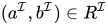
  • if and only if for every
Knowledge base
[edit]

Let be a knowledge base.

  • if and only if and

Inference

[edit]

Decision problems

[edit]

In addition to the ability to describe concepts formally, one also would like to employ the description of a set of concepts to ask questions about the concepts and instances described. The most common decision problems are basic database-query-like questions like instance checking (is a particular instance (member of an ABox) a member of a given concept) and relation checking (does a relation/role hold between two instances, in other words does a have property b), and the more global-database-questions like subsumption (is a concept a subset of another concept), and concept consistency (is there no contradiction among the definitions or chain of definitions). The more operators one includes in a logic and the more complicated the TBox (having cycles, allowing non-atomic concepts to include each other), usually the higher the computational complexity is for each of these problems (see Description Logic Complexity Navigator for examples).

Relationship with other logics

[edit]

First-order logic

[edit]

Many DLs are decidable fragments of first-order logic (FOL)[8] and are usually fragments of two-variable logic or guarded logic. In addition, some DLs have features that are not covered in FOL; this includes concrete domains (such as integer or strings, which can be used as ranges for roles such as hasAge or hasName) or an operator on roles for the transitive closure of that role.[8]

Fuzzy description logic

[edit]

Fuzzy description logics combines fuzzy logic with DLs. Since many concepts that are needed for intelligent systems lack well defined boundaries, or precisely defined criteria of membership, fuzzy logic is needed to deal with notions of vagueness and imprecision. This offers a motivation for a generalization of description logic towards dealing with imprecise and vague concepts.

[edit]

Description logic is related to—but developed independently of—modal logic (ML).[8] Many—but not all—DLs are syntactic variants of ML.[8]

In general, an object corresponds to a possible world, a concept corresponds to a modal proposition, and a role-bounded quantifier to a modal operator with that role as its accessibility relation.

Operations on roles (such as composition, inversion, etc.) correspond to the modal operations used in dynamic logic.[20]

Examples

[edit]
Syntactic variants
DL ML
K[8]
PDL[20]
DPDL (deterministic PDL)[20]
Converse-PDL[20]
Converse-DPDL (deterministic PDL)[20]

Temporal description logic

[edit]

Temporal description logic represents—and allows reasoning about—time dependent concepts and many different approaches to this problem exist.[21] For example, a description logic might be combined with a modal temporal logic such as linear temporal logic.

See also

[edit]

References

[edit]

Further reading

[edit]
[edit]
Revisions and contributorsEdit on WikipediaRead on Wikipedia
from Grokipedia
Description logics (DLs) are a of decidable representation formalisms descended from structured formalisms like semantic networks and , designed to model the relevant of an (its ) and assert properties about individuals in that domain using a restricted set of constructors. These languages emphasize concept descriptions (unary predicates denoting sets of individuals) and role descriptions (binary predicates denoting relationships between individuals), enabling over knowledge bases while balancing expressiveness and computational tractability. DLs provide model-theoretic semantics in the style of Tarski, interpreting as subsets of a domain and roles as binary relations, which supports key inference services like subsumption (determining if one concept is more specific than another) and (checking if a concept can have instances). The origins of DLs trace back to the late 1970s as a response to the logical ambiguities in early network-based systems such as semantic networks (introduced by Quillian in 1967) and (formalized by Minsky in 1975), which lacked precise semantics for inheritance and default reasoning. The term "description logics" emerged in the 1980s to highlight their focus on descriptive power and logical decidability, building on "terminological logics" and "concept languages"; a pivotal realization was the KL-ONE system in 1985, which introduced structured inheritance networks to mitigate these issues. Subsequent developments addressed the expressiveness-complexity tradeoff, with early systems like KL-ONE proving undecidable for full generality, leading to restricted sublanguages such as the AL family (attributive language with intersection, value restrictions, and limited ) and extensions like ALC (adding complement and full existential restrictions). By the 1990s, DLs had evolved into practical systems like (1991) and FACT (1998), incorporating tableau-based decision procedures for efficient reasoning. In terms of structure, a DL knowledge base comprises a TBox (terminological box) for defining concepts and roles via axioms like inclusions (e.g., ∩ ∃hasChild. ) and a ABox (assertion box) for stating facts about individuals (e.g., john: Male ∩ ∃hasChild. Female). Common constructors include conjunction (⊓), disjunction (⊔), negation (¬), universal restriction (∀R. C), existential restriction (∃R. C), and qualified number restrictions (e.g., (=1 hasChild. Female) for exactly one daughter). DLs underpin modern ontology languages, notably the (OWL), which draws from SHOIN(D) (a DL with ALC extended by transitive roles, nominals, inverse roles, and datatypes), facilitating applications in areas like information integration, medical terminologies (e.g., GALEN), and configuration tasks. Their tight integration of theory and practice has made DLs a of knowledge representation, with ongoing research exploring extensions for tractable reasoning in large-scale ontologies.

Introduction and Overview

Definition and Core Concepts

Description logics (DLs) are a family of knowledge representation formalisms that serve as decidable fragments of , specifically designed to model knowledge about individuals, classes, and relationships in a structured manner. These formalisms enable the explicit representation of domain concepts and the inference of implicit knowledge through tasks, such as subsumption (determining whether one concept is a subclass of another) and consistency checking (verifying whether a contains contradictions). The core purpose of DLs is to provide a logical foundation for capturing terminological in a way that supports efficient computational , making them particularly suitable for applications requiring automated deduction over complex hierarchies. In ontology , DLs play a pivotal by allowing the formal definition of ontologies—structured vocabularies that describe domain entities and their interconnections—while ensuring that reasoning remains feasible despite the inherent of representation. A key feature of DLs is their use of concept descriptions, which are constructed inductively from atomic concepts (basic unary predicates denoting classes, such as ""), roles (binary predicates representing relationships, such as "hasChild"), and a set of logical constructors including (conjoining multiple concepts), union (disjoining concepts), (complement of a concept), existential quantification (requiring at least one related individual satisfying a concept), and universal quantification (requiring all related individuals to satisfy a concept). This construction mechanism strikes a balance between expressive power, which allows for rich modeling of real-world domains, and computational tractability, as DLs are typically designed to ensure decidability and manageable reasoning complexity, often in complexity classes like or .

Applications and Use Cases

Description logics (DLs) form the foundational formalism for development in the , particularly through the (OWL) DL, which is based on the SHOIN description logic and enables the formal representation of using class descriptions, roles, and axioms. This application supports the creation of machine-readable ontologies that integrate heterogeneous data sources, facilitating over web-scale knowledge bases. For instance, OWL DL allows for the definition of complex concepts like "Person ⊓ ∃worksFor." to model real-world entities and relationships in distributed systems. In medical informatics, DLs underpin large-scale terminologies such as , which uses a description logic subset to represent clinical concepts, attributes, and hierarchies for electronic health records. This enables automated classification of medical terms, ensuring consistent encoding of diagnoses, procedures, and findings across healthcare systems. DL reasoning in supports subsumption hierarchies, where concepts like "" are inferred as subtypes of "Infectious disease," aiding in clinical decision support and between medical databases. Description logics have been applied in (NLP) to encode syntactic, semantic, and pragmatic knowledge in large knowledge bases, supporting tasks such as semantic interpretation and text generation. Systems like KL-ONE use DLs to derive logical forms from parsed sentences, integrating with domain ontologies for context-aware analysis. This approach facilitates the representation of nuanced meanings, such as disambiguating polysemous words through role restrictions and concept intersections, enhancing machine understanding of human language in dialogue systems. In , DLs enable automated classification and matchmaking by modeling product supplies and demands within standardized ontologies, allowing reasoners to identify compatible offers in electronic marketplaces. For example, the Concept Abduction Problem in DLs ranks potential matches by minimality criteria, such as subsumption and concept length, achieving high alignment with human judgments in prototype systems processing real-world advertisements. This supports dynamic categorization of items, like inferring "Laptop computer" as a suitable match for a "Portable computing device" query, streamlining processes. Legal knowledge bases leverage DLs for representing normative structures, with extensions like intuitionistic description logic accommodating and modal operators for obligations and permissions. This formalism models legal concepts, such as "Contract ⊓ ∃governedBy.Law," enabling inference over case laws and statutes in expert systems for compliance checking and . DL-based legal ontologies promote precise querying of regulatory knowledge, supporting automated analysis in domains like . In bioinformatics, the (GO) employs , grounded in DLs, to annotate functions across species, providing a structured vocabulary for processes, components, and functions. This application facilitates knowledge discovery by inferring relationships, such as linking a to "Apoptosis" via subclass axioms, and supports cross-species comparisons through over 9 million annotations. DL reasoning in GO enables enrichment analysis, identifying biologically significant patterns in genomic datasets. Key benefits of DLs include enhanced by standardizing representation in formats like and RDF, allowing seamless integration of disparate data sources in distributed environments. They also support efficient query answering through conjunctive queries and ABox reasoning, retrieving relevant instances from large bases with decidable . Furthermore, DLs drive discovery via automated inference, uncovering implicit relationships and patterns that inform decision-making in ontology-driven applications. DLs enable instance retrieval in databases by querying individuals satisfying concept descriptions, as demonstrated in benchmarks like the , where queries such as retrieving students advised by faculty teaching specific courses scale efficiently using optimized reasoners. In expert systems, DLs perform consistency checking to validate knowledge bases, ensuring no contradictions arise from asserted facts and axioms, such as detecting incompatible role assertions in TBox-ABox models. These capabilities underpin reliable in domains requiring precise data validation and retrieval.

Nomenclature and Terminology

Basic Concepts and Symbols

Description logics (DLs) employ a precise to represent about classes, relationships, and instances, distinguishing between different syntactic categories to facilitate structured reasoning. This vocabulary includes atomic concepts, atomic roles, and individuals, forming the building blocks from which more complex expressions are constructed. DLs are two-sorted logics, separating concepts—which describe sets of individuals—from individuals themselves, which denote specific entities. Atomic concepts, denoted by symbols such as CC or DD, serve as unary predicates that represent basic classes or categories of individuals, such as Person or Female. Atomic roles, denoted by RR or SS, function as binary predicates to express relationships between individuals, for example, hasChild or parentOf. Individuals, represented by constants like aa or bb (e.g., peter or mary), are used in the assertional component of DLs (the ABox) to refer to specific entities. Complex concepts are formed from atomic concepts using dedicated constructors. The top concept \top denotes the universal class containing all individuals, while the bottom concept \bot represents the empty class. Negation applied to a concept CC yields ¬C\neg C, the complement of CC. Conjunction combines concepts via CDC \sqcap D, and disjunction via CDC \sqcup D. Role constructors enable the building of complex relationships from atomic roles. The inverse of a role RR is denoted RR^{-}, reversing the direction of the relation, and composition RSR \circ S links roles such that it connects an through RR to an intermediate and then through SS to another. These basic elements underpin description logics, which provide the logical foundation for languages like .

Comparison to First-Order Logic and OWL

Description logics (DLs) can be viewed as a syntactic variant of (FOL) that restricts the language to unary predicates, known as concepts, which denote sets of individuals, and binary predicates, known as roles, which denote binary relations between individuals. This limitation excludes n-ary predicates (with greater than two) and function symbols, which are permitted in full FOL and contribute to its undecidability for problems like . By design, DLs form decidable fragments of FOL, enabling tasks such as concept and subsumption to be computationally tractable, often in exponential time for expressive DLs like SHOIN. A key correspondence between DLs and FOL lies in their translation: DL concepts map to FOL formulas with a single free variable, representing the individuals satisfying the concept description, while roles directly correspond to binary predicates. For instance, a DL concept like ∃R.C (there exists an R-successor that is a C) translates to an FOL formula ∃y (R(x,y) ∧ C(y)) with x as the free variable. This embedding preserves the semantics while restricting expressiveness to ensure decidability, avoiding the full power of FOL quantifiers over multiple variables or complex nesting that could lead to undecidable reasoning. In relation to the Web Ontology Language (OWL), the OWL DL profile corresponds precisely to the expressive DL SHOIN(D), incorporating features like transitive roles (S), role hierarchies (H), inverse roles (I), nominals (O, via individuals in class expressions), and datatypes (D). This alignment allows OWL DL ontologies to be reasoned over using DL-based tools, maintaining decidability for key inference tasks. In contrast, OWL Full extends beyond this by permitting unrestricted use of RDF and RDFS constructs, rendering it more expressive but undecidable, as it no longer adheres to the syntactic restrictions of SHOIN(D). Key differences include OWL's explicit support for datatypes in restrictions and nominals for enumerating individuals, which enhance DL expressiveness for real-world applications like the without introducing undecidability in the DL profile.

Naming Conventions and Examples

Description logics employ a systematic to denote variants based on their expressive constructors, with ALC serving as the foundational logic, standing for Attributivesprache with Komplement (Attributive Language with Complements). This base ALC incorporates full negation (complements), conjunction, , and . Extensions to ALC are indicated by appending letters representing additional features, such as H for role hierarchies, O for nominals (concepts denoting single individuals), I for inverse roles, N for unqualified number restrictions (e.g., at least or at most n successors along a ), and Q for qualified number restrictions (specifying the filler concept in number restrictions). Combined names are formed by sequencing these letters after the base, often starting from AL (Attributive Language, which includes atomic negation but lacks full complements or negation of complex concepts) or ALC, to specify the full set of constructors; for instance, SHOIN denotes ALC extended with transitive roles (S, sometimes conflated with H in early notations but distinct as role transitivity), role hierarchies (H), nominals (O), inverse roles (I), and number restrictions (N). Similarly, SROIQ represents ALC with transitive roles (S), role inclusions and complex axioms (R), nominals (O), inverse roles (I), and qualified number restrictions (Q), forming the basis for OWL 2 DL when extended with datatypes as SROIQ(D). Exceptions to this convention exist for certain lightweight or historically motivated logics; for example, EL is a non-standard name for a fragment restricted to existential restrictions, conjunction, and the top concept, prioritizing tractable reasoning over full expressivity. Historical variants include early terminological languages like FL₀ (feature logic without or quantification) and FL⁻ (without ), which predate the ALC scheme and influenced its development.

Historical Development

Origins in Knowledge Representation

Description logics trace their roots to the 1970s efforts in knowledge representation, particularly through semantic networks and frame-based systems, which aimed to model conceptual structures and hierarchies in . Semantic networks, pioneered by Quillian in the late and expanded in the , represented as graphs of nodes and labeled links to capture relationships between , but suffered from ambiguous semantics and inheritance anomalies. Frame systems, introduced by Minsky around 1975, extended this by organizing into structured slots for attributes and defaults, facilitating procedural attachments for reasoning; however, these approaches often lacked formal logical foundations, leading to inconsistencies in complex inferences. The first system resembling modern description logics emerged in the late 1970s with KL-ONE, developed by Brachman and later refined with Schmolze, marking a pivotal step toward formalizing terminological knowledge representation. KL-ONE, operationalized by 1985, introduced structured with roles, restrictions, and subsumption-based , addressing the semantic ambiguities of prior network and frame models while supporting taxonomic reasoning. This system shifted focus from purely procedural mechanisms to declarative specifications of definitions and hierarchies, enabling automatic of new terms. In the , key developments included the formal introduction of terminological logics, often termed TBoxes, which provided a declarative layer for defining general inclusions and equivalences separate from assertional knowledge. Systems like (1983) built on KL-ONE by incorporating Tarskian semantics for terminological cycles and hybrid reasoning, while works by Levesque and Brachman analyzed the expressiveness limits of these logics, demonstrating that adding features like or disjunction could render subsumption intractable (e.g., coNP-hard for basic FL). Levesque's contributions emphasized trade-offs between representational power and computational tractability, advocating for restricted languages to ensure polynomial-time reasoning in practical systems. The 1990s brought advancements in automated reasoning through tableaux algorithms, which enabled sound and complete decision procedures for more expressive description logics. Early tableaux methods, such as those by Schmidt-Schauß and Smolka (1991) for ALC, proved PSpace-completeness for concept satisfiability and supported integration with theorem proving techniques. Baader and Hanschke's 1991 work extended subsumption algorithms to handle concrete domains, allowing numerical and temporal constraints while preserving decidability in restricted cases. This era also reflected a broader shift in knowledge representation from procedural, implementation-dependent encodings—common in 1970s —to declarative formalisms grounded in , facilitating verifiable inferences and modular knowledge bases.

Adoption in Semantic Web and Beyond

The adoption of description logics gained significant momentum in the early 2000s through their integration into the standards, particularly via the (OWL). The precursor DAML+OIL (March 2001), which was submitted to the W3C in December 2001, extended earlier RDF-based languages with description logic-inspired constructs for richer semantic expressivity, laying the groundwork for standardized ontology representation. This culminated in the W3C's OWL Recommendation on February 10, 2004, where OWL DL was explicitly based on the SHOIN(D) description logic, enabling decidable reasoning over web-scale ontologies while restricting syntax to ensure computational tractability. Post-2000 developments further expanded description logics' role in the Semantic Web. The OWL 2 specification, published by the W3C on October 27, 2009, extended OWL DL to the more expressive SROIQ(D) description logic, incorporating features like qualified cardinality restrictions and property chains to support complex real-world modeling. These advancements facilitated applications in linked data initiatives, where description logic-based ontologies enable automated inference across distributed RDF datasets, enhancing data integration and discovery on the web. In artificial intelligence, description logics underpin knowledge representation systems for tasks such as semantic search and automated reasoning, with OWL serving as a bridge between formal logics and practical AI tools. Beyond the Semantic Web, description logics have diversified into other domains. In databases, the DL-Lite family of lightweight description logics, introduced in , supports efficient conjunctive query answering by reducing reasoning to standard operations, making it suitable for ontology-based data access in large-scale information systems. Applications in cybersecurity leverage description logics for modeling network vulnerabilities and policies, allowing formal analysis of threats through terminological reasoning. In , description logics facilitate task planning and by representing dynamic environments and actions in ontologies, enabling robots to infer and adapt to complex scenarios. Key milestones marked this period of growth. The Description Logic Handbook: Theory, , and Applications, edited by Franz Baader et al. and published in 2003 (with a 2004 reprint), provided a comprehensive reference that spurred and efforts across academia and industry. Concurrently, the proliferation of open-source reasoners—such as Pellet (2004), FaCT++ (2006), and (2008)—demonstrated the scalability of description logic inference, with ongoing developments ensuring compatibility with OWL standards and fostering widespread adoption in tools like Protégé.

Modeling Aspects

TBox and ABox Distinction

In description logics, the terminological box (TBox) consists of axioms that define general knowledge about and in the domain. These axioms include concept inclusions of the form CDC \sqsubseteq D, where concept CC is subsumed by concept DD, and role inclusions of the form RSR \sqsubseteq S, where role RR is subsumed by role SS. Additionally, the TBox may contain concept equalities CDC \equiv D and role equalities RSR \equiv S, which express that two concepts or roles are equivalent. Such axioms are typically expressed as implications over concepts, forming a reusable for the knowledge representation. The assertional box (ABox), in contrast, comprises assertions about specific individuals in the domain. These include concept assertions of the form a:Ca : C, indicating that individual aa belongs to concept CC, and role assertions of the form R(a,b)R(a, b), indicating that role RR relates individuals aa and bb. The ABox thus captures instance-level facts particular to the application data. The distinction between the TBox and ABox lies in their respective roles: the TBox provides intensional knowledge at the schema level, which is general and reusable across instances, while the ABox provides extensional knowledge at the instance level, which is data-specific and contingent on particular individuals. A description logic is formally structured as the union KB=TBoxABox\mathrm{KB} = \mathrm{TBox} \cup \mathrm{ABox}, integrating these components to represent both general and specific domain information. For simplicity, the TBox is often assumed to be acyclic, ensuring that concept definitions do not form cycles.

Motivations for the Separation

The separation of the TBox and ABox in description logics promotes modularity by isolating the schema-level definitions of concepts and roles in the TBox from the instance-level assertions in the ABox, allowing domain modelers to develop and maintain general knowledge structures independently of evolving specific data. This design facilitates flexible system architectures where multiple knowledge engineers can collaborate on terminological components without interfering with assertional updates. Reusability is a key advantage of this split, as TBox axioms defining general properties—such as ParentMotherFather\textit{Parent} \sqsubseteq \textit{Mother} \sqcup \textit{Father}—can be shared and applied across diverse ABoxes or applications, enabling consistent modeling without redundant specification of domain rules. In contrast, the ABox focuses on populating these reusable definitions with concrete individuals, supporting scalable construction in varied contexts like ontologies or databases. The division enhances reasoning efficiency by permitting targeted computations: subsumption and classification on the TBox can be precomputed independently, often yielding faster results than integrated inference, while ABox tasks like instance checking or realization leverage these precomputations to avoid redundant evaluations of general axioms. This separation optimizes overall performance in expressive description logics, where full knowledge base satisfiability would otherwise incur higher complexity. Historically, the TBox-ABox distinction emerged to resolve ambiguities in early knowledge representation systems, particularly by formalizing the separation between generic frames (general concepts) and specific instances in KL-ONE, which aimed for clearer, more application-independent representations of structured inheritance.

Formal Syntax and Semantics

Syntactic Elements

Description logics (DLs) are defined by a formal that specifies how to construct complex concepts and roles from atomic building blocks using a set of constructors. The is typically presented inductively, ensuring that expressions are built bottom-up from simpler to more complex forms. This structure allows for precise knowledge representation while maintaining decidability in many cases through restrictions on nesting and quantification. Atomic concepts, denoted by symbols such as AA or BB, represent basic unary predicates or classes in the domain. Similarly, atomic roles, denoted by RR or SS, are binary predicates describing relationships between individuals. The top \top denotes the universal class containing all individuals, while the bottom \perp denotes the empty class. Complex concepts are formed using the following constructors: ¬C\neg C, where CC is a ; conjunction CDC \sqcap D; existential restriction R.C\exists R.C, which describes individuals related via role RR to at least one member of CC; and universal restriction R.C\forall R.C, which describes individuals related via RR only to members of CC. These constructors enable the expression of complex class descriptions, such as in the ALC description logic, which includes , conjunction, existential restriction, and universal restriction without number restrictions. Disjunction can be derived in ALC as ¬(¬C¬D)\neg(\neg C \sqcap \neg D). Roles can be extended beyond atomic forms in various DLs: the inverse RR^- reverses the direction of the relation; composition RSR \circ S chains two roles; and inclusions RSR \sqsubseteq S specify subsumption between roles, often used in terminologies. However, in basic DLs, roles are primarily atomic, with extensions adding these operators for greater expressivity. The assertional component, known as the ABox, consists of assertions about : concept assertions C(a)C(a), stating that individual aa belongs to CC, and role assertions R(a,b)R(a, b), stating that role RR holds between individuals aa and bb. Individuals are denoted by constants like aa or bb. In general, DL syntax enforces bottom-up construction, where each complex expression is defined in terms of previously constructed simpler ones. To ensure decidability, many DLs impose restrictions, such as limiting nesting of quantifiers or prohibiting unlimited alternations of existential and universal restrictions. For instance, the ALC description logic exemplifies these rules by including all the listed concept constructors without number restrictions.

Semantic Interpretations

The semantics of description logics are defined model-theoretically in the style of Tarski, where interpretations provide the meaning for and . An interpretation I=(ΔI,I)\mathcal{I} = (\Delta^\mathcal{I}, \cdot^\mathcal{I}) consists of a non-empty domain ΔI\Delta^\mathcal{I}, which represents the set of individuals in the model, and an interpretation function I\cdot^\mathcal{I} that maps each name CC to a CIΔIC^\mathcal{I} \subseteq \Delta^\mathcal{I} and each name RR to a RIΔI×ΔIR^\mathcal{I} \subseteq \Delta^\mathcal{I} \times \Delta^\mathcal{I}. This function extends inductively to complex and roles, ensuring that the semantics capture the intended meanings of logical constructors. The semantics for basic constructors are defined set-theoretically. For intersection, the interpretation of CDC \sqcap D is given by: (CD)I=CIDI.(C \sqcap D)^\mathcal{I} = C^\mathcal{I} \cap D^\mathcal{I}. For existential restriction, the interpretation of R.C\exists R.C is the set of individuals that have at least one RR-successor in CC: (R.C)I={xΔIyΔI:(x,y)RIyCI}.(\exists R.C)^\mathcal{I} = \{ x \in \Delta^\mathcal{I} \mid \exists y \in \Delta^\mathcal{I} : (x, y) \in R^\mathcal{I} \land y \in C^\mathcal{I} \}. These definitions extend to other constructors in a similar manner, preserving the subset relationships that underlie subsumption. A TBox axiom CDC \sqsubseteq D is satisfied by an interpretation I\mathcal{I} if and only if CIDIC^\mathcal{I} \subseteq D^\mathcal{I}, meaning every individual in CC is also in DD. For the ABox, an assertion C(a)C(a) is satisfied if the interpretation of the individual name aa, denoted aIΔIa^\mathcal{I} \in \Delta^\mathcal{I}, belongs to CIC^\mathcal{I}, i.e., aICIa^\mathcal{I} \in C^\mathcal{I}; similarly, a role assertion R(a,b)R(a, b) holds if (aI,bI)RI(a^\mathcal{I}, b^\mathcal{I}) \in R^\mathcal{I}. A knowledge base consisting of a TBox and ABox is consistent if there exists at least one interpretation that satisfies all its axioms simultaneously. These satisfaction conditions embody the open-world assumption, where absence of information does not imply negation. Description logics exhibit monotonicity in their semantics when restricted to negation-free terminologies, where adding axioms cannot invalidate previously entailed subsumptions, leading to least and greatest fixpoint models for cyclic definitions. For reasoning about finite models, Herbrand interpretations are employed, where the domain is restricted to the finite Herbrand universe generated from the constants in the ABox, facilitating decidability checks for finite in expressive fragments. In the ALC description logic, these semantics align directly with the above definitions for its constructors.

Example: The ALC Description Logic

The ALC (Attributive Language with Complements) description logic serves as a foundational fragment of description logics, featuring a balance of expressive power and decidable reasoning. It includes constructors for , conjunction, existential and over roles, allowing the representation of complex conceptual knowledge while deriving disjunction implicitly through . ALC concepts are inductively defined starting from atomic concepts (e.g., , ), the top concept \top (interpreted as the universal set), and the bottom concept \bot (interpreted as the ). Complex ALC concepts are formed using the following constructors: negation ¬C\neg C for a concept CC; conjunction CDC \sqcap D; existential restriction R.C\exists R.C where RR is an atomic role; and universal restriction R.C\forall R.C. Disjunction CDC \sqcup D is not primitive but can be expressed as ¬(¬C¬D)\neg (\neg C \sqcap \neg D). Roles in ALC are simple atomic binary relations, without transitive or inverse features. The semantics of ALC follow a Tarski-style model-theoretic approach, where an interpretation I=(ΔI,I)\mathcal{I} = (\Delta^\mathcal{I}, \cdot^\mathcal{I}) consists of a non-empty domain ΔI\Delta^\mathcal{I} and an interpretation function I\cdot^\mathcal{I} that maps atomic concepts AA to subsets AIΔIA^\mathcal{I} \subseteq \Delta^\mathcal{I} and atomic roles RR to binary relations RIΔI×ΔIR^\mathcal{I} \subseteq \Delta^\mathcal{I} \times \Delta^\mathcal{I}. The semantics for constructors are defined as follows: I=ΔI,I=,(¬C)I=ΔICI,(CD)I=CIDI,(R.C)I={dΔIeΔI:(d,e)RIeCI},(R.C)I={dΔIeΔI:(d,e)RIeCI}.\begin{align*} \top^\mathcal{I} &= \Delta^\mathcal{I}, \\ \bot^\mathcal{I} &= \emptyset, \\ (\neg C)^\mathcal{I} &= \Delta^\mathcal{I} \setminus C^\mathcal{I}, \\ (C \sqcap D)^\mathcal{I} &= C^\mathcal{I} \cap D^\mathcal{I}, \\ (\exists R.C)^\mathcal{I} &= \{ d \in \Delta^\mathcal{I} \mid \exists e \in \Delta^\mathcal{I} : (d, e) \in R^\mathcal{I} \land e \in C^\mathcal{I} \}, \\ (\forall R.C)^\mathcal{I} &= \{ d \in \Delta^\mathcal{I} \mid \forall e \in \Delta^\mathcal{I} : (d, e) \in R^\mathcal{I} \to e \in C^\mathcal{I} \}. \end{align*} An ALC TBox consists of general concept inclusions (GCIs) of the form CDC \sqsubseteq D, satisfied by I\mathcal{I} if CIDIC^\mathcal{I} \subseteq D^\mathcal{I}. An ABox includes concept assertions a:Ca : C (satisfied if aICIa^\mathcal{I} \in C^\mathcal{I}) and role assertions (a,b):R(a, b) : R (satisfied if (aI,bI)RI(a^\mathcal{I}, b^\mathcal{I}) \in R^\mathcal{I}), where individuals a,ba, b are mapped by I\cdot^\mathcal{I} to elements of ΔI\Delta^\mathcal{I}. A knowledge base K=(T,A)\mathcal{K} = (\mathcal{T}, \mathcal{A}) is satisfied by I\mathcal{I} if I\mathcal{I} satisfies all axioms in T\mathcal{T} and A\mathcal{A}. For illustration, consider the TBox axiom Mother \sqsubseteq Woman \sqcap \existshasChild.Person, which states that every mother is a woman who has at least one child that is a person. An example ABox might assert mary : Mother and (mary, john) : hasChild, indicating that Mary is a mother and John is her child. In any model I\mathcal{I} satisfying this knowledge base, maryImary^\mathcal{I} \in WomanI^\mathcal{I} and there exists johnIjohn^\mathcal{I} \in PersonI^\mathcal{I} such that (maryI,johnI)(mary^\mathcal{I}, john^\mathcal{I}) \in hasChildI^\mathcal{I}. Subsumption Mother \sqsubseteq Woman holds if every model of the TBox has MotherI^\mathcal{I} \subseteq WomanI^\mathcal{I}.

Inference and Reasoning

Core Decision Problems

In description logics, the core decision problems focus on fundamental reasoning tasks that verify semantic relationships and properties within terminological (TBox) and assertional (ABox) components of a (KB), ensuring the coherence and utility of represented knowledge. These problems are defined in terms of interpretations, or models, which assign meanings to concepts as subsets of a domain and roles as binary relations over that domain. The primary tasks include checking subsumption between concepts, ensuring the consistency of a KB, verifying instance membership, and realizing concepts through individual retrieval, with extensions to roles and queries in more expressive logics. Concept subsumption determines whether one concept is more specific than another with respect to a TBox. Formally, a concept CC is subsumed by a concept DD (denoted CDC \sqsubseteq D) with respect to a TBox T\mathcal{T} if, for every model I\mathcal{I} of T\mathcal{T}, the interpretation satisfies CIDIC^{\mathcal{I}} \subseteq D^{\mathcal{I}}. This inference is central to , as it establishes hierarchical relationships among concepts, such as inferring that all instances of "" are also "" based on definitional axioms in the TBox. Knowledge base consistency assesses whether a full KB, comprising a TBox T\mathcal{T} and an ABox A\mathcal{A}, admits at least one model. A KB is consistent if there exists an interpretation I\mathcal{I} that satisfies both T\mathcal{T} and A\mathcal{A}; otherwise, it is unsatisfiable, indicating contradictory assertions or definitions. This problem encompasses concept satisfiability as a special case: a concept CC is satisfiable with respect to T\mathcal{T} if there is a model I\mathcal{I} of T\mathcal{T} such that CIC^{\mathcal{I}} \neq \emptyset. Consistency checks are essential for validating ontologies, detecting errors like asserting an individual to both a concept and its negation. Instance checking verifies whether a specific belongs to a given relative to a KB. Given an aa and CC, the assertion a:Ca : C holds with respect to KB = TA\mathcal{T} \cup \mathcal{A} if every model I\mathcal{I} of the KB satisfies aICIa^{\mathcal{I}} \in C^{\mathcal{I}}. This task supports querying knowledge bases to confirm properties of named entities, such as determining if a particular "vehicle" instance qualifies as an "automobile" under the ontology's definitions. Realization involves identifying all individuals in an ABox that satisfy a given concept, effectively retrieving instances that match the concept's . For a concept CC and ABox A\mathcal{A}, realization finds all individuals aa such that AC(a)\mathcal{A} \models C(a), meaning aa is an instance of CC in every model of A\mathcal{A}. This inference is crucial for applications like database querying in semantic systems, where one seeks all entities fulfilling a complex , such as "all cities connected by rail to ports." Other decision problems extend these notions to roles and queries. Role subsumption checks if one role is a subrelation of another with respect to a TBox, i.e., RSR \sqsubseteq S if RISIR^{\mathcal{I}} \subseteq S^{\mathcal{I}} for all models I\mathcal{I} of the TBox, enabling inferences about relational hierarchies like "parentOf \sqsubseteq ancestorOf." In extensions supporting conjunctive queries, query containment determines if the answers to one query are always a of another's under the KB constraints, a problem that arises in advanced reasoning for data integration and optimization.

Computational Complexity

The of reasoning tasks in description logics (DLs) varies significantly depending on the expressiveness of the logic, with key problems like subsumption and ABox consistency exhibiting tight bounds for many fragments. In the basic DL ALC, subsumption with respect to general TBoxes is EXPTIME-complete, as established through automata-based decision procedures that simulate exponential space usage for nondeterministic . Similarly, ABox consistency in ALC is EXPTIME-complete, matching the of TBox subsumption due to that embed ABox assertions into concept inclusions. In contrast, the lightweight DL EL achieves greater tractability, with subsumption decidable in polynomial time even for general TBoxes, making it suitable for large-scale ontologies where efficiency is paramount. This polynomial-time bound arises from completion-based algorithms that propagate existential restrictions in a deterministic manner without exponential blowup. EL's design thus prioritizes practical reasoning over full expressivity, enabling implementations that scale to ontologies with thousands of axioms. More expressive DLs, such as SHOIN—the logical underpinning of OWL DL—exhibit higher due to features like nominals and inverse roles. Reasoning in SHOIN is NEXPTIME-complete for subsumption and related tasks with general TBoxes, reflecting the need for doubly exponential space in worst-case tableau expansions triggered by nominals that force enumeration of exponential models. The inclusion of datatypes in SHOIN(D) maintains this NEXPTIME bound in standard cases, but extensions with complex datatype expressions or qualified number restrictions can elevate complexity to 2-EXPTIME-complete by introducing additional nondeterminism in checks. Qualified number restrictions in DLs like ALCQ introduce nondeterminism through branching in proof search, but preserve EXPTIME-completeness in the absence of inverses or nominals; however, combining them with such features amplifies the complexity as seen in SHOIN. Unrestricted use of quantifiers or full embedding of constructs renders DL reasoning undecidable, as these allow simulation of Turing machines or reduction to the .

Extensions and Relationships

Relation to First-Order Logic

Description logics (DLs) are decidable fragments of (FOL), where atomic concepts correspond to unary predicates and atomic roles to binary predicates, enabling a direct syntactic and semantic into FOL. The maps a DL concept CC to an FOL formula ϕC(x)\phi_C(x) with a single free variable xx, preserving the semantics in FOL interpretations. For instance, an atomic concept AA translates to A(x)A(x); the conjunction CDC \sqcap D to ϕC(x)ϕD(x)\phi_C(x) \land \phi_D(x); the existential restriction R.C\exists R.C to y(R(x,y)ϕC(y))\exists y \, (R(x,y) \land \phi_C(y)); and the universal restriction R.C\forall R.C to y(R(x,y)ϕC(y))\forall y \, (R(x,y) \to \phi_C(y)). This recursive extends to complex concepts, ensuring that the satisfaction of ϕC(a)\phi_C(a) in an FOL model corresponds to the interpretation of CC containing the individual aa in the DL model. A TBox in DL, consisting of general concept inclusions (GCIs) like CDC \sqsubseteq D or equivalences CDC \equiv D, translates to universal FOL axioms over the concept formulas. Specifically, CDC \sqsubseteq D becomes x(ϕC(x)ϕD(x))\forall x \, (\phi_C(x) \to \phi_D(x)), while CDC \equiv D yields x(ϕC(x)ϕD(x))\forall x \, (\phi_C(x) \leftrightarrow \phi_D(x)). For an example, the TBox axiom MotherWomanhasChild.[Person](/page/Person)Mother \equiv Woman \sqcap \exists hasChild.[Person](/page/Person) translates to x(Mother(x)(Woman(x)y(hasChild(x,y)[Person](/page/Person)(y))))\forall x \, (Mother(x) \leftrightarrow (Woman(x) \land \exists y \, (hasChild(x,y) \land [Person](/page/Person)(y)))). Acyclic TBoxes can be unfolded by substituting definitions, resulting in FOL formulas using only primitive vocabulary, which facilitates reasoning via FOL theorem proving. ABoxes translate similarly, with assertions like C(a)C(a) becoming ϕC(ca)\phi_C(c_a) (where cac_a is a constant for aa) and R(a,b)R(a,b) to R(ca,cb)R(c_a, c_b), conjoined into a single FOL sentence. This embedding reveals key limitations of DLs relative to full FOL: DLs cannot natively express the of roles or complex graph queries, as these require more than two variables or non-local quantification. Specifically, the problem for many DLs, such as ALC, corresponds to that of the two-variable fragment of FOL (\FO2\FO^2), which is decidable but lacks the expressive power for due to its variable restriction. For example, defining "ancestor" as the of "parent" demands quantifying over chains of individuals, exceeding \FO2\FO^2's capabilities and rendering it undefinable in basic DLs without extensions. To address these limitations and relate DLs to more expressive FOL subsets, extensions draw on the guarded fragment of FOL, where quantifiers are relativized to atomic "guards" that ensure locality, capturing features like role composition and union in advanced DLs such as SHIQ\mathcal{SHIQ}. Hybrid logics, incorporating nominals and binders, provide another bridge, embedding expressive DLs into guarded-like fragments while preserving decidability for certain reasoning tasks. These connections highlight how DLs balance expressiveness and tractability within restricted FOL dialects.

Fuzzy and Temporal Variants

Fuzzy description logics extend classical description logics to handle and imprecision by assigning truth values from the interval [0,1] to s and roles, rather than binary true/false assignments. In fuzzy DLs, interpretations are fuzzy sets, where the membership degree of an to a or a pair to a role is a value in [0,1], and logical connectives are interpreted using fuzzy operators such as s for conjunction (e.g., the Łukasiewicz t-norm defined as min(1,x+y1)\min(1, x + y - 1)) and t-conorms for disjunction. This allows representation of imprecise , such as "tall" individuals with varying degrees of tallness, making fuzzy DLs suitable for applications in domains like semantics and alignment where exact boundaries are unclear. A key variant is fuzzy ALC, which incorporates graded inclusions (e.g., assertions like (n:R.C)(a)α( \geq n : R.C )(a) \geq \alpha, meaning at least nn RR-successors of aa belong to CC to degree at least α\alpha) and supports reasoning over fuzzy general concept inclusions. Semantics for fuzzy ALC rely on fuzzy interpretations that extend standard ALC models. Recent research (as of ) has explored further extensions, such as generic concepts and threshold constructors in lightweight DLs like EL, to enhance expressiveness for nuanced modeling while addressing decidability challenges. Temporal description logics integrate temporal operators into DL to model evolving knowledge over linear time structures, such as the natural numbers with successor relation. Common operators include Always (GG) and Eventually (FF), applied to concepts (e.g., G.CG.C for concepts true at all future time points) or roles, yielding expressions like R.G.C\exists R.G.C, which denotes individuals related via RR to something always in CC. These logics are applied in dynamic ontologies for domains like action planning and evolving databases, where concepts change over time. Variants such as temporal ALC with concrete domains extend the logic by incorporating time points from a concrete domain like (R,<)(\mathbb{R}, <), allowing roles to map to temporal values and enabling precise temporal constraints (e.g., events occurring within specific intervals). Semantics interpret temporal DLs over time-labeled models, where interpretations vary across time points. Both fuzzy and temporal variants introduce significant reasoning challenges, with increased ; for instance, under the infinite-valued Łukasiewicz semantics with general concept inclusions, concept satisfiability in fuzzy ALC is undecidable, though it is decidable and EXPTIME-complete under finite approximations or other semantics like Gödel, often requiring specialized fuzzy tableau algorithms. Temporal extensions often escalate to NEXPTIME-complete or undecidable for full expressiveness, necessitating restrictions like rigid roles to maintain tractability.

Connections to Modal Logics

Description logics (DLs) exhibit a close correspondence to multi-modal logics, where atomic roles serve as modalities and existential restrictions translate directly to diamond operators. Specifically, the existential restriction R.C\exists R.C in a DL corresponds to the modal formula RϕC\Diamond_R \phi_C, where ϕC\phi_C represents the DL concept CC as a propositional formula, and universal restrictions R.C\forall R.C map to box operators RϕC\Box_R \phi_C. This translation establishes DLs as a notational variant of propositional multi-modal logics, allowing techniques from modal logic to be applied to DL reasoning tasks. The basic description logic ALC is equivalent to the multi-modal logic , where each corresponds to a distinct modality in a Kripke frame with multiple accessibility relations. When transitive roles are introduced, as in the DL S (or ALC with a transitive ), the correspondence extends to the S4 for that modality, incorporating reflexivity and transitivity axioms (T and 4) due to the transitive closure semantics of the . An example of this correspondence arises in ALC with inverse roles (ALCI), which maps to a multi-modal logic extended with converse modalities; the inverse role RR^- corresponds to the converse operator Rϕ=Rϕ\Diamond_{R^-} \phi = \Diamond_R^* \phi, where ^* denotes the converse. This structure has been applied in epistemic reasoning, where roles model relations between states, enabling DLs to represent multi-agent bases akin to epistemic modal logics. Despite these alignments, DLs and modal logics differ in focus and scope: DLs prioritize terminological descriptions and concept hierarchies for knowledge representation, whereas modal logics emphasize reasoning over possible worlds and accessibility relations. Moreover, DLs form decidable subsets of full modal logics by restricting expressivity, such as avoiding arbitrary nesting of modalities beyond two levels, which ensures tractable inference in many cases.

References

Add your contribution
Related Hubs
User Avatar
No comments yet.