Hubbry Logo
DioptaseDioptaseMain
Open search
Dioptase
Community hub
Dioptase
logo
8 pages, 0 posts
0 subscribers
Be the first to start a discussion here.
Dioptase
Dioptase
from Wikipedia
Dioptase
General
CategoryCyclosilicates
FormulaCu6Si6O18·6H2O
IMA symbolDpt[1]
Strunz classification9.CJ.30
Crystal systemTrigonal
Crystal classRhombohedral (3)
H–M symbol: (3)
Space groupR3 (No. 148)
Unit cella = 14.566, c = 7.778 [Å]; Z = 18
Identification
ColorDark teal, emerald green
Crystal habitSix-sided prisms terminated by rhombohedrons, to massive
CleavagePerfect in three directions
FractureConchoidal
TenacityBrittle
Mohs scale hardness5
LusterVitreous
StreakGreen
DiaphaneityTransparent to translucent
Specific gravity3.28–3.35
Optical propertiesUniaxial (+)
Refractive indexnω = 1.652 – 1.658 nε = 1.704 – 1.710
Birefringenceδ = 0.052
References[2][3]

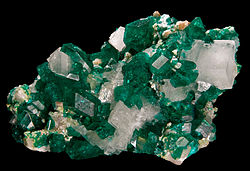
Dioptase is an intense emerald-green to bluish-green mineral that is cyclosilicate of copper. It is transparent to translucent. Its luster is vitreous to sub-adamantine. Its formula is Cu6Si6O18·6H2O, also reported as CuSiO2(OH)2. It has a Mohs hardness of 5, the same as tooth enamel. Its specific gravity is 3.28–3.35, and it has two perfect and one very good cleavage directions. Additionally, dioptase is very fragile, and specimens must be handled with great care. It is a trigonal mineral, forming six-sided crystals that are terminated by rhombohedra.

It is popular with mineral collectors and is sometimes cut into small gems. It can also be pulverized and used as a pigment for painting.

History

[edit]

Dioptase was used to highlight the edges of the eyes on the three Pre-Pottery Neolithic B lime plaster statues discovered at 'Ain Ghazal, known as Micah, Heifa and Noah.[4] These sculptures date back to about 7200 BC.[4]

Late in the 18th century, copper miners at the Altyn-Tyube (Altyn-Tube) mine, Karagandy Province, Kazakhstan[3] thought they had found the emerald deposit of their dreams. They found fantastic cavities in quartz veins in a limestone rock, filled with thousands of lustrous transparent emerald-green crystals. The crystals were dispatched to Moscow, Russia, for analysis. However, the mineral's inferior hardness of 5 compared with emerald's greater hardness of 8 easily distinguished it. Eventually, in 1797, the mineralogist Fr. René Just Haüy determined that the enigmatic Altyn-Tyube mineral was new to science and named it dioptase (Greek, dia, "through" and optos, "visible"), alluding to the internal cleavage planes that can be seen inside unbroken crystals.[5]

Occurrence

[edit]

Dioptase is an uncommon mineral found mostly in desert regions where it forms as a secondary mineral in the oxidized zone of copper sulfide mineral deposits. However, the process of its formation is not simple. The oxidation of copper sulfides should be insufficient to crystallize dioptase, as silica is normally minutely soluble in water except at highly alkaline pH. The oxidation of sulfides will generate highly acidic fluids rich in sulfuric acid that should suppress silica's solubility. However, in dry climates and with enough time, especially in areas of a mineral deposit where acids are buffered by carbonate, minute quantities of silica may react with dissolved copper forming dioptase and chrysocolla.

The Altyn Tube mine in Kazakhstan still provides handsome specimens; a brownish quartzite host distinguishes its specimens from other localities. The finest specimens of all were found at the Tsumeb Mine in Tsumeb, Namibia. Tsumeb dioptase is transparent and often highly sought after by collectors. Dioptase is also found in the deserts of the southwestern US. A notable occurrence is the old Mammoth-Saint Anthony Mine near Mammoth, Arizona where small crystals that make fine micromount specimens are found. In addition, many small, pale-green colored crystals of dioptase have come from the Christmas Mine near Hayden, Arizona. Another classic locality for fine specimens is Renéville, Congo-Brazzaville. Finally, an interesting occurrence is the Malpaso Quarry in and near Agua de Oro Argentina. Here tiny bluish-green dioptase is found on and in quartz. It appears in this case that dioptase is primary and has crystallized with quartz, native copper, and malachite.

Use

[edit]

Dioptase is popular with mineral collectors, and it is occasionally cut into small emerald-like gems. Dioptase and chrysocolla are the only relatively common copper silicate minerals. A dioptase gemstone should never be exposed to ultrasonic cleaning or the fragile gem will shatter. As a ground pigment, dioptase can be used in painting.[6] Dioptase dust is toxic due to its copper content and accidental ingestion can lead to serious health problems.[7]

The most famous (and expensive) dioptase mineral locality is at Tsumeb, Namibia.[8]

Crystal structure and properties

[edit]

Dioptase is a cyclosilicate mineral consisting of Si6O18 rings which are linked together by Jahn–Teller distorted octahedral d9 Cu(II) ions. Each copper ion is coordinated by four cyclosilicate oxygens and two water molecules. Although the copper ions are six-coordinate, they can be viewed as square planar. The copper centers have approximately C4V symmetry. Each Cu(II) shares a square planar edge with another Cu(II) and corners with two more. The copper ions are responsible for the mineral's color and magnetic properties. A broad visible absorption band at 752 nm is observed. Dioptase is anti-ferromagnetic at low temperatures (Néel temperature of 70 K). Above 70 K, it obeys the Curie–Weiss law.[9]

[edit]

See also

[edit]

References

[edit]
Revisions and contributorsEdit on WikipediaRead on Wikipedia
from Grokipedia
Dioptase is a rare, hydrated with the CuSiO₃·H₂O, classified as a cyclosilicate and renowned for its intense emerald-green to bluish-green coloration due to copper content. It typically occurs as small, prismatic or rhombohedral crystals in the oxidized zones of copper deposits, forming through the of primary copper sulfides in arid, alkaline environments. With a Mohs of 5 and specific of 3.28–3.35, dioptase exhibits a vitreous to subadamantine luster and perfect cleavage in three directions, making it brittle and challenging for practical applications beyond ornamentation. First described in 1797 by René Just Haüy and named from the Greek words for "through" and "to see" due to its visible cleavage planes, dioptase was initially discovered in the Altyn-Tyube deposit in , where it was mistaken for emerald by early mineralogists. Notable specimens have since been found in localities such as , ; the ; and various sites in the United States, including and , often associated with minerals like , , and . Although too fragile for widespread jewelry use, dioptase is highly valued in mineral collections for its vibrant hue and has historical applications as a green pigment, evidenced by its use in Neolithic statues from Jordan dating back to around 7200 BCE. Today, fine crystals command premium prices among collectors, underscoring its status as one of the most striking secondary copper minerals.

Etymology and History

Discovery and Early Recognition

Dioptase was first discovered in the late by copper miners working at the Altyn-Tyube deposit in the of , where vibrant emerald-green crystals lined cavities within veins hosted in formations. The miners, struck by the intense color resembling that of true emeralds, collected specimens believing they had uncovered a valuable gem deposit. These samples were promptly sent to for scientific evaluation, arriving amid growing interest in mineralogy during the Enlightenment era. Russian mineralogists initially misidentified the material as a variety of emerald, with French naturalist Jean-Claude de La Métherie describing it in 1793 as a "primitive emerald" based on early analyses. Further examination revealed its distinct composition, leading to confirmation as a new by 1797. In the early 1800s, specimens were transported to , where they captivated leading mineralogists such as René Just Haüy, who conducted detailed crystallographic studies that solidified its recognition in scientific circles. This exchange marked the beginning of broader interest in dioptase as a novel copper silicate.

Naming and Historical Significance

The name dioptase originates from the Greek terms dia, meaning "through," and optos, meaning "visible," a reference to the mineral's transparency that permits observation of its internal cleavage planes. This nomenclature was established by French mineralogist and crystallographer René Just Haüy in 1797, following his examination of specimens from Altyn-Tyube in present-day . Haüy's work, detailed in his 1801 publication Traité de Minéralogie, formalized the mineral's recognition as a distinct species through pioneering crystallographic analysis. Dioptase holds historical significance as one of the earliest scientifically described s, aiding 19th-century advancements in understanding hydrated minerals and their formation in oxidized deposits. Its initial in 1797 marked a key moment in , distinguishing it from emeralds despite superficial similarities in color and luster. Subsequent chemical analyses, including those by French chemist Nicolas-Louis Vauquelin around 1800, initially mistook associated for part of the structure and identified it as a carbonate; later analyses confirmed the composition as the hydrated CuSiO₃·H₂O. In the 19th century, dioptase gained prominence in European mineral collections for its vivid emerald-green hue, earning the moniker "copper emerald" among collectors and gem enthusiasts. Dioptase has been used as a green pigment since Neolithic times, including to highlight the eyes on lime plaster statues from 'Ain Ghazal, Jordan, dating to around 7200 BCE. Culturally, dioptase was frequently mistaken for emerald in Russian folklore, spurring trade along routes from Central Asian deposits through Bukharan merchants to European markets during the late 18th and early 19th centuries.

Physical and Optical Properties

Appearance and Morphology

Dioptase exhibits a striking vivid emerald-green to dark bluish-green coloration that defines its aesthetic appeal among collectors. This intense hue contributes to its nickname as the "emerald of the desert," evoking the vibrancy of true emerald while remaining distinct in form. The mineral displays a vitreous to subadamantine luster, enhancing its gem-like quality, with transparency ranging from fully transparent in clear crystals to translucent in more aggregated specimens. Its crystal habit typically manifests as rhombohedral crystals, often appearing as pseudohexagonal prisms with rhombohedral terminations, influenced by its underlying trigonal symmetry. These prisms are commonly elongated and doubly terminated, forming attractive druses that cover matrix surfaces in clustered, sparkling arrays. Individual crystals are generally small, reaching up to 1 cm in , though exceptional specimens can attain sizes up to 5 cm. Dioptase often appears in association with , , or other copper minerals such as and , where it contrasts vividly against the host rock. In certain deposits, it also occurs as masses, massive aggregates, or earthy varieties, presenting smoother, rounded surfaces rather than distinct .

Hardness, Density, and Mechanical Properties

Dioptase exhibits a Mohs hardness of 5, rendering it relatively soft and comparable to tooth enamel; this brittleness means it can be easily scratched by common tools such as a steel knife. The mineral's tenacity is also brittle, contributing to its susceptibility to breakage during handling or cutting. The specific gravity of dioptase ranges from 3.28 to 3.35, a value attributable to its composition as a hydrated . This can be verified through the standard crystallographic ρ=Z×MV×NA\rho = \frac{Z \times M}{V \times N_A}, where Z=18Z = 18 represents the number of per , M=157.65M = 157.65 g/mol is the of the \ceCuSiO3H2O\ce{CuSiO3 \cdot H2O}, V1430V \approx 1430 ų is the unit cell volume, and NAN_A is Avogadro's number; such calculations yield a theoretical aligning closely with measured values around 3.30 g/cm³. Dioptase displays perfect cleavage on the {1011} planes, which facilitates easy splitting along these directions and often results in rhombohedral fragments. Its fracture is conchoidal to uneven, further emphasizing its fragility in non-cleavage orientations. Dioptase is piezoelectric due to its non-centrosymmetric trigonal (space group ) but is thermally sensitive, undergoing over a broad range starting around 400°C and leading to structural decomposition up to 730°C. It is moderately soluble in acids such as (HCl), dissolving to form a green solution from released ions while leaving a gelatinous silica residue.

Optical Properties

Dioptase is uniaxial positive with refractive indices ω=1.6521.658\omega = 1.652 - 1.658 and ϵ=1.7041.710\epsilon = 1.704 - 1.710, yielding a of approximately 0.052. It may show three or six sectors in basal sections.

Crystal Structure

Unit Cell and Symmetry

Dioptase crystallizes in the trigonal crystal system, described using the hexagonal setting, with space group R3 (No. 146) and 3 (rhombohedral). The unit cell is defined by parameters a = 14.566 , c = 7.778 ; α = β = 90°, γ = 120°; yielding a of approximately 1430 ³. There are Z = 18 units per . The operations include a threefold axis along the c-axis, with no mirror planes or inversion centers, resulting in chiral, enantiomorphic forms. Common crystal faces are indexed as the rhombohedral form {101̄1}, basal pinacoid {0001}, and dipyramid {011̄2}, which contribute to the typical prismatic to rhombohedral habits observed.

Atomic Arrangement and Bonding

Dioptase has the Cu₆[Si₆O₁₈]·6H₂O, representing a hydrated cyclosilicate where the structure is built around cyclic units. The atomic arrangement features puckered trigonal rings composed of six SiO₄ tetrahedra forming [Si₆O₁₈] units, with each silicon atom bonded to four oxygen atoms in a tetrahedral coordination. These six-membered rings are linked laterally and vertically by cations, creating a three-dimensional framework. The atoms occupy sites where they coordinate to four oxygen atoms from the silicate rings in a nearly square-planar , supplemented by two axial molecules to complete distorted octahedral coordination. This connectivity results in channels running parallel to the c-axis, with an aperture diameter of approximately 2.0 . The CuO₆ octahedra exhibit significant elongation along the axial direction due to the Jahn-Teller distortion characteristic of the d⁹ of Cu²⁺. This distortion manifests in bond lengths averaging 1.95–1.98 Å for the four equatorial Cu–O bonds to the silicate oxygens and 2.50–2.65 Å for the axial Cu–O bonds to ligands, stabilizing the coordination environment within the framework. Hydrogen bonding plays a crucial role in stabilizing the , with the molecules forming hydrogen bonds among themselves in an ice-like puckered ring configuration and also to the bridging oxygen atoms of adjacent [Si₆O₁₈] rings. These interactions, with O–H distances of approximately 0.9–1.1 , connect the layers and maintain the overall framework integrity. Upon heating, begins around 100°C and completes near 700°C, leading to the loss of the molecules and subsequent collapse of the channeled into a denser, dehydrated phase. Bond valence analysis of the coordination polyhedra confirms the structural stability, with average Si–O bond valences around 1.0 valence units (v.u.) reflecting the tetrahedral Si⁴⁺ coordination and Si–O distances of 1.600–1.646 . For the copper sites, the equatorial Cu–O bonds contribute higher valences of approximately 0.5 v.u. each, while the longer axial bonds to yield lower values of about 0.2 v.u., yielding a total near 2.0 v.u. for Cu²⁺ and underscoring the role of the distortion in achieving valence balance.

Occurrence and Formation

Geological Environments

Dioptase is predominantly a secondary mineral that forms in the oxidized, zones of deposits via the of primary minerals, such as (CuFeS₂) and (Cu₅FeS₄). This process involves the oxidation of sulfides by descending meteoric waters, which dissolve and transport as Cu²⁺ ions, subsequently precipitating as silicates when silica is available from host rocks or fluids. The formation typically takes place in arid to semi-arid climates, where limited rainfall preserves the delicate crystals by reducing further dissolution or alteration. The geochemical conditions favoring dioptase precipitation include near-surface temperatures below 100°C, solutions with values around 5–8 that are enriched in Cu²⁺ and dissolved silica (SiO₂), often derived from the breakdown of feldspars or other in the host rock. These mildly acidic to neutral waters, buffered by carbonates, facilitate the reaction in open fractures, vugs, or voids within the oxidized cap of the deposit. Dioptase commonly occurs in paragenesis with other copper minerals, including (a related copper ), malachite (Cu₂CO₃(OH)₂), (Cu₃(CO₃)₂(OH)₂), (SiO₂), and (FeO(OH)·nH₂O), often lining cavities or replacing earlier-formed phases. Dioptase exhibits metastable stability under these low-temperature, oxidizing conditions but can alter to more stable copper silicates, such as , upon prolonged exposure to evolving solutions or increased .

Principal Localities

Dioptase, a hydrated silicate mineral, is primarily sourced from oxidized zones of deposits worldwide, with extraction focused on specimen collection rather than industrial production. The type locality for dioptase is the Altyn-Tyube deposit in the Altyn-Tyube area, Bukhar-Zhyrau District, , , where it was first described in the late after miners mistook its emerald-green crystals for the . This site yielded some of the finest historical specimens, featuring well-formed, gemmy crystals up to several centimeters, during mining operations from the 1770s to the early 1900s, though earlier extraction of associated minerals occurred. Today, the deposit is largely exhausted, but classic 19th- and early 20th-century pieces remain highly prized among collectors. In Africa, the Tsumeb Mine in the Oshikoto Region of stands out as one of the premier localities, renowned for producing large, gemmy, deep emerald-green crystals with exceptional luster and transparency, often exceeding 1 cm in size. Mining at Tsumeb, active since the early 20th century, has supplied world-class dioptase specimens, particularly from the mine's oxidized zones, though production has declined since the mine's closure in 1996. The also hosts significant occurrences, notably at the Mashamba West Mine in the Sicomines copper-cobalt project near Mutshatsha, , where deep green, well-terminated crystals on dolomite matrix have been recovered since the late 1970s in small-scale operations, with new specimens continuing to emerge as of 2025. The features notable dioptase from Arizona's copper districts, including the in Greenlee County, which has produced botryoidal and crystalline aggregates in association with selenite and since the late 19th century. Similarly, the historic Bisbee mines in Cochise County yielded specimens during peak in the early , often as drusy coatings on matrix. The Mammoth-St. Anthony Mine near in Pinal County is particularly valued for its matrix pieces, featuring radiating sprays of acicular dioptase crystals up to 1 cm, alongside and , from operations active until 1953. Elsewhere, dioptase occurs in the of , where historical mining in deposits has produced bright green crystals since the , though specimens are less abundant than from primary sites. In , the Municipality in , particularly the Rancho Jacalito area, has yielded gemmy crystals in recent decades from oxidized veins. Overall, dioptase production remains small-scale and geared toward collectors, with no significant commercial due to its limited abundance and fragility; the most exceptional specimens date from the 19th and early 20th centuries, reflecting peak activity in historic districts.

Uses and Applications

Gemological and Ornamental Uses

Dioptase serves a limited role in due to its perfect cleavage and Mohs of 5, which render it prone to scratching and fracture in everyday wear, necessitating protective settings for any jewelry applications. Despite these challenges, its vivid emerald-green hue, derived from content, makes it desirable for rare cabochons or faceted stones, often limited to small sizes under 1-2 carats for faceted gems owing to the scarcity of flawless material. The mineral's ranges from 1.644 to 1.709, with of 0.051-0.053, contributing to noticeable doubling in cut stones that can enhance its appeal in collector pieces. For ornamental purposes, dioptase is occasionally fashioned into beads or intaglios, leveraging its transparency and luster for decorative items rather than high-wear jewelry. In the , Russian jewelers employed dioptase as an affordable emerald substitute in some pieces, capitalizing on its intense color before its distinct properties were fully differentiated from beryl. Historically, dioptase has been used as a green pigment, notably in plaster statues from a settlement near , , dating to around 7200 BCE, where it outlined eyes formed from shells. Treatments are uncommon, but stabilization with may be applied to bolster durability against cleavage-related flaws, while is rarely, if ever, used due to the mineral's sensitivity. Market values for dioptase gems reflect their rarity, with transparent, high-quality faceted stones often exceeding $100 per carat, though prices can reach $500 or more for exceptional specimens. Synthetic production attempts, including early 19th-century efforts by scientists like Edmond Frémy and later microbial methods, have succeeded in laboratory settings but failed to yield viable gem-quality material owing to the complex hydrated copper silicate structure. For identification, dioptase shows weak or no under UV light and is readily distinguished from emerald by its higher and in dilute acids like , which dissolves it while leaving a silica residue.

Collecting and Scientific Value

Dioptase is highly prized among mineral collectors for its vibrant emerald-green color and well-formed, transparent crystals, which often occur in attractive clusters on host rocks like or . Specimens from renowned localities such as the Tsumeb Mine in are particularly sought after due to their exceptional quality and historical significance, with some large, intact examples fetching high prices at auctions; for instance, a dioptase on specimen from Tsumeb sold for $125,000 in a 2013 Heritage Auctions sale. The mineral's relative softness (Mohs hardness of 5) limits its use in jewelry but enhances its appeal for display collections, where it is valued for its rarity and aesthetic similarity to emerald without the latter's durability issues. In scientific research, dioptase serves as a model compound for studying cyclosilicate structures and -based , with its trigonal (space group R3) enabling detailed analyses of atomic arrangements and bonding. Early structural refinements, such as those by Ribbe et al. in 1977, established its framework of helical chains of SiO4 tetrahedra linked by copper cations and molecules, providing insights into hydrated stability. More recent studies have explored its behavior under , revealing phase transitions up to 30 GPa via single-crystal , which informs models of alteration in geological environments. Dioptase's magnetic properties have garnered significant attention as an S=1/2 antiferromagnet, with investigations into its spin networks and quantum fluctuations using and high-field measurements. For example, research on green dioptase has demonstrated a high-field spin-flop state and absence of quantum criticality, highlighting its unique helical chain connectivity along the c-axis. Similarly, studies on black dioptase variants have elucidated its and excitations up to 30 T, contributing to broader understanding of low-dimensional in natural minerals. These investigations underscore dioptase's role in advancing and , particularly in simulating ore oxidation processes.

References

Add your contribution
Related Hubs
User Avatar
No comments yet.