Hubbry Logo
Douro DOCDouro DOCMain
Open search
Douro DOC
Community hub
Douro DOC
logo
8 pages, 0 posts
0 subscribers
Be the first to start a discussion here.
Douro DOC
Douro DOC
from Wikipedia
Douro DOC wine

Key Information

Douro is a Portuguese wine region centered on the Douro River in the Trás-os-Montes e Alto Douro region. It is sometimes referred to as the Alto Douro (upper Douro), as it is located some distance upstream from Porto, sheltered by mountain ranges from coastal influence. The region has Portugal's highest wine classification as a Denominação de Origem Controlada (DOC) and is registered as a Protected Designation of Origin under EU and UK law, and as a Geographical Indication in several other countries through bilateral agreements.[1] While the region is best known for Port wine production, the Douro produces just as much table wine (non-fortified wines) as it does fortified wine. The non-fortified wines are typically referred to as "Douro wines".

Alto Douro was one of the 13 regions of continental Portugal identified by geographer Amorim Girão, in a study published between 1927 and 1930. Together with Trás-os-Montes it became Trás-os-Montes e Alto Douro Province.

The style of wines produced in the Douro range from light, Bordeaux-style claret to rich Burgundian-style wines aged in new oak.[2]

History

[edit]

There is archaeological evidence for winemaking in the region dating from the end of the Western Roman Empire, during the 3rd and 4th centuries AD, although grape seeds have also been found at older archaeological sites.[3] In medieval times from the mid-12th century, Cistercians had an important influence on winemaking in the region, through their three monasteries Salzedas, São João de Tarouca and São Pedro das Águias.

In the 17th century, the region's vineyards expanded, and the earliest known mention of "Port wine" dates from 1675. The Methuen Treaty between Portugal and England in 1703, and the subsequent establishment of many British Port lodges in Porto meant that Port wine became the primary product of the region, and it became economically very important to Portugal. As part of the regulation of the production and trade of this valuable commodity, a royal Portuguese charter of 10 September 1756 defined the production region for Port wine. It thus became the world's first wine region to have a formal demarcation. The vineyards covered by this demarcation were situated in the western part of the present region. Later, the vineyards have progressively expanded to the east into hotter and drier areas.

Douro was not spared from the vine diseases of the 19th century. Powdery mildew (oidium) struck in 1852 and Phylloxera in 1863.

While table wine has always been produced in the region, for a long time little of it was seen outside the region itself. The Port lodges were focused on the production and export of Port wine, which was their unique product on the export market, and had little interest in other wine styles. Thus, while the wines could be good, for a long time, there was no attempt to use Douro grapes to produce more ambitious table wine. The person credited with creating the first ambitious Douro wine is Fernando Nicolau de Almeida, who worked as an oenologist with the Port house Ferreira. He visited Bordeaux during World War II, which gave him inspiration for creating a top-quality table wine. The wine Barca Velha, first produced in 1952 using grapes from Quinta do Vale de Meão situated in the Douro Superior subregion, was the result.[4] Barca Velha didn't immediately get many followers, since most Port wine houses remained uninterested in non-fortified wines for a long time. A few more ambitious Douro wines made their appearance from the 1970s, but it was not until the 1990s when a large number of wines made their appearance. A contributing factor was Portugal's entry into the European Economic Community in 1986, which meant that the Port lodges' monopoly was abolished,[5] thus paving the way for producers in the Douro valley to produce and bottle their own wine - Port or dry Douro wines. At this stage, several Port houses also introduced Douro wines into their range.

The Douro winemaking region was declared a World Heritage Site in 2001.[6]

Geography and climate

[edit]

The Douro wine region is situated around the Douro river valley and lower valleys of its tributaries Varosa, Corgo, Távora, Torto, and Pinhão. The region is sheltered from Atlantic winds by the Marão and Montemuro mountains and has a continental climate, with hot and dry summers and cold winters.

It is usually subdivided into three subregions, from the west to the east:[7]

  • Baixo Corgo ("below Corgo"), a subregion with the mildest climate and most precipitation. It has 14,000 hectares (35,000 acres) of vineyards. Although it is the subregion which was planted first, in general, it is considered to give wines of lesser quality than the other two subregions.
  • Cima Corgo ("above Corgo") is the largest subregion with 19,000 hectares (47,000 acres) of vineyards, centered on the village of Pinhão, and where the majority of the famous Quintas are located.
  • Douro Superior ("upper Douro"[8]) is the hottest and driest of the subregions, and stretches all the way to the Spanish border. It has 8,700 hectares (21,000 acres) of vineyards and is the source of many wines of very good quality. As it is the least accessible of the three subregions, it is the most recently planted, and it is still expanding.

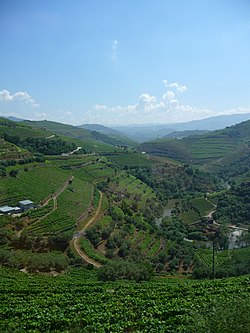
Terraced vineyards are very common in the Douro region. Vineyards dedicated to Port production are usually planted on schist while areas with granite-based soils are used for table wine production.

Grapes

[edit]

The principal grape varieties of the Douro region include the black grapes Bastardo, Mourisco tinto, Tinta Amarela, Tinta Barroca, Tinta Cão, Tinta Roriz (the same as Spain's Tempranillo), Touriga Francesa and Touriga Nacional, and the white grapes Donzelinho branco, Gouveio, Malvasia Fina, Rabigato, and Viosinho.[2]

A large number of grape varieties are grown in the Douro region, most of them local Portuguese grapes. For a long time, the grape varieties grown in the Douro were not very well studied. Vineyards of mixed plantation were the norm, and most of the time, the vineyard owners didn't know which grape varieties they were growing. A pioneering effort were made in the 1970s which identified Touriga Nacional, Tinta Roriz, Touriga Franca, Tinta Cão and Tinta Barroca as the prime dark-skinned grape varieties. Tinta Amarela and the teinturier Sousão has later come to be included among the varieties that attract the most interest.[4] This work was important for creating the new wave of top Douro wines and has also led to a greater focus on the grape varieties that go into Port wine. Most top quintas now replant with single-variety vineyards and focus on a limited number of varieties, but older, mixed vineyards will remain in production for many decades to come.

[edit]

See also

[edit]

References

[edit]
[edit]
Revisions and contributorsEdit on WikipediaRead on Wikipedia
from Grokipedia
The Douro DOC is a prestigious appellation designating non-fortified table wines produced in the Valley, a dramatic river gorge in northern spanning approximately 34,000 hectares of terraced vineyards. Established in 1979 to recognize the region's dry wines separate from its famous fortified , the Douro DOC encompasses three sub-regions—Baixo Corgo, Cima Corgo, and Douro Superior—and benefits from a moderated by the Atlantic, with soils ideal for . This area, the world's oldest demarcated wine region since 1756, has a viticultural history exceeding 2,000 years and was inscribed as a in 2001 for its exemplary of human-modified terraces, quintas (estates), and winemaking traditions. The DOC produces a diverse array of wines, primarily reds (often blends of , Touriga Franca, Tinta Roriz, Tinta Barroca, and Tinto Cão), crisp whites (from Malvasia Fina, Viosinho, Gouveio, and Rabigato), light rosés, sparkling varieties, and occasional late-harvest styles. These wines reflect the region's steep, sun-exposed slopes and varying altitudes, yielding complex, structured reds suited to aging and fresh, aromatic whites ideal for pairings. Regulated by the Instituto dos Vinhos do Douro e Porto (IVDP), established in , the ensures quality through strict production controls, including yield limits and classifications based on potential. Beyond wine, the Douro DOC embodies Portugal's heritage, where traditional methods like foot-treading in lagares coexist with modern innovations, fostering a in table wines since the late . Iconic producers have elevated its global reputation, with vintages often earning high acclaim for their elegance and expression, while the landscape's status highlights its ongoing economic and cultural vitality through sustainable farming.

History

Origins and Early Viticulture

The earliest evidence of viticulture in the Douro region traces back to , with palynological studies revealing the presence of wild grapevines in the Valley dating to approximately 4,000–5,000 years ago, during the late Neolithic to early period. Archaeological excavations have uncovered seeds of at sites such as Buraco da Pala near Mirandela, dated to 3,000–4,000 years old, suggesting early human cultivation of grapes in the area. These findings indicate that the region's soils and steep terrain were recognized for their suitability to grapevines long before organized agriculture. Roman influence significantly advanced in the during the 3rd and 4th centuries AD, toward the end of the , when systematic vineyard planting and wine production for local consumption became established practices. Archaeological records from this era confirm winemaking activities, with the Romans introducing terracing techniques to cultivate the hilly slopes and expanding across the , including the . This period marked the transition from wild gathering to structured cultivation, producing wines primarily for regional use and daily sustenance. In the mid-12th century, Cistercian monks further refined these practices upon their arrival in , establishing monasteries and managing extensive vineyards in the and adjacent valleys. They advanced terracing methods to maximize sunlight exposure on the steep hillsides and implemented disciplined vineyard management, shaping the landscape that persists today. Throughout this medieval era, production centered on unfortified table wines consumed locally by communities and clergy, laying the agricultural foundations before the 17th-century shift toward fortified wines for export.

Port Wine Demarcation and Trade

The emergence of Port wine as a distinct fortified product in the late was driven by English merchants seeking durable wines for export to Britain amid trade disruptions with . The earliest recorded shipment of wine labeled as "Port" occurred in 1678, when merchants added brandy during to stabilize it for long sea voyages, increasing its alcohol content and appeal in the English market. This practice transformed local Douro reds into a premium export, with British traders establishing dominance in the trade by the 1650s. The of 1703 between and marked a pivotal boost to Port exports, reducing tariffs on Portuguese wines to one-third those on French imports, which spurred shipments from 1,700 hectoliters in 1677 to over 55,900 by 1713. This agreement not only elevated Port's share of the British market to around 50% by 1710 but also entrenched Anglo-Portuguese commercial ties, positioning Port as a staple in English cellars. In 1756, Portugal's Marquis of Pombal issued a establishing the as the world's first demarcated wine region, defining its boundaries with 335 stone markers and creating the Companhia Geral da Agricultura das Vinhas do Douro to regulate production, , and . This intervention curbed fraud and overproduction, ensuring Port's authenticity and elevating its global prestige, though the company's monopoly was later dismantled in 1852. The 19th century brought severe challenges to Douro , beginning with a powdery mildew (oidium) outbreak in 1852 that slashed wine output by up to 90% by 1857, necessitating treatments for recovery. This was followed by phylloxera's arrival in the around 1865, which devastated over 50% of vineyards by 1893, prompting widespread replanting on phylloxera-resistant American rootstocks to salvage the industry.

Modern Developments and Emergence

In the mid-20th century, the region began to diversify beyond fortified wines, with the introduction of Barca Velha in 1952 by winemaker Fernando Nicolau de Almeida at Casa Ferreirinha. Inspired by winemaking techniques learned during , this premium unfortified red wine from Quinta do Vale Meão marked a pioneering effort in producing high-quality table wines from the region's soils and indigenous grapes, challenging the long-standing focus on . Regulatory advancements further supported this shift, culminating in the establishment of the Douro DOC in 1979, which provided a distinct for non-fortified wines separate from the stringent Port regulations governed by the Instituto dos Vinhos do Douro e Porto (IVDP). This framework allowed for greater flexibility in production, encouraging while maintaining standards tied to the historic 1756 demarcation. Portugal's accession to the in 1986 proved transformative, abolishing the Port shippers' monopoly on grapes and empowering independent growers to sell directly to table wine producers. This liberalization spurred investment in modern and facilities, fostering a new era of unfortified wine exports. Since the 1990s, production has surged, now rivaling in volume and often surpassing it in value, with unfortified wines comprising over 45% of the region's output by the early 2020s. Driven by advanced techniques like temperature-controlled and international recognition through awards and critics' acclaim, table wines have gained global appeal for their structure and expression. In 2001, the Alto Douro Wine Region received World Heritage status, honoring its shaped by centuries of and boosting and prestige for both fortified and still wines.

Geography and Climate

Location and Sub-Regions

The Douro DOC is situated along the River in northern Portugal's Trás-os-Montes e Alto Douro province, extending approximately 250 km eastward from near to the Spanish border. The region encompasses a total land area of about 250,000 hectares, with roughly 43,800 hectares dedicated to vineyards (as of 2020), primarily on steep slopes overlooking the river and its tributaries. Located approximately 80-90 km inland from the Atlantic Ocean at , the area benefits from natural shelter provided by the Marão and Montemuro mountains, which rise to the west and south. The Douro DOC is divided into three main sub-regions, each with distinct geographical features that influence viticulture. The westernmost Baixo Corgo (Lower Corgo) covers 13,204 hectares of vineyards on rolling hills near the river's lower course, representing the coolest and most fertile zone closest to the Atlantic influence. The central Cima Corgo (Upper Corgo), spanning 20,427 hectares, features dramatic steep terraces and is considered the heart of the region's quality production, centered around the village of Pinhão. To the east, the Douro Superior (Upper Douro) extends over 10,177 hectares into hotter, drier plateaus and more arid landscapes approaching the Spanish border. The landscape is defined by terraced vineyards, known as socalcos, consisting of hand-built walls that adapt to gradients up to 60%, enabling cultivation on otherwise uncultivable slopes. Many of these terraces date to the , when they were constructed to support the expansion of following the demarcation of the region in 1756. This engineered topography, carved into bedrock along the and its tributaries like the Corgo, Pinhão, and Távora rivers, creates a World Heritage emblematic of human adaptation to rugged terrain.

Climate and Terroir

The DOC region exhibits a Mediterranean-influenced characterized by hot, dry summers and cold winters. Average high temperatures in reach approximately 30°C (86°F), while January lows can drop to -5°C (23°F) during colder periods. Annual rainfall varies widely from approximately 400 to 1,200 mm across the region, with medians around 800–1,200 mm in the west decreasing eastward, and the majority—around 60-65%—concentrated in the winter months from to , leaving summers notably arid. Significant diurnal temperature variations occur, particularly in higher elevations, which help preserve acidity in grapes by cooling nights after warm days. Low levels during the minimize risks of fungal rot but exacerbate stress on vines, necessitating deep systems for . These climatic dynamics contribute to the region's viticultural potential by promoting concentrated flavors while challenging growers with water management. The dominant soils in the Douro are schist-based, particularly in lower elevations suited to production, offering excellent drainage and low that stress vines and enhance grape quality. In higher areas, mixes of schist and prevail, providing better water retention for cultivation and supporting more balanced vine growth. These soil compositions, combined with the steep , result in inherently low yields across the region. Terroir varies notably across sub-regions: the Baixo Corgo is more humid and fertile due to its proximity to the Atlantic, fostering slightly higher vigor but moderated ripening. In contrast, the Douro Superior experiences arid conditions with extreme summer heat, yielding more concentrated grapes under greater stress. Overall, the interplay of climate, soils, and topography defines the Douro's unique viticultural expression, emphasizing quality over quantity.

Grape Varieties

Principal Red Varieties

The Douro DOC permits over 80 grape varieties for wine production, though in practice, a handful of indigenous red grapes dominate the region's plantings and form the backbone of both fortified and table wines. Reds account for approximately 80% of the vineyard area, thriving in the schist-rich soils that promote deep root systems and concentrated flavors through restricted water access and mineral uptake. These varieties are often blended to achieve balance, with single-varietal expressions highlighting their unique traits in modern Douro reds. Among the principal reds, stands out as the most prestigious and widely planted, comprising about 11% of plantings (as of 2022). This late-ripening variety yields small, thick-skinned berries that produce structured wines with intense floral aromas of violet and bergamot, robust tannins, and notes of dark berries and spice, making it the structural core of many blends. Its low yields demand careful , but it excels in aging, contributing longevity to both and unfortified reds. Touriga Franca, formerly known as Touriga Francesa, is the most abundant at around 23% of plantings (as of 2022), valued for its high yields and reliability in the Douro's challenging terrain. It delivers aromatic wines with prominent violet and scents, elegant balance, and softer , often providing the fruity backbone in blends while softening the intensity of . Tinta Roriz, the Portuguese synonym for Spain's (also called Aragonez locally), represents about 16% of plantings (as of 2022) and brings robustness to assemblages with its deep color, black fruit flavors like and , and firm structure. Introduced from across the border, it adapts well to the Douro's heat, adding body and spice while resisting . Other significant reds include Tinta Barroca, which covers roughly 7% of plantings (as of 2022) and is prized for its early ripening and high sugar content, yielding alcohol-rich wines that enhance sweetness and roundness in blends, with flavors of ripe red fruits and subtle florals. Despite its vigor, it can produce lighter table wines when vinified alone. Tinta Cão, a rarer variety at just 1% due to its low yields and sensitivity to poor soils, offers elegant, age-worthy profiles with fine acidity, subtle floral and game notes, and silky tannins, adding complexity and freshness to premium blends. Tinta Amarela (synonymous with Trincadeira), accounting for about 3% (as of 2011), imparts spicy, herbaceous aromas and earthy depth but is prone to rot in humid conditions, making it a selective choice for hotter sub-regions where it bolsters fruit-driven reds. Finally, Bastardo (also known as Trousseau), though declining in acreage, contributes light color, aromatic elegance, and juicy raspberry notes, often featured in field blends or experimental rosés for its early maturity and versatility. Historically, vineyards relied on mixed field blends, where dozens of varieties coexisted in ungrafted plantings on steep terraces, harvested and co-fermented for resilient, terroir-driven wines—a practice dating back centuries but challenged by in the late . Since the 1970s, replanting efforts under IVDP guidelines have shifted toward single-variety rows and to improve quality and , though old-vine field blends persist in many sites for their irreplaceable complexity. These reds are equally vital in fortified Ports, where they provide color and structure during oxidative aging, and in table wines, emphasizing fresh fruit and minerality without fortification.

Principal White Varieties

White grape varieties constitute approximately 20% of plantings in the Douro DOC region, reflecting a historical emphasis on reds for fortified wines while supporting the production of fresh, aromatic table whites and blends. These varieties thrive in the region's and soils, contributing to wines with high acidity, mineral notes, and floral profiles that balance the Douro's warm climate. Key varieties include Viosinho, Rabigato, and Gouveio, which form the backbone of modern Douro white wines. Viosinho is prized for its citrus-driven aromas, high acidity, and floral elegance, producing structured, aromatic whites with notes of apricot and stone fruit that excel in varietal bottlings or blends. Rabigato offers mineral intensity, age-worthy freshness, and resistance to heat, yielding crisp wines with and citrus character that retain vibrancy even in challenging vintages. Gouveio, related to Spain's , delivers balanced acidity and body, with citrus, peach, and aniseed flavors, making it a versatile component in blends for lively, full-bodied whites. Other notable varieties include Malvasia Fina, a neutral, high-yielding that serves as a subtle base for white blends, imparting and fresh, moderately complex notes without overpowering other components. Donzelinho Branco contributes exotic peach and floral elements, particularly suited to late-harvest styles with its terpenic, rosemary-tinged profile. Códega do Larinho, an emerging option, brings apple-like acidity and aromas such as and , enhancing freshness in blends with its floral fragrance. These whites adapt well to the soils of higher-altitude sites, where they develop crisp, mineral-driven qualities ideal for table wines. Plantings of white varieties have increased since the , driven by demand for lighter styles amid warming, which favors their heat tolerance and acidity retention for producing elegant, ageable expressions.

Wine Production

Fortified Wines

Fortified wines under the Douro DOC are limited and distinct from , which is regulated separately. The primary style is Moscatel do Douro, a sweet fortified made exclusively from Moscatel Galego grapes, often sourced from higher-altitude vineyards in the Baixo Corgo sub-region. Production follows similar principles to other Douro wines but with using neutral grape spirit to reach 16-18% , halting to retain natural sweetness (typically 100-150 grams per liter of residual ). Grapes are harvested late for , gently pressed, and fermented briefly before fortification. Aging occurs in oak barrels for varying periods, developing notes of , , dried fruits, and , with styles ranging from young and fresh to aged versions labeled by years (e.g., 5, 10, or over 20 years old). The IVDP regulates yields and , with production remaining small-scale compared to table wines, emphasizing the wine's aromatic intensity and with desserts or blue cheeses.

Table Wines

Table wines from the Douro DOC represent unfortified still wines that have gained prominence alongside the region's traditional fortified styles, showcasing the versatility of its schist-dominated which imparts bold and concentrated black fruit profiles to the reds. Dry reds constitute the majority of table wine production, typically around 80% of the category, and are fermented to completion using a mix of tanks and barrels for aging, often French barriques, to develop structure without added spirits. These wines draw from indigenous varieties like and Touriga Franca, yielding bold expressions with dark berry notes and firm, schist-derived that evolve over 12-24 months of maturation in premium examples. White and rosé table wines emphasize freshness through cool processes, often at controlled temperatures around 18°C, with minimal intervention to preserve acidity and aromatic purity. s, blending grapes such as Rabigato and Viosinho, frequently employ indigenous yeasts for spontaneous in or neutral , while s result from light maceration of grapes like Tinta Barroca, delivering vibrant and cherry aromas in a pale hue. Increasing adoption of whole-cluster pressing for whites enhances texture and floral complexity without compromising the region's mineral-driven character. Production yields for Douro table wines are regulated with a maximum of 55 hl/ha, though actual averages hover around 30-35 hl/ha due to the challenging terrain and low-vigor old vines, ensuring concentration in the final wines. Modern estates like Quinta do Crasto exemplify this approach, crafting Reservas from field blends of vines averaging 75 years old, aged 18 months in French oak to balance fruit intensity with elegance. The category's output has surged dramatically, from less than 10% of total Douro production in the —when focus was overwhelmingly on fortified wines—to over 50% by the , driven by global demand for premium still expressions and innovative . Adapting to poses ongoing challenges for production, particularly with vineyards featuring an average vine age exceeding 40 years, which limits replanting flexibility but offers resilience through deep roots suited to dry farming. Sustainable practices, including organic conversion and elevated plantings to combat rising temperatures, are increasingly employed to maintain quality amid hotter, drier conditions, as seen in estates shifting to minimal and native reliance for environmental harmony.

Regulations and Classifications

The Douro DOC was established in 1979 to recognize unfortified table wines from the region, building on the historical demarcation of the Douro wine area in 1756, which was initially created to protect Port wine production. This classification extended protected status to still reds and whites, allowing producers to highlight the region's potential beyond fortified wines. The framework is overseen by the Instituto dos Vinhos do Douro e Porto (IVDP), a public institute founded in 1933 to regulate viticulture, production, and trade in the Douro, ensuring compliance with quality and origin standards. As of 2025, the sector faces challenges, with producers advocating for regulatory reforms to balance Port and table wine production, as highlighted in industry discussions since 2023. Core production rules mandate that Douro DOC wines must be made exclusively from grapes harvested within the demarcated zone, spanning approximately 34,000 hectares across three sub-regions: Baixo Corgo, Cima Corgo, and Douro Superior. The minimum (ABV) is 11% for both red and white varieties, reflecting the region's naturally concentrated fruit from soils and . Maximum yields are capped at 55 hl/ha for standard DOC wines, with lower limits for higher-quality designations based on vineyard to promote intensity and balance; is strictly forbidden except during declared droughts or for young vines to preserve the terroir-driven character. Only approved varieties may be used, with over 80 permitted in total, including principal reds like , Touriga Franca, and Tinta Roriz, and whites such as Viosinho, Rabigato, and Gouveio, ensuring typicity while permitting field blends common to the area. Labeling requirements stipulate that bottles must bear the "Douro DOC" designation, along with the IVDP certification seal, to verify origin and compliance. The region achieved EU (PDO) status in the 1980s, with formal registration in 1991, aligning regulations with European standards for geographical indications and providing international protection against imitation. In contrast to wines, which require fortification with grape spirit to reach 19-22% ABV and follow rigid aging and blending rules under separate DOC guidelines, Douro DOC table wines allow unfortified production with flexible blending options, fostering diverse styles from fresh whites to robust reds.

Vineyard and Wine Quality Classifications

The vineyard classification system in the Douro DOC, administered by the Instituto dos Vinhos do Douro e Porto (IVDP), evaluates the quality potential of each vineyard parcel using a points-based assessment of 12 factors, including (with preferred), altitude, , sun exposure, and age. Vineyards are graded from A (highest quality, over 1,200 points) to F (lowest, under 400 points), with A-rated sites designated for producing premium and table wines due to their superior and capacity for low-yield, high-concentration grapes, typically limited to under 6 tons per to maintain quality. B-rated vineyards (1,001–1,200 points) represent the majority suitable for quality wines, while C-rated (801–1,000 points) are used for entry-level or blended productions; D, E, and F ratings are generally reserved for non- table wines or lower-tier output. This classification influences permitted yields and the proportion of grapes that can be fortified into , with higher-rated vineyards allocated greater "benefit" quotas annually by the IVDP to balance supply and quality. The system, originally developed in 1948, undergoes periodic reviews, including considerations in the for climate change impacts like increased heat and , adjusting assessments for factors such as potential alcohol levels (typically 13–15% for grapes), sugar accumulation, and overall yield potential based on weather forecasts and vineyard conditions. These annual IVDP evaluations ensure sustainable production, with recent adaptations emphasizing resilience to warmer vintages that accelerate ripening and elevate sugar and alcohol potentials. For DOC table wines, terms like Regional, Reserva, Superior Reserva, and Grande Reserva are used by producers to indicate quality levels and often involve specific aging—such as 12–24 months total for Reserva (including at least 6 months in bottle), over 24 months for Superior Reserva (often with ), and at least 36 months for Grande Reserva (frequently from single-vineyard sources)—but these are not mandatory under DOC regulations, reflecting the wine's complexity and structure through voluntary practices. Regional wines represent the entry level with no specified aging, suitable for fresh, everyday consumption. These terms showcase the region's aging potential with concentrated fruit and spice notes. White Douro DOC wines follow similar producer-defined categories, but with an emphasis on preserving freshness and aromatics through or minimal aging; for instance, Reserva whites typically age 6–12 months to highlight and floral profiles without excessive oxidation. wines are classified under the tiers, sharing the same aging guidelines to maintain their vibrant color and fruit-driven character. These categories apply primarily to still wines, though table wines increasingly leverage the system to denote unfortified expressions of Douro .

References

Add your contribution
Related Hubs
User Avatar
No comments yet.