Hubbry Logo
search
logo
2325043

Draupnir

logo
Community Hub0 Subscribers
Read side by side
from Wikipedia

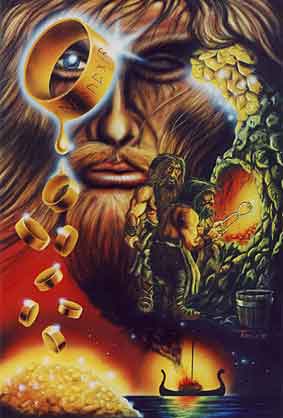
Draupnir multiplying itself
The third gift — an enormous hammer (1902) by Elmer Boyd Smith. The ring Draupnir is visible among other creations by the Sons of Ivaldi.

In Norse mythology, Draupnir (Old Norse: [ˈdrɔupnez̠], "the dripper"[1]) is a gold ring possessed by the god Odin with the ability to multiply itself: Every ninth night, eight new rings 'drip' from Draupnir, each one of the same size and weight as the original.

Draupnir was forged by the dwarven brothers Brokkr and Eitri (or Sindri). Brokkr and Eitri made this ring as one of a set of three gifts which included Mjöllnir and Gullinbursti. They made these gifts in accordance with a bet Loki made saying that Brokkr and Eitri could not make better gifts than the three made by the Sons of Ivaldi. In the end, Mjöllnir, Thor's hammer, won the contest for Brokkr and Eitri. Loki used a loophole to get out of the wager for his head (the wager was for Loki's head only, but he argued that, to remove his head, they would have to injure his neck, which was not in the bargain) and Brokkr punished him by sealing his lips shut with wire.

The ring was placed by Odin on the funeral pyre of his son Baldr:

Odin laid upon the pyre the gold ring called Draupnir; this quality attended it: that every ninth night there fell from it eight gold rings of equal weight.

— from the Gylfaginning

The ring was subsequently retrieved by Hermóðr. It was offered as a gift by Freyr's servant Skírnir in the wooing of Gerðr, which is described in the poem Skírnismál.

Notes

[edit]

References

[edit]
Revisions and contributorsEdit on WikipediaRead on Wikipedia
from Grokipedia
Draupnir is a magical gold arm-ring in Norse mythology, possessed by the chief god Odin and renowned for its enchanted property of producing eight new rings of equal weight every ninth night.[1] Forged by the dwarves Brokkr and Sindri during a legendary contest with Loki, it stands as one of the supreme treasures crafted by these supernatural smiths, alongside Thor's hammer Mjölnir and Freyr's golden boar Gullinborsti.[2] The ring's origins are detailed in the Prose Edda, where Loki wagers that Brokkr and Sindri cannot create gifts surpassing those made by the sons of Ívaldi, leading to Draupnir's creation from pure gold in Sindri's forge.[1] Its multiplying nature symbolizes inexhaustible wealth and divine prosperity, making it a potent emblem in skaldic poetry, where gold is often kenned as "Draupnir's drop," "Draupnir's tears," or "Draupnir's sweat."[1] Draupnir plays a poignant role in the myth of Baldr's death and funeral, as recounted in the Prose Edda's Gylfaginning. Odin places the ring on his slain son's pyre aboard the ship Hringhorni, honoring Baldr amid the gathered gods and giants.[3] Later, when Hermóðr journeys to Hel to retrieve Baldr, the deceased god returns Draupnir to Odin as a token of remembrance, accompanied by gifts from his wife Nanna to Frigg and her servant Fulla.[3] Additionally, Draupnir appears in the Poetic Edda's Skírnismól, where Freyr's servant Skírnir offers it to the giantess Gerðr in an attempt to secure her hand in marriage for his master, emphasizing its value by noting its survival from Baldr's funeral pyre and its reproductive magic.[4] Through these narratives, Draupnir embodies themes of loss, renewal, and the enduring power of the divine in Norse lore, influencing later cultural depictions of magical artifacts.[2]

Etymology

Name origin

The name Draupnir derives from Old Norse draupnir, a noun formed from the verb drjúpa, meaning "to drip" or "to drop."[5] Etymologically, draupnir connects to the Proto-Germanic verb dreupaną, which carries the same sense of dripping or dropping, underscoring a conceptual link to abundance through replication akin to liquid effusion. The term first appears in 13th-century Icelandic manuscripts, including those preserving Snorri Sturluson's Prose Edda composed around 1220, which draw on pre-existing oral poetic traditions.[6]

Interpretations

Scholars have interpreted the name Draupnir, deriving from the Old Norse verb drjúpa meaning "to drip" or "to drop," as evoking themes of fertility and endless generation within Germanic mythology, where the ring's ability to produce eight identical rings every ninth night symbolizes inexhaustible abundance and the perpetual renewal of prosperity. This generative quality aligns with broader concepts of natural and economic fertility, portraying the artifact as a divine emblem of unending productivity in a pre-industrial society reliant on cycles of growth and harvest.[7] The motif of self-replication in Draupnir connects to wider Indo-European traditions of magical treasures that embody divine favor and sovereignty, as preserved in Germanic legendry where such items link to priestly authority and ritual magic.[8] These parallels suggest an ancient inheritance, with Draupnir's dripping mechanism reflecting shared mythological patterns of abundance across Indo-European cultures, though specific analogs in Vedic or Celtic lore emphasize similar themes of multiplying wealth as markers of cosmic order and kingship. In 20th-century philological scholarship, Jan de Vries analyzed Draupnir through the lens of ancient Germanic religious practices, proposing that its nine-night replication cycle represents a symbolic nine-day week within an archaic lunar calendar system, potentially structuring seasonal rituals and sacrificial timings.[7] De Vries's interpretation in Altgermanische Religionsgeschichte underscores how the name's "dripping" connotation may evoke the measured outpouring of offerings in cultic ceremonies, tying the ring to the rhythmic essence of religious observance.

Description

Physical attributes

Draupnir is portrayed in Norse mythological accounts as a golden arm-ring, crafted as one of the supreme treasures bestowed upon the gods.[2] Made entirely of pure gold, it exemplifies the material's prestige in ancient Scandinavian society, where such artifacts symbolized wealth and authority in a pre-coinage economy reliant on precious metals for exchange and display.[9] As a product of dwarven craftsmanship, primary texts provide no explicit details on elements like engravings or runes. This ring's physical form underscores its role as a tangible emblem of divine favor, with its solid gold composition ensuring enduring value and luster.[9]

Magical properties

In Norse mythology, Draupnir is renowned for its primary magical property: every ninth night, it generates eight new gold rings, each identical in weight to the original, thereby multiplying itself to a total of nine rings. This self-replicating enchantment, forged by the dwarves, symbolizes boundless prosperity and divine favor, ensuring its possessor an inexhaustible source of wealth. The Prose Edda describes this ability explicitly in the context of the ring's creation, attributing it to the masterful craftsmanship of the dwarf Brokkr and his brother Sindri.[10] As a divinely enchanted artifact, Draupnir exhibits implied indestructibility, enduring extreme conditions without harm; for instance, Odin placed the ring on Baldr's funeral pyre, from which it was later retrieved intact by Hermóðr during his journey to Hel. This resilience underscores the ring's supernatural nature, transcending the vulnerabilities of mundane gold. The Prose Edda notes this event in the account of Baldr's death and funeral rites.[11] The mechanism of multiplication carries a mathematical implication of exponential growth—each new ring theoretically capable of producing further sets over time—though the myths limit exploration to the initial cycle and do not pursue such iterative expansion.

Creation myth

The dwarves' wager

In the Prose Edda, composed by Snorri Sturluson in the 13th century, the creation of Draupnir arises from a high-stakes wager initiated by the trickster god Loki. Having previously commissioned the Sons of Ivaldi to craft golden hair for Sif (to replace what he had maliciously cut), the ship Skíðblaðnir for Freyr, and the spear Gungnir for Odin, Loki boasted of their superior workmanship. He then bet his own head against the dwarf Brokkr, claiming that Brokkr's brother, the smith Eitri (also called Sindri), could not forge three items of equal or greater value.[12] Determined to prove Loki wrong, Brokkr and Eitri accepted the challenge and set to work in their forge, aiming to create gifts worthy of the gods. As Brokkr operated the bellows to maintain the fire, Eitri prepared the materials for three successive items: first, a golden-maned boar named Gullinbursti; second, a golden arm-ring called Draupnir; and third, a hammer later known as Mjölnir. Unbeknownst to the dwarves, Loki shape-shifted into a fly to sabotage their efforts, stinging Brokkr's hand during the forging of the boar, his neck for the ring, and his eyes for the hammer, causing blood to obscure his vision and briefly halting the bellows. Despite these interferences, the dwarves persevered, completing the items without fatal flaws—though the hammer's handle emerged slightly short.[12] The wager's resolution came in Asgard, where Odin, Thor, and Freyr judged the competing treasures. They deemed the dwarves' creations superior, particularly the hammer's utility in defending against giants, awarding Brokkr the victory and Loki's head as forfeit—though Loki cleverly argued only his head was at stake, leading to his lips being sewn shut instead. This contest not only highlighted the dwarves' unmatched craftsmanship under duress but also established Draupnir as a ring of profound magical worth, capable of multiplying itself by producing eight identical rings every ninth night.[12]

Craftsmanship details

Draupnir was forged by the dwarf brothers Brokkr and Eitri, also known as Sindri, renowned for their exceptional metallurgical skills in Norse mythology.[1] Working in their subterranean forge within Svartálfaheimr, the realm of the dark elves and dwarves, the brothers employed traditional yet supernaturally precise techniques to craft divine artifacts. The forging process began with Eitri placing a piece of gold into the hearth of their forge, instructing Brokkr to operate the bellows ceaselessly to maintain an intense, unwavering heat.[1] This continuous blasting of air into the fire, performed manually by the dwarf despite severe interruptions, ensured the gold melted and shaped without flaw, highlighting the brothers' reliance on disciplined craftsmanship infused with mythical endurance.[1] As part of a divine wager briefly referenced in the tale, the heated gold was transformed through this meticulous heating phase into the ring's form.[1] During the cooling and enchantment stage, the dwarves instilled Draupnir's core property: the ability to "drip" or multiply, producing eight new rings of equal weight every ninth night.[1] This feature, achieved through the dwarves' arcane knowledge of metallurgy and enchantment, symbolized an alchemical-like conversion of raw heat and gold into perpetual treasure, underscoring the transformative power of their underground artistry.[1] The result was a flawless artifact, demonstrating how dwarven forges blended physical labor with inherent magic to create items of eternal value for the gods.[1]

Role in Norse mythology

Acquisition by Odin

In the mythological account preserved in the Prose Edda, Draupnir was forged by the dwarves Brokkr and Sindri (also known as Eitri) as one of three treasures created to settle a wager initiated by Loki. Loki had bet his own head against Brokkr's claim that his brother could craft items surpassing those made by the sons of Ívaldi, which included Sif's golden hair, the ship Skíðblaðnir, and Odin's spear Gungnir. Despite Loki's sabotage—transforming into a fly to sting Brokkr and disrupt the forging—the dwarves succeeded in producing Draupnir, a golden arm-ring; Gullinborsti, a glowing boar; and Mjöllnir, Thor's hammer.[12] The treasures were presented to the gods for judgment, with Odin, Thor, and Freyr serving as arbiters. Brokkr formally offered Draupnir to Odin, declaring that every ninth night, eight rings of equal weight to the original would drop from it. The gods deemed the new creations superior overall, particularly praising Mjöllnir for its utility in defending Asgard against giants, thereby validating Brokkr's wager and awarding him the right to claim Loki's head (though the gods spared Loki's life by limiting the severance to his neck). In this context, Draupnir was recognized as the finest among the arm-rings and symbolic treasures, securing its place as Odin's possession.[12] Odin immediately accepted Draupnir, incorporating it into his divine regalia as a emblem of sovereignty and wealth, often worn on his arm alongside Gungnir. This acquisition highlights Odin's appreciation for the unparalleled craftsmanship of the dwarves, even amid Loki's interference, underscoring themes of ingenuity triumphing over deceit in Norse lore. Later, Odin would place Draupnir on Baldr's funeral pyre as a token of mourning.[12]

Use in Balder's funeral

In the wake of Baldr's death, which resulted from Loki's cunning trickery in guiding the blind god Höðr to strike him down with a sprig of mistletoe—the one substance that had not sworn to spare Baldr—the Æsir organized an elaborate funeral to honor their fallen kinsman.[3] Baldr's body was borne to the vast ship Hringhorni, the largest vessel in existence, which the gods intended to use as his funeral pyre after failing to launch it themselves and summoning the giantess Hyrrokin to propel it into the sea.[3] As the preparations culminated, Odin placed his prized ring Draupnir upon the pyre as a sacrificial offering to accompany Baldr into the afterlife, alongside the god's steed and other treasures.[3] The pyre was then set ablaze in a grand conflagration attended by the gods, including Frigg, the Valkyries, Freyr on his boar Gullinborsti, Heimdallr on his horse Gulltoppr, and Freyja in her cat-drawn chariot, with even rime-giants and hill-giants gathering to witness the rite.[3] Thor consecrated the flames with his hammer Mjöllnir, ensuring the sanctity of the burial.[3] Following the immolation, the ring's enchanted nature—its ability to multiply, producing eight equal rings every ninth night—enabled its miraculous return to Odin, underscoring its resilience amid destruction.[3] When Hermóðr rode Sleipnir to Hel in a desperate bid to reclaim Baldr, the deceased god greeted him in a place of honor and, taking Draupnir from his arm, entrusted it to Hermóðr to deliver to Odin as a keepsake, thereby restoring the artifact to its original owner after the pyre's fire.[3] This sequence of events, set against the profound grief of the gods, emphasizes themes of irrevocable loss and the persistence of divine bonds.[3]

Symbolism

Representation of wealth

In Norse mythology, Draupnir embodies infinite abundance within the gift economy of Viking society, where arm rings like it served as both currency and markers of social status, distributed by leaders to foster loyalty and alliances.[2] The ring's self-replicating property—producing eight new rings of equal weight every ninth night—reinforces this symbolism, representing unending prosperity and the cyclical flow of wealth in a system reliant on reciprocal exchanges rather than hoarding.[2] Archaeological evidence from Viking-Age hoards, such as those in Scotland, further illustrates rings' role as standardized units of value, underscoring their economic significance beyond mere ornamentation.[13] As the possession of Odin, the Allfather, Draupnir connects directly to kingship, signifying legitimate rule and economic sovereignty through the archetype of the "ring-giver" (Old Norse: hringdrífa), a poetic kenning for chieftains who bestowed such items to affirm authority and generosity.[2] In skaldic verse and sagas, this act of distribution symbolized a ruler's control over resources and their obligation to sustain followers, mirroring Odin's divine oversight of cosmic order and bounty.[14] Worn by the chief god, the ring thus elevates personal adornment to a emblem of hierarchical power, where wealth circulation validated governance.[15] Interpretations also link Draupnir's nine-night multiplication interval to Norse calendrical rhythms, potentially aligning with ancient lunisolar divisions of the month into three nine-day phases, evoking lunar cycles of renewal and abundance.[16] This temporal pattern reflects broader Indo-European motifs of transformation, where the number nine marked periods of gestation or cosmic periodicity in Germanic traditions, enhancing the ring's role as a symbol of perpetual prosperity tied to natural and ritual timekeeping.[16]

Themes of sacrifice and renewal

In Norse mythology, Draupnir serves as a profound symbol of sacrificial giving, exemplified by its placement on the funeral pyre of the god Baldr to honor his passage into the afterlife, an act that underscores the ritual consignment of valuables to the flames in Viking mortuary practices. Despite being burned, the ring's inherent magic enables its return to Odin, illustrating the theme of offerings that transcend death while maintaining ties to the living world. This duality mirrors the Norse cosmological view of death not as finality but as a transitional phase in the soul's journey. The renewal aspect of Draupnir is embodied in its enchanted property of producing eight identical rings every ninth night, a process that evokes regeneration and the perpetual cycle of creation amid destruction in Norse lore.[17] This multiplicative quality reinforces themes of enduring vitality and continuity. Scholars have connected Draupnir to historical Viking practices involving oath rings and grave goods, interpreting its form and function as a ritual bridge between the realms of life and the afterlife, where such objects facilitated oaths of loyalty and commemorated the deceased through deliberate deposition.[17] In this framework, the ring's regenerative dripping reinforces the sacrificial motif by symbolizing continuity and communal bonds that persist beyond individual mortality, aligning with broader patterns of ritual closure and renewal in pre-Christian Scandinavia.[17]

Attestations in sources

Poetic Edda references

In the Poetic Edda, Draupnir is prominently referenced in the poem Skírnismál, where it serves as a symbol of immense wealth and divine favor offered in a courtship narrative. In stanzas 21 and 22, the servant Skírnir presents the ring to the giantess Gerðr as a bride-gift to secure her consent to marry Freyr, describing it as the ring once burned on the pyre of Óðinn's son Baldr, from which eight equal rings drop every ninth night. Gerðr declines the offer, asserting that her father Gymir's halls lack no gold. This passage underscores Draupnir's magical replicative property and its status as a prized possession associated with Óðinn, emphasizing themes of abundance and the enumeration of godly treasures in eddic verse.[4][18] The reference highlights Draupnir's role within the broader poetic tradition of the Edda, where such artifacts illustrate the opulence of the gods' realm and are invoked to convey prestige in mythological exchanges. While not explicitly employed as a kenning in this eddic context, the ring's depiction aligns with its later use in skaldic poetry as a metaphorical base for expressions denoting gold, such as "Draupnir's drippings," thereby linking it to poetic devices that evoke divine ownership and inexhaustible riches.[18][2] These verses are preserved in the Codex Regius, the primary manuscript of the Poetic Edda, compiled around 1270 in Iceland and containing a collection of oral compositions likely originating in the 9th and 10th centuries. The inclusion of Draupnir in Skírnismál reflects the Edda's stylistic reliance on cataloguing mythical elements to build narrative tension and reveal character motivations, without delving into the ring's creation or full mythological backstory.[18]

Prose Edda accounts

In Snorri Sturluson's Prose Edda, a 13th-century compilation of Norse mythological lore, Draupnir receives detailed narrative treatment across its primary sections, serving as a key artifact in tales of divine craftsmanship and mourning.[19] The most extensive account appears in Skáldskaparmál, where the ring's origins are tied to a wager among dwarves and Loki. After Loki shears Sif's golden hair, he commissions the sons of Ívaldi to forge a replacement along with Odin's spear Gungnir and the ship Skíðblaðnir; to atone further, Loki wagers his head with the dwarf Brokkr, claiming that Brokkr's brother Sindri cannot craft superior items. Sindri forges three treasures in his forge: a golden boar named Gullinborsti, the ring Draupnir, and Thor's hammer Mjöllnir, undeterred despite Loki's sabotage as a fly stinging Brokkr during the process. The dwarves present the items to the Æsir, who award them to the gods: Odin receives Draupnir, described as a gold ring from which "every ninth night there shall drop eight gold rings like itself." The gods deem Mjöllnir the finest creation, granting Brokkr victory in the wager and sparing Loki's head.[1] In Gylfaginning, Draupnir features briefly during the account of Baldr's funeral, underscoring its enduring magical properties. As the gods prepare Baldr's pyre on his ship Hringhorni, Odin places the ring upon it as a sacrificial offering, noting its quality of producing eight equal rings every ninth night. Later, when Hermóðr journeys to Hel to retrieve Baldr, the deceased god returns Draupnir to Odin via Hermóðr as a remembrance, affirming the artifact's role in rituals of loss and continuity.[3] Snorri's Prose Edda, composed around 1220 in Iceland, synthesizes fragmented pagan traditions from oral and poetic sources into a coherent prose framework, often employing euhemerism—presenting gods as historical human figures descended from Trojan nobility—to reconcile pre-Christian myths with a Christian audience.

Cultural impact

Modern depictions

In the God of War video game series, Draupnir is prominently featured in God of War Ragnarök (2022) as the Draupnir Spear, a weapon forged by the dwarven brothers Brok and Sindri for protagonist Kratos. This adaptation transforms the ring's mythological ability to multiply into a mechanic allowing Kratos to create and detonate additional spears for ranged combat, environmental puzzles, and traversal elements, such as embedding spears to climb walls or destroy barriers.[20][21] The spear's design emphasizes elemental wind-based attacks, aligning with the game's Norse-inspired narrative while innovating on the original lore for interactive gameplay.[22] In contemporary literature and film, Draupnir appears as a symbol of Odin's divine authority and wealth. Neil Gaiman's novel American Gods (2001) references Draupnir among Odin's legendary treasures, underscoring the god's enduring power in a modern American context where old deities struggle for relevance.[23] In Marvel Comics adaptations, including the Thor film series, Draupnir is depicted as the "Odinring" or Ring Imperial, an enchanted armband worn by Odin and later rulers like Loki and Frigga, symbolizing Asgardian supremacy and capable of self-duplication to generate wealth.[24] These portrayals often emphasize its role as an emblem of kingship rather than its funerary aspects from mythology. Replicas of Draupnir have gained popularity in jewelry markets targeted at neo-pagan practitioners and enthusiasts of Viking revivalism, often crafted in sterling silver or gold to evoke themes of abundance and renewal. This trend originated during the 19th-century Romantic movement, when renewed interest in Norse sagas inspired artistic and cultural reinterpretations of Viking artifacts across Europe.[25] Today, such pieces are widely available through specialized retailers, blending historical authenticity with modern wearable art for Ásatrú adherents and historical reenactors.[26][27]

Archaeological connections

While no artifact has been definitively identified as Draupnir, Viking Age arm-rings discovered in high-status burials exhibit parallels to the mythical ring's role as a symbol of boundless wealth and prestige. These arm-rings, often crafted from silver or gold and featuring intricate animal-head terminals, were frequently included as grave goods to signify the deceased's social standing and economic power. For instance, the Oseberg ship burial in Norway (ca. 834 CE) contained an array of luxury items, including elaborately decorated wooden carvings, textiles, and tools, which collectively underscored the buried women's elite status and ability to command resources, much like Draupnir's connotation of inexhaustible riches.[28] In 2024, two silver arm-rings dated to around AD 900 were unearthed under the floor of a Viking house in Stein, Norway, further illustrating their use as valuable prestige objects in everyday high-status contexts.[29] The concept of Draupnir's self-multiplication—producing eight identical rings every ninth night—echoes real Viking economic practices involving the accumulation and division of ring-shaped valuables. Archaeological evidence from hoards across Scandinavia reveals that arm-rings and similar jewelry were often broken into fragments, known as hack silver, to facilitate trade and payments by weight in a bullion economy lacking standardized coinage. This fragmentation allowed for flexible wealth distribution, potentially inspiring the mythological motif of generative treasure in sagas, where rings represented both hoarded capital and divisible assets.[30] Although Draupnir itself remains unattested in physical form, motifs on runestones evoke comparable ideas of mythical treasures tied to heroic or divine narratives. The Rök Stone (Ög 136, ca. 800 CE) in Sweden, bearing the longest known runic inscription, weaves complex allusions to Norse legends of life, death, and regeneration, including heroic figures and otherworldly rewards that parallel the regenerative wealth embodied by Draupnir in later textual traditions. Such inscriptions suggest that concepts of multiplying or eternal treasures permeated pre-Christian commemorative art, linking elite burial practices to broader mythological frameworks.

References

User Avatar
No comments yet.