


Community hub
Recent from talks
Contribute something
Nothing was collected or created yet.
Gullveig
View on Wikipedia

Gullveig (Old Norse: [ˈɡulːˌwɛiɣ]) is a female figure in Norse mythology associated with the legendary conflict between the Æsir and Vanir. In the poem Völuspá, she came to the hall of Odin (Hár) where she is speared by the Æsir, burnt three times, and yet thrice reborn. Upon her third rebirth, she began practicing seiðr and took the name Heiðr.[1]
Gullveig/Heiðr is solely attested in the Poetic Edda, compiled in the 13th century from earlier traditional material. Scholars have variously proposed that Gullveig/Heiðr is the same figure as the goddess Freyja, that Gullveig's death may have been connected to corruption by way of gold among the Æsir, and/or that Gullveig's treatment by the Æsir may have led to the Æsir–Vanir War.
Etymology
[edit]The etymology of the Old Norse name Gullveig remains uncertain. It is a compound formed with the Old Norse word for 'gold' (gull), yet the second element–found in other personal names like Rannveig, Sölveig, or Thórveig–remains obscure. It could have meant 'power, strength' (cf. Icelandic veig, Faroese veiggj), 'intoxicating drink' (cf. Norwegian veigja), possibly 'lady' (cf. Norw. veiga) or even 'gold, gold thread' (cf. Old English wāg, Old Saxon wēg).[2] The name has been variously translated as 'Gold-drink', 'Gold-drunk',[3] or as 'Gold-draught'.[4] Gullveig is sometimes held to be a personification of gold itself, purified through repeated smelting.[4]
The name Heiðr, which in adjectival form means 'bright, clear',[5] is semantically related. Scholar Rudolf Simek comments that although Gullveig's name changes to Heiðr, the meaning still remains basically the same.[6]
Attestations
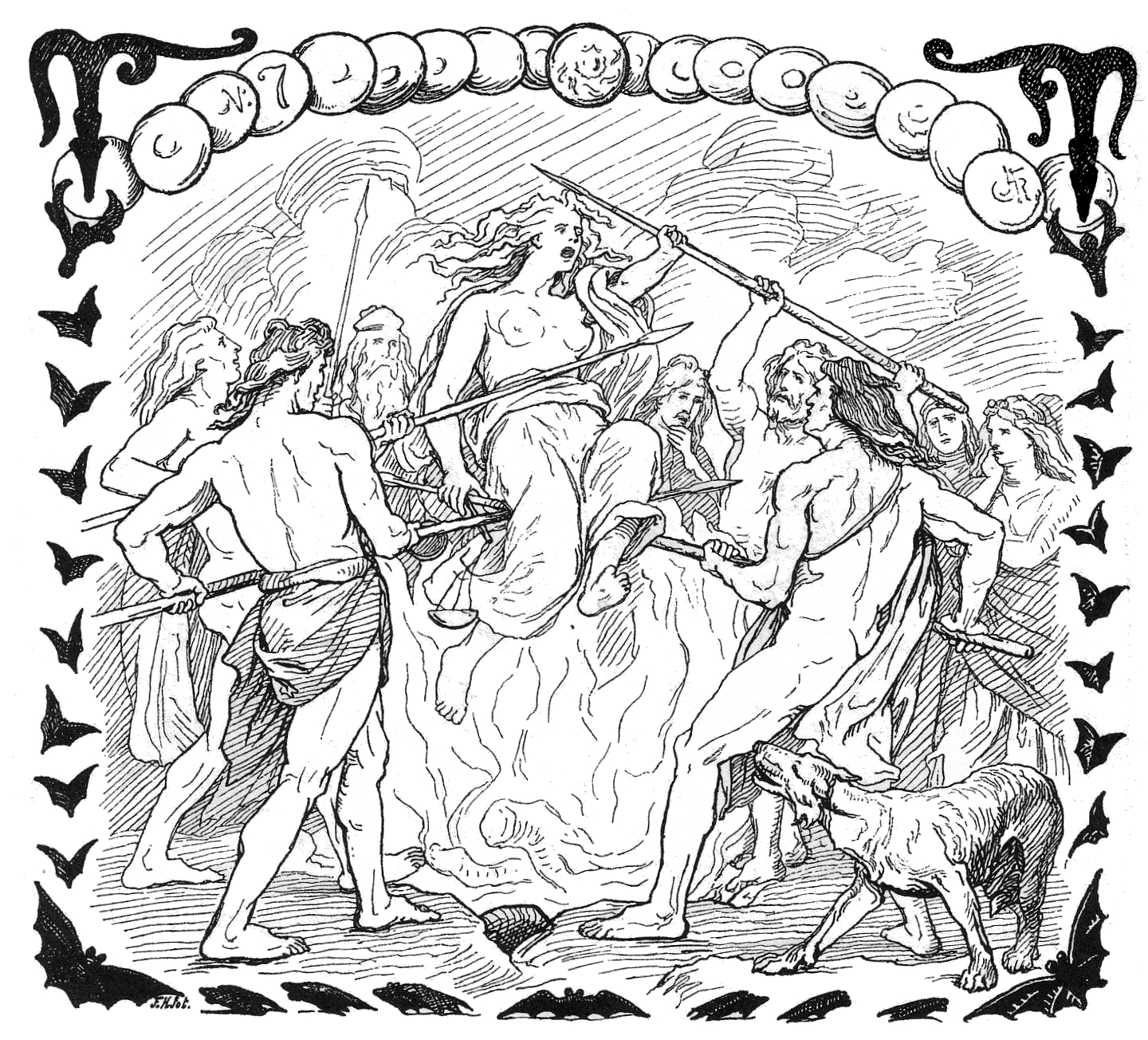
[edit]Gullveig is solely attested in a stanza of Völuspá (Prophecy of the Völva) immediately preceding the story of the Æsir–Vanir War.[4] A völva (seeress) recalls that Gullveig was pierced by spears before being burnt three times in the hall of Hárr (one of Odin's names), and yet was three times reborn. Presumably after her burning, Gullveig became known as Heiðr, a knowledgeable völva who could perform great feats:
H. A. Bellows translation (1923):
- The war I remember, the first in the world,
- When the gods with spears had smitten Gollveig,
- And in the hall of Hor had burned her,
- Three times burned, and three times born,
- Oft and again, yet ever she lives.
- Heith they named her who sought their home
- The wide-seeing witch, in magic wise;
- Minds she bewitched that were moved by her magic,
- To evil women a joy she was.[7]
A. Orchard translation (1997): Then [the sibyl] remembered the first great war in the world,
when they stabbed at Gullveig with spears,
and they burned her in Odin ’s hall;
thrice they burned the thrice-bom girl,
often, not once, but still she lived.
They called her heid, when she came to the house,
a sibylline witch, who knew the skill of wands,
she practised seid where she could, practised seid in a trance;
she was always a delight to wicked women.[4]
J. Lindow translation (2001): She remembers the war of peoples first in the world,
When Gullveig with spears they studded
And in Hár’s hall burned her;
Thrice burned, thrice born,
Often, unseldom, though she yet lives.
Heid they called her, wherever she came to houses,
A seeress skilled in prophecy, she observed magic staffs;
She performed seid, wherever she could, she performed seid in a trance,
She was ever the joy of an evil woman.[8]
Theories
[edit]Starting with scholar Gabriel Turville-Petre, many scholars such as Rudolf Simek and John Lindow have theorized that Gullveig/Heiðr is the same figure as Freyja.[6][3] Lindow notes that "since Ynglinga saga says that Freyja first brought seid to the æsir, it is not impossible that Gullveig is Freyja, and that she brought seid to the æsir in the first instance either as a strategy in the war, or that her bringing of seid started the war."[1] Orchard further mentions that Freyja, like Gullveig, is associated with gold and with the form of magic known as seid.[4]
See also
[edit]- List of names of Freyja, a list of various names attributed to the goddess Freyja
Notes
[edit]- ^ a b Lindow 2001, pp. 154–155.
- ^ de Vries 1962, p. 651.
- ^ a b Lindow 2001, p. 52.
- ^ a b c d e Orchard 1997, p. 67.
- ^ de Vries 1962, p. 217.
- ^ a b Simek 1996, pp. 123–124.
- ^ Bellows (1923:10).
- ^ Lindow 2001, p. 154.
References
[edit]- Bellows, Henry Adams (1923). The Poetic Edda. American-Scandinavian Foundation.
- de Vries, Jan (1962). Altnordisches Etymologisches Worterbuch (1977 ed.). Brill. ISBN 978-90-04-05436-3. Archived from the original on 23 April 2023. Retrieved 26 May 2020.
{{cite book}}: ISBN / Date incompatibility (help) - Lindow, John (2001). Norse Mythology: A Guide to Gods, Heroes, Rituals, and Beliefs. Oxford University Press. ISBN 978-0-19-983969-8.
- Orchard, Andy (1997). Dictionary of Norse Myth and Legend. Cassell. ISBN 978-0-304-34520-5.
- Thorpe, Benjamin (Trans) (1907). Edda Sæmundar Hinns Frôða The Edda of Sæmund the Learned. Part I. London Trübner & Co.
- Simek, Rudolf (1996). Dictionary of Northern Mythology. D.S. Brewer. ISBN 978-0-85991-513-7. Archived from the original on 20 April 2023. Retrieved 20 August 2019.
Gullveig
View on GrokipediaName
Etymology of Gullveig
The name Gullveig is a compound word in Old Norse, formed from gull, meaning "gold," and veig, which denotes a strong or intoxicating beverage, as well as strength or power.[4][5] This linguistic structure is evidenced in historical dictionaries of Old Norse, where veig appears in poetic contexts as a term for mead or a potent drink, often with connotations of vitality or essence, and is commonly incorporated into feminine personal names such as Sólveig and Þórveig.[5] Primary scholarly etymologies interpret Gullveig as "gold-strength" or "gold-intoxication," reflecting the dual themes of material wealth and potent, transformative force. In the 19th century, philologist Karl Müllenhoff proposed "Force of Gold" (Goldkraft), viewing the name as emblematic of gold's corrupting influence.[2] Similarly, 20th-century scholar Jan de Vries analyzed it in Altgermanische Religionsgeschichte (1957, vol. II, pp. 32–34), linking the compound to ritualistic elements of power and excess, though emphasizing its roots in Vanir-associated practices without altering the core breakdown. Lotte Motz, in her 1993 study, further refined this to "Golden Drink" or "Drink of Gold," connecting veig specifically to mead-like potions tied to prophetic insight in Eddic poetry.[2] In Old Norse poetic tradition, the name Gullveig operates akin to a kenning, evoking the allure of gold as a symbol of wealth alongside the bewitching, sorcery-inducing qualities of an intoxicating elixir. This duality underscores her character's association with avarice and magical potency, as gull frequently kennings treasures or divine gifts in skaldic verse, while veig implies a draught that confers otherworldly strength or delusion, unique to figures embodying disruption through enchantment.[5][2]The Name Heiðr
In the Poetic Edda, the figure known initially as Gullveig acquires the name Heiðr following her rebirth, signifying a profound transformation in her mythological role. This secondary name, Heiðr, stems from the Old Norse term heiðr, which carries multiple connotations including "brightness" or "shining," "honor" or "fame," and "heath" or open wilderness, often evoking ideas of clarity and uncultivated spaces.[3][2] The term heiðr frequently appears in Norse literature as an epithet for völvas, the prophetic seeresses associated with magic and foresight, underscoring its ties to female practitioners of sorcery in sagas such as the Saga of Erik the Red and Hyndluljóð.[3][6] The context of this name change emerges in Völuspá stanza 22, immediately following the description of Gullveig's ordeals in stanza 21, where she is depicted as reborn and renamed Heiðr, now a wandering völva who prophesies and practices seiðr, a form of Norse sorcery involving trance and manipulation of fate.[6] As Heiðr, she visits homes to offer prophecies, harm minds through her magic, and summon spirits, emphasizing her evolution into a mobile, influential seeress whose seiðr practices disrupt and enlighten those she encounters.[2][3] This shift highlights her role as a prototype for völva figures, blending prophecy with potentially malevolent enchantment in the poetic narrative.[6] Symbolically, Heiðr's name evokes enlightenment achieved through fiery trials, with its "brightness" root suggesting illumination or visionary clarity akin to the mantic inspiration derived from sacred mead in Norse cosmology.[2] The duality inherent in heiðr—as both "honor" (a positive, fame-bestowing quality) and "heath" (a wild, untamed expanse)—mirrors broader Norse naming conventions that reflect multifaceted identities, particularly for figures embodying transformation and the tension between order and chaos.[3] This interpretation aligns with Heiðr's portrayal as a reborn entity whose magic serves both regenerative and bewildering purposes, encapsulating the ambiguous nature of seiðr in the mythological tradition.[2]Mythological Accounts
Description in Völuspá
Gullveig is first attested in the Poetic Edda, specifically in stanzas 21 and 22 of Völuspá, a prophetic poem likely composed in the late 10th century and preserved in the 13th-century Codex Regius manuscript (GKS 2365 4to), with a variant version appearing in the 14th-century Hauksbók.[7] The poem's text exhibits variations between these manuscripts, such as differences in wording and stanza order, prompting 19th-century scholars like Sophus Bugge to undertake editorial reconstructions aimed at approximating the original oral composition through comparative philology. Bugge's work, including his 1867 edition of the Edda, emphasized emendations to resolve lacunae and inconsistencies in the surviving copies. In the Codex Regius version, the seeress narrator recounts Gullveig's introduction among the Æsir as the prelude to the first divine conflict:Þat man hon fólkvíg fyrst í heimi,
er Gullveigu geirum studdu,
ok í hǫll Hárs hana brendu;
þrysvar brendu þrysvar borna,
opt, ósjaldan, þó hon enn lifir.[6]
She recalls it, the first tribe-war in the world,The following stanza elaborates on her identity and practices:
when they stuck Gullveig up on spears,
and in Hárr’s hall burned her;
thrice they burned the thrice-born,
often, not seldom, yet she still lives.[6]
Heiði hana hétu, hvars til húsa kom,
vǫlu velspá, vitti hon ganda;
seið hon kunni, seið hon leikin,
æ var hon angan illrar brúðar.[6]
Heiðr they called her, wherever she came to houses,These lines depict Gullveig's arrival as a wandering seeress skilled in prophecy and seiðr (a form of Norse sorcery), where her name evokes connotations of gold and intoxicating power.[6] The description emphasizes Gullveig's physical and ritualistic torment by the Æsir: she is impaled on spears (geirum studdu) and burned thrice in the hall of Hárr (a name for Odin) despite being "thrice-born" (þrysvar borna), underscoring a motif of repeated immolation that fails to destroy her.[6] This cyclical burning serves as a symbolic representation of her supernatural resilience, portraying the act not merely as punishment but as a failed ritual to eradicate her influence, thereby heightening the tension of her enduring presence among the gods.[6]
a seeress of good prophecies, she drummed up spirits;
she knew sorcery, she practised sorcery while possessed,
she was ever the delight of an evil bride.[6]