Hubbry Logo
DrongoDrongoMain
Open search
Drongo
Community hub
Drongo
logo
8 pages, 0 posts
0 subscribers
Be the first to start a discussion here.
Drongo
Drongo
from Wikipedia

Drongo
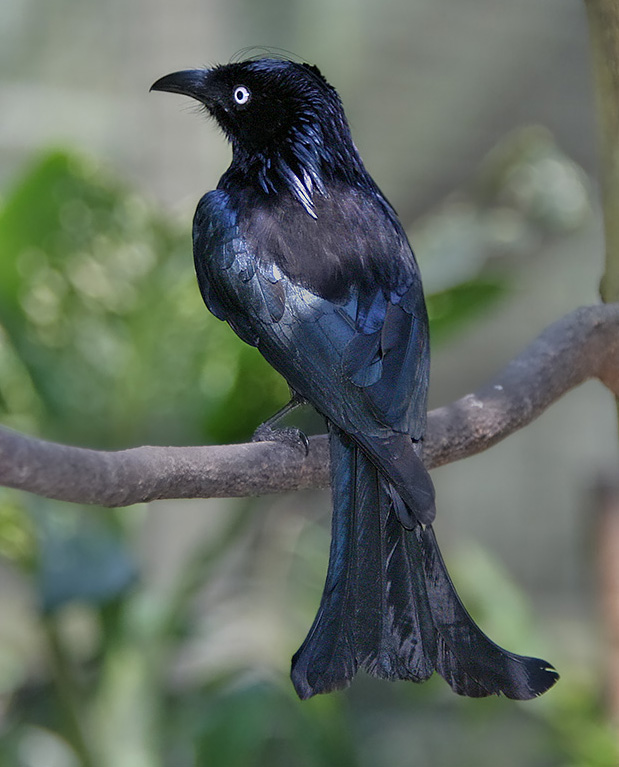
Hair-crested drongo (D. hottentottus striatus)
Scientific classification Edit this classification
Kingdom: Animalia
Phylum: Chordata
Class: Aves
Order: Passeriformes
Superfamily: Corvoidea
Family: Dicruridae
Vigors, 1825
Genus: Dicrurus
Vieillot, 1816
Type species
Corvus balicassius (Balicassiao)
Linnaeus, 1766
Dicrurus phylogeny
Dicruridae

aeneus

paradiseus

annectens

megarhynchus

bracteatus

hottentotus

balicassius

remifer

waldenii

aldabranus

forficatus

adsimilis

macrocercus

modestus

fuscipennis

leucophaeus

atripennis

ludwigii

Cladogram based on a study by Eric Pasquet and colleagues published in 2007.[1]

A drongo is a member of the family Dicruridae of passerine birds of the Old World tropics. The 28 species in the family are placed in a single genus, Dicrurus.

Drongos are mostly black or dark grey, short-legged birds, with an upright stance when perched. They have forked tails and some have elaborate tail decorations. They feed on insects and small birds, which they catch in flight or on the ground. Some species are accomplished mimics and have a variety of alarm calls, to which other birds and animals often respond. They are known to utter fake alarm calls that scare other animals off food, which the drongo then claims.

Taxonomy

[edit]

The genus Dicrurus was introduced by French ornithologist Louis Pierre Vieillot for the drongos in 1816.[2] The type species was subsequently designated as the balicassiao (Dicrurus balicassius) by English zoologist George Robert Gray in 1841.[3][4] The name of the genus combines the Ancient Greek words dikros "forked" and oura "tail".[5] "Drongo" is originally from the indigenous language of Madagascar, where it refers to the crested drongo; it is now used for all members of the family.[6]

This family now includes only the genus Dicrurus, although Christidis and Boles (2007) expanded the family to include the subfamilies Rhipidurinae (Australasian fantails), Monarchinae (monarch and paradise flycatchers), and Grallininae (magpie larks).[7]

The family was formerly treated as having two genera, Chaetorhynchus and Dicrurus. The genus Chaetorhynchus contains a single species, the New Guinea–endemic C. papuensis. On the basis of both morphological and genetic differences, it is now placed with the fantails (Rhipiduridae) and renamed from the pygmy drongo to the drongo fantail.[8]

The genus Dicrurus contains 28 species:[9]

Image Common name Scientific name Distribution
Square-tailed drongo Dicrurus ludwigii southern Africa.
Sharpe's drongo Dicrurus sharpei southern South Sudan and western Kenya to the Democratic Republic of the Congo to Nigeria
Shining drongo Dicrurus atripennis Cameroon, Central African Republic, Republic of the Congo, Democratic Republic of the Congo, Ivory Coast, Equatorial Guinea, Gabon, Ghana, Guinea, Liberia, Nigeria, Sierra Leone, and Togo.
Fork-tailed drongo Dicrurus adsimilis Gabon, Congo Republic, DRC, Angola, northwestern Zambia, Namibia, Botswana and northwestern South Africa
Velvet-mantled drongo Dicrurus modestus Nigeria and Cameroon to the Democratic Republic of Congo and Angola.
Grande Comore drongo Dicrurus fuscipennis Comoros.
Aldabra drongo Dicrurus aldabranus Seychelles
Crested drongo Dicrurus forficatus Madagascar and Comoros
Mayotte drongo Dicrurus waldenii Mayotte.
Black drongo Dicrurus macrocercus Iran through Pakistan, India, Bangladesh and Sri Lanka east to southern China and Indonesia and accidental visitor of Japan
Ashy drongo Dicrurus leucophaeus eastern Afghanistan east to southern China, Ryukyu Islands in southern Japan (particularly Okinawa) and Indonesia.
White-bellied drongo Dicrurus caerulescens India and Sri Lanka.
Crow-billed drongo Dicrurus annectens Bangladesh, Bhutan, Brunei, Cambodia, China, India, Indonesia, Laos, Malaysia, Myanmar, Nepal, Philippines, Singapore, Thailand, and Vietnam.
Bronzed drongo Dicrurus aeneus western Uttaranchal eastwards into Indochina and Hainan, the Malay Peninsula, Sumatra and northern Borneo
Lesser racket-tailed drongo Dicrurus remifer Bangladesh, Bhutan, Cambodia, India, Indonesia, Laos, Malaysia, Myanmar, Nepal, Thailand, and Vietnam.
Balicassiao Dicrurus balicassius Philippines.
Short-tailed drongo Dicrurus striatus Philippines.
Hair-crested drongo Dicrurus hottentottus Bangladesh, India, and Bhutan through Indochina to China, Indonesia, and Brunei.
Tablas drongo Dicrurus menagei Philippines.
Palawan drongo Dicrurus palawanensis Palawan.
Sumatran drongo Dicrurus sumatranus Sumatra in Indonesia.
Wallacean drongo Dicrurus densus Indonesia and East Timor.
Sulawesi drongo Dicrurus montanus Sulawesi in Indonesia.
Spangled drongo Dicrurus bracteatus Australia, New Guinea, Indonesia
Paradise drongo Dicrurus megarhynchus New Ireland in the Bismarck Archipelago, Papua New Guinea.
Andaman drongo Dicrurus andamanensis Andaman Islands
Greater racket-tailed drongo Dicrurus paradiseus India to Borneo and Java
Sri Lanka drongo Dicrurus lophorinus Sri Lanka.

The family Dicruridae is most likely of Indo-Malayan origin, with a colonization of Africa about 15 million years ago (Mya). Dispersal across the Wallace Line into Australasia is estimated to have been more recent, around 6 Mya.[1]

Characteristics

[edit]
Bronzed drongo (Dicrurus aeneus) in India

These insectivorous birds are usually found in open forests or bush. Most are black or dark grey in colour, sometimes with metallic tints. They have long, forked tails; some Asian species have elaborate tail decorations. They have short legs and sit very upright whilst perched, like a shrike. They flycatch or take prey from the ground. Some drongos, especially the greater racket-tailed drongo, are noted for their ability to mimic other birds and even mammals.

Two to four eggs are laid in a nest high in a tree. Despite their small size, they are aggressive and fearless, and will attack much larger species if their nests or young are threatened.

Several species of animals and birds respond to drongos' alarm calls, which often warn of the presence of a predator. Fork-tailed drongos in the Kalahari Desert use alarm calls in the absence of a predator to cause animals to flee and abandon food, which they eat, getting up to 23% of their food this way. They not only use their own alarm calls, but also imitate those of many species, either their victim's or that of another species to which the victim responds. If the call of one species is not effective, perhaps because of habituation, the drongo may try another; 51 different calls are known to be imitated. In one test on pied babblers, the babbler ignored an alarm call repeated three times when no danger was present, but continued to respond to different calls. Researchers have considered the possibility that these drongos possess theory of mind, not fully shown in any animal other than humans.[10][11][12]

Insult

[edit]

The word "drongo" is used in Australian English as a mild form of insult meaning "idiot" or "stupid fellow". This usage derives from an Australian racehorse of the same name (apparently after the spangled drongo, D. bracteatus) in the 1920s that never won despite many places. The word also has been frequently used among friends and can be used in a casual or serious tone.[13][14][15][16]

[edit]

References

[edit]

Further reading

[edit]
[edit]
Revisions and contributorsEdit on WikipediaRead on Wikipedia
from Grokipedia
Drongos are a of small to medium-sized birds (Dicruridae) comprising 28 in the single Dicrurus, distributed across the tropical and subtropical regions of the from to . These sleek, predominantly glossy black birds are distinguished by their deeply forked tails—often elaborate in shape—and prominent head crests in many , enabling agile aerial pursuits as they in a variety of wooded habitats. Drongos inhabit diverse environments, including tropical forests, open woodlands, savannas, mangroves, and even urban edges, with a preference for areas offering perches for scanning prey. Their diet is primarily insectivorous, consisting of flies, beetles, and other arthropods captured in flight, though some species supplement with small vertebrates, fruits, and during certain seasons. Renowned for their and vocal prowess, drongos produce a wide of calls, including harsh chattering, whistles, and notable vocal of other bird species, predators, or environmental sounds to defend territories or manipulate groups. This often facilitates , where drongos falsely alarm other animals to steal food, as observed in species like the (Dicrurus adsimilis). They are typically bold and aggressive, frequently larger birds or predators, and often join mixed-species flocks to enhance efficiency. While most drongo species are widespread and listed as Least Concern by the IUCN as of 2024, poses risks to several endemics, with two classified as Endangered and others as Near Threatened or Vulnerable. Notable examples include the Tablas drongo (Dicrurus menagei), restricted to a single Philippine and threatened by .

Taxonomy and Etymology

Taxonomic Classification

Drongos belong to the family Dicruridae, a lineage of birds in the order Passeriformes and oscines within the Corvides. The family includes a single , Dicrurus, encompassing 28 extant distributed across the tropics. The Dicrurus was established by French ornithologist Louis Pierre Vieillot in his 1816 work Analyse d'une Nouvelle Ornithologie Élémentaire, with the balicassiao (Dicrurus balicassius, originally described as Corvus balicassius by Linnaeus in 1766) selected as the by subsequent designation in 1841. Molecular phylogenetic analyses indicate that Dicruridae originated in the Indo-Malayan region, with the crown group radiating approximately 15 million years ago during the mid-Miocene. Subsequent dispersals led to colonization of around 15 million years ago and about 6 million years ago, driven by vicariance and overwater events across Wallace's Line. The family represents a monophyletic , supported by multi-locus data showing strong nodal support for all major lineages, though some island-endemic forms exhibit cryptic divergence warranting further taxonomic review. The 28 species of Dicrurus exhibit varying levels of endemism and subspecies diversity, particularly in archipelagic regions where isolation has promoted speciation. Notable examples include the black drongo (Dicrurus macrocercus), with up to 11 recognized subspecies across its extensive Asian range reflecting clinal variation in size and plumage gloss. Below is a comprehensive list of species, including common names, scientific names, and primary distributional regions:
Common nameScientific nameDistribution
Aldabra drongoDicrurus aldabranusSeychelles (endemic to Aldabra Atoll)
Andaman drongoDicrurus andamanensisAndaman Islands, India (endemic)
Ashy drongoDicrurus leucophaeusWidespread in South and Southeast Asia
Palawan drongoDicrurus palawanensisPhilippines (Palawan endemic)
BalicassiaoDicrurus balicassiusPhilippines (Luzon and nearby islands)
Black drongoDicrurus macrocercusWidespread in South and Southeast Asia
Blue-mantled drongoDicrurus cyanomelasSub-Saharan Africa
Bronzed drongoDicrurus aeneusSouth and Southeast Asia
Cebu balicassiaoDicrurus cebuensisPhilippines (Cebu endemic)
Comoro drongoDicrurus fuscipennisComoro Islands (endemic)
Crested drongoDicrurus forficatusMadagascar and nearby islands
Crow-billed drongoDicrurus annectensSoutheast Asia
Fork-tailed drongoDicrurus adsimilisSub-Saharan Africa
Greater racket-tailed drongoDicrurus paradiseusSouth and Southeast Asia
Hair-crested drongoDicrurus hottentotusSouth and Southeast Asia, Indonesia
Lesser racket-tailed drongoDicrurus remiferSoutheast Asia and Indonesia
Mayotte drongoDicrurus waldeniiMayotte Island (endemic)
Ribbon-tailed drongoDicrurus megarhynchusBismarck Archipelago (New Ireland endemic)
Sharpe's drongoDicrurus sharpeiCentral Africa
Shiny drongoDicrurus atripennisCentral and West Africa
Spangled drongoDicrurus bracteatusAustralia, New Guinea, and nearby islands
Sri Lanka drongoDicrurus lophorinusSri Lanka (endemic)
Square-tailed drongoDicrurus ludwigiiSub-Saharan Africa
Sulawesi drongoDicrurus montanusSulawesi, Indonesia (endemic)
Tablas drongoDicrurus menageiPhilippines (Tablas Island endemic)
Velvety drongoDicrurus modestusCentral Africa
Wallacean drongoDicrurus densusWallacea region, Indonesia
White-bellied drongoDicrurus caerulescensSouth Asia
White-throated balicassiaoDicrurus albothoraxPhilippines (Mindanao endemic)
This classification reflects current consensus from integrative , incorporating morphological, vocal, and genetic data, though ongoing studies may refine boundaries in polytypic .

The name Dicrurus, introduced by French ornithologist Louis Pierre Vieillot in , derives from the Greek words dikros (meaning "forked") and oura (meaning "tail"), alluding to the characteristic deeply forked tail of these birds. The common English name "drongo" originates from the of , where it refers to local species such as the crested drongo (Dicrurus forficatus), and was first adopted by European naturalists in the early to describe the family. In ornithological nomenclature, the term gained prominence through French descriptions in the 1800s, with species-specific names often reflecting plumage features; for instance, the spangled drongo (Dicrurus bracteatus) is so named for its iridescent, spangle-like feathers. Regional variations in nomenclature highlight local linguistic influences, such as "balicassiao" in the for Dicrurus balicassius, derived from indigenous Tagalog terms describing its glossy appearance.

Physical Characteristics

Morphology and Plumage

Drongos are characterized by an elongated body structure, short legs, and an upright perching stance that positions them prominently on exposed branches or wires. This morphology supports their agile, flycatching lifestyle, with strong feet equipped for secure perching on slender supports. A defining feature of drongos is their tail morphology, which is deeply forked in the majority of species, enhancing aerial maneuverability during pursuits. In certain species, such as the (Dicrurus paradiseus), the outer tail feathers develop into elongated, wire-like shafts tipped with racket-shaped paddles. The forked tail configuration also functions as a key taxonomic marker distinguishing the Dicruridae family from related passerines. The plumage of drongos is typically glossy black or dark grey, often displaying iridescent metallic sheens in hues of , or that vary by lighting and . These feathers provide a sleek, uniform covering that accentuates their streamlined form. Some feature distinctive head crests, as seen in the crested drongo (Dicrurus forficatus), where elongated frontal feathers form a prominent, curving tuft. Drongos possess a sturdy, slightly hooked bill that is black and well-suited for snatching mid-flight, complemented by dense rictal bristles at the base. Their legs and feet are also black, short, and robust, reinforcing their perching adaptations.

Size and Variation

Drongos in the family Dicruridae display considerable variation in body size, with total lengths typically ranging from 19 cm to 65 cm across (with the upper limit due to elongated tails in some species) and weights between 32 g and 125 g. Smaller species, such as the ashy drongo (Dicrurus leucophaeus), measure 23–30 cm in length and weigh 32–55 g depending on the subspecies. Larger species include the Wallacean drongo (Dicrurus densus), which reaches 28–38 cm, and the (Dicrurus paradiseus), with body lengths of 31–36 cm and weights up to 125 g, though total length can extend to 65 cm including the elongated tail. Sexual dimorphism in drongos is generally minimal, with males and females similar in and overall size across most species. However, subtle size differences occur in certain taxa; for example, in the square-tailed drongo (Dicrurus ludwigii), males exhibit larger measurements in wing length, culmen, and tail compared to females. Intraspecific variation is evident in juveniles, which possess duller and shorter tails than adults, aiding in during early development. Geographic races further contribute to diversity; in the ashy drongo, western display darker, nearly blackish-gray , while eastern forms are paler, reflecting adaptations to regional environments. Adaptations related to size include elongated tail feathers in breeding males of several , such as the , which serve as visual displays to attract mates and can significantly increase perceived body length.

Distribution and Habitat

Geographic Range

Drongos, members of the family Dicruridae, are primarily distributed across the tropics and subtropics, spanning from eastward through southern and to and the western Pacific islands. This range encompasses diverse biogeographic regions, with the family originating in around 20–30 million years ago before dispersing westward to Africa and . In Africa, five species occur, including widespread forms like the fork-tailed drongo (Dicrurus adsimilis), which breeds across from the to , excluding arid deserts. Asian distributions are the most diverse, with more than 15 species; for instance, the (Dicrurus macrocercus) ranges from southwest through the to southern , , and the . In Australasia, three to five species are found, such as the (Dicrurus bracteatus), which inhabits eastern and northern Australia, , and nearby islands including the and . Several species are endemic to specific islands, highlighting regional isolation; examples include the Tablas drongo (Dicrurus menagei), restricted to the forests of in the central , and the ribbon-tailed drongo (Dicrurus megarhynchus), found only on New Ireland in . Most drongos are resident within their ranges, but some exhibit altitudinal or short-distance migration, such as the ashy drongo (Dicrurus leucophaeus), which breeds in the and migrates southward to the and during winter. Historical range expansions have shaped current distributions, with evidence of post-Pleistocene dispersals driven by climatic fluctuations; for example, the crested drongo (Dicrurus forficatus) on shows weak phylogeographic structure, indicating recent range expansion and across the island following glacial periods. Earlier diversifications in and , around 12–13 million years ago, were followed by intercontinental dispersals from to .

Habitat Preferences

Drongos, members of the family Dicruridae, inhabit a wide variety of wooded habitats, ranging from dense to open woodlands, forest edges, , plantations, and human-modified landscapes. This adaptability allows them to exploit diverse environments with scattered trees and shrubs, as seen in species like the , which occupies all types of wooded habitats except dense forest, including open woodland and . Their insectivorous diet influences this habitat choice by favoring ecosystems that support abundant aerial insect populations. The family exhibits a broad altitudinal range, occurring from up to 3,000 m in certain species. For instance, the ashy drongo is commonly found in open woodlands and forest edges at elevations reaching 3,000 m in the , demonstrating adaptability to montane conditions. Drongos readily adapt to human-modified landscapes, frequently appearing in agricultural fields, gardens, and near human settlements. The exemplifies this tolerance, thriving in open countryside such as cultivated areas, grasslands, and savannas adjacent to villages. Within these habitats, drongos favor microhabitats that include perching on exposed branches or wires for hunting and nesting in tall trees, typically at heights of 5.5–12.5 m.

Behavior and Ecology

Diet and Foraging

Drongos, members of the family Dicruridae, are primarily insectivorous, with their diet consisting mainly of flying such as flies, beetles, , grasshoppers, , and mantises. Studies on the (Dicrurus adsimilis) indicate that comprise approximately 86% of their food intake. This is supplemented by small vertebrates, such as nestling and adult birds of small passerines, as well as in some cases, and occasionally from flowers like those of species or fruits and seeds from plants such as and . Foraging typically involves aerial hawking, where individuals perch upright on exposed branches, wires, or shrubs and launch sallying flights to capture mid-air or from . Ground is rare, though some snatch prey from foliage or the ground during brief dives. In the black drongo (Dicrurus macrocercus), aerial feeding accounts for over 50% of observed foraging bouts, often from perches 9-12 meters high, targeting dragonflies, moths, and beetles. Larger prey items are held in the claws and broken with before consumption. Drongos are active foragers from dawn to dusk. For instance, the frequently catches in mid-air, adapting to local prey availability. They aggressively defend foraging territories against potential competitors. Seasonal variations influence diet, with certain increasing consumption of fruits, , and when abundance may decline, as observed in fork-tailed drongos incorporating up to 14% plant matter overall.

Social Interactions and

Drongos generally maintain a solitary or paired , with individuals or mated pairs holding and defending territories year-round. This solitary lifestyle facilitates their aerial habits, allowing independent hawking of without interference. However, some exhibit more gregarious tendencies; for instance, the (Dicrurus macrocercus) forms loose flocks of 5–20 birds during migration in , dispersing to individual feeding territories at dawn. Many drongos also opportunistically join mixed-species flocks, associating with other insectivores to exploit flushed prey while contributing to group vigilance. Despite their small size, drongos display remarkable aggressiveness in territorial and nest defense, fearlessly and attacking much larger predators to deter threats. The , in particular, engages in intense of raptors and corvids, using dives and vocal harassment to drive them away from breeding areas. Similarly, the (Dicrurus adsimilis) aggressively pursues intruders, including eagles, employing physical chases and alarm calls to protect its territory. This bold behavior not only safeguards resources but also benefits nearby species by reducing predation pressure in shared habitats. A hallmark of drongo social interactions is their advanced vocal , used to manipulate interspecies relationships through and . The excels at imitating the alarm calls of at least 17 species, including mammals like meerkats (Suricata suricatta), to create false threats that scatter foraging groups and enable food theft via . In Kalahari studies, drongos caused meerkats to flee in 82% of mimicked alarm calls and abandon food in 54% of cases, with success declining over repeated exposures as victims learned to discriminate false calls. occurs through both direct attacks (45% of attempts, 40% success) and deceptive calls (55% of attempts), targeting insects and small vertebrates from hosts like pied babblers. Interspecies dynamics often balance with mutualism, as drongos provide genuine sentinel services to offset their thievery. Fork-tailed drongos associate with groups of sociable weavers (Philetairus socius) and produce specific cooperative calls to alert them to aerial predators, enhancing host survival while gaining safe foraging access. With meerkats, drongos issue true alarms against predators like , fostering a symbiotic vigilance that mitigates the costs of occasional stealing. These relationships highlight drongos' role as opportunistic commensalists in multi-species assemblages, where their skills facilitate both exploitation and reciprocity.

Reproduction

Breeding Biology

Drongos exhibit predominantly monogamous mating systems, with pairs forming for the duration of the breeding season and both partners sharing responsibilities in reproduction. In species such as the (Dicrurus paradiseus), pairs remain bonded throughout breeding, occasionally with assistance from in subsequent broods. This social is typical across the family Dicruridae, promoting territorial defense and biparental care without evidence of widespread . Breeding seasonality in drongos aligns closely with environmental cues, particularly rainfall in tropical regions, where it often coincides with the rainy to ensure food availability for nestlings. For instance, the (Dicrurus macrocercus) breeds from February to August in , peaking during the months. In more temperate or subtropical areas, such as , the (Dicrurus bracteatus) initiates breeding in spring from October to January, synchronizing with warmer weather and abundance. Near the , some populations, like the (Dicrurus adsimilis), may produce multiple broods annually, extending activity from to September north of the and September to January south, though not truly year-round. Courtship displays among drongos are elaborate and multisensory, involving aerial acrobatics, physical posturing, and vocalizations to attract mates and establish pair bonds. Males and females of the engage in aerobatic chases, sometimes locking wings and beaks in mid-air, while spreading tails to accentuate gloss. The performs more theatrical flights, including steep dives and object-dropping play behaviors, highlighting elongated tail rackets. Vocal duets, often incorporating of other ' calls, reinforce pair coordination during these displays. Clutch sizes in drongos typically range from 2 to 4 eggs, reflecting adaptations to variable predation and resource availability. Eggs are generally pale cream or pinkish with brown spots or blotches for , as observed in the where mean dimensions are approximately 24–27 mm in length and 16–20 mm in breadth. Incubation periods last 13–18 days, with both parents alternating duties; for example, the averages 13 days, ensuring synchronized hatching for efficient chick rearing.

Nesting and Parental Care

Drongos construct cup-shaped nests primarily from twigs, grasses, dry fibers, and spider webs, often weaving these materials together for stability. These nests are typically built in the upper canopy of trees, at heights ranging from 5 to 12 meters above the ground in species like the (Dicrurus macrocercus), though some, such as the Hair-crested Drongo (Dicrurus hottentottus), may place them higher, up to 20-30 meters in isolated or tall trees to reduce predation risk. Incubation of the eggs is shared between both parents, with the female often taking the primary role, particularly at night, while the male provides relief during the day; the typically lasts 13-18 days, commencing after the full is laid to ensure synchronous hatching. In species like the (Dicrurus adsimilis), both sexes participate equally in turning the eggs and maintaining nest temperature. Following hatching, is biparental, with both male and female drongos feeding the altricial chicks a diet of and small fruits delivered frequently throughout the day. The nestling period varies by but generally spans 16-22 days, after which the young ; post-fledging dependence continues for 1-2 months, during which parents continue provisioning and protecting the juveniles as they develop skills and full . Although drongos exhibit strong nest defense behaviors, including aggressive of potential threats, they are occasional victims of by cuckoos. The African cuckoo (Cuculus gularis) primarily targets the (Dicrurus adsimilis) in , while the drongo-cuckoo (Surniculus dicruroides) mimics drongo and calls to exploit nests of Asian species such as the . This parasitism is more prevalent in the , where up to 20% of nests may be affected, though drongos often reject foreign eggs through recognition behaviors.

Conservation Status

The majority of drongo species in the family Dicruridae are classified as Least Concern by the , reflecting their wide distributions and generally stable populations across much of , , and . For instance, the black drongo (Dicrurus macrocercus) maintains a stable population across its extensive range in South and , supported by its adaptability to diverse habitats. Similarly, the fork-tailed drongo (Dicrurus adsimilis), widespread in , shows no evidence of significant decline, with trends assessed as stable. However, several endemic species face higher risks, with Vulnerable or Endangered statuses due to restricted ranges and small populations. The Tablas drongo (Dicrurus menagei), confined to in the , is Endangered, with an estimated population of 400–1,000 mature individuals (as of 2024). The Mayotte drongo (Dicrurus waldenii) on Island is Vulnerable, with recent assessments estimating 2,500–9,999 mature individuals (as of 2021) and a stable or increasing trend, though earlier counts suggested as few as 100. The Grand Comoro drongo (Dicrurus fuscipennis), limited to a narrow band on Grand Comoro Island, is also Endangered, highlighting vulnerabilities among island endemics. Common drongo species in Asia, such as the greater racket-tailed drongo (Dicrurus paradiseus), are described as locally abundant, with unquantified but large populations likely numbering in the millions across their ranges, though overall trends are suspected to be slowly decreasing. In contrast, populations of endemic species in fragmented island habitats are declining, often remaining below 1,000 individuals for species like the Tablas drongo. For widespread species, national estimates provide context; for example, the black drongo has 10,000–100,000 breeding pairs in China alone. Population monitoring for drongos relies on standardized bird surveys and platforms, which track abundance and range occupancy over time. Data from eBird, a global observation database, indicate range stability for common species like the , with consistent reporting across core areas since the platform's in 2002. Additional efforts include point counts and density estimates in key regions, as used for the Mayotte drongo to refine population figures. Recent assessments as of 2024–2025 have supported potential status improvements for some endemics, such as the Mayotte drongo, through better survey data. Overall, drongo populations exhibit stability at the family level, with no global decline approaching IUCN thresholds for higher risk categories. However, local declines occur in deforested areas, particularly for forest-dependent endemics, where habitat loss has led to suspected reductions of 10–30% in some populations since 2000, as inferred from regional survey trends.

Threats and Conservation Measures

Drongos face several significant threats across their range, with being the most pervasive due to for , , and . This is particularly acute for forest-dependent , where conversion of woodlands into farmlands and human settlements fragments and reduces available nesting sites. For instance, the ribbon-tailed drongo (Dicrurus megarhynchus) is highly vulnerable to ongoing and habitat degradation in its limited range on New Ireland, Papua New Guinea, exacerbating risks for this . The widespread use of pesticides in agricultural areas poses another key risk by diminishing populations, the primary prey for most drongo species. Insectivorous drongos, such as the (Dicrurus adsimilis), experience reduced foraging opportunities in pesticide-heavy regions, contributing to localized declines. Additionally, is altering drongo distributions and physiologies; in East African highlands, warming temperatures have led to smaller body sizes in species like the square-tailed drongo (Dicrurus ludwigii), potentially affecting their resilience to environmental stressors. Island-endemic drongos are especially susceptible due to their restricted ranges, where habitat loss compounds vulnerability, though direct remains rare across the family. The paradise drongo (Dicrurus megarhynchus, also known as ribbon-tailed) exemplifies this, with its small population on a single facing intensified pressures from land clearance, while like the Aldabra drongo (Dicrurus aldabranus) on the Aldabra are near-threatened owing to limited habitat and isolation. The Tablas drongo (Dicrurus menagei) in the similarly contends with extreme forest degradation on a tiny range. Conservation efforts for drongos emphasize habitat protection and monitoring, with no species currently listed under but several tracked by through regional assessments. In , protected areas such as and safeguard populations of the white-bellied drongo (Dicrurus caerulescens) by preserving mixed forests essential for their survival. Community-based programs in regions like the support watershed forest reserves that encompass key habitats for endemics like the Tablas drongo, promoting sustainable to curb degradation. In African contexts, initiatives within national parks indirectly benefit widespread species like the by maintaining insect-rich ecosystems amid agricultural expansion. Ongoing monitoring by organizations like aids in early detection of threats, guiding targeted interventions for vulnerable taxa, including recent surveys that have informed status reviews for species like the Mayotte drongo.

Cultural Significance

Symbolism and Folklore

In Malagasy folklore from , the drongo is depicted as a clever . According to a traditional , a fire threatened the , and the bat extinguished it but slept upside down from exhaustion. The drongo, originally white, covered itself in ashes to appear blackened by the fire and claimed to that it had saved the , thus being crowned king of birds. This story highlights the bird's intelligence and deceptive abilities, explaining its black plumage and status. In Indian culture, the black drongo holds significant symbolic value as the "kotwal" or policeman, a title reflecting its fearless mobbing of larger predators like eagles and crows to safeguard its nest and nearby birds. This protective role extends to local beliefs where the bird is revered as a symbol of good fortune and ecological guardianship, particularly in agricultural areas where it controls insect pests. A traditional legend from Northeast India portrays the greater racket-tailed drongo as an ambitious protagonist who, through wit and persistence, acquires an elaborate tail to claim kingship among birds, highlighting themes of beauty and determination. Among Australian Aboriginal peoples, such as the Ngajan, the features in Dreamtime stories as a heroic helper; in one tale, it encounters shivering small birds and assists them in obtaining fire from a distant source, enabling warmth and survival for the group. This narrative underscores the drongo's role as a bold and protector in the natural world. In and , drongos often represent , , and , inspired by their vocal and opportunistic behaviors, appearing as metaphors for cunning survival in works exploring human-animal parallels.

Use as an Insult

In Australian English, the term "drongo" emerged as a slang insult denoting a foolish or incompetent person, originating from a notorious racehorse of the same name in the 1920s. This horse, named after the spangled drongo bird (Dicrurus bracteatus), competed in 37 races between 1920 and 1925 without securing a single victory, earning it a reputation for utter uselessness in the racing world. The animal's consistent failures led to "drongo" being applied derisively to underperformers in horse racing circles, symbolizing profound incompetence. By the early 1940s, the slang had spread beyond racing into broader Australian vernacular, particularly through military usage during . It first appeared as a (RAAF) term for an inexperienced or inept recruit, reflecting the era's adoption of colorful insults among service personnel. Post-war, the word entered everyday language in and , where it now commonly signifies an "idiot," "fool," or "simpleton" lacking common sense. Unlike more universal slurs, "drongo" remains largely confined to these regions, with no direct equivalents elsewhere. The term features prominently in Australian media, comedy, and popular culture as a mild yet pointed insult. For instance, in 1977, journalist Buzz Kennedy described it in The Australian newspaper as applying to "a simpleton who lacks commonsense and is a bit of a fool," highlighting its casual deployment in everyday discourse. It has appeared in films, television sketches, and stand-up routines to evoke bumbling characters, such as in comedic portrayals of inept Aussies, though its usage has somewhat declined in favor of stronger expletives since the 1980s. Actor , in a 2020 Vanity Fair interview, noted its old-fashioned charm while teaching international audiences , underscoring its enduring, if nostalgic, place in cultural lexicon. Ironically, the contrasts sharply with the drongo bird's real traits, as these birds are known for their sharp and bold, aggressive behaviors—qualities far removed from the ineptitude the term implies.

References

  1. https://en.wiktionary.org/wiki/drongo
Add your contribution
Related Hubs
User Avatar
No comments yet.