


Community hub
Recent from talks
Contribute something
Nothing was collected or created yet.
E-Trade
View on Wikipedia
Key Information


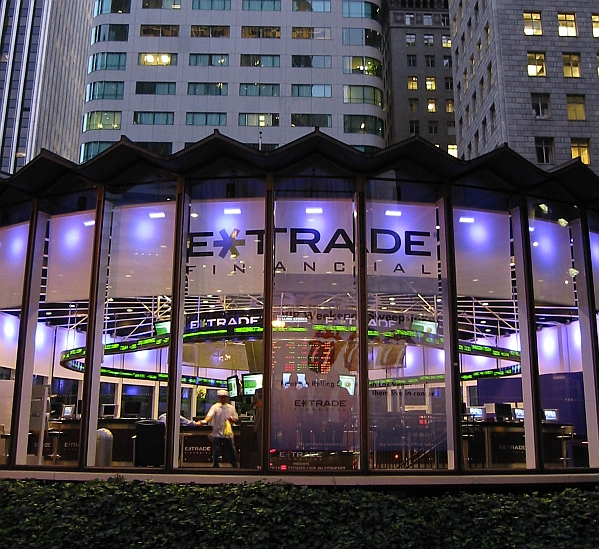
E-Trade (stylized as E*TRADE)[2] is an investment brokerage and electronic trading platform that operates as a subsidiary of Morgan Stanley.
History
[edit]![[icon]](https://en.wikipedia.org/wiki/File:Wiki_letter_w_cropped.svg) | This section needs expansion. You can help by adding to it. (June 2024) |

In 1982, physicist William A. Porter and Bernard A. Newcomb founded TradePlus in Palo Alto, California, with $15,000 in capital. In 1983, it launched its first trade via a Compuserve network. In 1992, Porter and Newcomb founded E-Trade and made electronic trading available to individual investors.[3]
On August 16, 1996, the company (by then known as the E-Trade Financial Corporation) became a public company via an initial public offering. The company sold 5,665,000 shares of its common stock for $10.50 per share under the stock ticker "ETFC" on the NASDAQ stock exchange.[4] The company figured prominently in the dot-com boom, as both a way to speculate in internet stocks and an internet stock itself.
In October 2020, the company was acquired by Morgan Stanley.[5][6][7]
Management history
[edit]In November 2007, Mitch Caplan resigned as CEO and Citadel LLC received a seat on the board of directors of the company after Citadel invested $2.5 billion in the company to bolster its finances after it suffered losses due to the bursting of the 2000s United States housing bubble.[8][9][10]
In March 2008, E-Trade named Donald Layton, formerly JPMorgan Chase vice chairman, its new CEO. Layton had joined E-Trade's board of directors in November 2007, at the same time as the Citadel LLC deal.[11][12][13]
In December 2009, Robert Druskin, a former chief operating officer of Citigroup, was named interim CEO and chairman.[14]
On March 22, 2010, Steven Freiberg was named CEO. Freiberg was the former co-CEO of Citigroup's global consumer group and the former head of its credit card unit.[15][16]
On January 17, 2013, Paul T. Idzik was appointed CEO. Idzik had previously been group chief executive of DTZ and also served ten years at Barclays bank.[17]
In September 2016, Karl A. Roessner, E-Trade's general counsel since 2009, was appointed CEO.[18]
On August 14, 2019, Michael Pizzi was appointed CEO.[19]
Advertising
[edit]In 2007, E-Trade introduced its talking baby campaign in which comedian Pete Holmes was the voice of the baby and Steve Burns was the voice of the announcer.[20]
Acquisitions and divestitures
[edit]| Date | Acquisition / Divestiture | Company | Ref. |
|---|---|---|---|
| January 2000 | Acquisition | Telebanc | [21][22][23] |
| May 2001 | Acquisition | Web Street Securities | [24][25][26] |
| August 2005 | Acquisition | Harrisdirect | [27][28][29] |
| October 2005 | Acquisition | Brown & Company | [30][31][32] |
| July 2007 | Divestiture | Australian division | [33][34][35][36] |
| September 2008 | Divestiture | Canadian division | [37][38] |
| September 2016 | Acquisition | OptionsHouse | [18][39][40] |
| April 2018 | Acquisition | Trust Company of America | [41] |
| December 2019 | Acquisition | Gradifi | [42][43] |
See also
[edit]


- Ajaxo Inc. v. E*Trade Financial Corp.
- Merrill Lynch, Pierce, Fenner & Smith Inc. v. Manning, a 2016 Supreme Court case involving naked short-selling claims against E*TRADE, Merrill Lynch, and others, resolved in the defendant's favor
References
[edit]- ^ "Contact Us | E*TRADE". about.etrade.com. Retrieved 30 December 2022.
- ^ "E*TRADE".
- ^ "Sidebar: A Brief History of ETrade". Computerworld. September 27, 2004.
- ^ "E*Trade hits Wall Street". CNET. August 16, 1996.
- ^ Manskar, Noah (October 2, 2020). "Morgan Stanley officially closes all-stock E*Trade takeover deal". New York Post.
- ^ Hoffman, Liz (October 8, 2020). "Morgan Stanley to Buy Eaton Vance for $7 Billion". The Wall Street Journal.
- ^ de la Merced, Michael J.; Kelly, Kate; Flitter, Emily (February 20, 2020). "Morgan Stanley to Buy E-Trade". The New York Times.
- ^ Robinson, Gwen (November 12, 2007). "Subprime mortgage fears batter E-Trade". Financial Times.
- ^ "E*TRADE Financial Announces $2.5 Billion Investment Led by Citadel" (Press release). E-Trade Financial. November 29, 2007 – via U.S. Securities and Exchange Commission.
- ^ Yerak, Becky (November 30, 2007). "Citadel boosts E-Trade stake with $2.5 billion investment". Chicago Tribune.
- ^ Giannone, Joseph A. (March 2, 2008). "E*Trade Chairman Layton adds CEO post". Reuters.
- ^ Spence, John (March 3, 2008). "E-Trade names Donald Layton as chief executive". MarketWatch.
- ^ Craig, Susanne (March 3, 2008). "E*Trade, With Layton as CEO, Might Be Angling for a Sale". The Wall Street Journal.
- ^ "E-Trade names director as chairman, interim CEO". San Diego Union Tribune. Associated Press. December 21, 2009.
- ^ Ellis, Blake (March 22, 2010). "ETrade names former Citigroup exec as CEO". CNN.
- ^ "E*Trade Hires Steven Freiberg As New CEO". The Wall Street Journal. March 22, 2010.
- ^ "E*TRADE Financial Appoints Paul T. Idzik Chief Executive Officer" (Press release). E-Trade Financial. January 17, 2013 – via Business Wire.
- ^ a b "E*TRADE Financial Corporation Announces Leadership Transition with Close of OptionsHouse Transaction" (Press release). E-Trade Financial. September 12, 2016 – via Business Wire.
- ^ Wylonis, Christian (August 19, 2019). "Here are the latest executive power moves that help explain everything that's going on at E*Trade, Rite Aid, and Yum! Brands". Business Insider.
- ^ https://www.cnn.com/2022/01/28/media/etrade-baby-super-bowl-ad
- ^ Buckman, Rebecca (January 12, 2000). "E*Trade Group Wins Approval To Acquire Telebanc Financial". The Wall Street Journal.
- ^ Knight, Jerry (January 26, 2004). "For E-Trade, Courtship Ends Short of Marriage". The Washington Post.
- ^ "ETrade to buy Telebanc Financial". Deseret News. Associated Press. June 1, 1999.
- ^ "E-Trade acquires Web Street". American City Business Journals. May 21, 2001.
- ^ "E-Trade to Buy Web Street for $45 Million". Los Angeles Times. Reuters. May 21, 2001.
- ^ "E-TRADE TO BUY RIVAL BROKERAGE WEB STREET". Ad Age. May 22, 2001.
- ^ "E-Trade to Acquire Rival Brokerage Harrisdirect". Los Angeles Times. August 9, 2005.
- ^ "E-Trade agrees to buy rival HarrisDirect". NBC News. Associated Press. August 8, 2005.
- ^ Perez, Juan Carlos (August 8, 2005). "E-Trade buys online brokerage for $700 million". InfoWorld.
- ^ "E-Trade to acquire BrownCo for $1.6B". American City Business Journals. September 30, 2005.
- ^ Bajaj, Vikas (September 29, 2005). "E*Trade to Buy BrownCo From J.P. Morgan for $1.6 Billion". The New York Times.
- ^ "E-Trade to Acquire BrownCo for $1.6 Billion". Los Angeles Times. September 30, 2005.
- ^ Thurlow, Rebecca (May 16, 2007). "ANZ Bank clears final hurdle in bid to acquire ETrade Australia". MarketWatch.
- ^ Thomas, Denny (August 9, 2007). "ANZ gets controlling stake in E*Trade Australia". Reuters.
- ^ Thurlow, Rebecca (April 24, 2007). "ANZ Increases Offer to Acquire ETrade Australia". The Wall Street Journal.
- ^ Thompson, Sarah; Macdonald, Anthony; Moullakis, Joyce (April 25, 2016). "ANZ Banking Group to re-name E*TRADE Australia". Australian Financial Review.
- ^ "Scotiabank Completes Acquisition of E*TRADE Canada" (Press release). Scotiabank. September 22, 2008.
- ^ "Scotiabank buys E*Trade Canada". CBC News. July 14, 2008.
- ^ Garcia, Tonya (July 25, 2016). "ETrade agrees to acquire OptionsHouse parent for $725 million". MarketWatch.
- ^ Carey, Theresa W. (September 2, 2017). "E*Trade, OptionsHouse Merge Platforms". Barron's.
- ^ "E*TRADE Announces Close of Trust Company of America (TCA) Transaction" (Press release). Business Wire. April 9, 2018.
- ^ "E*TRADE Bolsters Corporate Services Capabilities Through Purchase of Pioneering Student Loan Benefit Provider Gradifi" (Press release). E-Trade Financial. December 9, 2019 – via Business Wire.
- ^ Orlofsky, Steve (December 9, 2019). "E*Trade buys student loan provider Gradifi for $30 million". Reuters.
External links
[edit]
40°45′36″N 73°58′52″W / 40.760°N 73.981°W
| Founders |  | ||||
|---|---|---|---|---|---|
| Notable executives |
| ||||
| Subsidiaries |
| ||||
| Historical components | |||||
| Buildings | |||||
Online brokerages | |||||||||||||
|---|---|---|---|---|---|---|---|---|---|---|---|---|---|
| Companies |
| ||||||||||||
| Concepts | |||||||||||||

E-Trade
View on GrokipediaHistory
Founding and Early Development
E*TRADE was founded in 1982 as TradePlus by William A. Porter, a physicist, and Bernard A. Newcomb, a software engineer, in Palo Alto, California, with an initial investment of $15,000. The company aimed to automate stock trading through early computer networks, marking one of the first efforts to bring electronic brokerage services to individual investors. In May of that year, Max Ule launched Tickerscreen, an online financial information service that allowed users to place after-hours stock orders via a bulletin-board system, which was later integrated with TradePlus to enhance its order entry capabilities.[6][3] TradePlus achieved a milestone in July 1983 by executing its first online trade over the CompuServe network in partnership with C.D. Andersen & Co., enabling real-time order entry and execution during market hours. This innovation positioned TradePlus as a pioneer in electronic trading, though initially limited to subscribers of online services. By 1984, the platform had attracted approximately 500 customers, who generated up to 12% of C.D. Andersen's commission revenue, demonstrating early adoption despite the nascent state of digital infrastructure. To expand access, TradePlus formed a partnership with Quick & Reilly, the third-largest discount broker at the time, in 1985, allowing its services to be offered through CompuServe to a broader audience.[7][8][9] The 1987 stock market crash, known as Black Monday, significantly impacted early online trading services like TradePlus, as the sharp decline in trading volume—over 22% drop in the Dow Jones Industrial Average—stunted growth and reduced activity across the sector. However, the event highlighted the value of electronic platforms, with TradePlus servers operating nearly continuously (24/7) to handle inquiries and orders from both domestic and international users amid the market turmoil. By 1992, TradePlus rebranded its brokerage operations as E*TRADE Securities Inc., still based in Palo Alto, California, with combined revenues for TradePlus and the new entity reaching approximately $850,000, reflecting steady foundational progress in the evolving digital trading landscape.[9][3]Expansion and Public Listing
ETRADE experienced rapid growth in the mid-1990s, driven by increasing online trading adoption, which strained its initial infrastructure. In 1995, the company's systems faced overloads due to surging transaction volumes, prompting a quadrupling of its technological capacity to handle the demand.[3] To support this scaling, ETRADE expanded its workforce from 44 employees in 1994 to over 200 by the mid-1990s and grew its office space from 4,800 square feet to more than 20,000 square feet.[10] In April 1996, the company opened a second facility in Rancho Cordova, California, serving as a secondary data center to provide redundancy and operational continuity alongside its primary Palo Alto site.[11] That same year, Christos Cotsakos was appointed president and CEO in March, bringing expertise from Federal Express to steer the firm's expansion.[12] The company's growth culminated in its initial public offering on August 15, 1996, when it sold 5,665,000 shares at $10.50 each on the NASDAQ under the ticker ETFC, raising net proceeds of approximately $46.4 million.[11] This IPO fueled further development, with revenues more than doubling to $51.6 million for fiscal 1996 ended September 30, compared to $23.3 million the prior year.[11] By September 30, 1996, E*TRADE employed 327 full-time associates, reflecting the operational buildup.[11] In 1997, ETRADE strengthened its market position through strategic partnerships, including a June agreement with Yahoo! to integrate trading links on the search engine's platform, boosting visibility amid rising internet usage.[3] During the October 27, 1997, mini-crash triggered by Asian financial instability, the enhanced infrastructure allowed ETRADE to manage elevated trading volumes without major disruptions, demonstrating system resilience.[13] By fiscal 1999 ended September 30, revenues surged 132.4% to $662.3 million, underscoring the firm's dominance in online brokerage.[3] That year, E*TRADE pursued international expansion by launching branded websites in France, Japan, Sweden, and the United Kingdom, extending its services to new markets through licensing and joint ventures.[14] Diversification accelerated in 2000 with the April launch of E*TRADE Bank, a federally chartered online savings bank acquired via Telebanc Financial Corporation, offering deposit accounts and loans to complement brokerage services.[15] In October, the company introduced wireless banking and brokerage capabilities, enabling mobile access to accounts and trades via early cellular technology.[16] E*TRADE returned to profitability in fiscal 2000 ended September 30, posting net income of $19.2 million after prior losses, aided by revenue diversification and operational efficiencies.[17] However, the firm recorded a net loss of $241.5 million in fiscal 2001, influenced by restructuring charges and market downturns.[18]Challenges and Restructuring
In 2001, E*TRADE reported a net loss of $241.5 million, amid broader market challenges following the dot-com bust, while planning to roll out an international trading platform based on Versus Technologies to serve over 650 institutional customers worldwide.[19][20] To bolster its trading capabilities, E*TRADE acquired Tradescape Corporation in June 2002 for approximately $100 million in stock, a move that nearly doubled its daily brokerage transactions and enhanced direct market access for active traders.[21][22] The company faced significant leadership turmoil in early 2003 when CEO Christos Cotsakos resigned in January amid backlash over his $77.2 million compensation package for 2001, during which E*TRADE incurred substantial losses; Cotsakos returned $21 million of that package as a conciliatory gesture.[20][23][24] Mitchell H. Caplan succeeded Cotsakos as CEO in January 2003 and led a rebranding to E*TRADE Financial Corporation later that year, shifting emphasis toward diversified financial services including banking and lending alongside core brokerage operations.[25][26][27] The 2008 financial crisis severely impacted E*TRADE, resulting in a record $1.71 billion fourth-quarter loss driven by mortgage-related impairments and necessitating divestitures of international units to streamline operations and preserve capital.[28][29][30] Leadership instability persisted through the crisis and recovery, with Caplan resigning in November 2007 amid mounting losses; Donald Layton appointed CEO in 2008; Robert Druskin serving as interim CEO in 2009; Steven Freiberg taking over in 2010; Paul T. Idzik in 2013; Karl A. Roessner in 2016; and Michael Pizzi in 2019.[31][32][33][34][35][36] By the late 2010s, E*TRADE achieved revenue recovery, posting its first annual profit since 2006 with $156.7 million in net income for 2011, and refocused on core U.S. operations by divesting non-essential assets and enhancing domestic brokerage and banking services.[37][38]Acquisition by Morgan Stanley
On February 20, 2020, Morgan Stanley announced its acquisition of ETRADE in an all-stock transaction valued at $13 billion, offering $58.74 per share to ETRADE shareholders.[39][40] The deal aimed to combine Morgan Stanley's institutional expertise with E*TRADE's retail brokerage capabilities, marking a significant expansion into digital investing platforms.[41] The acquisition was completed on October 2, 2020, after receiving regulatory approvals, integrating E*TRADE as a key component of Morgan Stanley's operations.[42] This merger added approximately $56 billion in low-cost deposits to Morgan Stanley's balance sheet and brought in 5.2 million new customer accounts, enhancing its retail client base.[43] Strategically, the acquisition bolstered Morgan Stanley's wealth management division by incorporating ETRADE's digital brokerage model, which targeted tech-savvy retail investors and provided scalable growth in client assets.[41][44] Following the merger, ETRADE was folded into Morgan Stanley Wealth Management as one of its core client channels, alongside advisor-led and workplace services, and rebranded as E*TRADE from Morgan Stanley to reflect its subsidiary status.[45][46] By 2025, the integration had stabilized, with ETRADE maintaining approximately 10,200 employees as part of Morgan Stanley's broader workforce.[1] Key post-acquisition developments included the July 2025 launch of the Power ETRADE Pro desktop platform, designed specifically for active traders with advanced customization features.[45] In September 2025, Morgan Stanley announced plans to introduce cryptocurrency trading on the E*TRADE platform through a partner model, scheduled for rollout in the first half of 2026.[47]Products and Services
Brokerage and Trading
E*TRADE's brokerage services provide retail investors with access to a range of self-directed trading options focused on securities such as stocks, exchange-traded funds (ETFs), options, and futures.[48] The platform supports commission-free online trading for U.S.-listed stocks, ETFs, and options trades, a policy introduced in October 2019 to align with industry trends toward zero-commission models.[49] While stock and ETF trades incur no base commissions, options contracts carry an additional fee of $0.65 per contract, plus regulatory fees.[50] Futures trades are $1.50 per contract (per side, plus exchange fees).[50] E*TRADE provides exposure to silver through ETFs such as SIVR (abrdn Physical Silver Shares ETF) and SLV (iShares Silver Trust), as well as futures contracts (/SI for silver and /SIL for micro silver). However, the platform does not permit the purchase of physical silver or physical delivery of commodities to customers; futures positions generally must be closed before delivery, and no direct physical bars or coins are available.[51][48] Account types available through E*TRADE's brokerage include individual taxable accounts, joint accounts, custodial accounts for minors, traditional IRAs, Roth IRAs, and margin accounts for eligible investors seeking leverage.[52] These accounts enable users to hold and trade a variety of securities, with margin accounts requiring approval based on financial qualifications and experience.[53] Investors can also access over 6,000 mutual funds, including no-load and no-transaction-fee options, as well as fixed-income products such as more than 50,000 bonds and brokered certificates of deposit (CDs).[50][54] Brokerage accounts can be opened online in approximately 10 minutes through a fully digital application process. While the initial application is quick, full account approval, verification, and activation for trading often require additional time, such as up to three business days for electronic fund transfers and funding clearance.[55][56] Options trading on E*TRADE is structured around approval levels that determine permissible strategies, with Level 1 allowing basic covered calls and buy-writes against owned stock.[57] Higher levels include Level 2 for long calls and puts, long straddles and strangles, and Level 3 for advanced multi-leg strategies such as debit and credit spreads, butterflies, iron butterflies, iron condors, and naked puts, which require demonstrated experience and margin account approval for Levels 3 and above.[57] The platform supports execution of these multi-leg orders through features such as multi-leg order entry, customizable option chains, and strategy visualization tools to aid in analysis and implementation of strategies like Iron Condors.[57] These features support strategies including covered calls for income generation and spreads for risk-defined positions, with tools to analyze probability and potential outcomes.[58] To support trading activities, E*TRADE offers educational resources including in-depth articles, videos, and webinars on stock research, options basics, and strategy implementation.[59] These materials cover topics like fundamental analysis for stock selection and risk management in options trading, helping users build conceptual understanding without relying on exhaustive data lists.[60]Banking and Related Services
ETRADE Bank was established in early 2000 following the acquisition of Telebanc Financial Corporation, which became the holding company for the bank and enabled the offering of FDIC-insured deposit accounts.[17] Upon its launch, the bank provided customers with FDIC-insured savings accounts, checking accounts, and money market deposit accounts, allowing seamless integration with brokerage services for retail investors.[61] These accounts were designed to offer competitive interest rates while maintaining federal insurance protection up to applicable limits, catering to the growing demand for online banking among ETRADE's user base.[62] A key product in ETRADE Bank's lineup was the Premium Savings Account, which featured competitive annual percentage yields (APYs) and no monthly maintenance fees or minimum balance requirements.[63] As of November 2025, the account offers a 3.75% APY with FDIC insurance up to $500,000 under certain conditions, emphasizing accessibility for investors seeking to park cash outside of trading activities.[50] Additionally, ETRADE provided debit cards directly linked to brokerage accounts, facilitating seamless transfers between banking and investment holdings without the need for external wires or delays.[64] This integration allowed users to access uninvested cash for everyday spending while earning interest on idle funds, with no transaction fees for most domestic ATM withdrawals.[65] ETRADE also offers the free Transfer Money service, which allows customers to withdraw funds from their brokerage accounts to linked external bank accounts. To initiate a transfer, users link their external bank account online if not already linked, select the ETRADE account as the "From" account and the external bank account as the "To" account, enter the amount and desired date, choose recurrence if applicable, preview the transfer, and confirm. Processing typically takes 1-3 business days, depending on the receiving institution. Wire transfers are available as an alternative for potentially faster processing.[66][67] Prior to the 2020 acquisition by Morgan Stanley, ETRADE Bank offered lending products such as home equity lines of credit and personal loans as part of its consumer banking portfolio.[61] These were originated through a legacy program that included mortgage-related and other consumer loans, providing borrowers with flexible access to credit backed by home equity or unsecured personal needs.[61] Post-acquisition, these offerings were integrated into Morgan Stanley's broader private banking services, with the bank's legacy loan portfolio continuing to be managed under the combined entity.[68] The acquisition brought approximately $56 billion in low-cost deposits to Morgan Stanley, enhancing its funding capabilities for overall operations, including support for trading activities within the ETRADE platform.[41]Wealth Management Offerings
ETRADE offers wealth management services through its Core Portfolios program, an automated investment management solution managed by Morgan Stanley Wealth Management.[69] Core Portfolios builds customized, diversified portfolios based on investors' goals, risk tolerance, and preferences, including options for socially responsible investing. The service features automatic rebalancing, tax-loss harvesting to minimize capital gains taxes, and professional oversight using Modern Portfolio Theory. It requires a minimum investment of $500 and charges an annual advisory fee of 0.30% of assets under management. Eligible account types include individual, joint, custodial, and various IRA accounts. Additionally, ETRADE customers can access personalized financial advice from Morgan Stanley financial advisors for comprehensive wealth planning, integrating self-directed tools with expert guidance.[70]Technology and Platforms
Core Trading Platforms
ETRADE offers two primary web-based trading platforms designed for different levels of user expertise: the standard ETRADE web platform for everyday investors and the advanced Power E*TRADE platform for active traders seeking deeper analytical tools. These platforms provide seamless access to trade execution, market monitoring, and research capabilities across asset classes including stocks, options, ETFs, mutual funds, bonds, and futures. Both are accessible without downloads, emphasizing intuitive interfaces for analysis and order placement available to all brokerage account holders.[71] The standard E*TRADE web platform serves as the foundational interface, enabling users to place trades via user-friendly order tickets for stocks, options, ETFs, mutual funds, bonds, and qualified IPOs. It includes customizable watchlists that deliver streaming real-time quotes, integrated news feeds, interactive charts, and daily market commentary to track positions and opportunities efficiently. Market scanners are a core feature, allowing users to screen stocks, mutual funds, bonds, and ETFs based on predefined or custom criteria, while options-specific tools such as screeners, optimizers, backtesters, and analyzers help identify and evaluate trading strategies for stocks, options, and futures.[72][73] Power E*TRADE builds on the standard platform with enhanced tools tailored for sophisticated analysis and execution. It features advanced charting capabilities with over 145 technical studies and drawing tools, including automatic support and resistance lines as well as pattern recognition for technical analysis. Users can access customizable options chains to build and execute simple or complex strategies, such as four-legged spreads including Iron Condors, supported by real-time streaming quotes, news, earnings data, dividends, and market depth views. The platform offers Snapshot Analysis for visualizing the risk/reward probabilities of options strategies and supports multi-leg order entry for efficient execution of complex trades. The platform's Live Action scanner enables custom and preset scans to monitor market trends, unusual activity, and volatility in real time.[74][57] A key integration across these platforms is the visualization of corporate events on charts, where icons denote dividends (D), earnings (E), and splits (S) via an Events dropdown menu, aiding in contextual price analysis. Both platforms support customizable layouts and saved setups, allowing users to preserve personalized chart configurations, watchlists, and scanner parameters for recurring workflows—such as saving technical studies or options chain views for quick recall. These features extend to mobile applications for on-the-go access, though the full desktop and web experiences provide the most comprehensive customization.[75][74]Mobile and Digital Tools
E*TRADE introduced wireless trading services in October 2000, marking an early step toward mobile accessibility for investors and laying the foundation for its evolution into a comprehensive mobile brokerage platform.[14] This initial offering allowed users to execute trades via web-enabled phones, expanding beyond desktop limitations to provide on-the-go market access.[76] Over the subsequent decades, these capabilities advanced with smartphone proliferation, culminating in dedicated apps that prioritize user-friendly interfaces for everyday investors. The E*TRADE Mobile app, available for both iOS and Android devices, enables seamless trade execution of stocks, ETFs, options, and mutual funds with $0 commissions on eligible U.S.-listed trades, alongside robust portfolio tracking to monitor balances, positions, and performance metrics.[77] Users can receive real-time news alerts, including Bloomberg TV streams, third-party research, and breaking market updates, ensuring timely information without needing to switch applications.[77] The app's design emphasizes accessibility, with intuitive navigation that supports quick deposits, transfers, and bill payments directly from mobile devices.[78] Key security and convenience features include biometric login via fingerprint or face recognition for swift, secure access to accounts.[2] Extended-hours trading is supported through the app, allowing pre-market (7:00 a.m. to 9:30 a.m. ET) and after-market (4:00 p.m. to 8:00 p.m. ET) sessions on business days, alongside push notifications for market events, order status changes, and price alerts to keep users informed in real time.[79][80] For enhanced portability, the app integrates with the Apple Watch, providing watchlist summaries, market indices snapshots (such as Dow, NASDAQ, and S&P), and daily gains/losses at a glance.[77] Additionally, voice-activated features via digital assistants like Google Assistant enable hands-free portfolio checks, stock quotes, news retrieval, and market summaries after linking an E*TRADE account.[81]Recent Innovations
In July 2025, ETRADE from Morgan Stanley launched Power ETRADE Pro, a sophisticated desktop trading platform designed specifically for active traders. This innovation builds on the existing Power E*TRADE suite by introducing advanced order types for complex equity, options, and futures trading, including customizable options chains and multiple ladders. It supports multi-leg options strategies with deep market intelligence and Level II quotes, enabling traders to execute intricate positions efficiently. The platform also features extensive customization through up to six workspaces, each accommodating up to 20 tools and supporting over 120 charts across multiple monitors, allowing users to tailor interfaces with widgets for real-time data visualization and technical analysis.[45] In September 2025, ETRADE announced preparations to introduce cryptocurrency trading for its clients through a partner model, marking a significant expansion into digital assets. The initiative, developed in collaboration with cryptocurrency infrastructure provider Zerohash, aims to enable trading of popular coins such as Bitcoin and Ethereum, with a full wallet solution and asset-allocation strategies planned for subsequent rollout. This service is targeted for availability to ETRADE clients in the first half of 2026, reflecting Morgan Stanley's strategic push to integrate crypto offerings amid growing retail demand.[82] Post-acquisition, ETRADE has integrated advanced research insights from Morgan Stanley, including AI-related analyses and sector rotation studies, to enhance client decision-making tools. Morgan Stanley's AI research, accessible via ETRADE's thematic investing resources, explores opportunities in robotics, machine learning, and generative AI, projecting significant revenue growth—such as over $1 trillion by 2028 from GenAI alone—and guiding investments in automation and productivity technologies. Complementing this, ETRADE's monthly sector rotation studies, derived from customer trading data on S&P 500 sectors, provide empirical insights into investor sentiment and net buy/sell behavior. These integrations leverage Morgan Stanley's expertise to deliver data-driven perspectives directly within ETRADE platforms.[83][84] E*TRADE's educational offerings have been bolstered in 2025 with enhanced monthly market perspectives and webinars incorporating forward-looking outlooks from Morgan Stanley strategists. The January 2025 sector trends report, for example, analyzed potential market leadership shifts from momentum-driven tech sectors (influenced by AI) toward value and quality plays in financials, energy, and consumer goods, based on historical patterns where top sectors typically underperform in subsequent years. Quarterly webinars, such as the Q3 2025 Market & Economic Update, cover tariff impacts, interest rate trajectories, and investment strategies, while ongoing monthly perspectives address range-bound markets and policy influences. These resources aim to equip investors with timely, research-backed guidance amid 2025's volatile conditions.[85][86][87]Leadership and Management
Key Executives
Post-acquisition, E*TRADE's leadership is integrated into Morgan Stanley's structure, with key executives overseeing its operations including:- Jed Finn, Head of Wealth Management at Morgan Stanley, who supervises E*TRADE's self-directed brokerage services as of 2025.[88]
- Michael Pizzi, Executive Vice President and Global Head of Technology and Operations at Morgan Stanley, former CEO of E*TRADE.[89]
- Christopher Larkin, Managing Director and Head of Trading and Investing at E*TRADE from Morgan Stanley, responsible for retail trading and investing strategy.[90]
Governance and Integration
Prior to its acquisition by Morgan Stanley in 2020, E*TRADE Financial Corporation maintained a board of directors composed primarily of independent members to ensure compliance with public company governance standards under NYSE listing requirements, which mandated that a majority of directors be independent from management and free of material relationships with the company.[91][92] This structure emphasized oversight by non-executive directors to align with regulatory expectations for transparency and accountability in a publicly traded brokerage firm.[91] Following the completion of the acquisition on October 2, 2020, ETRADE's operations were integrated into Morgan Stanley's broader governance framework, with the former's leadership and business units reporting directly to the parent company's oversight structures.[93][94] As part of this integration, one independent director from ETRADE's pre-acquisition board joined Morgan Stanley's board to facilitate continuity and strategic alignment.[41] By 2025, ETRADE's leadership, including its technology and operational teams, reports to Jed Finn, Head of Wealth Management at Morgan Stanley, who oversees all channels encompassing ETRADE's self-directed brokerage services.[88][95] ETRADE maintains its regulatory status as a member of the Financial Industry Regulatory Authority (FINRA), ensuring adherence to industry standards for broker-dealers, while customer securities and cash are protected up to $500,000 (including $250,000 for cash claims) through membership in the Securities Investor Protection Corporation (SIPC).[96][97] Additionally, ETRADE Bank operates under the insurance of the Federal Deposit Insurance Corporation (FDIC), providing coverage up to $500,000 for eligible deposit accounts as part of Morgan Stanley's integrated wealth management offerings.[98][97] Post-acquisition, ETRADE does not operate with a separate CEO; instead, its executive functions have been absorbed into Morgan Stanley's hierarchy, with key figures such as former ETRADE CEO Michael Pizzi transitioning to roles like Executive Vice President and Global Head of Technology and Operations at Morgan Stanley by 2025.[99][100] This shift underscores the full integration of E*TRADE's leadership into Morgan Stanley's operational and strategic decision-making processes.[99] Morgan Stanley's governance of ETRADE places a strong emphasis on ethical standards and market integrity, exemplified by actions in 2024 when ETRADE considered barring influential retail trader Keith Gill (known as Roaring Kitty) from its platform amid concerns over potential market manipulation related to his GameStop disclosures.[101][102] This incident highlighted the firm's commitment to regulatory compliance and proactive monitoring of activities that could impact market fairness, aligning with FINRA guidelines on communications and trading practices.[103]Financial Performance
Pre-Acquisition Metrics
ETRADE Financial Corporation, trading under the ticker ETFC on NASDAQ, demonstrated significant revenue growth as an independent entity prior to its acquisition by Morgan Stanley in 2020. In fiscal year 1996, ending September 30, the company reported net revenues of $51.6 million, primarily driven by transaction fees and emerging interest income from brokerage activities.[11] By fiscal year 1999, ending September 30, net revenues had expanded to $621.4 million, reflecting the dot-com boom's surge in online trading volumes and the addition of international and institutional services.[104] This progression highlighted ETRADE's pivot from a niche electronic trading platform to a major retail brokerage, with revenues fueled by commissions, net interest, and diversified offerings. The company's financial trajectory faced challenges in the early 2000s amid the market downturn. For fiscal year 2001, ending September 30, ETRADE recorded a net loss of $241.5 million, attributed to reduced trading activity, restructuring costs, and amortization from acquisitions.[18] Despite this setback, ETRADE returned to profitability in fiscal 2002 and maintained consistent earnings through the 2010s, supported by cost controls, banking expansion via E*TRADE Bank, and growth in interest-bearing deposits. By late 2019, trailing twelve-month net revenues reached $2.89 billion for the year ended December 31, underscoring sustained recovery and scale in a maturing online brokerage landscape.[105] Pre-acquisition, E*TRADE's customer base expanded to 5.2 million retail and advisor services accounts by December 31, 2019, reflecting broad adoption among individual investors.[106] Assets under custody grew substantially, reaching $362 billion in retail client assets, which included securities holdings, cash, and deposits—establishing the firm's competitive position in wealth management.[106] ETFC stock performance mirrored this evolution: it peaked in early 2000 during the internet stock frenzy before declining sharply post-bubble, but recovered steadily, trading at $58.74 per share upon the October 2020 acquisition announcement.[39]| Fiscal Year | Net Revenues ($ millions) | Key Drivers |
|---|---|---|
| 1996 | 51.6 | Transaction fees and initial interest income[11] |
| 1999 | 621.4 | Surge in online trades and global expansion[104] |
| 2019 (TTM) | 2,886 | Interest from deposits and diversified services[105] |