


Community hub
Recent from talks
Contribute something
Nothing was collected or created yet.
WMVP (1000 kHz) is a commercial AM radio station licensed to Chicago, Illinois, carrying a sports radio format. Owned by Good Karma Brands, the station serves the Chicago metropolitan area as the market affiliate of ESPN Radio, the flagship station of the Chicago Bears, Chicago White Sox,[4] and the Chicago Wolves (the AHL affiliate of the NHL's Carolina Hurricanes) and is the home of local personalities David Kaplan, Tom Waddle and John Jurkovic. Formerly an ESPN Radio owned-and-operated station, WMVP's studios are co-located with WLS-TV in the Chicago Loop while the transmitter is located in Joliet.[5] In addition to a standard analog transmission, WMVP is simulcast over the second HD subchannel of WTBC-FM and is available online.
Key Information


From 1926 to 1987, 1000 AM was WCFL, the radio voice of the Chicago Federation of Labor. WMVP is a Class A radio station, broadcasting at 50,000 watts, the maximum power for commercial AM stations. It shares 1000 AM, a clear channel frequency, with KNWN in Seattle and XEOY in Mexico City. WMVP uses a directional antenna to avoid interfering with those other stations. WMVP's powerful nighttime signal allows it to be heard by listeners around the Midwestern United States and Central Canada.
History
[edit]Early years
[edit]
In 1922, the American Federation of Labor began discussions regarding owning and operating its own radio station. By 1925, the AFL decided not to enter the broadcasting business but to purchase time for organized labor's message on commercially operated radio. The dream stayed alive with the Chicago Federation of Labor, who believed having an owned and operated radio station would be an effective way to spread its message. In 1924, the Federation gave its approval to work toward establishing a radio station.[6] The original plan for WCFL called for it to be a non-commercial station, operating on the support of its listeners; in a sense it was one of the first large-scale efforts at public radio.[7] Spearheading the drive to make WCFL a reality was the Federation's Secretary, Edward Nockels;[8] without his efforts, there would have been no radio station at all.[6][9]
WCFL officially began on December 4, 1925; the Federation's hopes were temporarily dashed when the US Department of Commerce (there was no Federal Communications Commission until 1934 and no Federal Radio Commission which preceded it until 1927) refused to grant WCFL a wavelength on January 13, 1926. Just five days after what could have become an end to the station, the Federation announced it would go ahead with building it anyway.[10][11][12][13]

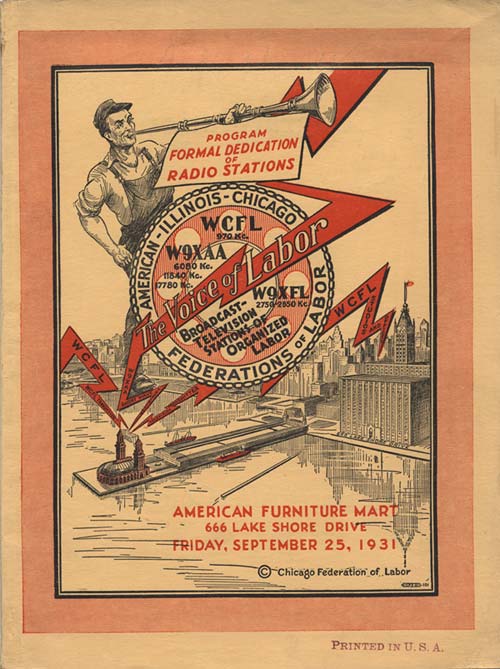
The first WCFL transmitter stood on Chicago's Navy Pier (then called Municipal Pier); the Federation was able to lease the pier's North Tower for 10 years at $1 per year and its willingness to make WCFL available for city broadcasts.[13] Initially the Illinois Manufacturers' Association attempted to keep WCFL off the air by protesting the use of public property for the station's transmitter and broadcasting site.[11] The station purchased the land in Downers Grove where the current transmitter operates in 1928 and broke ground there in 1932.[5] The Federation originally purchased 100 acres (0.40 km2) of land in the western suburb; 20 of them were allotted for the WCFL transmitter, while the other 80 were subdivided as lots for 258 homes and 72 businesses in "WCFL Park". Nockels believed having a union-based community spring up around the WCFL transmitter would be beneficial to both those purchasing lots and building homes and to the station itself. The labor union entered the real estate business shortly before the Great Depression hit. After selling no lots in the early part of the 1930s, the Federation put WCFL Park on hold, reviving it again in 1939 with the building of a model home on one of the lots, all of which would eventually be divested.[13]
AM 1000 began operation as WCFL in test broadcasts on June 19, 1926; the Commerce Department granted it call letters on July 10, 1926. It was officially on the air the next day on 610 kHz, with 1,000 watts of power, one of the last non-profit radio stations to take to the airwaves.[6][11][13] The first broadcast consisted of two hours of music.[14] In November 1926, with an eye toward being self-sustaining, the Federation added a shortwave station to the Navy Pier transmitter site, planning to use WCFL Radio Telegraph to help offset broadcasting costs. The station initially used studios at Navy Pier, but during the winter of 1926–1927 found that the weather often made them inaccessible.[13]
By 1927, WCFL was broadcasting from 623 South Wabash in Chicago (today the home of Columbia College, Chicago[11][15]) producing a quarterly radio magazine, and operating on 620 kHz; the frequency being shared with the Lane Tech High School radio station, WLTS.[11][12][1] In 1928, WCFL applied to the Federal Radio Commission for an increase in its transmitter power and hours of operation.[1] Several other radio stations were now also operating on the 620 kHz frequency along with WCFL and the Lane Tech station.[6] The commission disagreed with the reasoning that such increases were necessary to serve union members.[16] Further, it cut the operating power of WCFL to only 1,500 watts.[13] General Order 40 brought WCFL to the 970 kHz frequency, shared with KJR in Seattle, still at 1,500 watts and now allowed to operate in daylight only. The Federal Radio Commission had labeled the station as a "propaganda" type, not truly worthy of a license. The FRC would grant WCFL a 5,000-watt license in 1932,[17] but it would take some years of expensive discussions to attain clear-channel, 50,000-watt status.[6][18]
While the original idea of a self-supporting WCFL was based on each Federation member's donation of $1 a year for all station operating expenses, by 1926, 30% of the membership had donated. The donations continued to spiral downward as time passed, especially after 1928, when WCFL's operating power was cut and it was limited to "dawn to dusk" broadcasting—from sunrise to sunset. The dawn-to-dusk operation limitations were lifted in 1929, but there was still no clear channel yet for WCFL.[19][20] 1929 found the station notifying the Federation that unless members made their dollar donations, WCFL would need to implement some type of commercial broadcasting to stay afloat. This was the reason why the transmitter land had been purchased in 1928, but no construction was able to be done on the Downers Grove transmitter site until 1932. By 1930, commercials had become a reality on WCFL; the station did not show a profit until 1940.[6][13]
In 1927, WCFL broadcast the Gene Tunney-Jack Dempsey championship boxing match at Soldier Field, challenging the National Broadcasting Company's exclusive claim to the event.[13] This led to an arrangement whereby WCFL became one of three affiliates in Chicago of the Blue Network of NBC;[21] WCFL broadcast non-sponsored, or sustaining, NBC programs not carried by WENR or WLS, as well as selected major sporting events and any broadcast speeches by union leaders aired by the network. WCFL became a member of the Mutual Broadcasting System in December 1949.[21] When the Federal Communications Commission forced NBC to sell the Blue Network, WCFL's affiliation continued with the network through its new identity as the American Broadcasting Company, ending with the merger of WENR and WLS in 1959.[22] Prior to this, the station offered selected programming from the network.[21] WCFL was also to become an affiliate of the Amalgamated Broadcasting System in 1933, but that network collapsed after only a month of operations, prior to its planned westward expansion from New York.[13] The usual broadcast day included dance and classical music, comedy, as well as radio programs in 11 different languages designed to reach out to Chicago's immigrant population.[23]
Television, WCFL-FM, and evolution to Top 40
[edit]
WCFL was also involved in early experimental television broadcasts, and operated a shortwave repeater station, W9XAA, in the 1930s. This was the first television station in Chicago.[24] On June 19, 1928, Ulises Armand Sanabria, a local television pioneer, made the first Chicago television broadcast using the WCFL Navy Pier transmitter to send the video portion of the signal and Chicago radio station WIBO[24][25] for the audio portion.[26] Those with receivers were able to see a head and shoulders view of Edward Nockels, the Federation secretary and driving force behind WCFL.[27] It's also possible the broadcast was simulcast by the WCFL shortwave station, W9XAA.[25][28] Accounts of later broadcasts at WMAQ specify their shortwave station was used for this purpose.[29] As the Federation tried to revive their "WCFL Park" real estate project near the Downers Grove transmitter, the decision was made to abandon W9XAA in 1937, preferring to concentrate on gaining more transmitter power for WCFL. New Federal Communications Commission rules insisted that shortwave stations have a minimum of 5,000 watts of power; the cost to WCFL to upgrade to this level would have been around $10,000.[13] In the 1941 NARBA reallocation, WCFL moved to 1000 kHz.[1] The same year, it was granted a Class 1-B clear channel license, and increased its power to 10,000 watts.[1] In 1948, its power was increased to 50,000 watts.[1]
In the fall of 1937, the station was one of several Chicago radio stations to donate airtime to Chicago Public Schools for a pioneering program in which the school district provided elementary school students with distance education amid a polio outbreak-related school closure.[30]
In 1948, the Federation was granted a license for an FM radio station, WCFL-FM on 104.3 MHz. Its transmitter was atop the American Furniture Mart, where WCFL's studios and offices had been located since 1931. WCFL-FM went on the air March 12, 1949, and simulcast its sister AM station's programming for six hours a day–from 3 p.m. to 9 pm. This time the Federation was impatient for its new radio station to become profitable, having gone from 1926 to 1940 before WCFL was "in the black".[13] On January 10, 1950, WCFL-FM went off the air permanently; the Federation believed its dollars were better spent for its AM radio station. (Today, the frequency is occupied by WBMX, and the call letters belong to a station in Morris, Illinois that is now owned by University of Northwestern – St. Paul.)
During the 1940s, the Federation's thoughts turned once again to television, and in 1953, it applied for VHF channel 11 in Chicago. The Federation lost the bid to the city's educational groups, who would put WTTW on the air in 1955. An early 1960s try netted the Federation a license for Chicago UHF channel 38. In June 1968, plans were made for building a transmitter and antenna atop Chicago's John Hancock Center, as well as other construction needs to get WCFL-TV on the air. By late 1970, the Federation had begun to look at other uses for the station's license which didn't involve the organization. Christian Communications purchased WCFL-TV in August 1975, with the FCC approving the license transfer in early 1976. At the time of the sale, WCFL-TV had yet to be on the air; it became WCFC-TV and, later, WCPX-TV.[13]
The station carried general entertainment over the decades, but by the late 1950s, WCFL evolved into a popular music station, which had banned all Elvis Presley records from its playlist in late November 1957.[31] The pre-Top 40 talent lineup included Dan Sorkin[32][33] in the morning, Mike Rapchak following him and Sid McCoy's all-night jazz program. It was Sorkin who introduced a young Chicago comedian, Bob Newhart, to Warner Bros. in 1959.[34] Bob Elson did both White Sox games and interviewed celebrities at The Pump Room; his sports cohort, Milo Hamilton, also wore two hats, talking football and playing music.[13] Rapchak, who quit on the air in 1965 due to WCFL's new format, returned there in 1978, once again playing big band and jazz music.[35][36][37]
Top 40 at the "Voice of Labor"
[edit]

Between 1963 and 1965, WLS was the only Top 40 station in Chicago. This situation was unusual, as most major cities had two or even three stations featuring pop music. Consequently, WLS had become somewhat complacent as it had no real competitors. This all changed in 1965, when WCFL became a Top 40 music station, competing with WLS. The station also moved from the American Furniture Mart where it had been since 1931,[1][38] to the then new Marina City,[39] where it remained for the next 20 years.[40] While the station itself was on the 16th floor of the Commercial Building (today the Hotel Chicago Downtown),[41] WCFL also had a "VIP Room" on the fifth floor where the "WCFL VIPs" (DJs) hosted various events such as record parties and autograph sessions for listeners who were members of the WCFL VIP Club.[42][43] One of the station's first promotions was the "Bold" campaign-describing itself as a bold, new way of presenting today's music and its listeners (who wore "I'm Bold!" buttons) as bold enough to want a change.
General Manager Ken Draper[44] ran the station from 1965 to 1968 and brought many of the original staffers with him from the big Cleveland station KYW/WKYC he had run before.[14][36][45][46] These included not only DJs but also chief engineer Mike King[47] (later, Jim Loupas),[48] and members of the crack newsroom team, which included the unstoppable Jeff Kamen.[49] WCFL gained fame in 1966 when Kamen followed Chicago Civil Rights leader and comedy star Dick Gregory to Mississippi and was beaten by KKK members while reporting on a voter registration protest. The network TV film of the attack was seen by millions, with a still picture appearing on newspapers' front pages.[50] Prior to Draper's establishment of an eight-person news department, news was gathered by taking the copy from the station's news wires and reading it on the air.[36]
In their Top 40 years, some famous disc jockeys on WCFL included Jim Runyon, Joel Sebastian,[51] Dick Williamson, (who was already with WCFL at the time of the format change),[36] Jim Stagg,[36][52] Ron Britain,[53][54] ("America's First Psychedelic Disk Johnny"), who did a second stint at the station in 1978,[55] the legendary Dick Biondi,[56][57][58] whose Mutual Radio syndicated Dick Biondi's Young America show was heard here 3 years before his actual arrival,[59][60] Barney Pip,[61] Ron Riley,[62] and Sid McCoy and Yvonne Daniels with late night jazz[63] during the earliest days of the change to Top 40.[64] In late 1966, WKYC popular afternoon DJ Jerry Ghan (now Jerry G. Bishop) also decided to follow Draper to WCFL for morning drive.[65][66] Later, WIND's former long-time morning man Howard Miller,[67] who was a decided departure from the youthful staff, came to helm WCFL's 6-9AM spot in 1968.[68] He was replaced before long by Clark Weber, long-time WLS morning man.[69]

The DJ secretary during this era was Connie Szerszen, who went on to forge her own career on the air in Chicago radio, appearing on WIND and other stations. WCFL general manager Ken Draper also hired Carole Simpson as one of radio's first female newscasters; Carole went on to a big career with ABC-TV. Also on staff at that time was continuity director Barbara Sternig, who left for Los Angeles once the Beatles broke up, became Rona Barrett's writer, and later Senior Reporter in Hollywood for the National Enquirer.[70][71] Draper is also credited with the introduction of the Sound 10/WCFL survey, which became a competitor to the WLS "Silver Dollar Survey" that station issued weekly beginning in 1960.[72] From 1966 to 1970, the station produced six "branded" record albums.[73][74] Later in the "SuperCFL" era, Larry Lujack[75][76] and Art Roberts[77][78][79] came to WCFL.
WCFL's coverage of the Beatles 1965[80] and 1966[81][82][83][84] U.S. tours was provided by Jim Stagg, who traveled with the group.[80][85] The station began a weekly British Countdown program with British DJ Paul Michael, in 1965.[86]
During the late 1960s and early 1970s, WCFL also featured a popular Sunday night program of "underground" album-oriented music called Ron Britain's Subterranean Circus.[21][55] Due to madcap DJ Britain's sure ear for the innovative and his highly inventive sketches,[87] plus WCFL's powerful AM nighttime signal, these programs gained huge listenership not just in the Chicago area, but in other parts of the country as well. Britain's "Sub Circus" made WCFL one of the few AM stations to feature this kind of music, which was a major staple of "underground" FM stations.[88] The station also supported local bands with its Sunday evening "Chicago Countdown", hosted by Ron Britain, featuring the recordings of Chicago area music groups.[89]
The comedy feature Chickenman, a satire based on the Batman TV series, originated on Jim Runyon's morning drive-time show in the fall of 1966.[90][91][92][93] It was created by WCFL staffer Dick Orkin, who was also brought from Cleveland to Chicago by Ken Draper.[47][94] All the voices were done by Orkin, Runyon, and Jane Roberts, who also did WCFL's morning traffic reports as "Trooper 36-24-36" (She became Mrs. Jim Runyon.).[95][96][97] The Chickenman program was subsequently syndicated to radio stations worldwide.[98][99]
In August 1968, sales manager Lew Witz replaced Draper as WCFL general manager. Witz continued to make changes to the station during his tenure. It was Witz who lured Larry Lujack away from WLS in 1972, and the "less talk-more music" philosophy continued. On August 8, 1974, Richard Nixon announced his resignation from the office of President of the United States. The announcement occurred at 8 pm. Chicago time, but there was no acknowledgement of it on WCFL's airwaves until 11:30 pm. Witz defended his decision by saying there was ample local and national coverage of the story so there was no need to interrupt the music on WCFL. Gary Deeb, media critic for the Chicago Tribune, blasted Witz in print, saying it was this decision and many others like it that turned WCFL from, "a bright, civic-minded 50,000 watt rock powerhouse into a sonic slum".[100][101] By the time the station prepared to enter its "Beautiful Music" phase in early 1976, Witz had totally done away with WCFL's news department.[13] Under the management of Witz, the station's turntables used for transferring music onto tape cartridges for broadcast were speeded up from 45rpm to 48rpm. This was meant to make for a "brighter sound" than the station's main rival, WLS, and meant that since it was faster, more music could be aired. Witz also insisted his on-air personalities broadcast false time checks, in the event listeners might be part of Arbitron ratings households.[100]
An internet radio tribute station to this era of WCFL was launched on Labor Day 2013, including original airchecks, commercials, jingles and Chickenman episodes; jingle producer TM Productions waived its licensing fees to assist J. R. Russ, developer of the internet station.[102][103]
The end of "Super CFL" and the sale to Mutual
[edit]On March 15, 1976, after two years of falling ratings, WCFL abruptly dropped its Top 40 format in favor of The World's Most Beautiful Music, leaving WLS as Chicago's only AM Top 40 station.[104][105] Station management released all disc jockeys who did not have "no cut" clauses in their contracts with the official explanation of the format change as "being more in keeping with the labor movement".[13] Larry Lujack, still under contract with the station, stayed on at WCFL playing easy listening music until moving back to WLS in September 1976.[106] The easy listening format was already heard in stereo on FM beautiful music stations WLOO and WLAK. By 1978, the easy sounds were replaced by a gold-based adult contemporary format.[107]
WCFL and the Chicago Federation of Labor enjoyed the support of Mayor Richard J. Daley throughout his 1955–1976 administration. He proclaimed January 11, 1966, as "WCFL Day in Chicago" to mark the 40th anniversary of the station.[21] In 1976, when it became evident it was time for the Federation to sell the radio station, Federation President William A. Lee turned to his long-time friend, Mayor Daley, for advice.[13][108]
After deciding its profit margin was too small for the Chicago Federation of Labor to maintain, on April 10, 1978, it was announced that WCFL would be sold to the Mutual Broadcasting System, at the time a subsidiary of the Amway Corporation, for $12 million.[109][110] The history of the first and longest-lived labor radio station was over; after nearly 52 years, the "Voice of Labor" had been stilled.[13][111] The station began to identify itself as "Mutual/CFL". A magazine-type news/talk format was adopted, with sports talk in the evening hours and the syndicated Larry King Show overnight, but ratings remained low. In January 1981, WCFL flipped to a middle of the road format playing adult standards and pop hits of the 1950s and '60s mixed in with some softer oldies and AC cuts, and even a few currents. Ratings were still low; and later that year, WCFL evolved into an adult contemporary format.[13]
Religious years
[edit]_transmitter_building.jpg)
On November 4, 1983, WCFL was sold by Mutual to Statewide Broadcasting.[112] Statewide switched WCFL to adult contemporary Christian music about 10 hours a day and teaching programs the rest of the time on May 22, 1984. WCFL sold brokered programming in 30-minute blocks of time to Christian radio organizations and preachers. The format was profitable but received low ratings. At that time, WCFL advertised its call letters as standing for "Winning Chicago For The Lord". In early 1985, the station moved from Marina City into the backup studio at its original transmitter building in Downers Grove.[5] Statewide Broadcasting specialized in religious formats but merged with a secular company called Heftel Broadcasting in early 1987.[113][114][115] Although no longer in use, the former call letters WCFL, rendered massively in stainless steel, remain on the exterior wall of the transmitter building off 39th Street in Downers Grove.[5]
1000 WLUP
[edit]Following the Heftel takeover, WCFL remained religious alongside AOR-formatted WLUP (which had been purchased by Heftel in 1979)[116] until just after the stroke of midnight on April 29, 1987.[13][117][115] The call letters of the station were changed to WLUP, and its FM sister station became WLUP-FM.[118] WLUP-FM remained an AOR station, while WLUP switched to a full service rock format focusing on personality, comedy and talk programs with a few rock cuts an hour. After 7 pm, WLUP and WLUP-FM simulcast the AOR format until dawn.[119] As it concentrated on Spanish radio, Heftel sold its English-language stations, including WLUP-AM-FM; Evergreen Media bought WLUP-AM-FM in 1988.[120][121] From October 1992 until August 1993, WLUP (AM) was the first Chicago affiliate for The Howard Stern Show.[122][123]
WMVP
[edit]

Initially, the AM and FM stations remained the same under Evergreen. But on September 27, 1993, WLUP-FM switched to a full-service talk/comedy format, while WLUP (AM) became all-sports.[124][125] To differentiate between WLUP-FM and to reflect the new format, WLUP's call sign changed to WMVP, for "Most Valuable Player".[126][124] WMVP's schedule included some nationally syndicated shows such as The Fabulous Sports Babe and Ferrall on the Bench as well as play-by-play of local sports games. Despite broadcasting 24/7, the station trailed in the ratings to (at the time) daytime-only WSCR (820 AM) and to WMAQ's Sports Huddle at night. WMVP dropped its all sports format at 6 a.m. on June 5, 1996, the day before the Chicago Bulls opened the NBA Finals against the Seattle SuperSonics, and returned to mostly simulcasting WLUP-FM.[127] WMVP did carry its own night-time sports talk program, and play-by-play broadcasts of the White Sox, Blackhawks and Bulls, and would later air some shows from hosts who were moved over from the FM beginning that September.[128]
Evergreen later merged with Chancellor and sold WLUP-FM to Bonneville International in July 1997, with WMVP permanently splitting from WLUP-FM. WMVP began airing its own talk/sports format, simply called "AM 1000".[129] In August 1998, WMVP was sold by Chancellor to ABC/Disney, and flipped back to sports on October 12, this time affiliated with co-owned ESPN Radio.[130][131][132]
Good Karma Brands takeover
[edit]On August 28, 2019, it was announced by ESPN Radio that day-to-day management of the station would move from direct purview by ESPN to a management agreement with Good Karma Brands, a company owned by Craig Karmazin which has had sustained success running ESPN Radio stations to the north in Madison and Milwaukee, along with Cleveland and West Palm Beach, Florida. General manager, Jim Pastor, retired at the end of the year, with Good Karma beginning to operate the station on September 29, 2019, under a lease with Disney (no information about a conversion to an eventual station purchase has been revealed).
The lease makes WMVP a sister station to GKB's Milwaukee cluster of WTMJ, WKTI, WGKB, and WAUK, and the Madison market's WTLX (WTMJ carries a local news/talk format, with WGKB airing local format of Black talk). No changes to personnel and facilities in the near future are currently expected under the lease agreement,[133][134] though the station's morning schedule was adjusted in August 2020 due to the national network's large-scale schedule overhaul.[135]
In late June 2021, GKB entered into an agreement with Hubbard Broadcasting to simulcast WMVP in HD Radio, over WSHE-FM (100.3)'s HD2 subchannel to allow FM access to the station in some manner.[3] In December 2021, Andrew Marchand of the New York Post reported that GKB planned to acquire WMVP outright.[136] The deal was filed with the FCC on December 20, and did not include WMVP's current transmitter site.[137] The purchase was consummated on March 1, 2022. In August 2023, Good Karma applied to the FCC to move WMVP's transmitter from its longtime site in Downers Grove to WCPT's transmitter site near Joliet.[138] In May 2025, building infrastructure at the Downers Grove site was demolished, and in June 2025, the three guyed radio towers that have been in place since the 2000s were dismantled.[139]
On November 1, 2022, the NFL's Chicago Bears announced that they would move their radio flagship to WMVP starting in the 2023 season, replacing a 22-season long stint with WBBM.[140]
References
[edit]- ^ a b c d e f g History Cards for WMVP, fcc.gov. Retrieved August 8, 2019.
- ^ "Facility Technical Data for WMVP". Licensing and Management System. Federal Communications Commission.
- ^ a b Venta, Lance (June 21, 2021). "WMVP Adds HD Simulcast". radioinsight.com. Retrieved June 23, 2021.
- ^ Rosenthal, Phil (November 20, 2020). "Chicago White Sox name WMVP-AM 1000 their new radio home in a multiyear deal". Chicago Tribune. Retrieved August 11, 2021.
- ^ a b c d Fybush, Scott (2008). "WCFL/WMVP transmitter". Fybush. Retrieved April 19, 2010.
- ^ a b c d e f McChesney, Robert, ed. (1995). Telecommunications, Mass Media, and Democracy: The Battle for the Control of U.S. Broadcasting, 1928-1935. Oxford University Press. p. 416. ISBN 0-19-509394-1. Retrieved May 10, 2010.
- ^ Schardt, Sue (1996). "Public Radio-A Short History". The Christian Science Monitor. Archived from the original on August 9, 2011. Retrieved July 30, 2010.
{{cite web}}: CS1 maint: bot: original URL status unknown (link) - ^ "WCFL, 'Voice of Labor' at Chicago, starts 39th year of radio broadcasts". The Machinist. July 9, 1964. Archived from the original on February 15, 2010. Retrieved July 30, 2010.
{{cite web}}: CS1 maint: bot: original URL status unknown (link) - ^ "Illinois Union Hall of Honor-Edward Nockels". Illinois Labor History Society. 1987. Archived from the original on May 9, 2008. Retrieved July 30, 2010.
{{cite web}}: CS1 maint: bot: original URL status unknown (link) - ^ "History of WCFL Radio". Manteno. Archived from the original on August 13, 2003. Retrieved April 22, 2010.
- ^ a b c d e "Origination of WCFL-transcript". Chicago Federation of Labor. Archived from the original on August 19, 2003. Retrieved April 22, 2010.
- ^ a b "Aim and objective of WCFL-transcript". Chicago Federation of Labor. Archived from the original on August 19, 2003. Retrieved April 22, 2010.
- ^ a b c d e f g h i j k l m n o p q r s Godfried, Nathan, ed. (1997). WCFL, Chicago's Voice of Labor, 1926-78. University of Illinois Press. pp. 281–290. ISBN 0-252-06592-1. Retrieved April 6, 2010.
- ^ a b Fritz, Jose (November 21, 2005). "Chicago's Voice of Labor". Arcane Radio Trivia. Retrieved July 30, 2010.
- ^ "Columbia College Chicago South Michigan Campus". Columbia College. Archived from the original on June 3, 2010. Retrieved May 10, 2010.
{{cite web}}: CS1 maint: bot: original URL status unknown (link) - ^ Simmons, Steven J., ed. (1978). Fairness Doctrine and the Media. University of California Press. pp. 33–35. ISBN 0-520-03585-2. Retrieved April 19, 2010.
- ^ Godfried, Nathan (1997). WCFL, Chicago's Voice of Labor, 1926-78. Google Books: University of Illinois Press. p. 102.
- ^ Reid, Frank R. (May 19, 1930). "Remarks of Honorable Frank R. Reid of Illinois". U. S. House of Representatives. Archived from the original on July 8, 2010. Retrieved May 22, 2010.
- ^ Newton-Matza, Mitchell (December 1999). "There's A Rumbling In The Air: The Importance And Influence Of The Labor Press In Chicago". Illinois History Symposium. Retrieved July 30, 2010.
- ^ The March of Radio. Radio Broadcast. September 1929. pp. 272, 273. Retrieved March 6, 2014.
- ^ a b c d e "WCFL". Radio Timeline. Archived from the original on June 17, 2010. Retrieved March 14, 2010.
{{cite web}}: CS1 maint: bot: original URL status unknown (link) - ^ Blue Net Deal With WCFL a Plus. Billboard. May 27, 1944. Retrieved May 11, 2010.
- ^ Robinson, Anna, Garfinkel, Steve, Eckstein, Elizabeth (2000). "A Closer Look:Labor Radio and the Blind". University of Virginia. Archived from the original on February 17, 2001. Retrieved July 30, 2010.
{{cite web}}: CS1 maint: multiple names: authors list (link) - ^ a b "Ulises Armand Sanabria". Television Experimenters. Archived from the original on May 20, 2014. Retrieved January 23, 2011.
- ^ a b "WCFL Radio Magazine-Fall, 1928-WCFL Is on the air with Television Programs". WCFL/Chicago Fededration of Labor. Retrieved April 28, 2010.
- ^ "Carter's Aid Speeds Early Television in Chicago". Early Television.org. Retrieved December 9, 2010.
- ^ "Television Comes to Chicago". Chicago Television. Retrieved May 11, 2010.
- ^ "Early Chicago Television". Hawes TV. Retrieved April 28, 2010.
- ^ Weir, James W. H. (March 30, 1930). "WMAQ To Start Sound Television". The Pittsburgh Press. Retrieved December 6, 2010.
- ^ Strauss, Valerie; Hines, Michael. "Perspective | In Chicago, schools closed during a 1937 polio epidemic and kids learned from home – over the radio". The Washington Post. Retrieved August 16, 2021.
- ^ "WCFL Bans All Elvis Records (page 5)" (PDF). Mr. Pop History. November 23, 1957. Archived from the original on July 14, 2011. Retrieved April 1, 2010.
{{cite web}}: CS1 maint: bot: original URL status unknown (link) (PDF) - ^ "Dan Sorkin interview". Chicago Radio Spotlight. 2010. Retrieved April 20, 2010.
- ^ Segue (page 39). Billboard. September 14, 1963. Retrieved April 20, 2010.
- ^ Pioneering Warner Bros. Remains Comedy Kingpin (page 105). Billboard. September 28, 1996. Retrieved April 20, 2010.
- ^ Noel, Josh (March 29, 2006). "Mike Rapchak, 1920–2006". Chicago Tribune. Retrieved April 20, 2010.
- ^ a b c d e WCFL Takes First Step Toward Format Change. Billboard. April 15, 1965. Retrieved May 11, 2010.
- ^ "Radio Days-Mike Rapchak". Columbia College. 2006. Archived from the original on June 27, 2010. Retrieved May 11, 2010.
{{cite web}}: CS1 maint: bot: original URL status unknown (link) - ^ "Formal Dedication of Radio Stations". Chicago Federation of Labor. September 25, 1931. Archived from the original on July 8, 2010. Retrieved May 22, 2010.
{{cite web}}: CS1 maint: bot: original URL status unknown (link) - ^ "History of WCFL at Marina City". Marina City Online. Archived from the original on July 4, 2011. Retrieved March 22, 2010.
{{cite web}}: CS1 maint: bot: original URL status unknown (link) - ^ "WCFL Marina City Studios-a look in January 1985, shortly before the station left the building". Manteno. 1985. Retrieved March 22, 2010.
- ^ "Hotel Chicago Downtown". Marriott Hotels. Archived from the original on August 9, 2017. Retrieved August 8, 2017.
- ^ "Photo of WCFL VIP Club Card". WCFL/Chicago Federation of Labor. 1966. Retrieved April 24, 2010.
- ^ "1967 Radio 10 Survey with WCFL VIPs pictured". WFCL/Chicago Federation of Labor. Archived from the original on November 27, 2010. Retrieved April 24, 2010.
{{cite web}}: CS1 maint: bot: original URL status unknown (link) - ^ Martin, Harry. "Cleveland is no joke". Martin, Harry. Archived from the original on July 28, 2011. Retrieved August 1, 2010.
- ^ WCFL Is Looking to Be No. 1 (pages 34, 36). Billboard. September 30, 1967. Retrieved April 1, 2010.
- ^ Smith, Ron, ed. (2007). WCFL Chicago Top 40 Charts 1965-1976. iUniverse. pp. Front Matter Introduction. ISBN 978-0-595-43180-9. Retrieved April 2, 2010.
- ^ a b Henderson (1992). "He's Everywhere! He's Everywhere!". Chicago Reader. Retrieved May 21, 2010.
- ^ "About Jim Loupas". James Loupas Associates. Archived from the original on July 13, 2011. Retrieved May 21, 2010.
{{cite web}}: CS1 maint: bot: original URL status unknown (link) - ^ "Police:Tales of Three Cities". Time. June 22, 1970. Archived from the original on June 4, 2011. Retrieved August 8, 2010.
- ^ Sloman, Larry, ed. (1998), Steal This Dream: Abbie Hoffman & the Countercultural Revolution in America, Doubleday, pp. 464, ISBN 0-385-41162-6, retrieved July 30, 2010
- ^ "Joel Sebastian, radio disc jockey". Chicago Tribune. January 19, 1986. Retrieved July 31, 2010.
- ^ "Jim Stagg". Life in Legacy. November 10, 2007. Retrieved October 10, 2010.
- ^ "Ron 'King B' Britain". Leo Weekly. 2006. Archived from the original on October 31, 2006. Retrieved March 14, 2010.
- ^ "Ron Britain moves from WHK, Cleveland to WCFL (page 11)" (PDF). Mr. Pop History. December 20, 1965. Archived from the original on July 14, 2011. Retrieved April 1, 2010.
{{cite web}}: CS1 maint: bot: original URL status unknown (link) (PDF) - ^ a b "Ron Britain". Chicago Radio Spotlight. 2008. Retrieved March 7, 2010.
- ^ "Dick Biondi". Radio Hall of Fame. 1998. Archived from the original on January 9, 2010. Retrieved March 14, 2010.
- ^ "Biondi Returns to Chicago at WCFL (page 6)". Mr. Pop History. October 10, 1967. Archived from the original on January 9, 2010. Retrieved April 1, 2010.
{{cite web}}: CS1 maint: bot: original URL status unknown (link) (PDF) - ^ audio file-WCFL Aircheck-Biondi's first WCFL show-October 3, 1967 (RealPlayer)
- ^ "Biondi on Mutual Network". Airchexx. 1964. Archived from the original on July 22, 2011. Retrieved April 24, 2010.
{{cite web}}: CS1 maint: bot: original URL status unknown (link) - ^ audio file of Dick Biondi's Young America WCFL aircheck-1964 Archived July 22, 2011, at the Wayback Machine (RealPlayer)
- ^ "Death of Barney Pip". About.com-Radio. Archived from the original on August 9, 2010. Retrieved March 7, 2010.
- ^ "Ron Riley's website-ronriley.com". Archived from the original on December 5, 2006. Retrieved March 7, 2010.
- ^ "Yvonne Daniels-Radio Hall of Fame". Radio Hall of Fame. Archived from the original on January 11, 2011. Retrieved June 10, 2010.
{{cite web}}: CS1 maint: bot: original URL status unknown (link) - ^ Sid McCoy leaves WCFL (page 62). Billboard. April 1, 1967. Retrieved April 23, 2010.
- ^ "Jerry G. Bishop, 1936-2013". Chicago Tribune. August 3, 1936. Retrieved September 19, 2013.
- ^ Jajkowski, Steve (2002). "Chicago Television Alumni Club-Talkin' With Jerry G".
- ^ "Howard Miller". WMMB, Melbourne, FL. Archived from the original on August 15, 2010. Retrieved March 7, 2010.
{{cite web}}: CS1 maint: bot: original URL status unknown (link) - ^ "Howard Power". Time. January 31, 1969. Archived from the original on November 5, 2012. Retrieved May 11, 2010.
- ^ "Weber Replaces Miller-WCFL (page 9)" (PDF). Mr. Pop Culture. June 15, 1969. Archived from the original on July 14, 2011. Retrieved April 1, 2010.
{{cite web}}: CS1 maint: bot: original URL status unknown (link) (PDF) - ^ "Visitors recall the station and the personalities from their teen visit days". Manteno. Archived from the original on August 13, 2003. Retrieved April 9, 2010.
- ^ "Transcript of a Robert Feder Chicago Sun-Times column looking back at WCFL and its people". Archived from the original on August 1, 2003. Retrieved April 9, 2010.
- ^ "Ken Draper wants to win-announces WCFL Sound 10 survey". Mr. Pop Culture. June 25, 1965. Archived from the original on July 14, 2011. Retrieved April 26, 2010.
{{cite web}}: CS1 maint: bot: original URL status unknown (link) (PDF) - ^ "Solid Gold". WCFL Radio. Retrieved January 19, 2017.
- ^ "Double Gold". WCFL Radio. Retrieved January 19, 2017.
- ^ "Larry Lujack". Radio Hall of Fame. 2004. Archived from the original on January 26, 2010. Retrieved March 14, 2010.
{{cite web}}: CS1 maint: bot: original URL status unknown (link) - ^ "Larry Lujack joins WCFL (page 4)" (PDF). Mr.Pop History. July 13, 1972. Archived from the original on July 14, 2011. Retrieved April 1, 2010.
{{cite web}}: CS1 maint: bot: original URL status unknown (link) (PDF) - ^ "Art Roberts' website-artroberts.com". Archived from the original on April 18, 2010. Retrieved March 7, 2010.
{{cite web}}: CS1 maint: bot: original URL status unknown (link) - ^ "The Art Roberts Collection-audio files and information about Art Roberts". Reel Radio. Retrieved March 7, 2010.
- ^ "Tributes to Art". Radio Daily News. Archived from the original on March 16, 2010. Retrieved May 30, 2010.
- ^ a b "DJ's on 1965 Beatles Tour". Mr. Pop Culture/Mr. Pop History. September 15, 1965. Archived from the original on July 14, 2011. Retrieved April 1, 2010.
{{cite web}}: CS1 maint: bot: original URL status unknown (link) - ^ "17 Chicago 2 (12 August 1966)". Podomatic.
- ^ "19 Philadelphia + Toronto (16-18 August 1966)". Podomatic.
- ^ "20 Boston + Memphis (18-19 August 1966)". Podomatic.
- ^ "21 Memphis + NYC (19-22 August 1966)". Podomatic.
- ^ Winn, John C., ed. (2009). That Magic Feeling: The Beatles' Recorded Legacy, Volume Two, 1966-1970. Three Rivers Press. p. 416. ISBN 978-0-307-45239-9.
- ^ "British DJ Paul Michael Joins WCFL for British Countdown". Mr. Pop Culture/Mr. Pop History. October 18, 1965. Archived from the original on October 5, 2011. Retrieved April 1, 2010.
{{cite web}}: CS1 maint: bot: original URL status unknown (link) - ^ audio file Ron Britain Show WCFL March 11, 1970 (RealPlayer)
- ^ "Aircheck & transcript of Subterranean Circus-May 31, 1970". Archived from the original on January 19, 2017. Retrieved March 7, 2010.
{{cite web}}: CS1 maint: bot: original URL status unknown (link) - ^ Langer, Adam (January 12, 1989). "Glory Days". Chicago Reader. Retrieved July 30, 2010.
- ^ "Chickenman background information". AudioTheater. Archived from the original on December 2, 2010. Retrieved April 9, 2010.
{{cite web}}: CS1 maint: bot: original URL status unknown (link) - ^ Hoffman, Carl. "Chickenman". the Official 60's Site. Retrieved May 11, 2010.
- ^ Hoffman, Carl. "Winner of WCFL "What Does Chickenman Look Like?" Contest". the Official 60's Site. Archived from the original on June 4, 2010. Retrieved May 11, 2010.
- ^ "He's everywhere!". Discogs. 1966.
- ^ "It's a Bird! It's a Plane! Whoops, It's a Bird". Time. June 9, 1967. Archived from the original on December 15, 2008. Retrieved April 9, 2010.
- ^ "Windy City Airchecks Collection-10 audio files of "Chickenman" episodes also on page". ReelRadio. Retrieved March 31, 2010.
- ^ "RadioRanch-How the Radio Serials, Chickenman and Toothfairy Were Born". Radio-ranch.com. Archived from the original on July 15, 2011. Retrieved September 12, 2011.
- ^ "Interview with Dick Orkin covering Chickenman and WCFL". Manteno. 1985. Archived from the original on August 1, 2003. Retrieved April 9, 2010.
- ^ "Chickenman Syndication (page 9)" (PDF). Mr. Pop Culture. January 16, 1967. Archived from the original on July 14, 2011. Retrieved April 1, 2010.
{{cite web}}: CS1 maint: bot: original URL status unknown (link) (PDF) - ^ "How Chickenman was Born". RadioRanch. Archived from the original on July 9, 2011. Retrieved April 9, 2010.
{{cite web}}: CS1 maint: bot: original URL status unknown (link) - ^ a b Deeb, Gary (March 4, 1979). The Dark Side of the Medium (PDF). Chicago Tribune. p. 27. Retrieved March 9, 2014.(PDF)
- ^ Deeb, Gary (September 18, 1974). "CFL 'oversight' tunes out history". Chicago Tribune. p. 11. Retrieved December 24, 2014 – via Newspapers.com.

- ^ Hoekstra, Dave (January 14, 2014). "Fan of classic Chicago radio creates a cyber 'CFL". Chicago Sun-Times. Archived from the original on February 18, 2014. Retrieved January 15, 2014.
{{cite news}}: CS1 maint: bot: original URL status unknown (link) - ^ "WCFL internet radio". Retrieved January 15, 2014.
- ^ "Larry Lujack - Last Show on WCFL 3/15/76". November 30, 2008 – via YouTube.
- ^ Demos, Tom (September 16, 2005). "Loaning Larry Lujack Bus Fare During WCFL's Beautiful Music Summer of 1976". McMahon, Tom. Retrieved May 12, 2010.
- ^ "Larry Lujack Interview". Manteno. 1985. Archived from the original on August 16, 2003. Retrieved April 1, 2010.
- ^ "WCFL Returns to Pop Music (page 9)" (PDF). Mr. Pop History. January 23, 1978. Archived from the original on July 14, 2011. Retrieved April 1, 2010.
{{cite web}}: CS1 maint: bot: original URL status unknown (link) (PDF) - ^ "Illinois Union Hall of Honor-William A. Lee". Illinois Labor History Society. 1986. Archived from the original on May 9, 2008. Retrieved July 30, 2010.
{{cite web}}: CS1 maint: bot: original URL status unknown (link) - ^ "Mutual blows into the Windy City", Broadcasting. April 17, 1978. p. 52. Retrieved August 10, 2019.
- ^ "Mutual Purchases WCFL For $12 Million", Radio & Records. April 14, 1978. p. 1. Retrieved August 10, 2019.
- ^ "Laboring Voice". Time. June 27, 1949. Archived from the original on June 29, 2011. Retrieved February 26, 2011.
- ^ "Jordan Ginsburg-Statewide Broadcasting-co-owner obituary-Boca Raton, FL". August 26, 2009. Retrieved March 22, 2010.
- ^ "Heftel, Statewide Merge, Now H&G Communications", Radio & Records. January 9, 1987. pp. 1, 10. Retrieved August 10, 2019.
- ^ "H&G Establishes New Executive Tier", Radio & Records. February 27, 1987. pp. 1, 8. Retrieved August 10, 2019.
- ^ a b "WCFL Merger Puts WLUP on AM Radio", Chicago Tribune. April 29, 1987. Retrieved August 10, 2019.
- ^ "In Brief", Broadcasting. June 12, 1978. p. 41. Retrieved March 7, 2019.
- ^ Feder, Robert (April 29, 1987). "Dahl & Co. throw WCFL for a 'Loop'". Chicago Sun-Times. Archived from the original on March 12, 2018. Retrieved August 7, 2019.
- ^ Call Sign History, fcc.gov. Retrieved August 8, 2019.
- ^ Feder, Robert (July 8, 1987). "'Loop' looks for laughs in new weekend lineup". Chicago Sun-Times. Archived from the original on March 12, 2018. Retrieved August 7, 2019.
- ^ Public Notice Comment - BTC-19880622EC, fcc.gov. Retrieved August 8, 2019.
- ^ "The Controversial Jimmy De Castro Era At WGN Radio Is Coming To An End", Chicagoland Radio and Media. October 5, 2016. Retrieved August 8, 2019.
- ^ Feder, Robert (October 16, 1992). "Stern Opens Radio War With a Bang". Chicago Sun-Times. Archived from the original on March 12, 2018. Retrieved August 7, 2019.
- ^ Bednarski, P.J. (August 21, 1993). "WLUP-AM Dumps Stern // Station Cites 'Shock Jock's' Abrasive Style". Chicago Sun-Times. Archived from the original on March 12, 2018. Retrieved August 7, 2019.
- ^ a b Feder, Robert (October 5, 1993). "New Sports Loop Goes After WMVP". Chicago Sun-Times. Archived from the original on May 5, 2016. Retrieved August 7, 2019.
- ^ "Loop Changes: FM Emphasizes Personality, AM Heads Sports", Radio & Records. October 1, 1993. pp. 3, 26. Retrieved August 7, 2019.
- ^ Nidetz, Steve (January 17, 1994). "ESPN Scoring Here--On Radio". Chicago Tribune. p. 9. Archived from the original on June 29, 2011.
- ^ Feder, Robert (June 5, 1996). "'MVP Drops Sports For Loop Simulcast". Chicago Sun-Times. Archived from the original on May 5, 2016. Retrieved August 7, 2019.
- ^ Feder, Robert (September 25, 1996). "DJ shift to launch Loop's rock revival". Chicago Sun-Times. Archived from the original on May 5, 2016. Retrieved August 7, 2019.
- ^ Feder, Robert (October 20, 1997). "With Brandmeier gone, AM-1000 shuffles deck". Chicago Sun-Times. Archived from the original on March 12, 2018. Retrieved August 7, 2019.
- ^ Feder, Robert (June 3, 1998). "Disney may buy radio home of Bulls and Sox". Chicago Sun-Times. Archived from the original on September 11, 2016. Retrieved August 7, 2019.
- ^ "Disney OKs deal to buy WMVP-AM". Chicago Sun-Times. August 20, 1998. Archived from the original on May 5, 2016. Retrieved August 7, 2019.
- ^ Feder, Robert (October 7, 1998). "ESPN Radio hands off mornings to Canellis". Chicago Sun-Times. Archived from the original on November 12, 2012. Retrieved August 7, 2019.
- ^ Feder, Robert (August 28, 2019). "New management team brings Good Karma to take over ESPN 1000". Retrieved August 29, 2019.
- ^ Kirchen, Rich (August 28, 2019). "Milwaukee's Good Karma agrees to run Chicago ESPN radio station". The Business Journal of Milwaukee. Retrieved August 29, 2019.
- ^ Feder, Robert (August 11, 2020). "David Kaplan and Jonathan Hood to co-host mornings on ESPN 1000". Retrieved August 16, 2020.
- ^ Andrew Marchand [@AndrewMarchand] (December 13, 2021). "Good Karma Brands announces it plans to acquire ESPN 1050, ESPN 710 LA and ESPN 1000 in Chicago, as well as the local marketing agreement for 98.7 FM in New York. I'll try to put it all into English in column later" (Tweet) – via Twitter.
- ^ "More Details On Good Karma's ESPN New York, Los Angeles & Chicago Purchase". RadioInsight. December 20, 2021. Retrieved December 27, 2021.
- ^ "FCC Report 8/20: ESPN 1000 Chicago on the Move". RadioInsight. August 20, 2023. Retrieved September 19, 2023.
- ^ "Video shows landmark radio towers demolished in Downers Grove". ABC7 Chicago. June 2, 2025. Retrieved June 9, 2025.
- ^ "Chicago Bears To Move To ESPN 1000". RadioInsight. November 2022. Retrieved November 4, 2022.

External links
[edit]
- Official website
- Facility details for Facility ID 73303 (WMVP) in the FCC Licensing and Management System
- WMVP in Nielsen Audio's AM station database
- FCC History Cards for WCFL (1926–1980)
- A look at the ESPN 1000 studios-2004
- audio file:A Look Back at WCFL Part 1-Britain, Stagg and Pip on WJMK-FM 1985 (RealPlayer)
- audio file:A Look Back at WCFL Part 2-Britain, Stagg and Pip on WJMK-FM 1985 (RealPlayer)
- audio file-I Heard it on the AM Radio-WCFL being picked up in Sidi Yahia, Morocco-1967
- Reel Radio-John Celarek Collection-audio files and information on various WCFL disk jockeys
- Reel Radio-John Rook Collection-audio files including WCFL jingles and air checks for many personalities
- WCFL Personality lineups-1965-1976
| |||||||||||||||||||||||||||||||||||



WMVP (1000 kHz) is a commercial AM radio station licensed to Chicago, Illinois, United States, that carries a sports radio format as the flagship station of ESPN Chicago.[1][2] Owned and operated by Good Karma Brands, it serves the Chicago metropolitan area as the local affiliate of the ESPN Radio network.[1][3] The station broadcasts play-by-play coverage of the Chicago Bears of the National Football League and the Chicago White Sox of Major League Baseball, along with local sports talk programs and national ESPN content.[1][4] Launched in its current sports format in 1998 as the first ESPN Radio owned-and-operated station, WMVP has established itself as a primary source for Chicago sports commentary and analysis.[5] Good Karma Brands assumed operational control via a local marketing agreement in 2019 before acquiring full ownership, enabling expanded local programming focused on regional teams and events.[6][7] The station transmits from a 50 kW facility, with recent regulatory approvals allowing potential relocation to improve signal coverage.[8]
History
Establishment as WCFL under labor union control (1926–1964)
![Edward Nockels, secretary of the Chicago Federation of Labor and key architect of WCFL][float-right] The Chicago Federation of Labor (CFL) established WCFL in 1926 as the nation's first full-time labor-owned radio station, aiming to provide workers with an alternative to commercial broadcasting dominated by business interests.[9] The initiative stemmed from a 1923 resolution by the CFL's pressmen's union local, with feasibility studies conducted in 1925 leading to city council approval in late March 1926 and the station's first broadcast on July 27, 1926.[9] CFL President John Fitzpatrick and Secretary Edward Nockels, who served as the station's general manager until his death on February 27, 1937, drove the project to promote labor solidarity, education, and news independent of corporate influence.[9] [10] Initially operating from Chicago's Navy Pier with a 500-watt transmitter, WCFL broadcast on frequencies that shifted over time, starting around 610 kHz before moving to 970 kHz in 1928 under Federal Radio Commission reallocations.[9] [11] Programming emphasized a mix of 75% entertainment—such as music, vaudeville, and sports—and 25% labor-oriented content, including news bulletins like "Labor Flashes," educational talks, and union advocacy shows to inform workers and counter anti-labor narratives in mainstream media.[9] [12] Funded initially through listener donations and mandatory CFL member assessments—such as 25 cents per quarter per member—the station faced early deficits, recording losses of $5,127 in 1926 and $7,510.85 in 1927, with only 30-33% of members contributing by late 1927.[9] Revenue events like annual Radio Frolics helped, generating $2,069.38 in 1926, but advertising was introduced cautiously in June 1927 at $375.40 monthly, growing to comprise 30% of income by mid-1928 amid pressure from commercial competitors.[9] Regulatory hurdles marked the early years, including a mid-January 1926 Commerce Department license denial resolved by July 12, and 1928 Federal Radio Commission orders that reduced power to 1,000 watts on 970 kHz while limiting evening hours due to interference with KJR in Seattle.[9] Legal battles for clear-channel status on 770 or 720 kHz failed in 1929-1930, but by May 17, 1932, WCFL secured 5,000 watts unlimited time on 970 kHz, coinciding with groundbreaking on August 1, 1932, for a new transmitter site in Downers Grove, Illinois, supported by International Brotherhood of Electrical Workers Local 712.[9] Power upgrades continued, reaching 25,000 watts in 1941 and 50,000 watts by Labor Day 1948, enabling clearer signals and broader reach.[9] The Great Depression exacerbated financial strains post-1932, prompting sales manager Carl P. McAssey's hiring in 1933 and a shift toward more advertising, which by 1937 accounted for 93-95% of revenue at $336,000 annually.[9] Under Nockels' successor Maynard Marquardt (1937-1946), WCFL navigated the 1930s labor wars, including AFL-CIO splits that denied CIO access in 1937 and a 1938 restructuring contract, while maintaining some public affairs programming like ethnic shows and "Junior Federation Club" for youth education.[9] Post-World War II, under William Lee's leadership from 1946, the station supported strikes such as the 1947-1949 printers' action and introduced formats like "Meet the Union Printers," but faced criticism for increasing commercialization amid television's rise in the 1950s, with revenues exceeding $1 million annually by 1957 funding CFL benefits like a 1954-1955 retirement program.[9] By 1961, WCFL merged with the Cook County Industrial Union Council, completed in January 1962, preserving union control while balancing labor advocacy with popular entertainment to sustain operations through 1964.[9]Commercial Top 40 transformation and "Super CFL" peak (1965–1976)
In early 1965, WCFL, long operated by the Chicago Federation of Labor as a non-commercial outlet focused on labor news and public affairs, shifted to a commercial Top 40 format under general manager Tom Haviland to generate revenue and compete directly with dominant rival WLS.[13][9] The union leadership approved the change to maximize profits amid rising operational costs, hiring a new program director and adopting high-energy contemporary hits programming that emphasized popular music, jingles, and personality-driven shows.[9] This transition was publicly confirmed in the April 17, 1965, issue of Billboard magazine, marking the station's entry into Chicago's competitive Top 40 market with its full 50,000-watt clear-channel signal.[13] ![WCFL Sound 10 survey October 1966][float-right] The station rebranded as "Big 10 WCFL" and relocated its studios from the American Furniture Mart to the newly constructed Marina City complex, enhancing its modern image and accessibility in downtown Chicago.[14] Under program director John Rook, who refined the format with tighter playlists and aggressive promotion starting around 1966–1967, WCFL surged in popularity, often matching or surpassing WLS in Arbitron ratings during key demographics by emphasizing fast-paced air shifts, local talent scouting, and promotional stunts.[15][16] In 1967, "Big 10 WCFL" achieved top ratings for contemporary music in the market, drawing listeners with hits-driven surveys like the October 1966 "Sound 10" chart featuring artists such as The Beatles.[17] By the early 1970s, the station evolved its branding to "Super CFL," intensifying the rivalry with WLS through high-profile disc jockeys like Larry Lujack and innovative contests that boosted its 12+ share to competitive peaks, occasionally dethroning WLS as Chicago's leading Top 40 outlet between 1972 and 1975.[18][16] This era represented WCFL's zenith, with weekly music surveys documenting over a decade of chart-topping hits from 1965 to 1976, reflecting broad appeal amid the rock and pop explosion.[16] The format's success stemmed from causal factors like WCFL's non-networked flexibility versus WLS's ABC affiliation constraints, enabling quicker adaptation to listener trends, though both stations maintained strong signal coverage across the Midwest.[19] Despite occasional format tweaks for profitability, "Super CFL" sustained high listenership until financial pressures from the union's diversification efforts eroded its edge by mid-decade.[9]Financial decline, sale to Mutual, and shift to religious programming (1977–1984)
In the late 1970s, WCFL faced mounting financial pressures after abandoning its Top 40 format in March 1976 amid intensifying competition from FM stations and dominant AM rival WLS, which eroded its audience share and revenue.[9] The station, still owned by the Chicago Federation of Labor, reported ongoing operating losses that strained the union's resources, prompting leaders to seek a buyer to divest the unprofitable asset.[9] On November 10, 1978, the Mutual Broadcasting System—acquired by Amway Corporation the previous year—purchased WCFL for $12 million from the Chicago Federation of Labor, marking the end of union control after 52 years.[20] Under Mutual's stewardship, the station initially adopted a talk and news-heavy format emphasizing Mutual network programming, before shifting to adult contemporary music in August 1980 in an attempt to broaden appeal and stabilize finances.[17] However, these changes failed to reverse declining ratings and persistent revenue shortfalls, as the station struggled against established competitors in a market increasingly favoring FM for music delivery.[12] By 1983, Mutual's efforts proved unsustainable, leading to the sale of WCFL to Statewide Broadcasting for approximately $8 million, with FCC approval finalized in June 1984.[21] The new owner promptly pivoted to religious programming, introducing adult contemporary Christian music for about 10 hours daily alongside faith-based talk shows, a format that reflected Statewide's focus on niche evangelical audiences amid WCFL's commercial challenges.[17] This shift, effective late 1983, prioritized cost efficiency and targeted listener support over mass-market advertising, though it further distanced the station from its former Top 40 prominence.[22]WLUP rock format era and format experiments (1985–1999)
In 1987, following the acquisition of WCFL by Evergreen Media through a merger with Statewide Broadcasting, the station underwent a significant format overhaul, adopting the WLUP call letters and launching as "The Loop AM 1000" with an adult rock (AOR) format on April 29.[23] This change aimed to extend the successful rock programming of sister station WLUP-FM (97.9 MHz) to the more powerful AM signal, targeting a broader audience with album-oriented rock music interspersed with talk segments.[22] The hybrid approach featured high-profile personalities, including Jonathan Brandmeier hosting mornings and Kevin Matthews delivering nighttime "Night Service" shows that blended comedy bits, listener calls, and rock tracks.[24][25] The AM rock experiment sought to capitalize on WLUP-FM's irreverent, personality-driven style but struggled amid AM's shift away from music broadcasting in favor of talk and news, compounded by competition from FM stations.[26] Ratings placed WLUP-AM at 12th in the market with a 3.1 share in spring 1987, reflecting modest initial success but highlighting challenges in replicating FM's appeal on AM.[26] Programming emphasized classic and current rock acts, with talk elements providing differentiation, though the format evolved toward more comedy and personality content by the early 1990s, including syndication of Howard Stern as Chicago's first affiliate.[27] By late 1993, declining viability of the rock-talk hybrid prompted Evergreen to experiment with an all-sports format on AM 1000, announced as a rebuild to attract a dedicated male demographic underserved by existing outlets.[28] This shift aligned with broader industry trends toward niche talk formats on AM, abandoning music amid FM dominance, though the station retained WLUP calls initially before transitioning fully to sports under new branding by mid-decade.[11] The sports trial, however, proved temporary, reverting briefly to simulcasting WLUP-FM's evolving pop-rock blend in 1996 amid ownership and format instability.[29] These experiments underscored AM 1000's role as a testing ground for Evergreen's strategies, culminating in sustained format flux through the late 1990s as the station navigated ownership changes and market pressures.[28]Launch of WMVP as sports talk station under Infinity/CBS ownership (2000–2005)
In early 2000, WMVP operated as Chicago's ESPN Radio affiliate, delivering 24-hour sports talk programming amid intense competition from Infinity Broadcasting's WSCR (670 AM), which relocated from 1160 AM after discontinuing the WMAQ all-news format on August 1, 2000.[30] The station promoted itself as the market's top-rated sports outlet based on Arbitron ratings data, emphasizing local analysis of Chicago teams alongside national ESPN content.[31] This positioning helped WMVP secure key affiliations, including serving as the flagship for Chicago White Sox broadcasts, with play-by-play featuring announcers like Ken Harrelson and Darrin Jackson starting that season.[32] The station underwent management changes in May 2000 with the appointment of a new program director tasked with boosting ratings against WSCR's established lineup, focusing on talent recruitment and content emphasizing irreverent, listener-driven sports debate.[33] By 2001, WMVP debuted the "Mac, Jurko and Harry" afternoon drive program on May 3, hosted by Matt McBride, John Jurkovic, and Harry Teinowitz, which adopted a barroom-style format blending humor, fan interaction, and team coverage to differentiate from rivals' more conventional talk.[34] This show quickly gained traction, contributing to WMVP's revenue growth through increased ad sales tied to its growing audience share in the fragmented Chicago sports radio market. Through 2005, WMVP maintained its all-sports commitment, airing ESPN national shows like SportsCenter overnight and Mike & Mike mornings while prioritizing local midday and afternoon slots for Bears, Bulls, Cubs, and Blackhawks discussion. The format's emphasis on personality-driven content sustained listener loyalty despite format battles, with the station operating from studios in the John Hancock Center and transmitting at 50,000 watts daytime power from its Downers Grove site.[35]ESPN affiliation, Disney ownership, and expansion of sports programming (2006–2018)
In 2006, WMVP's transmitter facilities were upgraded with a full rebuild of its three-tower array in Downers Grove, Illinois, including temporary diplexing operations to maintain daytime broadcasting during construction, which improved signal propagation and supported expanded coverage across the Chicago metropolitan area.[35] As an owned-and-operated property of ESPN Radio under The Walt Disney Company's ABC Radio division, the station maintained its full-time affiliation with the ESPN network, blending syndicated national programming such as Mike and Mike (later rebranded as Mike & Mike in the Morning) with local sports analysis to capitalize on growing listener interest in round-the-clock sports talk.[36] The period saw organic expansion of on-air content through established local hosts, including the long-running afternoon drive team of Tom Waddle and Marc Silverman (known as "Waddle & Silvy"), which debuted prior to 2006 but solidified its role in driving audience engagement via in-depth discussions of Chicago teams like the White Sox, Bulls, and Blackhawks, often incorporating live updates and guest appearances from athletes and coaches.[34] Complementary shows like "Carmen & Jurko" (featuring Carmen DeFalco and John Jurkovic) further diversified the lineup, focusing on opinion-driven segments and event previews, contributing to WMVP's reputation as a hub for unfiltered sports commentary amid competition from rivals like WSCR.[34] By 2018, marking the 20th anniversary of its ESPN rebrand and sports format relaunch, WMVP had evolved into a comprehensive platform integrating ESPN's national syndication—expanded to include more primetime specials and playoff coverage—with hyper-local elements, such as extended pre- and post-game analysis for NBA and NHL contests, reflecting Disney's investment in cross-promotional synergies between radio and ESPN's television assets.[37] This growth aligned with broader ESPN Radio network milestones, including enhanced digital streaming integration, though the station prioritized AM audience retention in a fragmented media landscape.[38]Good Karma Brands operational takeover, full acquisition, and recent developments (2019–present)
In August 2019, ESPN Radio entered into a long-term local marketing agreement with Good Karma Brands, allowing the Milwaukee-based broadcaster to assume operational control of WMVP effective September 29, 2019, while retaining the ESPN affiliation and branding as ESPN 1000.[6] [39] The arrangement preserved existing personnel and facilities initially, with Good Karma focusing on enhancing local sports programming and sales operations.[7] On December 13, 2021, Good Karma Brands announced its intent to fully acquire WMVP, along with ESPN-owned stations WEPN in New York and KSPN in Los Angeles, from The Walt Disney Company for a combined $15 million; the deal closed subsequently, transferring full ownership to Good Karma.[40] [41] This acquisition solidified Good Karma's control over major-market ESPN Radio affiliates, enabling greater integration of its sports media and marketing strategies across its portfolio.[42] Subsequent developments under Good Karma ownership included technical upgrades and programming adjustments. In March 2024, the FCC approved a reduction in WMVP's nighttime power from 4.5 kW to 3.375 kW and relocation of the transmitter site from Downers Grove to Joliet, Illinois, to improve signal efficiency and accommodate shared facilities.[43] Programming evolved with targeted hires, such as Jeff Meller as host for Chicago White Sox pregame and postgame shows in 2023.[44] By August 2025, Good Karma revamped the weekday lineup, adding The Rich Eisen Show from 12 p.m. to 2 p.m. CT and shifting local hosts like Kap & J. Hood to mornings (6–9 a.m.), aiming to boost audience engagement amid competitive sports talk dynamics.[45]Technical Facilities
Signal characteristics and historical transmitter sites
WMVP operates on 1000 kHz as a Class A clear channel station with 50 kW daytime power using a two-tower directional array and 37 kW nighttime power, reduced from 50 kW in 2024 to facilitate relocation while maintaining interference protections for co-channel stations like KNWN in Seattle.[46][47] The signal employs directional patterns to minimize skywave interference at night, supporting its regional coverage from the Chicago area.[43] The station traces its transmitter origins to Navy Pier in Chicago, where WCFL began broadcasting in 1926 with initial low-power facilities.[48] This urban lakeside location proved insufficient for expansion by 1928, prompting the purchase of a 100-acre site in Downers Grove, Illinois, at 100 39th Street.[48] Construction there enabled a shift to higher power, with full operations commencing in 1932 using multiple towers optimized for the era's non-directional and later directional requirements.[48] The Downers Grove facility, spanning nearly 20 acres, housed transmitter buildings and an evolving array of towers, including three principal structures that supported 50 kW operations for much of the 20th century.[49] It underwent upgrades, such as a 2008 rebuild to modernize equipment while preserving the site's Class A status.[48] This location remained WMVP's primary transmitter site from WCFL's early commercial era through its sports format relaunch in 2000 until decommissioning in 2025.[50]Antenna array evolution, diplexing, and power adjustments
The transmitter facilities of WMVP (formerly WCFL) originated at Chicago's Navy Pier in 1926, utilizing U.S. Navy infrastructure from World War I for initial low-power operations.[48] By 1928, the station relocated to a 100-acre site in Downers Grove, Illinois, to accommodate a higher-power directional antenna array capable of 50,000 watts, establishing its Class A status with a DA-2 configuration for daytime nondirectional and nighttime directional patterns.[35] [48] The Downers Grove array evolved over decades, featuring self-supporting towers that provided strong coverage, particularly eastward, before a 2008 rebuild replaced them with three guyed towers—one at 489 feet and two at 410 feet—along with updated ground systems, transmission lines, and phasor to maintain 50 kW operations.[48] During this rebuild, WMVP temporarily diplexed with sister station WLS (890 AM) at its Tinley Park site under special temporary authority, operating at reduced nondirectional power not exceeding 12.5 kW to facilitate the transition.[48] [51] In 2023, owner Good Karma Brands sought FCC approval to relocate the transmitter to Joliet, Illinois, for cost efficiency amid site maintenance challenges at Downers Grove, enabling diplexing with co-located WCPT (820 AM), which employs a six-tower array of 298-foot towers.[8] [52] The Joliet setup uses two of WCPT's towers for WMVP's daytime nondirectional pattern at full 50 kW, with engineering optimizations from the Carl T. Jones Corporation yielding improved signal strength despite the configuration.[47] FCC approval in March 2024 permitted this move, alongside a nighttime power reduction to 37 kW—down 26% from 50 kW—to comply with interference protections while diplexing, with the Downers Grove towers demolished in June 2025.[46] [50] This adjustment prioritized operational viability over maximal power, as the new site's modeling demonstrated equivalent or superior coverage in key markets.[47]2024–2025 transmitter relocation to Joliet and tower demolition
In August 2023, Good Karma Brands, the owner of WMVP, filed an application with the Federal Communications Commission (FCC) to relocate the station's transmitter from its long-established three-tower site in Downers Grove, Illinois, to a shared facility near Joliet, Illinois, approximately 19 miles southeast.[46] The proposed move involved diplexing WMVP's signal with that of co-located station WCPT (820 AM), allowing for shared antenna use while maintaining WMVP's 50 kW daytime and 9 kW nighttime power levels, though with a 25% reduction in nighttime power to comply with interference protections.[43] The FCC granted construction permit modifications on March 6, 2024, approving the site change, minor directional antenna adjustments, and signal contour tweaks to preserve coverage over the Chicago metropolitan area.[46] The relocation commenced in late 2024 under a Special Temporary Authority (STA), with full operations shifting to the Joliet site by September 26, 2024, enabling WMVP to vacate the aging Downers Grove array, which dated back to the WCFL era in the 1920s and had served multiple stations including WLUP and WMVP itself.[47] Station engineer Scott Clifton noted that the new setup at the expanded WCPT facility improved signal reliability and propagation, particularly during nighttime hours, due to the site's terrain advantages and modern equipment, resulting in stronger reception across core markets without significant coverage loss.[47] The move was driven by the impending expiration of the Downers Grove lease and opportunities for cost efficiencies in a shared modern site, amid broader industry trends of consolidating AM infrastructure.[50] Demolition of the Downers Grove towers occurred on June 2, 2025, marking the end of nearly a century of operation at the site.[50] The array, consisting of three towers with the tallest reaching 480 feet, was methodically dismantled using controlled implosion and crane-assisted removal to ensure public safety and minimal disruption.[53] Local reports highlighted the site's historical significance to Chicago broadcasting, but confirmed no ongoing transmission activities post-relocation, paving the way for potential redevelopment of the 10-acre parcel.[49] The process underscored challenges facing legacy AM facilities, including maintenance costs and urban encroachment, though WMVP's Joliet operations have since stabilized without reported outages.[50]Programming and Operations
Core sports format and team affiliations
WMVP maintains a sports radio format as an ESPN Radio affiliate, blending syndicated national programming with locally produced talk shows focused on analysis, debate, and updates for Chicago's professional sports franchises.[1] The station emphasizes play-by-play coverage and commentary for select teams while dedicating airtime to broader discussions of local sports events, player performances, and league developments across the NFL, MLB, NBA, and NHL.[2] This structure positions WMVP as a hub for Chicago sports enthusiasts, prioritizing empirical game outcomes and strategic insights over entertainment-oriented segments.[54] The station holds flagship broadcast rights for the Chicago Bears of the National Football League, airing all regular season games, preseason contests, and postseason appearances starting from the 2023 season after securing a multi-year agreement.[55] [56] Similarly, WMVP serves as the radio home for the Chicago White Sox of Major League Baseball, broadcasting their full regular season schedule, including home and away games, along with playoff matchups when applicable.[1] These affiliations include pre-game shows, live game calls by dedicated announcers, and post-game breakdowns, ensuring comprehensive access to team-specific content.[57] For other Chicago teams, WMVP provides secondary coverage through its talk format rather than exclusive play-by-play rights; hosts regularly dissect Chicago Cubs baseball, Chicago Bulls basketball, and Chicago Blackhawks hockey games, drawing on recent statistics and on-field decisions to inform listener discussions.[2] This approach extends to college sports and occasional national ESPN events, but the core emphasis remains on Bears and White Sox programming, which dominate the schedule during their respective seasons.[1] The format avoids dilution by non-sports content, maintaining a focus on verifiable performance data and causal factors influencing team results.[58]Evolution of on-air shows and host lineup
Upon adopting a sports talk format in January 2000 under Infinity Broadcasting (later CBS Radio), WMVP introduced local programming to compete with WSCR, including the afternoon drive show "Mac, Jurko and Harry" featuring Dan McNeil, John Jurkovic, and Harry Teinowitz, which debuted on May 3, 2001, and quickly achieved high ratings through its irreverent style and focus on Chicago teams.[34][59] The show, branded as "The Afternoon Saloon," ran until January 2009, when McNeil departed amid a contract dispute, leading to Carmen DeFalco replacing him alongside Jurkovic and Teinowitz.[60] The ESPN Radio affiliation, formalized in 2005 with Disney's acquisition, expanded national content but retained key local shows; Waddle & Silvy, hosted by former Bears receiver Tom Waddle and Marc Silverman, debuted in 2007, initially in evenings before shifting to afternoon drive post-2009, establishing itself as a staple with consistent top ratings.[61] Teinowitz exited the afternoon lineup in March 2013 due to a suspension over workplace conduct allegations, after which DeFalco and Jurkovic continued as "Carmen & Jurko" in midday slots.[60] Midday and morning programming evolved toward more local voices in the 2010s; David Kaplan's "Kap & Co." launched around 2010, airing middays before swapping to 9 a.m.–noon in April 2017 with "Carmen & Jurko" moving to noon–2 p.m.[62] Mornings relied heavily on national ESPN feeds like "Mike & Mike" until August 2020, when Good Karma Brands shifted to fully local "Kap & J. Hood" with Kaplan and Jonathan Hood from 7–10 a.m., replacing portions of the national "Keyshawn, Jay & Zubin" show.[63] Under Good Karma's operational control from 2019 and full ownership by 2020, the lineup emphasized extended local blocks; "Carmen & Jurko" expanded to 12–3 p.m. in January 2024, incorporating a "Crosstalk" segment with Waddle & Silvy.[64] In August 2025, WMVP announced further tweaks effective September 2, adding syndicated "The Rich Eisen Show" from 12–2 p.m., shifting "Kap & J. Hood" to 6–9 a.m., "Carmen & Jurko" to 9 a.m.–noon, and inserting a one-hour "Bleck & Abdalla" segment before Waddle & Silvy's 3–6 p.m. drive.[65][66]Studio facilities and recent relocations
WMVP operates its studios at 190 North State Street in the Chicago Loop, co-located with the facilities of WLS-TV.[67] This location has housed the station's broadcast operations, including production studios equipped for sports talk programming, since at least the mid-2010s under ESPN Radio affiliation.[68] In June 2025, Good Karma Brands, the station's owner, announced plans to relocate WMVP's Chicago office and studios to approximately 15,000 square feet in the historic Chicago Board of Trade Building, also in the Loop, with the move scheduled for early 2026.[69] The relocation aims to consolidate operations in a prominent downtown landmark, potentially enhancing accessibility and integrating with the building's modernized office spaces while maintaining proximity to Chicago's sports venues and media ecosystem. No specific details on the new studio configuration, such as the number of on-air booths or technical upgrades, have been publicly disclosed as of the announcement.[69]Reception and Market Impact
Ratings performance and competition with WSCR
WMVP has competed directly with WSCR (670 The Score) as the two primary all-sports radio stations in the Chicago market since the early 2000s, with WSCR emphasizing locally produced programming and WMVP blending local shows with nationally syndicated ESPN content.[70][71] WSCR has maintained a ratings advantage in most survey periods, particularly in men 25-54, the key advertising demographic for sports radio, often ranking in the market's top 10 while WMVP trails in the lower half.[72][73] Nielsen Audio's Portable People Meter (PPM) data shows WSCR outperforming WMVP across multiple books. In the winter 2023 survey (January-March), WSCR tied for fourth place with a 4.4 share of persons 6+ Monday-Sunday 6 a.m.-7 p.m., compared to WMVP's 2.5 share tying for 16th.[74] The fall 2023 book (September-November) saw WSCR continue its lead with higher shares in key dayparts, while WMVP's afternoon drive (e.g., Waddle & Silvy) tied for 15th at 3.1, down from 4.0 and sixth place the prior year.[73] For Bears games through 14 contests in 2023, WSCR's next-day listener share among men 25-54 reached 7.2, more than double WMVP's 2.9.[75] Both stations experienced share declines amid broader Chicago sports radio softness, with WSCR dropping 22% from September to October 2023 and overall listenership plummeting by early 2023.[76][77] WMVP narrowed the gap in some months, such as March 2023 when it posted a 1.7 share to WSCR's 2.0, but WSCR dominated dayparts including mornings and middays.[78] In spring 2021, WSCR secured a decisive victory, while WMVP ranked 21st with a 1.7 weekday prime share.[70]| Survey Period | WSCR Share (Rank) | WMVP Share (Rank) |
|---|---|---|
| Winter 2023 | 4.4 (tied 4th) | 2.5 (tied 16th) [74] |
| Fall 2023 | Lead maintained | Afternoon 3.1 (tied 15th) [73] |
| Spring 2021 | Victory | 1.7 (21st) [70] |