Hubbry Logo
El HalconazoEl HalconazoMain
Open search
El Halconazo
Community hub
El Halconazo
logo
8 pages, 0 posts
0 subscribers
Be the first to start a discussion here.
El Halconazo
El Halconazo
from Wikipedia

El Halconazo
Part of Mexican Dirty War
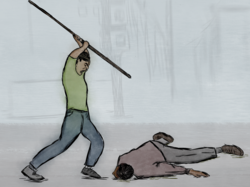
Illustration of a member of the paramilitary group Los Halcones beating a demonstrator fallen on the ground, in the repression of June 10, 1971.
El Halconazo is located in Mexico
El Halconazo
Location19°26′40″N 99°10′03″W / 19.44444°N 99.16750°W / 19.44444; -99.16750
Casco de Santo Tomás, Mexico City, Mexico
Date10 June 1971; 54 years ago (1971-06-10)
Attack type
Massacre
Deaths120
PerpetratorsLos Halcones
The Normal station of the Mexico City Metro was the scene of The Halconazo, the name given to the Corpus Thursday Massacre in 1971 in Mexico City.

El Halconazo (Spanish: The Falcon Strike) was a massacre of student demonstrators by members of the Halcones, a state-sponsored paramilitary group, on 10 June 1971 in Mexico City. Occurring during the Mexican Dirty War, the massacre resulted in nearly 120 demonstrators being killed, among them a 14-year-old boy.[1]

Background

[edit]

From his earliest days in office, President Luis Echeverría Álvarez announced intentions to reform democracy in Mexico. He immediately allowed some leaders of the 1968 student movement to return from exile in Chile and released many prisoners over the course of two years. In April 1971, the press spoke of coming reforms in education and soon figures such as José Revueltas and Heberto Castillo, both jailed for two and a half years, resurfaced in the political arena. Students were excited and thought they would have the opportunity to return to the streets to demonstrate dissatisfaction with the government. The conflict at the University of Nuevo León gave them a reason to do so: At the end of 1970, teachers and university students presented a basic law that proposed a joint government, and in March 1971 Héctor Ulises arrived at the rectory under the new law. The state government disagreed and slashed the budget, which angered university officials and led to the University Council's passage of a new bill that virtually abolished the autonomy of the institution. The university went on strike and called for solidarity with other universities. The National Autonomous University of Mexico and National Polytechnic Institute (IPN) immediately responded and the students called for a massive rally in support of Nuevo León on June 10, 1971.[1]

On May 30 the governor of Nuevo León, Eduardo A. Elizondo Lozano, resigned as part of the settlement of the Ministry of Education. With the governor's resignation, by June 5, a new law came into force that resolved the conflict. Nevertheless, students decided to march even if the demands were not clear. The committee coordinating committee control (CoCo) was divided as there were those who thought that the march was useless and would only provoke the government. However, most people supported the law, arguing that there were many unresolved problems. It was also an opportunity for the government to show that it would not be as repressive as before. Days before the demonstration many police vehicles and cars started making regular runs near the Casco de Santo Tomás (one of the IPN's main campuses).[1]

Massacre

[edit]

The march started at the Casco de Santo Tomás, and proceeded through Carpio and Maestros Avenues so the protesters could take the Mexico-Tacuba Causeway, and eventually end up at Zócalo. The streets leading to the Maestros Avenue were blocked by police officers and riot police, who did not allow the students to pass. There were tankettes parked along Melchor Ocampo Avenue, near the military school, and riot police trucks in a large police contingent at the intersection of the Melchor Ocampo and San Cosme avenues. A shock group trained by the Federal Security Directorate and the CIA,[1] known as "los Halcones", who came in grey trucks, vans, and riot trucks, attacked students from streets near Maestros Avenue after the riot police opened their blockade. The shock group first attacked with bamboo and kendo sticks so the students easily repelled them. Los Halcones then attacked the students again, with high-caliber rifles, while students tried, unsuccessfully, to hide. The police did not intervene because they had been ordered not to. The shooting lasted for several minutes, during which some cars gave logistical support to the paramilitary group. The support included extra weapons and makeshift transports, such as civilian cars, vans, police vehicles and an ambulance from the Cruz Verde (an organization similar to the Red Cross). The injured were taken to the general hospital Rubén Leñero, but to no avail, as the Halcones reached the hospital and killed them, while many were still in the operating room, and took the opportunity to scare the patients and doctors. Nearly 120 protesters were killed, among them a fourteen-year-old boy.[1]

That night army elements guarded the National Palace and Luis Echeverría announced an investigation into the killing and said he would punish the guilty.[1] Alfonso Martínez Domínguez, then-Mexico City governor, and Julio Sánchez Vargas [es], attorney general, denied that there were Halcones and police chief Escobar blamed the students for creating extremist groups within their movement. A week passed before Escobar accepted that there were Halcones, but denied their involvement in the massacre. The high number of journalists and photographers hit and arrested by Halcones managed to contradict the government's official version. Martínez Domínguez tendered his resignation on June 15 to Echeverría because he was convinced that the protesters had been provoked, among other things, so the government had an excuse to get rid of him. Despite this, Martínez Domínguez was known for many years as "Halconzo", in reference to the Corpus Thursday Massacre.

The number of dead in the demonstration discouraged many students, but also led others to be radicalized, some of whom later formed urban guerrilla organizations. Students in 1971 especially demanded the democratization of education, control of the university budget by students and teachers, and that it represent 12% of the GDP. They also demanded political freedom wherein workers, peasants, students, and intellectuals could enjoy real democratic freedoms and control the social system; quality education for everyone, especially farmers and workers; greater respect for cultural diversity; strict democratic transparency; and support for the political union of the workers.

Los Halcones

[edit]

The Halcones were a Mexican paramilitary group created in the late 1960s and led by Colonel Manuel Díaz Escobar, then deputy director of General Services of the Federal District Department.[2]

In fiction

[edit]

Mexican filmmaker Gabriel Retes produced, directed, and acted in a film titled El Bulto (The lump), where he portrays Lauro, a photojournalist, who was attacked by a Los Halcones member and left in a coma.[3]

The massacre is featured in the 2018 film Roma.[4]

The massacre is depicted in the first chapter of the 2021 novel Velvet Was the Night by Silvia Moreno-Garcia. One of the main characters, Elvis, is a member of Los Halcones.

See also

[edit]

References

[edit]
Revisions and contributorsEdit on WikipediaRead on Wikipedia
from Grokipedia
El Halconazo, also known as the Corpus Christi Thursday Massacre, occurred on June 10, 1971, in Mexico City when paramilitary forces called Los Halcones violently assaulted a march of approximately 10,000 student demonstrators organized by the National Strike Council (CNH). The attackers, armed with poles, chains, and truncheons, targeted protesters advocating for university autonomy and broader political reforms, while police forces present failed to intervene. Estimates of the death toll range from around 25 students killed to higher figures exceeding 30, with dozens more wounded, though exact numbers remain disputed due to government suppression of evidence. The event unfolded shortly after President Luis Echeverría Álvarez assumed office, promising a "democratic opening" following the 1968 , yet declassified U.S. and Mexican documents reveal Los Halcones were financed, trained, and directed by Federal District authorities under Colonel Manuel Díaz Escobar, with evidence of high-level presidential awareness. This repression marked a continuation of state tactics to neutralize perceived as a threat to the ruling (PRI)'s , employing deniable proxies to avoid direct military involvement. In the aftermath, the Echeverría administration orchestrated a , attributing the to student provocateurs and suppressing investigations, which fueled long-term controversies over accountability and contributed to the broader narrative of Mexico's "" of extrajudicial state . The massacre's significance lies in exposing the limits of promised reforms under PRI rule, galvanizing further despite immediate suppression, and highlighting systemic use of irregular forces for political control.

Historical and Political Context

Post-1968 Student Unrest in

Following the of October 2, 1968, student activism in did not cease but shifted toward more decentralized and ideologically charged expressions, as survivors and new participants channeled grievances against the (PRI)-led government's authoritarian control. While initial demands centered on democratic reforms like ending police repression and guaranteeing , a subset of activists drew inspiration from global leftist currents, including Cuban revolutionary models, fostering groups that explicitly called for armed insurrection against the PRI's one-party rule. This radicalization was evident in the emergence of urban guerrilla formations rooted in student networks, which rejected electoral politics in favor of direct confrontation to dismantle the regime's perceived monopoly on power. The (UNAM) and other institutions served as primary incubators for this organizing, hosting strikes, occupations, and assemblies that disrupted academic routines and spilled into urban spaces. Student enrollment nationwide surged from approximately 76,000 in 1960 to 247,000 by 1970, amplifying the potential scale of mobilization amid economic modernization that heightened youth disillusionment with PRI paternalism. Events such as the April 1969 protest in , where 70 students were arrested amid clashes with authorities, illustrated persistent challenges to public order, often involving barricades and confrontations that authorities attributed to agitators exploiting legitimate grievances for subversive ends. Government responses emphasized restoring stability through escalated policing and intelligence operations, framing student unrest as a communist-orchestrated peril to national unity during a period of international scrutiny post-Olympics. Declassified reports highlight procurement of tanks and arms by police in early 1969 to counter anticipated disturbances, reflecting a causal link between perceived threats from radicalized youth and preemptive state hardening. Student-initiated violence, including documented use of improvised explosives like Molotov cocktails in skirmishes, further justified official narratives of disorder requiring firm containment, though such tactics were often reactive to prior police interventions.

The Tlatelolco Massacre and Its Aftermath

On , , and surrounded and attacked a rally in the at Tlatelolco housing complex in , ten days before the opening of the Summer Olympics. The operation involved elite units, including the Presidential Guard (Battalion Olympia), which fired on the crowd after flares or shots reportedly initiated from the presidential helicopter or by provocateurs embedded among protesters. Casualty estimates from declassified U.S. intelligence and archival investigations range from dozens to over 300 deaths, with more than 1,000 arrests and widespread injuries; authorities initially reported only 20-44 fatalities, attributing higher figures to exaggeration by agitators. Government accounts emphasized the rally's disruption of public order and Olympic preparations, citing intelligence on armed factions and potential sniper fire from buildings, though independent verification of armament remains contested beyond reports of smuggled weapons linked to radical groups. The intervention reflected the Díaz Ordaz administration's calculus to neutralize perceived threats of revolutionary escalation, amid anxieties over communist infiltration modeled on Cuba's success. Declassified CIA and FBI documents detail Mexican intelligence concerns about Soviet and Cuban support for strikes, including moral encouragement, financial aid, and attempted arms smuggling to radicalize protests into insurgency. U.S. assessments, while downplaying direct foreign orchestration, acknowledged negligible but existent external influences that amplified domestic radicalism, justifying preemptive force to avert broader contagion in a region wary of U.S.-backed counterinsurgencies elsewhere. demands had evolved from educational reforms to broader anti-authoritarian critiques, escalating confrontations with police and occupations of campuses, which authorities viewed as intolerable challenges to PRI hegemony. In the immediate aftermath, the massacre prompted intensified state repression, including mass detentions, media blackouts, and intimidation campaigns that dismantled the National Strike Council leadership and quelled campus activism. Over 1,000 individuals faced trials or , with universities subjected to and to perceived subversives, fostering a climate of fear that temporarily suppressed organized dissent. Public trust in institutions eroded, as evidenced by ongoing demands for accountability unmet even decades later, yet the event's shock enabled short-term stability for the Olympics. By 1971, however, unrest resurged in the form of large-scale demonstrations—the first major protests since Tlatelolco—driven by lingering grievances over , authoritarian governance, and socioeconomic pressures like inequality amid uneven post-war growth, setting the stage for further confrontations under the Echeverría administration.

Luis Echeverría's Presidency and Reformist Facade

Luis Echeverría Álvarez assumed the presidency of Mexico on December 1, 1970, having previously served as Secretary of the Interior from 1964 to 1970, where he directed the Federal Security Directorate and coordinated the suppression of student unrest culminating in the of October 2, 1968. His July 5, 1970, election as the PRI candidate yielded an official 86% of the vote against fragmented opposition, but was tainted by documented irregularities including ballot stuffing and voter intimidation, consistent with the PRI's historical manipulation of electoral outcomes to perpetuate one-party rule. Echeverría cultivated a reformist facade through expansive foreign policy, embarking on over 100 international trips to champion solidarity, advocate for a at the , and position Mexico as a leader against perceived U.S. hegemony, thereby enhancing his image as a progressive statesman detached from domestic authoritarian precedents. Internally, however, his administration's populist measures—such as accelerated land expropriations redistributing over 17 million hectares to peasants by 1976, heightened public spending to stimulate growth, and selective nationalizations—drove fiscal deficits and inflationary pressures, with consumer prices rising from an official 6% in 1970 to approximately 12% by 1973 amid unchecked monetary expansion and import-substitution distortions. This economic populism, amplified by anti-imperialist discourse that implicitly legitimized radical critiques of the state, coincided with escalating urban violence, including a surge in kidnappings targeting businessmen and officials as financing tactics by nascent guerrilla networks in 1970–1971, precursors to formalized groups like the Liga 23 de Septiembre. Such instability stemmed causally from policy-induced resource strains and rhetorical tolerance for dissent, which undermined institutional authority and , while post-Tlatelolco public scrutiny deterred direct military intervention, compelling reliance on deniable proxies for containment to avert broader institutional backlash.

Los Halcones Paramilitary Group

Origins and Government Sponsorship

Los Halcones, a group, was established in the late 1960s in under the oversight of the (DFS), the Mexican government's intelligence and secret police agency. The group was commanded by Colonel Manuel Díaz Escobar, with operational ties to DFS leadership, including , who directed the agency's counter-subversion efforts. Funding derived from state resources channeled through the DFS, enabling discreet operations without overt budgetary traces. This structure incorporated informal networks, including links to criminal elements, to enhance operational deniability and obscure direct governmental fingerprints. The primary purpose of Los Halcones was to neutralize perceived subversive threats, including student-led dissent viewed by authorities as influenced by Soviet or Cuban-backed extremists amid rising urban guerrilla activities in the early . assessments, informed by intelligence on post-1968 unrest, prioritized countering these elements through irregular forces to avoid escalating tensions with the , which risked politicization and public backlash against overt military repression. By deploying plainclothes operatives, the state maintained a veneer of restraint while effectively delegating violent suppression, preserving institutional stability and international perceptions of 's PRI-led regime as reformist rather than authoritarian. Membership consisted of 200 to 400 individuals, primarily young men recruited from marginalized urban neighborhoods, supplemented by off-duty police and physically capable recruits such as athletes or street toughs amenable to coercive tactics. These elements were selected for their loyalty to state directives and expendability, allowing the group to blend into crowds for ambushes on protests without revealing uniformed affiliations. This composition facilitated rapid mobilization for urban counter-insurgency roles, drawing on DFS protocols adapted from operations against domestic radicals.

Recruitment, Training, and Operational Role

Los Halcones were recruited primarily from university-age individuals loyal to the (PRI), including sons of party officials who enjoyed the personal confidence of President . The group, formed in September 1968 under the leadership of Colonel Manuel Díaz Escobar, deputy director of the Department's General Services Directorate, numbered approximately 2,000 members by 1971. Training occurred under military supervision, emphasizing skills in crowd control, management of student demonstrations, physical defense techniques, and . Army personnel provided instruction at undisclosed locations, equipping members with tools like wooden poles, chains, and truncheons for non-lethal suppression. In early 1971, Colonel Díaz Escobar coordinated with U.S. Agency for International Development (AID) and (FBI) officials to arrange specialized police training; the first cohort of five Halcones members, including Díaz Escobar's son, departed for the on March 8, 1971. Declassified U.S. diplomatic records confirm this program aimed to enhance capabilities against urban unrest, though Mexican authorities denied any foreign involvement post-event. Operationally, Los Halcones functioned as a deniable extension of state authority, bypassing regular police to conduct preemptive interventions against perceived leftist agitators. Declassified (DFS) documents reveal close coordination with federal and local police, positioning the group to execute "" tasks that preserved the regime's facade of amid post-1968 unrest. Their doctrine prioritized rapid infiltration and disruption of opposition gatherings, supported by on suspected armament caches in facilities, enabling targeted raids on student safe houses in the lead-up to major confrontations. Armed with state-provided weaponry—including an allocation valued at $200,000, such as M-1 carbines—the Halcones intimidated and neutralized threats, incentivized by impunity from prosecution and modest financial compensation.

Prelude to the Massacre

Student Demonstrations in Spring 1971

In early 1971, at the (UNAM) and the National Polytechnic Institute (IPN) revived amid lingering grievances from the 1968 , including demands for the release of political prisoners and an end to institutional repression. These demonstrations, initially focused on university autonomy and opposition to administrative restrictions, escalated in March and April as participants from both institutions coordinated marches protesting broader government interference in education and perceived authoritarian controls. While starting small, the protests grew to involve hundreds to low thousands by May, incorporating disruptive tactics such as barricades and occasional rock-throwing at security forces, which authorities cited as evidence of organized agitation rather than peaceful reform. A pivotal trigger came in early May 1971, when students at the (UANL) in launched a strike against newly imposed restrictive bylaws limiting campus governance and freedoms, prompting solidarity actions in . IPN and UNAM groups responded with rallies and preparatory gatherings at sites like the Casco de Santo Tomás campus, framing their support for UANL as part of a national push against "imposed" federal policies on higher education. Eyewitness accounts and declassified reports indicate these events included ideological rhetoric advocating revolutionary change, influenced by Marxist literature and international insurgencies, with some factions calling for armed resistance to state power. The protests capitalized on underlying economic pressures, such as widespread underemployment among urban youth amid uneven post-1960s growth, but were increasingly viewed by the Echeverría administration as destabilizing threats akin to the 1968 unrest, rather than legitimate calls for dialogue. Radical elements within the movement, including groups with ties to clandestine networks, shifted focus from tuition or administrative complaints to broader anti-government confrontation, heightening tensions with police during skirmishes where both sides reported injuries from projectiles and batons. This perception of escalation, documented in government intelligence, positioned the demonstrations as precursors to larger disruptions, prompting heightened security measures ahead of Corpus Christi.

Escalation of Tensions with Authorities

In late May 1971, student groups at institutions including the National Polytechnic Institute (IPN) and National Autonomous University of Mexico (UNAM) escalated protests against perceived government interference in university affairs and ongoing repression of dissidents, demanding amnesty for prisoners from the 1968 Tlatelolco events and guarantees of institutional autonomy. These actions persisted despite President Luis Echeverría's public pledges of a "democratic opening" and non-intervention in academia, as demonstrated by his administration's resolution of a parallel autonomy crisis at the earlier that month. Echeverría's officials issued repeated warnings through state media and intermediaries, urging restraint to avoid disorder, but student leaders dismissed them amid vows to hold a major march on June 10, Corpus Christi Thursday. Mexican intelligence services, including the Federal Security Directorate (DFS), reported student contacts with emerging guerrilla factions active in rural areas, including alleged pacts for logistical support and arms smuggling from external sources, heightening official perceptions of a coordinated beyond . These concerns were partially corroborated post-event through arrests of radicalized participants that uncovered weapons caches, such as rifles traced to illicit networks, indicating some infiltration of armed elements into the movement. The administration viewed such developments as echoing the buildup, prompting preemptive measures to neutralize risks without broad mobilization. Mediation efforts faltered in early June 1971, as dialogues between student representatives and envoys broke down over refusals to cancel the planned demonstration, with authorities interpreting the intransigence as deliberate provocation. To circumvent a full military deployment—which risked internal army dissent and potential coups amid the Institutional Revolutionary Party's (PRI) fragile post-1968 stability—Echeverría's inner circle authorized the Los Halcones paramilitary unit for targeted suppression, leveraging their deniability and specialized training in crowd control. This approach reflected a calculated shift toward proxy forces, armed with government-supplied M-1 carbines and financed covertly, to restore order while preserving the regime's reformist image.

The Corpus Christi Thursday Confrontation

Timeline of Events on June 10, 1971

On the morning of June 10, 1971, coinciding with the Catholic feast of Corpus Christi, a religious procession proceeded through central , including areas near Santo Domingo Plaza, where students from the (UNAM) and the National Polytechnic Institute (IPN) gathered for a rally protesting ongoing detentions and demanding democratic reforms. The student assembly disrupted the procession as approximately 10,000 demonstrators initiated a march toward the historic center around 9:00 a.m., passing through streets such as Avenida by midday without initial clashes. Los Halcones, a paramilitary group under municipal oversight, received mobilization directives from federal security entities including the (DFS) around noon, positioning themselves near the park in anticipation of the march's path. By 2:00 p.m., Halcones elements, transported via buses and pickup trucks, had deployed in civilian attire along potential confrontation routes. The march reached the Casco de Santo Tomás area affiliated with the IPN by approximately 5:00 p.m., advancing along Avenida San Cosme, when dozens of Halcones assailants disembarked from vehicles and initiated an using wooden poles, chains, truncheons, and select firearms, while some vehicles rammed into the crowd; police units present observed without direct intervention. Eyewitness reports indicate students responded with improvised defenses including stones, sticks, and debris from the street. Violence escalated around 6:00 p.m. along Avenida and extended to Calzada México-Tacuba, with Halcones pursuing retreating demonstrators; clashes persisted for several hours amid reports of both sides igniting fires in the vicinity before Halcones forces withdrew by evening.

Tactics Employed by Los Halcones

Los Halcones operatives deployed in civilian attire and unmarked vehicles, including buses and pick-up trucks, to blend into the urban environment and execute a surprise on the student march near the Casco de Santo Tomás neighborhood. This infiltration tactic, honed through prior suppression efforts against leftist groups since , enabled rapid emergence from transport to initiate close-quarters assaults without immediate identification as state agents. The group primarily employed blunt and edged melee weapons such as wooden poles, chains, truncheons, machetes, and bamboo sticks—tools aligned with their army-conducted training in crowd control and Japanese kendo techniques—to overwhelm and dismantle the approximately 10,000 protesters. Government provisioning extended to firearms, including an allocation valued at $200,000 that encompassed 100 M-1 carbines, though melee implements dominated the initial clash to maintain deniability and minimize overt lethality. Assaults were synchronized with Federal District police actions, which included street blockades to contain the march and subsequent withdrawal to permit Halcones intervention, prioritizing swift crowd dispersion over sustained engagement. This operational focus on velocity, refined from earlier raids on student facilities in May 1971, achieved empirical dispersal of the demonstration within minutes but precipitated allegations of disproportionate violence due to the intensity of beatings and pursuits into adjacent areas like the Rubén Leñero hospital.

Casualties, Aftermath, and Initial Response

Official and Unofficial Death Toll Estimates

The Mexican government officially reported 11 deaths and 77 injuries from the June 10, 1971, confrontation, attributing most casualties to clashes between student factions rather than coordinated action. This figure derived from autopsies conducted under state control at facilities like the Semefo forensic , which focused on bodies recovered immediately at the scene and excluded reports of missing persons or those transported away. Contemporary U.S. Embassy assessments, drawing from eyewitness accounts and data, estimated around 25 student deaths and dozens of wounded, noting that official counts omitted individuals who vanished during or after the violence. Independent and activist estimates ranged higher, from 40 to over 120 deaths, based on witness testimonies, press compilations of victim names, and allegations of mass graves or secret disposals. These figures often incorporated both civilian protesters and Halcones members killed in the melee, as well as presumed disappeared whose bodies were not autopsied; U.S. diplomatic cables referenced up to 100 individuals potentially killed or vanished, highlighting government suppression of evidence as a factor in undercounting. Discrepancies arose from underreporting due to public fear of reprisals, which deterred families from claiming bodies, and from activist tallies that sometimes conflated event-specific casualties with broader unrest. Later forensic reviews, limited by the absence of preserved remains, have not yielded definitive reconciliations, underscoring reliance on incomplete archival and testimonial data.

Government Denials and Media Coverage

The Mexican government, under President , responded to the June 10, 1971, massacre by issuing denials of state responsibility and framing the violence as a clash provoked by student agitators and external subversives. On June 11, 1971, Echeverría publicly condemned the events but blamed "subversive elements" infiltrating the demonstrations, portraying the students as delinquents who had invited chaos rather than victims of organized repression. Officials further asserted that the Halcones were not government-linked paramilitaries but autonomous right-wing groups acting independently, a narrative designed to obscure ties to federal security agencies like the (DFS). Domestic media coverage was subject to stringent under the Ley de Imprenta, which empowered authorities to suppress dissenting reports and impose on publications. State-owned outlets and compliant newspapers downplayed the death toll—officially estimated at around 13—and emphasized student-initiated violence, while delaying or omitting accounts of premeditated attacks by plainclothes assailants. Independent voices, such as those in Excélsior, faced intimidation and editorial interference, resulting in fragmented initial reporting that aligned with the regime's version of events as a spontaneous rather than a targeted operation. This controlled narrative achieved short-term success in quelling widespread outrage, as protests subsided temporarily amid government promises of inquiry and economic palliatives, allowing the Partido Revolucionario Institucional (PRI) to maintain surface stability without immediate concessions. Foreign press outlets, less constrained, began circulating smuggled eyewitness testimonies of executions, highlighting discrepancies with official accounts and underscoring the domestic blackout's ineffectiveness beyond Mexico's borders.

Investigations, Revelations, and Accountability

Contemporary Inquiries and Cover-Ups

The Mexican government's immediate response to the June 10, 1971, events involved official denials of state orchestration, with President Luis Echeverría Álvarez publicly attributing the violence to spontaneous clashes among student groups rather than coordinated action. This framing deflected scrutiny from Los Halcones, a brigade linked to federal security apparatus, and aligned with broader efforts to portray the incident as mutual aggression rather than targeted repression. Efforts to suppress visual documentation emerged swiftly, as authorities used diplomatic channels to identify and censor photographs of circulating internationally, treating such images as subversive threats to the official narrative. Internal security entities, including the (DFS), compiled reports on the confrontation but emphasized student provocations, effectively whitewashing the premeditated tactics employed against demonstrators. No independent congressional probe gained traction amid the Institutional Revolutionary Party (PRI)'s dominant control of legislative bodies, stalling any potential oversight into state complicity. By late , zero prosecutions had been pursued against Halcones participants or officials, with implicated agents often shielded through internal reassignments rather than facing charges, perpetuating a pattern of .

Declassifications and Later Judicial Proceedings

In 2002, President ordered the declassification of files from the (DFS), Mexico's secret police agency, which revealed operational details of the government's orchestration of the June 10, 1971, attack on student protesters, including the paramilitary group Los Halcones' role under direct oversight from high-level officials in the Echeverría administration. These documents, numbering in the thousands, documented , arming of paramilitaries, and coordination between federal agents and Los Halcones, shifting historical narratives from official denials to evidence of state-sponsored violence, though access was limited by incomplete digitization and selective redactions. Judicial efforts intensified in the mid-2000s, with arrest warrants issued in 2006 against former President Álvarez and DFS director on genocide charges related to the massacre, citing command responsibility for the deaths of at least 26 confirmed victims and injuries to over 100 others. Echeverría, then 84, was briefly placed under , while Nazar Haro faced detention; however, both cases were stalled by procedural challenges, including arguments over retroactive application of genocide statutes enacted in 2001. In 2009, Mexico's Supreme Court dismissed the genocide charges against Echeverría and associated officials, ruling that a 30-year from the 1971 Federal Criminal Code applied, precluding prosecution despite international norms advocating against such temporal bars for grave violations. Nazar Haro, implicated as a key architect of repression tactics during the era, died in 2012 without facing trial for the Halconazo specifically, though his 2004 arrest for unrelated kidnappings highlighted broader impunity patterns; no conviction in absentia occurred for this event, as proceedings fragmented across multiple cases. Victim associations, such as the Comité 10 de Junio formed by survivors and families, pursued civil suits into the 2010s, securing symbolic reparations like public acknowledgments and modest compensation funds under Mexico's 2009 General Victims' Law, but these yielded no admissions of guilt or penalties for senior figures due to evidentiary thresholds unmet in reopened inquiries. Persistent impunity stemmed from transitional pacts during Mexico's shift from PRI dominance in the and early , which prioritized political stability over retroactive accountability, compounded by statutes of limitations that expired before specialized prosecutorial units like the Special Prosecutor's Office for Political and Social Crimes (FEMOSPP, 2001–2006) could amass prosecutable cases amid destroyed or withheld . These structural barriers, rather than lack of , explain the absence of high-level convictions, as declassified materials confirmed but failed to overcome legal technicalities in a historically aligned with executive interests.

Controversies and Scholarly Debates

Disputes Over Casualties and Provocation

The Mexican government's initial report following the June 10, 1971 confrontation stated 11 deaths, attributing the violence to clashes initiated by student protesters. Subsequent eyewitness testimonies, including from participants in the paramilitary group Los Halcones, indicated over 30 fatalities and around 100 wounded, with hospital records from facilities like Xoco reporting more than 150 injuries treated that day. Activist organizations and later human rights accounts escalated estimates to 120 or more deaths, often framing the event as a deliberate genocide against unarmed demonstrators; however, these higher figures remain unverified by forensic analysis, body identifications, or archaeological evidence of mass graves, despite post-event investigations and searches in the 1970s and beyond. The discrepancy reflects broader patterns where initial underreporting by state authorities contrasts with amplified claims in oppositional narratives, akin to unresolved debates over the 1968 Tlatelolco massacre, potentially serving propagandistic purposes amid political tensions. Regarding provocation, official government statements portrayed the students as aggressors who escalated a routine demonstration into , citing prior incidents in the ongoing movement where protesters employed rocks and improvised explosives against . Eyewitness accounts from participants and independent observers, however, described the as peaceful, with no firearms or heavy armament among demonstrators, and emphasized the sudden, coordinated assault by Los Halcones—armed with bats, chains, and knives—as unprovoked state repression. While the coalition had a documented history of defensive tactics including Molotov cocktails in earlier 1971 skirmishes, no contemporaneous police inventories or declassified logs from June 10 substantiate claims of significant weaponry recovered from the protesters at the site, undermining narratives of one-sided victimhood while highlighting causal factors like escalating rhetoric from both sides in the post-1968 unrest. Sources advancing unprovoked massacre interpretations often originate from advocacy-aligned academia and media, institutions prone to systemic left-leaning biases that prioritize emotive framing over empirical reconciliation of conflicting testimonies.

Assessments of State Responsibility and Student Violence

Declassified U.S. and Mexican documents reveal that President Álvarez tacitly authorized the Halcones' assault on student demonstrators, with internal communications framing the operation as a calculated "lesser evil" to contain escalating unrest and forestall civil war amid proliferating guerrilla insurgencies. The paramilitary unit, equipped with state-supplied weaponry and directed by federal security officials, underscored the PRI regime's devolution from centralized coercion to outsourced , signaling a fraying as conventional forces proved insufficient against persistent dissent. Countervailing analyses underscore student complicity in the confrontation's intensification, linking CNH-affiliated radicals to nascent urban guerrilla networks that traced origins to the 1968-1971 mobilizations, including overlapping cadres and rhetorical endorsements of Maoist-inspired "prolonged popular war" strategies in manifestos and communiqués. Such affiliations, involving shared logistical resources like arsenals repurposed from caches, lent credence to preemptive rationales by blurring lines between peaceful assembly and subversive preparation, thereby elevating the perceived stakes beyond routine disorder. Post-2000 scholarship from historians skeptical of romanticized narratives posits the state's intervention as imperative for order restoration, arguing that unchecked radicalism threatened the PRI's foundational compact of stability-through-authority, which had underwritten seven decades of institutional continuity and despite repressive costs. Predominant left-leaning interpretations in academic circles, however, selectively emphasize state while eliding the causal from escalations to reactive force, a tendency attributable to institutional biases favoring insurgent perspectives over empirical scrutiny of PRI-era threat dynamics.

Broader Interpretations in the Mexican Dirty War

El Halconazo exemplified a shift toward low-intensity tactics within Mexico's , spanning roughly 1964 to 1982, by deploying paramilitary units such as Los Halcones to conduct operations that obscured direct military involvement and preserved institutional deniability. This method reduced reliance on overt army deployments, aligning with broader Cold War-era strategies influenced by U.S. training programs that emphasized covert suppression of perceived leftist subversion across . Unlike earlier mass repressions like the 1968 , which involved uniformed forces, the 1971 event prototyped blending plainclothes agents with student infiltrators to dismantle urban dissent networks. Interpretations diverge on whether such actions constituted defensive realism against escalating threats or gratuitous terror. Proponents of the former argue that student mobilizations, including the June 10, 1971, march, intersected with armed guerrilla activities—over 30 groups operated from the late 1960s, executing kidnappings, assassinations, and bombings that challenged state monopoly on violence. Empirical patterns support efficacy: urban terrorism, including bombings in Mexico City, waned through the mid-1970s as state paramilitary responses intensified, culminating in the neutralization of key leaders by 1976. This tactical evolution mirrored causal necessities in counterinsurgency, where unchecked subversion risked broader instability, as evidenced by Chile's 1973 military intervention following Allende's accommodation of radical factions. Dominant scholarly accounts, often shaped by archival emphases on state abuses in declassified records, frame El Halconazo as an initiatory act of offensive repression absent existential threats from students, sidelining evidence of their overlaps with violent insurgents. Such views, prevalent in left-leaning , underweight the regime's incentives for preemption: inaction against hybrid threats could precipitate coups or , per regional precedents, prioritizing narrative symmetry with other Latin American "dirty wars" over granular threat assessments. Reassessments grounded in pre-1971 violence patterns instead posit it as calibrated escalation, not aberration, yielding measurable deterrence without full-scale mobilization.

Long-Term Impact and Representations

Political Consequences for the PRI Regime

The Halconazo massacre of June 10, 1971, exposed the contradictions in President Luis Echeverría's administration, which had campaigned on promises of political opening and reform following the 1968 , yet resorted to paramilitary violence against unarmed students, thereby accelerating the PRI's internal delegitimization without precipitating an immediate collapse of its one-party dominance. This event, occurring early in Echeverría's term (1970–1976), highlighted the regime's reliance on covert repression through groups like the Halcones, undermining claims of democratic renewal and fostering elite disillusionment within the PRI's own ranks, where reformist rhetoric clashed with authoritarian practice. In the short term, the PRI weathered the through controlled transitions and economic , as Echeverría handed power to on December 1, 1976, amid mounting fiscal strains but without electoral upheaval or party fracture. However, the massacre's revelations of state-sponsored brutality contributed to a pattern of , including later legal accusations against Echeverría for the killings, which eroded the regime's and sowed seeds of opposition mobilization. The PRI's adaptation strategy emphasized co-optation of dissenters—integrating intellectuals and students into state institutions—allowing it to maintain hegemony into the late , though this masked deepening fissures exposed by events like Halconazo. Over the longer term, Halconazo intensified the PRI's legitimacy crisis, intertwining with the broader (1960s–1980s) to fuel public skepticism toward the party's revolutionary credentials, culminating in the disputed 1988 presidential election where PRI candidate Carlos Salinas de Gotiari faced credible fraud allegations against opposition challenger , marking a pivotal challenge to one-party rule. This erosion propelled demands for in the 1990s, as and splinter groups highlighted PRI hypocrisy, yet the party survived by hybrid reforms—combining electoral openings with —postponing full transition until its 2000 defeat. The event's causal role lay in demonstrating the limits of PRI reformism, where tactics not only alienated urban elites but also strained relations with the regular military, perceived as sidelined by civilian-led dirty operations, thus hastening institutional rot without overthrow.

Cultural Depictions in Film, Literature, and Memory

The 2018 film Roma, directed by and set in early 1970s , incorporates the Halconazo as a climactic sequence depicting paramilitary Halcones attacking student marchers on June 10, 1971, amid broader political unrest, drawing from the director's childhood recollections of the violence. The scene underscores class tensions and state repression observed by the protagonist, a , but has been observed to prioritize the spectacle of the assault over preceding student mobilizations that included occupations and clashes with authorities. In documentary form, Carlos Mendoza's 2006 Halcones, terrorismo de Estado compiles eyewitness accounts from student survivors alongside period photographs and footage, framing the event as state-sponsored terror against demonstrators. Literary treatments include Eduardo Barraza's 2021 book El Halconazo: La masacre de estudiantes en México de 1971, which reconstructs the repression through archival evidence and participant narratives, emphasizing the government's role in mobilizing the Halcones group against protesters rekindling post-1968 activism. Photojournalist Enrique Salgado's autobiographical Memorias details his on-site documentation of the bloodshed, providing firsthand visual and textual records of the casualties amid the Corpus Christi procession route. These works often center victim perspectives, though broader historical analyses, such as those examining images from the era, situate the massacre within cycles of protest escalation and institutional responses during Mexico's period. Collective memory manifests in annual June 10 commemorations at sites like the Federal District Building, where survivors and activists gather to honor an estimated 40-120 deaths and hundreds injured, blending ritual mourning with demands for accountability from the administration. The 50th anniversary on June 10, 2021, drew marches through streets, protesting enduring and invoking the event's parallels to ongoing challenges, while anti-monuments and abstract sculptures at key locations perpetuate public remembrance. These observances, frequently amplified by left-leaning outlets, tend to foreground state culpability but occasionally intersect with discussions of bilateral violence in academic forums revisiting the era's insurgent contexts.

References

Add your contribution
Related Hubs
User Avatar
No comments yet.