Hubbry Logo
Ethan FromeEthan FromeMain
Open search
Ethan Frome
Community hub
Ethan Frome
logo
8 pages, 0 posts
0 subscribers
Be the first to start a discussion here.
Ethan Frome
Ethan Frome
from Wikipedia

Ethan Frome is a 1911 novella by American author Edith Wharton. It details the story of a man who falls in love with his wife's cousin and the tragedies that result from the ensuing love triangle. The novel has been adapted into a film of the same name.[1]

Key Information

Plot

[edit]

An unnamed male narrator is working for a power plant, and due to a carpenter's strike finds himself forced to spend a winter in the nearby small (fictional) town of Starkfield, Massachusetts. The man who daily chauffeurs him to work is a limping, quiet man named Ethan Frome, a lifelong resident and local fixture of the community. The narrator learns that Frome's limp arose from being injured in an accident. The story then flashes back 24 years to detail Frome's past.

The young Frome is married to a sickly woman named Zeena (Zenobia), who appears older than her age, is unkind to Ethan, and whose life revolves around seeking expensive treatments for her varied illnesses. Although the Fromes have limited means themselves, they have charitably taken in Zeena's cousin Mattie, whose family is poor. Ethan falls in love with Mattie, and it becomes increasingly clear that Mattie also loves him. While it remains ambiguous if Zeena suspects Ethan's unfaithfulness, she makes plans to send Mattie away. Zeena claims that, because of her failing health, her physician has recommended she hire a maid who will relieve her of housework. Zeena has already arranged for the hired girl to arrive by train soon, and Mattie must vacate her room immediately. Ethan, miserable at the thought of losing Mattie, considers running away with her, but he lacks the money to do so, and will feel guilty about leaving Zeena with the farm.

The next morning, Ethan rushes into town to try to get a cash advance from a customer for a load of lumber in order to have the money with which to elope with Mattie. His plan is unhinged by guilt, however, when the customer's wife expresses honest compassion for Ethan. He realizes that he cannot cheat this kindly woman and her husband out of their money.

Ethan comes back to the farm and picks up Mattie to take her to the train station. They stop at a hill upon which they had once planned to go sledding and decide to sled together as a way of delaying their sad parting. After their first run, Mattie suggests a suicide pact: that they go down again, and steer the sled directly into a big elm tree, so they will never be parted and so that they may spend their last moments together. The resulting crash leaves both of them alive, Ethan with a permanent limp and Mattie paralyzed from a spinal injury.

Returning to the present, the narrator tells of being forced by a blizzard to stay the night at the Frome house, the first stranger to enter the house in 20 years. He witnesses an unhappy scene with Mattie and the Fromes living together, with Zeena as Mattie's caregiver. Ethan and Mattie have gotten their wish to stay together, but in mutual unhappiness and discontent, and ironically Mattie has now developed an irritable disposition, and the sickly Zeena is rising to the challenge of becoming a caretaker. Zeena is a constant presence between the two of them, although it remains ambiguous as to whether she knew of their dalliance.

Development

[edit]

The story of Ethan Frome began as a French-language composition that Wharton had to write while studying the language in Paris,[2] but several years later she took the story up again and transformed it into a novel, basing her sense of New England culture and place on her ten years of living at The Mount, her home in Lenox, Massachusetts. She would read portions of her novel-in-progress each day to her good friend Walter Berry, who was an international lawyer. Wharton likely based the story of Ethan and Mattie's sledding experience on an accident that she had heard about in 1904 in Lenox.[3] Five people total were involved in the real-life accident, four girls and one boy. They crashed into a lamppost while sledding down Courthouse Hill in Lenox. A girl named Emily Hazel Crosby was killed in the accident. Wharton learned of the accident from one of the girls who survived, Kate Spencer, when the two became friends while both worked at the Lenox Library. Kate Spencer suffered from a hip injury in the accident and also had facial injuries. It is among the few works by Wharton with a rural setting.[3] Wharton found the notion of the tragic sledding crash to be irresistible as a potential extended metaphor for the wrongdoings of a secret love affair.

Lenox is also where Wharton had traveled extensively and had come into contact with at least one of the victims of the accident; victims of the accident are buried in graves nearby Wharton family members. In her introduction to the novel, Wharton talks of the "outcropping granite" of New England, the austerity of its land and the stoicism of its people. There are frequent references to larch, elm, pine, and hemlock trees. The connection between land and people is very much a part of naturalism; the environment is a powerful shaper of man's fate, and the novel dwells insistently on the cruelty of Starkfield's winters.[4]

Reception

[edit]

The New York Times called Ethan Frome "a compelling and haunting story."[5] Wharton was able to write an appealing book and separate it from her other works, where her characters in Ethan Frome are not of the elite upper class. However, the problems that the characters endure are still consistently the same, where the protagonist has to decide whether or not to fulfill their duty or follow their heart. She began writing Ethan Frome in the early 1900s when she was still married. The novel was criticized by Lionel Trilling as lacking in moral or ethical significance.[2] Trilling wrote that the ending is "terrible to contemplate," but that "the mind can do nothing with it, can only endure it."[6]

Jeffrey Lilburn notes that some find "the suffering endured by Wharton's characters is quite bleak and makes for a dull read," but others see the difficult moral questions addressed and note that it "provides insightful commentary on the American economic and cultural realities that produced and allowed such suffering." Wharton was always careful to label Ethan Frome as a brief reminiscence rather than a novel. Critics did take note of this when reviewing the book, some in more candor than others. Elizabeth Ammons reflected that reading Wharton's novel compelled her to reminisce upon when literature was more enthralling. She found a story that functions as a "realistic social criticism," a reminder that some are willing to indulge in dull prose based solely upon the name of the author. Despite her obvious quarrels with the work, Ammons proceeded to analyze the text. The moral concepts, as described by Ammons, are revealed with all of the brutality of Starkfield's winters. Comparing Mattie Silver and Zeena Frome, Ammons suggests that Mattie would grow as frigid and crippled as Zeena, so long as such women remain isolated and dependent. Wharton cripples Mattie, says Lilburn, but has her survive in order to demonstrate the cruelty of the culture surrounding women in that period.[7]

Adaptations

[edit]

The book was adapted to the 1993 film of the same name, directed by John Madden, and starring Liam Neeson, Patricia Arquette, Joan Allen and Tate Donovan.[1]

Cathy Marston adapted the book to a one-act ballet titled Snowblind for the San Francisco Ballet. The ballet premiered in 2018, with Ulrik Birkkjaer as Ethan, Sarah Van Patten as Zeena and Mathilde Froustey as Mattie.[8]

References

[edit]
[edit]
Revisions and contributorsEdit on WikipediaRead on Wikipedia
from Grokipedia
Ethan Frome is a tragic by American author , first published in 1911 by . Set in the fictional rural town of Starkfield, , during a harsh winter, the story centers on Ethan Frome, a struggling trapped in a loveless and burdensome marriage to his hypochondriac wife, Zenobia "Zeena" Frome. When Zeena hires her cheerful cousin, Mattie Silver, as a companion and helper, Ethan becomes deeply enamored with Mattie, igniting his dreams of escape from his desolate life but ultimately leading to a catastrophic accident that binds the three characters in perpetual . The narrative employs a frame structure, in which an unnamed visiting Starkfield for work reconstructs the past events through local and observations of the crippled Ethan, revealing the story's grim aftermath nearly 24 years later. Wharton, born Edith Newbold Jones in 1862 to a prominent New York family, crafted Ethan Frome as a departure from her typical portrayals of urban , instead delving into the hardships of and . Written during her residence in in 1910, the novella draws on naturalist influences, emphasizing how environmental and social forces inexorably shape human destiny. Key themes include the stifling effects of economic hardship and marital duty, the allure and futility of forbidden love, and the inexorable pull of tragic necessity in a unforgiving landscape. The work's stark realism and psychological depth have made it one of Wharton's most enduring pieces, widely regarded as a cornerstone of early 20th-century .

Publication and Composition

Development

Edith Wharton's inspiration for the central tragedy in Ethan Frome stemmed from a fatal accident she learned of while residing in , where a young woman, Emily Hazel Crosby, died after her sled collided with a pole on March 10, 1904, injuring several others involved. This event, reported in local newspapers like The Eagle, resonated with Wharton as a for doomed passion and isolation, influencing the novella's climactic crash despite her not directly witnessing it. Seeking to depart from the urban sophistication of her earlier novels such as (1905), Wharton turned to rural for Ethan Frome, drawing on her observations during her time living at The Mount in Lenox from 1902 to 1911. She explored derelict mountain villages in and , noting the "sad slow-speaking people" enduring harsh, unchanging conditions that contrasted sharply with the romanticized depictions by authors like Mary Wilkins Freeman and . The fictional Starkfield, —a composite evoking Berkshire County towns like Lenox and Stockbridge—emerged from these excursions, allowing Wharton to portray the grim realities of poverty, inarticulateness, and moral stagnation she encountered. To convey the story's emotional distance and ironic undertones, Wharton employed a framed structure, introducing an unnamed engineer-narrator who pieces together Frome's past from local accounts, a technique she adapted from Honoré de Balzac's "La Grande Bretèche" and Robert Browning's . This outsider's perspective, as Wharton explained, enabled her to interpret the "granite outcroppings" of her reticent characters without artificial directness, bridging the generational gap between the main events and their aftermath while heightening the tragedy's inevitability. Wharton experimented with a stark, concise style in Ethan Frome to mirror the protagonists' stifled lives and the bleak landscape, marking a deliberate from the expansive social satire of her prior works. She began drafting in French during a sojourn around 1908 to refine her descriptive precision, later revising in English and reading drafts aloud to friend Walter Berry to verify the authentic rhythm of rural speech, achieving what she described as the "artisan's full control" over her craft for the first time. This austere approach intensified the sense of and unspoken longing, setting the apart as a taut psychological study.

Publication History

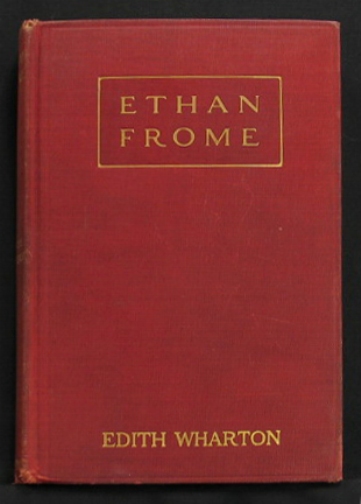
Ethan Frome was first serialized in three installments in from August to October 1911. The full appeared in book form shortly thereafter, published by on September 30, 1911. The first edition had an initial print run of approximately 6,000 copies, with the initial 2,500 featuring top-edge gilding as a distinguishing feature. It was issued in a standard red cloth binding typical of Scribner's publications at the time. Wharton played an active role in overseeing aspects of the production, though specific details on her involvement in title finalization or cover design remain limited in contemporary records. Early commercial performance was solid but not explosive, with sales reaching 4,000 copies by mid-November 1911. This success was aided by Wharton's established reputation from prior works like The House of Mirth and Ethan Frome's serialization in a prominent periodical, yet Wharton voiced frustration over Scribner's inadequate advertising and uneven distribution, which she believed hampered broader reach. Despite these concerns, the book's release marked a key moment in Wharton's career, capitalizing on her growing prominence in American literature.

Narrative and Setting

Plot Summary

The novella Ethan Frome is framed by an unnamed narrator who arrives in the rural of Starkfield during a harsh winter and becomes intrigued by the local figure Ethan , a man in his fifties marked by a severe and a stooped posture resulting from an old injury, whom he observes performing laborious daily routines at his farm despite the cold. The narrator pieces together Frome's story through conversations with locals and a brief stay at the Frome , leading into a flashback that recounts events from about twenty-four years earlier. In the flashback, Ethan Frome, then a young man studying to become an engineer, has returned to Starkfield to care for his ailing parents and marries Zeena (short for Zenobia), a distant cousin who had nursed them during their illnesses; shortly after the marriage, Zeena herself falls chronically ill with unspecified complaints, confining her mostly to the home and leaving Ethan to manage the farm alone. To ease the household burden, Zeena hires her impoverished cousin Mattie Silver as a helper, and Mattie soon takes on light domestic duties while bringing a sense of vitality to the isolated farmhouse. Over time, Ethan develops a growing, unspoken for the cheerful Mattie, which contrasts sharply with the increasing tension in his marriage to the complaining Zeena, culminating in a pivotal evening when Ethan escorts Mattie home from a church social in the village, where they share a rare moment of closeness amid the dancing and festivities. This encounter heightens Ethan's emotional turmoil, especially after Zeena announces plans to consult a new doctor and replace Mattie with a hired , prompting Ethan to desperately attempt to sell the farm and elope with Mattie using the proceeds. Unable to secure the funds, Ethan and Mattie instead embark on a reckless sled ride down a steep hill near the farmhouse on a snowy night, aiming to crash into a large tree in a bid to end their predicament together, but the attempt fails, leaving both severely injured—Ethan with a permanent limp and Mattie paralyzed from the waist down. The epilogue returns to the present, where the narrator visits the Frome home during a and witnesses the grim reality of the three living together: Zeena, now the primary caregiver, tends to the invalid Mattie and the physically limited Ethan in a tense, confined household that underscores the enduring consequences of the past events.

Setting and Structure

The novella Ethan Frome is set in the fictional town of Starkfield, a remote village in modeled after the austere communities encountered during her residence in Lenox in the early . This isolated locale, characterized by its barren fields and unyielding landscape, evokes a sense of and , reinforced by the Frome —a once-L-shaped structure typical of farmhouses, but altered by the removal of one wing, leaving it diminished and exposed to the elements. The story unfolds predominantly during a harsh, perpetual winter, where relentless snowstorms and biting cold not only dominate the physical environment but also constrain the characters' movements and interactions, amplifying the atmosphere of desolation over a 24-year period from Ethan's young adulthood in the late to his around 1900. These natural forces, covering the land in deep drifts and shortening days, create a claustrophobic mood that underscores the narrative's emotional restraint and the passage of time marked by stagnation rather than progress. Wharton employs a framed structure, with an outer frame set in the winter of the early 1900s from the perspective of an unnamed engineer-narrator who observes the aged Ethan Frome in Starkfield, and an inner story that flashes back 24 years to recount the pivotal events leading to Ethan's accident. This layering introduces irony, as the narrator's outsider viewpoint—gleaned secondhand from locals and limited interactions—presents an incomplete portrait of Frome, heightening the story's tragic undertones by contrasting the present ruin with the past's unfulfilled potential. Within the inner narrative, Wharton shifts to third-person limited narration focalized through Ethan, immersing readers in his introspections and sensory experiences while withholding insights into other characters' minds, which builds around unspoken tensions and introduces elements of unreliability tied to Ethan's own biases and silences. This technique enhances the mood of isolation, as the reader's understanding mirrors Ethan's constrained perspective amid the enveloping winter gloom.

Characters and Themes

Major Characters

Ethan Frome is the protagonist of Edith Wharton's , a farmer in the rural of Starkfield, , who is depicted as a self-educated man in his late twenties during the main events of the story. Having briefly studied in Worcester, he returned home after his father's sudden death and his mother's prolonged illness forced him to manage the family's failing farm and , resigning himself to a life of manual labor despite his intellectual aspirations. Ethan is characterized as sensitive, taciturn, and deeply attuned to world, yet burdened by a sense of duty that traps him in isolation and unfulfilled dreams; his relationship with his wife Zeena is marked by emotional distance and resentment, while his bond with the younger Mattie Silver awakens a rare sense of companionship and vitality. Zenobia Frome, known as Zeena, is Ethan's wife, approximately seven years his senior and already appearing aged and worn by chronic illness during the story's timeframe. She came to the Frome as a to Ethan's to provide care, remaining after the 's and marrying Ethan out of a sense of , which has since devolved into a dominated by her hypochondria and reliance on patent medicines and doctors. Renowned locally as "the greatest hand at doctoring in the county," Zeena's is querulous, observant, and fault-finding, with her "sickliness" shaping the dynamics and exacerbating tensions in her interactions with Ethan and the hired help Mattie. Mattie Silver serves as Zeena's orphaned cousin and unpaid household assistant, a lively young woman in her early twenties who arrives in Starkfield after her father's business failure leaves her destitute. Untrained in domestic skills and lacking formal education, Mattie brings an optimistic and dreamy energy to the Frome farm, contrasting sharply with Zeena's demeanor; her relationship with Ethan evolves into one of mutual affection and shared intellectual interests, such as discussions of during evening walks, highlighting her role as a foil to the stifling atmosphere of the . Minor characters like Ned Hale, a local engaged to Ruth Varnum, provide glimpses into the Starkfield community's social fabric, representing youthful romance and normalcy amid the Fromes' isolation; their frequent outings, such as near the Varnum spruces, underscore the town's interconnected village life.

Themes and Symbolism

One of the central themes in Ethan Frome is , where economic limitations, marital obligations, and the unforgiving rural environment converge to stifle the protagonist's aspirations and agency. Ethan, bound by and to his hypochondriac Zeena, embodies the of unfulfilled potential in a decaying farm life, as the barren Frome farmhouse symbolizes this pervasive confinement and emotional stagnation. The structure of the house, with its awkward L-shaped addition, further represents the fractured and incomplete unity of the household, mirroring Ethan's divided loyalties and the impossibility of wholeness amid these constraints. This motif underscores Wharton's critique of societal and natural forces that trap individuals in cycles of despair, preventing escape or renewal. The irony of aspiration versus harsh permeates the , highlighting Ethan's thwarted dreams of pursuit and escape from Starkfield's stagnation. Having briefly studied in , Ethan yearns for a life beyond farming, yet his return to the land due to family obligations leaves him mired in rural decay, a contrast amplified by symbols of unrealized vitality. The dead vine dangling from the porch evokes barren potential and living death, akin to a streamer, reflecting the withered hopes that cling to the property and Ethan's own stifled ambitions. This irony critiques the gap between personal desires and the inexorable pull of circumstance, portraying aspiration as a futile rebellion against deterministic forces. Gender dynamics and illness serve as mechanisms of control within the household, subverting patriarchal norms through Zeena's strategic use of her "nerves" to assert dominance over Ethan. In a society that marginalizes women, Zeena's hypochondria becomes a tool for power, inverting traditional roles by emasculating her husband and enforcing emotional isolation. The red pickle dish, a symbolizing the ideals of domestic and passion, shatters when used illicitly by Mattie, representing the irreparable fracture of Ethan's and Zeena's unyielding authority over their shared life. This symbolism exposes how illness and expectations perpetuate , transforming personal frailty into a weapon of relational control. Nature emerges as an antagonist in the novella, with the relentless winter landscape reinforcing themes of isolation and thwarting any hope of romantic or personal liberation. The recurring motif of a "white veil" of snow envelops Starkfield, creating a suffocating barrier that mirrors the characters' internal desolation and prevents meaningful connection or flight. This environmental hostility culminates in the sled crash, a desperate act symbolizing a failed escape from marital and societal bonds, where the icy terrain not only physically injures Ethan and Mattie but also eternally binds them in a grim triad with Zeena. Through this, Wharton illustrates nature's complicity in human suffering, amplifying the novella's exploration of inevitable decline.

Reception and Adaptations

Critical Reception

Upon its publication in 1911, Ethan Frome received mixed contemporary reviews, with some praising its emotional depth while others found it overly dramatic. The New York Times described the novella as a "cruel, compelling, haunting story of New England," highlighting its tragic intensity in depicting the characters' suffering. However, other critics labeled it cruel and violent, criticizing elements of melodrama in its portrayal of doomed romance. Wharton's close friend and mentor Henry James offered strong endorsement, providing what she described as his first "unqualified praise" for her work and admiring its "beautiful art & tone & truth" as well as its "kept-downness." In the early , scholars viewed Ethan Frome as a significant departure from Wharton's earlier society novels, emphasizing its realist and naturalist elements. Critics noted its shift toward rural , drawing parallels to the deterministic forces in Thomas Hardy's fiction, such as the bleak seen in . Blake Nevius, in his study, argued that the novella's naturalist influences from Hardy underscored Wharton's exploration of characters trapped by environment and circumstance, marking a maturation in her realism beyond urban . Mid-20th-century interpretations, particularly from the 1970s onward, introduced feminist perspectives that reframed the novella's gender dynamics and elevated its place in Wharton studies. Cynthia Griffin Wolff's analysis in A Feast of Words: The Triumph of (1977) highlighted Zeena's agency amid patriarchal oppression, portraying her not merely as a but as a figure shaped by societal constraints on women in rural isolation. This reading emphasized how the story critiques the limited roles available to women, contributing to a broader reevaluation of Wharton's work through lenses of power imbalances and female resilience. Post-2000 scholarship has increasingly focused on themes of class, regionalism, and , with reflections underscoring the novella's enduring . Essays marking the , including those in the series, explored how Ethan Frome anticipates modern discussions of economic hardship in rural America, portraying Starkfield's isolation as a microcosm of class-based entrapment. Critics have examined its regionalist depiction of , linking it to broader American literary traditions of and social critique.

Adaptations

The novella Ethan Frome has been adapted into several stage, film, and television productions, often emphasizing its themes of isolation, unfulfilled desire, and rural hardship while making adjustments for dramatic pacing and visual impact. The most notable stage adaptation is the 1936 Broadway play written by Owen and Donald Davis, based on Edith Wharton's novel and an earlier dramatization by Lowell Barrington. Produced by Max Gordon and directed by , it premiered at the National Theatre on January 21, 1936, and ran for 120 performances until May 5, 1936. portrayed Ethan Frome, Pauline Lord played Zenobia (Zeena) Frome, and starred as Mattie Silver, delivering performances that highlighted the characters' emotional desolation. Critics praised the production for its stark portrayal of winter landscapes and its unflinching focus on visual and psychological tragedy, with one review noting how the actors "tore tragedy out by the roots" through graceless, desperate interpretations that mirrored the story's icy despair. In 1993, director helmed a cinematic scripted by Richard Nelson, starring as Ethan Frome, as Mattie Silver, and as Zeena Frome. Produced by Films and , the film remains faithful to the novella's structure and setting, employing sweeping cinematography by Oliver Stapleton to capture the relentless snowy isolation of Starkfield, , which enhances the narrative's sense of entrapment. However, reviewers noted that it softens the protagonists' suffering and dilutes the novella's devastating conclusion, making the tragedy feel less raw and more sympathetic toward the antagonists. Despite these changes, the introduced Wharton's work to broader audiences, grossing $296,081 domestically and earning praise for its atmospheric fidelity. Other adaptations include a 1960 television production for NBC's The DuPont Show of the Month, directed by Alex Segal and starring as Ethan Frome and as Mattie Silver, which aired live and condensed the story into a 90-minute format while preserving its emotional core. A 2018 ballet titled Snowblind, choreographed by Cathy Marston for the , reimagined the tale through abstract dance movements to evoke the characters' inner turmoil and the harsh winter environment, premiering to acclaim for its innovative translation of literary motifs into physical expression.

References

Add your contribution
Related Hubs
User Avatar
No comments yet.