Recent from talks
Nothing was collected or created yet.
Exsecant
View on Wikipedia

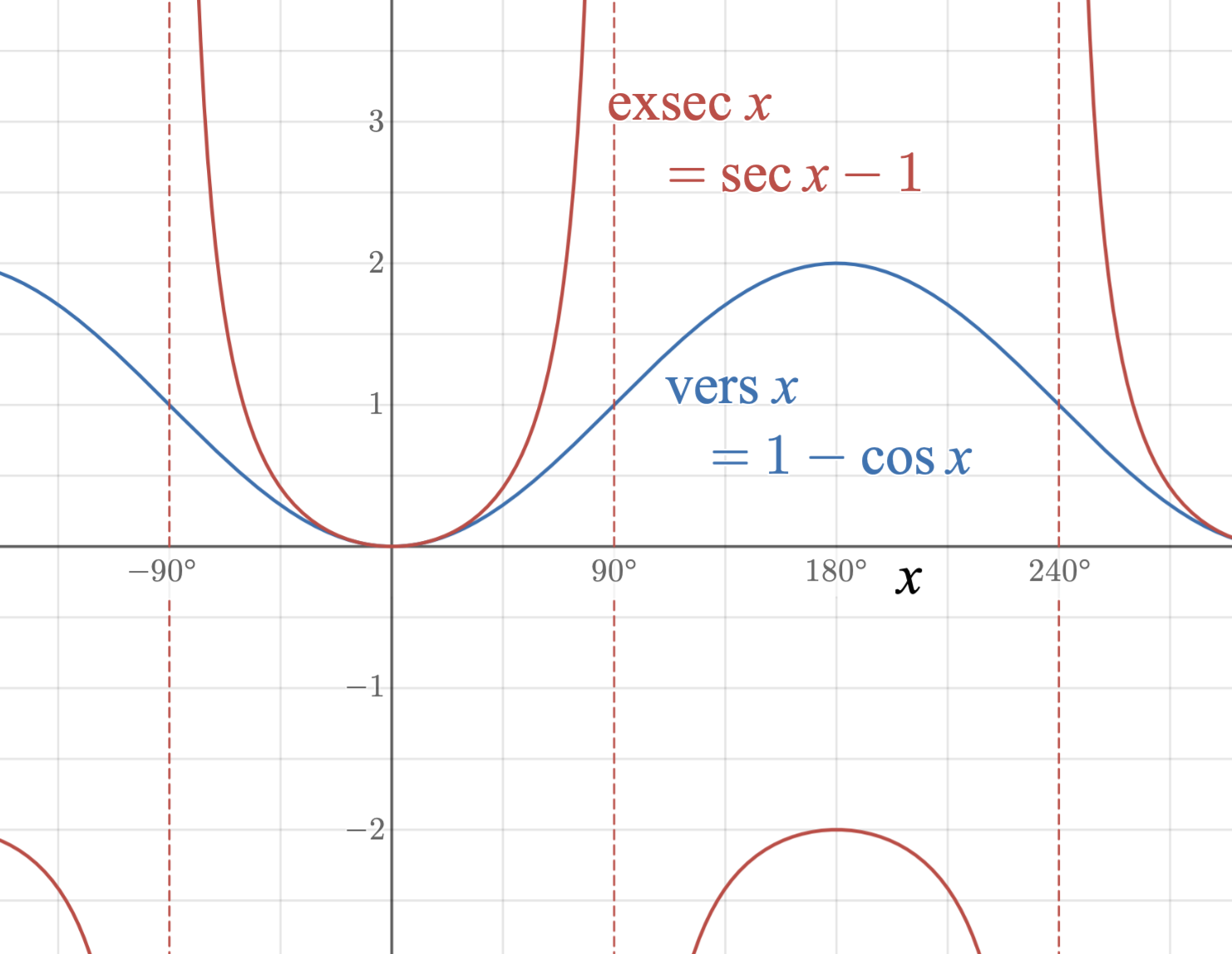
The external secant function (abbreviated exsecant, symbolized exsec) is a trigonometric function defined in terms of the secant function:

It was introduced in 1855 by American civil engineer Charles Haslett, who used it in conjunction with the existing versine function, for designing and measuring circular sections of railroad track.[3] It was adopted by surveyors and civil engineers in the United States for railroad and road design, and since the early 20th century has sometimes been briefly mentioned in American trigonometry textbooks and general-purpose engineering manuals.[4] For completeness, a few books also defined a coexsecant or excosecant function (symbolized coexsec or excsc), the exsecant of the complementary angle,[5][6] though it was not used in practice. While the exsecant has occasionally found other applications, today it is obscure and mainly of historical interest.[7]
As a line segment, an external secant of a circle has one endpoint on the circumference, and then extends radially outward. The length of this segment is the radius of the circle times the trigonometric exsecant of the central angle between the segment's inner endpoint and the point of tangency for a line through the outer endpoint and tangent to the circle.
Etymology
[edit]The word secant comes from Latin for "to cut", and a general secant line "cuts" a circle, intersecting it twice; this concept dates to antiquity and can be found in Book 3 of Euclid's Elements, as used e.g. in the intersecting secants theorem. 18th century sources in Latin called any non-tangential line segment external to a circle with one endpoint on the circumference a secans exterior.[8]
The trigonometric secant, named by Thomas Fincke (1583), is more specifically based on a line segment with one endpoint at the center of a circle and the other endpoint outside the circle; the circle divides this segment into a radius and an external secant. The external secant segment was used by Galileo Galilei (1632) under the name secant.[9]
History and applications
[edit]In the 19th century, most railroad tracks were constructed out of arcs of circles, called simple curves.[10] Surveyors and civil engineers working for the railroad needed to make many repetitive trigonometrical calculations to measure and plan circular sections of track. In surveying, and more generally in practical geometry, tables of both "natural" trigonometric functions and their common logarithms were used, depending on the specific calculation. Using logarithms converts expensive multiplication of multi-digit numbers to cheaper addition, and logarithmic versions of trigonometric tables further saved labor by reducing the number of necessary table lookups.[11]
The external secant or external distance of a curved track section is the shortest distance between the track and the intersection of the tangent lines from the ends of the arc, which equals the radius times the trigonometric exsecant of half the central angle subtended by the arc, [12] By comparison, the versed sine of a curved track section is the furthest distance from the long chord (the line segment between endpoints) to the track[13] – cf. Sagitta – which equals the radius times the trigonometric versine of half the central angle, These are both natural quantities to measure or calculate when surveying circular arcs, which must subsequently be multiplied or divided by other quantities. Charles Haslett (1855) found that directly looking up the logarithm of the exsecant and versine saved significant effort and produced more accurate results compared to calculating the same quantity from values found in previously available trigonometric tables.[3] The same idea was adopted by other authors, such as Searles (1880).[14] By 1913 Haslett's approach was so widely adopted in the American railroad industry that, in that context, "tables of external secants and versed sines [were] more common than [were] tables of secants".[15]
In the late-19th and 20th century, railroads began using arcs of an Euler spiral as a track transition curve between straight or circular sections of differing curvature. These spiral curves can be approximately calculated using exsecants and versines.[15][16]
Solving the same types of problems is required when surveying circular sections of canals[17] and roads, and the exsecant was still used in mid-20th century books about road surveying.[18]
The exsecant has sometimes been used for other applications, such as beam theory[19] and depth sounding with a wire.[20]
In recent years, the availability of calculators and computers has removed the need for trigonometric tables of specialized functions such as this one.[21] Exsecant is generally not directly built into calculators or computing environments (though it has sometimes been included in software libraries),[22] and calculations in general are much cheaper than in the past, no longer requiring tedious manual labor.
Catastrophic cancellation for small angles
[edit]Naïvely evaluating the expressions (versine) and (exsecant) is problematic for small angles where Computing the difference between two approximately equal quantities results in catastrophic cancellation: because most of the digits of each quantity are the same, they cancel in the subtraction, yielding a lower-precision result.
For example, the secant of 1° is approximately 1.000152, with the leading several digits wasted on zeros, while the common logarithm of the exsecant of 1° is approximately −3.817220,[23] all of whose digits are meaningful. If the logarithm of exsecant is calculated by looking up the secant in a six-place trigonometric table and then subtracting 1, the difference sec 1° − 1 ≈
If a table or computer implementation of the exsecant function is not available, the exsecant can be accurately computed as or using versine, which can itself be computed as
For a sufficiently small angle, a circular arc is approximately shaped like a parabola, and the versine and exsecant are approximately equal to each-other and both proportional to the square of the arclength.[27]
Mathematical identities
[edit]Inverse function
[edit]The inverse of the exsecant function, which might be symbolized arcexsec,[6] is well defined if its argument or and can be expressed in terms of other inverse trigonometric functions (using radians for the angle):
the arctangent expression is well behaved for small angles.[28]
Calculus
[edit]While historical uses of the exsecant did not explicitly involve calculus, its derivative and antiderivative (for x in radians) are:[29]
where ln is the natural logarithm. See also Integral of the secant function.
Double angle identity
[edit]The exsecant of twice an angle is:[6]
See also
[edit]- Chord (geometry) – A line segment with endpoints on the circumference of a circle, historically used trigonometrically
- Exponential minus 1 – The function also used to improve precision for small inputs
Notes and references
[edit]- ^ Cajori, Florian (1929). A History of Mathematical Notations. Vol. 2. Chicago: Open Court. §527. "Less common trigonometric functions", pp. 171–172.
- ^ The original conception of trigonometric functions was as line segments, but this was gradually replaced during the 18th and 19th century by their conception as length ratios between sides of a right triangle or abstract functions; when the exsecant was introduced, in the mid 19th century, both concepts were still common.
Bressoud, David (2010). "Historical Reflections on Teaching Trigonometry" (PDF). Mathematics Teacher. 104 (2): 106–112. doi:10.5951/MT.104.2.0106.
Van Sickle, Jenna (2011). "The history of one definition: Teaching trigonometry in the US before 1900". International Journal for the History of Mathematics Education. 6 (2): 55–70.
- ^ a b Haslett, Charles (1855). "The Engineer's Field Book". In Hackley, Charles W. (ed.). The Mechanic's, Machinist's, and Engineer's Practical Book of Reference; Together with the Engineer's Field Book. New York: James G. Gregory. pp. 371–512.
As the book's editor Charles W. Hackley explains in the preface, "The use of the more common trigonometric functions, to wit, sines, cosines, tangents, and cotangents, which ordinary tables furnish, is not well adapted to the peculiar problems which are presented in the construction of Railroad curves. [...] Still there would be much labor of computation which may be saved by the use of tables of external secants and versed sines, which have been employed with great success recently by the Engineers on the Ohio and Mississippi Railroad, and which, with the formulas and rules necessary for their application to the laying down of curves, drawn up by Mr. Haslett, one of the Engineers of that Road, are now for the first time given to the public." (pp. vi–vii)
Charles Haslett continues in his preface to the Engineer's Field Book: "Experience has shown, that versed sines and external secants as frequently enter into calculations on curves as sines and tangents; and by their use, as illustrated in the examples given in this work, it is believed that many of the rules in general use are much simplified, and many calculations concerning curves and running lines made less intricate, and results obtained with more accuracy and far less trouble, than by any methods laid down in works of this kind. [...] In addition to the tables generally found in books of this kind, the author has prepared, with great labor, a Table of Natural and Logarithmic Versed Sines and External Secants, calculated to degrees, for every minute; also, a Table of Radii and their Logarithms, from 1° to 60°." (pp. 373–374)
Review: Poor, Henry Varnum, ed. (1856-03-22). "Practical Book of Reference, and Engineer's Field Book. By Charles Haslett". American Railroad Journal (Review). Second Quarto Series. XII (12): 184. Whole No. 1040, Vol. XXIX.
- ^ Kenyon, Alfred Monroe; Ingold, Louis (1913). Trigonometry. New York: The Macmillan Company. p. 5.
Hudson, Ralph Gorton; Lipka, Joseph (1917). A Manual of Mathematics. New York: John Wiley & Sons. p. 68.
McNeese, Donald C.; Hoag, Albert L. (1957). Engineering and Technical Handbook. Englewood Cliffs, NJ: Prentice-Hall. pp. 147, 315–325 (table 41). LCCN 57-6690.
Zucker, Ruth (1964). "4.3.147: Elementary Transcendental Functions - Circular functions". In Abramowitz, Milton; Stegun, Irene A. (eds.). Handbook of Mathematical Functions. Washington, D.C.: National Bureau of Standards. p. 78. LCCN 64-60036.
- ^ Bohannan, Rosser Daniel (1904) [1903]. "$131. The Versed Sine, Exsecant and Coexsecant. §132. Exercises". Plane Trigonometry. Boston: Allyn and Bacon. pp. 235–236.
- ^ a b c Hall, Arthur Graham; Frink, Fred Goodrich (1909). "Review Exercises". Plane Trigonometry. New York: Henry Holt and Company. § "Secondary Trigonometric Functions", pp. 125–127.
- ^ Oldham, Keith B.; Myland, Jan C.; Spanier, Jerome (2009) [1987]. An Atlas of Functions (2nd ed.). Springer. Ch. 33, "The Secant sec(x) and Cosecant csc(x) functions", §33.13, p. 336. doi:10.1007/978-0-387-48807-3. ISBN 978-0-387-48806-6.
Not appearing elsewhere in the Atlas [...] is the archaic exsecant function [...].
- ^
Patu, Andræâ-Claudio (André Claude); Le Tort, Bartholomæus (1745). Rivard, Franciscus (Dominique-François) [in French] (ed.). Theses Mathematicæ De Mathesi Generatim (in Latin). Paris: Ph. N. Lottin. p. 6.
Lemonnier, Petro (Pierre) (1750). Genneau, Ludovicum (Ludovico); Rollin, Jacobum (Jacques) (eds.). Cursus Philosophicus Ad Scholarum Usum Accomodatus (in Latin). Vol. 3. Collegio Harcuriano (Collège d'Harcourt), Paris. pp. 303–.
Thysbaert, Jan-Frans (1774). "Articulus II: De situ lineæ rectæ ad Circularem; & de mensura angulorum, quorum vertex non est in circuli centro. §1. De situ lineæ rectæ ad Circularem. Definitio II: [102]". Geometria elementaria et practica (in Latin). Lovanii, e typographia academica. p. 30, foldout.
van Haecht, Joannes (1784). "Articulus III: De secantibus circuli: Corollarium III: [109]". Geometria elementaria et practica: quam in usum auditorum (in Latin). Lovanii, e typographia academica. p. 24, foldout.
- ^
Galileo used the Italian segante.
Galilei, Galileo (1632). Dialogo di Galileo Galilei sopra i due massimi sistemi del mondo Tolemaico e Copernicano [Dialogue on the Two Chief World Systems, Ptolemaic and Copernican] (in Italian).
Galilei, Galileo (1997) [1632]. Finocchiaro, Maurice A. (ed.). Galileo on the World Systems: A New Abridged Translation and Guide. University of California Press. pp. 184 (n130), 184 (n135), 192 (n158). ISBN 9780520918221.
Galileo's word is segante (meaning secant), but he clearly intends exsecant; an exsecant is defined as the part of a secant external to the circle and thus between the circumference and the tangent.
Finocchiaro, Maurice A. (2003). "Physical-Mathematical Reasoning: Galileo on the Extruding Power of Terrestrial Rotation". Synthese. 134 (1–2, Logic and Mathematical Reasoning): 217–244. doi:10.1023/A:1022143816001. JSTOR 20117331.
- ^ Allen, Calvin Frank (1894) [1889]. Railroad Curves and Earthwork. New York: Spon & Chamberlain. p. 20.
- ^ Van Brummelen, Glen (2021). "2. Logarithms". The Doctrine of Triangles. Princeton University Press. pp. 62–109. ISBN 9780691179414.
- ^ Frye, Albert I. (1918) [1913]. Civil engineer's pocket-book: a reference-book for engineers, contractors and students containing rules, data, methods, formulas and tables (2nd ed.). New York: D. Van Nostrand Company. p. 211.
- ^ Gillespie, William M. (1853). A Manual of the Principles and Practice of Road-Making. New York: A. S. Barnes & Co. pp. 140–141.
- ^ Searles, William Henry (1880). Field Engineering. A hand-book of the Theory and Practice of Railway Surveying, Location, and Construction. New York: John Wiley & Sons.
Searles, William Henry; Ives, Howard Chapin (1915) [1880]. Field Engineering: A Handbook of the Theory and Practice of Railway Surveying, Location and Construction (17th ed.). New York: John Wiley & Sons.
- ^ a b Jordan, Leonard C. (1913). The Practical Railway Spiral. New York: D. Van Nostrand Company. p. 28.
- ^ Thornton-Smith, G. J. (1963). "Almost Exact Closed Expressions for Computing all the Elements of the Clothoid Transition Curve". Survey Review. 17 (127): 35–44. doi:10.1179/sre.1963.17.127.35.
- ^ Doolittle, H. J.; Shipman, C. E. (1911). "Economic Canal Location in Uniform Countries". Papers and Discussions. Proceedings of the American Society of Civil Engineers. 37 (8): 1161–1164.
- ^ For example:
Hewes, Laurence Ilsley (1942). American Highway Practice. New York: John Wiley & Sons. p. 114.
Ives, Howard Chapin (1966) [1929]. Highway Curves (4th ed.). New York: John Wiley & Sons. LCCN 52-9033.
Meyer, Carl F. (1969) [1949]. Route Surveying and Design (4th ed.). Scranton, PA: International Textbook Co.
- ^ Wilson, T. R. C. (1929). "A Graphical Method for the Solution of Certain Types of Equations". Questions and Discussions. The American Mathematical Monthly. 36 (10): 526–528. JSTOR 2299964.
- ^ Johnson, Harry F. (1933). "Correction for inclination of sounding wire". The International Hydrographic Review. 10 (2): 176–179.
- ^ Calvert, James B. (2007) [2004]. "Trigonometry". Archived from the original on 2007-10-02. Retrieved 2015-11-08.
- ^ Simpson, David G. (2001-11-08). "AUXTRIG" (Fortran 90 source code). Greenbelt, MD: NASA Goddard Space Flight Center. Retrieved 2015-10-26.
van den Doel, Kees (2010-01-25). "jass.utils Class Fmath". JASS - Java Audio Synthesis System. 1.25. Retrieved 2015-10-26.
"MIT/GNU Scheme – Scheme Arithmetic" (MIT/GNU Scheme source code). v. 12.1. Massachusetts Institute of Technology. 2023-09-01.
exsecfunction,arith.scmlines 61–63. Retrieved 2024-04-01. - ^ In a table of logarithmic exsecants such as Haslett 1855, p. 417 or Searles & Ives 1915, II. p. 135, the number given for log exsec 1° is 6.182780, the correct value plus 10, which is added to keep the entries in the table positive.
- ^ The incorrect digits are highlighted in red.
- ^ Haslett 1855, p. 415
- ^ Nagle, James C. (1897). "IV. Transition Curves". Field Manual for Railroad Engineers (1st ed.). New York: John Wiley and Sons. §§ 138–165, pp. 110–142; Table XIII: Natural Versines and Exsecants, pp. 332–354.
Review: "Field Manual for Railroad Engineers. By J. C. Nagle". The Engineer (Review). 84: 540. 1897-12-03.
- ^ Shunk, William Findlay (1918) [1890]. The Field Engineer: A Handy Book of Practice in the Survey, Location, and Track-Work of Railroads (21st ed.). New York: D. Van Nostrand Company. p. 36.
- ^
"4.5 Numerical operations". MIT/GNU Scheme Documentation. v. 12.1. Massachusetts Institute of Technology. 2023-09-01. procedure: aexsec. Retrieved 2024-04-01.
"MIT/GNU Scheme – Scheme Arithmetic" (MIT/GNU Scheme source code). v. 12.1. Massachusetts Institute of Technology. 2023-09-01.
aexsecfunction,arith.scmlines 65–71. Retrieved 2024-04-01. - ^ Weisstein, Eric W. (2015) [2005]. "Exsecant". MathWorld. Wolfram Research, Inc. Retrieved 2015-11-05.
Exsecant
View on GrokipediaFundamentals
Definition
The exsecant function, denoted as , is a trigonometric function defined by , where is an angle measured in radians or degrees according to the context.[1] This definition positions the exsecant as the secant function shifted by subtracting 1, inheriting its periodic behavior with period . The domain of the exsecant coincides with that of the secant, consisting of all real numbers except where , namely for any integer .[4] The range of is , reflecting the fact that ; for , with the function taking the value 0 at .[1] Geometrically, on the unit circle centered at the origin, the exsecant can be interpreted as the length of the external secant segment: consider the ray from the origin at angle intersecting the unit circle at point and extending to intersect the vertical line at point ; the full secant length , while the internal radius , so the external segment . The exsecant relates to the versine function via , where , providing an alternative expression in terms of the versed sine.Notation
The exsecant function is standardly denoted as or the shortened form in contemporary mathematical texts, where represents the angle argument. Historically, the full Latin term exsecans was used to refer to the function. The analogous excosecant function, denoted as or , incorporates the same notation with the cosecant root. The following table summarizes key notations:| Function | Modern Notation | Historical/Latin Term |
|---|---|---|
| Exsecant | , | exsecans |
| Excosecant | , | excosecans |
Etymology and History
Etymology
The term "exsecant" derives from the Latin prefix ex-, meaning "out of" or "external," combined with secans (from secare, "to cut"), referring to the portion of a secant line extending outside the circle beyond its intersection points.[5][6] The base term "secant" was coined by Danish mathematician Thomas Fincke in his 1583 treatise Geometriae rotundi, where he introduced it to describe the line segment from the circle's center to the external point of intersection.[7] In early usage, the full Latin form exsecans emphasized the "cutting out" aspect of this external segment, distinguishing it from the internal secant. By the 19th century, the abbreviated English form "exsecant" became standard in mathematical literature, particularly in navigation and surveying tables where the function's value (sec θ - 1) proved useful for computations involving small angles.[8] A parallel term, "excosecant," follows the same pattern, applying the ex- prefix to the cosecant (from cosecans, reciprocal of sine) to denote its external equivalent (csc θ - 1).[5]Historical Development
The exsecant function emerged in the 19th century as part of advancements in trigonometric tables for practical computations, building on earlier secant-based methods introduced by Thomas Fincke in his 1583 treatise Geometriae rotundi. The function was first tabulated by American civil engineer Charles Haslett in 1855, who recognized its utility in calculating chord lengths and sagittas for circular curves in railroad and canal design, avoiding numerical instability in logarithmic tables. Fincke's work built on earlier chord-based methods, extending them to include secant-related functions to facilitate computations in plane and spherical triangles.[9] In the 19th century, the exsecant gained adoption through its inclusion in specialized trigonometric tables for navigation, astronomy, and surveying. These tables, often logarithmic in form, incorporated the exsecant alongside sines and tangents to support precise computations, particularly for small angles where it simplified subtractions and enhanced accuracy. The function's utility stemmed from its ability to mitigate roundoff errors in approximations, making it a standard entry in European and American mathematical handbooks of the era.[10] The exsecant reached its peak usage in the 19th century, particularly in astronomy and land surveying, where it appeared in printed tables designed for precise angular measurements and celestial calculations. By this period, comprehensive compilations, such as those referenced in logarithmic aids for professionals, routinely featured exsecant values to degrees of high precision, reflecting its role in pre-computational era mathematics. Related functions like the haversine, developed in the same navigational context but distinct in form, further highlighted the exsecant's integration into specialized tools.[2] The function's prominence waned in the 20th century, overshadowed by the rise of electronic computing and a preference for the more versatile sine and cosine functions in standard algorithms.[2] Its last major applications occurred in pre-electronic navigation aids during the 1940s, after which it faded from routine use in favor of direct computational methods.[2]Applications
Navigation and Astronomy
In navigation, the exsecant function played a key role in spherical trigonometry, particularly for computing great-circle distances between points on the Earth's surface, which was essential for determining ship positions and optimal routes. By simplifying the solution of spherical triangles—geometric figures formed by arcs on a sphere—the exsecant allowed navigators to calculate courses and distances more efficiently using precomputed tables. This was especially valuable in the pre-digital era, where manual computations relied on logarithmic tables that included exsecant values to apply formulas derived from the spherical law of cosines.[11][12] In astronomy, the exsecant was used in calculations involving small angles, where it provided better precision for near-zero values in historical tables.[2]Modern Computational Uses
In contemporary computing, the exsecant function occupies a niche role, implemented in select software libraries to support comprehensive trigonometric operations, particularly in symbolic and high-precision numerical contexts. The Michael Thomas Flanagan's Java Scientific Library, developed at University College London, includes a dedicated exsecant method (exsec(double a)) as part of its extensive mathematical functions, enabling direct computation in Java applications for engineering and scientific simulations.[13] Similarly, the Wolfram Language features interactive demonstrations on archaic trigonometric functions, incorporating the exsecant to visualize its behavior and relations to standard functions like secant and tangent, aiding in both research and pedagogical explorations.[14]
Although rarely invoked in mainstream numerical libraries due to the prevalence of core functions like sine and cosine, the exsecant appears occasionally in specialized high-precision trigonometric packages, where it facilitates computations involving geometric offsets or periodic adjustments without intermediate transformations.
Educationally, the exsecant serves as a teaching tool in advanced trigonometry courses to demonstrate the historical development and conceptual insights of obsolete functions, emphasizing how they simplify specific identities or geometric interpretations before the dominance of modern computational paradigms. For example, it illustrates the interplay between secant and linear adjustments in angle measurements, fostering deeper understanding of trigonometric evolution.[2]
Recent scholarly attention to the exsecant remains sparse, confined to post-2000 works on historical mathematical reconstruction and trigonometric aesthetics, such as a 2017 analysis exploring its geometric elegance alongside other lesser-known functions in applied physics contexts.[15] These references underscore its value in numerical analysis studies evaluating the accuracy of legacy trigonometric tables against contemporary methods, though practical computational adoption remains minimal.
