Hubbry Logo
ExodustersExodustersMain
Open search
Exodusters
Community hub
Exodusters
logo
8 pages, 0 posts
0 subscribers
Be the first to start a discussion here.
Contribute something
Exodusters
Exodusters
from Wikipedia
Exoduster movement
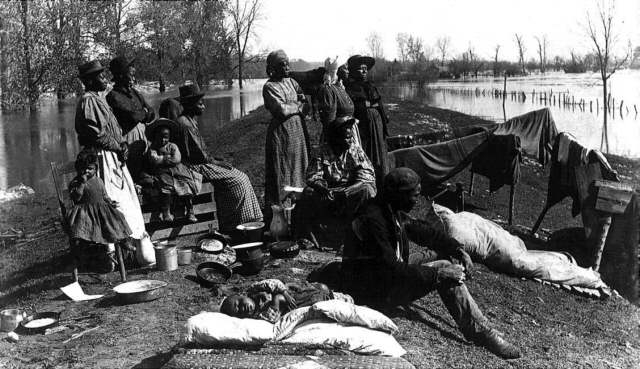
Refugees on Levee, 1879
Date1879
LocationUnited States
Also known asExodus of 1879
CauseDisenfranchisement after the Reconstruction Era
ParticipantsGovernment of the United States
African Americans
Outcome
  • 98,000 sign emigration papers
  • Around 26,000 African Americans arrive in Kansas

Exodusters was a name given to African Americans who migrated from states along the Mississippi River to Kansas in the late nineteenth century, as part of the Exoduster Movement or Exodus of 1879.[1] It was the first general migration of black people following the Civil War.[2]

The movement received substantial organizational support from prominent figures, such as Benjamin Singleton of Tennessee, Philip D. Armour of Chicago, and Henry Adams of Louisiana. As many as 40,000 Exodusters left the South to settle in Kansas, Oklahoma and Colorado.[3]

Reality of life for black people in the post-Reconstruction South

[edit]

The number one cause of black migration out of the South at this time was to escape racial violence or "bulldozing" by white supremacist groups such as the Ku Klux Klan and the White League, as well as widespread repression under the Black Codes, discriminatory laws that rendered blacks second-class citizens after Reconstruction ended.[4] Vigilantes operated with almost total impunity, and no other issue was of more importance to the majority of southern blacks living in the countryside. Given the extreme level of discrimination and violent intimidation blacks faced in the rural South, the Exodusters can be accurately described as refugees.[5]

Although blacks greatly outnumbered whites in Louisiana, black armed resistance was practically inconceivable. According to William Murrell in testimony given to the United States Senate, "the white people in Louisiana are better armed and equipped now than during the war".[6] As evidence of the frightening lawlessness, which empowered the terrorist activities of the White League in the mid-1870s, the League "managed to seize a huge cache of arms from the arsenal in New Orleans [...] worth about $67,000" stolen directly from the United States government.[6]

The Exodusters were not only fleeing extremist groups like the KKK. In fact, throughout Reconstruction a majority of the southern white population continued to resent black emancipation, resulting in an oppressive environment perpetuated by all segments of white society.[7] Most black migration, including the Exodus of 1879, was spurred on by the dire economic prospects of black labor in the rural South. The depression of the 1870s served to exacerbate the racist policies of white merchants and planters, who sought to offset their agricultural losses by increasing prices and interest rates for blacks.[8]

Most southern states completely undermined federal Reconstruction efforts to promote landowning as the blacks' ticket to economic freedom and equality. For example, in 1865 the Mississippi Black Code outlawed the selling or leasing of land to blacks.[9] As a result, in large parts of Mississippi, less than 1 in 100 black workers owned land or a house.[10]

In the aftermath of the Compromise of 1877 and the traumatic political campaigns of 1878 in Louisiana, the plight of organized black resistance had reached a point of hopelessness, leading to the Exodus of 1879. Political and economic oppression was enforced by means both legal and illegal, on the streets and in contracts, at both the local and federal levels. Grassroots black political activism, exemplified by the leadership of Henry Adams in Louisiana, functioned only in total secrecy and at great risk of assassination. Such efforts were eventually pushed out of rural communities and into New Orleans, where many organizers including Adams found themselves exiled.[11]

Millenarianism

[edit]

The Exoduster movement has been characterized as an example of millenarianism, in that many Exodusters created settlements they believed to be their new Promised Land. That the journey of these refugees was termed an "exodus", a word taken from the Old Testament in reference to the Jews' flight from Egypt, indicates that the movement had spiritual motivations. The millenarian aspect of the Exodus was most realized in Tennessee, where Benjamin "Pap" Singleton's boisterous proselytizing mostly found an enthusiastic black following and a more amenable white audience.[12]

"Ho For Kansas!" Copyprint handbill

Role of black leadership

[edit]

While the roles of community leaders like Singleton and Adams, white facilitators like Thomas W. Conway, formal politicians, and white philanthropists were in some ways crucial to the Exodus, the migration ultimately came about as a result of the collective misery of black southerners and the individual inquiry and initiative taken in response by would-be migrants. Black political leaders at the time, such as Adams and Singleton at the local level and Frederick Douglass and Mississippi Senator Blanche K. Bruce at the national level, were limited in their ability to influence the southern black populace. For this reason, during the post-Reconstruction period, blacks did not enjoy any truly representative national leadership.[5]

Promised lands

[edit]

Kansas vs. Liberia

[edit]

Before the Exodus of 1879 to Kansas, southern blacks convened to discuss the option of emigration both formally and informally.[13] Delegates from Louisiana, Mississippi, Alabama, Texas, Arkansas, and Georgia met at a New Orleans conference in 1875 and discussed black emigration to western territories and Liberia.[14] Black settlement outside of the South as a result of emigration was termed "colonization", and the New Orleans committee meeting became a full-fledged organization dubbed "The Colonization Council". The Council held its first public meetings in 1877.[15] Council meetings consisted of speechmaking and petition writing and signing, with some 98,000 men, women, and children from Louisiana signed onto emigration lists.[15]

Liberia proved an unrealistic destination for black refugees financially and logistically. As the land of John Brown, Kansas had fought bitterly for its Free State status, and took its fair treatment of black immigrants as a point of pride.[16][17] Kansas did not actively encourage the Exodusters, but its equal-opportunity stance was more welcoming than most of the country.

Reality in Kansas

[edit]

The most successful of the Exodusters were those who moved to urban centers and found work as domestic or trade workers.[18] Almost all of the Exodusters who attempted to homestead in the countryside settled in the Kansas uplands, which presented the most formidable obstacles to small-scale farmers.[19] The uplands were the only lands available for purchase after the squatters, railroads, and speculators had taken the best farmland. Given the agricultural challenge of farming these lands, many Exodusters were still destitute a year after their arrival.[20]

Response to the exodus

[edit]

The Exodus of 1879 consisted mostly of refugees fleeing Mississippi and Louisiana between March and May and Texas later in the year.[21] There was considerable uncertainty at the time as to the actual number of Exodusters that arrived in St. Louis. However, the Colored Relief Board estimated that about 20,000 Exodusters reached the city between 1879 and 1880; the St. Louis Globe-Democrat quoted 6,206 arriving between March and April 1879 alone.[22]

Many steamboat captains refused to carry migrants across the Missouri River, and thousands of Exodusters found themselves stranded for months in St. Louis.[23] Black churches in St. Louis, together with eastern philanthropists, formed the Colored Relief Board and the Kansas Freedmen's Aid Society to help those stranded in St. Louis reach Kansas.[4] In contrast to fundraising success in Kansas, "St. Louis officials discouraged the Exodusters whenever possible",[24] and therefore the burden of providing for stranded Exodusters fell entirely on the St. Louis black community. Other private relief organizations were funded by Quakers and other abolitionists in northern states and England.[25] The Kansas Freedman's Aid Society raised some $70,000 in support of Exoduster migration and settlement, $13,000 of which came from England.[20]

The failure of federal and state governments to financially support black migrants can be attributed to both bureaucratic incompetence (as in the case of the mayor of Kansas being denied temporary assistance from the secretary of war due to congressional jurisdiction) and to nineteenth-century preferences for limited government.[26] At the local level, Topeka Mayor Michael C. Case refused to spend municipal funds to aid Exodusters, believing that the money would be better spent to return them to the South.[20] Moreover, much of the poor white population resented the extent of relief efforts aimed at helping immigrant blacks.[19]

The political response of southern white Democrats, and of some conservative "representative" black men, was one of disgust and incomprehension. They distrusted the intentions of white philanthropy in aiding black migration; in fact, they were convinced of ulterior motives.[27] They denied outright claims of economic hardship and political oppression as motivating factors for black flight. They attributed feelings of discontent to a small group of leading black rabble-rousers and outside white meddling. In solidarity, the Democratic party as a whole "refused to admit to the fact of Southern lawlessness because many of the crimes had been perpetrated by Democrats, usually for their party's own advancement".[28] In contrast, the Senate minority opinion, represented in a report by Minnesota Senator William Windom and New Hampshire Senator Henry W. Blair, utilized the direct testimony of prominent black figures and sided with them.[28] Ultimately, though, the Democratic majority in Congress ensured that no legislation would be passed in support of the Exodus Movement.[29] Appropriation bills for refugee aid introduced by Kansas Senator John J. Ingalls and Ohio Representative James A. Garfield died in committee.[30]

Senate investigations debated whether or not black migration fit into a greater conspiratorial political scheme on the part of Republicans, who were thought to be packing swing states to increase their chances of success in the upcoming 1880 presidential election, which Republicans did win. Such accusations, lobbed in particular at Kansas Governor St. John and Thomas Conway, were only seriously considered at the end of 1879, when more attention was being given to the black migrants from North Carolina, who, unable to reach Kansas, were being redirected to Indiana.[31]

The Exodus was not universally praised by African Americans; indeed, Republican statesman Frederick Douglass, a former slave who escaped captivity, was a critic of the movement.[32] Douglass did not disagree with the Exodusters in principle, but he felt that the movement was ill-timed and poorly organized.[33]

Impact of the Exodusters

[edit]

Although the Exodus of 1879 saw a high volume of black migration during a shorter period of time, most of the black migration to Kansas occurred steadily throughout the decade. The black population of Kansas increased by some 26,000 people during the 1870s.[34] Historian Nell Painter further asserts that "the sustained migration of some 9,500 Blacks from Tennessee and Kentucky to Kansas during the decade far exceeded the much publicized migration of 1879, which netted no more than about 4,000 people from Louisiana".[35] During the 1870s and the decade that followed, blacks bought more than 20,000 acres (81 km2) of land in Kansas. The only surviving Exoduster settlements established during the period is Nicodemus, Kansas, which was founded in 1877.

Of note, however, western migration of African-Americans was not limited to the Exoduster period, and places like Quindaro, Kansas, thrived for some period before, during, and after the Exoduster movement.[citation needed] Similarly, in the early 20th century, black migrations to the American West and Southwest would continue, and several additional all-black towns would be established, especially in Indian Territory, which would become the state of Oklahoma.[citation needed]

The impact of the Exoduster migration on subsequent white treatment of African Americans was mixed. On the one hand, the exodus did little to alleviate the national propensity for violence towards blacks. From the 1880s through the 1930s, the lynching of African Americans increased, and some 3,000 lynchings took place during that period nationwide.[25] On the other hand, the Exoduster migration seems to have had some impact on labor relations between southern black farm workers and their white employers. Temporary benefits accorded to counties with the highest black labor scarcity included better price terms in leasing contracts and shrinking long-term contract commitments.[36]

Exodusters in fiction

[edit]
  • Gabriel's Story, by David Anthony Durham
  • Paradise, by Toni Morrison
  • Justin and the Best Biscuits in the World, by Mildred Pitts Walker
  • Why the Dark Man Cries, by Connie Fredricks

See also

[edit]

References

[edit]
[edit]
Revisions and contributorsEdit on WikipediaRead on Wikipedia
from Grokipedia
The Exodusters were African American migrants who undertook a mass from the to primarily in 1879, escaping intensifying racial violence, economic exploitation through , and political disenfranchisement following the end of Reconstruction, in pursuit of homestead land and greater autonomy. This movement, peaking with around 6,000 arrivals in the spring of 1879 alone, involved an estimated 20,000 to 40,000 individuals overall, many departing from , , and amid crop failures and threats from white groups enforcing Democratic resurgence. Organized in part by Benjamin "Pap" Singleton through promotional societies and handbills advertising as a "promised land" echoing the biblical Exodus, the migration reflected a pragmatic rejection of deteriorating conditions in the rather than naive optimism, though arrivals often faced initial destitution, inadequate preparation, and local ambivalence in . Despite challenges, including reliance on relief aid and harsh prairie conditions, Exodusters established resilient communities such as , demonstrating long-term viability for self-sustaining Black settlements on the frontier.

Historical Context

Post-Reconstruction Conditions in the South

The resolved the disputed 1876 presidential election by awarding the presidency in exchange for the withdrawal of remaining federal troops from the South, effectively terminating Reconstruction. This federal disengagement enabled , known as , to seize control of state governments across the former Confederacy by 1877, displacing Republican administrations and restoring white supremacist dominance in politics and law enforcement. Redeemer policies prioritized , debt repudiation from the war, and reduced state intervention in labor markets, while systematically undermining black voting rights through poll taxes, literacy tests, and intimidation, though full disenfranchisement laws emerged later. Economically, the post-Reconstruction South saw the entrenchment of and tenancy, which bound former slaves and poor whites to land owned by via contracts requiring crop shares for rent and supplies advanced on credit under the crop-lien system. High interest rates—often exceeding 50% annually—and deductions for seeds, tools, and living expenses created perpetual cycles, as yields rarely covered obligations amid falling prices and poor soil management. Census-linked studies indicate that by 1880, only about 12% of black households in the owned farmland, leaving the vast majority as tenants or sharecroppers with negligible equity accumulation. This landlessness rate stemmed from limited access to capital, discriminatory lending by merchant-bankers, and the absence of federal land redistribution policies post-1865, contrasting with brief ownership gains during wartime confiscations that were reversed under presidential amnesties. Violence and intimidation intensified after federal withdrawal, as local Democratic authorities often failed or refused to enforce laws against attacks on blacks asserting economic independence or political participation, reflecting breakdowns in impartial policing rather than coordinated inevitability. groups like the in and Red Shirts in , successors to earlier tactics, targeted black militias and voters, with incidents such as the 1878 campaigns in deterring land purchases and contract negotiations. These enforcement failures eroded black progress in and holding achieved under Reconstruction-era protections, as unrestrained local power dynamics favored planter interests over individual .

Push Factors: Violence, Economics, and Rights Erosion

Following the Civil War, Southern states enacted Black Codes, such as Mississippi's 1865 legislation, which included vagrancy laws defining freedmen over age 18 without steady employment or permanent residence as vagrants subject to arrest, fines, and forced labor on plantations or as apprentices to former enslavers. These measures restricted Black mobility, prohibited land ownership in some cases, and compelled annual labor contracts, often under penalty of imprisonment for breach, effectively recreating coerced labor systems despite emancipation. By the late 1870s, as Reconstruction ended in 1877, Redeemer Democratic regimes intensified rights erosion through early implementations of poll taxes—such as Mississippi's 1870 requirement of $2 annually—and literacy tests for voting, alongside widespread intimidation that diluted Black franchise gains from the 1867-1877 era. Violence surged post-Reconstruction, with groups like the and conducting campaigns of terror against Black communities, including over 2,000 documented lynchings of Black individuals from 1865 to 1877, many aimed at suppressing political organizing and economic autonomy. This intimidation led to a sharp decline in Black political participation, as white supremacist terrorism targeted Republican officials and voters, eroding the brief period of Black office-holding and legislative influence in states like and . Such acts fostered a pervasive fear of re-enslavement equivalents, prompting many to view migration as a rational escape from cycles of reprisal that stifled community advancement. Economically, freedmen faced arrangements that yielded minimal wages—often 10-20 cents daily after deductions for supplies—trapping families in debt peonage amid cotton price volatility and land scarcity. Illiteracy rates exceeded 75-80% among adults in , curtailing access to contracts, , and skilled labor, while overall Southern stagnation limited upward mobility. Yet, approximately 13% of farm households owned or operated land by , indicating some accumulated property despite systemic barriers, which framed Exoduster migration not solely as desperation but as a calculated pursuit of homestead opportunities forgone in the .

Origins of the Movement

Leadership and Promotion Efforts

Benjamin "Pap" Singleton initiated promotion of migration to in 1869 by founding the Tennessee Real Estate and Homestead Association to facilitate land purchases and colony formation for . He distributed printed circulars and dispatched agents throughout and neighboring states to recruit participants, establishing early settlements such as the Singleton Colony in , by 1871. These efforts exemplified self-directed organization, with Singleton emphasizing economic independence through homesteading rather than reliance on external aid. Henry Adams complemented these initiatives through the Colonization Council of the Colored People, which he established in around 1874 to coordinate from the lower Valley. By 1878, the council claimed membership exceeding 98,000 individuals across , , , and , who pledged support for collective relocation efforts. Adams shifted the group's focus toward in 1879 amid rising interest in the region, mobilizing pledges into practical recruitment drives independent of federal involvement. Promotion extended through grassroots channels, including local mutual aid societies and church-affiliated networks, which disseminated information on opportunities via word-of-mouth and community gatherings. These voluntary structures underscored the movement's entrepreneurial character, driven by ordinary African American leaders responding to southern conditions without centralized direction or subsidies.

Millenarian and Religious Dimensions

The Exodusters movement drew heavily on biblical imagery of the Exodus, with migrants and promoters framing their departure from the post-Reconstruction South as a divine escape from oppression analogous to the Israelites' flight from Egypt. Leaders like Benjamin "Pap" Singleton invoked this parallel in recruitment efforts starting in 1869, portraying Kansas as a providential "promised land" where African Americans could achieve self-determination free from white dominance. In a July 1877 meeting, organizer Huston Soloman urged unity by declaring, "Let us come together like the family of Israel," emphasizing collective deliverance through migration. Such rhetoric resonated amid the 1870s religious revivals among Black communities, transforming practical relocation into a sacred mission of liberation. Millenarian elements infused the movement with expectations of utopian Black republics in , where divine favor would yield prosperous, autonomous settlements untainted by Southern . Singleton's 1878 handbills and songs, such as "The Land That Gives Birth to Freedom," amplified "Kansas Fever" by promising supernatural-like transformation, evolving from his earlier "back to " advocacy to domestic exodus as God's will. Ministers like Colombus M. Johnson reinforced this in , while migrants echoed the sentiment—one New Orleans participant asserted, "Every black man is his own now"—viewing as a symbolic "" crossing. These apocalyptic visions, while galvanizing over 50,000 departures by 1879, often detached from empirical realities of prairie farming, fostering unpreparedness among urban or migrants unaccustomed to rigors. Black churches played a supportive role, funding relief efforts like the Colored Relief Board in to aid 1879 arrivals, though the migration was not strictly ecclesiastical in origin. Sermons in Southern congregations likely echoed exodus motifs, drawing on longstanding spirituals and narratives that equated enslavement with Egyptian bondage, but primary impetus stemmed from lay organizers rather than formal clerical hierarchies. This religious framing provided psychological momentum for mass action, yet historians note its millenarian strain—per Norman Cohn's criteria of supernatural salvation—manifested more as self-reliant agency than passive divine intervention, ultimately prioritizing escape over sustainable agrarian preparation.

Migration Process

Scale, Timing, and Routes

The Exoduster migration reached its peak in spring 1879, with the first major surges occurring in early March as groups began arriving in en route to ; by early March, at least 1,500 had passed through the city. This phase saw approximately 6,000 migrants reach within a few months, amid broader estimates of 20,000 to 40,000 African Americans departing southern states for and nearby territories like and during 1879 and into 1880. The movement subsided by early summer 1879, though smaller contingents continued through the year, including up to 1,000 from in November. Migrants originated predominantly from Mississippi, Louisiana, Arkansas, and Texas, with additional numbers from Tennessee; these were largely impoverished sharecroppers and tenant farmers traveling in family groups that included high proportions of women and children. Travel routes centered on steamboat passage up the Mississippi River from southern ports to St. Louis, followed by onward connections via rail, wagon, or foot to Kansas gateways such as Wyandotte; Texas migrants often utilized the Missouri, Kansas and Texas Railroad directly to destinations like Parsons.

Immediate Challenges and Mortality

The Exodusters' journey northward along the to in early 1879 often involved overcrowded steamboats, where migrants paid minimal deck fares—typically $4 per person from southern ports like Vicksburg—but arrived destitute after exhausting limited savings. Many underestimated the full distance to and the costs of overland or rail continuation, leading to widespread stranding upon reaching , where an estimated 20,000 passed through between 1879 and 1880. Steamboat captains frequently refused passage across the or to destinations, citing concerns over overloading vessels and potential spread of diseases like then afflicting river towns, which left groups exposed on wharves and riverbanks to cold spring weather, hunger, and inadequate shelter. These logistical breakdowns, stemming from migrants' incomplete preparations and carriers' discriminatory practices, compounded vulnerabilities during transit. Black communities in St. Louis stepped in with critical support, offering food, , and temporary refuge in churches, homes, and improvised camps, as white authorities imposed quarantines viewing the arrivals as vectors despite limited evidence of outbreaks among them. The resulting privations—prolonged exposure without proper or provisions—directly tied to poor foresight on travel , heightened risks of and , particularly for families with children and elderly members who had sold possessions to fund . While precise mortality figures from the transit phase remain undocumented in contemporary records, the combination of unsanitary camp conditions, nutritional deficits, and weather exposure in contributed to elevated health perils, underscoring the empirical toll of underplanned mass movement without secured onward transport or funds. City officials' alarm over infectious risks prompted restrictive measures that prolonged stays in substandard facilities, further straining migrants already weakened by the rigors of river travel.

Destination Choices

Appeal of Kansas and Land Policies

Benjamin "Pap" Singleton, a former slave and carpenter from , actively promoted as a "Promised Land" for through his Edgewood Real Estate Association and Industrial College Association, organizing meetings, distributing handbills, and leading scouting expeditions starting in the early 1870s. He portrayed as "Sunny Kansas," emphasizing its fertile soil and opportunities for self-sufficiency away from Southern oppression, which resonated with those disillusioned by post-Reconstruction conditions. The Homestead Act of 1862 provided a key policy incentive, allowing any citizen or intended citizen, including freed , to claim up to 160 acres of federal public for a small filing fee, provided they resided on and improved it for five years through cultivation or building a . By the late 1870s, much of the prime federal under this act had been claimed, but Kansas railroads, granted millions of acres by to spur development, offered alternative access to affordable tracts—often sold at $2 to $5 per acre—making acquisition feasible for those without initial capital, though success required farming implements, seed, and labor investment that many migrants lacked. Prior African American settlements bolstered Kansas's allure; by 1870, the state's Black population had reached approximately 17,000, including early homesteaders who had pioneered communities like those in the eastern counties since the Civil War's end, demonstrating viable Black landownership amid the frontier's promise. These examples, publicized by promoters like Singleton, suggested racial tolerance rooted in Kansas's history as a free-state bastion during "" conflicts over slavery in the , fostering perceptions of a haven where could own property without systemic disenfranchisement. Yet, the act's requirements presupposed skills in and financial reserves for initial hardships, which sharecropping backgrounds rarely provided, tempering the policy's practical draw for unskilled migrants.

Alternatives like Liberia and Their Shortcomings

In the late 1870s, amid discussions of emigration among southern , the (ACS) promoted repatriation to as an alternative to domestic relocation, offering subsidized transport to the West African republic founded decades earlier for free Blacks and manumitted slaves. However, participation remained minimal, with ACS records indicating fewer than 500 emigrants sailed for between 1870 and 1880, a fraction compared to the estimated 20,000–40,000 who joined the Exodus. This low uptake reflected logistical and financial barriers, as ACS voyages required upfront contributions or state aid, contrasting with the accessibility of overland or rail routes to under the Homestead Act's promise of 160-acre claims at minimal cost. Liberia's appeal dimmed further due to its documented perils, including extraordinarily high mortality among U.S.-born settlers unaccustomed to the and endemic diseases like and . Demographic analyses of ACS emigrants from the early to mid-19th century—patterns persisting into later waves—reveal annual adult death rates exceeding 5–10%, resulting in over 50% mortality within the first few years for many arrivals, far surpassing risks in temperate U.S. destinations. These rates stemmed from immunological vulnerabilities, as migrants from North American environments lacked acquired resistance to local pathogens, compounded by inadequate infrastructure and isolation from supply lines. Contemporary debates in , such as the Christian Recorder and New National Era, highlighted 's shortcomings relative to : the former's remoteness across the Atlantic imposed isolation from U.S. kin networks and markets, versus the cultural and climatic familiarity of Midwestern plains. Transport costs to Liberia averaged $40–$50 per adult—covering passage, provisions, and ACS fees—burdening impoverished families reliant on philanthropic or governmental subsidies, while offered self-reliant without such outlays. Broader failures underscored repatriation's impracticality, including cultural mismatches between Americo-Liberian settlers and indigenous populations, fostering ethnic tensions and governance strains in a resource-scarce environment. Early Liberian society grappled with political instability, marked by elite Americo-Liberian dominance over native majorities, economic dependency on U.S. aid, and recurrent unrest that deterred further migration. These factors reinforced the pragmatism of domestic alternatives like , where migrants could leverage existing skills in and community without the perils of transatlantic upheaval or subsidized dependency.

Settlement and Adaptation

Initial Reception and Aid Provision

The Kansas Freedmen's Relief Association, established in May 1879 by Governor John P. St. John, organized temporary camps and distributed rations to support arriving Exodusters, aiding thousands of destitute migrants in the initial months of the influx. The association issued public appeals for charitable contributions to cover essentials like food and shelter, ultimately raising approximately $70,000 from private donors, including international sources, though its capacity was quickly overwhelmed by the volume of arrivals estimated at over 5,000 by late 1879. State legislative debates on direct funding highlighted fiscal constraints and skepticism about long-term viability, resulting in limited official appropriations and a reliance on volunteer efforts that underscored the practical limits of goodwill amid 's own economic pressures. Local responses in reception points like Wyandotte mixed charitable impulses with protective measures, as city officials threatened quarantines against incoming steamboats carrying migrants to prevent health risks and overburdened local resources, prompting some captains to bypass the port. Established Kansans, numbering around 17,000 prior to , provided substantial aid through community meetings and donations, contrasting with white farmers' apprehensions over potential labor market saturation and downward pressure on wages in rural areas. These tensions reflected underlying economic realism, as earlier settlers in expressed reservations about the newcomers' preparedness for , prioritizing self-reliance over unchecked immigration that could strain scarce and communal support networks. The federal government under President maintained a policy of non-intervention, declining to allocate national resources or troops for migrant relief to avoid reviving Reconstruction-era federal oversight of Southern affairs or endorsing mass relocation as a solution to post-emancipation challenges. Hayes viewed as potentially beneficial for demonstrating agency but refrained from proactive measures, such as chartered transport or aid commissions, citing constitutional limits on federal involvement in internal migrations and deference to state-level handling. This hands-off approach prioritized fiscal restraint and political neutrality, leaving the burden on philanthropists and municipalities despite congressional inquiries into the movement's causes.

Community Formation and Early Struggles

The Exodusters formed distinct all-black enclaves in , exemplified by in Graham County, founded in 1877 through the efforts of the Nicodemus Town Company, which included six and two white Kansans promoting settlement on public lands. Initial groups of freedpeople from states like arrived that summer, staking homestead claims and establishing a framework for self-reliant community governance amid the semiarid plains. The town's population peaked around 500 during the 1879 influx of the Great Exodus, drawing migrants seeking autonomy from Southern oppression, though early arrivals numbered only a few dozen families who organized town lots and basic services. Settlers adapted to resource scarcity by excavating dugouts into hillsides and constructing sod houses from prairie turf, as lumber was unavailable on the treeless landscape; these structures, often shared initially, provided shelter while families filed thousands of homestead entries under the 1862 Act, requiring five years of improvements for title. Communal labor supported rudimentary farming of crops like corn and , but environmental barriers—droughts, grasshopper swarms, and infertile soil—led to frequent crop failures, resulting in many claims being forfeited as settlers struggled to meet residency and cultivation mandates. By 1880, basic infrastructure emerged, including a , general stores, and hotels, reflecting incremental progress despite these hardships. Social cohesion anchored in religious and fraternal institutions, with three churches established by 1880 serving as communal hubs for worship, mutual aid, and leadership selection, complemented by lodges like Masonic orders that fostered solidarity among diverse migrants. Schools followed in the early 1880s, enabling literacy and self-governance through elected officials handling town affairs independently of white oversight. Yet internal strains surfaced from disparities in backgrounds, as skilled artisans and educated leaders contrasted with unskilled agricultural laborers, complicating unified adaptation and contributing to early attrition when basic survival demands exacerbated divisions. Population dwindled below 200 by the 1890s, underscoring the enclave's resilience amid persistent barriers.

Outcomes and Assessments

Economic Achievements and Self-Reliance

Exodusters demonstrated economic agency through entrepreneurial ventures in urban areas such as Topeka and Leavenworth, where many secured employment in domestic service and skilled trades, enabling for independent businesses. In Topeka, early black business communities emerged from Exoduster migrations, with settlers leveraging migration networks to establish service-oriented enterprises that catered to growing African American populations. These efforts reflected self-directed economic adaptation, as migrants transitioned from wage labor to ownership without reliance on external subsidies. In rural settlements like , black entrepreneurs exemplified by founding the Nicodemus Town Company in , comprising six African American investors who platted the town and sold lots to incoming settlers. Prominent figures such as Zachary Fletcher opened a upon arrival in , followed by the St. Francis Hotel and a livery stable, which served as hubs for local and demonstrated sustained business viability into the 1880s. These initiatives fostered a local economy centered on trade and services, underscoring the migrants' capacity for independent enterprise amid conditions. Homesteading persistence yielded measurable rural gains, with farmers in acquiring land through personal effort and market participation. In counties receiving Exoduster influxes, such as Franklin County, the proportion of farmers owning stabilized around 36% by 1885, up from lower baselines in prior decades, with average holdings valued at $1,476—evidenced by individuals like Garrison James, whose farm value doubled to $2,400 over the period through expanded acreage and cash crop cultivation. Many cultivated surplus corn and castor beans for profit, with yields generating up to $900 annually from modest plots, highlighting commercial acumen and progression from tenancy to ownership. These achievements contributed to demographic expansion and community stability, as black populations in key areas like Graham County grew from 484 in 1880 to 863 by 1890, supporting self-sustaining networks of landowners and traders. By the late 1890s, such persistence culminated in over 114 black-owned homesteads in Graham County encompassing more than 18,000 acres, affirming the Exodusters' role in building enduring economic footholds through individual initiative.

Failures, Dependencies, and Return Migrations

Many Exodusters encountered profound agricultural and economic difficulties stemming from their limited preparation for Plains farming, including a scarcity of tools, seeds, , and capital upon arrival. Migrants, primarily former sharecroppers from the humid , lacked the resources and knowledge needed to adapt to Kansas's arid , where sod-breaking required specialized and was often absent. This mismatch contributed to widespread crop failures, exacerbated by recurrent droughts in and the early , as well as lingering effects from grasshopper plagues that had ravaged the region in –1877, destroying nascent plantings and fodder. Settlement outcomes reflected these challenges, with a substantial portion of claimants unable to fulfill Homestead Act requirements of five years' continuous residency and improvements, leading to abandonment of claims. Harsh winters, isolation, and insufficient yields forced many into wage labor or relief dependency, undermining self-sufficiency goals promoted by migration leaders like Benjamin "Pap" Singleton, whose promotional materials overstated Kansas's accessibility without emphasizing the need for upfront investment. Economic analyses indicate that while some communities endured, overall wealth accumulation lagged, with persistent poverty evident in low farm ownership rates and reliance on credit that often spiraled into debt. To address immediate crises, the Kansas state government formed the Freedmen's Relief Association in 1879, channeling charitable donations for food, shelter, and tools, but these efforts proved insufficient for the influx of up to 20,000 arrivals that year, fostering short-term dependency rather than long-term viability. Internal community tensions arose over aid distribution and leadership decisions, further complicating adaptation. By the mid-1880s, thousands had returned southward, citing unfulfilled promises of prosperity and the cumulative toll of environmental and logistical barriers, which validated contemporary critiques that the exodus overlooked practical barriers to success.

Contemporary Reactions

Southern Opposition and Economic Concerns

White planters in the South expressed significant alarm over the Exoduster migration, primarily due to fears of acute labor shortages that threatened their agricultural operations, particularly production, which relied heavily on sharecroppers and wage laborers. In states like and , where the exodus was most pronounced in , planters anticipated disruptions to planting and harvesting cycles, as thousands departed en masse, with estimates of up to 20,000-40,000 migrants leaving the Mississippi Valley region that year alone. This concern was rooted in the post-Reconstruction system, where labor constituted the backbone of the economy, and any mass departure risked reducing workforce availability during critical seasons, potentially leading to unplanted fields or diminished yields. To counter the outflow, Southern authorities enforced existing vagrancy and labor laws more stringently to restrict black mobility and compel workers to remain on plantations. In , for instance, vagrancy statutes—holdovers from Black Codes—allowed sheriffs to arrest unemployed or migrating blacks, fining them or binding them to labor contracts, effectively deterring departures by imposing penalties for leaving without employer consent. Planters and local officials also resorted to direct interference, such as conspiring with steamboat operators in to deny passage to migrant groups in April-May 1879, framing the exodus as a threat to regional stability. Politically, portrayed the migration as the result of Northern Republican agitation and false promises, arguing it destabilized the social order without acknowledging underlying grievances like debt peonage and that drove the departures. Some black Southern leaders and elites dissented from the exodus, viewing it as an abandonment of the fight for civil rights in the region and a potential weakening of the remaining black voting bloc. Figures like Frederick Douglass initially criticized the movement in a May 4, 1879, address in Baltimore, urging blacks to stay and consolidate political gains rather than flee, though he later moderated his stance amid evidence of Southern oppression. Local black clergy and educators echoed this, arguing that mass migration jeopardized community infrastructure and left behind populations vulnerable to intensified white reprisals, prioritizing long-term integration over immediate relocation. These objections reflected a strategic calculus that sustained presence in the South could yield gradual reforms, contrasting with the Exodusters' emphasis on physical escape from exploitative conditions.

Kansas and Federal Responses

In Kansas, Governor John P. St. John, a Republican and Quaker, responded to the 1879 influx of Exodusters by establishing the Kansas Freedmen's Relief Association that May, aiming to provide temporary shelter, food, assistance, and resettlement support for the destitute migrants. The association operated facilities like "The Barracks" in Topeka, which housed over 400 individuals at a time, and facilitated the establishment of a in Dunlap, , while coordinating with philanthropists for additional resources. However, initial state and municipal funding waned by 1880 amid growing taxpayer backlash and anti-black sentiments among some white Kansans, who resented the fiscal strain on local resources, shifting reliance to private donations from sources including English citizens and figures like . This curtailment exemplified the limits of state-level intervention under prevailing attitudes, prioritizing fiscal restraint over sustained public aid despite the . At the federal level, no direct financial assistance was extended to the Exodusters, reflecting a commitment to minimal government involvement in internal migrations during the post-Reconstruction era. In January 1879, Republican Senator William Windom of Minnesota introduced a resolution endorsing black emigration from the South as a means to escape oppression, signaling partisan sympathy from some northern Republicans. Yet, Democratic pressure, led by Senator Daniel W. Voorhees of Indiana, prompted the Senate to form a select committee in late 1879 to probe the exodus's causes, convening for three months in 1880 and interviewing over 150 witnesses, including migration organizer Benjamin Singleton. The inquiry highlighted divisions, with Republicans framing the movement as a natural flight from southern violence and disenfranchisement, while Democrats alleged Republican orchestration or artificial inducement and debated potential federal restrictions on interstate migration to preserve southern labor supplies, though no legislative action ensued amid partisan deadlock. These responses underscored a broader reluctance for expansive federalism, favoring inquiry over intervention and allowing market-driven outcomes to prevail despite evident migrant hardships.

Legacy and Interpretations

Demographic and Cultural Contributions

The Exoduster migration substantially augmented the African American population in , expanding from 17,108 residents in 1870 to 43,107 by 1880, with the approximately 26,000-person increase largely attributable to the influx of Southern migrants during the late 1870s. This demographic shift concentrated in rural counties, where Exodusters formed clusters that accounted for a notable proportion of the state's populace, rising to about 4% of 's total 996,096 inhabitants by 1880. These settlers seeded enduring all-Black towns, including in Graham County, established in 1877 by freedmen from and reinforced by subsequent Exoduster arrivals seeking land under the Homestead Act. Other communities, such as those in Singleton Colony and settlements along the Solomon River, emerged as self-contained enclaves that persisted into the , providing models of autonomous Black landownership amid frontier isolation. By fostering concentrated populations, these towns laid foundational demographics for later Western Black communities, though many declined post-1900 due to out-migration and environmental hardships. Culturally, Exodusters transplanted and adapted Southern African American traditions, including communal religious practices rooted in Baptist congregations that served as social anchors for mutual aid and moral instruction. In Nicodemus and similar outposts, early settlers prioritized institutional development, constructing churches and rudimentary schools by the early 1880s to promote literacy and vocational skills, which elevated educational attainment relative to stagnant Southern rates. These efforts preserved oral folkways—such as storytelling and spirituals—while integrating frontier self-reliance, contributing to a distinct Plains Black cultural identity marked by resilience rather than assimilation. The migrants' agricultural labor diversified Kansas's workforce, introducing expertise in and cultivation to prairie farming, yet historical assessments note modest ripple effects on state-level economic output, constrained by initial capital shortages and crop failures. Black entrepreneurship in these communities, including general stores and service trades, supported internal economies but yielded limited broader integration until subsequent generations.

Historiographical Debates and Cultural Representations

Historiographical interpretations of the Exodusters migration have evolved from early emphases on collective heroism and escape from oppression to more nuanced assessments incorporating economic agency and mixed outcomes. Nell Irvin Painter's 1977 monograph Exodusters: Black Migration to Kansas after Reconstruction established a foundational narrative, drawing on contemporary accounts to argue that grassroots decisions driven by persistent post-Reconstruction hardships—such as sharecropping exploitation and violence—propelled the exodus, rather than manipulation by demagogues like Benjamin "Pap" Singleton, whom she depicts as a promoter without centralized control. This view challenged prior dismissals of the migrants as misguided, instead highlighting their deliberate rejection of Southern leadership structures in favor of self-directed mobility. Subsequent scholarship in the late introduced critical scrutiny of romanticized portrayals, underscoring failures like inadequate preparation for 's harsh climate, leading to high initial mortality and dependency on aid, which tempered narratives of unmitigated triumph. Robert G. Athearn's 1978 In Search of emphasized class tensions within communities in , where established settlers viewed Exodusters as indigent burdens, complicating the image of unified racial advancement. Debates persist over causality, with some analyses rejecting monocausal attributions to alone; empirical data on land claims and crop yields reveal migrants' calculated economic choices, including responses to Southern labor shortages and Northern investment opportunities, as evidenced by investigations documenting voluntary departures amid wage disparities. Recent post-2010s works, such as Mart Ruef and Ihsan Beezer's 2022 study, foreground entrepreneurial agency among Exodusters, analyzing census records to show how subsets formed segregated business enclaves in towns like , achieving self-reliance through ventures in and despite barriers, thus countering victimhood frames with evidence of adaptive . Cultural representations of the Exodusters remain limited and often idealized, appearing sporadically in as allegories of biblical deliverance rather than pragmatic relocation. Early 20th-century Black utopian novels, such as those invoking , drew implicit parallels to the migration's promise of , yet rarely grappled with documented setbacks like crop failures in 1879-1880, which affected over arrivals. Modern fictional works, including children's historical novels like Journey to a Promised Land (2019), romanticize the quest for education and land ownership, aligning with Painter's emphasis on aspiration but underplaying return migrations estimated at 10-20% by 1885 due to disillusionment. These depictions, while evoking agency, have drawn critique for eliding empirical complexities, such as intra-community aid networks' strains, prioritizing inspirational motifs over causal analyses of economic viability.

References

Add your contribution
Related Hubs
Contribute something
User Avatar
No comments yet.