


Community hub
Recent from talks
Contribute something
Nothing was collected or created yet.
Explosive belt
View on Wikipedia | This article needs additional citations for verification. (February 2011) |


An explosive belt (also called suicide belt, suicide vest or bomb vest) is an improvised explosive device, a belt or a vest packed with explosives and armed with a detonator, worn by suicide bombers. Explosive belts are usually packed with ball bearings, nails, screws, bolts, and other objects that serve as shrapnel to maximize the number of casualties in the explosion.
History
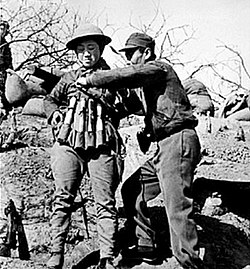
[edit]The Chinese used explosive vests during the Second Sino-Japanese War.[1][2] A Chinese soldier detonated a grenade vest and killed 20 Japanese at Sihang Warehouse. Chinese troops strapped explosives like grenade packs or dynamite to their bodies and threw themselves over Japanese tanks to blow them up.[3] This tactic was used during the Battle of Shanghai, where a Chinese suicide bomber stopped a Japanese tank column by exploding himself beneath the lead tank,[4] and at the Battle of Taierzhuang, where Chinese troops rushed at Japanese tanks and blew themselves up with dynamite and grenades.[5][6][7][8][9] During one incident at Taierzhuang, Chinese suicide bombers destroyed four Japanese tanks with grenade bundles.[10][11]
The use of suicidal attacks to inflict damage upon an enemy predates the Second World War, in which Kamikaze units (suicidal air attacks) and Kaiten ("living torpedoes") were used to attack Allied forces. Japanese soldiers routinely detonated themselves by attacking Allied tanks while carrying antitank mines, magnetic demolition charges, hand grenades and other explosive devices.[citation needed]
Description
[edit]
The explosive belt usually consists of several cylinders filled with explosive (de facto pipe bombs), or in more sophisticated versions with plates of explosive. The explosive is surrounded by a fragmentation jacket that produces the shrapnel responsible for most of the bomb's lethality, effectively making the jacket a crude, body-worn, Claymore mine. Once the vest is detonated, the explosion resembles an omnidirectional shotgun blast. The most dangerous and the most widely used shrapnel are steel balls 3–7 mm (1⁄8–9⁄32 in) in diameter.[12] Other shrapnel material can be anything of suitable size and hardness, most often nails, screws, nuts, and thick wire. Shrapnel is responsible for about 90% of all casualties caused by this kind of device.
A "loaded" vest may weigh between 5 and 20 kilograms (10 and 45 lb) and may be hidden under thick clothes, usually jackets or snow coats.
A suicide vest may cover the entire stomach and usually has shoulder straps.
A common security procedure against suspected suicide bombers is to move the suspect at least 15 metres (50 ft) away from other people, then ask them to remove their upper clothing. While this procedure is relatively uncontroversial for use on males, it may cause an issue when dealing with females suspected of being suicide bombers. Male security personnel may be reluctant to inspect or strip-search females, and can be accused of sexual harassment after having done so.[13] Alternatively, an infrared detector can be used. There are assertions that using a millimeter wave scanner would be viable for the task, but the concept has been disputed.
The discovery of remains as well as incidentally unexploded belts or vests can offer forensic clues to the investigation after the attack.[14]
Forensic investigation
[edit]Suicide bombers who wear the vests are often obliterated by the explosion; the best evidence of their identity is the head, which often remains relatively intact because it is separated and thrown clear off the body by the explosion. Journalist Joby Warrick conjectured: "The vest's tight constraints and the positioning of the explosive pouches would channel the energy of the blast outward, toward whoever stood directly in front of him. Some of that energy wave would inevitably roll upward, ripping the bomber's body apart at its weakest point, between the neck bones and lower jaw. It accounts for the curious phenomenon in which suicide bombers' heads are severed clean at the moment of detonation and are later found in a state of perfect preservation several metres away from the torso's shredded remains."[15]
References
[edit]- ^ 网易. "台儿庄巷战:长官电令有敢退过河者 杀无赦_网易军事" [Taierzhuang Street Fight: The Chief Executive Order has the courage to retreat to the river]. war.163.com (in Chinese). Archived from the original on 2018-06-19.
- ^ Wong, Bun. "Taierzhuang street fighting : Executive power to make those who have dared to retreat across the river Unforgiven - Netease International News". Archived from the original on 2017-10-20.
- ^ Schaedler, Luc (2007). Angry Monk: Reflections on Tibet: Literary, Historical, and Oral Sources for a Documentary Film (PDF) (Thesis Presented to the Faculty of Arts of the University of Zurich For the Degree of Doctor of Philosophy). University of Zurich, Faculty of Arts. p. 518. Archived from the original (PDF) on 2014-07-19. Retrieved 24 April 2014.
- ^ Harmsen, Peter (2013). Shanghai 1937: Stalingrad on the Yangtze (illustrated ed.). Casemate. p. 112. ISBN 978-1612001678. Retrieved 24 April 2014.
- ^ "Chinese Tank Forces and Battles before 1949". TANKS! E-Magazine (#4). Summer 2001. Archived from the original on 7 August 2014. Retrieved 2 August 2014.
- ^ Xin Hui (August 1, 2002). "Xinhui Presents: Chinese Tank Forces and Battles before 1949". Newsletter 1-8-2002 Articles. Archived from the original on 2014-08-08. Retrieved 2014-08-02.
- ^ Ong, Siew Chey (2005). China Condensed: 5000 Years of History & Culture (illustrated ed.). Marshall Cavendish. p. 94. ISBN 9812610677. Retrieved 24 April 2014.
- ^ Olsen, Lance (2012). "Taierzhuang 1938 – Stalingrad 1942". Numistamp. Clear Mind Publishing. ISBN 978-0-9838435-9-7. Archived from the original on 26 April 2014. Retrieved 24 April 2014.
- ^ Dr Ong Siew Chey (2011). China Condensed: 5,000 Years of History & Culture (reprint ed.). Marshall Cavendish International Asia Pte Ltd. p. 79. ISBN 978-9814312998. Retrieved April 24, 2014.
- ^ International Press Correspondence, Volume 18. Richard Neumann. 1938. p. 447. Retrieved 24 April 2014.
- ^ Epstein, Israel (1939). The people's war. V. Gollancz. p. 172. Retrieved 24 April 2014.
- ^ "What is Shrapnel?". NBC News. Archived from the original on May 7, 2021.
- ^ Niiler, Eric (Jan 22, 2014). "Sochi Suicide Bomber Threat: Why Terrorists Use Women". Discovery.net. Discovery Communications. Archived from the original on 2015-11-25. Retrieved 2014-04-27.
- ^ AFP/NEWSCORE "Ugandan police find suicide vest, hunts suspects". July 13, 2010, New York Post. Retrieved ?
- ^ Joby Warrick (2012). The Triple Agent: The Al-Qaeda Mole Who Infiltrated the CIA. Vintage Books. p. 151. ISBN 978-0-307-74231-5.
External links
[edit]
Explosive belt
View on GrokipediaHistory
Origins and Early Development
The explosive belt emerged as a tactical innovation by the Liberation Tigers of Tamil Eelam (LTTE) amid the asymmetric guerrilla warfare of Sri Lanka's civil war, which intensified after 1983 ethnic clashes between the Tamil minority and Sinhalese-majority government forces. Confronted by a better-equipped national army, LTTE fighters required concealable devices to penetrate fortified positions and maximize casualties in urban or military settings, prompting the adaptation of explosives into body-worn configurations for suicide operations by their elite Black Tigers unit. This addressed the limitations of prior vehicle-borne attacks, which were more detectable and less precise in infiltration scenarios.[4][5] LTTE's initial suicide attacks began in July 1987 with a truck-borne assault on a Sri Lankan army barracks by operative Vallipuram Vasanthan, known as Captain Miller, but the group soon refined the method into vests by the late 1980s to enable attackers to evade checkpoints on foot and detonate amid targets. These early vests drew from readily available military-grade explosives like C-4, smuggled via international networks or improvised from commercial precursors, combined with simple wiring for remote or manual detonation—cost-effective adaptations of satchel charges that minimized logistical demands in resource-scarce insurgency. By institutionalizing such devices, LTTE conducted over 270 verified suicide missions by 2009, establishing the belt's role in high-lethality, low-signature strikes against superior foes.[5][4]Major Adoptions and Evolutions
The Liberation Tigers of Tamil Eelam (LTTE) pioneered the modern explosive belt as part of their suicide attack tactics during the Sri Lankan civil war, with the group's Black Tigers unit conducting the first such operation on July 5, 1987, against a military base in Nelliady, killing 40 Sri Lankan soldiers.[4] Over the subsequent decades, the LTTE executed at least 378 suicide bombings, many employing vests loaded with C-4 or Semtex explosives combined with ball bearings for enhanced fragmentation, demonstrating tactical innovations like female operatives and concealment under civilian clothing despite the group's secular ethnic separatist motivations.[5] Hezbollah refined explosive belt designs following early vehicle-borne suicide attacks, incorporating them into operations against Israeli targets in Lebanon by the mid-1980s, with Iranian technical support enabling more concealable vests using military-grade PETN or RDX for urban infiltration.[6] This evolution influenced Palestinian groups during the First Intifada, where Hamas conducted its initial suicide bombings in 1994, such as the April 6 Afula bus attack that killed eight civilians, transitioning from car bombs to body-worn vests for bypassing checkpoints.[7] By the Second Intifada starting in 2000, Hamas and allied factions like Islamic Jihad deployed over 130 explosive belt attacks in Israel, often augmenting charges with nuts, bolts, and chemicals for antipersonnel effects in crowded markets and buses.[8] Post-2000, al-Qaeda integrated explosive belts into its global operations, notably through affiliates in Iraq where Abu Musab al-Zarqawi's network used vests in over 500 suicide attacks between 2003 and 2006, emphasizing synchronized teams for mass casualty events.[9] The Islamic State (ISIS) further evolved the device by the 2010s, favoring homemade triacetone triperoxide (TATP) explosives derived from readily available precursors like acetone and hydrogen peroxide, as seen in the November 2015 Paris attacks where three vests detonated simultaneously, killing 130.[10] This shift to TATP facilitated lone-actor adaptations, reducing reliance on state-supplied munitions while increasing shrapnel density—such as embedding screws and glass shards—for indiscriminate civilian targeting in Europe and the Middle East, with at least 14 Western attacks involving such devices since 2014.[11]Design and Construction
Core Components and Materials
The primary explosive fillers in explosive belts consist of high explosives such as TATP, TNT, Semtex, C-4, RDX, and PETN, particularly in devices analyzed from the Middle East, with variations like ammonium nitrate or urea nitrate in African cases.[1] These materials are chosen for their relatively high energy density and capacity to produce a rapid detonation velocity exceeding 6,000 m/s for RDX-based compounds, enabling a compact payload that maximizes blast pressure while allowing concealment beneath clothing due to their moldable or granular forms.[1] Semtex and C-4, plastic explosives primarily composed of RDX with plasticizers, offer stability against accidental ignition during wear, unlike more sensitive improvised peroxides like TATP.[12] To amplify fragmentation effects and extend the lethal radius beyond the pure blast overpressure zone, which for typical payloads equates to a fatal blast radius of about 5-15 meters depending on the explosive equivalent, belts incorporate shrapnel such as ball bearings, nails, screws, or cartridge cases embedded within or around the explosive matrix.[1] [13] This enhancement propels fragments at velocities sufficient to cause penetrating injuries up to 20 meters or more, as evidenced in forensic reconstructions of attacks where ball bearings from belts in Lebanon and Yemen were recovered scattered over similar distances.[1] The physics of such dispersion relies on the explosive's shock wave imparting kinetic energy to low-mass projectiles, increasing the device's area-denial effectiveness in confined spaces. Initiation systems typically employ simple detonators including commercial electric blasting caps, grenade-pin mechanisms, or rocker switches, powered by basic batteries to ensure reliable functioning in payloads often weighing 5-10 kg total.[1] These low-voltage electrical circuits, sometimes augmented with military fuses or custom radio-frequency triggers, provide the requisite shock initiation for secondary high explosives, prioritizing concealability and operator control over complexity.[1] The engineering favors components sourced from commercial or scavenged materials to minimize detectability, with stability maintained through compartmentalization in fabric pouches that distribute weight evenly across the torso or waist.[1]Assembly and Variations
Explosive belts and vests are assembled by packing high explosives such as TATP, TNT, or military-grade C4 into custom-fitted pouches or compartments tailored to the wearer's body measurements, then connecting these charges via wiring to detonators and activation switches for reliable initiation.[1] This construction allows the device to be secured around the torso or waist, often designed for rapid donning and concealment beneath loose or bulky clothing to facilitate mobility and evasion of visual detection.[1] Variations in form include waist-encircling belts, which predominate in regions like Gaza and Lebanon for superior concealability in crowded settings, versus full-torso vests more commonly observed in African contexts such as along the Tunisia-Libya border.[1] Detonation mechanisms differ as well, encompassing manual options like rocker switches or grenade-pin pulls held by the wearer, remote systems utilizing DTMF decoders triggered by cell phones, and dead-man switches that activate upon release of pressure to prevent premature disarming.[1] [14] Adaptations such as incorporating pipe bombs or artillery shell fragments as shrapnel enhance fragmentation effects, while shifts to improvised fillers like shell powder in ISIL devices reflect efforts to circumvent supply constraints and detection of commercial explosives.[1] Empirical analyses of captured devices reveal trade-offs in using improvised materials: while homemade peroxides like TATP evade precursor monitoring and reduce traceability, inconsistent mixing and sensitivity to mishandling elevate dud rates compared to stable military explosives, as poor formulation disrupts uniform detonation propagation.[1] These forensic insights from body-worn IEDs underscore how regional availability and tactical necessities drive design choices, balancing payload capacity against operational reliability and stealth.[1]Operational Use
In Terrorist Campaigns
Explosive belts have been deployed extensively in terrorist campaigns by non-state actors seeking to infiltrate urban areas and maximize civilian casualties through close-proximity detonation. The Liberation Tigers of Tamil Eelam (LTTE) pioneered the systematic use of suicide vests in the 1980s, conducting over 378 suicide attacks between 1987 and 2009, many employing explosive belts concealed under clothing to target security forces and civilians alike.[3] Their inaugural such operation occurred on July 5, 1987, at the Nelliady army camp, where an LTTE cadre detonated an explosive vest, killing 40 Sri Lankan security personnel.[3] LTTE's Black Tigers unit specialized in these assaults, contributing to over 27,000 total deaths in the Sri Lankan civil war, with vests enabling attackers to breach perimeters and strike at point-blank range in crowded settings.[4] Islamist groups adopted and refined explosive belt tactics for campaigns emphasizing civilian targets to instill widespread fear. Palestinian organizations, including Hamas and Palestinian Islamic Jihad, executed at least 166 suicide and other bombing attacks in Israel from April 6, 1994, onward, with many involving explosive belts worn by bombers infiltrating buses, cafes, and markets during the Second Intifada (2000-2005).[15] These operations resulted in over 1,000 Israeli fatalities and thousands wounded, as bombers detonated in densely populated civilian areas, such as the March 27, 2002, Passover Seder attack at the Park Hotel in Netanya, where one assailant killed 30 and injured 140.[16] Hamas frequently claimed responsibility, framing attackers as martyrs to bolster recruitment amid ongoing conflict.[8] The Islamic State (ISIS) integrated explosive belts into its urban terror strategy in Iraq and Syria from 2014 to 2019, launching 411 documented suicide attacks that inflicted high civilian tolls in markets, checkpoints, and public gatherings.[17] In Iraq's markets and Syria's conflict zones, these vests allowed operatives to evade detection and detonate amid crowds, as seen in repeated assaults on Mosul civilians, where ISIS adapted tactics like strapping explosives to disabled fighters in wheelchairs for enhanced infiltration.[18] Such operations amplified psychological disruption, with bombings in 2016-2017 alone contributing to thousands of non-combatant deaths by exploiting urban density for shrapnel dispersal and mass panic.[7] Across these campaigns, explosive belts facilitated low-cost, high-lethality strikes by enabling bombers to blend into civilian flows, contrasting with vehicle-borne devices and prioritizing indiscriminate impact over precision. Patterns reveal a focus on soft targets: LTTE emphasized military disruption with civilian spillover, while Hamas and ISIS honed belts for deliberate civilian maximization, yielding casualty rates often exceeding 20 per incident in confined spaces.[19][20]In Asymmetric Warfare
In asymmetric conflicts, insurgents deploy explosive belts to assault state military installations, exploiting the device's portability to infiltrate checkpoints and patrols where vehicular armor offers limited protection against close-range detonation. This tactic compensates for technological disparities by enabling human delivery of payloads into denied areas, forcing adversaries to divert resources toward perimeter security and individual vigilance rather than offensive maneuvers.[9] During the Iraq insurgency post-2003 invasion, groups like Al-Qaeda in Iraq frequently used human-borne explosive vests against U.S. and coalition forces at static checkpoints and during dismounted operations. Between 2003 and 2004, 54 suicide attacks inflicted 813 fatalities, including instances targeting patrols such as the March 29, 2003, Najaf incident that killed four U.S. soldiers.[9] These operations succeeded initially by leveraging urban concealment but faced rising interception rates as forces implemented detection protocols, highlighting the tactic's vulnerability to disciplined training and rapid adaptation.[21] In Afghanistan, Taliban fighters employed similar vests against NATO checkpoints, as in the June 20, 2012, Wardak Province attack where a suicide bomber killed three U.S. soldiers and 18 Afghan personnel.[22] Syrian rebels in the 2010s targeted Assad regime positions analogously, exemplified by the October 19, 2013, Damascus Jaramana checkpoint bombing that eliminated over 30 government fighters.[23] Palestinian groups have pursued comparable strikes on IDF outposts, though empirical records show frequent thwarting via proactive searches, as evidenced by repeated discoveries of concealed belts en route to military sites. Insurgents rationalize these methods as imperative against entrenched occupations and firepower imbalances, yet operational data reveals elevated failure probabilities—often exceeding 50% in contested zones—against professional militaries employing layered defenses, underscoring the tactic's reliance on operational surprise over inherent superiority.[9]