Hubbry Logo
FakfakFakfakMain
Open search
Fakfak
Community hub
Fakfak
logo
8 pages, 0 posts
0 subscribers
Be the first to start a discussion here.
Fakfak
Fakfak
from Wikipedia

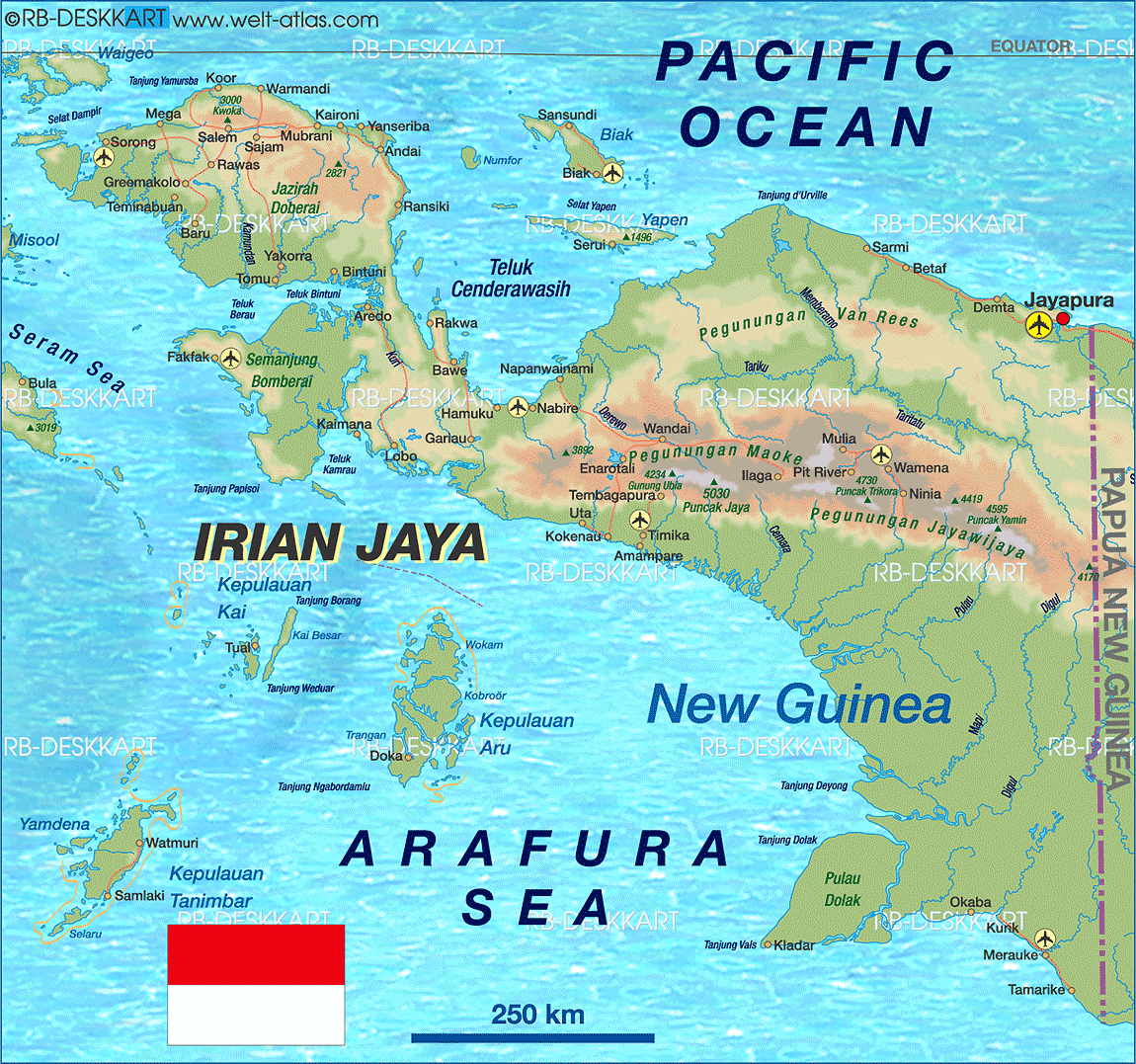
Fakfak ([ˈfaʔfaʔ]), also known as the District of Fakfak, is a town in West Papua and seat of the Fakfak Regency.[2] It had a population of 12,566 at the 2010 Census,[3] which rose to 18,900 at the 2020 Census.[1] It is served by Fakfak Airport. It is the only town in West Papua with a significant Muslim Indian and Arab Indonesian presence.

Key Information

History

[edit]

The former name of the settlement was Kapaur and it is still in use by biologists.[4] Historically Fakfak was a significant port town, being one of the few Papuan towns that had relations with the Sultanate of Ternate, being bound to it.[5] The Sultanate later granted the Dutch colonial government permission to settle in Papua, including in Fakfak.[6] The Dutch began settlement in 1898.[7] The town still has some colonial buildings remaining from this settlement.[6]

The Japanese 1st Detachment landed in Fakfak on April 1, 1942.[8] The small Royal Netherlands East Indies Army garrison surrendered without a fight and later a small garrison of 67 men of the 24th Special Base Unit occupied the area and used it as a seaplane base. Between April 1943 and October 1944, the town was attacked several times by allied bombers.[9] Japanese forces occupied the town until the end of the war in September 1945.

Fakfak is now an isolated town, not often used for the import and export of goods.[6]

Geography

[edit]
Toran Bay, south of Fakfak

Fakfak is located in West Papua, Indonesia, on the Bomberai Peninsula at the foothills of the Fakfak Mountains, near Tambaruni Bay.[7] It is situated in an area with many limestone hills, rivers and caves. As such, the streets twist and turn.[7][10]

Climate

[edit]
Climate data for Fakfak (2000–2020)
Month Jan Feb Mar Apr May Jun Jul Aug Sep Oct Nov Dec Year
Mean daily maximum °C (°F) 30.6
(87.1)
30.6
(87.1)
30.6
(87.1)
29.9
(85.8)
29.5
(85.1)
28.4
(83.1)
27.7
(81.9)
27.4
(81.3)
28.3
(82.9)
29.4
(84.9)
30.3
(86.5)
30.6
(87.1)
29.4
(85.0)
Mean daily minimum °C (°F) 22.8
(73.0)
22.6
(72.7)
22.6
(72.7)
22.8
(73.0)
22.9
(73.2)
22.5
(72.5)
22.1
(71.8)
22.0
(71.6)
22.3
(72.1)
22.6
(72.7)
22.9
(73.2)
23.1
(73.6)
22.6
(72.7)
Average precipitation mm (inches) 290.6
(11.44)
216.4
(8.52)
216.4
(8.52)
296.1
(11.66)
354.6
(13.96)
434.0
(17.09)
354.7
(13.96)
298.7
(11.76)
280.4
(11.04)
237.0
(9.33)
165.9
(6.53)
210.1
(8.27)
3,354.9
(132.08)
Average precipitation days 16.2 14.5 14.5 15.8 17.1 18.3 19.2 18.1 16.6 14.3 13.6 15.0 193.2
Source: Meteomanz[11]

Demographics

[edit]

Fakfak has a small community of Muslim Arab and Indian Indonesians, descended from traders and religious teachers who came to Papua in the 19th century and possibly earlier; this minority population has decreased recently due to Fakfak's diminishing role as a port town. It is the only place in West Papua with such a community.[6]

The local Papuan population are majority Muslim, with sizable minorities of Catholics and Protestants. Islamization in Fakfak occurred due to Fakfak being part of the broader trading relationship with the Maluku Islands, intermarriages between traders with native nutmeg producing tribes, informal religious education through Muslim missionaries, and through political channels as native kingdoms and their aristocracy adopted Islam.[12]

Cultural identity

[edit]
Satu Tungku Tiga Batu Monument

The local philosophy is called “Satu tungku tiga batu” which means a stove/cauldron with three stones/legs. The majority of local ethnic groups are member of Mbaham Matta Wuh, who traditionally cook with cauldron which is balanced over three stones. The cauldron symbolizes life, while the three stones symbolizes the pronouns you, me, and they. Another saying to reflect this is “Ko, on, kno mi mbi du Qpona” which means you, me, and they are related. This forms the basis for religious tolerance in the area as Fakfak is a majority Muslim area while also having a sizable Christian minority. Whatever the religion the people are still considered family. There is a monument symbolizing this philosophy located in the center of Fakfak to commemorate its multiculturalism and tolerance.[13] Due to historically being under the control of Ternate but being located in West Papua, Fakfak is torn between being pro-Indonesian or supporting the Free Papua Movement.[14]

Tourism

[edit]

Fakfak has 1.5 kilometres (0.93 mi) of white sand beaches, located approximately half an hour from the town. Nearby there are also rock paintings. It is served by the Fakfak Airport.[7]

References

[edit]

Bibliography

[edit]
Revisions and contributorsEdit on WikipediaRead on Wikipedia
from Grokipedia
Fakfak Regency (Indonesian: Kabupaten Fakfak) is an administrative regency in province, , with its capital at the coastal town of Fakfak on the southwestern .

Covering an area of 14,320 km², the regency consists of 17 districts, 7 urban villages, and 142 rural villages, and recorded a of 87,894 in the 2020 census.
Historically, Fakfak served as a key maritime trading hub linked to regional networks since at least the and became one of the earliest Dutch colonial settlements in Papua in 1898, alongside .
The regency's economy relies on —particularly nutmeg production—, traditional barter markets like Mambunibuni, and nascent industrial projects such as a complex aimed at boosting regional growth.
Its defining characteristics include rich in coastal and mountainous terrains, remnants of colonial-era , and a strategic position facilitating trade between Papua and eastern .

History

Pre-Colonial and Colonial Eras

Fakfak, located on the Onin Peninsula in , functioned as a pre-colonial trading integrated into regional maritime networks dominated by the , which exerted influence over coastal areas through vassal rajas and tribute systems. Local populations, including indigenous Papuan groups such as the Fakfak (or Mbaham Mbojo) and migrant traders from Maluku and , facilitated exchanges of , pearls from nearby reefs, forest products like birds-of-paradise feathers, and slaves, linking the Bird's Head region to broader archipelago trade routes extending to and beyond. These interactions predated European arrival, with evidence of sustained Tidore-Fakfak ties persisting into the colonial period despite VOC disruptions elsewhere in the . Dutch colonial administration formalized control over in the late , establishing Fakfak as one of the initial outposts in 1898 to counter perceived threats from other powers and subdue local practices among upland groups. By 1901, it became the administrative center for Afdeeling West Nieuw-Guinea, serving as a hub for tax collection, missionary activities, and limited infrastructure development amid challenging terrain and sparse population. Dutch records document efforts to consolidate authority through resident assistants and small garrisons, though permanent fortifications were modest, focusing instead on coastal patrols to regulate trade and prevent raids; the post's role expanded modestly by the , with correspondence noting interactions with neighboring districts like Mimika. During , Japanese forces seized Fakfak on April 1, 1942, as part of their southward expansion toward , transforming the site into a strategic base with constructed bunkers and defenses that exploited its natural harbor. Occupation involved resource extraction and forced labor, disrupting prior Dutch structures until Allied advances prompted withdrawal by mid-1944. , Dutch authorities reoccupied the area in 1945, restoring administrative functions amid renewed focus on development, but Indonesian independence declarations that year prompted immediate claims to the entire territory, including Fakfak, framing it as integral to the unitary based on historical archipelago ties; this initiated diplomatic tensions, with pursuing integration through protests and low-level agitation into the while Dutch control persisted on the ground.

Indonesian Integration and Post-Independence Era

Following the signed on August 15, 1962, between the and under auspices, administration of Netherlands New Guinea—including the Fakfak region—was transferred to effective May 1, 1963, after a transitional (UNTEA) period. The agreement stipulated a subsequent act of self-determination to ascertain the territory's preferences, implemented as the Act of Free Choice in July-August 1969 through musyawarah consultations among selected representatives rather than . In Fakfak, the regional assembly convened on July 23, 1969, and unanimously voted to remain integrated with , contributing to the overall outcome ratified by the on November 19, 1969. Kabupaten Fakfak was formally established as one of eight autonomous regencies under the newly formed Provinsi Irian Barat via Undang-Undang Nomor 12 Tahun 1969, with Fakfak town designated as the administrative seat. This structure persisted through the era, during which the regency encompassed broader areas including present-day Kaimana and Mimika regencies, reflecting centralized control from . Post- decentralization under Laws No. 22/1999 and No. 32/2004 on regional autonomy prompted boundary adjustments, including the separation of Mimika Regency in 1997 and Kaimana Regency in 2002, refining Fakfak's jurisdiction to approximately 14,320 km² across nine districts. These changes aimed to enhance local governance efficiency amid Indonesia's "big bang" administrative proliferation, though they increased fiscal dependencies on central transfers. Indonesia's , active from 1964 onward, relocated over 78,000 families to Papua provinces by 1999, contributing to non-indigenous population influx and overall demographic expansion in regencies like Fakfak. Regional rates in West Papua, exceeding natural reproduction, were largely migration-driven, with estimates of 300,000 Indonesians resettled province-wide between 1972 and 2000, bolstering labor for resource extraction while straining local resources. Decentralization post-2000 facilitated infrastructure upgrades in Fakfak, including road network expansions to support inter-district connectivity and the transition from Torea Airport to the larger Siboru Airport, intended to accelerate economic activity. enhancements at Fakfak Harbor positioned it as a potential consolidation hub for eastern Indonesian maritime trade, with studies emphasizing capacity upgrades for regional cargo handling. These developments, funded partly through special autonomy allocations for Papua since 2001, improved access to remote areas but faced challenges from terrain and maintenance costs.

Geography and Environment

Location and Physical Features

Fakfak Regency occupies the Bomberai Peninsula in Province, , with a total area of 14,320 km². The regency's capital, the town of Fakfak, is positioned at approximately 2°55′S 132°15′E along the northern coastal margin of the peninsula, adjacent to the to the north. This location places it within a tectonically active zone of , characterized by ongoing plate boundary interactions. The terrain features coastal plains fringing steeper hilly slopes and rugged mountain ranges, including the Fakfak Mountains, with gradients exceeding 40° in many areas. The regency borders McCluer Gulf (Teluk Arguni-Berau) to the northwest, contributing to its indented coastline and diverse coastal geomorphology. The urban core of Fakfak centers on these low-elevation coastal plains, hemmed in by surrounding tropical rainforests that cloak the inland hills and uplands.

Climate and Natural Resources

Fakfak Regency features a (Af under the Köppen classification), with average annual temperatures ranging from 26°C to 30°C and minimal seasonal variation. High persists year-round, and averages substantial volumes, with as the wettest month at approximately 246 mm and the driest. Monsoonal influences drive wet seasons that impact local water cycles and , though specific annual totals from historical station data (1958–1983) indicate consistently high rainfall exceeding 2,500 mm in many periods. The regency's natural resources encompass diverse terrestrial and marine assets. Forests cover 86% of Fakfak's area (946 kha of natural as of 2020), supporting timber extraction amid low recent rates of 1.21 kha in 2024. Proximity to major hydrocarbon deposits, including those linked to the Tangguh LNG project spanning Bintuni Bay and Fakfak, underscores potential for oil and development. Marine resources in Fakfak Bay and adjacent waters include productive fisheries and extensive systems, contributing to the Bird's Head region's status as Indonesia's highest . These reefs harbor diverse , with Papua overall ranking tops in biodiversity metrics, though extraction pressures from fisheries persist alongside terrestrial logging influences on coastal ecosystems.

Conservation Efforts and Challenges

In 2018, the Fakfak Regency government formalized the establishment of two marine protected areas (MPAs) covering key coral reefs and mangrove ecosystems, aimed at bolstering sustainable fisheries and preservation within the Bird's Head . These MPAs, including Nusalasi Bay, emerged from local government initiatives seeking NGO support for management, enforcement, and community engagement to curb habitat degradation. Complementary efforts include regular patrols averaging 15 activities per period in designated zones, involving local stakeholders to monitor compliance and educate on sustainable practices. Collaborations with international organizations have integrated conservation with , such as partnerships with Divers Alert Network (DAN) since 2018 to promote safe diving while funding habitat protection and alternatives to extractive activities. Traditional leaders, including nine customary kings from Bomberay areas spanning Fakfak and adjacent regencies, have pledged to safeguard coastal forests and seas through (petuanan) declarations, emphasizing intergenerational resource . These initiatives align with regional MPA networks, yielding localized reductions in destructive practices like dynamite fishing through enforced regulations and community buy-in. Persistent challenges include uncontrolled across the Bird's Head , which threatens reef-associated species and fisheries yields despite MPA boundaries, as exploitation often exceeds sustainable levels without comprehensive monitoring. Illegal and unregulated activities, including historical dynamite use, continue to degrade habitats, compounded by limited enforcement capacity in remote areas. Proximal extractive industries, such as oil and gas exploration in West Papua regencies, pose indirect risks via potential spills and sedimentation, though site-specific impacts in Fakfak remain under-documented relative to hotspots like Raja Ampat. Pearl farming, a traditional economic driver, has raised concerns over localized overharvesting of stocks, necessitating data-driven quotas to mitigate depletion.

Demographics and Society

Population and Urbanization

The population of Fakfak Regency stood at 92,850 as of 2024, according to official statistics from Indonesia's Central Bureau of Statistics (BPS). This reflects an average annual growth rate of approximately 1.4% since the 2020 census figure of around 88,000, influenced by and natural increase amid limited industrial pull factors. remains low at about 6-7 persons per square kilometer across the regency's 14,320 km², underscoring its predominantly rural character. Urbanization in Fakfak is minimal, with the administrative capital town of Fakfak serving as the primary urban hub, accommodating roughly 19% of the regency's residents in its core districts. Surrounding rural villages, comprising the majority of settlements, depend heavily on subsistence farming and , with limited supporting migration to the town for services and administration. This divide contributes to uneven development, as urban areas concentrate basic amenities while remote kampung (villages) face access challenges. Health infrastructure includes one (RSUD Fakfak) and multiple puskesmas ( centers) distributed across districts to serve the dispersed , though coverage ratios remain strained in outer areas. The regency's (IPM) reached 71.52 in 2024, classifying it as high nationally and incorporating education and components, with ongoing efforts to expand access amid a productive-age share of about 64%.

Ethnic and Linguistic Diversity

The indigenous population of Fakfak Regency primarily consists of Papuan ethnic groups, including the Mbaham (also known as Baham), Onin, Iha, Mor, Mata, Irarrutu, and Arguni, who trace their origins to the Melanesian racial family and have inhabited the Onin Peninsula and surrounding areas for centuries. These groups formed traditional lordships with distinct social structures before significant external influences, and Papuans overall accounted for 47.61% of the regency's population as of the early 2010s census data analysis. Non-Papuan ethnic minorities, largely from Austronesian backgrounds, include migrants such as Javanese, Butonese, , , Sundanese, and Makassarese, who arrived through Indonesia's initiated in the 1960s and intensified in the 1980s to redistribute population from densely populated islands like and . This program has driven demographic shifts, with transmigrant descendants increasingly dominating local compositions in certain districts, fostering through and but also contributing to resource competition and occasional social tensions between indigenous Papuans and newcomers. Fakfak's ethnic fractionalization remains high, reflecting a of over a dozen groups coexisting in coastal and inland communities, with inter-ethnic marriages and networks promoting pragmatic harmony despite underlying disparities in land access. Linguistically, Fakfak hosts approximately 20 vernacular languages and dialects, spanning Papuan (non-Austronesian) families dominant in the Bomberai Peninsula, such as Iha (widely used in West Bomberai subdistricts), (spoken by about 30 individuals along the Bomberai River as of ), Baham (with around 1,000 speakers in the northwest peninsula), and Uruangnirin (primarily on offshore Karas Islands). Some Austronesian influences appear in peripheral dialects, but the core inventory reflects South Bird's Head Papuan branches, with languages often tied to specific ethnic subgroups like Onin or Mbaham. Indonesian serves as the primary , facilitating communication across ethnic lines in markets, administration, and schools, while vernaculars persist in rural villages and cultural rituals, though younger generations show declining fluency amid and migration pressures.

Government and Economy

Administrative Structure

Fakfak serves as the administrative capital of Fakfak Regency (Kabupaten Fakfak), a second-level administrative division in Southwest Papua Province, Indonesia. The regency is governed by a bupati (regent) and deputy bupati, who are directly elected by residents for five-year terms, with the current structure established under Indonesia's regional autonomy framework. The executive branch, led by the bupati, handles policy implementation, while the legislative body, the Regency People's Representative Council (Dewan Perwakilan Rakyat Daerah, DPRD), oversees budgeting and legislation, comprising members elected proportionally. The regency is subdivided into 17 districts (distrik or kecamatan), encompassing 142 rural villages (kampung or desa) and 7 urban villages (kelurahan), facilitating localized for services like infrastructure maintenance and . This structure supports decentralized operations, with heads (kepala distrik) appointed by the bupati to manage sub-regency affairs under Peraturan Bupati guidelines. Fiscal operations are influenced by national decentralization policies post-Law No. 22/1999, which devolved significant authority to regencies while retaining provincial oversight from for coordination and special autonomy allocations. Village funds (Dana Desa), mandated by Law No. 6/2014 and implemented from 2015, provide direct transfers to villages for priorities like , with Fakfak allocating approximately IDR 72.27 billion across 142 villages in 2022, equating to roughly IDR 509 million per village on average. These funds aim to enhance local autonomy but face challenges in remote areas due to geographic constraints.

Traditional and Modern Economic Activities

The traditional economy of Fakfak Regency relies heavily on subsistence activities centered on fishing, sago processing, and nutmeg cultivation, which sustain local communities through small-scale, family-based operations. Artisanal fishing targets reef fish and marine resources, with seven dedicated fish markets facilitating local trade and contributing to the primary sector's dominance in regional output. Sago farming involves extracting starch from Metroxylon sagu palms, a staple processed via traditional milling methods that yield modest volumes for food security rather than commercial export. Nutmeg (Myristica fragrans), a historical cash crop introduced during colonial eras, remains a cornerstone, with Fakfak accounting for over 80% of West Papua's production through community plantations employing low-tech harvesting and drying techniques. Annual nutmeg yields reach up to 18,000 tons, processed into seeds, mace, and flowers for domestic and limited international markets, underscoring self-reliant agricultural practices over external dependencies. Marine products, including cultivation and pearl farming, supplement traditional livelihoods and account for a notable share of economic activity, though exact GDP contributions vary by year amid fluctuating yields from coastal operations. These sectors emphasize localized extraction and processing, with harvested for export-oriented drying and pearls from small farms in sheltered bays, fostering resilience through diverse, low-capital marine resource use. In contrast, modern economic shifts incorporate small-scale —primarily alluvial —and expanded trade networks, transitioning partially from pure subsistence toward market-oriented commerce without large industrial overlays. Local ports, such as those in Fakfak town, handle modest cargo volumes of and , supporting 1,267 kiosks, 500 shops, and 21 traditional markets that drive intra-regional exchange. Empirical indicators reflect this hybrid structure, with the regency's GDP at IDR 65.38 million in 2023, trailing the national average and highlighting constraints in scaling beyond traditional bases despite trade growth. This figure, derived from primary sectors like and fisheries comprising the bulk of GRDP, illustrates a grounded in endogenous production, where modern elements like improved market enhance but do not yet supplant self-reliant foundations.

Recent Industrial and Infrastructure Developments

In November 2023, President laid the foundation stone for the Fakfak Industrial Area in Arguni District, designating it a national strategic project (PSN) to bolster production capacity in Eastern and support by curbing imports. The initiative, backed by an estimated IDR 30 trillion investment, targets annual output of 1.15 million metric tons of and 825,000 metric tons of , leveraging local resources to serve regional agricultural needs. Construction advanced in October 2024 when PT Pupuk Kaltim commenced building a core -urea facility within the complex, with a project cost of IDR 15.4 trillion (approximately $1 billion) and a planned capacity of 600,000 metric tons of annually. This development, supplied by 101 million standard cubic feet per day of under a gas sales agreement, represents the first major plant in West Papua in over 40 years and aims to integrate upstream gas processing with downstream output. In energy infrastructure, the government outlined plans in August 2025 for modular refineries at sites near domestic crude production, explicitly including Fakfak, to process imported crude more rapidly and diminish reliance on foreign refined fuels. These smaller-scale facilities, part of a national target for up to 17 new refineries, would position Fakfak as a processing hub proximate to existing fields in . Marine industrial potential advanced in June 2025 with the identification of zones in Fakfak Regency, targeting subdistricts such as Kokas and Teluk Patipi to revive cultivation amid prior production declines and capitalize on suitable coastal conditions. This supports downstream processing linkages, aligning with broader strategies to diversify resource-based industry in the region.

Culture and Religion

Indigenous Cultural Practices

The indigenous populations of Fakfak, primarily comprising Onin Peninsula clans such as the Baham and Onin ethnic groups, preserve traditions linked to their historical maritime and lifestyles. Archaeological evidence includes prehistoric sites like Tapurarang, located on coastal cliffs, featuring ochre paintings of hand stencils, animal figures (including dolphins and ), human soles, eyes, and palms, which illustrate scenes and symbolic motifs tied to subsistence activities. Similar motifs appear at Afofo in Fakfak Regency, where animal depictions reflect the environmental influences on ancient communities' and daily practices. Recent pigment analysis from Teluk Berau sites confirms the use of natural , providing material insights into these enduring expressions of clan heritage. Craft practices among these groups emphasize utilitarian items with cultural significance, such as incorporating geometric motifs derived from local patterns, which embed mathematical principles observable in elementary education contexts in Fakfak. Maritime traditions, shaped by early external contacts on the Onin Peninsula, involve knowledge of wooden vessel construction adapted for coastal , supporting and resource gathering. These elements persist through clan-based oral transmissions of practical skills, distinct from broader mythological narratives. Amid modernization pressures, preservation initiatives include digital documentation of cultural sites via Android applications to catalog and promote heritage locations in Fakfak, countering erosion from and external influences. Local wisdom systems, such as village naming conventions among Mbahammatta subgroups, reinforce communal identity and sustainable practices, with efforts focusing on verifiable artifacts like for educational and touristic purposes without unsubstantiated embellishments.

Religious Composition and Interfaith Dynamics

The religious composition of Fakfak Regency is characterized by a Muslim majority comprising approximately 63.08% of the , followed by Protestant at 18.27% and Catholics at 18.65%, with negligible adherents of , , , or indigenous beliefs. These figures, drawn from local administrative records, reflect the 2020 of around 87,894, where Islam predominates due to historical trade migrations from and eastern introducing the faith among coastal communities since the , while arrived later through Dutch colonial missions in the 19th century, establishing Protestant and Catholic congregations among indigenous Onin, Mbaham, and Iha groups. The distribution underscores a tripartite structure limited to these three faiths, with over 100 mosques, churches, and chapels reported across the regency's 143,320 square kilometers, though precise counts vary by district due to rural dispersal. Central to interfaith dynamics is the local wisdom of "Satu Tungku Tiga Batu" (One Stove, Three Stones), a metaphorical framework originating from indigenous cooking practices where three stones support a single pot, symbolizing balanced coexistence among , , and Catholicism without a fourth element disrupting equilibrium. Formalized in regency policies and commemorated by a 2010 in , this model promotes through tribal dialogues led by customary leaders (raja-raja), who mediate disputes via cultural rituals rather than formal courts, as evidenced in resolutions of land or resource conflicts involving mixed-faith villages. Interfaith councils, coordinated under the Ministry of Religious Affairs, facilitate joint events like shared harvest festivals and markets in districts such as Fakfak Timur, where Muslim traders and Christian farmers interact daily without reported segregation. Empirical patterns show sustained harmony, with no major religiously motivated since pre-independence eras; for instance, during annual Tombor rituals, participants from all three faiths share symbolic meals to reinforce communal bonds. Rare flare-ups, such as the 2019 unrest involving at a traditional and local markets, stemmed primarily from ethnic migration tensions rather than doctrinal clashes, quickly contained through invocation of the "Satu Tungku" principle by local authorities. This contrasts with broader Papuan separatist contexts, where interfaith cooperation persists as a stabilizing factor amid external pressures, though analysts note potential vulnerabilities from in-migration altering demographic balances without eroding the foundational triadic model.

Tourism and Attractions

Historical and Natural Sites

Fakfak Regency preserves notable historical sites tied to prehistoric and colonial eras, including the in Kokas District, featuring red hand stencils and paintings on coastal cliffs and caves estimated to date from thousands of years ago. These depictions, part of broader West Papuan traditions, include handprints and motifs potentially linked to early maritime cultures. Accessibility to Tapurarang requires travel by road or boat from Fakfak town, approximately 100 kilometers away, with basic infrastructure limiting visits. relics, such as Japanese defensive caves and forts in Kokas, remain from the area's occupation period, serving as military outposts before Allied advances in 1944. Natural attractions emphasize Fakfak's position in the Bird's Head Peninsula's biodiverse , with offering snorkeling amid coral reefs and marine life, though sites see minimal development. White sand beaches, such as Patawana Beach with its clear waters and preserved sands, lie within 30 minutes' drive from central Fakfak, providing serene coastal access via local roads. , unique for cascading directly into the at Nusalasi Bay, draws visitors for its exotic flow and surrounding landscapes, reachable by short boat or hike from nearby shores. Pearl farms operate in adjacent bays, like those in the Bomberai Peninsula, allowing observation of amid rich underwater . Tourism remains low-volume, with roughly 1,700 foreign and 8,000 domestic visitors recorded in 2022, constrained by remoteness, limited flights to Fakfak Airport, and underdeveloped trails or facilities at these sites. Proximity to Raja Ampat enhances potential for eco-tourism focused on Bird's Head marine hotspots, yet empirical data underscores thousands rather than mass arrivals annually.

Development and Accessibility Issues

Fakfak's primary air access is provided by Fakfak Airport, which serves as a regional connector to locations such as in , in , and Kaimana, facilitating limited domestic flights. The local functions as a consolidation hub for distribution and inter-island sea transport, including participation in Indonesia's sea toll program aimed at reducing freight costs, though human resource limitations and low regional HDI scores of 68.36 in 2020 constrain . Road infrastructure in Fakfak requires enhanced to link urban areas with surrounding regions, as empirical assessments highlight ongoing needs for improved connectivity amid broader Papuan development efforts. Since , the Fakfak regency has advanced diving tourism by formalizing two marine protected areas (MPAs) and seeking international expertise for , including assistance from organizations like Divers Alert Network to build tourism capacity. Conservation programs initiated in have supported MPA establishment and local efforts, representing early eco-tourism pilots focused on marine preservation. Persistent challenges include inadequate accommodations and elevated travel costs due to remoteness and underdeveloped , limiting tourist influx despite promotional initiatives.

Conflicts and Controversies

Separatist Tensions in West Papua Context

The separatist tensions affecting Fakfak are embedded within broader West Papuan independence claims, which trace their origins to the disputed Act of Free Choice conducted from July 14 to August 2, 1969, under auspices. In this process, Indonesian authorities selected 1,025 delegates—far short of the territory's of over 800,000—to vote unanimously for integration with , a outcome criticized by Papuan advocates and international observers for involving coercion, restricted participation, and military oversight that precluded a one-person-one-vote as initially anticipated in the 1962 . This integration formalized 's control following the Dutch withdrawal in 1963, but it galvanized resistance groups, including the (OPM), formally organized in 1965 to pursue armed struggle for sovereignty through ambushes and sabotage against Indonesian forces. OPM operations in the Fakfak area, a coastal regency in southwestern West Papua, have historically been limited and intermittent, contrasting with more sustained guerrilla campaigns in the central highlands where terrain favors insurgents and ethnic strongholds concentrate violence. Documented incidents in Fakfak include rare clashes, such as a 2000 police shooting of two locals amid pro-independence gatherings, but lack the frequency of highland attacks, with no major OPM bases or territorial control established there. This relative quiescence aligns with patterns where separatist activity correlates with remoteness and lower economic integration; coastal zones like Fakfak benefit from fisheries, trade ports, and migrant labor inflows that raise the opportunity costs of insurgency participation. Indonesia has countered these tensions through developmental policies framed as pathways to national cohesion, notably the Special Autonomy Law (Otsus), which devolves fiscal resources—totaling trillions of rupiah annually from resource revenues—to Papuan provincial and regency governments for , , and health initiatives aimed at undercutting separatist narratives by demonstrating tangible benefits of integration. Empirical assessments indicate mixed security outcomes: while Otsus funds have expanded road networks and schools, correlating with localized stability in less insurgent-prone areas like Fakfak, overall violence metrics from onward show no uniform decline, with armed incidents persisting at 100-200 annually province-wide per some trackers, often tied to highland hotspots rather than coastal regencies. Indonesian officials attribute reduced per-capita conflict in integrated zones to these incentives, though critics from Papuan exile groups argue mismanagement and undermine efficacy, perpetuating low-level unrest without resolving core disputes.

2019 Unrest and Government Response

The 2019 unrest in Fakfak occurred on August 21 amid broader protests across Papua province, triggered by the eviction and racial slurs directed at Papuan students in Surabaya, East Java, on August 16–17, where they were derogatorily called "monkeys" over alleged property damage. In Fakfak, demonstrators raised the banned Morning Star independence flag, set fire to the Thumburuni market—destroying stalls and structures—and torched the local customary council (Dewan Adat) office, escalating into street clashes with police. Security forces responded by deploying Brimob units to Fakfak and additional troops province-wide, totaling over 1,000 soldiers to quell the violence, while imposing an internet blackout in Papua to limit coordination among protesters. Clashes resulted in dozens of injuries across West Papua sites including Fakfak, primarily from confrontations involving stones, , and security gunfire, though no fatalities were reported locally in Fakfak unlike in areas such as where at least 10 deaths occurred amid similar riots. Several protesters were detained in Fakfak, with four later prosecuted for their roles in the violence, receiving sentences that monitors described as politically motivated. In the aftermath, Indonesian authorities, including President , declared the province returned to normalcy within days, facilitating funding for infrastructure repairs such as the Thumburuni market, which allowed traders to resume operations via temporary setups and distributions. Local economic indicators, including market activity, showed rapid rebound through these interventions, with no sustained disruptions evident in subsequent trade data despite initial property losses estimated in the millions of rupiah.

References

Add your contribution
Related Hubs
User Avatar
No comments yet.