


Community hub
Recent from talks
Contribute something
Nothing was collected or created yet.
Lipid emulsion
View on Wikipedia
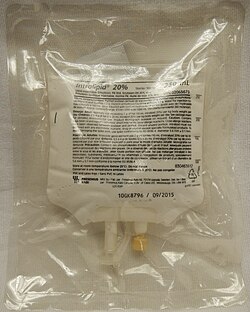
Lipid emulsion or fat emulsion refers to an emulsion of fat for human intravenous use, to administer nutrients to critically-ill patients that cannot consume food. It is often referred to by the brand name of the most commonly used version, Intralipid, which is an emulsion containing soybean oil, egg phospholipids and glycerin, and is available in 10%, 20% and 30% concentrations. The 30% concentration is not approved for direct intravenous infusion, but should be mixed with amino acids and dextrose as part of a total nutrient admixture.
Medical uses
[edit]Nutrition
[edit]Intralipid and other balanced lipid emulsions provide essential fatty acids, linoleic acid (LA), an omega-6 fatty acid, alpha-linolenic acid (ALA), an omega-3 fatty acid. The emulsion is used as a component of intravenous nutrition for people who are unable to get nutrition via an oral diet. These nutrients are combined with the intention of administering parenteral nutrition, where nutrients are delivered in an alternative pathway other than the gastrointestinal tract.
Local anaesthetic toxicity
[edit]Lipid emulsions are effective in treating experimental models of severe cardiotoxicity from intravenous overdose of local anaesthetic drugs such as bupivacaine.[1][2][3][4]
They have been effective in people unresponsive to the usual resuscitation methods. They have subsequently been used off-label in the treatment of overdose from other fat-soluble medications.[5]
Vehicle for other medications
[edit]Propofol is dissolved in a lipid emulsion for intravenous use. Sometimes etomidate (the usual vehicle for etomidate is propylene glycol) is supplied using a lipid emulsion as a vehicle. The possibility of lipid emulsions as an alternative drug delivery medium is under works.
History
[edit]Intravenous lipid emulsions have been used experimentally since at least the 19th century. An early product marketed in 1957 under the name Lipomul was briefly used in the United States but was subsequently withdrawn due to side effects.[6] Intralipid was invented by the Swedish physician and nutrition researcher Arvid Wretlind, and was approved for clinical use in Sweden in 1962.[7] In the United States, the Food and Drug Administration initially declined to approve the product due to prior experience with another fat emulsion. It was approved in the United States in 1972.
Research
[edit]Intralipid is also widely used in optical experiments to simulate the scattering properties of biological tissues.[8] Solutions of appropriate concentrations of intralipid can be prepared that closely mimic the response of human or animal tissue to light at wavelengths in the red and infrared ranges where tissue is highly scattering but has a rather low absorption coefficient.
Cardioprotective agent
[edit]Intralipid is currently being studied for its potential use as a cardioprotective agent, specifically as a treatment for ischemic reperfusion injury. The rapid return of myocardial blood supply is critical in order to save the ischemic heart, but it also has the potential to create injury due to oxidative damage (via reactive oxygen species) and calcium overload.[9] Myocardial damage with the resumption of blood flow after an ischemic event is termed "reperfusion injury".
The mitochondrial permeability transition pore (mPTP) is normally closed during ischemia, but calcium overload and increased reactive oxygen species (ROS) with reperfusion open mPTP allowing hydrogen ions to flow from the mitochondrial matrix into the cytosol. The hydrogen flux disrupts the mitochondrial membrane potential and results in mitochondrial swelling, outer membrane rupture, and the release of pro-apoptotic factors.[9][10] These changes impair mitochondrial energy production and drive cardiac myocyte apoptosis.
Intralipid (5mL/kg) provided five minutes before reperfusion delays the opening of mPTP in vivo rat models, making it a potential cardioprotective agent[11] Lou et al. (2014) found that the cardioprotection aspect of Intralipid is initiated by the accumulation of acylcarnitines in the mitochondria and involves inhibition of the electron transport chain, an increase in ROS production during early (3 min) reperfusion, and activation of the reperfusion injury salvage kinase pathway (RISK).[9] The mitochondrial accumulation of acylcarnitines (primarily palmitoyl-carnitine) inhibits the electron transport chain at complex IV, generating protective ROS.[12] The effects of ROS are both "site" and "time" sensitive, meaning that both will ultimately determine whether the ROS are beneficial or detrimental.[12] The generated ROS, which are formed from electrons leaking from the electron transport chain of the mitochondria, first act directly on mPTP to limit opening.[13] ROS then activate signalling pathways that act on the mitochondria to decrease mPTP opening and mediate protection.[13] Activation of the RISK pathway by ROS increases the phosphorylation of other pathways, such as phosphatidylinositol 3-kinase/Akt and extracellular-regulated kinase (ERK) pathways,[11] both of which are found in pools localized at the mitochondria.[14] The Akt and ERK pathways converge to alter glycogen synthase kinase-3 beta (GSK-3β) activity. Specifically, Akt and ERK phosphorylate GSK-3β, inactivating the enzyme, and inhibiting the opening of mPTP.[11] The mechanism by which GSK-3β inhibits the opening of the mPTP is controversial. Nishihara et al. (2007) proposed that it is achieved through interaction of GSK-3β with ANT subunit of mPTP, inhibiting the Cyp-D–ANT interaction, resulting in the inability of the mPTP to open.[15]
In a study by Rahman et al. (2011) Intralipid-treated rat hearts were found to required more calcium to open mPTP during ischemia-reperfusion. The cardiomyocytes are therefore, better able to tolerate the calcium overload, and increase the threshold for opening of the mPTP with the addition of Intralipid.[11]
References
[edit]- ^ Picard J, Meek T (February 2006). "Lipid emulsion to treat overdose of local anaesthetic: the gift of the glob". Anaesthesia. 61 (2): 107–9. doi:10.1111/j.1365-2044.2005.04494.x. PMID 16430560. S2CID 29843241.
- ^ Weinberg GL, VadeBoncouer T, Ramaraju GA, Garcia-Amaro MF, Cwik MJ (April 1998). "Pretreatment or resuscitation with a lipid infusion shifts the dose-response to bupivacaine-induced asystole in rats". Anesthesiology. 88 (4): 1071–5. doi:10.1097/00000542-199804000-00028. PMID 9579517. S2CID 1661916.
- ^ Weinberg G, Ripper R, Feinstein DL, Hoffman W (2003). "Lipid emulsion infusion rescues dogs from bupivacaine-induced cardiac toxicity". Regional Anesthesia and Pain Medicine. 28 (3): 198–202. doi:10.1053/rapm.2003.50041. PMID 12772136. S2CID 6247454.
- ^ Weinberg G (2004). "Reply to Drs. Goor, Groban and Butterworth – Lipid rescue: Caveats and recommendations for the 'silver bullet' (letter)". Regional Anesthesia and Pain Medicine. 29: 74–75. doi:10.1097/00115550-200401000-00022.
- ^ Mahoney D. "IV Fat Emulsion Beneficial for Some Drug Overdoses". Acep.org. Elsevier Global Medical News. Archived from the original on 18 September 2016. Retrieved 3 November 2013.
- ^ Hallberg D, Holm I, Obel AL, Schuberth O, Wretlind A (April 1967). "Fat emulsions for complete intravenous nutrition". Postgraduate Medical Journal. 43 (498): 307–16. doi:10.1136/pgmj.43.498.307. PMC 2466293. PMID 4962960.
- ^ Isaksson B, Hambraeus L, Vinnars E, Samuelson G, Larsson J, Asp NG (2002). "In memory of Arvid Wretlind 1919 – 2002". Scandinavian Journal of Nutrition. 46 (3): 117–118. doi:10.1080/11026480260363233.
- ^ Driver I, Feather JW, King PR, Dawson JB (1989). "The optical properties of aqueous suspensions of Intralipid, a fat emulsion". Physics in Medicine and Biology. 34 (12): 1927–1930. Bibcode:1989PMB....34.1927D. doi:10.1088/0031-9155/34/12/015. S2CID 250815526.
- ^ a b c Li J, Iorga A, Sharma S, Youn JY, Partow-Navid R, Umar S, Cai H, Rahman S, Eghbali M (October 2012). "Intralipid, a clinically safe compound, protects the heart against ischemia-reperfusion injury more efficiently than cyclosporine-A". Anesthesiology. 117 (4): 836–46. doi:10.1097/ALN.0b013e3182655e73. PMC 3769111. PMID 22814384.
- ^ Sanada S, Komuro I, Kitakaze M (November 2011). "Pathophysiology of myocardial reperfusion injury: preconditioning, postconditioning, and translational aspects of protective measures". American Journal of Physiology. Heart and Circulatory Physiology. 301 (5): H1723-41. doi:10.1152/ajpheart.00553.2011. PMID 21856909.
- ^ a b c d Rahman S, Li J, Bopassa JC, Umar S, Iorga A, Partownavid P, Eghbali M (August 2011). "Phosphorylation of GSK-3β mediates intralipid-induced cardioprotection against ischemia/reperfusion injury". Anesthesiology. 115 (2): 242–53. doi:10.1097/ALN.0b013e318223b8b9. PMC 3322241. PMID 21691195.
- ^ a b Lou PH, Lucchinetti E, Zhang L, Affolter A, Schaub MC, Gandhi M, Hersberger M, Warren BE, Lemieux H, Sobhi HF, Clanachan AS, Zaugg M (2014). "The mechanism of Intralipid®-mediated cardioprotection complex IV inhibition by the active metabolite, palmitoylcarnitine, generates reactive oxygen species and activates reperfusion injury salvage kinases". PLOS ONE. 9 (1) e87205. Bibcode:2014PLoSO...987205L. doi:10.1371/journal.pone.0087205. PMC 3907505. PMID 24498043.
- ^ a b Perrelli MG, Pagliaro P, Penna C (June 2011). "Ischemia/reperfusion injury and cardioprotective mechanisms: Role of mitochondria and reactive oxygen species". World Journal of Cardiology. 3 (6): 186–200. doi:10.4330/wjc.v3.i6.186. PMC 3139040. PMID 21772945.
- ^ Martel C, Huynh L, Garnier A, Ventura-Clapier R, Brenner C (2012). "Inhibition of the Mitochondrial Permeability Transition for Cytoprotection: Direct versus Indirect Mechanisms". Biochemistry Research International. 2012: 1–13. doi:10.1155/2012/213403. PMC 3364550. PMID 22675634.
- ^ Nishihara M, Miura T, Miki T, Tanno M, Yano T, Naitoh K, Ohori K, Hotta H, Terashima Y, Shimamoto K (November 2007). "Modulation of the mitochondrial permeability transition pore complex in GSK-3beta-mediated myocardial protection". Journal of Molecular and Cellular Cardiology. 43 (5): 564–70. doi:10.1016/j.yjmcc.2007.08.010. PMID 17931653.
External links
[edit]- Lipid rescue (intralipid as antidote)
Lipid emulsion
View on GrokipediaOverview
Definition
A lipid emulsion is a heterogeneous colloidal system comprising an oil-in-water dispersion, where lipid droplets are suspended in an aqueous phase and stabilized by emulsifiers to prevent coalescence.[4] These emulsions feature lipid droplets typically ranging from 100 to 500 nm in diameter, with a mean droplet size often around 300 nm, ensuring stability and biocompatibility for therapeutic applications.[5][6] The core components of a lipid emulsion include lipids primarily in the form of triglycerides derived from sources such as soybean oil or fish oil, which provide essential fatty acids and energy.[6] Emulsifiers, such as egg yolk phospholipids, form a stabilizing monolayer around the lipid droplets to maintain dispersion, typically at a concentration of 1.2% w/v.[7] Stabilizers like glycerol are incorporated to achieve isotonicity with blood, preventing osmotic imbalances during administration.[8] Unlike general emulsions used in food or cosmetics, lipid emulsions for therapeutic purposes are specifically formulated for parenteral administration, rendered sterile and pyrogen-free to minimize risks of infection and immune reactions such as fever.[9] The term "lipid emulsion" historically denotes these intravenous formulations, which gained approval for human use in the 1960s following advancements in stable oil-phospholipid combinations that resolved earlier instability issues.[6][10] These emulsions serve as vehicles for nutrition and toxicity reversal, with further applications detailed in subsequent sections.Composition
Lipid emulsions for medical use are oil-in-water colloidal systems primarily composed of triglycerides as the lipid phase, emulsified in an aqueous medium. The lipid phase typically constitutes 10-30% w/v triglycerides derived from various sources, including soybean oil, safflower oil, olive oil, medium-chain triglycerides (MCTs) from coconut or palm kernel oil, and structured lipids such as fish oil rich in omega-3 fatty acids like eicosapentaenoic acid (EPA) and docosahexaenoic acid (DHA).[11] These oils provide essential fatty acids and non-protein calories, with soybean oil-based formulations often containing 44-62% linoleic acid and 4-11% alpha-linolenic acid.[12] Emulsifying agents, usually 1-2% phospholipids, stabilize the formulation by forming micelles around lipid droplets. Common sources include egg yolk phospholipids, though synthetic alternatives exist for allergen concerns; for instance, Intralipid 20% uses 1.2% egg yolk phospholipids.[9][11] The aqueous phase includes 2-3% glycerol to achieve isotonic osmolarity of approximately 300 mOsm/L and prevent red blood cell hemolysis during infusion. Antioxidants such as vitamin E (dl-alpha-tocopherol, 0.15-0.3 mg/mL in fish oil emulsions) are added to inhibit lipid peroxidation, alongside minor components like sodium oleate for pH adjustment.[13][11]| Commercial Example | Lipid Sources and Concentrations | Emulsifier and Additives | Key Properties |
|---|---|---|---|
| Intralipid (soybean-based) | 20% soybean oil | 1.2% egg yolk phospholipids; 2.25% glycerin; α-tocopherol | pH 6-8.9; osmolarity 260 mOsm/L; 2 kcal/mL[9] |
| Omegaven (fish oil-based, for pediatrics) | 10% fish oil | 1.2% egg yolk phospholipids; 2.5% glycerin; 0.15-0.3 mg/mL α-tocopherol | pH 6-9; osmolarity 273 mOsm/L; 1.12 kcal/mL[13] |
| SMOFlipid (mixed oils) | 6% soybean oil, 6% MCTs, 5% olive oil, 3% fish oil (total 20%) | 1.2% egg yolk phospholipids; 2.5% glycerin; 16.3-22.5 mg/100 mL α-tocopherol | pH 6-9; osmolarity 270 mOsm/L; 2 kcal/mL[14] |
| Clinolipid (mixed oils, approved for neonatal use in 2024) | 16% olive oil, 4% soybean oil (total 20%) | 1.2% egg yolk phospholipids; 2.25% glycerin; vitamin E | pH 5-9; osmolarity 260 mOsm/L; 2 kcal/mL[15] |
Clinical Applications
Parenteral Nutrition
Lipid emulsions are a cornerstone of total parenteral nutrition (TPN), delivering essential caloric and nutritional support to patients unable to ingest food orally or enterally due to conditions like severe gastrointestinal dysfunction. They provide 20-40% of total daily calories in TPN regimens, offering a dense energy source while supplying critical essential fatty acids, including linoleic acid (an omega-6 fatty acid) and alpha-linolenic acid (an omega-3 fatty acid), to prevent deficiencies that can lead to dermatologic, hematologic, and neurologic complications during prolonged intravenous feeding.[17][18] Standard dosage guidelines recommend 1-2 g/kg/day of lipids for adults, infused continuously over 12-24 hours to prevent metabolic overload and ensure steady assimilation.[19] Safety monitoring includes regular assessment of serum triglycerides, targeting levels below 400 mg/dL to avoid hypertriglyceridemia and associated risks like pancreatitis.[20] In pediatric populations, such as neonates and infants, dosages start at 1-2 g/kg/day and advance to 2-3 g/kg/day based on tolerance and age-specific guidelines, with adjustments for growth requirements and lower tolerance thresholds compared to adults.[20] These emulsions are routinely used in critically ill patients in intensive care units, post-surgical cases requiring recovery support, and malnourished individuals with chronic conditions like cancer or inflammatory bowel disease, where enteral intake is insufficient or contraindicated.[21] Compared to dextrose-only TPN, lipid-inclusive formulations reduce hyperglycemia by distributing caloric load away from glucose, thereby stabilizing blood sugar and minimizing insulin resistance.[22] Emulsions containing omega-3 fatty acids further enhance immune function by attenuating excessive inflammation and supporting resolution of acute-phase responses in stressed states.[23] Evidence from randomized controlled trials in ICU settings indicates that lipid emulsions improve nitrogen balance by promoting protein synthesis and sparing amino acids for tissue repair, while also lowering infection rates through better nutritional equilibrium.[24] For example, omega-6-sparing lipid strategies have been associated with reduced nosocomial infections and shorter hospital lengths of stay in critically ill adults.[25] In clinical practice, lipid emulsions are compounded directly into TPN admixtures alongside amino acids and glucose to form a complete, isotonic solution that fulfills macronutrient, electrolyte, and micronutrient demands without requiring separate infusions.[26] Fish oil-containing blends, when incorporated, may provide supplementary anti-inflammatory effects in patients with heightened oxidative stress.Toxicity Treatment
Lipid emulsions are primarily indicated as a rescue therapy for local anesthetic systemic toxicity (LAST), a potentially life-threatening condition arising from inadvertent intravascular injection or excessive dosing of local anesthetics such as bupivacaine, which can lead to cardiac arrest and central nervous system excitation or depression.[28][3] The standard protocol for lipid rescue therapy involves administering a 1.5 mL/kg bolus of 20% lipid emulsion intravenously over 2-3 minutes, followed by a continuous infusion at 0.25 mL/kg/min until hemodynamic stability is achieved, with a maximum total dose of approximately 12 mL/kg.[28][3] This approach is integrated into advanced cardiac life support algorithms for LAST-induced cardiac arrest.[28] The mechanism of action primarily involves the lipid emulsion acting as a "lipid sink," sequestering lipophilic toxins like bupivacaine into lipid droplets, thereby reducing their free plasma concentrations and facilitating redistribution from critical tissues such as the myocardium (detailed further in the Pharmacology section).[3][28] Beyond LAST, lipid emulsions have been used off-label for toxicities from other lipophilic drugs, including bupropion, verapamil, and tricyclic antidepressants, with evidence derived from case reports demonstrating hemodynamic improvement and case series supported by animal models showing reversal of cardiovascular collapse. As of 2025, narrative reviews continue to support off-label use in overdoses of calcium channel blockers and beta-blockers, with improving evidence from case series, though randomized trials remain needed.[29][30][31][32][33] The American Society of Regional Anesthesia and Pain Medicine (ASRA) provides the primary guidelines endorsing lipid emulsion therapy for LAST, recommending its immediate use in cases of cardiovascular collapse, with reported success rates exceeding 70% in resuscitating patients from cardiac arrest associated with local anesthetic overdose based on registry data and systematic reviews.[28][34][35] Contraindications include known severe hypersensitivity to soy or egg components in the emulsion, as most formulations contain soybean oil and egg phospholipids.[36][3] Additionally, administration can interfere with laboratory tests, such as causing falsely elevated bilirubin levels due to lipemia, necessitating careful timing of blood draws.[37][3]Drug Delivery
Lipid emulsions serve as effective vehicles for the delivery of lipophilic drugs, enhancing their solubility in aqueous environments and enabling intravenous administration without the need for toxic organic solvents. By encapsulating hydrophobic active pharmaceutical ingredients within the oil droplets stabilized by emulsifiers such as phospholipids, these formulations improve drug bioavailability and reduce local tissue irritation at the infusion site compared to traditional aqueous solutions.[6][38] A prominent example is propofol, formulated as Diprivan, an injectable emulsion containing 1% propofol in a soybean oil-based vehicle with egg lecithin as the emulsifier, which allows for rapid onset of anesthesia while minimizing pain on injection associated with aqueous formulations.[39] Similarly, diazepam is available in lipid emulsion forms like Diazemuls, which demonstrated pain on injection in only 0.4% of 2,435 patients, with no associated skin reddening or tenderness.[6] Etomidate has also been incorporated into lipid emulsions to facilitate safe intravenous delivery, avoiding propylene glycol-related adverse effects in conventional preparations.[40] These emulsions offer advantages including sustained drug release due to partitioning into the lipid phase, which prolongs circulation time, and reduced toxicity by serving as cremophor-free alternatives that avoid solvent-induced hypersensitivity.[38] In oncology, lipid-based paclitaxel formulations, such as nanoemulsions, have shown clinical evidence of decreased infusion site reactions and overall hypersensitivity compared to cremophor EL-containing Taxol, with approvals in regions like China for products such as Lipusu demonstrating comparable antitumor efficacy but improved tolerability.[41][42] Nanoemulsions further extend applications to oral and topical routes, where lipid droplets enhance permeation across mucosal barriers and skin, improving absorption of poorly soluble actives without gastrointestinal irritation.[43][44] In formulation, drugs are typically incorporated into the lipid core via solubilization in the oil phase during emulsification or adsorbed onto droplet surfaces, followed by rigorous stability testing to monitor for phase separation, droplet coalescence, or creaming over storage at various temperatures.[45][6] Phospholipids aid in drug encapsulation by forming a stabilizing interfacial layer, though excessive drug loading can compromise emulsion integrity.[46] Despite these benefits, limitations include potential drug-lipid interactions that may alter pharmacodynamics, such as reduced hypnotic potency of certain anesthetics when co-administered with lipid emulsions, necessitating careful compatibility assessments to maintain therapeutic efficacy.[47]Pharmacology
Mechanisms of Action
In parenteral nutrition, lipid emulsions serve as a source of essential fatty acids and energy, undergoing hydrolysis primarily by endothelial lipoprotein lipase to release free fatty acids that are taken up by tissues for beta-oxidation and incorporation into cell membranes.[17] This process mimics the metabolism of endogenous chylomicrons, with the emulsions' triglyceride cores being cleaved to provide non-esterified fatty acids bound to albumin for transport, thereby preventing essential fatty acid deficiency by supplying linoleic and alpha-linolenic acids at levels of at least 1-3.2% of total caloric intake.[2] Medium-chain triglycerides within some emulsions are hydrolyzed more rapidly than long-chain variants, enhancing their availability for mitochondrial beta-oxidation and ATP production.[48] In the context of toxicity treatment, particularly for local anesthetic systemic toxicity, lipid emulsions operate via the partitioning hypothesis, wherein the emulsion droplets act as a lipid sink that preferentially binds lipophilic toxins such as bupivacaine (logP ≈ 3.4), sequestering them from aqueous plasma and tissue compartments to expand the volume of distribution and reduce free drug concentrations at target sites like the myocardium and brain.[49] This redistribution lowers the toxin's availability to bind sodium channels, mitigating cardiovascular collapse, as evidenced by rapid reductions in plasma bupivacaine levels following emulsion infusion in animal models.[50] The binding affinity is quantified by the partition coefficient , which exceeds 100 for effective sinks with bupivacaine showing values around 1,870 in soybean oil-based emulsions like Intralipid.[51] For drug delivery, lipid emulsions enhance the solubility and absorption of lipophilic payloads (logP > 5) by promoting their incorporation into chylomicron-like particles within enterocytes, facilitating lymphatic uptake that bypasses hepatic first-pass metabolism and increases systemic bioavailability.[52] This mechanism improves membrane permeability through association with fatty acid-binding proteins and lipid transporters, allowing sustained release and targeted delivery, as seen with formulations like testosterone undecanoate achieving 83-84% bioavailability via lymph in preclinical studies.[53] At the cellular level, lipid emulsions exert anti-inflammatory effects by modulating peroxisome proliferator-activated receptor (PPAR) activity; for instance, Intralipid blocks lysophosphatidylcholine-induced inhibition of PPARγ in dendritic cells, thereby suppressing maturation and promoting resolution of inflammatory responses.[54] In cardioprotection, they activate voltage-gated calcium channels to increase intracellular Ca²⁺ levels, enhancing myocardial contractility and countering toxin-induced depression, while also stimulating the PI3K/Akt pathway to inhibit mitochondrial permeability transition and apoptosis.[55] Emulsion composition influences these actions; omega-3-rich variants, containing eicosapentaenoic and docosahexaenoic acids from fish oil, upregulate specialized pro-resolving mediators such as resolvins, protectins, and maresins, which actively resolve inflammation by modulating immune cell function and reducing pro-inflammatory cytokine production in clinical nutrition settings.[56]Pharmacokinetics
Lipid emulsions administered intravenously achieve immediate bioavailability, entering the systemic circulation directly without gastrointestinal processing.[6] In contrast, oral lipid emulsions are subject to gastrointestinal lipolysis, where gastric and pancreatic lipases initiate the breakdown of triglycerides into free fatty acids and monoglycerides, facilitating absorption primarily via the intestinal lymphatic system as chylomicron-like particles.[57] Following intravenous infusion, lipid emulsions rapidly distribute to tissues, with significant uptake by the reticuloendothelial system, including the liver, spleen, and lungs, mimicking the behavior of endogenous chylomicrons.[6] The emulsion particles, typically 200-400 nm in diameter, acquire apolipoproteins such as apo-E and apo-CII from high-density and very low-density lipoproteins within minutes, enabling receptor-mediated distribution.[6] The plasma half-life of these chylomicron-like particles is short, ranging from 10-20 minutes for soybean oil-based emulsions like Intralipid, reflecting rapid clearance.[58] Metabolism of intravenous lipid emulsions occurs primarily through hydrolysis by lipoprotein lipase in peripheral tissues and hepatic lipase in the liver, converting triglycerides to free fatty acids and sn-2 monoglycerides for energy utilization or re-esterification.[6] Phospholipids in the emulsion are similarly metabolized to lysophospholipids and free fatty acids by phospholipases.[6] Clearance rates vary by emulsion composition; medium-chain triglyceride-containing formulations exhibit faster hydrolysis and elimination compared to long-chain triglyceride-based ones, with half-lives around 34 minutes for mixed emulsions like SMOFlipid versus 59 minutes for pure long-chain types.[59] Excretion of lipid emulsion components is predominantly hepatic, with remnants processed via low-density lipoprotein receptors and eliminated through biliary secretion as cholesterol esters, followed by fecal elimination; renal excretion remains minimal, accounting for less than 1% of the dose due to the hydrophobic nature of lipids.[6] Several factors influence pharmacokinetics. Hypertriglyceridemia impairs lipoprotein lipase activity, prolonging clearance and extending half-life beyond 30 minutes by saturating metabolic pathways.[60] In pediatric patients, metabolism is generally faster than in adults due to higher lipoprotein lipase activity, though preterm neonates may exhibit slower clearance.[10] Lipid emulsions interact with lipophilic drugs by sequestering them into emulsion droplets, increasing volume of distribution and potentially delaying their clearance, as observed with anesthetics like bupivacaine.[61] Pharmacokinetics can be monitored through plasma clearance rates, assessed via turbidimetry or nephelometry to measure triglyceride levels and lipemic index, ensuring safe infusion rates and detecting impaired elimination.[59]Administration and Safety
Preparation and Delivery
Lipid emulsions for clinical use are manufactured through a multi-step process that ensures sterility, uniformity, and stability. The primary method involves high-pressure homogenization, where the oil-in-water emulsion is subjected to pressures up to 500 bar to reduce droplet sizes to less than 400 nm, achieving the fine particle distribution required for safe intravenous administration.[62] This step follows the initial mixing of lipid sources, emulsifiers such as phospholipids, and aqueous phases, with subsequent terminal sterilization or aseptic processing to eliminate microbial contaminants. The final product is aseptically filled into glass vials or flexible plastic bags under controlled environmental conditions to prevent contamination.[9] Quality control measures are rigorously applied to verify the emulsion's safety and efficacy. Sterility is confirmed through testing per United States Pharmacopeia (USP) Chapter <71>, which involves incubation of samples in growth media to detect viable microorganisms.[63] Particle size analysis, typically using light scattering techniques, ensures compliance with USP Chapter <729> limits for globule size distribution, with a volume-weighted mean diameter below 500 nm and minimal large-diameter globules exceeding 5 μm to reduce embolism risk.[63] Endotoxin levels are limited to less than 0.5 EU/mL via the Limulus amebocyte lysate test outlined in USP Chapter <85>, preventing pyrogenic reactions.[64] Storage conditions are critical to maintain emulsion integrity, as exposure to heat, light, or oxygen can promote peroxidation and phase separation. Unopened lipid emulsions are stored refrigerated at 2–8°C and protected from light, with a typical shelf life of up to 24 months from the date of manufacture, depending on the formulation.[65] Once opened or compounded, they should be used promptly or refrigerated for short-term stability, avoiding freezing which may cause irreversible damage to the emulsion structure. Delivery of lipid emulsions occurs via intravenous infusion, suitable for both central and peripheral lines due to their low osmolarity (typically 270–410 mOsm/L).[60] Infusion pumps are employed to regulate flow rates precisely, with a maximum recommended rate of 0.1 g/kg/hour to minimize risks such as fat overload syndrome.[9] Administration begins slowly, often at 0.02–0.05 g/kg/hour for the first 15–30 minutes, to monitor for tolerance before increasing to the target rate over 12–24 hours. Compatibility considerations guide co-administration practices. Lipid emulsions are generally compatible for Y-site infusion with electrolytes and many aqueous solutions, provided the pH remains stable (around 8 for optimal emulsifier function).[66] However, they are incompatible with amphotericin B, which can cause immediate precipitation and emulsion destabilization, necessitating separate lines or sequential administration.[67] In home care settings, lipid emulsions are often compounded into total parenteral nutrition (TPN) admixtures under sterile conditions, combining them with amino acids, dextrose, and micronutrients in a single bag for convenience. Patients receive education on proper handling, including visual inspection of the bag for signs of instability such as creaming (layering of lipid droplets on top) or cracking (phase separation into oily and aqueous layers), which indicate compromised stability and require discarding the solution.[68] Such inspections, performed before each infusion, help prevent infusion of unstable emulsions that could lead to adverse events.[66]Adverse Effects
Lipid emulsions used in parenteral nutrition can elicit a range of adverse effects, primarily related to lipid metabolism, infusion dynamics, and component sensitivities. Common effects include hypertriglyceridemia, where serum triglyceride levels exceed 500 mg/dL, often resulting from infusion rates surpassing 0.1 g/kg/hour or cumulative doses approaching metabolic limits.[7] Additional frequent manifestations encompass nausea, fever, and infusion-related chills due to transient inflammatory responses or fat overload.[69] More serious risks arise from excessive or prolonged exposure, notably fat overload syndrome, which presents with hepatomegaly, splenomegaly, fever, and potential organ dysfunction when daily doses exceed 2.5 g/kg.[69] This syndrome stems from overwhelmed lipid clearance mechanisms, leading to fat accumulation in tissues. Pulmonary embolism represents another grave concern, particularly in vulnerable populations like neonates, where large lipid droplets can obstruct pulmonary vasculature; autopsy findings have shown lipid deposits in cases involving prolonged infusions.[69] Allergic reactions, including anaphylaxis, occur in response to emulsifiers such as egg lecithin or soy phospholipids, with a low incidence (<1%); these hypersensitivity events manifest as urticaria, dyspnea, or hypotension shortly after initiation.[70] Alternatives with different lipid compositions, such as olive oil-based emulsions, may be considered, but patients should be screened for allergies to components like egg or soy.[71] Long-term administration may result in excess essential fatty acids, particularly omega-6 polyunsaturated fatty acids from soybean-based formulations, contributing to immunosuppression via reduced reticuloendothelial system clearance by up to 40% after repeated dosing.[7] Routine monitoring through liver function tests is essential to detect early hepatic stress or cholestasis. Contraindications encompass severe hyperlipidemia, where baseline triglyceride elevations contraindicate use, and acute pancreatitis, especially when accompanied by hypertriglyceridemia, as lipids may exacerbate pancreatic inflammation.[9] Precautions are warranted in sepsis, where impaired lipid metabolism heightens complication risks.[72] Effective management prioritizes dose reduction to below 2 g/kg/day in at-risk patients, alongside inline filtration using 1.2 μm filters to eliminate oversized droplets and prevent embolism.[73] Infusion should be discontinued if triglycerides surpass 1000 mg/dL, with temporary withholding typically resolving elevations within 5 days.[74] Meta-analyses of total parenteral nutrition regimens report severe adverse events, such as fat overload or anaphylaxis, in fewer than 2% of cases, underscoring the overall favorable safety profile when guidelines are followed.[75]History
Early Development
Early attempts at intravenous fat administration date back to the 17th century, when English naturalist William Courten infused olive oil into dogs in 1712, resulting in fatal pulmonary embolism due to the oil's insolubility and tendency to form large droplets.[76] In the 19th century, further experiments included Edward Hodder's 1873 infusion of milk into cholera patients, where some recovered but many suffered severe adverse effects from instability and contamination.[76] By the 1920s, researchers in the United States and Japan developed numerous olive oil-based emulsions using various emulsifiers, but these consistently failed in clinical trials due to droplet aggregation, embolism risks, and pyrogenic reactions, preventing safe human use.[77] The drive for viable intravenous lipid emulsions intensified during and after World War II, amid food shortages and the need for protein-sparing parenteral nutrition to support malnourished patients unable to eat orally.[76] In the 1950s, Swedish physician and biochemist Arvid Wretlind addressed these challenges by formulating a stable emulsion using purified soybean oil as the lipid source and egg yolk phospholipids as the emulsifier, creating Intralipid to mimic natural chylomicrons and ensure biocompatibility.[77] This innovation stemmed from Wretlind's work at Karolinska Institute, where he refined earlier concepts to provide essential fatty acids and calories without the toxicity of prior formulations.[78] Initial hurdles included preventing droplet coalescence and eliminating pyrogen contamination through rigorous sterilization and quality controls, which Wretlind overcame via optimized manufacturing processes.[77] Animal studies in dogs demonstrated safe hepatic clearance and minimal adverse effects, confirming the emulsion's tolerability at doses up to 3 g/kg body weight daily.[76] The first commercial version, 10% Intralipid with 1.2% phospholipids, was approved for clinical use in Sweden in 1962 following successful trials in malnourished patients, who showed improved nitrogen balance and weight gain.[76] It received U.S. FDA approval in 1975 after additional refinements to address regulatory concerns over long-term safety.[78]Key Milestones
Building on the foundational work of Arvid Wretlind in the 1960s, subsequent decades saw significant refinements in lipid emulsion formulations to enhance clinical utility and patient tolerance in parenteral nutrition.[11] In the 1980s, advancements included the introduction of 20% lipid emulsions, such as Liposyn 20% by Abbott in 1981, which allowed for more concentrated delivery of calories and essential fatty acids while reducing fluid volume load.[79] Concurrently, medium-chain triglyceride/long-chain triglyceride (MCT/LCT) blends emerged, exemplified by Lipofundin in the mid-1980s, offering improved metabolic clearance and reduced risk of hypertriglyceridemia compared to pure LCT emulsions.[80] The 1990s and early 2000s marked the advent of omega-3 enriched emulsions, with Omegaven (a fish oil-based lipid emulsion) receiving approval in Europe in 1998 for use in preventing parenteral nutrition-associated cholestasis in pediatric patients requiring long-term nutrition support.[81] In the 2000s, lipid emulsions expanded beyond nutrition into toxicology, as the American Society of Regional Anesthesia and Pain Medicine (ASRA) incorporated intravenous lipid emulsion therapy into its 2010 practice advisory for treating local anesthetic systemic toxicity (LAST), recommending a 1.5 mL/kg bolus of 20% emulsion followed by infusion to sequester lipophilic toxins.[82] US regulatory progress included the 2016 FDA approval of SMOFlipid, a mixed-lipid emulsion combining soybean oil, MCT, olive oil, and fish oil, providing a balanced fatty acid profile to mitigate inflammation and essential fatty acid deficiency in adults.[83] This was followed by FDA approval of SMOFlipid for pediatric patients in 2022.[84] In 2018, Omegaven received FDA approval for pediatric use in parenteral nutrition-associated cholestasis.[81] Further expansion occurred in 2024 with FDA approval of Clinolipid, another mixed-oil emulsion, for neonatal and pediatric patients.[85] From the 2010s onward, innovations focused on advanced delivery systems, including lipid nanoemulsions for oral administration, which improved bioavailability of poorly soluble drugs through enhanced solubility and lymphatic uptake, as evidenced in formulations developed for therapeutics like orlistat.[86] The COVID-19 pandemic in 2020 disrupted supply chains, leading to shortages of intravenous lipid emulsions, particularly for propofol formulations, which strained parenteral nutrition availability and prompted contingency protocols for rationing.[87] Further innovations encompassed structured lipids, such as randomized triglycerides combining MCT and LCT on the same glycerol backbone for optimized oxidation and reduced liver burden, and all-in-one total parenteral nutrition bags, which integrate lipids, amino acids, and carbohydrates to minimize handling steps and contamination risks during preparation and administration.[88][89]Research
Cardioprotective Effects
Lipid emulsions, particularly those enriched with omega-3 fatty acids, have demonstrated cardioprotective effects in preclinical models of myocardial ischemia-reperfusion injury. In rat models, pretreatment with ω-3 fish oil fat emulsion significantly reduced infarct size by approximately 25-30%, alongside decreased incidence of ventricular arrhythmias, attributed to the anti-arrhythmic properties of eicosapentaenoic acid (EPA) and docosahexaenoic acid (DHA).[90] Similarly, acute administration of n-3 rich triglyceride emulsions in murine ischemia-reperfusion models provided cardioprotection by mitigating oxidative stress and apoptotic pathways in cardiomyocytes.[91] These findings highlight the potential of lipid emulsions to limit myocardial damage during ischemic events through omega-3 mediated stabilization of cardiac electrophysiology.[92] The cardioprotective mechanisms of lipid emulsions involve membrane stabilization and modulation of ion channel activity, including inhibition of excessive calcium influx during reperfusion. Omega-3 components incorporate into cardiac cell membranes, enhancing fluidity and reducing susceptibility to arrhythmias by altering sodium and calcium channel function.[93] In toxicity models, lipid emulsions reverse mitochondrial calcium overload and restore membrane integrity, a process analogous to ischemia-reperfusion protection.[55] Some randomized trials suggest intralipid postconditioning may attenuate myocardial injury markers like troponin I, though meta-analytic evidence from five RCTs is mixed with no overall significant reduction.[94] For instance, in off-pump CABG patients, 1.5 mL/kg intralipid infusion after sternotomy decreased ischemic reperfusion injury markers, including troponin, though not creatine kinase-MB.[95] Human studies, primarily randomized controlled trials (RCTs) in cardiac surgery, suggest perioperative lipid emulsion infusion may lower postoperative arrhythmia rates. Some meta-analyses suggest a reduction in post-operative atrial fibrillation incidence with omega-3 supplementation, including intravenous forms, linked to anti-inflammatory effects on atrial tissue.[96] Perioperative infusions of fish oil-based emulsions (0.2 g/kg) in CABG patients increased plasma EPA/DHA levels and reduced systemic inflammation, correlating with fewer arrhythmias over 48 hours.[97] However, results vary; one RCT found no significant prevention of atrial fibrillation with fish oil infusion post-CABG, underscoring the need for optimized dosing.[98] Fish oil-based lipid emulsions are preferred for cardioprotection due to their high EPA and DHA content, typically administered at 1-2 g per dose to achieve therapeutic plasma levels. These formulations, such as Omegaven 10%, deliver 0.1-0.2 g/kg EPA/DHA intravenously, promoting membrane incorporation without adverse hemodynamic effects.[99] Doses around 1.8 g EPA daily have shown plaque stabilization benefits in coronary patients when combined with standard therapy.[100] Despite promising data, limitations persist; clinical trials in chronic heart failure yield mixed results, with some showing no significant improvement in ejection fraction or symptoms from omega-3 emulsions.[101] Lipid emulsions lack FDA approval for cardioprotective indications beyond nutritional support. As of 2025, ongoing phase II trials explore adjunctive uses, such as fish oil emulsions in high-risk cardiac surgery to reduce atrial fibrillation, though specific STEMI applications remain investigational.[102]Emerging Therapeutic Uses
Lipid emulsions enriched with omega-3 fatty acids have shown promise in managing sepsis and inflammation by mitigating cytokine storms, particularly in acute respiratory distress syndrome (ARDS) models, through reductions in pro-inflammatory markers such as interleukin-6 (IL-6) and tumor necrosis factor-alpha (TNF-α).[103] A 2024 randomized controlled trial in critically ill COVID-19 patients demonstrated that omega-3 supplementation in parenteral nutrition significantly lowered inflammatory biomarkers like C-reactive protein and IL-6, alongside improvements in clinical outcomes including reduced ventilator days.[104] Meta-analyses of clinical trials indicate that omega-3 polyunsaturated fatty acids (PUFAs) in enteral formulations for ARDS patients enhance oxygenation parameters, such as the PaO2-to-FiO2 ratio, by up to 20% in early and late phases, potentially decreasing ICU length of stay without altering overall mortality rates.[105] Meta-analyses, including a 2022 review of RCTs, indicate omega-3 lipid emulsions may reduce mortality in sepsis (RR 0.74), attributed to immunomodulatory effects on hyperinflammation; a 2024 narrative review notes a trend toward reduced 28-day mortality without increased harm.[106][107] As of 2025, a narrative review highlights potential benefits of omega-3 emulsions in critical care. In neurological disorders, lipid emulsion formulations akin to propofol have been investigated for sedation protocols that minimize respiratory depression, offering alternatives for prolonged use in intensive care.[108] Fospropofol, a prodrug delivered via lipid emulsion, demonstrates neuroprotective potential in preclinical models of cerebral ischemia and stroke by modulating cerebral blood flow and reducing neuronal damage, potentially leveraging transient blood-brain barrier (BBB) permeability to enhance drug delivery.[109] Studies indicate that propofol-based lipid emulsions can increase BBB permeability at clinical doses, facilitating targeted transport of therapeutics across the barrier in stroke scenarios without exacerbating respiratory compromise when dosed appropriately.[110] For cancer therapy, doxorubicin-loaded lipid nanoemulsions have emerged as a strategy to reduce cardiotoxicity while improving tumor targeting through the enhanced permeability and retention (EPR) effect in preclinical models.[111] These nanoemulsions encapsulate doxorubicin within lipid matrices, achieving high drug loading and sustained release, which preclinical data show minimizes cardiac toxicity by limiting systemic exposure and enhances antitumor efficacy via passive accumulation in tumor vasculature leaky to nanoparticles larger than 50 nm.[112] In vitro and animal studies confirm that such formulations reduce doxorubicin-induced cardiotoxicity markers by over 50% compared to free drug, while exploiting the EPR effect for up to 10-fold higher intratumoral drug concentrations.[113] Lipid emulsions encapsulating antimicrobials like vancomycin have demonstrated enhanced penetration into bacterial biofilms, addressing limitations in treating persistent infections such as those caused by methicillin-resistant Staphylococcus aureus (MRSA).[114] Fusogenic liposomes loaded with vancomycin exhibit superior biofilm eradication, reducing viable bacteria by 3-4 logs in mature S. aureus biofilms compared to free vancomycin, due to lipid-mediated fusion and intracellular delivery.[115] Preclinical evaluations of lipid-coated hybrid nanoparticles further validate this approach, showing improved biofilm disruption in chronic wound infections with minimal cytotoxicity to host cells.[116] Recent developments include lipid nanoparticles (LNPs) as vectors for gene therapy, with ongoing clinical trials for RNA-based and CRISPR-enabled editing as of 2025.[117] LNPs facilitate efficient nucleic acid delivery, protecting payloads from degradation and enabling targeted gene expression, as evidenced by FDA approvals for LNP-delivered therapies in rare genetic disorders.[118] In regenerative medicine, omega-3-enriched lipid emulsions accelerate wound healing by promoting epithelialization and collagen deposition, with topical applications showing 20-30% faster closure rates in animal models through anti-inflammatory and pro-resolving lipid mediators.[119] Multifunctional lipid nanoparticles further support tissue regeneration by controlled release of growth factors at wound sites.[120] Despite these advances, challenges in scalability and long-term safety persist for lipid emulsions in emerging applications, including variability in manufacturing reproducibility and potential immunogenicity from repeated dosing. As of 2025, preclinical studies, including NIH-funded research on LNP delivery, address biosafety concerns, such as lipid accumulation in organs.[121]References
- 00037-7/fulltext