Hubbry Logo
Fear of GodFear of GodMain
Open search
Fear of God
Community hub
Fear of God
logo
8 pages, 0 posts
0 subscribers
Be the first to start a discussion here.
Fear of God
Fear of God
from Wikipedia
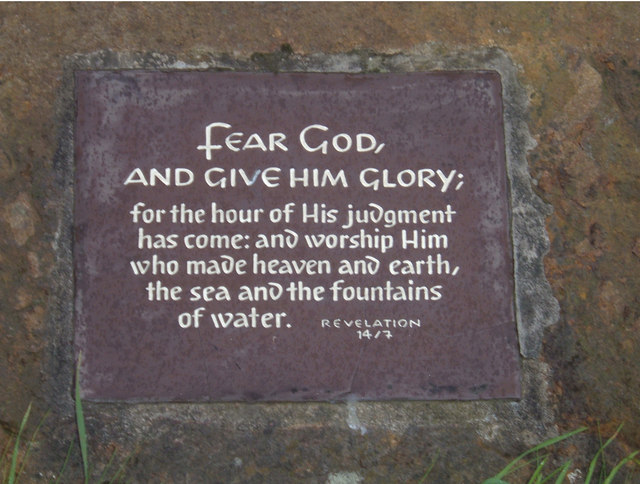
Religious text on a metal plaque set in a stone boulder near the parking area and viewpoint on Hawksworth Road north of Baildon.

Fear of God or theophobia[a] may refer to fear itself, but more often to a sense of awe, and submission to, a deity. People subscribing to popular monotheistic religions for instance, might fear Hell and divine judgment, or submit to God's omnipotence.

Judaism

[edit]

The first mention of the fear of God in the Hebrew Bible is in Genesis 22:12, where Abraham is commended for putting his trust in God. In Isaiah 11:1–3, the prophet describes the shoot that shall sprout from the stump of Jesse, "The spirit of the Lord shall rest upon him: a spirit of wisdom and of understanding, A spirit of counsel and of strength, a spirit of knowledge and of fear of the Lord, and his delight shall be the fear of the Lord." Proverbs 9:10 says that "fear of the Lord" is "the beginning of wisdom".[1]

The Hebrew words יִרְאַ֣ת (yir’aṯ) and פחד (p̄aḥaḏ) are most commonly used to describe fear of God/El/Yahweh.[citation needed]

Bahya ibn Paquda characterized two types of fear as a lower "fear of punishment" and a higher "fear of [divine awe] glory." Abraham ibn Daud differentiated between "fear of harm" (analogous to fear of a snake bite or a king's punishment) and "fear of greatness," analogous to respect for an exalted person, who would do us no harm. Maimonides categorized the fear of God as a positive commandment, as the feeling of human insignificance deriving from contemplation of God's "great and wonderful actions and creations."[2][3]

Christianity

[edit]

In the New Testament, this fear is described using the Greek word φόβος (phobos, 'fear/horror'), except in 1 Timothy 2:10, where Paul describes γυναιξὶν ἐπανγελλομέναις θεοσέβειαν (gynaixin epangellomenais theosebeian), "women professing the fear of God", using the word θεοσέβεια (theosebeia lit.'god-respecting').

The term can mean fear of God's judgment. However, from a theological perspective "fear of the Lord" encompasses more than simple fear. Robert B. Strimple says, "There is the convergence of awe, reverence, adoration, honor, worship, confidence, thankfulness, love, and, yes, fear."[4] In the Magnificat (Luke 1:50) Mary declaims, "His mercy is from age to age to those who fear him." The Parable of the Unjust Judge (Luke 18:1–8) finds Jesus describing the judge as one who "...neither feared God nor cared for man." Some translations of the Bible, such as the New International Version, sometimes replace the word "fear" with "reverence".[citation needed]

According to Pope Francis, “The fear of the Lord, the gift of the Holy Spirit, doesn’t mean being afraid of God, since we know that God is our Father that always loves and forgives us,...[It] is no servile fear, but rather a joyful awareness of God’s grandeur and a grateful realization that only in him do our hearts find true peace.”[5] Roman Catholicism counts this fear as one of the seven gifts of the Holy Spirit. In some contexts it is called wonder and awe in God's presence, such as the enumeration of the seven gifts in the Roman Rite of the sacrament of Confirmation.[6] In Proverbs 15:33, the fear of the Lord is described as the "discipline" or "instruction" of wisdom.[7] Writing in the Catholic Encyclopedia, Jacques Forget explains that this gift "fills us with a sovereign respect for God, and makes us dread, above all things, to offend Him."[8] In an April 2006 article published in Inside the Vatican magazine, contributing editor John Mallon writes that the "fear" in "fear of the Lord" is often misinterpreted as "servile fear" (the fear of getting in trouble) when it should be understood as "filial fear" (the fear of offending someone whom one loves).[9]

Lutheran theologian Rudolf Otto coined the term numinous to express the type of fear one has for God. Anglican lay theologian C. S. Lewis references the term in many of his writings, but specifically describes it in his book The Problem of Pain and states that fear of the numinous is not a fear that one feels for a tiger, or even a ghost. Rather, the fear of the numinous, as C. S. Lewis describes it, is one filled with awe, in which you "feel wonder and a certain shrinking" or "a sense of inadequacy to cope with such a visitant and our prostration before it". It is a fear that comes forth out of love for the Lord.[citation needed]

A related concept (mostly present within Catholic theology) is the 'Sin of Human Respect'. This occurs when the 'Fear of God' is replaced with a 'Fear of other people' (aiming to please other people more than God), leading to sin.[10]

Islam

[edit]

Taqwa is an Islamic term for being conscious and cognizant of God, of truth, of the rational reality, "piety, fear of God".[11][12] It is often found in the Quran. Al-Muttaqin (Arabic: اَلْمُتَّقِينَ Al-Muttaqin) refers to those who practice taqwa, or in the words of Ibn Abbas, "believers who avoid shirk with Allah and who work in His obedience."[13]

Bahá'í Faith

[edit]

In the Bahá'í Faith, "The heart must be sanctified from every form of selfishness and lust, for the weapons of the unitarians and the saints were and are the fear of God."[14]

See also

[edit]

Notes

[edit]

Further reading

[edit]

References

[edit]
[edit]
Revisions and contributorsEdit on WikipediaRead on Wikipedia
from Grokipedia
The is a central theological in the , , , and the Bahá'í Faith—denoting a profound sense of reverence, , and pious obedience toward the divine that underpins ethical conduct, , and spiritual devotion. Distinct from terror or dread, this fear fosters a relational intimacy with , motivating believers to align their lives with divine will while acknowledging God's holiness, , and . Often described as the "beginning of wisdom," it appears prominently in sacred texts across these traditions, serving as a foundational that integrates with practical living. Specifically, in the Book of Proverbs, the phrase "the fear of the Lord is the beginning of wisdom" or its close equivalent appears twice: in Proverbs 1:7 ("The fear of the LORD is the beginning of knowledge, but fools despise wisdom and instruction") and Proverbs 9:10 ("The fear of the LORD is the beginning of wisdom, and the knowledge of the Holy One is understanding"), with slight variations across translations such as the King James Version, New International Version, and English Standard Version. In Judaism, the fear of God, or yirat Hashem, emphasizes awe and respect for God's commandments, as articulated in Leviticus 19:14, where it calls for ethical restraint and recognition of humanity's creation in the divine image. Rabbinic interpreters like Rashi view it as awareness of God's omniscience, discouraging hidden wrongs, while Ibn Ezra highlights fear of divine punishment to uphold justice, and Abarbanel stresses obedience to God's laws over human reasoning. This concept permeates the Hebrew Bible, linking reverence to wisdom in Proverbs 1:7 and Psalms 111:10, and extends to ethical attitudes acquired through study and emulation of righteous teachers. Within , the of the Lord builds on foundations but evolves in the to include a trembling awe that draws believers closer to God, as in Philippians 2:12–13 and Hebrews 12:28–29, where it motivates and guards against spiritual drift. Scholars interpret it as a dynamic of devotion and , contrasting with "Adamic fear" of exclusion by emphasizing refuge in Christ's grace, thus transforming potential terror into delighted reverence (1 John 4:18). It remains essential for ethical discernment and perseverance, integrating with themes of accountability and holiness across both Testaments. In , —often translated as the fear of —represents God-consciousness and protective , shielding the believer from through vigilant adherence to 's commands, as defined in Quranic exhortations like Al-Baqarah 2:197. This concept encompasses devoutness, uprightness, and active deference to divine will, fostering a state of self-restraint and moral accountability that elevates the soul toward nearness to . Early Islamic scholars, such as , describe it as fearing while preparing for the hereafter through contentment and obedience, making it a core attribute of that influences daily conduct and spiritual growth.

Conceptual Foundations

Definition and Etymology

The fear of God denotes a profound sense of awe-inspired reverence, coupled with moral obedience and pious respect toward the divine, fundamentally distinct from terror, dread, or punishment-based fear. This understanding emphasizes a relational posture of humility and worship, fostering ethical conduct and spiritual alignment rather than paralyzing anxiety. Linguistically, the phrase originates in Hebrew as yir'at Hashem ("fear of the Lord"), drawn from the Tanakh, where the root yirah (יִרְאָה) conveys both literal fear and visionary awe, implying a perceptive encounter with divine majesty that inspires reverence. In the Greek Septuagint translation of the Hebrew Bible and the New Testament, this evolves into phobos Theou ("fear of God"), with phobos (φόβος) denoting not mere fright but holy respect, humility, and obedient submission to God's authority. Similarly, in Arabic, the Quranic term taqwa (تقوى), rooted in the verb ittaqā meaning "to protect" or "guard against," encapsulates God-consciousness as a vigilant piety that shields the believer from sin through constant awareness of the divine. A pivotal distinction in its usage emerges in Proverbs 1:7, which declares, "The fear of the Lord is the beginning of ; fools despise and instruction," framing this reverence as the essential starting point for true understanding and moral insight. In wisdom literature, the fear of the Lord embodies , covenantal , and the pursuit of righteous living as the core of .

Theological and Philosophical Interpretations

In theological discourse, the fear of God plays a central role in shaping the divine-human relationship, serving as a profound sense of reverence and that acknowledges 's holiness, , and while contrasting human imperfection. This fear fosters intimacy with the divine by motivating believers to align their lives with 's will, transforming it from mere dread into a relational dynamic that draws individuals closer to as Creator, Redeemer, and . Theological interpretations often link the fear of God to love, portraying it not as terror but as a loving reverence that undergirds obedience and ethical living; for instance, it is described as a virtue that results in humble, devoted adherence to divine commands because of God's inherent worthiness. This connection positions fear as the foundation for wisdom, enabling discernment, humility, and a balanced life oriented toward moral integrity and spiritual growth. Philosophically, explores the fear of through the lens of existential awe in his work , where it manifests as a paradoxical "" that embraces the absurd—transcending rational in absolute devotion to the divine, evoking both terror and infinite trust in 's inscrutable will. This view highlights faith as an individual, non-universal relation to , where fear underscores the risk and mystery of surrendering to divine beyond human comprehension. Thomas Aquinas further delineates fear into servile fear, which arises from dread of punishment and self-preservation, and filial or reverential fear, rooted in love and the aversion to offending God as a loving parent; the latter perfects the divine-human bond through charity, persisting as pure awe in eternal union while servile fear serves as an initial, imperfect motivator toward spiritual maturity. Key theological concepts integrate the fear of God with human free will by presenting it as a deterrent that respects moral agency, allowing individuals to choose obedience amid accountability to divine standards, thereby preserving autonomy while guiding decisions toward righteousness. It functions in sin avoidance by instilling a reverent caution against transgression, promoting self-examination and holy living as a safeguard against moral failure. In relation to eschatological judgment, fear orients believers toward future divine reckoning, where present reverence mitigates dread of ultimate accountability, emphasizing God's righteous evaluation of lives in the context of salvation history. Debates in on whether the fear of God is primarily emotional or rational reveal a tension between instinctive —manifesting as trembling or mystery in response to divine otherness—and a refined disposition grounded in reasoned reverence for God's attributes like holiness and . Theologians such as argue for a blended "" fear that combines emotional intensity with rational , essential for , while Aquinas and like advocate its evolution into a rational filial form that harmonizes with and assurance, diminishing raw emotion in mature faith.

Historical Context

Ancient Near Eastern Influences

In ancient Mesopotamian culture, the concept of fearing the gods served as a foundational principle for maintaining social and cosmic order. The Enuma Elish, the Babylonian creation epic dating to the second millennium BCE, depicts the gods' submission to Marduk's authority following his victory over , with lesser deities expressing fear and awe in the face of divine power, thereby establishing a hierarchical order that mirrored societal structures. This reverence underscored the gods' role in imposing stability, as the epic's narrative reinforces the idea that divine fear prevents chaos and ensures the world's orderly functioning. Similarly, the Code of Hammurabi, inscribed around 1750 BCE, explicitly links fear of the gods to the enforcement of law and justice. In its prologue, King Hammurabi proclaims himself "the pious prince, who fears the gods," attributing his authority to Anu and Enlil, who charged him with promoting righteousness and suppressing wrongdoing to uphold societal harmony. The epilogue warns that any violator of the laws will incur the gods' wrath, emphasizing fear as a deterrent against disorder and a basis for legal obedience. In ancient Egyptian tradition, the inspired by deities like Amun-Ra manifested in hymns that celebrated their cosmic dominion, promoting reverence as essential to preserving ma'at—the principle of truth, balance, and universal order. Hymns from the New Kingdom period, such as those inscribed in temples, portray Amun-Ra as the hidden creator whose rising fills creation with dread and wonder, compelling humans and gods alike to align with ma'at to avert chaos. This reverence was not mere terror but a pious acknowledgment of divine order, integral to rituals and daily life for sustaining harmony. Ugaritic texts from the second millennium BCE, discovered at the site of ancient in , reveal divine fear motifs that parallel early concepts of godly reverence, depicting interactions among deities where fear of higher powers like El ensures ritual and cosmic propriety. In epics such as the , gods exhibit trepidation before superior beings, reflecting a cultural emphasis on awe as a mechanism for maintaining divine and human hierarchies around 1400–1200 BCE. These motifs, embedded in mythological narratives, highlight fear's role in fostering obedience and order within the pantheon.

Development in Biblical Texts

The concept of the fear of God emerges in the patriarchal narratives of Genesis as a profound awe and obedience toward the divine, exemplified by Abraham's willingness to sacrifice Isaac, where God declares, "Now I know that you fear God, since you have not withheld your son, your only son, from me" (Gen 22:12). This motif portrays fear not merely as terror but as reverential trust, motivating ethical conduct, as seen when Abraham refrains from wrongdoing due to his fear of God (Gen 20:11). Similarly, Joseph invokes his fear of God to assure his brothers of his integrity, emphasizing moral restraint (Gen 42:18). In the Deuteronomic tradition, the fear of God evolves into a central covenantal imperative, binding to through obedience and . Deuteronomy 10:12 encapsulates this progression: "And now, , what does the your require of you? To the your , to walk in all his ways, to him, to serve the your with all your heart and with all your soul." Here, fear integrates affective reverence with practical devotion, serving as the foundation for covenant fidelity and preventing or (Deut 13:4). This emphasis reflects a shift from individual patriarchal to communal ethical responsibility under the law. The further refines the of as the bedrock of and moral insight. Proverbs declares it "the beginning of " (Prov 1:7) and "the beginning of " (Prov 9:10), linking it to , avoidance of , and prolonged life (Prov 3:7; 10:27; 16:6). reinforces this by concluding that humans should " God and keep his commandments, for that is the whole of everyone" (Eccl 12:13), portraying as a response to life's transience and divine sovereignty (Eccl 3:14; 5:7; 8:12–13). These texts conceptualize intellectually and normatively, as a learned fostering amid . Prophetic writings extend the motif to calls for social justice and eschatological hope, intertwining fear with ethical reform. Isaiah highlights it as a divine endowment for the ideal ruler, who will delight in "the of the " to judge with (Isa 11:2–3), while the himself experiences overwhelming in 's presence (Isa 6:5). echoes this by associating with humility and equity: "He has told you, O mortal, what is good; and what does the require of you but to do , and to love kindness, and to walk humbly with your ?" (Mic 6:8), implying reverence as the basis for societal (Mic 6:9). These oracles critique the absence of among the corrupt, urging its restoration for covenant renewal. The translation of the , completed between the 3rd and 2nd centuries BCE, rendered the Hebrew term yirʾāh (fear/awe) primarily as Greek phobos tou theou, preserving its reverential nuance while adapting it for Greek-speaking audiences. This version influenced Hellenistic Jewish thought by facilitating philosophical dialogues, such as in Philo's works, where fear of God aligns with Greco-Roman ideas of and without diluting its covenantal depth.

In Judaism

Scriptural Foundations

The scriptural foundation of the fear of God, known in Hebrew as yirat Hashem, is rooted in the Torah, where it emerges as a direct response to divine encounters. Following the revelation of the Ten Commandments, Moses addresses the terrified Israelites in Exodus 20:20: "Do not be afraid, for God has come to test you, to awe you so that you never sin." This declaration positions yirat Hashem not as mere terror, but as a constructive reverence intended to deter sin and uphold moral conduct. A pivotal illustrating this concept occurred at , traditionally dated to the 13th century BCE, when God's presence manifested amid thunder, lightning, thick clouds, and a resounding blast, causing the mountain to tremble and the people to stand at a distance in fear. The ' overwhelming awe led them to implore to mediate, as direct exposure to the divine voice seemed life-threatening, yet this event was designed to embed lasting reverence for God's holiness. In the Psalms, yirat Hashem finds liturgical expression, portraying it as an eternal and purifying force in worship and ethical life. Psalm 111:10 states, "The fear of the Lord is the beginning of wisdom; all those who practice it have a good understanding. His praise endures forever," emphasizing its foundational role in acquiring insight and understanding. Likewise, Psalm 19:10 describes it as "pure, enduring forever," linking reverence to the unchanging truth of divine judgments and commandments. The concept of the fear of the Lord as the beginning of wisdom and knowledge is also prominently featured in the Book of Proverbs, where it appears in equivalent forms twice: in Proverbs 1:7, "The fear of the Lord is the beginning of knowledge; but fools despise wisdom and instruction," and in Proverbs 9:10, "The fear of the Lord is the beginning of wisdom, and the knowledge of the Holy One is understanding." No additional identical repetitions exist in the book, though translations may vary slightly in wording. Central to Jewish , yirat Hashem serves as a response to God's transcendent holiness, motivating fidelity to the mitzvot (commandments) that define the covenantal relationship. Deuteronomy 10:12 encapsulates this by outlining God's requirements for : "to fear the Lord your God, to walk in all His ways, to love Him, and to serve the Lord your God with all your heart and with all your soul." This fear thus reinforces obedience to the Sinai covenant, blending with devotion to sustain communal and personal adherence to .

Rabbinic and Medieval Interpretations

In , the concept of yirat shamayim (fear of heaven) is emphasized as a foundational essential for ethical conduct and observance. The in Shabbat 31b illustrates this by comparing one who possesses Torah knowledge but lacks fear of heaven to a treasurer given keys only to the inner chambers but not the outer door, underscoring that Torah alone cannot be accessed without the fear that serves as the prerequisite entry point. Midrashic narratives further exemplify ethical fear through stories of piety in adversity, such as the tale of the Hebrew midwives Shifrah and Puah—identified in tradition as and —who defied Pharaoh's decree to kill newborn males because they feared God more than the king, thereby earning divine reward and contributing to Israel's preservation (Exodus Rabbah 1:15). Rabbinic teachings often position yirat as preceding ahavat (), viewing fear as the initial stage that cultivates reverence and moral discipline before deeper affection can emerge (Sifrei Deuteronomy 32). Medieval Jewish thinkers expanded these ideas with philosophical and mystical dimensions. , in his (Hilchot Yesodei HaTorah 2:2), reinterprets fear of God not as servile dread but as intellectual (yirah intellektualit), arising from profound of God's unity and , which motivates adherence to commandments through rational understanding rather than mere emotion. In contrast, Kabbalistic sources like the introduce a mystical layer, portraying fear as a trembling (ra'ash) before the divine majesty that aligns the soul with the sefirah of (severity and judgment), fostering spiritual purification and in the presence of the infinite ( 1:11b). These interpretations reflect a synthesis of and esotericism, adapting fear to intellectual and contemplative practices amid philosophical challenges. The destruction of the Second Temple in 70 CE profoundly shaped the role of fear of God in Jewish life, shifting emphasis from external cultic rituals to internalized piety during the . Rabbinic authorities, responding to the loss of sacrificial worship, promoted yirat shamayim as the core of piety, enabling Jews to maintain covenantal fidelity through prayer, study, and ethical living without the Temple's physical center (Berakhot 32b). This internalization helped sustain communal identity and resilience across dispersed communities, as evidenced in the development of synagogue-based observance where fear of heaven became the "outer key" to accessing divine favor in exile.

In Christianity

Old Testament Continuity

Early Christians maintained a strong continuity with the Old Testament's portrayal of the fear of God as reverential awe and obedience, adapting it as a foundational attitude toward the divine in their theology. This concept, rooted in Hebrew Scriptures such as Proverbs 1:7 and Psalm 111:10, was preserved through the Septuagint, which early Church Fathers interpreted allegorically to emphasize humility before God's majesty. Patristic writers like Origen (c. 185–254 CE) exemplified this adoption by linking the fear of God to humility in scriptural exegesis and spiritual ascent. In his writings, Origen approached biblical interpretation with a profound fear of God, excusing himself humbly from fully expounding mysteries beyond human capacity, viewing such fear as essential for virtuous conduct and avoiding presumption. This humility-oriented fear fostered a teachable disposition, aligning with Old Testament wisdom traditions while preparing the soul for deeper Christian contemplation. Continuity was also evident in the liturgical incorporation of Psalms, which frequently invoke the fear of the Lord (e.g., Psalm 19:9), used in early Christian worship to evoke awe and ethical living within communal prayer. A theological shift emerged in which fear of God served as preparation for , particularly in conversion narratives. (354–430 CE), in his Confessions, describes this fear as the beginning of wisdom (citing Job 28:28), marking an initial stage of turning from sin toward God, where dread of judgment prompts the soul's readiness for grace-enabled renewal. This positions fear not as mere terror but as a catalyst for transformation, bridging servile fear (fear of punishment) with Christian filial fear (reverence born of love). In key doctrines, early integrated the of with Trinitarian understanding, directing it toward Christ as who reconciles humanity to the . Patristic texts portray Christ as the one through whom reverential finds fulfillment, alleviating the distance between the divine and human while upholding 's holiness. , in his dual nature, enables approach to without presumption, transforming into confident communion within the .

New Testament and Patristic Views

In the New Testament, the concept of the fear of God builds upon Old Testament foundations but emphasizes its role in the life of the early Christian community and individual believers' path to salvation. For instance, Acts 9:31 describes the church's growth across Judea, Galilee, and Samaria as occurring while "walking in the fear of the Lord and in the comfort of the Holy Spirit," portraying fear as a foundational attitude that fosters peace, edification, and multiplication amid persecution. Jesus himself teaches this priority in Matthew 10:28, instructing disciples not to fear those who can kill the body but to fear God, who can destroy both soul and body in hell, thus framing fear as an ethical imperative that aligns human allegiance with divine sovereignty over eternal destiny. Similarly, Revelation 14:7 issues an eschatological proclamation to all nations: "Fear God and give him glory, because the hour of his judgment has come," linking fear to worship of the Creator and preparation for divine judgment at the end times. Early Church Fathers in the patristic era elaborated on these themes, integrating into baptismal practices and ethical formation as essential for . Tertullian, writing in the early third century, underscores the gravity of in his treatise On Baptism, arguing that those who grasp its profound significance "will its reception more than its delay," as it marks entry into a life of accountability before God, with sound ensuring despite the rite's weighty implications. This serves not as terror but as reverent awareness that motivates moral vigilance post-baptism. , in the late second to early third century, balances this by viewing of God as a pedagogical stage that "trains and restores to ," contrasting it with the hatred bred by of demonic influences, thereby positioning as a bridge to mature (divine ) in the Christian's ethical and salvific journey. By the fourth century, this motif profoundly shaped monastic traditions among the , where fear of judgment became a core driver of ascetic discipline and communal ethics. In their sayings and writings, such as those compiled in the Apophthegmata Patrum, fear of impending prompts withdrawal from worldly distractions, fostering and as safeguards against eternal loss. This emphasis on fear as an initial catalyst in spiritual ascent underscores its doctrinal impact, guiding monks toward ethical purity and ultimate union with , while influencing broader early Christian .

In Islam

Quranic Expositions

In the Quran, the concept of fear of God is primarily encapsulated in the term taqwa, which denotes a profound consciousness and protective awareness of the Divine, serving as a shield against moral and spiritual transgression. Revealed progressively to the Prophet between 610 and 632 CE, the Quran employs taqwa and its derivatives over 250 times, underscoring its centrality to Islamic piety as a guiding force in both ritual observance and ethical conduct. This awareness fosters a life oriented toward righteousness, where believers actively guard themselves from sin while striving for excellence (ihsan) in devotion. The Quran illustrates taqwa's role in ritual life through verses like Surah Al-Baqarah 2:197, which states during the pilgrimage (Hajj): "Take provisions for the journey, but the best provision is taqwa. So fear Me, O you of understanding." Here, taqwa is positioned as the ultimate sustenance, surpassing material needs and emphasizing self-restraint and mindfulness of God amid sacred duties. Exegetes such as interpret this as guarding oneself against to ensure spiritual independence and divine favor during worship. Similarly, Surah Al-Hujurat 49:13 links to human dignity and righteousness: "O mankind, indeed We have created you from male and female and made you peoples and tribes that you may know one another. Indeed, the most noble of you in the sight of is the most righteous (atqakum) of you." This verse establishes as the criterion for superiority over tribal or social distinctions, promoting moral equity and deterrence from arrogance or injustice. In tafsir traditions, this fear acts as a promoter of , elevating actions from mere compliance to perfected worship through constant divine awareness. Overall, Quranic expositions frame as an internal mechanism that deters sin by instilling reverence for God's , while encouraging as the pinnacle of —worshiping as if beholding the Divine. This dual function integrates into every facet of life, from personal to communal , as a pathway to and success.

Prophetic Traditions and Jurisprudence

In prophetic traditions, the concept of (fear of God) is elaborated through numerous hadiths that highlight its role in attaining paradise and guiding conduct. One prominent example from narrates that the Prophet Muhammad (d. 632 CE) was asked what most frequently admits people to Paradise, to which he replied, "The taqwa of Allah and good conduct." This underscores taqwa as a foundational that, combined with ethical behavior, secures divine reward. Similarly, in preparations for military expeditions, including the (624 CE), the Prophet consistently advised commanders to prioritize taqwa, instructing them: "Fear Allah wherever you are, and follow up a bad deed with a good one which will wipe it out, and behave well towards the people." Such guidance emphasized taqwa as essential for moral restraint and unity among believers during trials like Badr, where outnumbered Muslims relied on piety for victory. Within Islamic jurisprudence (fiqh) and its foundational principles (usul al-fiqh), taqwa motivates the ethical application of sharia rulings, ensuring actions align with divine intent rather than mere legalism. Scholars view taqwa as integral to deriving and interpreting laws, where God-fearing consciousness prioritizes justice, mercy, and avoidance of harm in areas like contracts, family matters, and criminal penalties. For instance, in usul al-fiqh, the emphasis on pious intention (niyyah) rooted in taqwa guides jurists to favor rulings that foster communal welfare and spiritual growth, as seen in classical texts that link legal validity to fear of divine accountability. This role extends to ethical domains, where taqwa restrains excess and promotes equity, reinforcing sharia as a path to righteousness. Sufi scholars, particularly Abu Hamid (d. 1111 CE), further developed taqwa through a nuanced distinction between spiritual and worldly fear in his Ihya' Ulum al-Din. In the "Book of Fear and Hope," describes spiritual fear (khawf) as a profound dread of God's punishment for sins in the afterlife, serving as "the whip of God with which He drives His servants to Paradise," which purifies the soul and fosters repentance. In contrast, worldly fear pertains to transient material losses, which he deems inferior and insufficient for true devotion. , drawing on Sufi traditions, advocates balancing this spiritual fear with (raja') to avoid despair, positioning taqwa as central to mystical ascent and ethical living, where the Sufi "fears most and hopes most" in pursuit of divine proximity.

In the Bahá'í Faith

Core Writings

In the , revealed by Bahá'u'lláh in 1873, the fear of God is commanded as an essential aspect of obedience and recognition of the Manifestation of God, appearing repeatedly as a call to adhere to divine laws and dispel ignorance. For instance, Bahá'u'lláh exhorts, "Fear God, and be not of those who are shut out as by a . Burn ye away the veils with the fire of My love, and dispel ye the mists of vain imaginings by the dawning-light of divine guidance," emphasizing that such fear enables humanity to behold the divine reality and align with God's will. This concept portrays fear not as terror, but as an awe-inspired detachment from worldly attachments, fostering nearness to the divine essence. It builds on the Abrahamic traditions of reverence while evolving through progressive revelation to emphasize unity and moral transformation. In the Hidden Words, Bahá'u'lláh further illustrates this through calls to prostrate before divine might and awaken from spiritual slumber with reverence and humility. Passages such as "O Son of Being! Walk in My statutes for love of Me and deny thyself that which thou desirest if thou seekest My pleasure" evoke a profound sense of awe that purifies the heart, drawing the seeker closer to God's eternal light while detaching from material veils. This reverence underscores fear as a transformative power, aligning the individual with the eternal truths revealed across Abrahamic scriptures. 'Abdu'l-Bahá, in his early 20th-century Tablets, elaborates on fear of God as a moral safeguard that restrains base impulses and initiates spiritual growth, gradually evolving into the pure love of the divine. He explains that true fear is "the fear of depriving oneself of the mercy of God and of turning away from His good-pleasure," distinct from mere dread of punishment, which can foster hypocrisy; instead, it acts as the "beginning of faith" and the foundation for loving obedience. In works like Some Answered Questions, 'Abdu'l-Bahá describes it as the "greatest provision for the journey of life," protecting the wayfarer from moral pitfalls and guiding toward divine nearness through detachment from self-interest. At the core of Bahá'í unity principles, the fear of God plays a foundational role by instilling virtues that promote global harmony and the elimination of , as it is deemed "the essence of all wisdom" and the "fountain-head of all goodly deeds." Bahá'u'lláh affirms that this fear "encompasseth all things, and reigneth over all things," empowering individuals to transcend divisions of race, , and , thereby fostering a unified world order rooted in justice and mutual respect. Through this lens, fear becomes the spiritual catalyst for collective progress, ensuring that humanity's diverse elements coalesce in divine love and equity.

Contemporary Applications

In the 20th century, Shoghi Effendi, as Guardian of the Bahá'í Faith, emphasized the fear of God as essential to the functioning of the Bahá'í administrative order, linking it directly to obedience and ethical conduct among its institutions and members. In his writings from the 1920s and 1930s, such as Bahá'í Administration, he described the members of elected bodies and the Hands of the Cause as needing to "manifest the fear of God by their conduct, their manners, their deeds and their words," underscoring that this reverence fosters detachment, purity, and steadfast adherence to divine laws within the community's governance structure. This guidance extended into the 1940s and 1950s through letters like those in Messages to America, where he portrayed fear of God as a protective "raiment" alongside reliance on divine will, essential for building a unified administrative system that promotes justice and collective obedience. Contemporary Bahá'í practices integrate the fear of God into educational programs, particularly through the Ruhi Institute's curriculum, which serves as ethical training for personal and social transformation. In Book 3 of the Ruhi sequence, focused on teaching children's classes, fear of God is referenced in the writings as the "prime factor" in human education, linked to love of God and cultivating virtues like truthfulness and compassion to build noble character and community cohesion. Book 7, Walking Together on a Path of Service, further explores it as a "vital force" paired with love of God, indispensable for obedience to divine commands and renunciation of self, enabling participants to contribute to societal progress through acts of service such as home visits and collective reflection. These courses, widely adopted since the late 20th century, emphasize a twofold moral purpose: individual spiritual growth and the advancement of communities toward harmony and justice. Since the election of the Universal House of Justice in 1963, Bahá'í applications of fear of God have extended to , where it informs discussions on shared ethical imperatives across religions, promoting mutual respect and collaborative action on global issues. In this context, fear of God—rooted in reverence for divine unity—encourages participants to transcend sectarian divisions, as highlighted in Bahá'í contributions to ecumenical forums that stress moral education and individual responsibility. A distinctive feature of modern Bahá'í interpretations is the integration of fear of God with the principle of the oneness of humanity, particularly in responses to 2020s environmental challenges, where it motivates ethical stewardship and collective action. Bahá'í statements at events like COP29 in 2024 emphasized humanity's interconnectedness and the need for consultation in addressing climate crises, aligning with broader principles of obedience to divine laws for planetary well-being. This approach views fear of God not as dread but as a constructive force driving social transformation amid crises, aligning personal piety with global solidarity.

Comparative and Broader Perspectives

In Non-Abrahamic Religions

In Hinduism, the concept of bhaya—often translated as fear but connoting a profound reverential awe—plays a significant role in bhakti traditions, particularly in devotion to Vishnu as depicted in the Bhagavata Purana, a key Vaishnava text composed around the 9th century CE. This awe manifests as an initial apprehension toward the divine's overwhelming power and majesty, which devotees must transcend to attain pure love (prema bhakti), yet it serves as a foundational emotion that instills humility and ethical conduct. For instance, in the Vishnu Sahasranama section of the Mahabharata, Vishnu is described as bhaya-kRt (one who causes fear) and bhaya-nASanah (destroyer of fear), illustrating how divine awe motivates moral alignment while ultimately leading to liberation from worldly terrors. In contrast to the punitive fear sometimes emphasized in Abrahamic traditions, Hindu bhaya evolves into ecstatic surrender, as seen in narratives of devotees like the gopis whose initial trembling before Krishna's form deepens into intimate union. Within Shaiva tantric traditions, reverence toward Shiva embodies a similar dynamic of awe-infused fear, where the deity's fierce aspects, such as , evoke terror to dismantle ego and reveal non-dual consciousness. The Vijnanabhairava Tantra, a foundational text from around the 9th-10th century, instructs practitioners to contemplate fear directly—treating it as a gateway to transcendence—by meditating on terrifying visions or the body's tremors during intense rituals, transforming dread into liberated awareness of Shiva's all-pervading presence. This approach underscores tantric Shaivism's view of the divine as both destroyer and protector, where reverential fear purifies the practitioner, fostering union () without the dualism of creator and created. Buddhism, lacking a creator God, analogizes divine awe through reverence for the Dharma—the cosmic law of truth—and the fear of karmic consequences, prominent in Theravada texts like the Pali Canon. In Theravada, bhaya (fear) arises from awareness of samsara's sufferings and the inexorable results of unwholesome actions, motivating ethical adherence to the Noble Eightfold Path; for example, the Abhidhamma describes fear of rebirth in lower realms as a "wholesome dread" that propels mindfulness and renunciation. This karmic fear contrasts with personal divine judgment by emphasizing impersonal causality, yet it cultivates awe for the Dharma's impartial order. In Zen Buddhism, a Mahayana offshoot, the "great doubt" (daigi) serves as an analogous intense existential apprehension, described as a terrifying yet essential force that shatters illusions of self, akin to awe before the ungraspable reality of enlightenment. Practitioners are urged to nurture this doubt through koan study, leading to sudden awakening (satori), much like fear's role in prompting profound insight. In , a pre-Abrahamic influencing later monotheisms, reverence for centers on asha—the principle of truth, order, and righteousness—evoking an awareness of cosmic harmony that instills rather than terror toward the divine. Devotees align with asha through good thoughts, words, and deeds to counter chaos (druj), fostering a respectful fear of moral disorder while celebrating Mazda's benevolent wisdom as the source of creation. Indigenous Native American spiritualities, diverse across tribes, often express divine through encounters with the or sacred natural forces, where fear of imbalance—such as violating taboos or harming the land—prompts rituals of harmony and respect. For instance, among many Plains and Woodland peoples, vision quests induce awe-filled trepidation before spiritual entities, reinforcing ethical reciprocity with the , as documented in ethnographic studies of visionary s.

Modern Psychological and Cultural Analyses

In the early 20th century, critiqued the concept of fear of God as a manifestation of psychological in his 1927 work . He argued that religion, including the fear of a divine authority, originates from the Oedipal complex and serves as a collective obsessional , providing illusory protection against human helplessness and the uncertainties of life. Freud posited that this fear reflects an unconscious projection of a paternal figure to alleviate guilt and anxiety, ultimately hindering mature psychological development by substituting fantasy for reality. Contrasting Freud's pathological view, in the late 20th and early 21st centuries has reframed reverence toward the divine—often encompassed in —as a beneficial mechanism. Pargament's theory of religious , developed in the , describes positive religious strategies, such as seeking spiritual support and reappraising stressors through a sacred lens, as pathways to enhanced and resilience. These approaches foster a of connectedness and empowerment, with over 1,000 studies indicating that positive religious correlates with reduced depression, anxiety, and improved during adversity. Post-2010 neuroscientific research has illuminated the brain mechanisms underlying , a core component of reverential fear of God, distinguishing it from mere dread. Functional MRI studies show that experiences, often induced by religious stimuli like vast natural phenomena or divine contemplation, deactivate the (DMN), promoting and diminished ego-focus, which aligns with spiritual states of and interconnectedness. For instance, threat-based , such as fear of , may not yield these benefits and can elevate stress responses, whereas positive enhances and emotional regulation, as evidenced in cross-cultural experiments. This research bridges and , suggesting that fear of God, when experienced as , supports adaptive neural pathways for . In secular societies, the cultural legacy of fear of God continues to shape ethical frameworks, even as overt declines, by instilling internalized moral constraints akin to monitoring. Scholarly analyses indicate that this promotes prosociality through autonomic regulation, where prestige-based reverence (rather than punitive dread) encourages and in diverse groups. Evolutionary cognitive studies further reveal that religious ethics, rooted in fear of divine oversight, persist in by fostering social cohesion and reducing free-riding behaviors, as seen in experimental paradigms comparing religious and non-religious . Media portrayals of fear of God have evolved from reverential depictions to critical deconstructions, reflecting shifting cultural attitudes. The 1956 epic The Ten Commandments, directed by , dramatizes divine fear as a transformative force for moral awakening, aligning with Cold War-era emphases on and obedience to counter secular threats. In contrast, modern films like Paul Schrader's (2017) deconstruct this fear as a source of existential dread and psychological torment, portraying a grappling with environmental despair and divine , which critiques institutionalized religion's emotional toll. Similarly, Martin Scorsese's (2016) explores under , challenging the redemptive narrative of fear by questioning God's apparent absence amid suffering. Contemporary interfaith dialogues, particularly through initiatives in the 2020s, leverage shared reverence for the divine to advance , addressing gaps in traditional theological interpretations. The UN's World Interfaith Harmony Week, observed annually since 2010 and reinforced in resolutions like A/RES/78/129 (2023), promotes mutual among faiths by emphasizing common ethical imperatives derived from awe-inspired reverence, fostering social cohesion in conflict zones. Events such as the 2023 UNHCR inter-religious dialogues in refugee contexts, such as those in , highlight how shared and mutual reduce intergroup tensions, contributing to sustainable efforts in diverse societies.

References

Add your contribution
Related Hubs
User Avatar
No comments yet.