Hubbry Logo
Filippo InzaghiFilippo InzaghiMain
Open search
Filippo Inzaghi
Community hub
Filippo Inzaghi
logo
35 pages, 0 posts
0 subscribers
Be the first to start a discussion here.
Filippo Inzaghi
Filippo Inzaghi
from Wikipedia

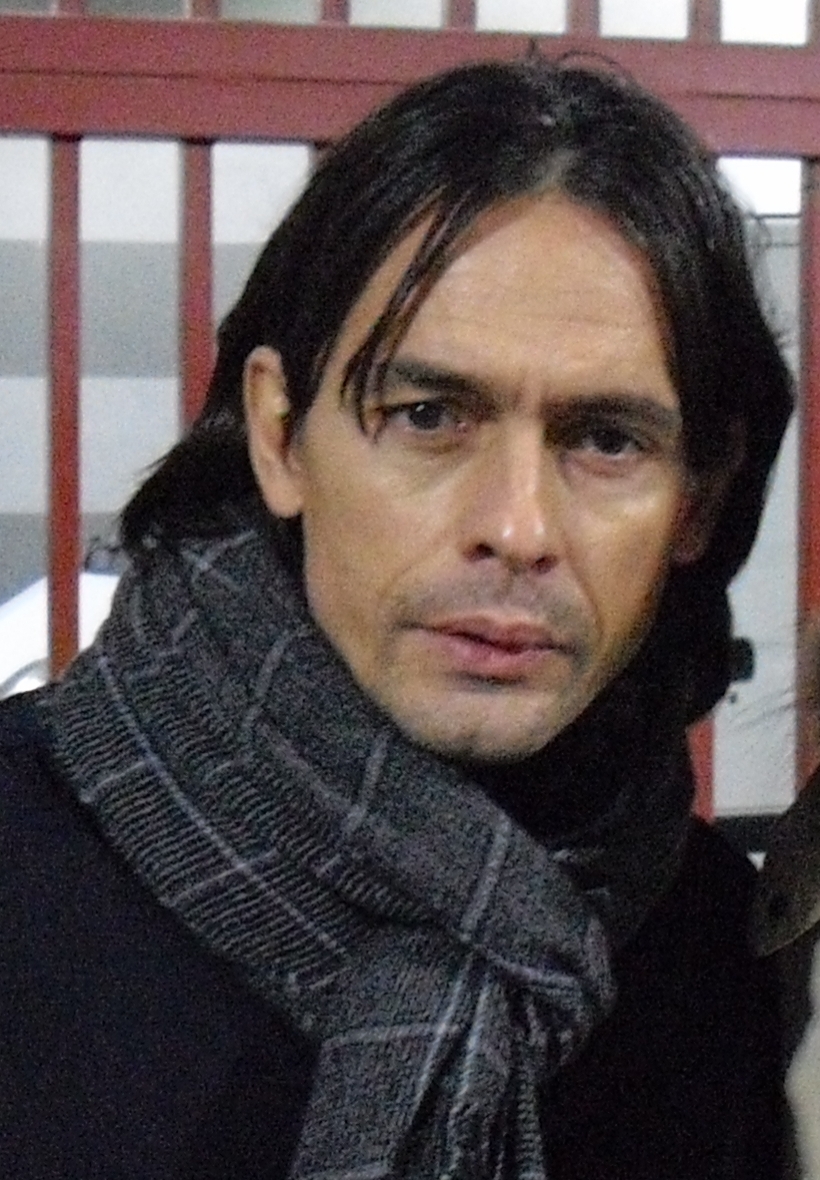
Filippo "Pippo" Inzaghi Ufficiale OMRI (Italian pronunciation: [fiˈlippo ˈpippo inˈdzaːɡi];[3] born 9 August 1973) is an Italian professional football manager and former player who played as a striker. He is the head coach of Serie B club Palermo. Nicknamed "Superpippo" ("Super Goof") or "Alta tensione" ("High Tension") by fans and commentators during his playing career, Inzaghi is regarded as one of the greatest strikers of his generation.[4] In the UEFA Champions League, he is the all-time Italian top goalscorer, scoring 46 goals.[5]

Key Information

Inzaghi played for several Italian clubs and spent the most notable spells of his club career with Juventus and AC Milan, winning two Champions League titles (2003, 2007), and three Serie A titles (1998, 2004, 2011). He is the seventh highest scorer in Italy, with 313 goals scored in official matches. He is currently the sixth-highest goalscorer in European club competitions with 70 goals, behind only Cristiano Ronaldo, Lionel Messi, Robert Lewandowski, Raúl and Karim Benzema. He is also Milan's top international goalscorer in the club's history with 43 goals. He also holds the record for most hat-tricks in Serie A with 10.

At international level, Inzaghi earned 57 caps for the Italy national team between 1997 and 2007, scoring 25 goals. He represented his country at three FIFA World Cups, winning the 2006 edition, and he also took part in UEFA Euro 2000, where he won a runners-up medal.

His younger brother, Simone Inzaghi, is also a football manager and former Italian international player.

Club career

[edit]

Early career

[edit]

Inzaghi's favourite footballers as a child were Paolo Rossi and Marco van Basten.[6] The elder brother of fellow footballer Simone Inzaghi,[7] he got his start playing for hometown club Piacenza as a teenager in 1991, but made only two league appearances before being loaned to Serie C1 side Leffe, with whom he scored an impressive 13 goals in 21 matches. In 1993, Inzaghi moved to Serie B club Hellas Verona and scored 13 goals in 36 league appearances. Upon his return to Piacenza, he scored 15 times in 37 games helping his team win Serie B and proving himself to be an exciting young prospect.[8][9][10]

Inzaghi made his Serie A debut when he transferred to Parma in 1995, but scored only twice in 15 league matches. One of these two goals came against one of his former clubs, Piacenza, literally "making him cry". He added another two goals in European competitions that season. In the following season, he moved on to Atalanta, finishing as the Capocannoniere (Serie A's top scorer) with 24 goals after scoring against every team in the league. He was crowned Serie A Young Footballer of the Year and served as team captain in the last game of the season.[8][9][10]

Juventus

[edit]
Inzaghi playing for Juventus in a 1997–98 Coppa Italia match

Inzaghi, however, was soon on the move once again to his sixth team in seven seasons, this time to Juventus for a reported 23 billion lire.[11] He formed a formidable attacking partnership along with Alessandro Del Piero and Zinedine Zidane, a tandem which would last for four seasons, under managers Marcello Lippi, and subsequently Carlo Ancelotti, marking Inzaghi's longest stint with one team at the time. During his time with the Bianconeri, he scored two Champions League hat-tricks – against Dynamo Kyiv and Hamburger SV – becoming the first player to do so.[12]

During his first season with the club, Inzaghi scored two goals as Juventus beat Vicenza 3–0 in the 1997 Supercoppa Italiana.[13] Juventus won the Scudetto during the 1997–98 season, in which Inzaghi scored 18 goals, including a decisive, Scudetto-winning hat-trick against Bologna.[14] He also scored six goals to help Juventus reach the Champions League final, although they were defeated 1–0 by Real Madrid.[15]

The 1998–99 season was less successful for Juventus, as they were defeated in the 1998 Supercoppa Italiana by Lazio and finished the season seventh place in Serie A. Inzaghi still managed 20 goals in all competitions, finishing the season as the club's top-scorer;[16] Six of his goals came in the Champions League, as Juventus were eliminated in the semi-finals by eventual champions Manchester United. During the second leg of the semi-finals in Turin, Inzaghi scored two goals in the first ten minutes, but Manchester United eventually managed to come back and win the match 3–2.[17]

Inzaghi helped Juventus win the 1999 UEFA Intertoto Cup, scoring five goals in the semi-finals against Rostov, and two in the finals against Rennes, qualifying Juventus for the UEFA Cup that season.[18] Inzaghi scored 15 goals in Serie A as Juventus narrowly missed out on the title to Lazio, defeated on the final matchday. The following season, Inzaghi managed 11 goals in Serie A as Juventus finished second in the league for the second consecutive season; he also scored five goals in the UEFA Champions League, including a hat-trick in a 4–4 draw against Hamburger SV,[19] although Juventus were eliminated in the first round. With 16 goals in all competitions, he was Juventus's top goalscorer for the third consecutive season. However, his once-effective partnership with Del Piero had become less effective in recent seasons, due to their lack of understanding, individualism, and their strained relationship both on and off the pitch.[20][21][22]

AC Milan

[edit]
Inzaghi (center, no. 9) celebrating with his Milan teammates the triumph in the 2003 UEFA Champions League final

Despite scoring a high 89 goals in 165 games for the Bianconeri, Inzaghi was soon benched in favour of David Trezeguet and on 2 July 2001 signed for AC Milan[23][24] for a reported 70 billion lire,[11] or 45 billion lire cash plus Cristian Zenoni[25][26][27][28] (Sky Sports reported a smaller total figure, £17 million[29]) for the 2001–02 campaign by coach Fatih Terim. Juventus announced that the sale of Inzaghi produced a capital gain of €31.1 million to the club, making the actual transfer fee much exceed that figure.[30] Inzaghi, however, suffered a knee injury and missed the first half of the season. Upon his return, he was able to forge a strong goalscoring partnership with Andriy Shevchenko, and he soon earned many trophies with the Rossoneri under new manager Carlo Ancelotti, among them the 2002–03 Champions League (in which Milan defeated his previous team, Juventus, in the final on penalties), along with the 2002–03 Coppa Italia (scoring in a 2–2 draw in the second leg),[31] the 2003 UEFA Super Cup, the 2004 Supercoppa Italiana, and the 2003–04 Scudetto.[10] In the 2002–03 Champions League campaign, he scored his record third Champions League hat-trick against Deportivo de La Coruña in the Group Stage and a decisive goal in quarter-finals against Ajax, totalling 12 European goals in that season. In November 2004, he signed a contract extension with the club.[32]

Inzaghi celebrating the 2007 UEFA Champions League triumph with his Milan teammates

Inzaghi fully recovered from the persistent knee injuries that had dogged him for two years and regained his predatory goalscoring form by scoring 12 goals in 22 Serie A matches in 2005–06, along with four goals in five Champions' League appearances; two against Lyon in the quarter-finals and another two against Bayern Munich in the first knockout stage. He scored the decisive goal against the Bavarians in the 2007 quarter-finals, helping Milan to reach the semi-finals of the competition. On 23 May 2007, in the 2007 Champions League final in Athens, he scored both of Milan's goals in their 2–1 victory over Liverpool in a rematch of the 2005 final. He declared after the match:[10]

It's a dream since I was a child to score twice in the final, and the ones I scored yesterday evening were the most important in my life. It was an unforgettable game. It's something that will stay with me all my life and two goals in the final speaks for itself.

— Filippo Inzaghi

At the start of the 2007–08 season, he picked up where he left off in Athens, scoring the equalizer in the Super Cup in Milan's 3–1 victory over Sevilla. Inzaghi capped off the year by scoring two goals in the 2007 FIFA Club World Cup final, helping Milan win 4–2 against Boca Juniors to take revenge for the defeat on penalties in 2003.[10]

On 24 February 2008, Inzaghi scored the match-winning goal in Milan's 2–1 win over Palermo with a diving header after coming into the game from the bench; it marked his first Serie A goal in over a year. This was followed by ten more goals in the league, the last against Udinese. This strike against Udinese was his 100th goal for the club in official games. But despite incredible form, Italy national team manager Roberto Donadoni declined to call him for Euro 2008. In November 2008, Inzaghi agreed to a contract extension with Milan until June 2010.[33]

Inzaghi celebrating a goal against Torino with David Beckham and Mathieu Flamini in 2009

On 8 March 2009, Inzaghi scored his first hat-trick of the season for Milan against Atalanta, leading his team to a 3–0 victory at the San Siro. His 300th career goal came in the 5–1 thrashing of Siena away from home. He then went on to score three goals against Torino, his second professional hat-trick in that season. Scoring this hat-trick enabled him to set a record for the player with the most hat-tricks in Serie A over the last 25 years. With ten hat-tricks in Serie A, Inzaghi is ahead of Giuseppe Signori (9), Hernán Crespo (8), Roberto Baggio, Marco van Basten, Gabriel Batistuta, Abel Balbo, Vincenzo Montella (7), Antonio Di Natale and David Trezeguet (6). Inzaghi scored one hat-trick for Atalanta, four for Juventus, and five for Milan.[34]

In the 2009–10 season, under manager Leonardo, Inzaghi was relegated to the role of backup player with his contract set to expire in June 2010. On 21 May 2010, he was offered a new one-year contract which would last until 30 June 2011.[35]

On 3 November 2010, in the UEFA Champions League 2010–11 Group Stage campaign, with Milan trailing by 1–0 to Real Madrid, Inzaghi came off the bench in the second half and scored a brace to give Milan a 2–1 lead. Pedro León, however, equalized in the 94th minute, with the final score ending 2–2. On that occasion, he became the new all-time top scorer of all European club competitions with 70 goals. He also became the second-oldest player to score in the Champions League, aged 37 years and 85 days, behind only Manchester United's Ryan Giggs, now surpassed by Inzaghi's compatriot Francesco Totti. With these two goals, Inzaghi went ahead of his idol Marco van Basten on the club list of the all-time top goalscorers with 125 goals.

On 10 November 2010, Inzaghi suffered a serious injury while playing for Milan against Palermo. A statement on the official Milan club website confirmed that Inzaghi had suffered a lesion of the anterior cruciate ligament (ACL) and an associated lesion to the external meniscus of the left knee. It was thought he would be out for the rest of the season.[10] Due to his age, this injury could have ended his career; nonetheless, Inzaghi was optimistic. On 7 May 2011, with Inzaghi still out recovering from his injury, Milan won the 2010–11 Serie A title. After being sidelined by injury for six months, he came off the bench for the first time since his injury on 14 May, with Milan defeating Cagliari 4–1. He extended his contract till June 2012 during the 2011–12 pre-season.

Just like with Andrea Pirlo in 2011, Milan decided not to renew the contracts of several veteran players at the end of the season and Inzaghi was one of those, along with Gennaro Gattuso, Clarence Seedorf, Alessandro Nesta and Gianluca Zambrotta.[36] He played his final game for Milan against Novara on 13 May 2012 and marked his performance by scoring the winning goal.[37] On 24 July 2012, Inzaghi announced his retirement from professional football to start a coaching career.[38]

European competition records

[edit]

With 70 goals, Inzaghi is the sixth-highest scorer in European club competitions, behind only Cristiano Ronaldo, Lionel Messi, Robert Lewandowski, Raúl and Karim Benzema. He became the first player to score two Champions League hat-tricks – both with Juventus – when he netted a treble during a 4–4 group stage draw with Hamburger SV on 13 September 2000; his first was in a 4–1 victory over Dynamo Kyiv during the 1997–98 quarter–finals. Inzaghi scored a record third Champions League hat-trick in a 4–0 win against Deportivo de La Coruña in the 2002–03 season, while playing for Milan. This record would later be tied by Michael Owen, who scored two hat-tricks for Liverpool and a third for Manchester United.

International career

[edit]

Between 1993 and 1996, Inzaghi made 14 appearances for the Italy under-21 team, scoring three goals; he was also a member of the Italy under-21 squad that won the 1994 UEFA European Under-21 Championship. Inzaghi earned his first senior cap for Italy in the Tournoi de France,[10] against Brazil on 8 June 1997, under his former under-21 manager Cesare Maldini, and provided an assist to goalscorer Alessandro Del Piero. Italy went on to draw 3–3.[39] He scored his first goal for Italy on 18 November 1998, in a 2–2 friendly draw against Spain;[40] he has since scored 25 goals in 57 appearances.[39] He was called up for the 1998 FIFA World Cup, Euro 2000, the 2002 World Cup and the 2006 World Cup.

Inzaghi's boots from UEFA Euro 2000, on display at the San Siro Museum

Although Inzaghi went scoreless throughout the 1998 World Cup, as he was mainly deployed as a substitute, he came off the bench to set up a goal for Roberto Baggio in Italy's final group match against Austria, which ended in a 2–1 win, and allowed Italy to top their group;[41] Italy were knocked out in the quarter-finals on penalties to hosts and eventual champions France.[42] At Euro 2000, he was one of Italy's starting strikers under the new Italy manager Dino Zoff. He scored two goals throughout the tournament; his first came from a penalty, in Italy's 2–1 opening group win over Turkey,[43] in which he was named man of the match,[44] while his second came in a 2–0 win over Romania in the quarter-finals of the competition;[45] he also set up Stefano Fiore's goal in a 2–0 win over co-hosts Belgium in his nation's second group match of the tournament.[46] His performances helped Italy reach the final, where they were defeated by France once again, on a golden goal.[47] Along with Francesco Totti, he was Italy's top-scorer throughout the tournament.[48]

Under Zoff's replacement, Giovanni Trapattoni, Inzaghi was Italy's top goalscorer during the qualifying rounds of the 2002 World Cup and Euro 2004,[49] scoring his first and only international hat-trick in a 4–0 home win over Wales on 6 September 2003,[50] although he missed the latter tournament due to injury.[51] He went scoreless throughout the 2002 World Cup, making two appearances, as Italy were controversially eliminated in the round of 16 to co-hosts South Korea;[52] in Italy's 2–1 loss to Croatia in their second group match, Materazzi played a floating ball over the top from just over halfway to Inzaghi in the 90th minute, but everyone missed the ball and it rolled into the back of the net, although the goal was disallowed after referee Graham Poll claimed that Inzaghi had grabbed an opponent's shirt.[53] Inzaghi also had a goal wrongly disallowed in Italy's final group match against Mexico, which ended in a 1–1 draw.[54]

Inzaghi's persistent knee and ankle injuries put a halt to his international play for almost two years before his resurgence at club level, which resulted in being called up by Italy coach Marcello Lippi for the 2006 World Cup final tournament.[55] Due to the abundance of other top strikers such as Alessandro Del Piero, Francesco Totti and Luca Toni, Inzaghi made his only appearance – subbing on for Alberto Gilardino – in Italy's final group stage match against the Czech Republic on 22 June 2006, scoring his only goal in the tournament, rounding Petr Čech in a one-on-one encounter to net Italy's second goal, which made him the oldest player to have scored for Italy in a World Cup, after Daniele Massaro.[56] Italy went on to win the tournament, defeating France on penalties in the final.[57]

Following Italy's fourth World Cup victory, Inzaghi made six appearances under new manager Roberto Donadoni in Italy's UEFA Euro 2008 qualification campaign, scoring three goals, two of which came in a 2–1 away win against the Faroe Islands on 2 June 2007.[58] He was not called up for the final tournament, however, where Italy were eliminated by eventual champions Spain in the quarter-finals on penalties, and he made his last appearance for Italy on 8 September 2007, in a 0–0 draw against France in Milan.[59]

Inzaghi is currently the sixth-highest goalscorer in the Italian national team's history, with 25 goals, alongside Adolfo Baloncieri and Alessandro Altobelli.[39][60]

Style of play

[edit]

"It's not Inzaghi who is in love with goals; it's the goals that are in love with him."

Inzaghi was an intelligent, extremely fast, agile, and opportunistic player, with excellent reactions and a lanky, slender physique;[9][62][63][64][65][66][67][68][69] although not very technically gifted,[70] he was known for his great skill in taking advantage of the carelessness of his opponents, his excellent positional sense in the area, and his eye for goal,[70] making a name for himself as a "goal poacher", due to his style of play and tendency to operate mainly in the penalty box,[67] as well as his timing and ability to find spaces and anticipate opponents to get on the end of passes.[71] These qualities, along with his finishing ability with both his head and feet, made him one of the most prolific strikers of the past decades.[65][66] Inzaghi was described as a player who lived on the offside line.[63][64][72]

When he was first called up to the national team, the other Italian players were surprised at his lack of technical accomplishment,[69] but came to accept him because he scored so frequently.[9] Johan Cruyff described this contrast—"Look, actually he can't play football at all. He's just always in the right position."[9] Fans nicknamed him Superpippo,[73] the Italian name for Super Goof, the superhero alter ego of cartoon character Goofy (Pippo being a common hypocorism of his first name Filippo). Tactically, Inzaghi was noted for his vision and ability to read the game,[74] as well as his outstanding offensive movement off the ball, ability to play off the shoulders of the last defender, and to time his attacking runs to beat the offside trap,[9] which allowed him to get on the end of passes, but also to provide depth to his team,[71] leading long-time Manchester United manager Sir Alex Ferguson to quip: "That lad must have been born offside."[75]

Although in the past, due to his poor defensive work-rate and lack of notable technical skills, strength in the air or long range striking ability, he was initially accused by some in the sport for being a limited striker or a "lucky" player,[22][62][69] and also drew criticism at times for being selfish,[22][69][20][21][76][77] for not participating in the build-up of plays,[78] and for going to ground too easily,[9] he has been praised by several of his former managers and teammates for his prolific goalscoring.[9][62][69] Despite his lack of significant talent, Inzaghi and others attribute his success, aside from technical prowess, to personal drive, intelligence, and determination.[9][69][79] Due to his opportunistic playing style, Inzaghi was frequently compared to Paolo Rossi throughout his career.[22][78] Despite his prolific goalscoring, Inzaghi was often considered injury-prone throughout his career.[80]

Managerial career

[edit]

AC Milan

[edit]
Inzaghi managing Milan in 2014

Inzaghi started his coaching career at the beginning of the 2012–13 season, signing a two-year deal as the manager of AC Milan's Allievi (under-17) team.[81]

On 9 June 2014, Inzaghi was named manager of Milan's first team after the dismissal of his former Rossoneri teammate Clarence Seedorf.[82] In Inzaghi's first match as a manager in Serie A on 31 August, Milan defeated Lazio 3–1 at the San Siro.[83] Inzaghi then led Milan to a second consecutive win in a match that ended with a 5–4 Milan win against Parma.[84]

On 4 June 2015 Adriano Galliani, the CEO of Milan, announced that Inzaghi would not be the coach for next season.[85] He was officially dismissed on 16 June 2015.

Venezia

[edit]

On 7 June 2016, Inzaghi was appointed as the new coach of ambitious Lega Pro club Venezia.[86] On 19 April 2017, after beating Parma to top spot, he won promotion to Serie B as champions.[87] He also won the Coppa Italia Lega Pro in the same season.[87]

During the 2017–18 season, Inzaghi guided the Venetians to a fifth-place finish in Serie B, finishing in the playoffs positions to earn promotion to Serie A. After eliminating Perugia (coached by his former teammate Alessandro Nesta) in the preliminary round, his team was defeated by Palermo in the semi-finals.[88]

Bologna

[edit]

On 13 June 2018, Inzaghi was announced as the new head coach of top-flight Bologna, taking over from Roberto Donadoni.[89] He faced a Lazio side coached by his younger brother Simone in an eventual 0–2 defeat on 26 December.[90] Following a record of two wins in 21 games, he was dismissed on 28 January 2019 and replaced by Siniša Mihajlović.[91]

Benevento

[edit]

On 22 June 2019, Inzaghi was appointed manager of Benevento in Serie B.[92] On 30 June the following year, his club achieved promotion as champions with seven games remaining, reaching Serie A for the second time in their history.[93] On his Serie A debut for the team, they won 3–2 at Sampdoria on 26 September, having been losing 2–0.[94] Benevento ended the 2020–21 Serie A season in eighteenth place, being relegated back to Serie B after only one season; as a consequence of the events, Inzaghi was not offered a new contract and left Benevento afterwards.

Brescia

[edit]

On 9 June 2021, Inzaghi was appointed manager of Brescia in Serie B.[95] On 16 August, Inzaghi made his debut for Brescia in the first round Coppa Italia match losing 4–2 in the penalty shoot-out after a 2–2 draw in the extra-time.[96]

On 23 March 2022, Inzaghi was dismissed by club chairman Massimo Cellino, leaving the club in fifth place in the league table.[97] After his successor Eugenio Corini was eliminated in the promotion playoff semifinals by Monza, on 25 May 2022 Cellino formally reappointed Inzaghi as head coach, due to a clause that was legally forbidding his sacking if Brescia were placed in one of the top eight league places.[98]

Reggina

[edit]

On 12 July 2022, Inzaghi was appointed manager of Reggina in Serie B, signing a three-year deal with the Calabrians.[99] After guiding Reggina to a spot in the promotion playoffs, he was released together with all players and staff as Reggina were excluded due to financial issues, thus finding himself without a job by the beginning of the 2023–24 season.

Salernitana

[edit]

On 10 October 2023, relegation-struggling Serie A club Salernitana announced the appointment of Inzaghi in place of outgoing Paulo Sousa. He was sacked on 11 February 2024 and replaced by Fabio Liverani.[100]

Pisa

[edit]

On 3 July 2024, Inzaghi signed for Serie B club Pisa.[101] In his debut season with the club, Inzaghi led Pisa to promotion to Serie A, marking their return to the top flight after a 34-year absence.[102] He left Pisa on 13 June 2025.[103]

Palermo

[edit]

On 17 June 2025, Inzaghi was confirmed as the new head coach for Palermo.[104]

Media

[edit]

Inzaghi features in EA Sports' FIFA video game series; he was on the cover for the Italian edition of FIFA 2001,[105] and was named in the Ultimate Team Legends in FIFA 14.[106]

In 2015, the arcade game company Konami announced that Inzaghi would feature in their football video game Pro Evolution Soccer 2016 as one of the new myClub Legends.[107]

Career statistics

[edit]

Club

[edit]
Appearances and goals by club, season and competition[108][109]
Club Season League Coppa Italia Europe Other Total
Division Apps Goals Apps Goals Apps Goals Apps Goals Apps Goals
Piacenza 1991–92 Serie B 2 0 1 0 3 0
1994–95 Serie B 37 15 4 2 41 17
Total 39 15 5 2 44 17
Leffe (loan) 1992–93 Serie C1 21 13 0 0 21 13
Verona (loan) 1993–94 Serie B 36 13 1 1 37 14
Parma 1995–96 Serie A 15 2 1 0 6[a] 2 22 4
Atalanta 1996–97 Serie A 33 24 1 1 34 25
Juventus 1997–98 Serie A 31 18 4 1 10[b] 6 1[c] 2 46 27
1998–99 Serie A 28 13 1 0 10[b] 6 3[d] 1 42 20
1999–2000 Serie A 33 15 2 1 8[e] 10 43 26
2000–01 Serie A 28 11 0 0 6[b] 5 34 16
Total 120 57 7 2 34 27 4 3 165 89
AC Milan 2001–02 Serie A 20 10 1 2 7[f] 4 28 16
2002–03 Serie A 30 17 3 1 16[b] 12 49 30
2003–04 Serie A 14 3 3 2 8[b] 2 3[g] 0 28 7
2004–05 Serie A 11 0 2 0 2[b] 1 15 1
2005–06 Serie A 23 12 2 1 6[b] 4 31 17
2006–07 Serie A 20 2 5 3 12[b] 6 37 11
2007–08 Serie A 21 11 0 0 5[b] 4 3[h] 3 29 18
2008–09 Serie A 26 13 0 0 6[f] 3 32 16
2009–10 Serie A 24 2 2 1 7[b] 2 33 5
2010–11 Serie A 6 2 0 0 3[b] 2 9 4
2011–12 Serie A 7 1 2 0 0 0 9 1
Total 202 73 20 10 72 40 6 3 300 126
Career total 466 197 35 16 112 69 10 6 623 288
  1. ^ Appearances in UEFA Cup Winners' Cup
  2. ^ a b c d e f g h i j k Appearances in UEFA Champions League
  3. ^ Appearance in Supercoppa Italiana
  4. ^ Two appearances and one goal in UEFA Cup qualification, one appearance in Supercoppa Italiana
  5. ^ Four appearances and seven goals in UEFA Intertoto Cup, four appearances and three goals in UEFA Cup
  6. ^ a b Appearances in UEFA Cup
  7. ^ One appearance in Supercoppa Italiana, one appearance in UEFA Super Cup, one appearance in Intercontinental Cup
  8. ^ Two appearances and two goals in FIFA Club World Cup, one appearance and one goal in UEFA Super Cup

International

[edit]
Appearances and goals by national team and year[39][110]
National team Year Apps Goals
Italy 1997 3 0
1998 6 3
1999 8 3
2000 11 5
2001 8 4
2002 8 0
2003 4 6
2004 0 0
2005 0 0
2006 5 2
2007 4 2
Total 57 25
Scores and results list Italy's goal tally first, score column indicates score after each Inzaghi goal.
List of international goals scored by Filippo Inzaghi[111]
No. Date Venue Opponent Score Result Competition
1 18 October 1998 Salerno, Italy  Spain 1–0 2–2 Friendly
2 2–1
3 16 December 1998 Rome, Italy United Nations World Stars 1–0 6–2 Friendly[112]
4 27 March 1999 Copenhagen, Denmark  Denmark 1–0 2–1 UEFA Euro 2000 qualifying
5 31 March 1999 Ancona, Italy  Belarus 1–1 1–1 UEFA Euro 2000 qualifying
6 5 June 1999 Bologna, Italy  Wales 2–0 4–0 UEFA Euro 2000 qualifying
7 11 June 2000 Arnhem, Netherlands  Turkey 2–1 2–1 UEFA Euro 2000
8 24 June 2000 Brussels, Belgium  Romania 2–0 2–0 UEFA Euro 2000
9 3 September 2000 Budapest, Hungary  Hungary 1–0 2–2 2002 FIFA World Cup qualification
10 2–1
11 7 October 2000 Milan, Italy  Romania 1–0 3–0 2002 FIFA World Cup qualification
12 24 March 2001 Bucharest, Romania  Romania 1–0 2–0 2002 FIFA World Cup qualification
13 2–0
14 28 March 2001 Trieste, Italy  Lithuania 1–0 4–0 2002 FIFA World Cup qualification
15 3–0
16 6 September 2003 Milan, Italy  Wales 1–0 4–0 UEFA Euro 2004 qualifying
17 2–0
18 3–0
19 10 September 2003 Belgrade, Serbia  Serbia and Montenegro 1–0 1–1 UEFA Euro 2004 qualifying
20 11 October 2003 Reggio Calabria, Italy  Azerbaijan 2–0 4–0 UEFA Euro 2004 qualifying
21 4–0
22 22 June 2006 Hamburg, Germany  Czech Republic 2–0 2–0 2006 FIFA World Cup
23 2 September 2006 Naples, Italy  Lithuania 1–1 1–1 UEFA Euro 2008 qualifying
24 2 June 2007 Tórshavn, Faroe Islands  Faroe Islands 1–0 2–1 UEFA Euro 2008 qualifying
25 2–0

Managerial

[edit]
As of match played 28 October 2025[citation needed]
Managerial record by team and tenure
Team From To Record
G W D L GF GA GD Win %
AC Milan 9 June 2014 16 June 2015 40 14 13 13 58 52 +6 035.00
Venezia 7 June 2016 11 June 2018 95 47 31 17 138 88 +50 049.47
Bologna 13 June 2018 28 January 2019 24 4 8 12 21 36 −15 016.67
Benevento 22 June 2019 24 May 2021 78 33 20 25 112 110 +2 042.31
Brescia 9 June 2021 23 March 2022 32 14 13 5 50 34 +16 043.75
Reggina 12 July 2022 31 August 2023 40 17 4 19 49 47 +2 042.50
Salernitana 10 October 2023 11 February 2024 18 3 4 11 21 36 −15 016.67
Pisa 31 July 2024 13 June 2025 40 24 7 9 67 37 +30 060.00
Palermo 17 June 2025 present 12 4 5 3 11 10 +1 033.33
Total 379 160 105 114 527 450 +77 042.22

Honours

[edit]

Orders

[edit]
5th Class / Knight: Cavaliere Ordine al Merito della Repubblica Italiana: 2000[125]
4th Class / Officer: Ufficiale Ordine al Merito della Repubblica Italiana: 2006[126]
CONI: Golden Collar of Sports Merit: Collare d'Oro al Merito Sportivo: 2006[127]

See also

[edit]

References

[edit]
[edit]
Revisions and contributorsEdit on WikipediaRead on Wikipedia
from Grokipedia
Filippo Inzaghi (born 9 August 1973) is an Italian professional and former striker renowned for his exceptional goal-poaching instincts and clinical finishing inside the penalty area. Over a distinguished playing career spanning from 1991 to 2012, he amassed over 300 goals across various clubs, most notably with Juventus (1997–2001) and (2001–2012), where he won multiple domestic and European titles, including two trophies in 2003 and 2007. Internationally, Inzaghi represented Italy 57 times, scoring 25 goals, and was a key member of the squad that clinched the , where he netted a crucial goal against the in the group stage. Transitioning to management after retiring, Inzaghi has coached several Italian clubs, including stints at (2014–2015), Venezia (2016–2018), and more recently leading to promotion in the 2024–25 season before taking over as head coach of in June 2025. Inzaghi's journey began in the youth academy of his hometown club , where he made his professional debut in during the 1991–92 season before loan spells at and Hellas Verona honed his skills as a forward. He broke into with in 1995 and enjoyed a breakout year at in 1996–97, scoring 24 goals to become the league's top Italian scorer. His transfer to Juventus marked the start of his major honors, where in 165 appearances he scored 89 goals and contributed to two titles (1997–98 and 1999–2000) and the 1997 , highlighted by his brace in the latter final. At , Inzaghi formed a lethal partnership with stars like and , netting 126 goals in 300 matches and starring in pivotal victories such as his two goals in the 2007 Champions League final against , securing a 2–1 win for revenge over their 2005 defeat. His Milan haul included two titles (2003–04 and 2010–11), the 2007 (where he also scored twice in the final against ), two Super Cups, one , and two Italian Supercups. On the international stage, Inzaghi debuted for 's senior team in 1997 against and won the in 1994. He featured in three World Cups (1998, 2002, 2006) and , where he scored twice as reached the final, tying him for sixth on 's all-time scoring list with 25 goals. Inzaghi's offside-trap expertise and predatory positioning earned him the nickname "SuperPippo," and he holds records like being the oldest scorer in a final at age 34 in 2007. As a manager, Inzaghi began with AC Milan's youth team in 2012 before succeeding as first-team coach in 2014, guiding them to a sixth-place finish in his debut season. Subsequent roles at Venezia saw promotion to in 2017, while at (2019–2020) and Salernitana (2021), he focused on development amid challenges like relegation battles. His tenure at from 2023 culminated in a second-place finish in for 2024–25, earning promotion to after 34 years away, though he departed by mutual consent shortly after. In June 2025, Inzaghi signed a two-year contract with in (with an option for extension), positioning the club as promotion contenders.

Early life and youth career

Early life

Filippo Inzaghi was born on 9 August 1973 in , , , to parents Giancarlo and Marina Inzaghi. His father, Giancarlo, worked as a textile seller, providing a stable environment for the family in the region's industrial landscape. The Inzaghi household was middle-class, typical of during the and , where supported community-oriented lives amid post-war recovery and booms. Inzaghi grew up alongside his younger brother Simone, born three years later in 1976, who would also pursue a career in professional football before transitioning to . The brothers shared a close bond, with their mother playing a central role in family dynamics; she supported their interests while emphasizing education, hoping they would become professionals like doctors or lawyers. Both eventually obtained degrees in accountancy, reflecting Marina's influence, though football became their primary path. The family resided in San Nicolò, a small village near , immersing the brothers in the area's vibrant local football culture from an early age. They played together on village junior teams, where Filippo developed his scoring prowess and Simone demonstrated leadership by captaining the side despite being younger. Beyond football, their childhood included hobbies like reading the Gazzetta dello Sport newspaper and analyzing team line-ups, fostering an analytical approach to the sport amid Piacenza's tradition of community matches and support for the local Piacenza Calcio club.

Youth career

Filippo Inzaghi began his football development in the ranks of Calcio, the club from his hometown, where he focused on refining his instincts as a forward during the mid-1980s. Joining the around 1985, Inzaghi progressed through the various levels, emphasizing positioning and finishing that would define his playing style. His transition to senior football occurred in the 1991–92 with Piacenza's first team in , where he made two league appearances but did not score. To build match experience, Inzaghi was loaned to Serie C1 side for the 1992–93 campaign, scoring 13 goals in 21 league matches and demonstrating his clinical finishing. The subsequent 1993–94 season saw him loaned to Serie B club Hellas Verona, where he netted 13 goals in 36 league appearances, further solidifying his reputation as a prolific striker. Returning to in 1994 for the Serie B season, Inzaghi played a pivotal role in their promotion to , tallying 15 goals in 37 league appearances to help secure the title.

Playing career

Early club career

Filippo Inzaghi made his professional debut with his hometown club in the 1991–92 season, appearing in two matches without scoring as a 18-year-old substitute. The following season, he was loaned to Serie C1 side , where he quickly established himself as a prolific scorer, netting 13 goals in 21 league appearances and helping the team avoid relegation. In 1993–94, Inzaghi joined club Hellas Verona on loan, scoring 13 goals in 36 league games during a season that saw the team finish eighth in the table. His sharp instincts in the penalty area began to draw attention, though Verona ended the campaign mid-table without achieving promotion or facing relegation. Returning to for the 1994–95 season, Inzaghi formed a potent attacking partnership and scored 15 goals in 37 appearances, contributing significantly to the club's championship-winning campaign and promotion to . In the summer of 1995, he secured a permanent transfer to for a reported fee of €3.05 million, but was immediately loaned back to newly promoted for the 1995–96 season. There, Inzaghi made his top-flight debut and adapted quickly, scoring 10 goals in 22 league matches despite Piacenza's struggle to avoid relegation. In the summer of 1996, transferred Inzaghi to for a fee of approximately €4 million. During the season, he enjoyed a breakout campaign, scoring 24 goals in 33 league appearances and finishing as the top-scoring Italian player in the league, which helped secure a mid-table position. Across his early professional spells from 1991 to 1997, he tallied 72 goals in 130 league games, building a reputation as an opportunistic finisher that earned him the affectionate "SuperPippo" from fans admiring his uncanny ability to be in the right place at the right time.

Juventus

Inzaghi transferred to Juventus from in the summer of 1997 for a fee of €10.3 million, joining to form a potent attacking partnership with under manager . His poacher's instincts aligned well with Lippi's counter-attacking system, emphasizing quick transitions and exploitation of spaces behind defenses. In his debut 1997–98 Serie A campaign, Inzaghi netted 18 goals across 31 appearances, contributing significantly to Juventus clinching the league title with a 1-point advantage over . A highlight was his in a 3–2 home win against on 10 May 1998, a result that mathematically secured the . The following seasons saw steady output, including 13 goals in 1998–99 and 15 in 1999–2000—his most prolific year at the club despite Juventus finishing as runners-up—amid defenses of the title and deep European runs. Over four years, Inzaghi tallied 57 goals in 126 matches for Juventus, establishing himself as a key figure in their domestic challenges. However, the 2000–01 season brought challenges, with 11 league goals overshadowed by recurring injuries and heightened competition following David Trezeguet's arrival, which limited his starts. These factors prompted his €36 million move to in July 2001, seeking a fresh start under .

AC Milan

In July 2001, Inzaghi transferred to from Juventus for a then-world-record fee for a striker of €36 million. Under manager , he adapted to a 4-3-2-1 formation, often partnering with creative players like and as the central or second striker, leveraging his movement to exploit spaces in defenses. During his 11-year tenure from 2001 to 2012, Inzaghi made 300 appearances and scored 126 goals across all competitions, becoming a key figure in the club's successes. His contributions helped Milan win two titles in the 2003–04 and 2010–11 seasons, a in 2002–03, two Italian Supercups in 2004 and , and the . Despite periods hampered by injuries, particularly in his later years, Inzaghi maintained his clinical finishing, retiring at the end of the 2011–12 season after a final appearance in the .

European competition records

Filippo Inzaghi is the all-time sixth-highest scorer in , with 70 goals in 114 matches. Of these, he scored 17 goals during his time at Juventus and 53 goals with . In the , Inzaghi netted 56 goals overall, establishing himself as the competition's all-time leading Italian scorer. His most prolific season came in 2002–03 with , where he scored 10 goals, a joint-record for the most in a single campaign at the time, shared with players like . This tally included a in a 4–0 group stage victory over on 24 September 2002, marking one of three Champions League s in his career. Inzaghi won two titles with , in 2003 and 2007, scoring crucial goals in both finals—the winner against Juventus in 2003 and a brace against in 2007. He also featured in three matches, winning the 1996 edition with Juventus and the 2003 and 2007 versions with Milan, where he contributed one goal in the latter. Across other UEFA competitions, Inzaghi scored 14 goals in the UEFA Cup, including notable contributions during Milan's 2001–02 campaign and Juventus's 1999–2000 run. These performances underscored his reputation as a clinical finisher in high-stakes European ties, often capitalizing on limited opportunities.

International career

Filippo Inzaghi made his debut for the national team on 8 June 1997, coming on as a substitute in a 3–3 friendly draw against in the U.S. Cup. Over his international career spanning 1997 to 2007, he earned 57 caps and scored 25 goals, establishing himself as a key forward for the Azzurri under multiple coaches. Inzaghi's breakthrough tournament came at in and the , where he featured in all five of Italy's matches as the team reached the final, finishing as runners-up after a 2–1 extra-time defeat to France. He scored twice during the competition, including the decisive second goal in the 2–0 quarter-final victory over on 24 June, tapping in after a move involving . His other goal came in the group stage against , helping secure a 2–0 win that advanced Italy from . At the in and , Inzaghi was part of Italy's squad but had a limited role, making three substitute appearances in the group stage without scoring as the Azzurri were eliminated in the Round of 16 by co-hosts following a controversial 2–1 defeat. His involvement was influenced by strong club form at Juventus, though competition from other strikers like restricted his starts. Inzaghi contributed to Italy's triumphant 2006 FIFA World Cup campaign in Germany, where the team won the title for the fourth time with a 1–1 draw against France in the final, decided by penalties. He made one appearance as a substitute in the final group match, a 2–0 win over the Czech Republic on 24 June, where he scored the second goal in the 87th minute with a clinical finish from a Gilardino assist, helping secure first place in Group E. Inzaghi also featured as a late substitute in the semi-final against Germany, entering in the 87th minute during the 2–0 extra-time victory on 4 July. Across three World Cup editions (1998, 2002, and 2006), he accumulated five appearances and one goal. Inzaghi was named in Italy's provisional squad for in but ultimately omitted from the final 23-man roster due to an ankle injury sustained in club play. He returned for under , scoring three goals in five appearances to help Italy top , but was not selected for the final tournament squad amid stiff competition from younger forwards like . Following a dip in form and limited club minutes at , Inzaghi effectively retired from international duty after his last cap on 8 September 2007, a 0–0 draw against in Euro 2008 qualifying. At 34, he focused on his club career thereafter, with no further call-ups despite Italy's 2010 qualification.

Style of play

Filippo Inzaghi epitomized the classic "goal poacher," renowned for his exceptional off-the-ball movement, impeccable timing within the , and acute anticipation of plays that allowed him to capitalize on loose balls and deflections. Standing at 1.81 meters (5 ft 11 in), he lacked physical dominance in aerial duels and raw power in his shots, but compensated through cunning positioning and instinctive that maximized his opportunities inside the box. His style prioritized efficiency over flair, often appearing unremarkable outside the 18-yard area but transforming into a lethal finisher once there, with a career conversion rate reflecting his clinical precision despite limited shot volume. Tactically, Inzaghi thrived in 4-4-2 or 4-3-1-2 formations, frequently deployed as a second striker alongside a more creative partner, where his "invisible" runs exploited spaces behind defenses without drawing excessive attention. Coaches like at Juventus and at praised his subtle movement and ability to time arrivals in the box, with Ancelotti noting Inzaghi's knack for being "always in the right position" despite underwhelming training performances. This approach earned him nicknames such as "SuperPippo"—a nod to the Italian superhero alter ego of —and "The Poacher," drawing comparisons to earlier Italian strikers like Paolino Pulici for his predatory instincts. Complementing his predatory style, Inzaghi had a signature goal celebration in which he ran with arms outstretched like an airplane or wings, often heading toward the corner flag or fans in a joyful, energetic manner; this became one of his iconic trademarks during his career at Juventus and AC Milan. Over his career, Inzaghi amassed 313 official goals, placing him seventh on Italy's all-time list, a testament to his specialized role in high-stakes environments like and European competitions.

Managerial career

AC Milan

Filippo Inzaghi began his coaching career at in July 2012, when he was appointed manager of the club's Allievi (under-17) team on a two-year contract. He progressed to lead the Primavera (under-19) side in 2013 before becoming first-team assistant coach under in January 2014. Following Seedorf's dismissal at the end of the 2013–14 season, Inzaghi was promoted to on 9 2014, signing a two-year contract. As a club legend from his 11-year playing spell that yielded two titles and two triumphs, Inzaghi aimed to revive the Rossoneri's fortunes amid a transitional period. In the 2014–15 season, under Inzaghi finished 10th in , accumulating 52 points from 13 wins, 13 draws, and 12 losses—the club's worst league position in 17 years. In the , the team advanced from Group H with three wins, two draws, and one loss before exiting in the round of 16 against (1–1 home, 0–2 away). They also reached the Coppa Italia quarter-finals, defeating 2–1 before a 1–0 loss to . Across all competitions, Inzaghi's record stood at 17 wins, 16 draws, and 15 losses in 48 matches. Inzaghi was sacked on 16 June 2015, ahead of the new season, after a series of poor pre-season results that included losses to teams like Real and United. Sinisa Mihajlovic replaced him as .

Venezia

Filippo Inzaghi was appointed as of Venezia on 7 June 2016, taking charge of the club in Italy's third tier, Lega Pro, following his dismissal from earlier that year. The appointment came amid Venezia's ongoing revival after a third in a decade, with the club having been refounded in 2015 under American ownership led by and recently promoted from Serie D. In his debut season of 2016–17, Inzaghi guided Venezia to the Lega Pro Girone B title, securing direct promotion to Serie B after 12 years away from the second tier. The team amassed 80 points from 38 matches, recording 23 wins, 11 draws, and just 4 losses while scoring 67 goals and conceding only 27. This success marked Inzaghi's first major achievement in management, revitalizing a club still rebuilding its infrastructure and fanbase post-bankruptcy. The following campaign in 2017–18 saw Venezia adapt to Serie B under Inzaghi's leadership, where he implemented a 3-5-2 formation emphasizing defensive solidity and quick transitions. The side finished fifth with 64 points from 42 league games, qualifying for the promotion playoffs. They advanced past Perugia with a 3–0 aggregate victory in the preliminary round but were eliminated by Palermo in the semi-finals (1–2 aggregate). Over his two-year tenure from July 2016 to June 2018, Inzaghi managed 95 matches at Venezia, achieving 48 wins, 30 draws, and 17 losses, for a points-per-match average of 1.83 and a win percentage of approximately 50.6%. His efforts were widely credited with stabilizing and elevating the club, laying the foundation for further progress despite limited resources. Inzaghi departed in June 2018 to join Serie A side Bologna, leaving Venezia in a stronger position than when he arrived.

Bologna

Filippo Inzaghi returned to Serie A management with Bologna on 13 June 2018, signing a two-year contract after guiding Venezia to promotion from Lega Pro the previous season. He replaced Roberto Donadoni, who departed following a 15th-place finish in 2017–18 that had seen the club flirt with relegation. Inzaghi's appointment was viewed as a bold move to inject attacking flair into a side that had struggled for consistency, drawing on his experience as a prolific forward and his recent success in lower divisions. Inzaghi implemented a 3-5-2 formation from the outset, emphasizing fluid transitions, wide play through wing-backs, and a compact defensive structure to counter opponents. To support this system during the summer , bolstered their squad with targeted acquisitions, including goalkeeper Łukasz Skorupski from Roma for defensive stability, wing-backs from Ajax and Federico Mattiello from to provide crossing options, and striker Diego Falcinelli from to lead the line alongside existing forwards like . Despite these changes, Inzaghi's spell proved challenging, with mired in the bottom half of the table amid defensive vulnerabilities and an inability to convert chances. In 21 matches, he oversaw just 2 wins, 8 draws, and 11 losses, culminating in a 0–0 draw against on 20 January 2019 that left the team 18th and in the relegation zone. On 28 January 2019, Inzaghi was sacked, with Sinisa Mihajlović taking over; ultimately survived relegation, finishing ninth under the new coach.

Benevento

Filippo Inzaghi was appointed as manager of Benevento on 22 June 2019, following his departure from Bologna earlier that year. Taking charge of the Serie B side, he implemented an attacking-oriented approach reminiscent of his own playing career as a clinical forward, emphasizing quick transitions and exploitation of spaces. In the 2019–20 Serie B season, Inzaghi guided Benevento to the league title and promotion to Serie A with a dominant record of 26 wins, 8 draws, and 4 losses across 38 matches, accumulating 86 points while scoring 67 goals and conceding just 25. This performance set a Serie B record for the earliest promotion, secured with seven games remaining, and highlighted the team's offensive potency and defensive solidity under his leadership. Including a Coppa Italia second-round defeat to Spezia, Benevento played 39 competitive fixtures that season, with Inzaghi's preferred 3-5-2 formation providing a balanced structure that supported fluid attacking play. The campaign proved more challenging, as finished 18th with 7 wins, 12 draws, and 19 losses, earning 33 points and facing immediate relegation after one top-flight season. Despite the struggle, Inzaghi's side produced standout results, including a 1–0 away victory over Juventus in March 2021, which temporarily boosted their survival hopes and demonstrated their resilience against elite opposition. In , they were eliminated in the third round by (2–4). Over his entire tenure from June 2019 to June 2021, Inzaghi oversaw 79 matches across all competitions, achieving 34 wins, 20 draws, and 25 losses for a points-per-match average of approximately 1.54. He departed the club on 8 June 2021 by mutual consent following the relegation, having established as a competitive force in the second tier during his time there.

Brescia

Filippo Inzaghi was appointed as manager of in on 9 June 2021, bringing his prior experience in securing promotions, such as with Venezia, to the club aiming for a return to . His early tenure showed promise through the integration of young talents, including French forward Florian Ayé, who contributed goals in pre-season friendlies and adapted to Inzaghi's attacking setup. Inzaghi emphasized blending academy products like centre-back Andrea Papetti with experienced players, fostering a pathway for youth development amid the club's transitional phase under owner . In the 2021–22 season, Inzaghi implemented a 4-3-3 formation, experimenting with fluid attacking transitions and pressing to leverage Brescia's pacey forwards, though defensive vulnerabilities led to high concession rates despite offensive output. The team started solidly, sitting near the promotion spots by mid-season, but internal tensions with Cellino—stemming from tactical disagreements and the owner's interference—escalated. Brescia finished fifth in the league table under split management, qualifying for the playoffs but ultimately failing to advance after semi-final losses to . Inzaghi's record across 32 matches (primarily league and cup) stood at 14 wins, 12 draws, and 6 losses, yielding 1.69 points per match and 54 total points, a respectable haul that positioned competitively before disruptions. However, on 23 March 2022, he was dismissed by Cellino despite the fifth-place standing, in a controversial move that violated a protecting him from sacking while in the top eight; Inzaghi pursued legal action for breach. The tenure highlighted ongoing ownership instability, with Cellino's erratic decisions undermining stability, though Inzaghi was briefly reinstated on 27 May 2022 following the playoff exit before departing for Reggina in July.

Reggina

Filippo Inzaghi was appointed as head coach of Reggina on 12 July 2022, signing a three-year contract with the Serie B club following their promotion from Serie C the previous season. Inzaghi took over a squad aiming to consolidate its position in the second tier amid ongoing financial challenges, bringing his experience from prior lower-division roles to focus on tactical discipline and team cohesion. During the 2022–23 Serie B campaign, Reggina finished 7th in the 19-team league table, earning 50 points from 17 wins, 4 draws, and 17 losses across 38 matches, which secured a berth in the promotion playoffs despite a five-point deduction for late payments of taxes and salaries (initially seven points, reduced on appeal). Inzaghi's preferred 3-4-2-1 formation emphasized defensive solidity, with the team conceding just 45 goals in the league—among the better records for a mid-table side—and contributing to an improved backline that stabilized after early-season struggles. The Amaranto mounted an unbeaten run of several matches in the closing months, including key victories that propelled them into the postseason despite the points penalty. In the playoffs, Reggina faced Südtirol in the quarter-finals but were eliminated after a 1-0 aggregate defeat, with the decisive goal coming late in the second leg. Inzaghi departed the club in June 2023 following the conclusion of the campaign, as Reggina faced administrative exclusion from for the 2023–24 season due to financial irregularities; his tenure was credited with steadying the newly promoted side and fostering a competitive spirit that kept them in contention for elevation.

Salernitana

On 10 October 2023, Salernitana appointed Filippo Inzaghi as their new manager, replacing Paulo Sousa amid the club's struggles at the bottom of the Serie A table during the 2023–24 season. Drawing on his prior Serie A experience with Bologna, Inzaghi aimed to stabilize the team and avoid relegation by implementing a defensive 3-5-2 formation focused on solidity at the back. Inzaghi's tenure lasted until 11 February 2024, during which he managed 18 Serie A matches, recording 3 wins, 4 draws, and 11 losses, for a total of 13 points and a points-per-match average of 0.72. The team scored 21 goals but conceded 36, highlighting defensive vulnerabilities despite the tactical setup. Salernitana, operating on one of the league's lowest payrolls at approximately €34.73 million, faced significant financial constraints that limited squad depth and reinforcements. Inzaghi was sacked on 11 February 2024 following the poor results, with taking over. Under subsequent management, Salernitana were mathematically relegated from on 26 April 2024 after a 3–0 defeat to , finishing the season with just 17 points from 38 matches and rooted to the bottom of the table. The stint underscored the challenges of managing a promotion-threatened side with limited resources and ongoing injury issues to key players throughout the campaign.

Pisa

In July 2024, Filippo Inzaghi was appointed as head coach of in , replacing ahead of the 2024–25 season. Under Inzaghi's leadership, mounted a strong promotion campaign, finishing second in with 76 points from 23 wins, 7 draws, and 8 losses across 38 matches, securing automatic promotion to without needing playoffs. The team scored 64 goals while conceding 36, showcasing an effective attacking approach built on Inzaghi's preferred 4-3-3 formation that emphasized vertical play and high pressing. Key contributors included Robert Gucher, whose defensive stability and leadership in the engine room anchored the squad's midfield transitions. Promotion was mathematically confirmed on May 4, 2025, marking Pisa's return to after a 34-year absence since their last top-flight appearance in 1990–91. This achievement echoed Inzaghi's earlier success in guiding to promotion in 2019–20, highlighting his expertise in elevating underdog sides. The campaign culminated in widespread celebrations, with Inzaghi praised for transforming into title challengers through disciplined tactics and squad cohesion. Inzaghi departed by mutual consent on June 13, 2025, shortly after the promotion, leaving the club on a high note as they prepared for . His tenure was hailed as historic, ending with Pisa's triumphant return to the elite level of Italian football.

Palermo

Filippo Inzaghi was appointed head coach of club on 17 June 2025, shortly after securing promotion to with , which enhanced his reputation as a promotion specialist in Italian football. He signed a two-year contract running until 30 June 2027, with the primary objective of guiding the team toward playoff contention and potential elevation to . Inzaghi's tenure began with the 2025–26 season, where has mounted a mid-table push, occupying sixth place with 22 points from 12 matches as of November 17, 2025, including a record of 6 wins, 4 draws, and 2 losses for a win rate of approximately 50%. He has implemented his preferred 3-4-2-1 formation, emphasizing defensive solidity with wing-back support and quick transitions, while placing a focus on youth integration, including opportunities for academy talents like 20-year-old forward Corona. This approach aligns with 's squad rebuilding, adapting to the passionate Sicilian football culture by fostering and local identity. A highlight of Inzaghi's early period was an unbeaten streak through much of 2025, featuring a 2–1 away victory over Spezia on 4 —the club's first win there in 93 years—and a 1–1 draw against on 19 , before the run ended with a 0–1 defeat to on 25 . The team followed with a 5–0 home win over on 1 November before a 0–1 loss to Juve Stabia on 8 November. These results underscore Palermo's competitiveness in a tightly contested league, positioning them well for postseason aspirations.

Personal life and media

Personal life

Filippo Inzaghi shares a close bond with his younger brother, , who is also a professional football manager currently leading Al Hilal in the . The siblings have maintained a strong relationship throughout their careers, with Filippo noting that they have never argued and have always supported each other's professional endeavors in coaching. Prior to his current marriage, Inzaghi had several high-profile relationships. He dated Italian model and Alessia Ventura from around 2011 to 2013. He was also briefly involved with model Claudia Galanti in 2008. Inzaghi married Angela Robusti, an Italian model and fashion designer, in June 2024 at the Church of Sant Francesc Xavier in , . The couple had been together since 2017. They have two children: son Edoardo, born on October 24, 2021, and daughter Emilia, born on March 21, 2023. Inzaghi and his family reside in , where he balances his coaching duties with family life.

Media appearances

Following his retirement from professional football, Filippo Inzaghi transitioned into media roles, leveraging his reputation as a prolific goalscorer to contribute to sports broadcasting and public campaigns. Inzaghi has served as a on Italian television, providing analysis for matches on Sky Sport Italia, where he offers insights into tactics and player performances based on his extensive playing experience. During his active career, Inzaghi was featured as a playable character in numerous editions of the FIFA video game series, spanning from 1997 to 2012, reflecting his prominence in Italian and European football. He also appeared as a legendary player in Pro Evolution Soccer 2016, included in the myClub mode as part of Konami's roster of retired stars. Inzaghi endorsed Nike during his playing days, participating in the brand's football campaigns alongside other prominent Italian players. Post-retirement, he collaborated with the AC Milan Foundation on charitable initiatives, including a 2003 television and press campaign supporting the "Children with Heart Disease in the World" project, which funded medical care for over 400 children in developing countries. Inzaghi made a brief acting appearance with a cameo role as himself in the 2008 Italian comedy film L'allenatore nel pallone 2, directed by , alongside other football personalities. He maintains an active social media presence on under the handle @pippoinzaghi, where he shares updates on his managerial career and personal interests, amassing over 1 million followers as of 2025.

Career statistics

Club

Filippo Inzaghi's club career spanned several Italian teams, with his professional statistics highlighting his prolific scoring record across various competitions.

Early club career (1991–1997)

During his early career, primarily associated with including loans, and later and , Inzaghi made approximately 189 appearances and scored 79 goals in all competitions.
SeasonClubAppearancesGoals
1991–92124
1992–93 (loan)2113
1993–94 (loan)3714
1994–953715
1995–96Parma (loan)112
1996–973424
Total15272
Note: Figures are approximate all-competitions totals based on available data; minor variations in cup matches.

Juventus (1997–2001)

Inzaghi joined Juventus in 1997, where he played 165 matches and netted 89 goals over four seasons, contributing significantly to the team's domestic and European campaigns. His peak performance came in the 1997–98 season.
SeasonAppearancesGoals
1997–983520
1998–994223
1999–004824
2000–014022
Total16589

AC Milan (2001–2012)

Inzaghi spent the final and most successful phase of his playing career at , appearing in 300 matches and scoring 126 goals, including key contributions in multiple Champions League triumphs.
SeasonAppearancesGoals
2001–023315
2002–034120
2003–043112
2004–05278
2005–064020
2006–073514
2007–083412
2008–094520
2009–103716
2010–114011
2011–1262
Total300126

Overall Club Breakdown by Competition

Inzaghi's club statistics across all teams show a total of 624 appearances and 288 goals. The following table breaks down his performances by major competitions.
CompetitionAppearancesGoalsAssists
37015639
3516N/A
European Competitions11463N/A
Other Domestic10553N/A
Total624288~55
These figures underscore Inzaghi's efficiency as a poacher, with notable records in European competitions where he stands among the all-time top scorers.

International

Filippo Inzaghi represented the national team from 1997 to 2007, accumulating 57 caps and scoring 25 goals during his international career. His goal-scoring efficiency in internationals stood at a conversion rate of 44%, calculated as goals per appearance. As of 2025, Inzaghi ranks tied for 10th on Italy's all-time list of top goalscorers with 25 goals. Inzaghi featured in three finals tournaments (1998, 2002, 2006), making 6 appearances and scoring 1 goal overall. He also participated in one finals (2000), with 5 appearances and 2 goals. The majority of his caps came in qualifying campaigns and friendlies, where he excelled as a poacher.
CompetitionAppearancesGoals
Finals61
Euro Finals52
Friendlies223
World Cup Qualifiers87
Euro Qualifiers1812
Total5725
In the , which won, Inzaghi made 2 substitute appearances, with 0 starts, 1 goal (against ), and 0 assists.

Managerial

Filippo Inzaghi began his managerial career with AC Milan's youth teams in 2012, transitioning to senior management with the club's first team in 2014. Over his career, he has managed 420 matches across various Italian leagues, achieving 171 wins, 103 draws, and 146 losses, for an overall win percentage of 40.7% and an average of 1.52 points per match. His tenure has been marked by successes in lower divisions, including three promotions, alongside challenges in that resulted in two relegations. The following table summarizes Inzaghi's record at each senior club, focusing on league matches where applicable:
ClubSeasonsMatchesWinsDrawsLossesWin %Key Competition Results
2014/153810101826.3%10th in
Venezia2016/17–2017/187638162250.0%Promotion from Lega Pro to (2016/17); 5th in playoffs (2017/18)
2018/1921561023.8%21st in (replaced mid-season)
2019/20–2020/217832143241.0%Promotion from to (2019/20); 19th in (relegated, 2020/21)
2021/2228148650.0%5th in playoffs
Reggina2022/23361491338.9%19th in (relegated to Serie C)
Salernitana2023/241634918.8%20th in (relegated)
2024/2538209952.6%2nd in (promoted to )
2025/261364346.2%6th in (as of 17 November 2025)
Data excludes cup matches and youth teams for focus on senior league performance; totals approximate league games only. Inzaghi's record varies by league level. In , he has overseen approximately 153 matches across stints at , , , and Salernitana, with 32 wins for a 20.9% win rate, often in high-pressure survival scenarios. In , his 210 matches yield 92 wins and a 43.8% win rate, reflecting stronger results in promotion pushes. Lower-tier competitions, such as Lega Pro with Venezia, show even higher efficiency at around 55% wins in 38 matches. Inzaghi has secured three promotions: Venezia from Lega Pro to Serie B in 2017, Benevento from Serie B to Serie A in 2020, and Pisa from Serie B to Serie A in 2025. Conversely, his teams suffered two relegations in Serie A (Benevento in 2021 and Salernitana in 2024) and one from Serie B (Reggina to Serie C in 2023).

Honours

Player

During his playing career, Filippo Inzaghi amassed an impressive collection of team honours across club and international levels, contributing significantly to his teams' successes in major competitions.

Club

  • Serie A (4): 1997–98, 1999–2000 (Juventus), 2003–04, 2010–11 ()
  • (2): 2002–03, 2006–07 ()
  • Coppa Italia (1): 2002–03 ()
  • Supercoppa Italiana (3): 1997 (Juventus), 2004, 2011 ()
  • UEFA Super Cup (2): 2003, 2007 ()
  • FIFA Club World Cup (1): 2007 ()
  • UEFA Intertoto Cup (1): 1999 (Juventus)
  • Serie B (1): 1994–95 ()

International

  • FIFA World Cup (1): 2006 ()
  • UEFA European Under-21 Championship (1): 1994 ( U21)

Manager

Filippo Inzaghi's managerial career has been marked by successful promotions from Italy's lower divisions, though he has yet to secure major honours at the senior level in . During his tenure at Venezia in the 2016–17 season, Inzaghi guided the club to the title in Group B, earning direct promotion to after finishing atop the standings. Venezia also won the that year, defeating 2–0 in the final. Inzaghi achieved his first promotion to with in the 2019–20 season, where the team clinched the league title with a record seven games remaining, securing their second-ever ascent to the top flight. His third promotion came in the 2024–25 campaign with , finishing second to earn automatic elevation to for the first time since 1991. Inzaghi's highest finish as a manager was 10th place with in 2014–15. He has not won any major domestic or European trophies in the top tier.

Individual

As a player, Filippo Inzaghi received several individual accolades highlighting his prolific scoring ability. He won the award as the top scorer in the 1996–97 season, netting 24 goals for . Inzaghi was also named the Man of the Match in the , where he scored both goals in AC Milan's 2–1 victory over . His career achievements include 156 goals in , placing him among the competition's historical top scorers, and 46 goals in the , making him the all-time leading Italian scorer in that tournament. Inzaghi's international contributions earned recognition, including his role in Italy's 2006 FIFA World Cup-winning squad, where he scored two goals in the group stage. Later in his career, he received the Gran Galà del Calcio AIC Lifetime Achievement Award in 2012 and the Player Career Award at the 2014 Globe Soccer Awards. As a manager, Inzaghi's most notable individual honor came in 2020 when he won the Panchina d'Argento, awarded by the Italian Football Federation to the best Serie B coach of the 2019–20 season, for leading Benevento to the league title and promotion. As of 2025, he has not received major individual coaching awards in higher divisions despite successful promotions with Venezia (2016–17), Benevento (2019–20), and Pisa (2024–25).

Orders

Filippo Inzaghi was appointed Ufficiale nell'Ordine al Merito della Repubblica Italiana (OMRI) in 2006, in recognition of his contributions to Italian football, particularly his role in Italy's victory at the . This honor, the fourth class of the of the Italian Republic, acknowledges outstanding service to the nation in fields such as sports and public life. In addition, Inzaghi received the Collare d'oro al merito sportivo from the (CONI) on 23 October 2006, awarded to members of the triumphant 2006 World Cup squad for their exceptional achievements in international competition. This prestigious gold collar represents the highest sporting merit in , celebrating athletes who have brought significant prestige to the country through their performances. No further state or honorary orders have been bestowed upon Inzaghi in his managerial career; his recognitions remain tied to his accomplishments as a player.

References

Add your contribution
Related Hubs
User Avatar
No comments yet.