


Community hub
Recent from talks
Contribute something
Nothing was collected or created yet.
FlixBus
View on Wikipedia
 | You can help expand this article with text translated from the corresponding article in German. (March 2024) Click [show] for important translation instructions.
|
 | This article needs to be updated. (October 2025) |
 FlixBus' current logo, used since 5 May 2016 | |||
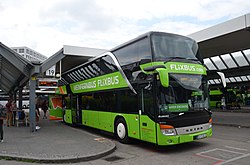
 A FlixBus Setra S 431 DT at Berlin Messe in 2016 | |||
| Parent | Flix SE | ||
|---|---|---|---|
| Founded | 2011 | ||
| Headquarters | Munich, Bavaria, Germany | ||
| Service area |
| ||
| Service type | Intercity coach service | ||
| Website | www | ||
| |||


FlixBus (German pronunciation: ['flɪksbʊs]; styled FLiXBUS) is a German brand that offers low-cost intercity coach services in Europe, North America, South America and Asia. It is owned by Flix SE, which also operates FlixTrain, FlixCar, Kâmil Koç, and Greyhound Lines. FlixBus operates buses or, in many cases, just handles marketing, pricing, and customer service for a commission, on behalf of bus operators.[1][2][3] In 2023, FlixBus had revenues of €2 billion and carried 81 million passengers of which 55 million were in Europe, 14 million were in Turkey, and 12 million were in North America.[4]
History
[edit]FlixBus was founded in 2011 in Munich by Daniel Krauss, Jochen Engert and André Schwämmlein. They had met in university and began discussing the concept in 2009 after plans were made to deregulate the bus industry in Germany.[5]
FlixBus launched its first three routes in February 2013 in Bavaria, Germany, to take advantage of Germany opening up its bus market to competition.[6] In the following years, it added routes across Europe.[7]
In April 2018, FlixBus was the first to use all-electric vehicles on a long-distance bus route, between Paris La Défense and Amiens.[8]
FlixBus expanded to the United States in 2018, first operating from Los Angeles,[9] then expanding to the East Coast in 2019 through a partnership with Eastern Bus.[10] FlixBus also launched service in Brazil in 2021,[11] Canada in 2022,[12][13][14] Chile in 2023, India in 2024,[15] and Mexico in 2025.[16]
In April 2022, the company converted from a GmbH structure to an SE structure and was renamed Flix SE.[17]
Financing history – parent company, Flix SE
[edit]In 2013, the company received equity financing from Mercedes-Benz Group and the Technical University of Munich.[5]
In July 2019, the company raised €500 million in a Series F financing round led by TCV and Permira, valuing the company at over €2 billion.[18]
In June 2021, FlixMobility GmbH raised $650 million in a Series G financing round at a valuation of US$3 billion from investors including General Atlantic, Permira, TCV, HV Capital, BlackRock, Baillie Gifford, and SilverLake.[19]
In July 2024, EQT AB and Kuehne + Nagel acquired a 35% stake in the company for €1 billion.[20][21]
Acquisitions
[edit]
| # | Date | Company | Seller | Notes | Ref(s). |
|---|---|---|---|---|---|
| 1 | January 2015 | MeinFernbus | Received investment from General Atlantic | [22] | |
| 2 | November 2015 | LIINITA | Provider of trips of up to 15 kilometers | [23] | |
| 3 | July 2016 | Megabus Europe | Stagecoach Group | Stagecoach became an operating partner | [24] |
| 4 | August 2016 | Postbus | Deutsche Post | German bus lines | [25] |
| 5 | May 2017 | Hellö coach network | Austrian Federal Railways (ÖBB) | Austrian bus lines | [26] |
| 6 | May 2018 | Swebus Express | Nobina | Swedish bus lines | [27] |
| 7 | April 2019 | Eurolines and Isilines | Transdev | Acquisition of Eurolines operating businesses including France, The Netherlands, Belgium, Czech Republic and Spain and excluding Bosnia-Herzegovina, Croatia, Estonia, Latvia, Lithuania, Ireland, Switzerland and Serbia | [28][29] |
| 8 | August 2019 | Kâmil Koç | Private equity firm Actera Group | Turkish bus lines | [30] |
| 9 | October 2021 | Greyhound Lines | FirstGroup | U.S. bus lines; price was $78 million | [31][32][33][34][35] |
International expansion
[edit]As of 2025, FlixBus operates across five continents: Europe, North America, South America, Asia, and will launch in Oceania in late 2025.[36][37] Its services span 44 countries,[38] with expansion plans continuing into new markets.[37]
The company’s growth began in Europe following the deregulation of the German intercity bus market in 2013. In 2015, FlixBus merged with MeinFernbus,[39] consolidating its position in Germany and enabling further international expansion. Between 2015 and 2016, it launched services in France, Italy, Central and Eastern Europe and Scandinavia.
In 2018, FlixBus entered the North American market, initially launching routes in the southwestern United States. This was followed by expansion to the East Coast in 2019 and the acquisition of Greyhound Lines in 2021, which significantly extended Flix’s network to over 1,600 destinations in the U.S. and Canada.[40] Canadian operations formally launched in 2022.
FlixBus entered Latin America in 2021 with services in Brazil,[11] expanding to more than 100 cities by 2024. In 2023, it launched operations in Chile,[41] serving cities across eight regions. Services in Mexico began in May 2025, with a planned launch in Peru later the same year.[37]
In Asia, FlixBus entered the Turkish market through the 2019 acquisition of Kâmil Koç, one of Turkey’s largest intercity bus operators.[42][43] In 2024, FlixBus launched services in India,[15] connecting 46 cities via 59 stops.
In 2025, Flix announced its entry into the Australian market, marking the company’s fifth continent of operation.[38][44]
Operations
[edit]FlixBus operates an asset-light model in which travel services are provided by over 1,000 local bus partners, while Flix centrally manages network planning, scheduling, pricing, booking, and marketing.[45]
As of 2025, the company operates in 44 countries across five continents, offering over 300,000 daily connections.[46] The network continues to grow through market entries in Latin America, Asia, and Oceania.
Key regional operations include:
- Europe: The core network spans major countries in Western, Central, and Eastern Europe, with recent growth in cross-border and airport routes.
- North America: After acquiring Greyhound Lines in 2021, Flix integrated Greyhound’s network of more than 1,600 destinations in the U.S., Canada, and Mexico.[47] The integration also improved on-time performance (OTP) to over 95 percent.
- Latin America: The Brazilian network has grown to over 100 cities since launching in 2021, while Chile began service in 2023 and now spans 14 cities across eight regions.[46]
- Mexico: FlixBus launched operations in Mexico in May 2025, initially covering five states including Mexico City, Querétaro, and Monterrey, with cross-border integration to Greyhound services.[48][49]
- India: FlixBus entered India in early 2024, connecting 46 cities through a network of 59 stops and more than 200 connections.[50]
Accidents
[edit]- In May 2017, the driver of a double-decker bus outside Berlin, Germany, attempted to drive under a bridge with insufficient clearance, completely ripping off its roof. No passengers were on board.[51]
- In May 2018, a bus rolled and crashed near Udine, Italy. There were 43 people on board, of whom 26 were injured.[52]
- In August 2018, a bus travelling from Stockholm to Berlin crashed in Germany after veering off a highway, seriously injuring sixteen passengers.[53][54]
- In December 2018, a bus crashed on a motorway near Zurich, Switzerland, killing two people including the driver.[55]
- In May 2019, a bus crashed in Germany. At least three passengers were seriously injured. Initial police findings were that the bus driver was not at fault for the accident.[56]
- In May 2019, a bus rolled and crashed into a road safety barrier in Germany. One person was killed and 60 were injured. The local police found early indications the driver had fallen asleep.[57]
- In October 2019, a bus rolled and crashed near Bizanet, France. One person was killed and 17 were injured.[58]
- In November 2019, a bus rolled and crashed near Amiens, France, injuring more than 30 people.[59]
- In February 2023, an Uber Eats bicycle courier was struck and killed by a Flixbus coach in Brussels, Belgium.[60] Two months after the incident, the government and FlixBus were criticized for not moving the bus stop away from the bike lane.[61]
- In June 2023, a bus crashed in Avellino, Italy, when it swerved to avoid another car, resulting in one death and injuries to 26 passengers. The company was criticized by a passenger for the lack of support offered after the incident.[62][63]
- In July 2023, a bus crashed into another bus in the Czech Republic, killing one of the drivers and injuring 76 people.[64]
- In September 2023, a 19-year-old Austrian woman died after a bus overturned near Micheldorf, Austria, injuring 20 people.[65]
- In December 2023, an overcrowded Flixbus from Vienna, Austria to Kyiv, Ukraine overturned in Trebišov district of the Košice region of Slovakia, injuring 9 passengers.[66]
- On 5 January 2024, one person died and 11 others were injured in NY State, USA, after a Flixbus that was bound for New York City from Montreal, Canada, rolled over on Interstate 87.[67]
- On 24 March 2024, one person died in Italy after a Flixbus travelling between Milan and Rome crashed close to Modena.[68]
- On 27 March 2024, five people died and 20 others were injured when a Flixbus crashed near Leipzig, Germany, after veering off a highway bound for Zürich from Berlin.[69]
- On 7 November 2024, around 7:10am, a Flixbus operated by Tribal Sun Bus LLC left the roadway and rolled over on I-490 just west of Rochester, New York. All 28 passengers were injured and transported, one critical patient died at the hospital that night.[70] The bus left New York City around midnight, bound for Niagara Falls. The driver was charged for fatigued driving, excessive speed, unsafe lane change, and no seatbelt.[71][72]
- On 3 January 2025, a Flixbus crashed into two cars between the Perušić and Gospić junctions, in the direction of Dubrovnik.[73]
- On 11 January 2025, a Flixbus carrying 13 passengers crashed when exiting the Autobahn 11 between Berlin and Szczecin, causing 2 deaths and 11 injuries.[74]
- On 4 May 2025, a Flixbus from Arlington, Virginia to New York City rear-ended another bus on the New Jersey Turnpike. 39 people were hospitalized because of this chain-reaction crash.[75]
- On 4 July 2025, a Flixbus overturned in Germany leaving 23 injured.[76]
- On 22 July 2025, two FlixBus buses bound for Amsterdam were involved in a crash on the A4 motorway near Nieuw-Vennep, Netherlands. No serious injuries were reported.[77]
Controversies
[edit]Working conditions for drivers in Germany
[edit]In 2016, FlixBus was accused by a German government agency of forcing its partners to make drivers work excessive hours at low wages.[78]
Use of infrastructure without toll payments in Germany
[edit]Unlike train services and trucks, buses do not pay any road toll in Germany; this was criticized as a "hidden subsidy" by some German politicians in the spring of 2015.[79] bdo, an association of German bus companies, responded that buses pay for infrastructure use in the form of related taxes (on fuel, for example) while billions in subsidies are paid to national rail provider Deutsche Bahn.[80]
Dominant market share in Germany
[edit]In August 2016, following the acquisition of Postbus, FlixBus had control of roughly 80% of the German long-distance bus market, a move criticised by various media outlets as a de facto monopoly and harmful to competition. It was also suggested at the time that FlixBus' control of the market could lead to higher prices and less service to smaller destinations.[81][82][83]
Buses inaccessible for wheelchair users in California
[edit]On 14 May 2020, the Disability Rights Legal Center (DRLC) filed a federal class action lawsuit in a California U.S. District Court against FlixBus and other bus operators alleging that buses were inaccessible for wheelchair users and staff was untrained on how to accommodate wheelchair users.[84]
Logos
[edit]-
 Flixbus – 2015
 -
 Meinfernbus.de
 -
 MeinFernbus Flixbus – 2015
 -
 Flixbus – 2015–2016
 -
 FlixBus – 2016–present


References
[edit]- ^ Wembridge, Mark (6 June 2019). "Flixbus aims 'to make coach travelling cool again'". Financial Times. Archived from the original on 28 October 2020. Retrieved 19 June 2019.
- ^ "Bus Partners". FlixBus. Archived from the original on 21 December 2019. Retrieved 21 January 2020.
- ^ Ellingson, Annlee (15 May 2018). "European FlixBus brings tech-driven bus network to L.A." American City Business Journals.
- ^ "Another record year: Flix reports EUR 2 billion total revenue in 2023" (Press release). Flix SE. 7 March 2024.
- ^ a b "FlixMobility". Technical University of Munich (in German). Archived from the original on 21 May 2024. Retrieved 12 September 2024.
- ^ "How Flixbus conquered the European coach market". The Economist. London. 10 May 2018. Archived from the original on 6 November 2020. Retrieved 9 September 2019.
- ^ "German bus firm Flixbus opens new Vaasa to Warsaw route". Yle. 18 July 2023.
- ^ "Europe's FlixBus inaugurates 1st 100% electric long-distance bus line". Metro Magazine. 12 April 2018. Archived from the original on 12 September 2024. Retrieved 12 September 2024.
- ^ O'Brien, Chris (15 May 2018). "Germany's data-driven FlixBus launches in the U.S. to make bus travel cool again". VentureBeat. Archived from the original on 9 November 2020. Retrieved 16 May 2018.
- ^ Schwieterman, Joseph; Antolin, Brian (11 July 2019). "How Greyhound, Coach USA sales will impact intercity bus lines". Metro Magazine. Archived from the original on 14 December 2019. Retrieved 9 September 2019.
- ^ a b "Flixbus starts up in Brazil". Buses. 12 January 2022.
- ^ Dunne, James (8 April 2022). "Giant German bus company hits the highway in Canada". CBC News. Archived from the original on 10 April 2022. Retrieved 10 April 2022.
- ^ Chan, Cheryl (24 May 2022). "FlixBus launches new bus service between Vancouver and Seattle". Vancouver Sun.
- ^ Chan, Kenneth (27 May 2022). "FlixBus: Vancouver to Seattle bus service launches in June with $18 fares". Daily Hive. Archived from the original on 18 July 2023. Retrieved 18 July 2023.
- ^ a b "Massive step as Flix launches in India". Bus & Coach Buyer. 1 February 2024.
- ^ Stoate, Joey (28 May 2025). "FlixBus Launches New Mexican Services".
- ^ "Flixbus parent company is now called Flix". Startbase. 20 April 2022.
- ^ Busvine, Douglas; Hübner, Alexander; Schuetze, Arno (18 July 2019). "Transport app FlixMobility gets Germany's biggest tech funding round to drive growth". Reuters. Archived from the original on 12 July 2023. Retrieved 12 September 2024.
- ^ Lunden, Ingrid (2 June 2021). "FlixMobility raises $650M+ at a $3B valuation to double down on buses and other transport in the US". TechCrunch. Archived from the original on 12 September 2024. Retrieved 12 September 2024.
- ^ "EQT and Kühne Holding invest in Flix, the global travel company" (Press release). EQT AB. 4 July 2024.
- ^ "EQT, German Tycoon Buy €1 Billion Stake in Greyhound Owner Flix". SWI swissinfo. 4 July 2024.
- ^ "MeinFernbus and FlixBus Become One" (Press release). General Atlantic. 17 January 2015. Archived from the original on 28 September 2023. Retrieved 18 July 2023.
- ^ "FlixBus Acquires LIINITA". Mergr. Archived from the original on 26 May 2024. Retrieved 26 May 2024.
- ^ "Megabus Europe retail operations sold to FlixBus". CBW (Press release). 4 July 2016. Archived from the original on 22 September 2023. Retrieved 18 July 2023.
- ^ "Deutsche Post sells long-distance bus unit, confirms 2016 targets". CNBC. Reuters. 3 August 2016. Archived from the original on 18 July 2023. Retrieved 18 July 2023.
- ^ "Flixbus buys out Austria's Hellö". Buses. 15 June 2017. Archived from the original on 12 September 2024. Retrieved 12 September 2024.
- ^ "Nobina divests express bus operations" (Press release). Nobina. 2 May 2018. Archived from the original on 26 May 2024. Retrieved 26 May 2024.
- ^ "Negotiations successfully completed: FlixBus buys Eurolines/isilines from Transdev Group" (Press release). Transdev. 2 May 2019. Archived from the original on 13 June 2019.
- ^ Lundgren, Ingrid (4 March 2019). "FlixBus, the German Uber-like bus service, is buying rival". TechCrunch. Archived from the original on 30 November 2020. Retrieved 9 September 2019.
- ^ "German FlixBus moves to acquire prominent Turkish bus company Kamil Koç". Daily Sabah. 21 August 2019. Archived from the original on 9 May 2023. Retrieved 28 January 2021.
- ^ Lunden, Ingrid (21 October 2021). "Germany's FlixMobility acquires Greyhound Lines, the iconic". TechCrunch. Archived from the original on 14 January 2022. Retrieved 14 January 2022.
- ^ "Germany's Flixbus acquires US Greyhound bus company". Deutsche Welle. 21 October 2021. Archived from the original on 14 January 2022. Retrieved 14 January 2022.
- ^ "FlixBus owner hitches ride with Greyhound as FirstGroup exits". Reuters. 21 October 2021. Archived from the original on 23 October 2021. Retrieved 23 October 2021.
- ^ O'Donnell, Paul; Walters, Natalie (21 October 2021). "Dallas-based Greyhound sells to Europe's largest long-distance bus network". The Dallas Morning News. Archived from the original on 14 January 2022. Retrieved 14 January 2022.
- ^ "FlixBus owner hitches ride with Greyhound as FirstGroup exits". Reuters. 21 October 2021. Archived from the original on 23 October 2021. Retrieved 23 October 2021.
- ^ "Flix expands to its 5th continent: Australia as next move". flix. Retrieved 22 October 2025.
- ^ a b c May, Tiana (17 February 2025). "FlixBus to Launch in Peru and Mexico in 2025". Bus-News. Retrieved 22 October 2025.
- ^ a b Flix SE (10 July 2025). "Flix expands to its 5th continent: Australia as next move". Archived from the original on 14 August 2025. Retrieved 26 October 2025.
- ^ Böll, Sven (9 January 2015). "Fernbus-Markt: MeinFernbus und Flixbus fusionieren". Der Spiegel (in German). ISSN 2195-1349. Retrieved 22 October 2025.
- ^ "FlixBus owner hitches ride with Greyhound as FirstGroup exits". Reuters. Archived from the original on 21 January 2025. Retrieved 22 October 2025.
- ^ InvestChile. "Flixbus remains committed to Chile and expects sales to increase 300%". blog.investchile.gob.cl. Retrieved 22 October 2025.
- ^ WebSupport (28 August 2019). "Flixbus expands with Turkish acquisition". CBW. Retrieved 22 October 2025.
- ^ Sabah, Daily (21 August 2019). "German FlixBus moves to acquire prominent Turkish bus company Kamil Koç". Daily Sabah. Retrieved 22 October 2025.
- ^ Visontay, Elias (24 October 2025). "The European travel giant invading Australia's 'golden triangle'". Archived from the original on 24 October 2025. Retrieved 26 October 2025.
- ^ "Flixbus setzt internationale Expansion fort: Markteintritt in Mexiko und Peru geplant". Aviation.Direct. Retrieved 22 October 2025.
- ^ a b "FlixBus Chile expects sales increase". InvestChile. Retrieved 22 October 2025.
- ^ "FlixBus, Greyhound and the Future of Intercity Travel". Metro Magazine. Retrieved 22 October 2025.
- ^ "FlixBus Launches New Mexican Services". Bus-News. Retrieved 22 October 2025.
- ^ "Mobility Leader Flix to Enter Mexico in 2025". Mexico Business News. Retrieved 22 October 2025.
- ^ "Flix, Europe's biggest bus operator and owner of Greyhound, to enter India in early 2024". The Economic Times. Retrieved 22 October 2025.
- ^ "Flixbus roof sheared off by bridge". Deutsche Welle. 12 May 2017. Archived from the original on 23 July 2024. Retrieved 9 August 2023.
- ^ Treppo, Paola (19 May 2018). "Bus della Flixbus si ribalta sull'A4 in provincia di Udine: 26 feriti, uno grave". Il Messaggero (in Italian). Archived from the original on 24 March 2024. Retrieved 12 June 2023.
- ^ "Several injured in mystery Flixbus crash". Deutsche Welle. 17 August 2018. Archived from the original on 27 July 2023. Retrieved 27 July 2023.
- ^ "Update: 16 injured after Flixbus travelling from Stockholm to Berlin tips over in crash". The Local. 17 August 2018. Archived from the original on 27 July 2023. Retrieved 27 July 2023.
- ^ "Zurich coach accident claims second victim". Swissinfo. 2 January 2019. Archived from the original on 27 July 2023. Retrieved 27 July 2023.
- ^ "Drei Schwerverletzte Zwei Flixbus-Unfälle in einer Nacht". Berliner Zeitung (in German). 5 June 2019.
- ^ "One dead, many injured in German Flixbus crash". Deutsche Welle. 20 May 2019. Archived from the original on 27 July 2023. Retrieved 27 July 2023.
- ^ "Un mort et 17 blessés, dont un grave, dans un accident de car Flixbus dans l'Aude" [One dead and 17 injured, including one seriously, in a Flixbus bus accident in Aude]. L'Obs (in French). 6 October 2019.
- ^ "Dozens injured in France Flixbus bus crash". Deutsche Welle. 3 November 2019. Archived from the original on 9 May 2023. Retrieved 12 June 2023.
- ^ Ro.Ma (24 February 2024). "Près de trois mois après le décès de Sultan, livreur percuté par un Flixbus, des poteaux sont installés boulevard Albert II, proche de la Gare du Nord". La Dernière Heure (in French).
- ^ "Twee maanden na dood fietskoerier nog niks veranderd". BRUZZ (in Dutch). 16 April 2023.
- ^ Doyle, Michael (5 June 2023). "Australian involved in fatal Italian bus crash says company offered $16 meal voucher". Australian Broadcasting Corporation.
- ^ Parker, Benjamin (5 June 2023). "Flixbus passengers offered just €10 meal voucher after fatal bus crash". The Independent. London. Archived from the original on 19 July 2023. Retrieved 19 July 2023.
- ^ "1 dead and 76 injured in a bus crash on a major highway in southeastern Czech Republic". ABC News. 17 July 2023. Archived from the original on 9 September 2023. Retrieved 27 July 2023.
- ^ "One dead and 20 injured after Flixbus travelling from Berlin overturns in Austria". The Local. 19 September 2023. Archived from the original on 28 March 2024. Retrieved 23 September 2023.
- ^ Lisnychuk, Maryna (17 December 2023). "An overcrowded bus from Ukraine overturns in Slovakia: children are among the victims". Obozrevatel. Archived from the original on 16 April 2024. Retrieved 17 December 2023.
- ^ Olson, Issac (5 January 2024). "1 dead, 11 injured after bus coming from Montreal crashes in New York's Adirondacks". CBC News. Archived from the original on 19 January 2024. Retrieved 7 January 2024.
- ^ "Milan, the Flixbus accident heading to Rome: here's who the victim is, Vindou Illumine". Italy 24. Archived from the original on 28 March 2024.
- ^ Langner, Markus; Proft, Johannes; Keim, Karl; Meinfelder, Laura; Fischer, Thomas (27 March 2024). "A9 bei Leipzig: Fünf Tote und 20 Verletzte bei Flixbus-Unfall". Bild (in German). Archived from the original on 18 July 2024. Retrieved 27 March 2024.
- ^ Bourtis, Evan (7 November 2024). "Passenger on bus that crashed on I-490, injuring over 20 people, has died". WHEC-TV.
- ^ "'It was surreal': 28 injured, 1 critically, in tour bus crash on 490". WHAM-TV. 7 November 2024.
- ^ Bourtis, Evan (7 November 2024). "Bus crash on I-490 injures 28 people, 1 critically". WHEC-TV.
- ^ "Lančani sudar pet automobila i autobusa na A1 kod Macole" [Chain collision of five cars and a bus on the A1 near Macola. Cars wrecked]. Index.hr (in Croatian). 3 January 2025.
- ^ "Zwei Tote und elf Verletzte bei schwerem Reisebusunfall auf der A11" [Two dead and eleven injured in serious coach accident on the A11]. Rundfunk Berlin-Brandenburg (in German).
- ^ Grassi, Emily Rose (3 May 2025). "2 buses, 3 cars crash on NJ Turnpike leaving at least 39 hurt".
- ^ "Flixbus overturns in Germany leaving 23 injured". 4 July 2025.
- ^ "Flixbus: er waren 66 passagiers aan boord van botsende bussen". 22 July 2025.
- ^ "Einhaltung der Sozialvorschriften im Straßenverkehr und der Arbeitszeiten bei Fernlinienbusunternehmen ..." (in German). North Rhine-Westphalia. 9 August 2016.
- ^ "Verkehrsminister fordern Maut für Fernbusse" [Transport ministers call for tolls for long-distance buses]. Die Zeit (in German). 14 April 2016. Archived from the original on 14 January 2022. Retrieved 14 January 2022.
- ^ "bdo weist Forderungen nach einer Fernbusmaut zurück" [bdo rejects calls for a long-distance bus toll]. bdo.org (in German). 18 April 2015.
- ^ Arzt, Ingo (3 August 2016). "Flixbus schluckt Postbus: Die Fernbuskrake" [The long-distance bus cracks]. Die Tageszeitung (in German).
- ^ Jahns, Christin; Schultz, Stefan (3 August 2016). "Flixbus kauft Postbus: Was die Fernbusfusion für Fahrgäste bedeutet" [What the long-distance bus merger means for passengers]. Der Spiegel (in German).
- ^ Doll, Nikolaus (3 August 2016). "Das bedeutet das neue Fernbus-Monopol für Kunden" [That means the new long-distance bus monopoly for customers]. Die Welt (in German). Archived from the original on 2 October 2016. Retrieved 7 March 2017.
- ^ "Class Action Lawsuit Alleges 'Discrimination and Humiliation' by FlixBus Passengers with Disabilities Repeatedly Denied Accessible Vehicles". Disability Rights Legal Center. 14 May 2020. Archived from the original on 26 September 2022. Retrieved 26 September 2022.
External links
[edit]
| Services | |
|---|---|
| Related articles | |
FlixBus
View on GrokipediaFlixBus is a leading intercity bus service brand operated by Flix SE, a Munich-based mobility technology company founded in 2011 by André Schwämmlein, Daniel Krauss, and Jochen Engert.[1] The company employs an asset-light business model, leveraging a proprietary digital platform to coordinate routes, pricing, and bookings while partnering with independent bus operators who provide the vehicles and drivers, thereby disrupting traditional coach markets in deregulated environments across Europe and beyond.[1] Since its inception following the liberalization of long-distance bus services in Germany, FlixBus has expanded rapidly, now serving over 8,000 destinations in more than 40 countries across four continents, with a network of over 5,000 buses and having transported more than 500 million passengers.[1] Key achievements include the launch of FlixTrain rail services in select European markets and the 2021 acquisition of Greyhound Lines, which solidified its position as North America's largest intercity bus network operator, further extending into Canada, Mexico in 2025, Australia, and India since February 2024. In India, operations initially covered 46 cities in northern states, expanding to over 200 cities with more than 900 stops by 2025 and surpassing 1 million passengers.[2][3] This growth has been driven by low fares, dynamic pricing, and integration with multimodal travel apps, though the company has faced regulatory pushback in markets with protected competition and a 2025 fine in Belgium for unsubstantiated environmental claims on its website.[4] FlixBus emphasizes sustainability through lower per-passenger CO₂ emissions compared to cars and planes—averaging 27.8 grams per passenger kilometer in Europe—and commitments to net-zero operations by 2040 in Europe and 2050 globally, validated under the Science Based Targets initiative.[1]
History
Founding and Early Development
FlixBus was established in Munich, Germany, in 2013 by Jochen Engert, André Schwämmlein, and Daniel Krauss, who had initially conceived the idea during university discussions around 2009 amid anticipation of regulatory changes in the European bus sector.[5] [6] The venture capitalized on Germany's deregulation of long-distance bus services, effective January 1, 2013, which ended prior restrictions prohibiting competition with state-subsidized rail networks like Deutsche Bahn.[7] [8] This liberalization created an opportunity for private entrants to challenge incumbents by emphasizing cost efficiencies over capital-intensive operations. From inception, FlixBus adopted an asset-light framework, outsourcing bus operations to independent carriers while managing reservations, pricing, and network planning via a proprietary digital platform.[9] This model incorporated dynamic pricing algorithms to undercut rail fares, targeting underserved demand for affordable intercity travel in a market previously dominated by higher-cost alternatives.[10] On February 13, 2013, the company debuted its first scheduled service on the Munich-to-Nuremberg route in Bavaria, soon adding two more regional lines to test demand and refine operations.[6] [11] Early growth focused on domestic German routes, where the technology-driven approach minimized fixed costs and enabled revenue-sharing incentives for partners, fostering scalability without heavy infrastructure investment.[10] By 2014, initial successes prompted cross-border extensions into Austria, including the Graz-Vienna connection, marking the onset of networked expansion while maintaining emphasis on entrepreneurial agility over traditional carrier models.[6] [12]European Expansion and Acquisitions
Following its launch in Germany in 2013, FlixBus initiated European expansion in 2015 by entering markets in France, the Netherlands, Belgium, and Austria, capitalizing on regulatory liberalization to add routes and achieve network density through interconnected hubs.[6] This organic growth leveraged algorithmic route optimization and partnerships with local operators, enabling rapid scaling without owning assets, which reduced capital intensity and improved load factors via shared passenger flows across borders.[13] By late 2015, the company had merged with rival MeinFernbus, pooling route inventories and technology to form a denser pan-European network, backed by investment from General Atlantic that facilitated joint operations and market consolidation in Germany.[11][14] Strategic acquisitions accelerated penetration in subsequent years. In 2016, FlixBus acquired Postbus from Deutsche Post DHL, integrating its 200 routes and enhancing coverage in eastern Germany and adjacent regions.[15] The same year, it purchased Megabus Europe's operations from Stagecoach Group, adding over 400,000 daily connections to more than 3,000 destinations and bolstering presence in the UK, France, and Italy through retained partner fleets.[16] In 2019, FlixBus agreed to acquire Eurolines' long-distance coach services from Transdev, incorporating international lines across 30 countries and further densifying cross-border links.[17] These moves yielded efficiency gains, such as optimized scheduling that increased average occupancy rates above 80% on acquired routes, per operator reports, while preempting fragmented competition.[18] Funding through Flix SE supported this phase, with venture capital infusions enabling acquisitions and tech investments. A 2015 round from General Atlantic valued the merged entity at over €500 million, funding initial cross-border rollout.[14] Subsequent rounds culminated in Series F financing in July 2019, co-led by TCV and Permira, raising €500 million at a €2 billion valuation and conferring unicorn status, which underwrote European network fortification amid rising demand.[19] This capital structure emphasized scalable, asset-light growth, prioritizing data-driven route economics over physical ownership.[20]Entry into North American and Global Markets
FlixBus launched operations in the United States in May 2018, targeting the southwestern region with initial routes connecting major cities including Los Angeles to Las Vegas, Phoenix, and Tucson. The entry leveraged the company's asset-light approach by partnering with six regional U.S. operators, such as Arrow Stage Lines and Gray Line Arizona, to provide services without owning the fleet outright. Fares started as low as $0.99 to compete with established players like Greyhound, emphasizing digital booking and dynamic pricing adapted from the European model.[21][22][23] Expansion accelerated with the acquisition of Greyhound Lines on October 21, 2021, purchased from FirstGroup for $78 million in cash. This deal provided immediate access to Greyhound's extensive network of over 1,400 destinations across the U.S. and into Canada, enabling FlixBus to scale beyond pilot routes and integrate legacy infrastructure with its optimization algorithms. However, adapting the European model faced hurdles, including U.S. Federal Motor Carrier Safety Administration regulations on driver hours-of-service, vehicle inspections, and interstate compliance, which imposed stricter documentation and safety protocols than in the EU. Competition from subsidized rail services like Amtrak and fragmented local markets further required adjustments, such as negotiating partnerships amid skepticism from traditional operators toward tech-centric entrants.[24][25][26] Early North American efforts extended to Canada via cross-border routes from the U.S., with domestic services launching in Ontario on April 7, 2022, linking Toronto, Ottawa, Niagara Falls, and Kitchener-Waterloo. These operations navigated bilingual requirements and provincial deregulations, building on U.S. infrastructure while addressing shorter distances and urban congestion compared to Europe. Initial global explorations included pilots in Latin America and Asia before 2020, though verifiable scaling remained limited until later; these tested adaptations to diverse regulatory environments, such as varying labor standards and informal competition, yielding insights into hybrid models for non-European markets. Early successes manifested in growing ridership and route density, despite ongoing challenges like infrastructure variability and economic sensitivity in bus-dependent regions.[27][28]Recent Milestones and Strategic Shifts (2020–Present)
In response to the COVID-19 pandemic, FlixBus suspended a significant portion of its routes in 2020 amid widespread lockdowns and travel restrictions, prioritizing health protocols and operational viability across Europe and North America. The company adapted by streamlining digital platforms for bookings and refunds, while maintaining limited services on essential corridors. By 2023, ridership had rebounded to pre-pandemic levels, reflecting strong consumer preference for affordable, flexible bus travel as economic activity resumed and alternative modes like air travel faced higher costs.[29] FlixBus accelerated international expansion post-recovery, entering India in February 2024 with over 200 daily connections linking 46 cities including Delhi, Agra, and Jodhpur, targeting the country's vast intercity bus market.[30] In September 2024, it extended operations to South India, adding routes such as Bangalore to Chennai and Hyderabad, increasing its national footprint to 101 cities and 215 stops.[31] By early 2025, the network had expanded to over 200 cities with more than 900 stops, surpassing 1 million passengers.[32] FlixBus introduced electric bus services, including a pilot on the Hyderabad-Vijayawada route in February 2025 in partnership with ETO Motors.[32] Key partnerships included a memorandum of understanding with Vertelo in April 2025 to deploy 500 electric intercity buses, Ashok Leyland for advanced chassis and sustainable mobility solutions, and Fleetx for AI-enabled fleet safety enhancements.[33][34][35] Ongoing electric vehicle rollouts continued into 2026, with operations remaining active. This move capitalized on rising demand for reliable, app-integrated services in a fragmented sector. In 2025, FlixBus launched national bus operations in Mexico on May 27, initially connecting Mexico City to six key stops, as part of a broader Latin American push including planned entry into Peru later that year to leverage high bus usage volumes.[36][37] In North America, the company introduced 11 new routes across the U.S. and Canada by mid-2025, focusing on Midwest, South, and university hubs to enhance connectivity amid sustained ridership growth exceeding 1,400% network expansion since entry.[38] Strategic partnerships underscored a shift toward visibility and sustainability integration. In October 2024, FlixBus became the official mobility partner of the UEFA Europa League and UEFA Conference League through 2027, promoting coach travel to events as a lower-emission alternative and embedding eco-messaging in fan experiences.[39] Complementing this, the company quantified environmental impact, stating that 2024 passenger choices over private vehicles or flights avoided 1.5 million tonnes of CO₂ emissions globally, based on lifecycle comparisons.[40] These initiatives highlight a pivot to data-backed green claims and brand alliances driving organic demand rather than reliance on public funding.Business Model
Asset-Light Operations and Technology Integration
FlixBus operates an asset-light model by contracting with independent local bus operators for vehicle provision and driving services, while retaining control over network planning, pricing, and digital distribution. This structure minimizes capital expenditure on fleet ownership and maintenance, allowing the company to scale operations rapidly across markets without bearing the financial risks of asset depreciation or underutilization.[1][41] The partnerships typically involve revenue-sharing agreements, where operators supply compliant vehicles and personnel in exchange for access to FlixBus's booking platform and customer base, enabling small and medium-sized enterprises to enter long-distance routes efficiently.[42] Technology forms the backbone of this model, with a centralized digital platform handling reservations, customer interactions, and operational coordination. FlixBus employs dynamic pricing algorithms that adjust ticket fares in real time based on factors such as demand forecasts, booking velocity, and remaining capacity, optimizing revenue per departure compared to fixed pricing.[43] Route optimization tools, powered by data analytics and AI platforms like Snowflake, analyze historical and live data to schedule services that reduce empty running miles and improve load factors, enhancing overall network efficiency.[44] The company's mobile application integrates real-time GPS tracking for buses, providing passengers with live location updates, estimated arrival times, and disruption alerts to foster reliability in a decentralized fleet.[45] This tech stack supports data-driven decision-making, such as predictive demand modeling, which has enabled dense route networks and contributed to FlixBus securing over 90% market share in Germany's long-distance bus sector through superior utilization and competitive pricing.[13]Partner Network and Revenue Strategies
FlixBus employs an asset-light business model that relies on partnerships with over 1,000 local bus operators across its network, who provide and maintain buses, hire and manage drivers, and handle fueling and day-to-day operations while adhering to FlixBus standards for comfort and safety.[46][9] In this structure, FlixBus focuses on non-operational functions such as route planning, dynamic pricing, marketing, customer service, and digital booking, which allows partners to utilize underutilized assets and generate additional revenue streams without FlixBus owning physical infrastructure.[47][48] This commission-based arrangement aligns incentives by tying partner compensation to bus utilization and ticket sales, as FlixBus deducts a commission—reportedly around 25% in some agreements—from gross ticket revenue before remitting the balance to operators, encouraging efficient operations and capacity optimization through shared data insights.[49][1] Primary revenue derives from ticket sales, where FlixBus captures commissions on bookings facilitated via its platform, supplemented by ancillary fees for services like seat reservations, extra luggage allowances, and ticket flexibility changes or cancellations.[50][48] Additional streams include advertising partnerships, affiliate commissions from bundled offerings with hotels or attractions, and platform fees, which enhance monetization without direct operational costs to FlixBus.[51][50] Partners benefit from this model through access to a broader customer base and predictable income, as FlixBus's technology optimizes load factors and reduces empty runs, fostering mutual reliance on market-driven performance rather than fixed subsidies or regulatory mandates.[1][47] The partner-centric approach facilitates rapid scalability into fragmented markets, such as India where FlixBus launched services on February 6, 2024, initially partnering with five local operators from Delhi to connect 46 cities including Ayodhya and Lucknow, and later expanding southward to 33 cities like Bengaluru and Chennai by September 2024.[52][53] In Latin America, this model supported entries into Brazil and Chile, with planned 2025 launches in Peru and Mexico leveraging local expertise to navigate regulatory and infrastructural variances.[54][1] By minimizing capital outlays and regulatory hurdles—such as owning only one bus in India for licensing compliance—FlixBus enters high-growth regions efficiently, relying on partners' localized knowledge to deploy fleets without imposing uniform labor or maintenance protocols beyond performance-based contracts.[55][56]Operations
Route Network and Fleet Management
FlixBus operates an extensive route network connecting nearly 8,000 destinations across more than 40 countries, including Europe, North America, parts of Latin America, and Asia with operations in India, as of October 2025.[57] FlixBus launched operations in India in February 2024, initially connecting 46 cities across northern states with over 200 daily services. By early 2025, the Indian network expanded to over 200 cities and more than 900 stops, surpassing 1 million passengers.[52][58] This coverage prioritizes high-density corridors, such as the Northeast Corridor in the United States linking cities like Boston and New York, and major European intercity links, with Paris and Lisbon ranking among the most frequently traveled-to destinations in 2024.[59][60] The company employs an asset-light model for fleet management, outsourcing vehicle operations to a network of partner bus operators while centrally coordinating route planning, scheduling, and quality standards.[61] In India, partnerships such as with Vertelo for deploying 500 electric intercity buses, ETO Motors for initial electric services on routes like Hyderabad to Vijayawada starting February 2025, and Ashok Leyland for advanced chassis and sustainable mobility enhance the fleet's sustainability.[32][62][34] Partner-provided coaches generally feature modern amenities including air conditioning, free Wi-Fi, power outlets, reading lights, onboard toilets, and comfortable seating with extra legroom, though availability of specific features can vary by operator and route.[63][64] Scheduling strategies emphasize frequent departures on popular routes to enhance reliability and accessibility, with many services operating overnight to offer cost-effective alternatives to flights by minimizing accommodation needs and aligning with traveler flexibility.[57][65] This approach supports daily connections on high-demand lines, such as those in the Midwest and South regions of the United States, where routes connect major metros and university hubs.[66]Service Features and Customer Experience
FlixBus enables app-based booking through its mobile application, which supports real-time bus tracking, timetable updates, and e-ticket access for seamless trip management. Passengers are advised to arrive at the bus stop at least 15 minutes before departure, as buses adhere to timetables and do not wait for late arrivals.[67] Users can modify or cancel reservations via the "Manage My Booking" platform, with refund options available depending on fare conditions and timing, though execution often requires advance notice. Refund claims, including complaints for refunds due to cancellation or delay, must be submitted within 3 months after the actual or planned date of the bus service, aligning with EU passenger rights regulation and FlixBus policy; automatic refunds may occur for cancellations, but claims for refunds or compensation require submission within this period.[68][69] This digital integration facilitates pricing that undercuts traditional rail and air alternatives, with average fares for intercity routes frequently 50% or more below comparable train tickets, prioritizing affordability over premium speed.[70] On certain U.S. routes, such as Miami to Orlando, scheduled journey times average 4 hours 10 minutes, outperforming typical Amtrak durations of 5 hours 12 minutes due to direct highway routing.[71]Onboard amenities standardize across partners with free Wi-Fi connectivity, power outlets at most seats, restrooms, reclining seating for comfort on longer hauls, and designated baggage areas accommodating one large suitcase up to 20 kg and carry-on per passenger at no extra cost under the usual policy, with possible exceptions in some countries. In the United States, FlixBus prohibits pets on buses for safety reasons, except for ADA-recognized service animals such as trained guide or service dogs, which travel free, must remain on the handler's lap or at their feet without blocking aisles or exits, and comply with other specific requirements. Emotional support animals, therapy animals, or comfort animals are not permitted, as they do not qualify as service animals under the ADA.[63][72][73] Extra legroom seats and additional baggage can be reserved via the app for a fee, enhancing flexibility for varied traveler needs. However, variability arises from the asset-light model relying on third-party operators, where overcrowding risks emerge during peak seasons or high-demand periods, potentially reducing per-seat space and comfort below advertised levels.[74] Customer experience metrics show U.S. riders rating FlixBus at 4.4 out of 5 stars in company-collected feedback, underscoring appeal for budget intercity options amid rising ridership—evidenced by a 7.5% year-over-year holiday increase in 2024 and network expansion to over 1,600 stops following seven years of U.S. operations as of May 2025.[75][76] Yet, broader user reports on platforms like Trustpilot (3.1/5 average) reveal persistent trade-offs, including frequent delays averaging 30-60 minutes from traffic or operator issues, inadequate real-time communication, and hygiene concerns on select services, which amplify variability for time-sensitive travelers.[77] These factors, while offset by low costs drawing young and price-sensitive demographics, highlight causal dependencies on external traffic patterns and partner reliability rather than guaranteed punctuality.[78]