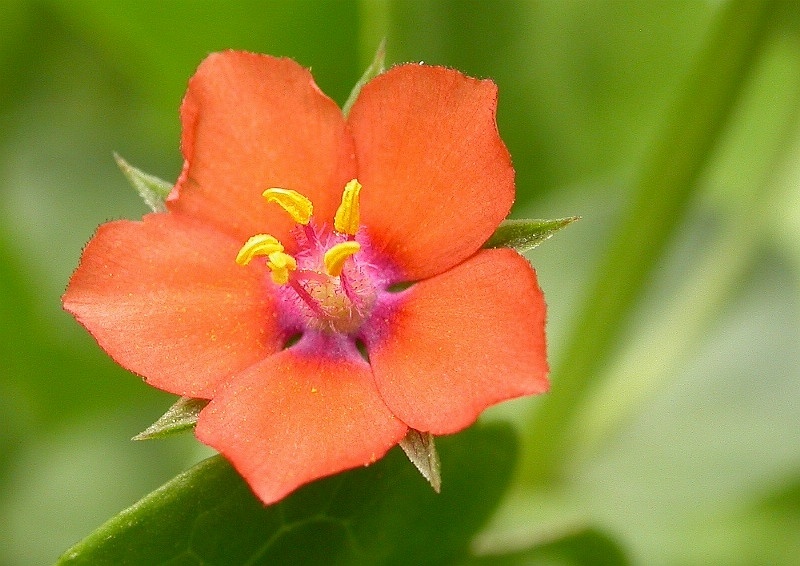

Floral formula
View on Wikipedia | |
| ✶ K5 [C(5) A5] G(5) | |
| Floral formula of Anagallis arvensis.[1]: 307 Polysymmetric flower. The perianth consists of 5 free sepals and 5 joined petals, which are fused with androecium. The flower is bisexual, it contains 5 stamens, the pistil is fused of five carpels, and the ovary is superior. |
A floral formula is a notation for representing the structure of particular types of flowers. Such notations use numbers, letters and various symbols to convey significant information in a compact form. They may represent the floral form of a particular species, or may be generalized to characterize higher taxa, usually giving ranges of numbers of organs. Floral formulae are one of the two ways of describing flower structure developed during the 19th century, the other being floral diagrams.[2] The format of floral formulae differs according to the tastes of particular authors and periods, yet they tend to convey the same information.[1]
A floral formula is often used along with a floral diagram.
History
[edit]Floral formulae were developed at the beginning of the 19th century.[2] The first authors using them were Cassel[3] (1820), who first devised lists of integers to denote numbers of parts in named whorls, and Martius[4] (1828). Grisebach[5] (1854) used 4-integer series to represent the 4 whorls of floral parts in his textbook to describe characteristics of floral families, stating numbers of different organs separated by commas and highlighting fusion. Sachs[6] (1873) used them together with floral diagrams; he noted their advantage of being composed of "ordinary typeface".
.png)
Although Eichler widely used floral diagrams in his Blüthendiagramme,[7][8] he used floral formulae sparingly, mainly for families with simple flowers. Sattler's[9] Organogenesis of Flowers (1973) takes advantage of floral formulae and diagrams to describe the ontogeny of 50 plant species. Newer books containing formulae include Plant Systematics by Judd et al.[10] (2002) and Simpson[11] (2010). Prenner et al. devised an extension of the existing model to broaden the descriptive capability of the formula and argued that formulae should be included in formal taxonomic descriptions.[2] Ronse De Craene (2010)[1] partially utilized their way of writing the formulae in his book Floral Diagrams.
Contained information
[edit]Organ numbers and fusion
[edit]The formula expresses counts of different floral organs;[note 1] these are usually preceded by letters or abbreviations according to the organ type. They are ordered corresponding to the arrangement of the parts of the flower from the outside to the inside:
| Bracts | Bracteoles | Tepals (perigon or perianth), or sepals (calyx) and petals (corolla) | Stamens (androecium) | Carpels (gynoecium) | Ovules | |
|---|---|---|---|---|---|---|
| B[2] | Bt[2] | P[2] or CaCo[12] | A | G | V[2] or O[9] | |
| K[2] or Ca[12] | C[2] or Co[12] | |||||
The labels with darker backgrounds are less common. "V" used by Prenner et al. for the number of ovules per gynoecium is followed by lowercase letter describing the type of placentation. For epicalyx/calyculus, the letter "k" is used.
The numbers are inserted after the labels, they may be formatted as sub- or superscript. If an organ is absent, its number is written as "0" or it is omitted, if there are "many" (usually more than 10–12) instances, it can be written as "∞". Whorls of the same organ are separated by "+". Organ counts within a whorl can be separated by ":", for example when part of the whorl is morphologically different. A range can be given if the number is variable, e.g. when the formula summarizes a taxon.
- K3+3 – a calyx with six free sepals, arranged as two separate whorls
- A∞ – many stamens
- P3–12 – perianth from three to twelve petals
Groups of organs can be described by writing the number of instances in the group as superscript.
- A5² – 5 groups of 2 stamens
The formula can also express organ fusion. Fusion of one organ type can be shown by enclosing the number in a circle, fusion of different organs can be represented by ties, as e.g. in Judd et al. Prenner et al. state that this method is difficult to achieve via standard typesetting.[2]: 242 Joining of organs can be more readily written using parentheses "(…)" if instances of the same organ are fused. Fusion between different organs can be achieved by square "[…]", eventually curly brackets "{…}".
- A(5) – five fused stamens
- [C(5) A5] – corolla fused from 5 petals, fused to stamens
Prenner et al. propose superscript zero for a lost organ, and superscript "r" for a reduced one. Ronse De Craene uses a degree symbol to mark a staminode (infertile stamen) or pistillode (infertile carpel).
- A3:2r+50 – (Prenner et al.) androecium in two whorls, first contains 3 stamens and 2 staminodes, second whorl lost
- A1+2° – (Ronse De Craene) androecium in two whorls, first whorl containing a stamen, second whorl containing two stamens in Ovary position
Ovary position is shown by alternating the "G" label. Simpson circumvents the intricate formatting by expressing the ovary position by words.
| superior ovary | inferior ovary | half-inferior ovary | |
|---|---|---|---|
| Prenner et al.,[2]: 243 Ronse De Craene[1]: 39 | G | Ĝ, Ğ | -G- |
| Sattler[9]: xviii | G | ||
| Simpson[11] | G…, superior | G…, inferior | G…, half-inferior |
Symmetry
[edit]Symmetry or arrangement may be described for the whole flower; in such case the corresponding symbol is usually placed at the beginning of the formula. It may be also outlined separately for different organs, placing it after their labels or numbers, or it may not be included in the formula at all. It is described by following symbols:
| polysymmetry (actinomorphic) |
disymmetry | monosymmetry (zygomorphic) |
asymmetry | spiral arrangement | |
|---|---|---|---|---|---|
| Prenner et al.[2]: 242 | * | ┼ | ↓, → or Ø, depending on the symmetry plane orientation | ∂ | not mentioned |
| Ronse De Craene[1]: 39 | ✶ | ↔ | ↓, arrow orientation depending on symmetry plane orientation | ↯ | ↺ |
| Sattler[2]: xviii | ✳ | + | ∙|∙ | not mentioned | |
| Judd et al.[10]: 66 | * | not mentioned | X | $ | |
| Subrahmanyam[13] | ⊕ | % in median plane, ÷ in lateral plane | not mentioned | ||
| Rosypal[14] | ✳ | ⤧ | ↓ | ↯ | 
|
Sexuality
[edit]Sexuality of the flower can be highlighted by ☿ or ⚥ for hermaphrodite (bisexual), ♂ for male (staminate) and ♀ for female (pistillate) flower. The symbols are usually placed at the beginning of the formula, after or before the symmetry symbol. Prenner et al. recommend to use the corresponding symbols (♀ and ♂) only for flowers of separate sexuality. Ronse De Craene utilizes the words "pistillate" or "staminate" instead of the symbols.
Floral formula can also incorporate the fruit type; Judd et al.[10] place it at the very end.
Examples
[edit]↯ K3 [C3 A1°–3°+½:2°] Ğ(3)[1]: 39 – the formula of Canna indica; asymmetric flower; calyx of three free sepals; corolla of three free petals joined with androecium; androecium in two whorls, the outer whorl contains 1–3 staminodes, the inner contains ½ of a stamen and 2 staminodes; gynoecium fused of 3 carpels, inferior ovary
B BtC K3:(2)C↓ C3:2r↓ A(3):2r↓+4r:10 G1↓ Vm8–10[2]: 246 – the formula of Tamarindus indica; bract and petaloid bracteoles; monosymmetric calyx of three and two petaloid sepals; monosymmetric corolla of three and two reduced petals; two whorls of stamens, the outer monosymmetric from three fused and two reduced stamens, the inner of 4 reduced and 1 lost stamen; monosymmetric gynoecium of 1 carpel with superior ovary; marginal placentation with 8–10 ovules per gynoecium.
Using boxes
[edit]| Narcissus Floral formula | |
| Br ✶ ☿ P3+3+Corolla A3+3 G(3)
Bracteate, Actinomorphic, Bisexual Perianth: 6 tepals in 2 whorls of 3 Stamens: 2 whorls of 3 Ovary: Superior - 3 fused carpels |
Flowers actinomorphic and hermaphrodite with 6 undifferentiated tepals in two whorls of three, the same number and arrangement of stamens, and a superior ovary with 3 fused carpels. Individual species and genera may have more or less derived formulas.
| Haloragaceae Floral formula | |
| ✶ or 3-4 free sepals, 3-4 free petals (or absent), 2-8 stamens, inferior ovary with 2-4 fused carpels |


See also
[edit]Notes
[edit]- ^ Bracts and bracteoles are not considered parts of the flower itself, yet they may be included in the floral formula
References
[edit]- ^ a b c d e f Ronse De Craene, Louis P. (2010-02-04). Floral Diagrams: An Aid to Understanding Flower Morphology and Evolution. Cambridge: Cambridge University Press. ISBN 978-0-521-49346-8.
- ^ a b c d e f g h i j k l m n Prenner, Gerhard; Richard M. Bateman; Paula J. Rudall (February 2010). "Floral formulae updated for routine inclusion in formal taxonomic descriptions". Taxon. 59 (1): 241–250. Bibcode:2010Taxon..59..241P. doi:10.1002/tax.591022. ISSN 0040-0262. Archived from the original on 2018-03-29. Retrieved 2014-02-06.
- ^ Cassel, F. P. (1820). Morphonomia botanica: sive observationes circa proportionem et evolutionem partium plantarum. Colonia Agrippina [Cologne]: M. DuMont-Schauberg.
- ^ Martius, C. F. (1828). "Über die Architectonik der Blüthen". Isis (Oken) (21): 522–529.
- ^ Grisebach, A. (1854). Grundriss der systematischen Botanik. Göttingen: Verlag der Dieterichschen Buchhandlung.
- ^ Sachs, J. (1873). Lehrbuch der Botanik nach dem gegenwaertigen Stand der Wissenschaft. Leipzig: Engelmann.
- ^ Eichler, August Wilhelm (1875). Blüthendiagramme, erster Theil: Enthaltend Einleitung, Gymnospermen, Monocotylen und sympetale Dicotylen. Vol. 1. Leipzig: Wilhelm Engelmann.
- ^ Eichler, August Wilhelm (1878). Blüthendiagramme, zweiter Theil: Enthaltend die apetalen und choripetalen Dicotylen. Vol. 2. Leipzig: Wilhelm Engelmann.
- ^ a b c Sattler, Rolf (1973). Organogenesis of flowers; a photographic text-atlas. Toronto, Buffalo: University of Toronto Press. ISBN 0-8020-1864-5.
- ^ a b c Judd, Walter S.; Christopher S. Campbell; Elizabeth A. Kellogg; Peter F. Stevens; Michael J. Donoghue (2002). Plant Systematics: A Phylogenetic Approach (2nd ed.). Sunderland, Mass., U.S.A.: Sinauer Associates. ISBN 0878934030.
- ^ a b Simpson, Michael George (2010). Plant Systematics. Oxford (Great Britain): Academic Press. ISBN 978-0-12-374380-0.
- ^ a b c "Floral formula".
- ^ Subrahmanyam, N. S. (1997-01-01). Modern Plant Taxonomy. Jangpura, New Delhi: South Asia Books. ISBN 9780706993462.
- ^ Rosypal, Stanislav (2003). Nový přehled biologie. Praha: Scientia. ISBN 80-7183-268-5.
Bibliography
[edit]External links
[edit]- Kvetné vzorce – a website dedicated to floral formulae (in Slovakian)
- Table 2.1. Floral formulae; symbols used in this book. In Ronse De Craene, p. 39
- Symbols employed in floral formula. In Subrahmanyam, p. 42
- Floral Diagram Generator – a website to generate floral diagrams from floral formulae.
- Virtual Floral Formula, an online learning resource for floral formulas
| Subdisciplines | |||||||||||
|---|---|---|---|---|---|---|---|---|---|---|---|
| Plant groups | |||||||||||
| Plant anatomy |
| ||||||||||
| Plant physiology Materials | |||||||||||
| Plant growth and habit | |||||||||||
| Reproduction | |||||||||||
| Plant taxonomy | |||||||||||
| Practice | |||||||||||
| |||||||||||

Floral formula
View on GrokipediaDefinition and Purpose
Core Concept
A floral formula is a written shorthand notation in botany that uses letters, numbers, and symbols to represent the structure of a flower, capturing essential morphological features such as the whorls of organs, their counts, fusion, symmetry, and sexuality./3.2.04:_Angiosperm_Diversity/3.2.4.04:_Angiosperm_Families) This system relies on a fundamental understanding of flower anatomy, where a typical flower comprises four concentric whorls: the calyx (collective sepals, protective outer leaves), corolla (collective petals, often colorful attractants), androecium (collective stamens, male reproductive organs consisting of filaments and anthers), and gynoecium (collective carpels, female reproductive organs forming the ovary, style, and stigma).[3] The notation typically commences with symbols denoting the flower's sex—♂ for male (staminate, bearing only stamens), ♀ for female (pistillate, bearing only carpels), and ⚥ for bisexual (perfect, with both stamens and carpels)—followed by indicators of symmetry, such as * for actinomorphic (radial, divisible into mirror images along multiple planes) or X for zygomorphic (bilateral, divisible along one plane)./3.2.04:_Angiosperm_Diversity/3.2.4.04:_Angiosperm_Families) It then proceeds acropetally (from outer to inner whorls) with abbreviated letters for each: K for calyx, C for corolla, A for androecium, and G for gynoecium, accompanied by numbers to specify organ counts (e.g., 5 for five parts) and symbols like brackets or circles to denote fusion (connation) among organs within a whorl or adnation between whorls.[3] This compact representation serves to standardize the description of flower morphology, enabling efficient comparison of structures across plant species for taxonomic classification, evolutionary analysis, and identification purposes, while eliminating the need for detailed diagrams.[4] By distilling complex anatomical variations into a universal format, floral formulae support broader botanical research and communication among scientists./3.2.04:_Angiosperm_Diversity/3.2.4.04:_Angiosperm_Families)Historical and Modern Uses
Floral formulas emerged as a practical tool in 19th-century botany, where they were employed in regional floras to provide concise descriptions of flower structures, allowing botanists to summarize organ arrangements and symmetries efficiently within the constraints of printed texts.[5] This approach, pioneered in works like those of Grisebach (1854) and Sachs (1873), enabled the representation of typical floral patterns for families or genera using abbreviated notations, reducing the need for lengthy prose while facilitating identification in field guides and systematic accounts.[5] In contemporary botany, floral formulas remain integral to plant taxonomy databases, where they standardize floral data for large-scale comparisons across species inventories.[5] They support evolutionary studies by integrating with phylogenetic analyses to reconstruct ancestral flower groundplans and track character evolution, such as stamen reduction in Orchidaceae.[5] Additionally, in educational contexts, they serve as a foundational tool for teaching floral morphology, encouraging students to dissect and encode flower features systematically.[5] Updates in 2010, incorporating Unicode symbols for features like symmetry (e.g., ↓ for zygomorphy) and fusion, have enhanced their digital viability, enabling routine inclusion in formal taxonomic descriptions and online repositories without specialized fonts.[5] One key advantage of floral formulas is their space efficiency over descriptive prose, making them ideal for compact summaries in biodiversity inventories and rapid assessments during phylogenetic research.[5] They promote uniformity in notation, aiding quick cross-species comparisons and data integration in taxonomic workflows.[5] However, floral formulas have limitations in visualizing spatial relationships or organ orientations, often requiring supplementary diagrams for full comprehension, and they are less effective for documenting unique morphological anomalies outside standardized patterns.History
Origins in Early Botany
The floral formula, a symbolic notation for describing flower structure, originated in the early 19th century as botanists sought efficient ways to document morphological details amid the rapid expansion of plant collections from global explorations. German botanist Franz-Peter Cassel is credited with the initial development of this system in his 1820 work Morphonomia botanica: sive observationes circa proportionem et evolutionem partium plantarum, where he devised lists of floral characteristics using numerical and symbolic representations to capture organ arrangements and proportions. This innovation addressed the limitations of verbose textual descriptions in an era when herbaria were burgeoning with specimens from expeditions, necessitating standardized methods to compare and classify diverse angiosperm forms. The approach was further refined by Carl Friedrich Philipp von Martius in 1828, who developed the first formulae resembling those used today.[6] Cassel's approach laid the groundwork for concise floral summaries, but its widespread adoption came later through German botanist August Wilhelm Eichler, who integrated and refined such notations in the 1870s. In his seminal two-volume Blüthendiagramme (1875–1878), Eichler employed early floral formulas alongside diagrams, using Roman numerals to denote organ counts (e.g., V for five sepals) and basic symbols for fusion or arrangement, primarily for simpler flower types.[7] This system facilitated systematic botany by providing a compact, visual aid for morphological analysis, influencing subsequent European floras and taxonomic works that required precise, language-independent communication across multilingual scientific communities. Emerging in the post-Linnaean period, when Carl Linnaeus's binomial nomenclature had shifted focus toward detailed organ-based classification, the floral formula responded to the need for tools beyond mere naming to encompass evolutionary and structural insights. Eichler's contributions, in particular, promoted empirical descriptions of floral whorls, bridging observational botany with emerging phylogenetic ideas and setting a precedent for standardized notation in 19th-century systematics.Key Developments and Standardizations
In the late 19th century, August Wilhelm Eichler significantly advanced the floral formula notation through his multi-volume work Blüthendiagramme (1875–1878), where he standardized the sequential representation of floral whorls as K (calyx), C (corolla), A (androecium), and G (gynoecium), while introducing parentheses to denote fusion of organs within whorls.[8] This formalization provided a concise textual complement to his pioneering floral diagrams, facilitating comparative morphology across angiosperms and influencing subsequent botanical classifications.[5] During the 20th century, floral formulas saw broader adoption in English-speaking botany through morphological studies that integrated them into analyses of flower structure and evolution. By the mid-century, notations were refined to incorporate symbols for ovary position, such as an overline for inferior ovaries (e.g., ) and an underbar for superior ovaries (e.g., ), enhancing their utility in phylogenetic systems.[5] These additions allowed for more precise depiction of gynoecium insertion relative to other whorls, supporting detailed taxonomic revisions. In recent decades, efforts to standardize floral formulas for digital and international use culminated in the 2010 proposal by Gerhard Prenner, Richard M. Bateman, and Paula J. Rudall, which advocated an expanded, maximally informative format compatible with Unicode standards to routinely include acropetal organ sequences (from base to apex) and aestivation patterns (e.g., using symbols like < for imbricate arrangements).[9] This update addressed limitations in traditional notations, promoting their integration into electronic taxonomic publications for improved accessibility and consistency. Today, floral formulas are a standard feature in major floras, including the Flora of North America, where they summarize family-level traits, and in taxonomic software such as DELTA, which employs them to generate interactive identification keys and automated descriptions.Notation System
Symbols for Floral Whorls and Organs
The primary symbols in floral formulas denote the four main whorls of a flower, progressing from the outermost to the innermost: the calyx (K), corolla (C), androecium (A), and gynoecium (G). When sepals and petals are undifferentiated, as in many monocots, the perianth is represented by P.[1] Organ counts are indicated by Arabic numerals placed after the whorl symbol, specifying the exact number of parts (e.g., K5 for five sepals). An infinity symbol (∞) denotes many or indefinite organs, typically more than 12, while a dash (-) indicates the absence or reduction of a whorl.[1] Fusion among organs is notated using parentheses for partial fusion within a whorl (e.g., C(5) for five fused petals) and brackets for complete fusion or adnation across whorls (e.g., [C(5)A(5)] for corolla and androecium fused together). For antepetalous stamens, where the inner whorl adheres to the corolla, notations may include superior numbers or plus signs to indicate whorl positions (e.g., A3+3 for three antesepalous and three antepetalous stamens).[5] In unisexual flowers, symbols such as ♂ for male (staminate) and ♀ for female (pistillate) precede the formula to denote sexuality.[1]| Symbol | Meaning | Example Usage |
|---|---|---|
| K | Calyx (sepals) | K5 |
| C | Corolla (petals) | C(5) |
| P | Perianth (tepals) | P3+3 |
| A | Androecium (stamens) | A∞ |
| G | Gynoecium (carpels) | G(2) |
| ∞ | Many/indefinite organs | A∞ |
| - | Absent whorl | K- |
| ( ) | Partial fusion within whorl | A(5) |
| [ ] | Complete fusion across whorls | [CA] |
| ♂ | Male flower | ♂ K5 C5 A5 G- |
| ♀ | Female flower | ♀ K5 C5 G1 |