Hubbry Logo
CataphyllCataphyllMain
Open search
Cataphyll
Community hub
Cataphyll
logo
8 pages, 0 posts
0 subscribers
Be the first to start a discussion here.
Contribute something
Cataphyll
Cataphyll
from Wikipedia
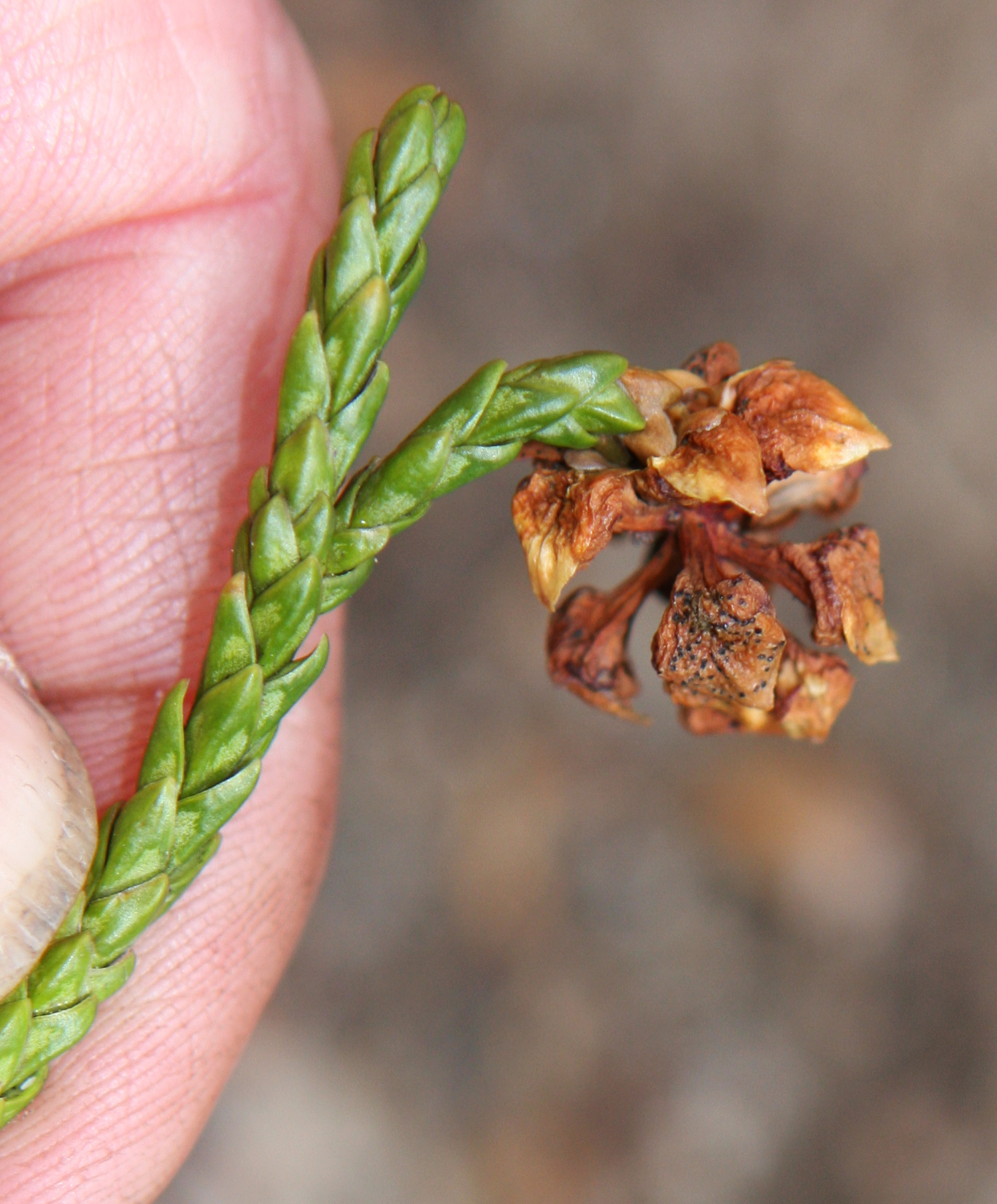
The stems of Athrotaxis are covered with small flat pointed leaves called "scale leaves" or "cataphylls".

In plant morphology, a cataphyll (sometimes also called a cataphyllum[1] or cataphyll leaf[2]) is a reduced, small leaf.[3] Many plants have both "true leaves" (euphylls), which perform most of the photosynthesis, and cataphylls, which are modified to perform other functions.[4]

Cataphylls include bracts, bracteoles and bud scales, as well as any small leaves that resemble scales, known as scale leaves.[5] The functions of cataphylls, such as bud scales, may be short-lived, and they are often shed after their function is fulfilled.[6]

Etymology

[edit]
Leaf bud of American Sweet gum (Liquidambar styraciflua); the cataphylls covering the bud show a little chlorophyll, but they shed instead of growing into photosynthetic leaves.

Cataphyll comes from the Ancient Greek κατά ("kata"), meaning "down", and φύλλον ("phyllon"), meaning "leaf".[7]

Forms

[edit]

In some cases, cataphylls perform a transient function, after which they die and may shed. Those that shed early are said to be caducous. The sepals of Papaver species are shed during the very opening of the petals and are a dramatic example of caducous leaves.[citation needed]

Cataphylls can have many other forms. Some, such as spines, corm-scales, and bud-scales, may be persistent but may not perform their major function until they die, whether or not they are physically shed. Examples of various kinds of living cataphylls include bulb-scales, rhizome-scales, cotyledons, and scaly bracts.[2] Several of these occur in various forms and contexts. For example, bud scales occur on numerous kinds of leaf or branch buds, as well as on flower buds.[citation needed]

Protective masses of dead leaves encircle the stems of some species of palm trees or aloes, but those are not usually regarded as cataphylls because their primary function while alive is photosynthesis.[citation needed]

Cotyledons as cataphylls

[edit]
Acer pseudoplatanus seedling showing cotyledons that supplied the first photosynthetic function for the growing plant. They will soon drop off after the young leaves grow large enough to take over.

Cotyledons are widely regarded as a class of cataphyll,[8] though many kinds of cotyledons function as living tissue and remain alive until, at least, the end of their function, at which time they wither and may drop off. They begin as leaf rudiments. Many kinds accumulate nutrient materials for storage, starting to give up their stored material as the plant germinates. Some, such as the cotyledons of many legumes, conifers, and cucurbits, develop chlorophyll and perform the first photosynthesis for the germinating plant.[citation needed]

Corm scales

[edit]
Opuntia compressa, commonly called the Eastern Prickly Pear. Each areole contains one or more fixed, large spines as well as a sheaf of glochidia. The spines are examples of cataphylls.[citation needed]

Like bulb-scales, corm scales are largely the basal parts of the photosynthetic leaves that show up above ground. Some species of cormous plants, such as some Lapeirousia, also produce cataphylls that act solely as tunic leaves for the corm.[9] Unlike bulb-scales, however, the corm tunic has no significant storage function; that task is left to the parenchyma of the cortex of the corm.[citation needed]

See also

[edit]

References

[edit]
Revisions and contributorsEdit on WikipediaRead on Wikipedia
from Grokipedia
A cataphyll is a rudimentary, scale-like that precedes the foliage leaves of a , often functioning as a scale or protective sheath. These modified leaves are typically small, non-photosynthetic, and adapted for rather than . Cataphylls serve to shield dormant buds or newly emerging shoots from environmental stresses, such as , by forming a tough, often resinous covering. In many species, they are transient structures that wither, turn brown, and eventually shed once the protected foliage leaves expand. Their initiation often occurs early in the , such as in spring for temperate trees, before the production of fully developed leaves. Variations in cataphyll form include simple bud scales on trees, papery sheaths enveloping new leaves in aroids like philodendrons, and protective scales on corms or rhizomes in geophytes. In cycads, cataphylls specifically guard developing true leaves within the crown. Some cataphylls, such as those in certain , exhibit irregularities like basal development or irregular shedding patterns that aid in taxonomic identification. In monocots like the titan arum (Amorphophallus titanum), cataphylls act as outer protective layers that persist briefly before withering as the or leaf emerges.

Definition and Characteristics

Core Definition

A cataphyll is a reduced, scale-like in , typically non-photosynthetic and serving protective or preparatory roles in development rather than . These structures occur in many vascular plants as rudimentary modifications preceding the expanded foliage leaves (euphylls). Cataphylls are identified by their small size relative to mature leaves, simplified structure often without an expanded (lamina), and early position at shoot or root bases during growth. They function as transitional structures before fully photosynthetic leaves develop. Cataphylls differ from prophylls, the first leaves of lateral shoots, though both may protect emerging growth.

Key Morphological Traits

Cataphylls differ from foliage leaves in their greatly reduced size relative to mature leaves, often with a rudimentary or absent blade that emphasizes protection over photosynthesis. Their texture is typically membranous, scaly, or leathery for durability. They usually lack chlorophyll and appear non-green, with simple or absent venation limited to supportive keels or ribs. In development, cataphylls arise early from the shoot apex, enveloping buds, rhizomes, or corms to protect meristems and young structures from environmental stress before true leaves expand. Their primordia form compactly, transitioning in sequence to larger foliage leaves on proleptic shoots. Cataphylls vary in persistence: some are caducous, shedding after fulfilling protection (e.g., post-bud burst), while others persist as scales or spines for ongoing support, adapting to developmental needs where caducous types aid quick photosynthetic shift and persistent ones offer extended defense.

Terminology

Etymology

The term cataphyll is derived from kata-, meaning "down" or "against" and implying a subordinate or basal position, combined with , meaning "leaf". This construction highlights the organ's reduced, protective role at the base of shoots, distinct from primary photosynthetic leaves. The English term serves as a direct translation of the German Niederblatt, literally "lower ", which had been used in continental botanical morphology prior to the 20th century. First recorded in English botanical literature in the 1911 , cataphyll emerged amid advancements in by systematists who classified leaf variations. In contrast, the term euphyll (from Greek eu-, meaning "true" or "well-developed", plus phyllon) denotes fully formed foliage leaves capable of , underscoring the binary distinction between primitive and mature leaf types in morphological studies. Cataphylls differ from s, which are specialized leaf-like structures that subtend and protect flowers or inflorescences in reproductive contexts, whereas cataphylls serve vegetative roles without direct association to floral organs. Bracteoles, also known as bractlets, represent smaller subtypes of s, often occurring singly or in pairs on pedicels or calyces to support individual flowers, further highlighting their reproductive specialization in contrast to the broader vegetative protective function of cataphylls. Hypophylls describe the basal region of leaf primordia in ferns and certain vascular plants, developing into the leaf base and sometimes stipules, distinct from cataphylls as they constitute a developmental zone rather than a complete reduced leaf structure. In comparison, prophylls are the initial foliage leaves emerging on lateral branches or shoots, which may exhibit cataphyll-like reduction to scales (termed cataprophylls) in monocots but generally transition to more developed forms unlike the consistently scale-like cataphylls on main axes. The term scale leaf frequently overlaps with cataphyll in botanical descriptions, referring to thin, membranous, non-photosynthetic leaves that protect buds or rhizomes, though in non-technical usage, scale leaf may broadly encompass any small, dry foliar structure without the precise morphological connotations of cataphyll. This terminological intersection arises from shared etymological roots in Greek "phyllon" (leaf), but cataphyll specifically denotes early or protective vegetative leaves preceding foliage development.

Forms and Types

Cotyledons as Cataphylls

Cotyledons are classified as cataphylls when they are reduced in form, lack , and serve primarily as storage organs for nutrients rather than performing like typical foliage leaves. In such cases, these embryonic leaves protect the developing by enclosing the plumule and within the seed coat, while mobilizing stored reserves like and proteins to support initial growth. This non-photosynthetic role distinguishes them from epigeal cotyledons, which expand above ground and contribute to early carbon fixation. A prominent example occurs in hypogeous germination, where cotyledons remain subterranean and function solely as storage structures without emerging to photosynthesize. In peas (Pisum sativum), a dicot, the thick, pale cotyledons stay below the soil surface during germination, providing essential nutrients to the elongating epicotyl while the radicle anchors the seedling./04%3A_Plant_Physiology_and_Regulation/4.06%3A_Development/4.6.04%3A_Germination) Similarly, in oaks (Quercus spp.), such as Quercus crispula, the hypogeal cotyledons are non-photosynthetic and store nonstructural carbohydrates that fuel root and shoot development in the first weeks after emergence, often comprising a significant portion of the seed's biomass. Following the exhaustion of their reserves, cataphyll-like cotyledons in these systems typically undergo resorption or , transitioning the seedling to reliance on true foliage leaves for sustained growth. In hypogeal , the cotyledons shrink as their cellular contents are reabsorbed by the or roots, preventing further metabolic investment in non-functional tissue. This process ensures efficient , with the shed or absorbed remnants decomposing underground without interfering with the emerging photosynthetic organs.

Scale Leaves and Bud Scales

Scale leaves and bud scales represent specialized cataphylls adapted for enclosing and shielding vulnerable plant structures, particularly dormant buds, rhizomes, and bulbs. Bud scales form tight, overlapping imbricate layers that envelop winter buds in many temperate woody plants, creating a barrier against , physical damage, and pathogens during . In , for instance, terminal buds feature three or more shiny, green-to-orange-brown scales that overlap like shingles, often coated in a sticky for enhanced impermeability. These bud scales exhibit diverse textural adaptations to bolster environmental resistance, including leathery surfaces for toughness, waxy or resinous coatings to repel water, and hairy exteriors to trap insulating air layers. Leathery textures predominate in many , providing flexibility and durability without excessive rigidity, as seen in the protective coverings of various temperate . Waxy variations, such as those with resin-filled interstices, further seal the bud against moisture loss, while hairy scales, like those on certain poplars, add a fuzzy layer that mitigates frost damage. On underground structures, scale leaves function similarly as cataphylls on and , offering insulation and moisture retention to support in geophytes. In species, such as (Allium cepa), bulb scales form concentric, tunicate layers of thin, fleshy, and often transparent cataphylls that encase the storage tissues, preventing dehydration and microbial invasion in environments. scales in monocots like irises likewise consist of dry, papery or leathery sheaths that overlap to maintain and protect meristems from abrasion. These adaptations ensure the scales remain persistent until new growth emerges, at which point they typically abscise or degrade.

Other Specialized Forms

In certain cacti, such as those in the genus , spines represent persistent cataphylls derived from modified bud scales or leaf primordia within areoles, serving as hardened, protective structures that remain after the initial developmental phase. These spines, often barbed and numerous, arise from the axillary positions of reduced leaves and contribute to long-term defense against herbivores while minimizing water loss in arid environments. In the family, particularly in genera like and , cataphylls manifest as thin, membranous sheaths that envelop emerging foliage or reproductive structures, providing mechanical support and moisture retention during growth. For instance, in , these cataphylls feature specialized colleters at their apices that secrete to deter pathogens and insects, with the sheaths typically splitting longitudinally as the new expands. In vining , the cataphylls become post-emergence, shedding to avoid encumbrance on climbing stems. Transitional cataphyll forms occur in geophytic species of Lapeirousia (), where they develop as scaly, fibrous bracts forming the tunic layers around , offering insulation and protection during seasonal dormancy. In the L. corymbosa complex, for example, two pale or brownish membranous cataphylls encase the corm base, with their compacted fibers creating a woody outer layer that persists across growth cycles. These structures facilitate renewal by shielding the from and physical damage in Mediterranean-like habitats.

Functions

Protective Functions

Cataphylls primarily serve to enclose and shield apical meristems and developing young tissues within buds, preventing damage from environmental stressors such as , , and herbivory. In temperate climates, bud scales— a common form of cataphyll—form a protective mantle around the embryonic shoot during winter , insulating vulnerable primordial leaves and meristems from freezing temperatures and excessive moisture loss. This enclosure allows for extra-organ ice formation outside the bud, thereby mitigating intracellular frost damage to sensitive tissues. Additionally, cataphylls act as a physical barrier against herbivores by separating bud contents from external threats, often enhanced by chemical defenses like and anthocyanins that deter feeding and bolster frost resistance. The mechanical barrier properties of cataphylls arise from their specialized multi-layered , which effectively reduces water loss and physical abrasion. These structures typically feature a thick on the to minimize and , combined with imbricate (overlapping) layers of tough, scale-like tissues that create a robust shield against , sun exposure, and mechanical . Glandular trichomes and air cavities in the epidermal complex also contribute to this barrier by repelling water and reducing temperature fluctuations. Once the protected tissues have developed sufficiently, many cataphylls employ shedding mechanisms to avoid resource drain, particularly in caducous forms that post-protection. This process involves the formation of an layer at the base, which weakens the attachment and facilitates the timely detachment of the cataphyll, as seen in species like Pterocarya stenoptera where scales abscise before winter to expose foliage. In vines and herbaceous plants, this shedding often occurs promptly after , with the cataphyll recurling and splitting to release the new without compromising the stem. Such mechanisms ensure efficient transition from protection to growth phases.

Storage and Developmental Roles

Cataphylls serve critical storage functions by accumulating essential nutrients that support early plant growth and regrowth after dormancy. In particular, cotyledons acting as cataphylls store reserves derived from the endosperm to nourish the emerging seedling until photosynthesis begins. In non-endospermic seeds such as those of grain legumes, the endosperm is largely degraded during cotyledon expansion, allowing the cotyledons to become the primary storage sites for proteins, oils, and other mobilized nutrients that fuel initial development. For instance, in legume seeds, cotyledons accumulate significant amounts of storage proteins and lipids, which provide energy and building blocks for hypocotyl elongation and root establishment post-germination. Scale leaves, a common form of cataphyll, contribute to storage in underground organs by accumulating and other , enabling and seasonal regrowth. In bulbous plants, fleshy scale leaves function as key reservoirs, storing derived from prior to sustain shoot emergence in the next . These cataphylls in , such as those in lilies, form the bulk of the storage tissue, with the current season's fleshy cataphyll developing into the primary nutrient depot for the following year's . Although corm tunics composed of scale leaves primarily protect rather than store, analogous cataphylls in related geophytes underscore their role in reserve accumulation for regrowth after adverse conditions. Beyond storage, cataphylls influence developmental processes by initiating phyllotaxy, the spatial arrangement of leaves on the stem, which guides the positioning of subsequent true leaves. In monocots, prophylls—a specialized type of cataphyll as the first on lateral shoots—establish the starting phyllotactic pattern, typically in an adaxial orientation relative to the main axis, thereby determining the divergence angles and spiral or opposite arrangements of later foliage. This positional control ensures optimal light capture and in the developing shoot system.

Occurrence and Examples

In Monocotyledons

Cataphylls are particularly prevalent in monocotyledons, where they often form protective sheaths or scales adapted to underground storage organs and emerging shoots in tropical and temperate environments. In the family Araceae, cataphylls manifest as membranous sheaths that envelop developing leaves and inflorescences, providing mechanical protection during early growth stages. For instance, in species of Monstera, such as M. adansonii and M. spruceana, these sympodial cataphylls consist primarily of a shortened sheath without a blade, shielding the shoot apex and supporting inflorescence development until the structure dries and flakes off. In , cataphylls are evident as the fleshy bulb scales that encase the underground , serving dual roles in storage and protection against . Tulips (Tulipa spp.) exemplify this, where the comprises multiple cataphylls or bracts that form the modular structure, with each module including two such scales alongside foliage leaves; these scales store carbohydrates and shield the apical during . Similarly, in , cataphylls contribute to the fibrous or leathery s surrounding s, enhancing drought resistance in arid-adapted species. In , the is enclosed by several layers of brownish fibrous s derived from sheathing cataphylls, with the lowest leaf often reduced to a subterranean cataphyll that protects the emerging shoot while the prevents water loss. In (grasses), the single is modified into a scutellum, which acts as an absorptive structure that protects the embryo and facilitates nutrient uptake from the without developing photosynthetic tissue. This structure, combined with the sheath, underscores the protective adaptations in monocot seedlings.

In Dicotyledons

In dicotyledons, cataphylls often appear as modified cotyledons that remain subterranean during , particularly in the family. For instance, in peas (Pisum sativum), the two cotyledons are hypogeous, staying below the soil surface and functioning primarily as storage organs that supply nutrients to the growing and epicotyl rather than performing . These cotyledons are thick and non-green, embodying the protective and storage characteristics typical of cataphylls, and they eventually wither after nutrient mobilization. Similar hypogeous cotyledons occur across many species, where the shortened pushes the shoot upward without elevating the seed leaves, emphasizing their role in early establishment. Bud scales represent another prominent form of cataphyll in temperate dicotyledons, providing essential protection for dormant buds. In genera like Acer (maples), such as and , multiple overlapping bud scales—modified, scale-like leaves—encase overwintering buds to shield the immature foliage and meristems from , , and mechanical damage. These cataphylls are typically leathery, resin-coated, and valvate in arrangement, with 2 to 12 scales per bud depending on the species, and they abscise in spring as the true leaves expand. This adaptation is widespread in woody temperate dicots, enabling survival through harsh winters by minimizing and entry. In herbaceous dicotyledons like those in the family, cataphylls manifest as reduced leaves during early growth phases, offering transient protection to the shoot apex. For example, in Trichosanthes pentaphylla, a single cataphyll emerges prior to the first foliage , measuring about 2 cm long with an ovate to triangular shape, and it safeguards the plumule against environmental stresses before senescing. Such rudimentary leaves are common in vining cucurbits during establishment, where they are small, non-photosynthetic, and quickly replaced by expansive true leaves adapted for climbing and light capture. This pattern highlights the transitional role of cataphylls in facilitating rapid post-germination development in these fast-growing species.

In Gymnosperms and Other Groups

In gymnosperms, cataphylls often manifest as scale-like or reduced leaves that precede the development of more specialized foliage, particularly in conifers. In species of the genus Pinus, such as pines, cataphylls appear as small, non-chlorophyllous primary leaves arranged helically on young shoots, serving as basal scales before the emergence of mature needle-like leaves in fascicles. These juvenile cataphylls, which can exhibit needle-like tips in some conifer taxa, are typically subulate or lanceolate with erose margins and are shed to reveal the characteristic pattern of dwarf shoots bearing needles. For instance, in Pinus seedlings, cataphylls form green or brown bud scales that transition to the adult needle morphology after the initial growth phases. Cycads, another major group, feature prominent cataphylls as modified, thickened leaves at the base of crowns or stems, distinctly separate from their pinnate foliage leaves. These cataphylls are produced in flushes prior to or emergence and act protectively around the apical . Examples include genera like and , where these scales overlap to shield reproductive structures during early development. Occurrences of cataphylls in non-seed , such as (pteridophytes), are less common but notable on structures. In species like the ostrich fern (Matteuccia struthiopteris), cataphylls appear as persistent, scaly leaf bases surrounding the central , forming a protective crown that stores and guards the growing point. These prophyll-like cataphylls on fern are typically the first modified leaves on branches, reduced to scales that cover primordia and prevent in subterranean or basal positions. Such adaptations highlight the sporadic but evolutionarily conserved role of cataphylls in fern protection.

Evolutionary and Ecological Aspects

Evolutionary Origins

The evolutionary origins of cataphylls are closely tied to the development of leaves in early vascular plants during the period, approximately 419–359 million years ago, where simple, non-vascularized enations—small outgrowths from stems—served as precursors to more complex foliar structures. These enations, observed in fossils from the such as those in Asteroxylon, gradually vascularized and specialized, transitioning into protective forms that shielded apical meristems and developing buds in ancestral lineages. In euphyllophytes, the clade encompassing ferns and seed plants, this progression led to the differentiation of megaphylls, from which cataphylls as scale-like modifications emerged, adapting to environmental pressures by prioritizing protection over . In seed plants, cataphylls underwent beginning in the Permian to periods (around 299–201 million years ago), coinciding with the diversification of gymnosperms and the colonization of increasingly variable terrestrial climates. This radiation is evidenced by fossil records, such as those of the cycad Antarcticycas schopfii, which display primitive cataphyll features like triangular shapes and specialized vascular patterns that facilitated by enveloping buds against , , and mechanical damage during unfavorable seasons. Such adaptations enhanced survival in fluctuating environments, allowing lineages to persist through climatic shifts that challenged earlier vascular forms. Comparative morphology highlights cataphylls as a derived trait within euphyll-bearing lineages, distinct from the microphylls of lycophytes, which evolved independently from enations with single, unbranched veins and lack the complex, multi-veined of megaphylls. Lycopod microphylls, as seen in fossils like Leclercqia, represent a simpler, enation-based homology without the potential for extensive modification into protective scales, underscoring the evolutionary innovation of cataphylls in euphyllophytes for specialized roles in enclosure and seasonal . This divergence reflects broader phylogenetic patterns where cataphylls evolved as homologous reductions of foliage leaves, optimizing protection in woody perennials across gymnosperms and angiosperms.

Ecological Significance

Cataphylls play a crucial role in enhancing plant resilience in arid and seasonal habitats by providing a protective barrier around dormant buds, shielding them from and other environmental stresses. In South American species, cataphylls have been observed to safeguard buds against factors such as moisture loss and abrasion, enabling survival in dry, exposed environments. This protective function is evident in perennial grasses of semi-arid rangelands, where cataphylls enclose dormant buds beneath the soil surface, preventing water loss during prolonged dry periods and facilitating resprouting upon favorable conditions. The rapid bud protection afforded by cataphylls in tropical aroids supports their establishment and proliferation in disturbed or competitive environments. In aroids such as and , cataphylls encase emerging leaves, enabling quick development and regrowth that facilitates adaptation to variable tropical habitats. This mechanism allows for efficient during early growth stages.

References

  1. https://en.wikisource.org/wiki/1911_Encyclop%C3%A6dia_Britannica/Cataphyll
Add your contribution
Related Hubs
Contribute something
User Avatar
No comments yet.