



Community hub
Recent from talks
Contribute something
Nothing was collected or created yet.
Diagonalizable matrix
View on Wikipedia
In linear algebra, a square matrix is called diagonalizable or non-defective if it is similar to a diagonal matrix. That is, if there exists an invertible matrix and a diagonal matrix such that . This is equivalent to . (Such , are not unique.) This property exists for any linear map: for a finite-dimensional vector space , a linear map is called diagonalizable if there exists an ordered basis of consisting of eigenvectors of . These definitions are equivalent: if has a matrix representation as above, then the column vectors of form a basis consisting of eigenvectors of , and the diagonal entries of are the corresponding eigenvalues of ; with respect to this eigenvector basis, is represented by .


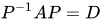


Diagonalization is the process of finding the above and and makes many subsequent computations easier. One can raise a diagonal matrix to a power by simply raising the diagonal entries to that power. The determinant of a diagonal matrix is simply the product of all diagonal entries. Such computations generalize easily to .
The geometric transformation represented by a diagonalizable matrix is an inhomogeneous dilation (or anisotropic scaling). That is, it can scale the space by a different amount in different directions. The direction of each eigenvector is scaled by a factor given by the corresponding eigenvalue.
A square matrix that is not diagonalizable is called defective. It can happen that a matrix with real entries is defective over the real numbers, meaning that is impossible for any invertible and diagonal with real entries, but it is possible with complex entries, so that is diagonalizable over the complex numbers. For example, this is the case for a generic rotation matrix.
Many results for diagonalizable matrices hold only over an algebraically closed field (such as the complex numbers). In this case, diagonalizable matrices are dense in the space of all matrices, which means any defective matrix can be deformed into a diagonalizable matrix by a small perturbation; and the Jordan–Chevalley decomposition states that any matrix is uniquely the sum of a diagonalizable matrix and a nilpotent matrix. Over an algebraically closed field, diagonalizable matrices are equivalent to semi-simple matrices.
Definition
[edit]A square matrix with entries in a field is called diagonalizable or nondefective if there exists an invertible matrix (i.e. an element of the general linear group GLn(F)), , such that is a diagonal matrix.


Characterization
[edit]The fundamental fact about diagonalizable maps and matrices is expressed by the following:
- An matrix over a field is diagonalizable if and only if the sum of the dimensions of its eigenspaces is equal to , which is the case if and only if there exists a basis of consisting of eigenvectors of . If such a basis has been found, one can form the matrix having these basis vectors as columns, and will be a diagonal matrix whose diagonal entries are the eigenvalues of . The matrix is known as a modal matrix for .
- A linear map is diagonalizable if and only if the sum of the dimensions of its eigenspaces is equal to , which is the case if and only if there exists a basis of consisting of eigenvectors of . With respect to such a basis, will be represented by a diagonal matrix. The diagonal entries of this matrix are the eigenvalues of .


The following sufficient (but not necessary) condition is often useful.
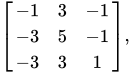
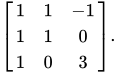
- An matrix is diagonalizable over the field if it has distinct eigenvalues in , i.e. if its characteristic polynomial has distinct roots in ; however, the converse may be false. Consider which has eigenvalues 1, 2, 2 (not all distinct) and is diagonalizable with diagonal form (similar to ) and change of basis matrix : The converse fails when has an eigenspace of dimension higher than 1. In this example, the eigenspace of associated with the eigenvalue 2 has dimension 2.
- A linear map with is diagonalizable if it has distinct eigenvalues, i.e. if its characteristic polynomial has distinct roots in .


Let be a matrix over . If is diagonalizable, then so is any power of it. Conversely, if is invertible, is algebraically closed, and is diagonalizable for some that is not an integer multiple of the characteristic of , then is diagonalizable. Proof: If is diagonalizable, then is annihilated by some polynomial , which has no multiple root (since ) and is divided by the minimal polynomial of .



Over the complex numbers , almost every matrix is diagonalizable. More precisely: the set of complex matrices that are not diagonalizable over , considered as a subset of , has Lebesgue measure zero. One can also say that the diagonalizable matrices form a dense subset with respect to the Zariski topology: the non-diagonalizable matrices lie inside the vanishing set of the discriminant of the characteristic polynomial, which is a hypersurface. From that follows also density in the usual (strong) topology given by a norm. The same is not true over .


The Jordan–Chevalley decomposition expresses an operator as the sum of its semisimple (i.e., diagonalizable) part and its nilpotent part. Hence, a matrix is diagonalizable if and only if its nilpotent part is zero. Put in another way, a matrix is diagonalizable if each block in its Jordan form has no nilpotent part; i.e., each "block" is a one-by-one matrix.
Diagonalization
[edit]Consider the two following arbitrary bases and . Suppose that there exists a linear transformation represented by a matrix which is written with respect to basis E. Suppose also that there exists the following eigen-equation:
![{\displaystyle E=\{{{\boldsymbol {e}}_{i}|\forall i\in [n]}\}}](https://wikimedia.org/api/rest_v1/media/math/render/svg/c713e2dfbd10285e2ad74bc1af00a7536a9616f0)
![{\displaystyle F=\{{{\boldsymbol {\alpha }}_{i}|\forall i\in [n]}\}}](https://wikimedia.org/api/rest_v1/media/math/render/svg/f257452f06ba7c5860fbc9c1bc6fd4fd30985ff5)


The alpha eigenvectors are written also with respect to the E basis. Since the set F is both a set of eigenvectors for matrix A and it spans some arbitrary vector space, then we say that there exists a matrix which is a diagonal matrix that is similar to . In other words, is a diagonalizable matrix if the matrix is written in the basis F. We perform the change of basis calculation using the transition matrix , which changes basis from E to F as follows:


,

where is the transition matrix from E-basis to F-basis. The inverse can then be equated to a new transition matrix which changes basis from F to E instead and so we have the following relationship :


Both and transition matrices are invertible. Thus we can manipulate the matrices in the following fashion:The matrix will be denoted as , which is still in the E-basis. Similarly, the diagonal matrix is in the F-basis.
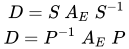

If a matrix can be diagonalized, that is,
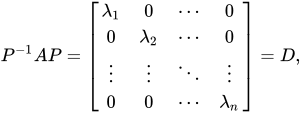
then:
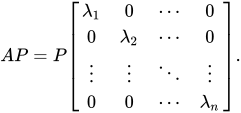
The transition matrix S has the E-basis vectors as columns written in the basis F. Inversely, the inverse transition matrix P has F-basis vectors written in the basis of E so that we can represent P in block matrix form in the following manner:


as a result we can write:

In block matrix form, we can consider the A-matrix to be a matrix of 1x1 dimensions whilst P is a 1xn dimensional matrix. The D-matrix can be written in full form with all the diagonal elements as an nxn dimensional matrix:

Performing the above matrix multiplication we end up with the following result:Taking each component of the block matrix individually on both sides, we end up with the following:


So the column vectors of are right eigenvectors of , and the corresponding diagonal entry is the corresponding eigenvalue. The invertibility of also suggests that the eigenvectors are linearly independent and form a basis of . This is the necessary and sufficient condition for diagonalizability and the canonical approach of diagonalization. The row vectors of are the left eigenvectors of .

When a complex matrix is a Hermitian matrix (or more generally a normal matrix), eigenvectors of can be chosen to form an orthonormal basis of , and can be chosen to be a unitary matrix. If in addition, is a real symmetric matrix, then its eigenvectors can be chosen to be an orthonormal basis of and can be chosen to be an orthogonal matrix.


For most practical work matrices are diagonalized numerically using computer software. Many algorithms exist to accomplish this.
Simultaneous diagonalization
[edit]A set of matrices is said to be simultaneously diagonalizable if there exists a single invertible matrix such that is a diagonal matrix for every in the set. The following theorem characterizes simultaneously diagonalizable matrices: A set of diagonalizable matrices commutes if and only if the set is simultaneously diagonalizable.[1]: p. 64
The set of all diagonalizable matrices (over ) with is not simultaneously diagonalizable. For instance, the matrices

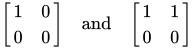
are diagonalizable but not simultaneously diagonalizable because they do not commute.
A set consists of commuting normal matrices if and only if it is simultaneously diagonalizable by a unitary matrix; that is, there exists a unitary matrix such that is diagonal for every in the set.


In the language of Lie theory, a set of simultaneously diagonalizable matrices generates a toral Lie algebra.
Examples
[edit]Diagonalizable matrices
[edit]- Involutions are diagonalizable over the reals (and indeed any field of characteristic not 2), with ±1 on the diagonal.
- Finite order endomorphisms are diagonalizable over (or any algebraically closed field where the characteristic of the field does not divide the order of the endomorphism) with roots of unity on the diagonal. This follows since the minimal polynomial is separable, because the roots of unity are distinct.
- Projections are diagonalizable, with 0s and 1s on the diagonal.
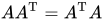
- Real symmetric matrices are diagonalizable by orthogonal matrices; i.e., given a real symmetric matrix , is diagonal for some orthogonal matrix . More generally, matrices are diagonalizable by unitary matrices if and only if they are normal. In the case of the real symmetric matrix, we see that , so clearly holds. Examples of normal matrices are real symmetric (or skew-symmetric) matrices (e.g. covariance matrices) and Hermitian matrices (or skew-Hermitian matrices). See spectral theorems for generalizations to infinite-dimensional vector spaces.


Matrices that are not diagonalizable
[edit]In general, a rotation matrix is not diagonalizable over the reals, but all rotation matrices are diagonalizable over the complex field. Even if a matrix is not diagonalizable, it is always possible to "do the best one can", and find a matrix with the same properties consisting of eigenvalues on the leading diagonal, and either ones or zeroes on the superdiagonal – known as Jordan normal form.
Some matrices are not diagonalizable over any field, most notably nonzero nilpotent matrices. This happens more generally if the algebraic and geometric multiplicities of an eigenvalue do not coincide. For instance, consider
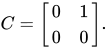
This matrix is not diagonalizable: there is no matrix such that is a diagonal matrix. Indeed, has one eigenvalue (namely zero) and this eigenvalue has algebraic multiplicity 2 and geometric multiplicity 1.


Some real matrices are not diagonalizable over the reals. Consider for instance the matrix
![{\displaystyle B=\left[{\begin{array}{rr}0&1\\\!-1&0\end{array}}\right].}](https://wikimedia.org/api/rest_v1/media/math/render/svg/4941e8021022600bd893174955fd7d0fda584c54)
The matrix does not have any real eigenvalues, so there is no real matrix such that is a diagonal matrix. However, we can diagonalize if we allow complex numbers. Indeed, if we take


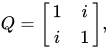
then is diagonal. It is easy to find that is the rotation matrix which rotates counterclockwise by angle

Note that the above examples show that the sum of diagonalizable matrices need not be diagonalizable.
How to diagonalize a matrix
[edit]Diagonalizing a matrix is the same process as finding its eigenvalues and eigenvectors, in the case that the eigenvectors form a basis. For example, consider the matrix
![{\displaystyle A=\left[{\begin{array}{rrr}0&1&\!\!\!-2\\0&1&0\\1&\!\!\!-1&3\end{array}}\right].}](https://wikimedia.org/api/rest_v1/media/math/render/svg/58d4bf4a6225301829b5d901fde06b5d437666a4)
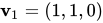
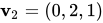
The roots of the characteristic polynomial are the eigenvalues . Solving the linear system gives the eigenvectors and , while gives ; that is, for . These vectors form a basis of , so we can assemble them as the column vectors of a change-of-basis matrix to get: We may see this equation in terms of transformations: takes the standard basis to the eigenbasis, , so we have: so that has the standard basis as its eigenvectors, which is the defining property of .







![{\displaystyle P^{-1}AP=\left[{\begin{array}{rrr}1&0&1\\1&2&0\\0&1&\!\!\!\!-1\end{array}}\right]^{-1}\left[{\begin{array}{rrr}0&1&\!\!\!-2\\0&1&0\\1&\!\!\!-1&3\end{array}}\right]\left[{\begin{array}{rrr}1&\,0&1\\1&2&0\\0&1&\!\!\!\!-1\end{array}}\right]={\begin{bmatrix}1&0&0\\0&1&0\\0&0&2\end{bmatrix}}=D.}](https://wikimedia.org/api/rest_v1/media/math/render/svg/3f9e3351d58c7861f8c69580f3cd14ac82ec7a3d)


Note that there is no preferred order of the eigenvectors in ; changing the order of the eigenvectors in just changes the order of the eigenvalues in the diagonalized form of .[2]
Application to matrix functions
[edit]Diagonalization can be used to efficiently compute the powers of a matrix :

and the latter is easy to calculate since it only involves the powers of a diagonal matrix. For example, for the matrix with eigenvalues in the example above we compute:

![{\displaystyle {\begin{aligned}A^{k}=PD^{k}P^{-1}&=\left[{\begin{array}{rrr}1&\,0&1\\1&2&0\\0&1&\!\!\!\!-1\end{array}}\right]{\begin{bmatrix}1^{k}&0&0\\0&1^{k}&0\\0&0&2^{k}\end{bmatrix}}\left[{\begin{array}{rrr}1&\,0&1\\1&2&0\\0&1&\!\!\!\!-1\end{array}}\right]^{-1}\\[1em]&={\begin{bmatrix}2-2^{k}&-1+2^{k}&2-2^{k+1}\\0&1&0\\-1+2^{k}&1-2^{k}&-1+2^{k+1}\end{bmatrix}}.\end{aligned}}}](https://wikimedia.org/api/rest_v1/media/math/render/svg/a75e9ac586b275dab0b07cfa8a76cf1fa56d759f)
This approach can be generalized to matrix exponential and other matrix functions that can be defined as power series. For example, defining , we have:

![{\displaystyle {\begin{aligned}\exp(A)=P\exp(D)P^{-1}&=\left[{\begin{array}{rrr}1&\,0&1\\1&2&0\\0&1&\!\!\!\!-1\end{array}}\right]{\begin{bmatrix}e^{1}&0&0\\0&e^{1}&0\\0&0&e^{2}\end{bmatrix}}\left[{\begin{array}{rrr}1&\,0&1\\1&2&0\\0&1&\!\!\!\!-1\end{array}}\right]^{-1}\\[1em]&={\begin{bmatrix}2e-e^{2}&-e+e^{2}&2e-2e^{2}\\0&e&0\\-e+e^{2}&e-e^{2}&-e+2e^{2}\end{bmatrix}}.\end{aligned}}}](https://wikimedia.org/api/rest_v1/media/math/render/svg/10abb668f51f9306f9384119e09ee5d32c0df35f)
This is particularly useful in finding closed form expressions for terms of linear recursive sequences, such as the Fibonacci numbers.
Particular application
[edit]For example, consider the following matrix:
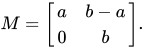
Calculating the various powers of reveals a surprising pattern:


The above phenomenon can be explained by diagonalizing . To accomplish this, we need a basis of consisting of eigenvectors of . One such eigenvector basis is given by


where ei denotes the standard basis of Rn. The reverse change of basis is given by

Straightforward calculations show that

Thus, a and b are the eigenvalues corresponding to u and v, respectively. By linearity of matrix multiplication, we have that

Switching back to the standard basis, we have

The preceding relations, expressed in matrix form, are
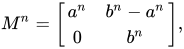
thereby explaining the above phenomenon.
Quantum mechanical application
[edit]In quantum mechanical and quantum chemical computations matrix diagonalization is one of the most frequently applied numerical processes. The basic reason is that the time-independent Schrödinger equation is an eigenvalue equation, albeit in most of the physical situations on an infinite dimensional Hilbert space.
A very common approximation is to truncate (or project) the Hilbert space to finite dimension, after which the Schrödinger equation can be formulated as an eigenvalue problem of a real symmetric, or complex Hermitian matrix. Formally this approximation is founded on the variational principle, valid for Hamiltonians that are bounded from below.
First-order perturbation theory also leads to matrix eigenvalue problem for degenerate states.
Operator theory
[edit]Matrices can be generalized to linear operators. A diagonal matrix can be generalized to diagonal operators on Hilbert spaces.
Let be a Hilbert space. An operator is a diagonal operator iff there exists an orthonormal basis of , such that for some .


For any , define the p-Schatten norm as follows. Let be an operator, then , where is the trace. The p-Schatten class is the set of all operators with finite p-Schatten norm.


Weyl[3], von Neumann[4], and Kuroda[5], showed the following:
For any , any self-adjoint operator on a Hilbert space , and any , there exists a diagonal operator , such that .


In other words, any self-adjoint operator is an infinitesimal perturbation from a diagonal operator, where "infinitesimal" is in the sense of p-Schatten norm. In particular, since the Hilbert–Schmidt operator class is the 2-Schatten class, this means that any self-adjoint operator is diagonalizable after a perturbation by an infinitesimal Hilbert–Schmidt operator. In fact, the above result could be further generalized:
For any norm ideal that is not the trace class, with norm , any self-adjoint operator on a Hilbert space , and any , there exists a diagonal operator , such that .


The result is false for (the trace class). This is a simple corollary of the Kato[6]–Rosenblum[7][8]: Theorem XI.8 theorem, which states that if is self-adjoint, and is trace class, then have the same absolutely continuous part of the spectrum. The result is sharp, however, in the sense that if has no absolutely continuous part, then it can be diagonalized after perturbation by an infinitesimal trace class operator.[9]


For simultaneous diagonalization, it's known that, given a finite list of self-adjoint operators that commute with each other, for any , there exists a sequence of diagonal operators , such that , where is the n-Schatten norm. Note that [10]


See also
[edit]- Defective matrix
- Scaling (geometry)
- Triangular matrix
- Semisimple operator
- Diagonalizable group
- Jordan normal form
- Weight module – associative algebra generalization
- Orthogonal diagonalization
References
[edit]- ^ Horn, Roger A.; Johnson, Charles R. (2013). Matrix Analysis, second edition. Cambridge University Press. ISBN 9780521839402.
- ^ Anton, H.; Rorres, C. (22 Feb 2000). Elementary Linear Algebra (Applications Version) (8th ed.). John Wiley & Sons. ISBN 978-0-471-17052-5.
- ^ Von Weyl, Hermann (December 1909). "Über beschränkte quadratische formen, deren differenz vollstetig ist". Rendiconti del Circolo Matematico di Palermo (in German). 27 (1): 373–392. doi:10.1007/BF03019655. ISSN 0009-725X.
- ^ von Neumann, John (1935). "Charakterisierung des Spektrums eines Integraloperators" [Characterization of the spectrum of an integral operator]. Actualités Scientifiques et Industrielles (in German). 229: 3–20.
- ^ Kuroda, Shige Toshi (1958-01-01). "On a theorem of Weyl-von Neumann". Proceedings of the Japan Academy, Series A, Mathematical Sciences. 34 (1). doi:10.3792/pja/1195524841. ISSN 0386-2194.
- ^ Kato, Tosio (1957). "Perturbation of Continuous Spectra by Trace Class Operators". Proceedings of the Japan Academy. 33 (5): 260–264. doi:10.3792/pja/1195525063.
- ^ Rosenblum, Marvin (1957). "Perturbation of the continuous spectrum and unitary equivalence". Pacific J. Math. 7 (4): 997–1010. doi:10.2140/pjm.1957.7.997.
- ^ Reed, Michael; Simon, Barry (May 12, 1979). Scattering Theory. Methods of Modern Mathematical Physics. Vol. 3 (1st ed.). Academic Press. ISBN 978-0125850032.
- ^ Carey, R. W.; Pincus, J. D. (1976). "Unitary Equivalence Modulo the Trace Class for Self-Adjoint Operators". American Journal of Mathematics. 98 (2): 481–514. doi:10.2307/2373898. ISSN 0002-9327. JSTOR 2373898.
- ^ Voiculescu, Dan (1990-06-01). "On the existence of quasicentral approximate units relative to normed ideals. Part I". Journal of Functional Analysis. 91 (1): 1–36. doi:10.1016/0022-1236(90)90047-O. ISSN 0022-1236.

Diagonalizable matrix
View on GrokipediaFundamentals
Definition
In linear algebra, a square matrix of size over a field is diagonalizable if there exists an invertible matrix (also of size ) and a diagonal matrix such that where the diagonal entries of are the eigenvalues of .[9] This relation expresses as similar to a diagonal matrix via a change of basis given by the columns of . The similarity transformation preserves key spectral properties of , including its eigenvalues, characteristic polynomial, trace, and determinant, as these are invariant under similarity. For matrices with real entries, the field is typically extended to the algebraically closed field of complex numbers to guarantee the existence of all eigenvalues, even if they are non-real. The origins of the diagonalization concept trace back to Joseph-Louis Lagrange's 18th-century investigations of quadratic forms, where he employed linear transformations to reduce them to diagonal form, and were formalized within modern linear algebra by David Hilbert's work on spectral theory around 1900.[10]Characterization
A square matrix over a field is diagonalizable if and only if there exists a basis of the underlying vector space consisting of linearly independent eigenvectors of , where is the dimension of the space.[11] This condition ensures that can be represented by a diagonal matrix in some basis, as the eigenvectors form the columns of the invertible matrix in the similarity transformation , where is diagonal.[12] An equivalent characterization involves the multiplicities of the eigenvalues of . For each eigenvalue of , the geometric multiplicity, defined as , must equal the algebraic multiplicity, which is the multiplicity of as a root of the characteristic polynomial .[13] This equality holds across all eigenvalues if and only if the sum of the geometric multiplicities is , guaranteeing a full basis of eigenvectors.[11] Another criterion uses the minimal polynomial of , the monic polynomial of least degree that annihilates . The matrix is diagonalizable over if and only if its minimal polynomial factors into distinct linear factors over , meaning it has no repeated roots.[14] This condition implies that the minimal polynomial splits completely into linear terms without multiplicity greater than one. Over an algebraically closed field such as , the characteristic polynomial of any matrix always splits into linear factors by the fundamental theorem of algebra.[15] In this setting, diagonalizability reduces to the minimal polynomial having distinct linear factors or, equivalently, the algebraic and geometric multiplicities matching for each eigenvalue, as the splitting is automatic. For matrices over general fields , diagonalizability requires both that the characteristic polynomial splits into linear factors over and that the geometric multiplicity equals the algebraic multiplicity for each root.[15]Diagonalization Techniques
Diagonalization Procedure
To diagonalize a square matrix (or over ), the procedure involves computing its eigenvalues and eigenvectors to determine if a basis of linearly independent eigenvectors exists, enabling the decomposition where is diagonal and is invertible.[16]/07%3A_Spectral_Theory/7.02%3A_Diagonalization) The first step is to find the eigenvalues by solving the characteristic equation , where is the identity matrix; the roots (with possible multiplicities) are the eigenvalues of .[16][17] For each distinct eigenvalue , compute the corresponding eigenspace by solving the eigenvector equation to find a basis for the null space; the dimension of this eigenspace is the geometric multiplicity of .[16]/07%3A_Spectral_Theory/7.02%3A_Diagonalization) The matrix is diagonalizable if and only if the geometric multiplicity equals the algebraic multiplicity (from the characteristic polynomial) for every eigenvalue, ensuring the eigenspaces collectively span (or ) with linearly independent eigenvectors.[16][17] If linearly independent eigenvectors are obtained, form the matrix with these as columns and the diagonal matrix ; the diagonalization is then , which can be verified by direct computation.[16]/07%3A_Spectral_Theory/7.02%3A_Diagonalization) If the geometric multiplicity is less than the algebraic multiplicity for any eigenvalue, the matrix is defective and not diagonalizable over the field; in such cases, the Jordan canonical form provides an alternative block-diagonal representation using generalized eigenvectors, though it requires additional computational steps beyond standard eigendecomposition.[18][19] For large matrices, numerical implementations in software such as MATLAB'seig function or Python's SciPy linalg.eig are essential, as they employ algorithms like the QR method for eigenvalue computation. However, these are sensitive to floating-point errors, particularly for matrices with clustered or nearly degenerate eigenvalues, where small perturbations can lead to inaccurate eigenvectors or failure to detect linear independence.[19][20]