Hubbry Logo
search
logo
GP2X
GP2X
current hub
1949500

GP2X

logo
Community Hub0 Subscribers
Read side by side
from Wikipedia
GP2X
ManufacturerGamePark Holdings
TypeHandheld game console
GenerationSeventh generation era
Lifespan
  • SK: November 10, 2005
Units soldOver 60,000
MediaSecure Digital card
Operating systemLinux
CPUDual CPU:

200 MHz Host ARM920T

200 MHz ARM940T
Memory64MB
PredecessorGP32
SuccessorGP2X Wiz

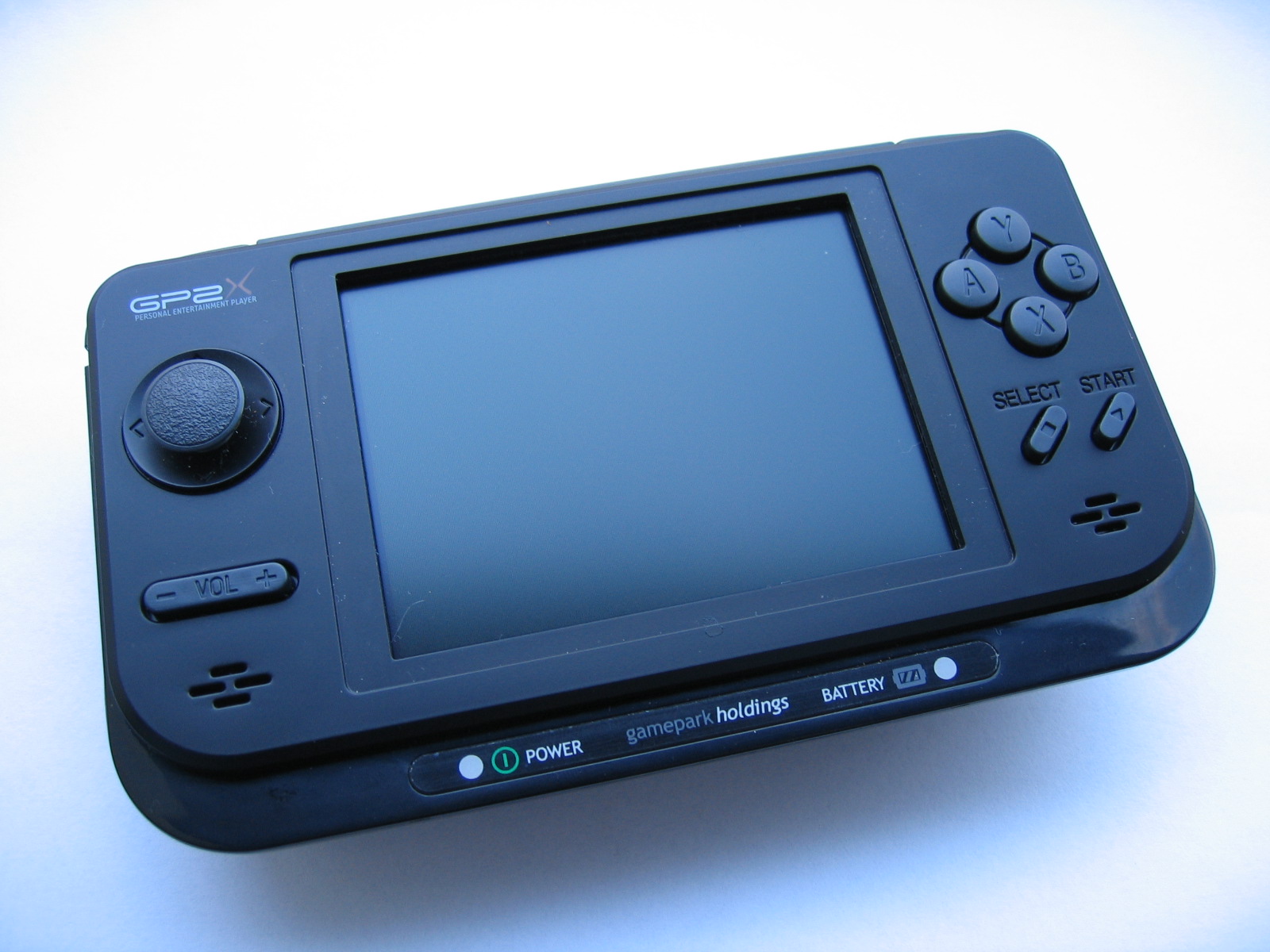
The GP2X is a Linux-based handheld video game console and portable media player developed by South Korean company GamePark Holdings. It was released on November 10, 2005, in South Korea only.

The GP2X is designed for homebrew developers as well as commercial developers. It is commonly used to run emulators for game consoles such as Neo Geo, Mega Drive/Genesis, Master System, Game Gear, Amstrad CPC, Commodore 64, NES, TurboGrafx-16, and MAME.

Overview

[edit]

The GP2X was designed to play music and videos, view photos, and play games. It had an open architecture (Linux based), allowing anybody to develop and run software. Also, there was the possibility for additional features (such as support for new media formats) to be added in the future due to the upgradeable firmware.

A popular use of the GP2X was to run emulators, which allows one to use software from a video game of another system on the GP2X.

History

[edit]
The newer model "F200" with touchscreen stylus

Shortly after the release of the GP32 in 2001, its maker Game Park began to design their next handheld. A disagreement within the company about the general direction of this system prompted many of the staff [citation needed] to leave and create their own company, GamePark Holdings, to produce a 2D-based handheld system which they saw as the sequel to the GP32.

GamePark Holdings spoke to previous GP32 distributors and developers to determine the specifications for the new machine and how it should be promoted. Meetings were held in Seoul, Korea, where the final design of the new console was agreed upon.

The first name of this console was the GPX2. However, it couldn't be used as a final name due to a possible trademark violation with the name of a Japanese printer, the GPX. A contest for a new name was announced on August 3, 2005. Around 1500 names were submitted in total. The winner of the competition was Matt Bakse who chose the title GP2X. For this he was awarded a free GP2X console, although delivery of his prize was rather delayed.

The GP2X has seen several minor hardware updates, most notably the changes from the First Edition to Normal Edition and the Normal Edition to the MK2. Also, a new version called the "F200" was released earlier then expected[1] on October 30, 2007[2] and features a touchscreen, among other changes.

By August 23, 2006 the GP2X was available to buy through an online distributor in the United States of America.[3]

As of October 16, 2006, the GP2X had sold 30,000 units.[4] On August 31, 2008, the CEO of Gamepark Holdings told German GP2X distributor Michael Mrozek (aka. EvilDragon[5]) that 60,000 GP2X units had been sold.[6] The Korea Times reported in 2009 that over 60,000 GP2X units had been sold.[7]

On 26 August 2008, GamePark Holdings announced the successor to the GP2X, the "Wiz".[8]

As of September 1, 2008 a version of the GP2X is still being sold in Korea by Vocamaster that is geared toward Koreans who wish to learn English.[9] In fact, according to the official GP2X distributor for the UK, Craig Rothwell, most GP2X units sold to date have been sold through Vocamaster as English-learning tools.[10]

Hardware

[edit]
A disassembled GP2X F-200

Specifications

[edit]

Source:[11]

The ARM940T was used by GPH's implementation of Linux to control video processing. Using the 940T core in Linux for other tasks apart from video processing is difficult but possible. Accessing the hardware directly makes it easier to use both CPUs.

The F-200 version of the GP2X hardware replaced the joystick with a directional pad and added a touchscreen.

Expandability

[edit]

The GP2X had an expansion "EXT" port on the base of the unit into which a range of special cables (for USB host, TV-out etc.) or break out box could be plugged,[14] allowing four USB devices to be connected to and used with the GP2X directly.[15] The only thing limiting what can be used through this interface is the availability of drivers.

The connector used to expand the GP2X is hard to come by on its own but it is used with a few other devices. The Samsung e810/e730 and LG U8110/20/30/36/38 mobile telephone data cables, along with the official GP2X TV-Out adapter are suitable connectors.

This connector isn't proprietary; the specifications of this connector are fully open, encouraging home cable construction.

TV output

[edit]

The GP2X also supported TV-out with a special cable that plugs into the EXT port. This allows videos that are normally scaled down to fit the GP2X's screen to be played at native resolution on a TV. It also lets software be displayed on the higher resolution TV rather than the screen. Not all software supports this natively, but 3rd party software exists that enables TV-out functionality in all applications. This is done by launching a background process.

Power

[edit]

The GP2X requires 2 AA-sized batteries if not running from an external power supply. Due to the high current drain, standard alkaline batteries will not function for very long in the GP2X; NiMH or lithium batteries are recommended.

Battery life varies depending on the type of activity being performed and can last anywhere from 10 minutes (using alkaline batteries) to over 6 hours (using high-capacity NiMH batteries). When listening to music, power can be conserved by turning off the backlight and display.

The GP2X has a socket for an external power supply. It must be rated 3.3V DC at 1A with a standard center-grounded (negative center) connector. The power supply should be regulated, as voltage spikes can permanently damage the unit.

Storage

[edit]

The GP2X's primary storage device is the Secure Digital card, which can be placed into a socket at the top of the unit. Older firmware only supported SD cards up to 4 GB in capacity. SD cards must be formatted as either FAT16, FAT32 (32 is more reliable), or ext2. The GP2X also has 64 MB of internal flash memory storage, of which 32MB can be used for user data.

From firmware release version 4.0 the GP2X F200 is capable of addressing the new SDHC standard and thus now works with SDHC cards up to 64GB in size.

Overclocking

[edit]

The two ARM processors in the GP2X can be overclocked beyond their rated speed in software. The maximum speed one can reach through overclocking varies from system to system, with about 1 in 50 reaching over 300 MHz and others barely reaching 240 MHz (many systems can be overclocked beyond 240 MHz with no problems. The highest they are advertised to overclock to is 266 MHz.)

Multimedia support

[edit]

Video

[edit]
  • Video formats: DivX 3/4/5, Xvid (MPEG-4)[16]
  • Audio formats: MP3 and Vorbis
  • Container files: AVI and OGM (WMA and MPG via additional software)
  • Maximum Resolution: 720*480[17] (scaled to 320x240 screen resolution using built in scaling chip)
  • Captions: SMI, SRT
  • Battery Life: 3.5 hours average, longer times possible with high capacity batteries and with use of the power saving modes within.

Audio

[edit]
  • Audio Formats: MP3, Vorbis (more with alternative players)
  • Channels: Stereo
  • Frequency Range: 20 Hz - 20 kHz
  • Power output: 100 mW
  • Sample Resolution/Rate: 16bit/8โ€“48 kHz
  • Equalizer: includes "Normal", "Classic", "Rock", "Jazz", "Pop" presets
  • Battery Life: ~6 hours (information given by manufacturer) with 2 x 2500mAh AA batteries.

Software

[edit]

Because the tools required for development on the GP2X are freely available, there is a wealth of software available for the GP2X, much of which is free. Types of software available includes emulators, games, PDA applications and multimedia players.

Built-in software

[edit]

The GP2X has several pieces of software built directly into the firmware. There is a version of MPlayer which is used to play music and video, an image viewer, an e-book reader (which can display the contents of standard text documents on-screen) and a utility to adjust the LCD update frequency to eliminate any flickering.

Other applications available (though not accessible directly through the menu) were a Samba server, for transferring files to the machine using the default Windows network file sharing protocol; an HTTP server, for providing web pages; an FTP server, a different way of transferring files; and telnet access allowing for direct command line access from outside the machine. These servers operate over the included USB networking functionality, allowing one to connect the GP2X to a wider network through a PC. The new GP2X-F200 supports none of these network programs.

Version 3.0.0 of the firmware comes with 5 games pre-installed in the NAND memory. The games are Payback (demo), Noiz2sa, Flobopuyo, SuperTux, and Vektar (freeware version). This firmware is currently shipped with new GP2Xs.

Emulators

[edit]

There are many emulators available for the GP2X which allow you to run software from other systems on the GP2X. Many emulators will run most software perfectly and at the intended speed, but some others may have various issues (often to do with speed or sound). Popular emulators include GnGeo which emulates the Neo Geo; GNUboy2x, Game Boy and Game Boy Color emulators; MAME, an emulator of various arcade machines; DrMD, which emulates the Master System, Game Gear and Mega Drive/Genesis; SquidgeSNES and PocketSNES, which emulate Super NES games; and Picodrive, which emulates Mega Drive and Sega CD games; psx4all which emulates PlayStation games. Stella, an emulator for the Atari 2600 has also been ported to the GP2X

Games

[edit]

Since the GP2X has a much smaller following than other handheld consoles, such as the Sony PSP or the Nintendo DS, there are very few commercial games available for it. Vektar, Payback, Quartzยฒ, retrovirus RTS, Wind and Water: Puzzle Battles and Blazar have been released as commercial games for the GP2X, and the games Odonata and Elsewhere were released in October 2006 for Korean distribution only.[18]

However, there are many ports of games from other platforms, mostly Linux, to the GP2X. Popular ports include SuperTux and Frozen Bubble as well as the Duke Nukem 3D, Quake, and Doom engines (which can run the original games if the user owns a copy with the correct data files). There are also hundreds of original freeware games such as Tilematch and Beat2X, made by GP2X programmers in their spare time.

Multimedia players

[edit]

There are several unofficial multimedia players available for the GP2X, intended to support more formats than the built-in music and video players can handle. One such program is a port of FFPlay that allows you to play several RealMedia and Windows Media formats. Since the release of the MPlayer source code, several unofficial builds have been released for various purposes. One of these adds support for playing music in the AAC format.

Music Creation Tools

[edit]

The GP2X natively runs the free homebrew application Little Game Park Tracker, a music tracker program which was created by chip musician M-.-n specifically for the GP2X. Little Game Park Tracker, also known as LGPT or Little Piggy Tracker, allows for sample-based music production with a myriad of sample tweaking abilities. LGPT borrows the interface of the popular Game Boy music tracker Little Sound DJ. It has since been ported to the PSP, Dingoo, Windows, OS X, and other platforms.

PDA Applications

[edit]

Two popular PDA desktop environments have been ported to the GP2X: Qtopia and GPE. Both contain a range of programs such as a web browser, word processor, etc. and can be controlled with either the GP2X controls or a USB mouse and keyboard connected through a USB cable attached to the EXT port.

Open source development

[edit]

SDKs (software development kits) are freely and easily available for the GP2X allowing anybody with the required skills to write an application or game. Most SDKs are based around a gcc cross-compiler toolchain and SDL. SDL is available for many systems, allowing for cross-compatibility of code with other platforms such as Microsoft Windows and GNU/Linux.

A port of the Allegro[19] game programming library is also available for the GP2X, as are ports of the Fenix and BennuGD game toolkits.

Other libraries under development include Minimal Library SDK, which allows for direct hardware access inside the GP2X Linux environment, and sdk2x a set of libraries and a program which allows you to leave Linux completely for total control of all the hardware with no operating system to interfere.

Currently in development is gpu940, a soft 3D renderer that can do many rendering types, including true perspective texture mapping/lighting. It utilizes the ARM940T CPU of the GP2X, and allows for the GP2X to run basic OpenGL functions. In January 2007, the renderer's OpenGL functions allowed for the 3D roleplaying game Egoboo to be ported to the GP2X at a playable speed, and a month later updated with increased speed and added lighting effects.

GP2X executables

[edit]

GP2X executable files have one of two 3 letters file extensions. For games, the .gpe extension is used. These are listed in the Games section of the menu. Utilities have the extension .gpu, and appear in the Utilities section of the menu; in firmware 3.0.0 they appear along with the games.

DRM controversy

[edit]

There was debate before launch[20] over the implied inclusion of DRM in the GP2X. However, since release, the GP2X platform was shown to be clear of any form of DRM.

See also

[edit]

References

[edit]
[edit]
Revisions and contributorsEdit on WikipediaRead on Wikipedia
from Grokipedia
The GP2X is a Linux-based handheld video game console and portable media player developed by the South Korean company GamePark Holdings and released in South Korea on November 10, 2005.[1][2] It was designed primarily for running homebrew software and emulators, allowing users to play games from classic systems like arcade machines, Super Nintendo Entertainment System, Game Boy, and even PlayStation titles, while also supporting multimedia functions such as video playback in DivX/XviD formats, music in MP3/OGG/WMA, photo viewing in JPEG/GIF, and e-book reading.[3][2] Key hardware features include a 3.5-inch TFT LCD screen with 320ร—240 resolution and 65,536-color support, powered by dual ARM processors (ARM920T and ARM940T) clocked at 200 MHz, 64 MB of SDRAM, and 64 MB of NAND flash storage expandable via SD card slot.[4][3] The device measures approximately 14.4 cm ร— 8.3 cm ร— 3.4 cm, weighs 160 grams, and uses two AA batteries for up to six hours of gameplay, with controls consisting of a directional pad, four face buttons, two shoulder triggers, and a volume rocker.[4][3] Ports include a mini-USB for data transfer, a 2.5 mm headphone jack, DC power input, and an EXT port for accessories.[3] As an open-source platform, the GP2X emphasized developer accessibility, fostering a community for custom applications and indie games, though it lacked official commercial titles at launch and targeted tech-savvy enthusiasts rather than casual gamers.[2][3] It served as a successor to GamePark's earlier GP32 console and paved the way for revised models like the GP2X F200 (2007), which added a touchscreen, and the GP2X Wiz (2009), introducing Wi-Fi connectivity.[2] Despite modest commercial success, the GP2X influenced the retro emulation handheld market and remains notable for its role in early open-source portable gaming.[3][2]

Background

Overview

The GP2X is a Linux-based open-source handheld video game console and portable media player developed by the South Korean company GamePark Holdings (GPH).[5] It supports playback of video, music, photos, and e-books alongside gaming capabilities, distinguishing it from proprietary handhelds of the era through its emphasis on user customization and developer accessibility.[3] Released on November 10, 2005, in South Korea, the GP2X targeted homebrew developers, emulation enthusiasts, and consumers seeking an affordable option for portable gaming and media consumption, with an initial price of approximately $189 USD including shipping via international distributors.[6] By late 2006, sales had reached about 30,000 units globally, reflecting its niche appeal in the open-source community despite limited commercial game support.[7] Key innovations included full open-source software support, reliance on SD card storage for games and media.[8] Many applications from its predecessor, the GP32, were ported by the community, allowing users to expand its library without proprietary cartridges. These features fostered a vibrant ecosystem of community-developed emulators and applications, powered by its dual ARM processors running at 200 MHz.[9]

Development and Release

The GP2X originated as a successor to the GP32 handheld console. Following the 2005 split from Game Park due to internal conflicts, GamePark Holdings (GPH) was founded by a group of former employees focused on open-source development. GPH began designing the device to emphasize homebrew and multimedia capabilities, drawing from lessons learned with the GP32's architecture.[10][11] Originally codenamed GPX2, the device underwent a public naming contest announced in August 2005 to avoid potential trademark conflicts with existing products. Approximately 1,500 entries were submitted, with GP2X selected as the final name for its simplicity and nod to the GP32 lineage. Preorders for the console began in October 2005 through select online retailers, with the release occurring on November 10, 2005, in South Korea. Units were manufactured entirely in South Korea by GPH.[12][13] Global distribution was limited, relying on third-party resellers such as GBAX in the UK and Lik-Sang for international shipping, which delayed wider availability. The GP2X reached the US market on August 23, 2006, via online vendors like ThinkGeek. In response to user feedback on controls and usability, GPH released the F-200 variant on October 30, 2007, retaining the core hardware but adding a touchscreen LCD, an improved eight-way D-pad for better ergonomics, and SDHC card support. This model maintained the same processor and memory configuration while enhancing interface options for developers and users.[5][14][6][15][16]

Hardware Design

Core Specifications

The GP2X handheld console features a dual-processor architecture centered on the MagicEyes MP2520F system-on-a-chip, which integrates an ARM920T core clocked at 200 MHz for general computing tasks such as operating system management and user interface handling, alongside an ARM940T co-processor also at 200 MHz dedicated primarily to video decoding and multimedia processing.[17][18] This configuration enables efficient parallel execution of gameplay logic and video playback, with the ARM940T optimizing hardware-accelerated decoding for formats like DivX and XviD.[17] The device is equipped with 64 MB of SDRAM, shared across the CPU cores and video subsystems, providing the primary working memory for applications, graphics rendering, and frame buffering.[17] This unified memory pool supports the console's multitasking capabilities but limits high-resolution or memory-intensive operations due to the era's hardware constraints. Visually, the GP2X utilizes a 3.5-inch TFT LCD display with a native resolution of 320 ร— 240 pixels and 16-bit color depth, supporting up to 65,536 colors for vibrant on-screen graphics and video output.[17][18] The screen is backlit for indoor and low-light portability, though it lacks touch functionality. User input is handled through a combination of controls including an 8-way digital D-pad (with clickable thumb stick functioning as an additional action button), six dedicated action buttons (four face buttons labeled A, B, X, Y, plus two shoulder triggers), Start and Select buttons, and a volume rocker for audio adjustment.[17] These ergonomically arranged elements facilitate precise control in gaming scenarios, drawing inspiration from contemporary handheld designs. Audio capabilities include built-in stereo speakers for direct playback and a 3.5 mm headphone jack, delivering 16-bit stereo output with sampling rates ranging from 8 to 48 kHz and a frequency response of 20 Hz to 20 kHz.[17] This setup supports immersive sound for music, videos, and emulated games, with software equalizers offering 11 preset configurations for customization. Physically, the GP2X measures 143.6 ร— 82.9 ร— 34 mm and weighs approximately 161 grams without batteries, balancing portability with a robust plastic chassis suitable for extended handheld use.[17] Community modifications, such as overclocking the processors beyond 200 MHz, can enhance performance but require careful tuning to maintain stability.[18]

Power and Battery

The GP2X is powered by two AA batteries, which can be either alkaline or rechargeable NiMH types, inserted into a compartment on the rear of the device. An optional AC adapter providing 3.3V DC power (center negative) connects via the EXT port for continuous operation without batteries. This setup allows for portable use but requires users to carry spare batteries due to the device's relatively high power draw from its ARM9 processor and LCD screen.[19] Battery life varies significantly based on battery type, capacity, and usage intensity. With 2000mAh NiMH rechargeables, users can expect approximately 6 hours for video playback and up to 10 hours for audio playback under moderate conditions, while standard alkaline batteries provide approximately 2-3 hours for gaming or emulation, though voltage drop-off may degrade performance toward the end of the charge. High-capacity 2800mAh NiMH batteries extend runtime to 5-6 hours for intensive gaming or emulation sessions, though real-world performance often falls short in prolonged use.[20][21][4][22] The community developed software-based overclocking methods to boost the CPU from its default 200 MHz to 266 MHz, improving emulation performance for systems like SNES or Neo Geo, but this increases power consumption, reducing battery life by up to 20-30% and potentially causing instability or heat issues if sustained. To mitigate drain, the firmware includes power-saving features such as a sleep mode activated by locking the buttons and turning off the screen, along with adjustable brightness settings in the menu to conserve energy during idle periods. A battery indicator in the settings menu displays three levels (empty, medium, full) to help monitor remaining charge.[21][19]

Expandability and Storage

The GP2X incorporates 64 MB of internal NAND flash memory, primarily allocated for the operating system and essential libraries, leaving approximately 20 MB available for limited user storage. This internal capacity is insufficient for extensive media or game libraries, necessitating external expansion for practical use. Primary storage relies on an SD/MMC card slot located at the top of the device, which supports cards formatted in FAT16, FAT32, or ext2 file systems. Official firmware for the original F100 model initially supported SD cards up to 2 GB, with community-patched firmwares extending compatibility to SDHC cards and reliable operation up to 32 GB capacities.[19][3] Expandability is facilitated through the EXT port at the bottom of the device, a multi-pin connector that exposes USB 1.1 host and device interfaces, a serial port, JTAG debugging pins, audio/video outputs, and 3.3V power supply. This port enables the connection of external peripherals via custom cables or breakout adapters, providing up to 500 mA at 5V for powered USB devices when using an appropriate hub. The USB host mode, activated through Linux kernel support, allows integration of input devices such as keyboards and mice for enhanced control in applications, as well as additional storage like USB drives or hard disks for file access beyond SD card limits. Custom add-ons, including WiFi USB dongles compatible with chipsets like RT2570, can be attached to enable wireless networking, though power constraints may require external supplies for sustained operation.[23][24][23] The platform supports a range of USB peripherals, including gamepads for alternative input in gaming and emulation software, leveraging the host mode to emulate standard PC connectivity. Community-driven modifications extend this further; for instance, GPS receivers have been integrated via the serial port or USB, using modules from disassembled SDIO cards to provide location data output in NMEA format for navigation applications. Similarly, USB webcam modules can be connected for live video input, supported by open-source drivers in custom firmware builds. These hacks demonstrate the GP2X's modular design but often require soldering or specialized cabling for optimal integration.[23][25][26] Firmware customization and updates are handled via the SD card, allowing users to load official releases from GamePark Holdings or community-developed versions without hardware modifications. To upgrade, files are placed on the root of a formatted SD card, and the device is powered on while holding specific button combinations (such as Start and Select for versions 2.0.0 and later) to initiate the flash process. This method supports enhancements like improved SD card recognition and USB stability, with community firmwares from developers like Notaz adding features such as overclocking and broader peripheral compatibility while preserving the stock boot process. Interruptions during updates risk bricking the device, underscoring the need for stable power sources.[19][27]

Display and Output

The GP2X is equipped with a 3.5-inch TFT LCD display offering a native resolution of 320ร—240 pixels (QVGA), suitable for rendering games and media content directly on the device. This internal display leverages the integrated MagicEyes MP2520F video processor, which includes dedicated scaling units capable of resizing, zooming, and flipping images to fit non-native resolutions, thereby providing anti-aliased graphics effects through hardware-based interpolation for smoother visuals in applications exceeding the screen's pixel grid.[19][18][21] External output capabilities are provided through the 40-pin EXT port on the bottom of the unit, enabling connection to televisions via a separate adapter cable for composite or S-Video signals. Official support includes S-Video output at up to 720ร—480 resolution for both NTSC and PAL standards, allowing full-resolution video decoding without downscaling to the internal display's limits, as facilitated by the device's video hardware.[19][28] Higher-quality connections like HDMI or component video are not supported, restricting output to analog composite formats with their inherent limitations in sharpness and color separation. The community has addressed this by creating custom cables that wire the EXT port for composite video alongside stereo audio, offering a more accessible alternative to S-Video for standard RCA inputs on older televisions. Users have also found that overclocking the CPU to around 250 MHz can enhance playback smoothness on external displays by reducing frame drops in demanding video scenarios.[29][30]

Software and Capabilities

Operating System and Built-in Features

The GP2X operates on a custom Linux 2.4 kernel adapted for its ARM-based architecture. This kernel forms the core of the factory firmware, which is stored in the device's 64 MB internal NAND flash memory and serves as the primary boot source. The system can also load applications and content from an inserted SD card, enabling flexible storage and execution of software without overwriting the NAND firmware. Community alternatives like the Open2x firmware provided enhanced features and broader software compatibility.[31][32][19][33] The built-in software suite provides essential multimedia and productivity tools directly integrated into the firmware. MPlayer handles video and audio playback, supporting formats such as MP3 and OGG for music, while a simple image viewer allows browsing of picture files. An e-book reader based on FBReader supports text files for reading, complemented by a basic text editor for editing notes and a file manager for navigating directories on the NAND or SD storage. These applications emphasize portability and low resource usage, fitting the device's 64 MB RAM constraints.[34][35] Five pre-installed games are included in the firmware's NAND memory, offering immediate entertainment upon boot; examples include the platformer SuperTux, the shooter Noiz2sa, and the puzzle game Flobopuyo (varying by firmware version). The user interface consists of a straightforward menu system accessed via the directional pad (D-pad) and buttons, with no touchscreen support in the original F100 model, ensuring intuitive navigation for media, games, and settings without complex input methods.[36] Official firmware updates continued through 2008, with the final major release being version 4.1.0, which prioritized stability improvements, better SD card compatibility (including early SDHC support), and bug fixes for playback and booting reliability. Earlier versions, such as 2.0 (April 2006) and 3.0 (April 2007), introduced UI refinements and enhanced hardware integration, but all updates maintained the core Linux 2.4 foundation without major overhauls.[37][38]

Multimedia Support

The GP2X supports playback of various video formats through its dedicated media player, leveraging hardware acceleration for efficient decoding. It handles DivX versions 3 through 5 and XviD codecs based on the MPEG-4 Advanced Simple Profile (ASP), with a maximum resolution of 720x480 at 30 frames per second. This capability is enabled by the device's ARM940T co-processor, which performs hardware decoding and scaling specifically for these formats, allowing smooth playback of AVI container files without excessive CPU load on the primary ARM920T core. Higher resolutions, such as 640x480 for TV output, are possible but recommended to stay at 320x240 for optimal battery efficiency and storage use on SD cards. Audio playback on the GP2X includes support for MP3, Ogg Vorbis, and WAV formats, with built-in stereo speakers providing output. The media player accommodates playlists for organized listening and reads ID3 tags for metadata display, such as track titles and artist information. Ports of software like MPlayer further enhance audio handling, including stereo processing and an equalizer for adjusting bass, midrange, and treble frequencies during playback. For static media, the GP2X's photo viewer natively supports JPEG and BMP images, enabling slideshows and basic navigation through files on SD cards. PNG format is accessible via community-developed viewers like pv2x, which also handle formats such as GIF and TGA for more versatile image browsing. Text-based content is supported through an e-book reader that displays TXT and RTF files, offering rudimentary zooming and scrolling to adjust text size for readability on the 320x240 LCD screen. Battery performance during multimedia use varies by activity; video playback typically lasts 3-4 hours on high-capacity NiMH batteries rated at 2700mAh, while audio can extend up to 10 hours. Limitations include the absence of hardware acceleration for advanced codecs like H.264, relying instead on software decoding that results in poor performance or incompatibility. Playback becomes choppy for resolutions exceeding 480p without overclocking the CPU to 250-266 MHz, which can improve frame rates but increases power consumption and heat.

Gaming and Emulation

The GP2X's gaming capabilities centered on emulation of retro consoles, leveraging its open-source Linux environment to support a range of emulators that delivered playable experiences for 8-bit and 16-bit systems. It achieved full-speed emulation for the Nintendo Entertainment System (NES), Game Boy, Sega Master System, and Sega Genesis, allowing smooth gameplay with full audio and no significant frame skipping in most titles.[39][40] Near-full-speed performance was possible for the Super Nintendo Entertainment System (SNES) and Neo Geo, though some demanding titles required minor optimizations or occasional slowdowns during intensive scenes.[39][41] Partial support extended to the PlayStation 1 (PS1) via the psx4all emulator, where only a limited selection of lighter games ran at acceptable speeds, with most experiencing notable slowdowns due to the hardware constraints.[41][42] Key emulators highlighted the device's strengths in 2D gaming. GnGeo provided robust Neo Geo emulation, achieving full speed for many titles when using memory expansion tricks to access up to 64 MB of RAM.[41] DrMD handled Sega systems including the Master System and Genesis at full speed, supporting accurate sprite rendering and sound.[41][43] PocketSNES enabled near-full-speed SNES gameplay for the majority of its library, with enhancements for transparency effects.[41] For arcade gaming, RACE and the limited MAME4ALL offered access to select titles, though performance varied and required frame skipping for more complex cabinets.[41] Native gaming on the GP2X included ports of classic PC titles adapted for its hardware. Ports of Quake and Doom, such as 2xQuake and PrBoom, ran at playable frame rates, bringing first-person shooters to the handheld with basic 3D rendering.[44][45] ScummVM facilitated adventure games like those from LucasArts, supporting point-and-click interactions through mapped controls.[46] Commercial native titles were scarce but notable, including Vektar, a shoot 'em up, and Wind and Water: Puzzle Battles, a puzzle-platformer, both developed specifically for the platform and distributed via SD cards.[47] The GP2X's 200 MHz ARM CPU provided sufficient power for 2D emulation and simpler 3D ports but limited performance in complex 3D environments, often resulting in reduced frame rates without adjustments.[39] Overclocking to 240-260 MHz, achievable on most units via software tweaks, improved frame rates in demanding emulators and native games, enabling smoother playback at the cost of higher battery drain.[48] Input mapping optimized the GP2X for retro gaming, with its D-pad and array of buttons (including two shoulder triggers) suiting 2D platformers and fighters from emulated systems like NES and Genesis.[40]

Community and Development

Homebrew Ecosystem

The GP2X was launched with an open development model that encouraged community involvement, including the release of a software development kit (SDK) by GamePark Holdings in 2005 to enable developers to create and run custom software on the device.[49] The firmware source code, incorporating Linux kernel elements, was made available under the GNU General Public License (GPL), with GamePark releasing the kernel source for version 2.1 in 2006 and subsequent updates following GPL compliance requirements.[50] This openness extended to hardware documentation, allowing developers to access detailed specifications for integration and modification.[51] The homebrew ecosystem flourished through dedicated community hubs, including the GP2X wiki for documentation and tutorials, the gp32x.de forums for discussions (as a successor to the GP32 community), and the #gp2xdev IRC channel on EFnet for real-time development collaboration.[52] By 2008, these efforts had produced over 1,000 homebrew titles, encompassing games, emulators, and applications, archived and distributed via community repositories.[53] The development process typically involved cross-compilation on desktop systems using GCC toolchains targeted at the ARM architecture, with libraries like SDL for portability and ease of graphics handling.[54] Testing was streamlined by copying executables to SD cards, which the GP2X could boot directly, facilitating rapid iteration without specialized hardware.[54] Key tools in the ecosystem included DevkitGP2X, a comprehensive toolchain released in 2006 that provided compilers, libraries, and utilities for building ARM executables on Linux, Windows, or OS X platforms.[55] This kit supported ports from predecessor devices like the GP32, such as the Yahtzee board game adaptation, and from PCs, including open-source titles like Doom and Cave Story, leveraging the shared ARM ecosystem and Linux base.[56][57] As of 2025, preservation efforts by retro communities, such as the OpenHandhelds archive, continue to maintain access to firmware, tools, and software collections totaling over 1,700 files, ensuring compatibility with modern SD cards through custom firmware patches that address original hardware limitations like capacity recognition.[58][59] These initiatives sustain the ecosystem's legacy, allowing new enthusiasts to explore and extend GP2X homebrew on updated storage media.[58]

Open-Source Tools and Applications

The GP2X's open architecture fostered the development of PDA-style applications through ports of established Linux environments. Qtopia, a graphical user interface for embedded systems based on the Qt framework, was adapted for the GP2X to provide core productivity features including calendar management, contact organization, and basic task handling.[60] Similarly, the GPE Palmtop Environment, a lightweight desktop suite for handheld devices, was ported as GP2X-GPE, offering integrated tools such as a word processor (AbiWord), document viewer (Evince), spreadsheet application (Gnumeric), and instant messaging client (Gaim).[61] These environments supported web browsing via third-party browsers like Dillo, though full functionality often required custom Wi-Fi adapters for the F100 model lacking built-in wireless.[61] In the realm of music creation, the Little GP2X Tracker (LGPT), also known as Piggy Tracker, emerged as a specialized open-source tool optimized for the device's controls and audio hardware. This tracker enabled users to compose chiptunes using a pattern-based interface, supporting synthesis, sampling, and real-time effects tailored to the GP2X's 16-bit stereo output.[62] For playback of module formats, applications like OldPlay integrated the open-source ModPlug library, allowing reproduction of tracker music files (e.g., MOD, S3M, XM) with accurate emulation of original hardware sounds.[63] A range of utility executables expanded the GP2X's practical uses beyond entertainment. Examples include simple calculators for arithmetic operations, system monitors displaying CPU usage and memory statistics, and file converters for handling text or image formats between SD cards and external storage.[64] These tools, often compiled using the community's open-source SDK, were distributed via repositories to enhance file management and diagnostics on the device.[64] Multimedia capabilities received unofficial extensions through community ports, such as an experimental Rockbox adaptation that added support for lossless formats like FLAC, improving audio quality over the stock player's limitations. Development aids for firmware customization drew from early projects like Open2X, a community-driven replacement OS that served as a precursor to later systems like OpenDingux, providing toolchain integrations for kernel modifications and bootloader tweaks.[33]

Notable Games and Ports

The GP2X supported a modest library of commercial games, with a small number of titles released during its lifecycle, including notable entries like Payback, an action shooter developed by Enjoy Co., Ltd., and Retrovirus RTS, a real-time strategy game that stood out as one of the few native RTS titles for the platform. Other commercial releases encompassed puzzle and adventure games such as Wind and Water: Puzzle Battles and Blazar, often distributed through partnerships with developers targeting open-source handhelds, though specific collaborations like those with Dingoo were more prominent in successor devices. These titles were typically sold as pre-loaded SD card packs or digital downloads, highlighting the device's emphasis on accessible multimedia integration over exclusive console exclusives.[61][65][66] Ported classics formed a cornerstone of the GP2X gaming experience, bringing 1990s PC favorites to the handheld. Iconic first-person shooters like Doom, Quake, and Duke Nukem 3D received optimized ports that ran at playable frame rates, leveraging the device's ARM processors for smooth gameplay in enclosed environments. Additionally, ScummVM provided support for LucasArts adventure games, such as Monkey Island and Day of the Tentacle, allowing point-and-click interactions via button inputs. These ports preserved the original mechanics while adapting controls for portability, often sourced from open-source engines like id Tech.[21][67][64] Freeware and homebrew games proliferated through the vibrant developer community, exceeding 100 titles that ranged from platformers to simulations. SuperTux, a side-scrolling platformer inspired by Super Mario, offered full-speed performance with sound effects and multiple levels featuring Tux the penguin as the protagonist. OpenTTD, an open-source remake of Transport Tycoon Deluxe, enabled complex railway and logistics management on the go. Other examples included Frogger-like arcade clones and PDA-style puzzle games, many of which were simple yet addictive, drawing from public domain mechanics. These were freely available and frequently updated via community contributions.[68][69] Games for the GP2X were primarily distributed via SD cards, which served as the primary storage medium and allowed users to load titles directly from expandable slots supporting up to several gigabytes. Online archives like the OpenHandhelds repository hosted downloadable packages, enabling easy firmware integration and game installation over USB.[59][70] Among community favorites, emulated arcade games via ports like MAME4ALL drew enthusiasts for achieving high scores in classics such as Pac-Man and Street Fighter II, fostering online leaderboards and tournaments. These elements underscored the GP2X's appeal as a versatile retro gaming hub.[71][30]

Controversies and Legacy

DRM Concerns

Prior to the GP2X's launch, rumors circulated in September 2005 suggesting that the device would implement mandatory digital rights management (DRM) for all software, raising significant concerns among open-source enthusiasts and potential buyers who feared restrictions on homebrew development and free software distribution.[72] A BoingBoing blog post amplified these fears, leading to at least 18 order cancellations as users worried about compatibility issues with Linux-based open-source applications and emulation projects.[72] Discussions on community forums, including gp2x.de, highlighted the backlash, with developers debating the potential stifling of the device's open development model.[73] GamePark Holdings (GPH) addressed the controversy through official clarifications, stating that any DRM functionality would mirror the GP32's approach and apply solely to commercial third-party games sold via their website, leaving homebrew, multimedia playback, and open-source software entirely unaffected.[73] In November 2005, coinciding with the device's release on November 10, GPH issued statements confirming the absence of enforced DRM in the final product, ensuring all user-installed software ran DRM-free.[20] This resolution significantly bolstered community trust, as the DRM-free nature aligned with the GP2X's emphasis on open-source ethos and encouraged widespread homebrew adoption.[73] GPH subsequently incorporated explicit no-DRM assurances into their marketing materials, positioning the device as a haven for unrestricted development and portability.[20]

Successors and Impact

The GP2X's direct successors were developed by GamePark Holdings, continuing its focus on open-source handheld gaming. The GP2X Wiz, released in 2009, introduced Wi-Fi connectivity and a more powerful ARM9 CPU clocked at 533 MHz, improving multimedia capabilities and online features while maintaining compatibility with GP2X software.[74] This was followed by the Caanoo in 2010, which emphasized touchscreen interaction with a resistive display and retained the Wiz's processor for enhanced emulation performance.[75] These devices built on the GP2X's Linux foundation, influencing the design of subsequent open handhelds by prioritizing developer accessibility and community-driven content. The GP2X sparked the open-handheld movement through its fully accessible Linux operating system and free software development kit, enabling a vibrant homebrew ecosystem that encouraged widespread experimentation.[76] Preservation efforts in the 2020s, such as the GP2X Starter Packโ€”a curated collection of emulators, games, and tools pre-installed on SD cardsโ€”have sustained interest among new users and archivists, ensuring compatibility with original hardware variants like the F-200 model.[77] Culturally, the GP2X popularized Linux on portable devices by demonstrating its potential for running emulators and applications on low-power ARM hardware, supporting hundreds of ports including Doom and various console emulators.[34] Over 800 software titles, including 696 games and 149 emulators, remain archived in community repositories, highlighting its role in early retro gaming preservation and its frequent citation in histories of open-source portables.[58] In modern contexts, GP2X emulation software has been adapted for platforms like Android and Raspberry Pi, allowing its optimized codebasesโ€”such as SNES and MAME portsโ€”to run on contemporary single-board computers and mobile devices.[78] The device maintains relevance in collector circles, with functional units commanding premium prices on secondary markets due to their pioneering status in DIY gaming handhelds. Despite its innovations, the GP2X faced criticisms for its short battery life, which lasted only 3-4 hours on rechargeable Ni-MH cells and mere minutes on standard alkalines, alongside dated hardware like limited 64 MB RAM that hindered broader adoption.[3][16] These limitations, combined with a dim, low-resolution screen, confined its appeal to enthusiasts rather than mainstream gamers.[3]

References

User Avatar
No comments yet.