Hubbry Logo
search
logo
2309945

Gadiformes

logo
Community Hub0 Subscribers
Read side by side
from Wikipedia

Gadiformes
Temporal range: Maastrichtian–present
Gadus morhua
Scientific classification Edit this classification
Kingdom: Animalia
Phylum: Chordata
Class: Actinopterygii
Clade: Zeiogadaria
Order: Gadiformes
Goodrich, 1909
Type species
Gadus morhua
Linnaeus 1758
Families

See text

Gadiformes /ˈɡædɪfɔːrmz/, also called the Anacanthini, are an order of ray-finned fish that include the cod, hakes, pollock, haddock, burbot, rocklings and moras, many of which are food fish of major commercial value. They are mostly marine fish found throughout the world and the vast majority are found in temperate or colder regions (tropical species are typically deep-water) while a few species may enter brackish estuaries. Pacific tomcods, one of the two species that makes up the genus Microgadus, are able to enter freshwater, but there is no evidence that they breed there. Some populations of landlocked Atlantic tomcod on the other hand, complete their entire life cycle in freshwater. Yet only one species, the burbot (Lota lota), is a true freshwater fish.[1]

Common characteristics include the positioning of the pelvic fins (if present), below or in front of the pectoral fins. Gadiformes are physoclists, which means their swim bladders do not have a pneumatic duct. The fins are spineless. Gadiform fish range in size from the codlets, which may be as small as 7 cm (2.8 in) in adult length, to the Atlantic cod, Gadus morhua, which reaches up to 2 m (6.6 ft).[2]

The earliest gadiforms are Palaeogadus weltoni from the Maastrichtian of the United States and the undescribed, informally named "Protocodus" from the Early Paleocene of Greenland.[3][4]

Taxonomy

[edit]

The following classification is based on Eschmeyer's Catalog of Fishes:[5]

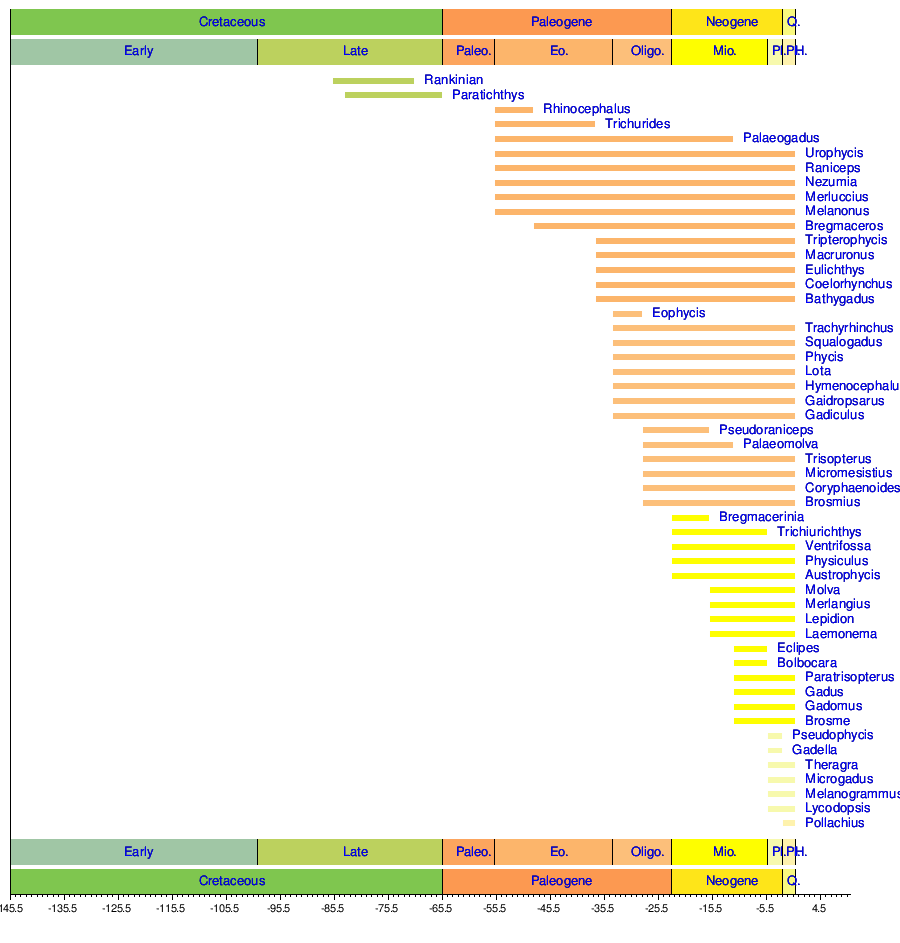
Timeline of genera

[edit]
QuaternaryNeogenePaleogeneCretaceousHolocenePleistocenePlioceneMioceneOligoceneEocenePaleoceneLate CretaceousEarly CretaceousPollachiusLycodopsisMelanogrammusMicrogadusTheragraGadellaPseudophycisBrosmeGadomusGadusParatrisopterusBolbocaraEclipesLaemonemaLepidionMerlangiusMolvaAustrophycisPhysiculusVentrifossaTrichiurichthysBregmaceriniaBrosmiusCoryphaenoidesMicromesistiusTrisopterusPalaeomolvaPseudoranicepsGadiculusGaidropsarusHymenocephalusLotaPhycisSqualogadusTrachyrhinchusEophycisBathygadusCoelorhynchusEulichthysMacruronusTripterophycisBregmacerosMelanonusMerlucciusNezumiaRanicepsUrophycisPalaeogadusTrichuridesRhinocephalusParatichthysRankinianQuaternaryNeogenePaleogeneCretaceousHolocenePleistocenePlioceneMioceneOligoceneEocenePaleoceneLate CretaceousEarly Cretaceous

References

[edit]
Revisions and contributorsEdit on WikipediaRead on Wikipedia
from Grokipedia
Gadiformes is an order of ray-finned fishes (class Actinopterygii) belonging to the cohort Paracanthopterygii, comprising five suborders, 17 families, and approximately 613 species commonly known as cods, hakes, grenadiers, and their relatives.[1] These fishes are characterized by the absence of true fin spines, long-based dorsal and anal fins that extend along much of the body, cycloid scales (rarely ctenoid), and pelvic fins that, when present, are inserted below or anterior to the pectoral fins with up to 11 rays.[2] The order derives its name from the Latin gadus (cod) and forma (shape), reflecting the prominence of cod-like forms within the group.[2] Gadiformes exhibit a broad global distribution, primarily in marine environments ranging from Arctic and temperate coastal waters to deep-sea habitats exceeding 6,000 meters in depth, with some species also occurring in freshwater and brackish systems.[2] Ecologically diverse, they occupy various trophic levels as predators of invertebrates, smaller fishes, and plankton, while serving as prey for larger marine predators; their swim bladders typically lack a pneumatic duct, an adaptation suited to deep-water pressures in many taxa.[2] The group's evolutionary history traces back to the Late Cretaceous (approximately 80 million years ago), with Stylephorus chordatus as its closest extant relative, and recent phylogenomic studies confirm their monophyly within Paracanthopterygii based on nuclear and mitochondrial data.[1] Many Gadiformes species hold substantial economic value, underpinning major global fisheries that harvest species like the Atlantic cod (Gadus morhua), Pacific cod (Gadus macrocephalus), and various hakes for food, with annual catches supporting industries in the North Atlantic, Pacific, and Southern Oceans.[3] Overfishing and climate change pose ongoing threats to several populations, influencing stock management and conservation efforts worldwide.[4] The order's diversity in body forms—from slender, deep-sea grenadiers to robust, schooling cods—highlights their adaptability and key role in aquatic ecosystems.[1]

Taxonomy and phylogeny

Classification

Gadiformes is an order of ray-finned fishes within the class Actinopterygii, superorder Paracanthopterygii, and more broadly the clade Neoteleostei.[5] The order is sometimes referred to by the synonym Anacanthini, reflecting historical classifications that emphasized the lack of spines in the dorsal and anal fins.[6] The name "Gadiformes" derives from the genus Gadus (Latin for cod) combined with the suffix -formes (indicating form or shape), highlighting the cod-like body plan characteristic of the group; the order was formally established by Edwin S. Goodrich in 1909.[7][8] According to recent phylogenomic analyses, Gadiformes is divided into five suborders and 17 families, encompassing approximately 654 species distributed across 89 genera.[1][9] These families represent a diverse array of cods, hakes, grenadiers, and related forms, primarily marine but with some freshwater representatives. The classification follows the phylogenetic framework outlined in Betancur et al. (2021), which recognizes the following suborders and families:
SuborderFamiliesApproximate GeneraApproximate Species
BregmacerotoideiBregmacerotidae116
GadoideiGadidae, Merlangiidae, Phycidae, Gaidropsaridae, Eretmophoridae~25~100
RanicipitoideiRanicipitidae14
MerluccioideiMerlucciidae, Pristigasteridae630
MacrouroideiBathygadidae, Euclichthyidae, Lotidae, Macrouridae, Melanonidae, Moridae, Muraenolepididae, Steindachneriidae, Trachyrincidae~55~500
Numbers are approximate based on current data from Eschmeyer's Catalog of Fishes and Catalogue of Life as of 2024, with variations due to ongoing taxonomic revisions.[10][9] Within Gadidae, the type genus is Gadus, with Gadus morhua (Atlantic cod) serving as the type species, exemplifying the family's typical three dorsal fins and chin barbel.[11] Merlucciidae includes notable genera like Merluccius (true hakes), while Macrouridae dominates in diversity, featuring deep-sea species such as those in Coryphaenoides. These categorizations provide the foundational hierarchy for understanding gadiform diversity, with phylogenetic relationships further explored elsewhere.[12]

Evolutionary history

The order Gadiformes originated in the Late Cretaceous, with molecular time-calibrated analyses estimating the crown-group divergence around 79.5 million years ago (Ma).[1] The earliest fossil records consist of otoliths attributed to early gadiforms from the Maastrichtian stage (~72–66 Ma), including Palaeogadus weltoni from the Severn Formation in the United States and unnamed forms from the Maastricht Formation in the Netherlands and Belgium. These predate the Cretaceous-Paleogene (K-Pg) extinction event and indicate an initial presence in shallow marine environments of the Western Interior Seaway and Tethyan margins. Possible Early Paleocene (Danian, ~66–61.6 Ma) extensions include the undescribed genus Protocodus from deposits in Europe and South Australia, suggesting survival and early recovery post-extinction. Gadiformes occupy a basal position within the superorder Paracanthopterygii, with molecular phylogenies consistently supporting their monophyly based on nuclear (e.g., RAG1) and mitochondrial (e.g., 12S, 16S) markers across diverse taxa. Relationships to other orders, such as Percopsiformes, Zeiformes, Stylephoriformes, and Polymixiiformes, form a broader monophyletic clade within Paracanthopterygii, as resolved by phylogenomic datasets encompassing over 14,000 loci from 58 species. Fossil-calibrated trees incorporating 15 gadiform taxa reinforce this positioning, highlighting shared morphological traits like reduced swim bladders and specialized otoliths.[1] Key genera of Gadiformes appeared progressively through the Cenozoic, marking initial diversification from shelf-dwellers to deep-sea forms:
Period/EpochApproximate Age (Ma)Key Genera and Notes
Late Cretaceous (Maastrichtian)72–66Palaeogadus (earliest otoliths, shallow shelf habitats)
Paleocene (DanianSelandian)66–59Protocodus (undescribed, bipolar distribution in Europe and Australia)
Eocene56–33.9Macrourus (deep-sea Macrouridae radiation, e.g., Antarctic skulls with otoliths); early Merluccius (hakes, ~15 cm length); Gadus precursors in North Atlantic
OligoceneMiocene (PaleogeneNeogene transition)33.9–5.3Expansion of Gadus (cod) and morids; Neogene sees extant family diversification
PlioceneQuaternary (NeogeneQuaternary)5.3–0Modern genera dominance, e.g., full radiation of Gadidae and Macrouridae
Diversification accelerated post-K-Pg extinction, with rapid Paleogene radiation in the eastern North Atlantic and North Sea Basin, transitioning from shallow-shelf origins to deep-sea adaptations in Macrouridae by the Eocene. This included early colonization of polar regions, as evidenced by Antarctic fossils, and bipolar distributions by the early Paleogene. Further adaptive radiations occurred during Neogene cooling phases, particularly in the Miocene (~23–5.3 Ma), promoting speciation in cold-temperate waters and establishing modern global diversity across shelf and abyssal habitats.[1]

Physical characteristics

External morphology

Gadiformes exhibit a characteristically elongated body form, which can be cylindrical or laterally compressed depending on the family, facilitating efficient swimming in diverse marine environments. Body lengths vary significantly across the order, ranging from as small as 7 cm in adult codlets of the family Bregmacerotidae to over 2 m in large species such as the Atlantic cod (Gadus morhua) in the Gadidae.[13][14] The skin is typically covered with small cycloid scales that are often deciduous, meaning they are easily shed, although some families like Macrouridae possess rougher, spinoid or ctenoid scales arranged in oblique rows.[15][12] The fins of Gadiformes are ray-finned, characteristic of actinopterygians, and lack true spines, with soft rays providing flexibility. Dorsal and anal fins are typically long-based and continuous or divided into multiple sections, aiding in stability during movement; for instance, Gadidae often have three dorsal fins, while Macrouridae feature a single long dorsal fin merging with the caudal. Pelvic fins are positioned in a jugular or thoracic location relative to the pectoral fins, with up to 11 rays, and are sometimes filamentous or elongated for sensory purposes. The caudal fin is usually forked or rounded, though it may be reduced or absent in deep-sea forms like some grenadiers.[12][3] Head morphology includes a large mouth that is either terminal or inferior, suited for capturing prey, and a well-developed lateral line system comprising canals and pores along the body and head for detecting vibrations in the water. Some taxa, such as those in Lotidae and certain Gadidae, possess barbels on the chin or snout, which serve tactile and chemosensory functions. Coloration is generally countershaded, with darker pigmentation on the dorsal surface and paler tones ventrally, enhancing camouflage against predators from above or below; for example, many Gadidae display mottled brown or green dorsally fading to white underneath. Family-specific variations include the tapering, whip-like tails of Macrouridae (grenadiers), which lack a distinct caudal fin and end in a filament, contrasting with the more robust, barbel-equipped forms in cods.[12][3][16]

Internal anatomy

The swim bladder in Gadiformes is typically physoclistous, characterized by a closed structure without a pneumatic duct connecting it to the digestive tract, which necessitates gas secretion and resorption through vascular structures for buoyancy regulation.[17] A gas gland, supported by a rete mirabile—a countercurrent exchange system of capillaries—facilitates oxygen and gas concentration to maintain neutral buoyancy, with species-specific patterns in the rete's organization.[12] In deep-sea and bathypelagic forms, such as certain macrourids (grenadiers), the swim bladder is often reduced, rudimentary, or absent, reflecting adaptations to high hydrostatic pressures where gas retention becomes inefficient.[18] Skeletal features of Gadiformes exhibit variability suited to their diverse habitats, with reduced ossification and lower bone mineralization observed in some deep-sea species to enhance buoyancy through decreased density.[19] The vertebral column generally comprises 40 to 60 or more vertebrae, with counts varying by family and species—for instance, 39–40 in early morids—supporting an elongated body form.[20] Otoliths, the calcified structures in the inner ear, are notably large and annular, enabling precise age determination through growth ring analysis, a key tool in fisheries assessments for gadiforms like cod and hake.[21] The digestive system reflects the predominantly carnivorous diet of Gadiformes, featuring a short, coiled intestine with numerous pyloric caeca—blind diverticula arising near the pylorus that increase absorptive surface area, as seen in Atlantic cod (Gadus morhua) with approximately 700 such caeca.[22] Unique intestinal traits include a prominent duodenal bulb at the proximal end, aiding initial digestion, and an arrangement of hepatic ducts that deliver bile directly into this region to emulsify lipids from prey.[12] Sensory systems in Gadiformes are adapted to low-light and deep-water environments, with eyes in mesopelagic and bathyal species showing enhanced rod photoreceptor density and spectral tuning of visual pigments for dim-light vision, as evidenced by convergent genetic adaptations in rhodopsin genes.[23]

Distribution and ecology

Geographic distribution

Gadiformes exhibit a cosmopolitan distribution in marine environments worldwide, with the majority of species inhabiting temperate to polar waters of the Northern Hemisphere, while southern distributions are more restricted to deep-sea habitats. The order is predominantly marine, though some taxa extend into brackish and freshwater systems. Tropical occurrences are limited and typically confined to deep-water realms, reflecting adaptations to cooler, oxygen-rich conditions at depth.[2] In the North Atlantic, Gadidae such as cods (Gadus spp.) and haddocks (Melanogrammus aeglefinus) dominate, with ranges spanning from the Barents Sea and Iceland southward to the Gulf of Maine and beyond Cape Hatteras. The North Pacific hosts abundant populations of pollock (Gadus chalcogrammus) and Pacific hakes (Merluccius productus), distributed from the Bering Sea to the coasts of Japan and California. Deep-water macrourids (family Macrouridae) prevail along Indo-Pacific continental slopes, extending from the Indian Ocean to the western Pacific, while in the Southern Hemisphere, species like Antarctic grenadiers (Macrourus whitsoni) are circumpolar around Antarctica, primarily in sub-Antarctic and Antarctic waters.[11][24][25][26] Endemism within Gadiformes includes notable freshwater representatives, such as the burbot (Lota lota), the sole fully freshwater species in the order, which occurs in rivers and lakes across Eurasia and North America north of approximately 40°N latitude. Landlocked populations are observed in some gadiforms, including the Atlantic tomcod (Microgadus tomcod) in certain Canadian lakes, where they have become isolated from marine ancestors. Biogeographically, concentrations are highest in boreal and subarctic zones, with depth partitioning evident: Gadidae favor shallower continental shelves (typically 50–500 m), whereas Macrouridae extend into abyssal depths exceeding 2,000 m across global oceans.[27][28][29][30]

Habitat preferences

Gadiformes exhibit diverse habitat preferences, primarily occupying cold-temperate marine environments across a broad depth gradient, from near-surface coastal waters to abyssal depths exceeding 4,000 m. Species in families such as Gadidae (cods) and Merlucciidae (hakes) are typically found on continental shelves at depths of 0–200 m, with some extending to 1,000 m or more, while Macrouridae (grenadiers) dominate deeper habitats on continental slopes and abyssal plains, ranging from 200 m to over 7,000 m.[12][3] Vertical migrations are common, particularly diel patterns in shallower species like Atlantic cod (Gadus morhua), where individuals move off the bottom into the water column at night.[31] Seasonal movements also occur, often linked to spawning or feeding aggregations, though these do not involve long-distance horizontal shifts.[12] Temperature preferences center on cold waters, generally 0–15°C, with optimal ranges varying by depth and family; for instance, Atlantic cod favor 0–6°C during spawning, while grenadiers like the roundnose grenadier (Coryphaenoides rupestris) thrive at 3.5–4.5°C in the Northwest Atlantic.[32][33] Salinity is predominantly marine at 30–35 ppt for most species, reflecting their oceanic distribution, but some exhibit euryhalinity. The burbot (Lota lota), the only fully freshwater gadiform, inhabits rivers and lakes with salinities near 0 ppt and temperatures around 4°C, while Atlantic tomcod (Microgadus tomcod) tolerates brackish conditions up to 15–23 ppt and ascends to freshwater for reproduction.[12][34] Most gadiforms lead demersal or benthic lifestyles, associating with soft substrates like mud, sand, or gravel on shelves and slopes, as seen in haddock (Melanogrammus aeglefinus) over rocky or broken shell bottoms.[35] A few, such as walleye pollock (Gadus chalcogrammus), adopt semi-pelagic habits in mid-water columns over continental shelves.[3] Deep-sea forms, particularly grenadiers, show adaptations to extreme pressures, including lipid-rich swim bladders that resist gas diffusion and reduced bone mineralization for buoyancy.[33][36] They also avoid oxygen minimum zones through behavioral and physiological means, such as hemoglobin variants with lower carbon monoxide affinity in deeper species.[37][38]

Feeding ecology

Gadiformes exhibit a predominantly carnivorous and opportunistic diet, consuming a variety of prey including crustaceans such as amphipods, shrimp, and euphausiids, polychaetes, small fish, and cephalopods like squid.[39][40] For instance, species in the family Gadidae, such as Atlantic cod (Gadus morhua), primarily feed on forage fish like herring (Clupea harengus) and capelin (Mallotus villosus), alongside larger crustaceans and crabs, while deep-sea grenadiers (Macrouridae) incorporate scavenged organic matter and benthic invertebrates.[40][41] This dietary flexibility allows adaptation to local prey availability across diverse habitats. Ontogenetic shifts are common in Gadiformes feeding habits, with juveniles typically targeting smaller planktonic or benthic organisms like euphausiids and polychaetes, transitioning to larger prey such as fish and squid as they grow.[39] In European hake (Merluccius merluccius), for example, smaller individuals rely on euphausiids, while adults shift to pelagic fish, increasing their trophic level from approximately 3.95 to 4.24.[39] Similarly, in grenadiers like Coryphaenoides cinereus, juveniles consume small crustaceans and polychaetes, with adults incorporating fish and larger cephalopods around 50 cm in length.[41] Foraging behaviors vary by species and depth; shallow-water Gadiformes, such as cod and whiting (Merlangius merlangus), often engage in active pursuit or schooling predation on pelagic prey, while deep-sea grenadiers employ scavenging strategies supplemented by opportunistic predation on benthic and benthopelagic organisms.[42][41] Hake species favor pelagic pathways through active hunting, whereas cod and haddock (Melanogrammus aeglefinus) focus on benthic resources via more sedentary or ambush tactics.[42] As mid-level predators with trophic levels ranging from 3.5 to 4.5, Gadiformes play key roles in marine food webs by linking benthic and pelagic pathways and regulating prey populations.[39][42] Atlantic cod, for example, exerts top-down control on herring stocks in regions like the Barents Sea and Baltic Sea, where herring can comprise up to 50% of their diet, influencing ecosystem dynamics and prey recruitment.[40] Their position also facilitates bioaccumulation of pollutants like mercury, with concentrations increasing with size and trophic level in species such as grenadiers (Antimora rostrata).[43] Seasonal variations in Gadiformes diets often align with migrations and prey availability, such as cod shifting to herring during spawning seasons in spring, optimizing energy intake for subsequent growth and reproduction.[44] In the Celtic Sea, whiting exhibits seasonal ontogenetic adjustments between invertivory and piscivory, reflecting migratory patterns between benthic and pelagic zones.[42]

Life history

Reproduction

Gadiformes exhibit predominantly oviparous reproduction with external fertilization, where females release eggs into the water column and males simultaneously release milt to fertilize them. This mode is characteristic across the order, with species in the family Gadidae, such as the Atlantic cod (Gadus morhua), producing buoyant pelagic eggs that drift in the plankton. Fecundity is notably high in these species, with a single female cod capable of releasing 2.5 to 9 million eggs depending on body size, enabling broad dispersal but also high mortality rates due to predation and environmental factors. In contrast, some morids (family Moridae), like the common mora (Mora moro), lay demersal eggs that adhere to substrates on the seafloor, potentially reducing dispersal but increasing vulnerability to benthic predators.[14][45] Spawning cycles in Gadiformes are largely seasonal in temperate and coastal species, peaking in winter to spring when water temperatures range from 5 to 7°C, as seen in Atlantic cod populations that form large aggregations for synchronized release. Deep-sea representatives, such as certain morids and grenadiers (family Macrouridae), often display protracted or year-round spawning patterns, with mature individuals present throughout much of the year except during brief resting periods. Most species are iteroparous, reproducing multiple times over their lifespan. Maturity is typically reached between 2 and 7 years of age, varying by species, sex, and environmental conditions; for example, Atlantic cod females historically matured at around 6 years but have shown earlier maturation at 2.8 years in response to fishing pressure.[46][47] Reproductive events are often batch-spawning, where females release eggs in multiple portions over days or weeks to maximize fertilization success amid variable conditions. Sex ratios are generally balanced, and hermaphroditism is rare, with only isolated cases of intersexuality reported, such as in walleye pollock (Gadus chalcogrammus). Environmental cues, including temperature and photoperiod, strongly influence gonadal development and spawning timing, synchronizing populations for optimal larval survival. Parental care is minimal or absent in most Gadiformes, leaving eggs unguarded after release; however, some lotids, like the burbot (Lota lota), scatter slightly adhesive eggs over substrates without further attendance. Many species, including cods, undertake seasonal migrations to dedicated spawning grounds, such as offshore banks, to aggregate and enhance encounter rates between sexes.[14][48][49]

Growth and development

Gadiform larvae are predominantly planktonic and exhibit a generalized teleostean morphology, characterized by a relatively undifferentiated body form adapted for a pelagic lifestyle. Unlike the highly specialized leptocephalus larvae of elopomorph fishes, gadiform larvae lack extreme leaf-like transparency or elongated bodies, though some deep-water species display mildly compressed, translucent forms that aid in camouflage among plankton. Development progresses through yolk-sac, preflexion, flexion, and postflexion stages, with key morphological changes including the formation of fin rays and the development of the hypural plate during flexion. Metamorphosis typically occurs at standard lengths of 20-50 mm (2-5 cm), marking the transition to a more benthic-oriented juvenile form with fully developed fins, scales, and a subterminal mouth; this process involves ossification of the skeleton and remodeling of the digestive tract. Mortality during the larval phase is exceptionally high, often exceeding 90% in natural populations due to predation, starvation, and advection away from suitable prey fields, though laboratory conditions can achieve survival rates of 40-60% to metamorphosis under optimal feeding and temperature regimes.[50][51][52][53] Post-metamorphosis growth in gadiforms is highly variable across species and influenced by factors such as temperature, food availability, and population density. Juveniles initially exhibit rapid linear growth, with rates of 10-20 cm per year in the first year for species like the Atlantic cod (Gadus morhua), slowing to 5-10 cm annually thereafter as they approach asymptotic sizes of 80-150 cm. Growth is assessed primarily through otolith annuli, which provide precise age estimates by revealing seasonal increments formed during faster summer growth periods. Sexual dimorphism is common, with females generally achieving larger maximum sizes than males due to differences in energy allocation toward reproduction versus somatic maintenance. Environmental temperature plays a critical role, as higher temperatures accelerate metabolic rates and early growth but can increase mortality if exceeding optimal ranges (e.g., 4-10°C for temperate gadiforms).[31][54][55][56] Adult lifespans in Gadiformes range from 5 to over 25 years, with long-lived species like Atlantic cod reaching up to 25 years in the wild, determined via otolith or scale readings. These fishes are iteroparous, spawning multiple times over their lives, though fecundity declines with age as energy shifts from reproduction to maintenance amid accumulating physiological senescence. Environmental factors, particularly temperature, modulate longevity by influencing metabolic demands; warmer conditions can shorten lifespan through elevated oxidative stress but enhance early growth if not extreme.[57][14][58] Juvenile gadiforms often migrate to protected nursery areas in shallow coastal bays and estuaries, where reduced currents and abundant prey support faster growth and lower predation risk compared to open offshore waters. In these habitats, typically at depths of 10-50 m over sandy or vegetated bottoms, young fish form schools to dilute individual predation risk and enhance foraging efficiency through collective vigilance. This schooling behavior persists into early adulthood, providing a key antipredator strategy during the vulnerable post-larval phase.[59][60][61]

Human interactions

Commercial importance

Gadiformes, particularly species within the family Gadidae, play a significant role in global fisheries, with Alaska pollock (Gadus chalcogrammus) being one of the most harvested marine fish species worldwide. In 2022, global capture of Alaska pollock reached approximately 3.4 million tonnes in the Northwest Pacific alone, representing about 5% of total marine finfish catches and making it the top captured species by volume.[62] Other major species include Atlantic cod (Gadus morhua), with catches around 0.1 million tonnes in the Northwest Atlantic in 2021–2022, down from a historical peak of 2.1 million tonnes in 1965; hakes (Merluccius spp.), such as Argentine hake at 0.415 million tonnes in 2021; and haddock (Melanogrammus aeglefinus), at about 0.1 million tonnes in the Northwest Atlantic.[62] Collectively, cods, hakes, and haddocks accounted for roughly 9% of global marine fish catches in recent years, a decline from 12% in 1976, reflecting shifts in production shares.[62] Commercial harvesting of Gadiformes primarily employs demersal trawling and longlining, targeting these bottom-dwelling species in temperate and subarctic waters. Trawling, using otter trawls towed along the seabed, dominates catches of Alaska pollock and hakes, while longlining with baited hooks is common for Atlantic cod and haddock to improve size selectivity and reduce undersized captures. Processed products include fresh and frozen fillets, breaded fish sticks (notably from Alaska pollock), surimi for imitation crab, and cod liver oil extracted from Atlantic cod livers for nutritional supplements. These fisheries face bycatch challenges, particularly in trawling operations, where non-target species like seabirds and other demersal fish are incidentally captured. Aquaculture of Gadiformes remains limited compared to capture fisheries, with Atlantic cod farming in Norway as the primary example. Production in Norway was approximately 8,310 tonnes of slaughtered cod in 2022, with exports of fresh farmed cod reaching 11,971 tonnes in 2024, up 37% from the previous year. In 2024, total farmed cod harvest reached about 8,300 tonnes, with fresh farmed cod exports continuing to grow into 2025. Challenges include high larval mortality rates, early sexual maturation leading to escapes and genetic impacts on wild stocks, and disease susceptibility, hindering scaling beyond current low volumes of around 10,000 tonnes annually.[63][64] The economic value of Gadiformes fisheries and trade supports coastal communities worldwide, generating approximately USD 17.8 billion in exports for cods, hakes, and haddocks in 2022, or 9% of total aquatic animal export value.[62] This sector provides employment for millions in harvesting, processing, and distribution, particularly in regions like the North Atlantic and Pacific, though declining wild stocks have increased reliance on management to sustain livelihoods.[62]

Conservation status

Gadiformes populations face significant threats from overfishing, which has led to dramatic declines in several key species. For instance, the northern cod stock off Newfoundland collapsed in the early 1990s due to decades of excessive harvesting, reducing biomass to approximately 1% of historical levels.[65] Similarly, North Sea cod experienced severe depletion during the 1990s from intensified industrial fishing, resulting in persistent low abundance.[66] Bycatch in non-selective fisheries exacerbates mortality, while bottom trawling causes habitat destruction by disrupting seafloor ecosystems essential for Gadiformes reproduction and foraging.[67] Climate change further compounds these pressures by inducing range shifts, with Atlantic cod distributions moving northward and deeper in response to warming waters.[68] Conservation status varies across Gadiformes species, reflecting differing levels of exploitation and resilience. The Atlantic cod (Gadus morhua) is assessed as Vulnerable (1996 assessment, pending update) on the IUCN Red List, primarily due to overfishing impacts across its transatlantic range.[69] In contrast, many grenadier species, such as Gadomus arcuatus, are categorized as Least Concern, owing to their deep-sea habitats and lower fishing pressure.[70] Stock assessments by the International Council for the Exploration of the Sea (ICES) guide management, with quotas set to maintain sustainable yields; for example, Northeast Arctic cod spawning stock biomass remains above maximum sustainable yield levels despite recent declines.[71] Conservation efforts have included targeted interventions to rebuild stocks. Canada imposed a moratorium on northern cod fishing in 1992, halting commercial harvests to allow recovery. As of 2025, the stock shows significant recovery progress, with spawning stock biomass now the second largest among global cod stocks and the Total Allowable Catch increased to 38,000 tonnes for the 2025-2026 season.[72][65] Marine Protected Areas (MPAs) protect critical habitats, such as Gilbert Bay in Labrador, designated in 2005 to safeguard a resident Atlantic cod population.[73] Sustainable certification programs, like the Marine Stewardship Council (MSC), have been applied to fisheries such as Alaska pollock, promoting ecosystem-friendly practices and market incentives for reduced impact.[74] Signs of recovery are evident in the Northeast Arctic cod stock, which reached record highs in recent assessments following quota reductions and improved management.[75] Looking ahead, ecosystem-based management approaches integrate environmental factors into Gadiformes fisheries to address multiple stressors, emphasizing holistic stock rebuilding.[76] Preservation of genetic diversity is crucial for aquaculture development and resilience against climate variability, with studies highlighting the need to maintain wild stock variability to support selective breeding programs.[77]

References

User Avatar
No comments yet.