


Community hub
Recent from talks
Contribute something
Nothing was collected or created yet.
Anabantiformes
View on Wikipedia
| Anabantiformes Temporal range:
| |
|---|---|

| |
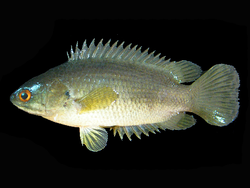
| Climbing perch (Anabas testudineus) | |
Scientific classification 
| |
| Kingdom: | Animalia |
| Phylum: | Chordata |
| Class: | Actinopterygii |
| Clade: | Percomorpha |
| Order: | Anabantiformes Li, Dettaï, Cruaud, Couloux, Desoutter-Meniger & Lecointre, 2009[1] |
| Type species | |
| Anabas testudineus | |
| Suborders and families[2] | |
|
See text | |
| Synonyms | |
| |
The Anabantiformes /ænəˈbæntɪfɔːrmiːz/, is an order of bony fish (Teleostei) proposed in 2009.[1] They are collectively known as labyrinth fish,[4] are an order of air-breathing freshwater ray-finned fish with three suborders, eight families, and at least 350 species.[5][6] This order is the sister group to the Synbranchiformes, with both comprising the monophyletic clade Anabantaria. Anabantaria is a sister group to the Carangiformes, with the clade comprising both being a sister clade to the Ovalentaria.[7] This group of fish are found in Asia and Africa, with some species introduced to North America.
These fish are characterized by the presence of teeth on the parasphenoid.[7] The snakeheads and the anabantoids are united by the presence of the labyrinth organ, which is a highly folded suprabranchial accessory breathing organ. It is formed by vascularized expansion of the epibranchial bone of the first gill arch and used for respiration in air.[8][7]
.jpg)
Many species are popular as aquarium fish - the most notable are the Siamese fighting fish and several species of gouramies.[8] In addition to being aquarium fish, some of the larger anabantiforms (such as the giant gourami[10]) are also harvested for food in their native countries.[8][11]
Taxonomy
[edit]There are three suborders and eight families currently recognized within the order Anabantiformes:[5][12]
- Order Anabantiformes
- Suborder Anabantoidei Berg, 1940
- Family Anabantidae Bonaparte, 1831
- Family Helostomatidae Gill, 1872
- Family Osphronemidae van der Hoeven, 1832
- †Ombilinichthys Murray et al., 2015a[9]
- Subfamily Belontiinae Liem, 1962
- Subfamily Osphroneminae van der Hoeven, 1832
- Osphronemus Lacepède, 1801
- Subfamily Luciocephalinae Bleeker, 1852
- Luciocephalus Bleeker, 1851
- Sphaerichthys Canestrini, 1860
- Ctenops McClelland, 1845
- Parasphaerichthys Prashad & Mukerji, 1929
- Subfamily Macropodusinae Hoedeman, 1948
- Trichogaster Bloch & Schneider, 1801
- Trichopodus Lacepède, 1801
- Betta Bleeker, 1850
- Parosphromenus Bleeker, 1877
- Macropodus Lacepède, 1801
- Malpulutta Deraniyagala, 1937
- Pseudosphromenus Bleeker, 1879
- Trichopsis Canestrini, 1860
- Suborder Channoidei Berg, 1940
- Family Aenigmachannidae Britz et al., 2020
- Family Channidae Fowler, 1934
- †Anchichanna Murray & Thewissen, 2008 (one species)
- †Eochanna Roe, 1991
- Parachanna Teugels & Daget, 1984
- Channa Scopoli, 1777
- Suborder Nandoidei Bleeker, 1852
- Family Nandidae Bleeker, 1852
- Nandus Valenciennes, 1831
- Family Badidae Barlow, Liem & Wickler, 1968
- Family Pristolepididae Regan, 1913
- ?†Palaeopristolepis Borkar, 1973[14]
- Pristolepis Jerdon, 1849
- Family Nandidae Bleeker, 1852
- Suborder Anabantoidei Berg, 1940
Alternative systematics
[edit]Phylogeny
[edit]Below shows the phylogenetic relationships among the Anabantiform families after Collins et al. (2015), here including the Nandoidei as Anabantiforms:[15][failed verification]
.jpg)
.jpg)
.jpg)
.jpg)
.jpg)
References
[edit]- ^ a b Li, Blaise; Dettaï, Agnès; Cruaud, Corinne; Couloux, Arnaud; Desoutter-Meniger, Martine; Lecointre, Guillaume (2009-02-01). "RNF213, a new nuclear marker for acanthomorph phylogeny". Molecular Phylogenetics and Evolution. 50 (2): 345–363. doi:10.1016/j.ympev.2008.11.013. ISSN 1055-7903. PMID 19059489.
- ^ R. Betancur-Rodriguez, E. Wiley, N. Bailly, A. Acero, M. Miya, G. Lecointre, G. Ortí: Phylogenetic Classification of Bony Fishes – Version 4 Archived 2017-07-11 at the Wayback Machine (2016)
- ^ Fricke, Ron; Eschmeyer, William N. & van der Laan, Richard (eds.). "Anabas". Catalog of Fishes. California Academy of Sciences. Retrieved 11 December 2019.
- ^ "Labyrinth". the. Retrieved 16 January 2022.
- ^ a b Fricke, R.; Eschmeyer, W. N.; Van der Laan, R. (2025). "ESCHMEYER'S CATALOG OF FISHES: CLASSIFICATION". California Academy of Sciences. Retrieved 2025-02-10.
- ^ "CAS - Eschmeyer's Catalog of Fishes - Genera/Species by Family/Subfamily". researcharchive.calacademy.org. Retrieved 2025-03-12.
- ^ a b c J. S. Nelson; T. C. Grande; M. V. H. Wilson (2016). Fishes of the World (5th ed.). Wiley. p. 390. ISBN 978-1-118-34233-6. Archived from the original on 2019-04-08. Retrieved 2019-12-08.
- ^ a b c Pinter, H. (1986). Labyrinth Fish. Barron's Educational Series, Inc., ISBN 0-8120-5635-3
- ^ a b Murray, A. M.; Zaim, Y.; Rizal, Y.; Aswan, Y.; Gunnell, G. F.; Ciochon, R. L. (2015). "A Fossil Gourami (teleostei, Anabantoidei) from Probable Eocene Deposits of the Ombilin Basin, Sumatra, Indonesia". Journal of Vertebrate Paleontology. 35 (2) e906444. doi:10.1080/02724634.2014.906444. ISSN 0272-4634. JSTOR 24524161.
- ^ Chanphong, Jitkasem. (1995). Diseases of Giant Gourami, Osphronemus goramy (Lacepede) Archived January 6, 2007, at the Wayback Machine. The Aquatic Animal Health Research Institute Newsletter 4(1).
- ^ Froese, R.; D. Pauly (eds.). "Trichogaster trichopterus". FishBase. Retrieved 2006-12-23.
- ^ Richard van der Laan; William N. Eschmeyer & Ronald Fricke (2014). "Family-group names of Recent fishes". Zootaxa. 3882 (2): 001–230.
- ^ Raghavan, Rajeev; Dahanukar, Neelesh; Anoop, V. K.; Britz, Ralf (2019-05-09). "The subterranean Aenigmachanna gollum , a new genus and species of snakehead (Teleostei: Channidae) from Kerala, South India". Zootaxa. 4603 (2): 377–388. doi:10.11646/zootaxa.4603.2.10. ISSN 1175-5334. PMID 31717234.
- ^ Friedman, Matt; V. Andrews, James; Saad, Hadeel; El-Sayed, Sanaa (2023-06-16). "The Cretaceous–Paleogene transition in spiny-rayed fishes: surveying "Patterson's Gap" in the acanthomorph skeletal record André Dumont medalist lecture 2018". Geologica Belgica. doi:10.20341/gb.2023.002. ISSN 1374-8505.
- ^ Collins, R.A.; Britz, R.; Rüber, L. (2015). "Phylogenetic systematics of leaffishes (Teleostei: Polycentridae, Nandidae)". Journal of Zoological Systematics and Evolutionary Research. 53 (4): 259–272. doi:10.1111/jzs.12103.
Anabantiformes
View on GrokipediaDescription
Morphology
Anabantiformes display considerable diversity in body morphology, reflecting adaptations to various freshwater environments. The body shape ranges from elongated and cylindrical in snakeheads of the family Channidae, such as Channa species, featuring large scales that are cycloid or ctenoid, a large mouth with protruding lower jaw and depressible canine-like teeth, long dorsal and anal fins without spines, and paired suprabranchial chambers serving as the air-breathing organ, which facilitate movement through vegetated habitats, to laterally compressed forms in families like Nandidae and Osphronemidae, enhancing maneuverability in dense aquatic vegetation.[5][6][7] Scales in this order are typically ctenoid, providing a rough texture, though cycloid scales occur in some taxa.[8] The dorsal and anal fins are often elongated in males of Anabantoidei families, such as Betta and Trichogaster, forming extended rays that contribute to the overall body plan.[9] Pelvic fins in Anabantiformes vary across families; they are reduced or jugular-positioned in Channidae, aiding in precise positioning during ambushes, while in Anabantidae and Osphronemidae, they are more developed and thoracic.[10] Some Anabantoidei, particularly in Osphronemidae, possess thread-like pectoral fins that extend beyond the body, enhancing sensory capabilities. The skull is robust, featuring teeth on the parasphenoid bone, a diagnostic trait that supports feeding mechanics by opposing other dental elements during prey processing.[11][12] Size variation within the order is pronounced, spanning from diminutive species in the genus Badis (family Badidae), which rarely exceed 6 cm in standard length, to large predators like Channa striata (family Channidae), capable of reaching 1.5 m total length.[13][5] The labyrinth organ, a key structural feature unique to Anabantiformes, consists of paired suprabranchial chambers derived from modified gill arches, forming intricate bony lamellae lined with vascularized epithelium. This organ provides a structural basis for supplemental air-breathing in low-oxygen environments.Physiology
Anabantiformes exhibit bimodal respiration, combining aquatic gas exchange through gills with aerial oxygen uptake facilitated by the labyrinth organ, a highly vascularized suprabranchial chamber that enhances oxygen absorption from atmospheric air. This organ consists of thin respiratory epithelium folded into intricate bony plates, providing an extensive surface area for efficient gas diffusion during air-breathing events, which become essential in oxygen-poor aquatic environments. The transition between respiratory modes allows these fish to supplement gill-based oxygen extraction—typically responsible for carbon dioxide excretion—with aerial respiration, enabling survival in habitats where dissolved oxygen levels drop below 1 mg/L.[14][15] This physiological strategy confers remarkable tolerance to hypoxia, with species like the Siamese fighting fish (Betta splendens) exhibit developmental plasticity in labyrinth organ size in response to low-oxygen conditions. In the Channidae subfamily, such as Channa argus, aerial respiration via the suprabranchial chamber reduces overall oxygen consumption by approximately 22-24% during emersion, mitigating metabolic stress and extending survival out of water to over 20 hours. These fish also exhibit resilience to hypercapnia, thriving in waters with elevated CO2 levels (up to 20 mmHg) common in stagnant tropical habitats, through downregulated metabolic rates that limit anaerobic reliance and acidosis. Some Channidae species, including Channa argus, can aestivate by burrowing into mud during seasonal droughts, entering a state of metabolic depression that conserves energy and allows prolonged survival—up to several days—until rehydration.[15] Sensory adaptations in Anabantiformes are tailored to low-visibility environments, with an enhanced lateral line system comprising neuromasts that detect subtle water vibrations and pressure gradients, aiding navigation and prey detection in murky, sediment-laden waters. This mechanosensory array, distributed along the body flanks and head, provides hydrodynamic cues equivalent to a "distant touch," crucial for orienting in turbid conditions where visual cues are obscured.[16][17] Metabolic adjustments enable Anabantiformes to withstand environmental fluctuations, including temperature ranges of 20-30°C and pH variations from 4 to 8, by modulating enzyme activities and ion channel expressions that maintain cellular homeostasis. For instance, species like Trichogaster spp. exhibit elevated heat-shock protein responses at upper thermal limits, preventing protein denaturation, while acid-base regulatory mechanisms buffer pH shifts through gill bicarbonate transport. These tolerances support their persistence in variable tropical freshwater systems, where diurnal temperature swings and acidic runoff from vegetation are common.[14][18] Predominantly freshwater inhabitants, though some species tolerate brackish conditions, Anabantiformes maintain osmoregulation through active ion uptake across gills and integument, countering osmotic water influx and ionic dilution via Na+/K+-ATPase pumps in chloride cells. Gills predominate in sodium and chloride absorption, linked to ammonia excretion, while the skin contributes auxiliary uptake, particularly during aerial phases when gill function is reduced. This dual-site strategy ensures plasma ion concentrations remain stable (around 150 mM Na+), preventing dehydration in dilute media.[19][20]Distribution and habitat
Geographic distribution
Anabantiformes exhibit a disjunct native distribution across Africa and Asia, reflecting their primary freshwater origins in tropical and subtropical regions. In Africa, the family Channidae, including genera such as Parachanna, is predominantly found in West and Central African river systems, extending northward to the Nile River basin in Sudan and Egypt. Additionally, the family Anabantidae is native to Africa, with genera such as Ctenopoma and Microctenopoma in the Congo Basin and Sandelia in southern African coastal rivers.[21][22][23] In Asia, the order spans from the Indian subcontinent through Southeast Asia to Indonesia, with families like Osphronemidae inhabiting river basins such as the Mekong in Thailand, Laos, Cambodia, and Vietnam.[24][25] Endemism patterns are particularly pronounced within the suborder Anabantoidei in Southeast Asia, where high species diversity occurs in regions like Sumatra and the Malay Peninsula, contributing to localized radiations among labyrinth fishes.[26] Within the suborder Nandoidei, certain species of Badidae are restricted to the Western Ghats of India, underscoring regional isolation in peninsular freshwater systems.[27] Introduced populations of snakeheads (Channa spp.), which are aggressive predators in Asian and African freshwaters, have established beyond their native ranges, notably in North America where Channa argus has colonized the Potomac River and its tributaries in Maryland and Virginia since 2004, posing risks as an invasive predator.[28][29] Similar introductions of Channa species have occurred in parts of Europe, leading to ecological concerns due to their adaptability and predatory impact.[30][29] The fossil record of Anabantiformes dates to the Eocene epoch, with early channid remains reported from deposits in Pakistan and Africa, suggesting an Asian origin around 48 million years ago followed by dispersals that shaped their current disjunct pattern, potentially linked to Gondwanan vicariance influences.[31][21] Biogeographic barriers such as the Himalayas have driven speciation in channids through vicariance in the Eastern Himalayan hotspot, while the dynamic paleogeography of Sundaland facilitated diversification among anabantoids via Pleistocene sea-level fluctuations and island connectivity.[32][33]Habitat preferences
Anabantiformes exhibit a strong preference for lentic aquatic environments, including slow-flowing rivers, swamps, rice paddies, and floodplain lakes characterized by dense vegetation cover. These habitats provide shelter and foraging opportunities amid thick aquatic plants, which are essential for species in the suborder Anabantoidei, such as gouramis and bettas.[34] In contrast, members of the Channidae family, like snakeheads, favor similar stagnant or sluggish waters but often associate with muddy substrates rather than heavy vegetation.[35] These fishes thrive in warm, low-oxygen conditions typical of stagnant waters, with temperatures ranging from 24–30°C and dissolved oxygen levels often below 5 mg/L due to stagnation and organic decay. Water pH is generally acidic to neutral (4.0–7.5), particularly in blackwater habitats stained by tannins from peat swamps and leaf litter, which many species, including various bettas, preferentially inhabit for their chemical stability and reduced predation visibility.[36] Their accessory air-breathing organs enable survival in these hypoxic environments, allowing exploitation of niches unavailable to obligate gill-breathers.[37] Microhabitat selection varies by subfamily: Anabantoidei species are predominantly surface-dwellers, utilizing weed beds and floating vegetation for ambush predation and nest-building, while Channidae tend toward benthic zones, burrowing into soft mud for concealment and aestivation.[38] In floodplain systems, many Anabantiformes undertake seasonal migrations during monsoon floods to access nutrient-rich inundated areas, dispersing overland or via connected waterways to exploit temporary habitats.[39] During dry seasons, species like snakeheads demonstrate drought tolerance by burrowing into moist mud cocoons, estivating for weeks or months until rains refill water bodies.[40] Habitat loss poses a severe threat to Anabantiformes, primarily through deforestation and drainage of wetlands in Southeast Asia, where peat swamp conversion for agriculture and palm oil plantations has fragmented critical lentic ecosystems. These activities exacerbate seasonal droughts and degrade water quality, contributing to population declines in endemic species across Sundaland hotspots.[41]Behavior
Locomotion and respiration
Anabantiformes primarily utilize labriform propulsion for locomotion, relying on oscillatory movements of the pectoral fins to generate thrust and enable precise maneuvering at low speeds. This swimming style is particularly effective in vegetated or structurally complex habitats, allowing for agile turns and station-holding without significant body undulation. In contrast, members of the family Channidae, known as snakeheads, exhibit specialized terrestrial capabilities, crawling overland for short distances using cyclic oscillations of the axial body combined with pectoral fin support to traverse moist substrates between water bodies.[42] Air breathing in Anabantiformes involves routine surfacing to gulp atmospheric oxygen, with the frequency of these events varying based on dissolved oxygen levels in the water; for instance, in the paradise fish (Macropodus opercularis), gulping occurs approximately once per minute under standard laboratory conditions, increasing during hypoxia.[37] In species like Ctenopoma muriei, breathing becomes more frequent and spatially synchronous as oxygen decreases, serving as an obligatory mechanism for buoyancy and equilibrium maintenance.[43] Some species, such as croaking gouramis (Trichopsis spp.), produce audible croaking or chirping sounds during rapid pectoral fin movements associated with surfacing, potentially linked to the mechanics of air intake.[44] Escape responses in Anabantiformes typically include rapid darting motions or seeking refuge in dense vegetation to evade predators, behaviors enhanced by their labriform swimming efficiency. The climbing perch (Anabas testudineus) demonstrates an advanced escape strategy by walking short distances on land, employing uniaxial rotations of the opercular gill covers for propulsion and traction on substrates, which facilitates movement away from desiccating pools or threats. In oxygen-poor environments, these fish reduce gill ventilation rates to conserve energy, minimizing the metabolic costs of aqueous respiration and associated ionoregulatory demands while relying more heavily on aerial oxygen uptake via the labyrinth organ. Many Anabantiformes exhibit crepuscular patterns in air-breathing activity, surfacing more actively at dawn and dusk when predation risk from aerial hunters is lower, often favoring shallow, vegetated microhabitats during the day to balance respiratory needs with safety.[45] This temporal and spatial strategy reduces exposure during frequent gulps, linking locomotion directly to survival in hypoxic, predator-rich aquatic systems.Feeding ecology
Anabantiformes species predominantly exhibit carnivorous diets, feeding on insects, crustaceans, small fish, and other invertebrates. In the family Channidae, snakeheads such as Channa marulius consume fish, frogs, insects, earthworms, and tadpoles, reflecting their opportunistic predatory nature.[46] Similarly, species in the genus Betta, including Betta splendens, primarily ingest zooplankton, insect larvae, and small crustaceans.[47] Within the family Osphronemidae, diets are more varied and often omnivorous; for instance, the giant gourami Osphronemus goramy incorporates aquatic weeds, algae, detritus, fish, and frogs.[48] Foraging strategies differ by family and habitat. Channidae employ ambush predation, remaining stationary among vegetation or substrate to surprise prey, which enhances their efficiency in shallow waters.[49] Air-breathing taxa like Betta species frequently engage in surface feeding, targeting insects and floating matter accessible at the water-air interface, facilitated by their labyrinth organ.[50] These methods position Anabantiformes as mid-level predators in freshwater ecosystems, controlling invertebrate and small fish populations, though snakeheads often act as apex predators in Asian wetlands due to their size and aggression.[51] Ontogenetic and seasonal variations influence feeding ecology. Juveniles across families, such as in Nandidae, are largely planktivorous, relying on zooplankton before shifting to more diverse prey as adults.[52] In tropical regions, monsoon seasons increase insectivory, as flooding enhances the availability of terrestrial insects and larvae falling into water bodies.[53] Economically, Channa species hold significant value in Indian aquaculture, farmed extensively for human consumption due to their fast growth and market demand.[40] As invasives, however, they disrupt native ecosystems by overpredating local prey, leading to declines in biodiversity.[54]Social interactions
Social interactions in Anabantiformes are characterized by a range of agonistic and cooperative behaviors that facilitate resource access and conflict resolution. Territoriality is particularly pronounced among males, especially during breeding periods, where individuals aggressively defend spaces against intruders through displays and physical confrontations. For instance, in Betta splendens, males exhibit intense territorial aggression, including opercular flaring and biting, to establish dominance over limited aquatic territories, a behavior historically exploited in staged fights in Thailand.[55] Females in this species display lower levels of aggression, focusing more on resource guarding rather than overt combat. In other anabantoids like Trichogaster trichopterus (blue gourami), Colisa lalia (dwarf gourami), and Macropodus opercularis (paradise fish), territoriality emerges within 7 days in group settings, peaking at intermediate population densities such as six individuals per tank, where defense of personal space reduces intraspecific competition.[56] Hierarchy formation is common in group-living anabantoids, establishing dominance ranks through ritualized displays that minimize injury. In gouramis such as T. trichopterus and C. lalia, hierarchies develop within 3-5 days, involving behaviors like chasing, butting, and fin-tugging, with dominant individuals suppressing subordinates via opercle spreading (fin flaring) and sigmoid posturing.[56] Rank stability varies, but aggression often decreases over time as pecking orders solidify, particularly in unisexual groups where females may show higher aggression rates per interaction than males. In species like the samurai gourami (Sphaerichthys vaillanti), dominant pairs harass subordinates, leading to stress-induced paling in lower-ranked fish to avoid conflict.[57] Schooling behavior is uncommon in Anabantiformes but occurs loosely among juveniles in certain families. Juveniles of Pristolepis marginata (Malabar leaffish, Pristolepididae) form temporary shoals for protection, exhibiting coordinated movements in vegetated habitats before dispersing as adults.[58] This contrasts with the solitary or territorial tendencies of most adults in the order. Interspecific interactions often involve predation, with some Anabantiformes acting as predators on smaller fish and invertebrates. Dwarf gouramis (Trichogaster lalius) employ ballistic water-shooting to stun insect prey, demonstrating specialized hunting tactics that extend to opportunistic predation on conspecifics or other species in shared habitats.[59] Certain species, such as leaf fishes in Nandidae (e.g., Monocirrhus polyacanthus), engage in camouflage-based interactions with plants, mimicking leaf structures to ambush prey while evading detection by larger predators, effectively using the environment for symbiotic concealment. Communication in Anabantiformes relies heavily on visual and acoustic signals to convey dominance or intent during contests. Visual cues include rapid color changes and fin erections; for example, male B. splendens flare gill covers and intensify body coloration to intimidate rivals.[60] Acoustic signals are prominent in species like the croaking gourami (Trichopsis vittata), where males produce low-frequency croaks via pectoral fin tendon plucking during lateral displays, aiding in territorial disputes without physical contact; these sounds vary by sex and size, with larger sonic muscles enabling more intense calls in males.[61] Such multimodal signaling enhances interaction efficiency in turbid freshwater environments.[62]Reproduction
Mating systems
Mating systems in Anabantiformes are diverse but predominantly feature polygynous or promiscuous strategies within the suborder Anabantoidei, where males often court and spawn with multiple females during a breeding cycle. In species like the climbing perch (Anabas testudineus), a single male may engage in repeated spawning bouts with one or more females, with matings occurring at intervals of 2-10 minutes over several hours, facilitating polygamic reproduction.[63] This system contrasts with the more pair-oriented behaviors observed in some Channoidei, such as snakeheads (Channa spp.), where courtship typically involves stable male-female pairs exhibiting synchronized chasing and body touching prior to spawning.[64] Courtship rituals in Anabantoidei are elaborate and male-driven, often centered on nest construction to attract females. In Siamese fighting fish (Betta splendens), males build bubble nests by blowing air bubbles coated in oral mucus and saliva, which serve as a visual and structural signal during prespawning displays; these displays include lateral and frontal posturing to entice the female toward the nest.[65] Similarly, in giant gourami (Osphronemus goramy), males construct nests from plant fibers like palm leaves, arranging them in a basket-like structure over several days, accompanied by aggressive chasing, opercular flaring, and synchronized swimming to court receptive females.[66] Chasing and gentle nipping behaviors are common across these displays, escalating as the female approaches the nest, with males in Betta exhibiting up to 678 aggressive or courtship bouts per spawning session to secure mating.[65] In croaking gourami (Trichopsis vittata), courtship involves vocalizations and fin displays by males, who are typically larger and heavier than females, to initiate pairing. Sexual dimorphism in Anabantiformes supports these mating dynamics, with males generally exhibiting brighter coloration, elongated fins, and more vibrant patterning to enhance visibility during courtship. In paradise fish (Macropodus opercularis), adult males possess extended dorsal, caudal, and anal fins along with intense red and blue hues, distinguishing them from the duller, shorter-finned females and aiding in mate attraction.[67] Honey gourami (Trichogaster chuna) males display striking red-orange body tones with lemon-yellow dorsals, a dimorphism that intensifies during breeding to signal readiness. Females in these species often exercise choice based on male nest quality and display vigor; for instance, in Betta, receptive females preferentially approach males with well-constructed bubble nests, indicating male fitness and territory stability.[68] Hermaphroditism is absent in Anabantiformes, with all species exhibiting gonochoristic sex determination. Breeding in many Anabantiformes is seasonal, triggered by environmental cues such as monsoon rains and flooding, which increase water levels and oxygen availability in floodplain habitats. In regions like Bangladesh and India, species including gouramis and snakeheads initiate courtship and spawning during the monsoon period (typically June to October), when rising waters provide optimal conditions for nest building and egg dispersal.[69] This timing aligns with heightened resource availability post-flooding, enhancing reproductive success in these air-breathing fishes. Alternative mating strategies occur in some Channidae, where subordinate males may employ sneaking tactics to intercept spawnings from established pairs, though such behaviors are less documented than in nest-building Anabantoidei. In striped snakehead (Channa striatus), while primary courtship involves paired chasing, opportunistic intrusions by non-territorial males can contribute to fertilization during group spawnings under captive conditions.[64]Parental care
Parental care in Anabantiformes is diverse but predominantly involves male or biparental investment in egg incubation and protection, reflecting plesiomorphic traits ancestral to the order Anabantiformes, with variations or losses in some lineages.[70] In the family Osphronemidae, many species are bubble-nest builders, where males construct floating nests from mucus-coated air bubbles often anchored beneath vegetation or artificial substrates; adhesive eggs are deposited into these nests post-spawning, providing a protected aerial environment that enhances oxygenation.[71] In Channidae (Channoidei), biparental care is common, with both parents guarding floating or substrate-adhered eggs and newly hatched fry against predators until the young are free-swimming.[40] Substrate spawning occurs in Nandidae (Nandoidei), where eggs are laid directly on the bottom or attached to surfaces without nest construction, with parental guarding varying among species—absent in some such as certain Nandus and present (e.g., male guarding of eggs on cave walls) in others like Nandus nebulosus.[72][73] Mouthbrooding represents another key strategy, primarily paternal in some Osphronemidae such as the chocolate gourami (Sphaerichthys osphromenoides), where males collect fertilized eggs into their oral cavity for incubation lasting 12–16 days until hatching.[74] Contrary to reports in some literature, Helostomatidae like the kissing gourami (Helostoma temminckii) do not exhibit mouthbrooding; instead, they broadcast floating eggs with no oral incubation by either parent.[75] Guarding behaviors are common across caring species, with males or pairs actively fanning eggs or nests to maintain oxygen flow and remove debris, while aggressively defending against predators; such actions significantly boost hatching success, reaching over 90% under parental care compared to about 62% without it.[71] Fry development proceeds rapidly post-hatching, with larvae becoming free-swimming and capable of independent feeding within 1–2 weeks, though the labyrinth organ matures over several additional weeks, a vulnerable phase marked by high mortality rates exceeding 50% in the absence of continued parental protection.[71] Without care, egg and fry survival drops sharply due to predation and poor oxygenation, underscoring the adaptive value of these plesiomorphic behaviors in hypoxic habitats.[70]Taxonomy and evolution
History of classification
The taxonomic history of Anabantiformes reflects a progression from morphological groupings based on the distinctive labyrinth organ to molecular phylogenies that redefined the order's boundaries and monophyly. In the early 19th century, Georges Cuvier and Achille Valenciennes first recognized the labyrinth fishes as a cohesive assemblage within Perciformes, designating them "poissons à pharyngiens labyrinthiformes" in their seminal work Histoire naturelle des poissons, which included both the true labyrinth fishes and the snakeheads (Channidae) due to the shared accessory breathing structure. This initial classification emphasized the suprabranchial organ as a key synapomorphy, placing the group within the broader perciform framework prevalent at the time.[34] By the mid-19th century, refinements separated the Channidae into distinct categories, often as a separate suborder (Channoidei) or even an independent order (Channiformes) within Perciformes, highlighting morphological divergences such as differences in body form and scale patterns beyond the labyrinth organ.[76] The Anabantoidei were retained as a suborder of Perciformes, focused on the air-breathing gouramis and allies, with classifications like those of Bleeker (1877) delineating families based on anatomical features of the labyrinth and jaws. These early schemes underscored the labyrinth organ's role but struggled with the group's placement amid the expansive Perciformes, sometimes linking it loosely to labroid fishes via pharyngeal jaw specializations.[77] Mid-20th-century revisions, particularly in the 1960s and 1970s, reinforced the separation of labyrinth fishes as a specialized perciform lineage, with emphasis on functional morphology of air-breathing adaptations. Lauder and Liem (1983) offered the inaugural cladistic phylogeny of Anabantoidei, partitioning it into five families (Anabantidae, Helostomatidae, Belontiidae, Osphronemidae, and Luciocephalidae) based on labyrinth organ ontogeny, jaw mechanics, and breeding behaviors, while excluding Channidae as more basal.[34] This morphological framework solidified Anabantoidei as monophyletic within Perciformes but questioned close ties to Channoidei.[78] Molecular data from the 1990s and early 2000s began hinting at a broader monophyly encompassing Anabantoidei, Channoidei, and related taxa like Nandidae, challenging prior separations. Chen et al. (2003) provided early molecular evidence using mitochondrial and nuclear ribosomal genes, recovering Anabantoidei and Channoidei as sister groups within a larger acanthomorph clade, overturning some morphological doubts about their unity. These findings positioned the assemblage within Percomorpha, shifting from traditional perciform confines toward a more inclusive framework influenced by genomic markers.[78] The order Anabantiformes was formally proposed in 2009 by Li et al., who analyzed the nuclear RNF213 gene across acanthomorphs and identified a well-supported clade (clade F) uniting Anabantoidei, Channoidei, and Nandioidei, elevated to ordinal rank based on this molecular evidence complemented by morphological traits like the labyrinth organ's variations.[76] Prior to this, the components were variably synonymized under Labroidei or dispersed within Percomorpha in morphological schemes, but the 2009 synthesis marked a paradigm shift toward integrating molecular data for higher-level fish taxonomy. Subsequent adoptions, such as by Betancur-R et al. (2013), refined and affirmed this structure within a comprehensive bony fish phylogeny.[79]Current taxonomy
The order Anabantiformes is currently divided into three suborders: Anabantoidei, Channoidei, and Nandioidei, encompassing a total of 8 families, 26 genera, and 287 valid species.[80][3] https://pmc.ncbi.nlm.nih.gov/articles/PMC5501477/ The suborder Anabantoidei includes three families: Anabantidae (climbing gouramis; 4 genera, 33 species), Helostomatidae (kissing gouramis; 1 genus, 1 species), and Osphronemidae (gouramis and bettas; 14 genera, 141 species), representing the majority of anabantiform diversity with approximately 175 species.[80][3] The suborder Channoidei comprises two families: Aenigmachannidae (gollum snakeheads; 1 genus, 1 species) and Channidae (snakeheads; 2 genera, 59 species), totaling about 60 species.[80][3] The family Aenigmachannidae was erected in 2020 to accommodate the highly specialized, subterranean snakehead-like fishes discovered in Kerala, India.https://www.nature.com/articles/s41598-020-73129-6 The suborder Nandioidei consists of three families: Nandidae (leaffishes; 1 genus, 8 species), Badidae (chameleonfishes; 2 genera, 36 species), and Pristolepididae (glass leaffishes; 1 genus, 6 species), with roughly 50 species.[80][3]| Suborder | Families | Genera | Species |
|---|---|---|---|
| Anabantoidei | Anabantidae, Helostomatidae, Osphronemidae | 19 | 175 |
| Channoidei | Aenigmachannidae, Channidae | 3 | 60 |
| Nandioidei | Nandidae, Badidae, Pristolepididae | 4 | 50 |
| Total | 8 | 26 | 287 |