


Community hub
Recent from talks
Contribute something
Nothing was collected or created yet.
GameCube online functionality
View on Wikipedia

The GameCube has limited support for online gaming. Nintendo never commissioned any servers to interface with the console, but allowed other publishers to do so. The only games released with internet-based gameplay modes were Phantasy Star Online, Phantasy Star Online Episode III: C.A.R.D. Revolution, and Homeland. Nintendo also published three racing games with local area network (LAN) support: 1080° Avalanche, Kirby Air Ride, and Mario Kart: Double Dash!!. Using network functions requires the official broadband or modem adapter since the console does not have out of the box network capabilities.
Despite competitors Microsoft and Sony advancing online gaming for their consoles, the Xbox and PlayStation 2, Nintendo remained pensive with its online strategy for the duration of the GameCube's lifespan. Company leaders including Shigeru Miyamoto and Satoru Iwata based their stance on concerns with maintaining quality control over their games and doubts that players would want to pay subscription fees.
History
[edit].jpg)

Before the GameCube, Nintendo had experimented with network connectivity with three accessories released exclusively in Japan for the Famicom, Super Famicom, and Nintendo 64. For the Famicom, they developed the Family Computer Network System peripheral in 1988. The device acted as a modem and allowed players to view weather forecasts, the stock market, and bet on horse races, among other activities.[1] Following their experiences with the device, Nintendo developed the Satellaview for the Super Famicom, a satellite modem peripheral. The modem communicated to a series of BS satellites which relayed information from servers hosted by satellite radio company St.GIGA. Using this service, players had access to exclusive games, magazines, and other downloads. Nintendo ended its partnership with St.GIGA in 1999, and partnered with Recruit to build a new online service called Randnet for the 64DD, a magnetic disk drive add-on for the Nintendo 64. Randnet gave players access to message board communities and a web browser for surfing the internet.[2][3]
In 1999, an unnamed source at Nintendo of America said, "Networkability is at the top of the list for the new console."[4][5] referring to the N2000 prototype which would later become the GameCube. On August 28, 1999, Nintendo EAD general manager Shigeru Miyamoto stated that the Dolphin needed some type of network communication because it was becoming an important component of entertainment. However, he said that Nintendo did not have any true motive to become significantly involved in the internet business. He stated Nintendo has a responsibility to families so that parents can always feel secure with children playing Nintendo products, and went on to say that he did not think network capabilities would be a core component of their next console.[5]
On February 9, 2000, Miyamoto said that he was interested in online gaming, but Nintendo would only get involved with it if they developed a unique approach to the idea, not because others were doing it.[6] At E3 2001, though demonstrating their networking accessories and Phantasy Star Online, Nintendo director and general manager Satoru Iwata stated Nintendo was confident enough with its offline strategy to not seriously explore the possibilities of online gaming. He said that Nintendo would build a network to support a worldwide audience if they could make it profitable, but he expressed doubts that online gaming would be a sustainable business model for the company, citing subscription costs as prohibitive at retaining a steady customer base.[7][8] On June 8, 2000, Nintendo President Hiroshi Yamauchi said, "We are planning to introduce an internet business next March or April. The first step will be online sales of a brand new type of Pokémon cards."[9]
Nintendo remained cautious and terse with its online strategy for the remainder of the system's lifespan while competitors Microsoft and Sony were advancing their online gaming business.[10][11] Months after the system's release, Nintendo stated it was researching online projects internally, but not planning any public demonstrations.[12] Miyamoto solidified his stance against online gaming around the same time, citing concerns that Nintendo would not be able to dictate the vision of their games nor guarantee their quality. In addition, he believed that players would not want to pay monthly fees.[13] In a 2022 interview, Nintendo of America's former president Reggie Fils-Aimé said that Nintendo felt it excelled in local multiplayer experiences and wanted to spend time determining how to replicate those online. He added that cultural differences between Nintendo's regional branches slowed its adoption of online multiplayer, as the Japanese branch disagreed with the American and European ones over whether the infrastructure was worth investing in.[14]
Hardware
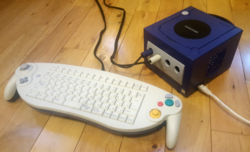
[edit]Nintendo released two networking accessories for the GameCube in October 2002 produced by Conexant, the Broadband Adapter (a network adapter) and the Modem Adapter (a 56k dial-up modem).[15][16] The adapters fit flush into "Serial Port 1" on the underside of the GameCube. The Broadband Adapter is built for faster internet speeds and adds an ethernet jack to the side of the console while the Modem Adapter adds a phone jack and operates through dial-up.[17][18] Both adapters can be used for the Phantasy Star Online games and Powerful Pro, but the Broadband Adapter is required for LAN-only games and Homeland.[19][20] To help players communicate in Phantasy Star Online, ASCII Corporation released a stretched out controller with a full keyboard in the middle.[21]
Supported games
[edit]| Title | Publisher | Regions | Internet | LAN |
|---|---|---|---|---|
| 1080° Avalanche | Nintendo | All | 
|

|
| Homeland | Chunsoft | JP |
|
|
| Jikkyō Powerful Pro Yakyū 10 | Konami | JP | DLC |
|
| Kirby Air Ride | Nintendo | All |
|
|
| Mario Kart: Double Dash!! | Nintendo | All |
|
|
| Phantasy Star Online Episode I & II | Sega | All |
|
|
| Phantasy Star Online Episode I & II Plus | Sega | JP / NA |
|
|
| Phantasy Star Online Episode III: C.A.R.D. Revolution | Sega | All |
|
|
Nintendo did not develop any servers or internet service to interface with GameCube consoles, and instead made publishers responsible for providing server interfaces and managing the online experience for their games.[22]
Internet games
[edit]The first GameCube game with internet access was Phantasy Star Online Episode I & II, a role-playing game (RPG) developed by Sonic Team and published by Sega. Originally released for the Dreamcast in 2000, it was ported to the GameCube in 2002 with additional content. The servers were maintained by Sega, and players were charged USD $8.95 per month to play online.[23][24] Sega released an enhanced version in 2003, subtitled Plus, which added quests to the offline mode, originally exclusive to the online mode.[25] Sega released a sequel in 2003 which also featured online modes, Phantasy Star Online Episode III: C.A.R.D. Revolution. The game features turn-based RPG battles that could be played competitively online.[26] The Phantasy Star Online servers were officially discontinued on March 31, 2007, but all three games can still be played online via fan maintained private servers.[19][27][28]
Japan received an exclusive online RPG in 2005 by Chunsoft titled Homeland. Chunsoft did not charge a subscription fee and elected to allow players to host games on their own system, although they maintained central servers to match players with one another.[29] The host player was the "God player" and could transform the world and lead the other players, or "questers", on their adventure.[30] The matching service ended April 30, 2007.[28] Up to 35 players could join one game, and LAN connectivity was also supported.[20][31]
Japan also received Jikkyō Powerful Pro Yakyū 10, a baseball game that could access free downloadable content, but offered no online gaming modes.[32]
LAN games
[edit]Nintendo published three racing games with LAN multiplayer modes: 1080° Avalanche, Kirby Air Ride, and Mario Kart: Double Dash!!.[33] When playing over a LAN, multiple systems can be connected through a shared ethernet hub or two systems can be connected directly to one another with a cross cable.[34] 1080° Avalanche and Kirby Air Ride support up to four players across four consoles. If two consoles are used, up to two players can play on each system. If three or four consoles are used, only one player may play per system.[35][36] For Mario Kart, up to 16 players can play simultaneously across eight consoles, with two players controlling each kart. When two consoles are used, up to four players can play per console, with each player controlling their own kart. If more than two consoles are used, only two players can play on each system cooperatively as two characters sharing one kart.[34] Although the games do not support internet gameplay natively, hobbyists developed third-party PC applications that tunnel the GameCube's network traffic across the internet, such as Warp Pipe and XLink Kai.[37][38][16]
Abandoned projects
[edit]Some developers planned networking modes for their GameCube games but these were never realized. Hironobu Sakaguchi commented in July 2001 that they were planning on taking their Final Fantasy series online and it would need to be on all platforms to be profitable, including the GameCube.[39] In May 2001, Namco mentioned they were working on six online titles for all three sixth generation consoles, including the GameCube.[40] The GameCube version of Tom Clancy's Splinter Cell: Pandora Tomorrow had a planned online mode.[41] The first Battlefield game, Battlefield 1942, was proposed by DICE as a GameCube exclusive to Nintendo. Though satisfied with the proposal, negotiations never made it further because Nintendo had no online strategy.[42] LAN modes were planned for Mario Power Tennis and F-Zero GX, but these were later abandoned.[43][44][45]
See also
[edit]- Nintendo Wi-Fi Connection and WiiConnect24, Nintendo's free online services for the Wii and DS
- Nintendo Network, Nintendo's free online service for the Wii U and 3DS
- Nintendo Switch Online, Nintendo's paid online service for the Switch
- SegaNet and Dreamarena
- PlayStation 2 online functionality
- Xbox Live
References
[edit]- ^ Takano, Masaharu (September 11, 1995). "How the Famicom Modem was Born". Nikkei Electronics (in Japanese). English translation linked written by GlitterBerri. Archived from the original on July 3, 2012. Retrieved November 24, 2017.
- ^ "Nintendo Online Magazine" (in Japanese). Nintendo Co., Ltd. Archived from the original on July 1, 2015. Retrieved June 23, 2017.
- ^ IGN Staff (February 23, 2001). "64DD: Broken Promises". IGN. Archived from the original on January 11, 2015. Retrieved January 11, 2015.
- ^ IGN Staff (March 12, 1999). "It's Alive!". IGN. Archived from the original on July 14, 2014. Retrieved June 25, 2014.
- ^ a b Miyamoto, Shigeru (August 28, 1999). "Miyamoto Talks Dolphin at Space World '99". GameSpot (Interview). Interviewed by Chris Johnston. Archived from the original on March 23, 2014. Retrieved July 6, 2014.
- ^ Kennedy, Sam (February 9, 2000). "Miyamoto Goes Online for Dolphin". GameSpot. Archived from the original on October 20, 2017. Retrieved July 6, 2014.
- ^ EGM Staff (August 2001). "Nintendo GameCube". Electronic Gaming Monthly. No. 145. pp. 49, 66.
- ^ IGN Staff (May 24, 2001). "The Big GameCube Interview: Satoru Iwata (GameCube)". IGN. Archived from the original on January 20, 2018. Retrieved January 20, 2018.
- ^ "Yamauchi Confirms Dolphin Delay, internet Plans". IGN. June 7, 2000. Retrieved June 6, 2014.
- ^ Macdonald, Keza (November 16, 2016). "How The First Online Game Consoles Changed Everything". Rolling Stone. Archived from the original on January 20, 2018. Retrieved January 20, 2018.
- ^ Isensee, Pete; Ganem, Steve (March 28, 2003). "Developing Online Console Games". Gamasutra. Archived from the original on July 17, 2017. Retrieved January 20, 2018.
- ^ Morris, Chris (May 13, 2002). "Nintendo unveils online strategy". CNN. Archived from the original on March 9, 2016. Retrieved January 20, 2018.
- ^ Morris, Chris (March 6, 2002). "Miyamoto not impressed by online gaming". CNN. Archived from the original on March 7, 2016. Retrieved January 20, 2018.
- ^ Hagues, Alana (May 23, 2022). "Reggie Talks About Nintendo's Slow Adoption Of Online Play". Nintendo Life. Retrieved December 25, 2023.
- ^ Mirabella, Fran (September 26, 2001). "Nintendo GameCube Broadband Adapter". IGN. Archived from the original on February 23, 2014.
- ^ a b Bivens, Danny (October 31, 2011). "GameCube Broadband/Modem Adapter". Nintendo World Report. Archived from the original on April 6, 2016. Retrieved September 7, 2016.
- ^ Broadband Adapter Instruction Booklet (PDF). USA: Nintendo. 2002. Archived (PDF) from the original on May 31, 2010. Retrieved August 15, 2010.
- ^ IGN Staff (October 3, 2002). "Hands-on: GameCube Broadband". IGN. Archived from the original on January 20, 2018. Retrieved January 20, 2018.
- ^ a b "| Nintendo - Customer Service | Nintendo GameCube - Online/LAN". Nintendo. Archived from the original on July 21, 2017. Retrieved November 16, 2017.
- ^ a b "ホームランドの「ネットプレイ」の仕組み". Spike-Chunsoft (in Japanese). Archived from the original on October 16, 2015. Retrieved January 20, 2018.
- ^ Torres, Ricardo (October 15, 2001). "TGS 2001 Fall: Hands-on: Phantasy Star Online GameCube". GameSpot. Archived from the original on November 17, 2017.
- ^ IGN Staff (May 13, 2002). "Nintendo Jumps Online". IGN. Archived from the original on December 24, 2013. Retrieved July 21, 2013.
- ^ Mirabella III, Fran (November 1, 2002). "Phantasy Star Online Episode I & II". IGN. Archived from the original on December 1, 2017. Retrieved November 24, 2017.
- ^ Bramwell, Tom (April 2, 2003). "Phantasy Star Online: Episode I & II". Eurogamer. Archived from the original on December 1, 2017. Retrieved November 24, 2017.
- ^ Casamassina, Matt (July 13, 2004). "PSO Episode I&II Plus". IGN. Archived from the original on October 26, 2013. Retrieved October 5, 2012.
- ^ Nutt, Christian (March 2, 2004). "Phantasy Star Online Episode III: C.A.R.D. Revolution (GCN)". GameSpy. Archived from the original on July 8, 2008.
- ^ Fenlon, Wes (April 14, 2017). "Phantasy Star Online will never die: how the nicest fans in gaming keep a 16-year-old MMO alive". PC Gamer. Archived from the original on January 2, 2018. Retrieved January 20, 2018.
- ^ a b "『ホームランド』4月30日でオンラインサービス終了に | インサイド". インサイド (in Japanese). April 5, 2007. Archived from the original on January 20, 2018. Retrieved January 20, 2018.
- ^ Sklens, Mike (March 25, 2004). "Chunsoft's "Homeland" GameCube RPG Goes Online". Nintendo World Report. Archived from the original on December 1, 2017. Retrieved November 18, 2017.
- ^ "神さまプレイ". Spike-Chunsoft (in Japanese). Archived from the original on April 20, 2016. Retrieved January 20, 2018.
- ^ "HOMELAND - Q&A". Spike-Chunsoft (in Japanese). Archived from the original on January 20, 2018. Retrieved January 20, 2018.
- ^ "ダウンロード". Konami (in Japanese). November 19, 2005. Archived from the original on November 19, 2005. Retrieved November 25, 2017.
- ^ "| Nintendo - Customer Service | Nintendo GameCube - Connecting over a LAN". Nintendo. Archived from the original on November 16, 2017. Retrieved November 16, 2017.
- ^ a b Mario Kart: Double Dash!! instruction manual. North America: Nintendo. 2003. pp. 36–39.
- ^ "| Nintendo - Customer Service | Nintendo GameCube - LAN 1080 Setup". Nintendo. Archived from the original on November 16, 2017. Retrieved November 16, 2017.
- ^ "| Nintendo - Customer Service | Nintendo GameCube - Kirby's Air Ride". Nintendo. Archived from the original on November 16, 2017. Retrieved November 16, 2017.
- ^ Ransom, James (November 30, 2004). "XLink Kai: free online gaming for the masses". Joystiq. Archived from the original on June 16, 2013. Retrieved November 6, 2012.
- ^ Thorsen, Tor (October 28, 2003). "DIY developers bring GameCube online". GameSpot. Archived from the original on November 17, 2017.
- ^ Mirabella III, Fran (July 19, 2001). "GameCube by Genre". IGN. Archived from the original on January 20, 2018. Retrieved January 20, 2018.
- ^ IGN Staff (May 23, 2001). "Namco Confirms GameCube Development Plans". IGN. Archived from the original on January 20, 2018. Retrieved January 20, 2018.
- ^ Burnes, Andrew (December 16, 2003). "Splinter Cell: Pandora Tomorrow Online Enabled On GameCube". IGN. Archived from the original on January 20, 2018. Retrieved January 20, 2018.
- ^ Ronaghan, Neal. "Battlefield Could Have Been Exclusive to GameCube". Nintendo World Report. Archived from the original on February 11, 2017. Retrieved January 21, 2018.
- ^ IGN Staff (June 24, 2004). "Mario Tennis Connected". IGN. Archived from the original on November 17, 2017. Retrieved November 17, 2017.
- ^ IGN Staff (July 7, 2003). "No LAN Play for F-Zero". IGN. Archived from the original on November 17, 2017. Retrieved November 17, 2017.
- ^ Bramwell, Tom (June 30, 2004). "No online play for Mario Tennis". Eurogamer. Archived from the original on July 3, 2015. Retrieved July 21, 2013.
External links
[edit]| Hardware | |
|---|---|
| Accessories | |
| Games | |
| Emulators | |
| Related | |
| |
