Hubbry Logo
Gauss's methodGauss's methodMain
Open search
Gauss's method
Community hub
Gauss's method
logo
7 pages, 0 posts
0 subscribers
Be the first to start a discussion here.
Gauss's method
Gauss's method
from Wikipedia

In orbital mechanics (a subfield of celestial mechanics), Gauss's method is used for preliminary orbit determination from at least three observations (more observations increases the accuracy of the determined orbit) of the orbiting body of interest at three different times. The required information are the times of observations, the position vectors of the observation points (in Equatorial Coordinate System), the direction cosine vector of the orbiting body from the observation points (from Topocentric Equatorial Coordinate System) and general physical data.

Working in 1801, Carl Friedrich Gauss developed important mathematical techniques (summed up in Gauss's methods) which were specifically used to determine the orbit of Ceres. The method shown following is the orbit determination of an orbiting body about the focal body where the observations were taken from, whereas the method for determining Ceres' orbit requires a bit more effort because the observations were taken from Earth while Ceres orbits the Sun.

Observer position vector

[edit]

The observer position vector (in Equatorial coordinate system) of the observation points can be determined from the latitude and local sidereal time (from Topocentric coordinate system) at the surface of the focal body of the orbiting body (for example, the Earth) via either:

Geodetic latitude
Geocentric latitude

or where,

  • is the respective observer position vector (in Equatorial Coordinate System)
  • is the equatorial radius of the central body (e.g., 6,378 km for Earth)
  • is the geocentric distance
  • is the oblateness (or flattening) of the central body (e.g., 0.003353 for Earth)
  • is the eccentricity of the central body (e.g., 0.081819 for Earth)
  • is the geodetic latitude (the angle between the normal line of horizontal plane and the equatorial plane)
  • is the geocentric latitude (the angle between the radius and the equatorial plane)
  • is the geodetic altitude
  • is the local sidereal time of observation site

Orbiting body direction cosine vector

[edit]
Right ascension (blue) and declination (green) as seen from outside the celestial sphere

The orbiting body direction cosine vector can be determined from the right ascension and declination (from Topocentric Equatorial Coordinate System) of the orbiting body from the observation points via:

where,

  • is the respective unit vector in the direction of the position vector (from observation point to orbiting body in Topocentric Equatorial Coordinate System)
  • is the respective declination
  • is the respective right ascension

Algorithm

[edit]

The initial derivation begins with vector addition to determine the orbiting body's position vector. Then based on the conservation of angular momentum and Keplerian orbit principles (which states that an orbit lies in a two dimensional plane in three dimensional space), a linear combination of said position vectors is established. Also, the relation between a body's position and velocity vector by Lagrange coefficients is used which results in the use of said coefficients. Then with vector manipulation and algebra, the following equations were derived. For detailed derivation, refer to Curtis.[1]

NOTE: Gauss's method is a preliminary orbit determination, with emphasis on preliminary. The approximation of the Lagrange coefficients and the limitations of the required observation conditions (i.e., insignificant curvature in the arc between observations, refer to Gronchi[2] for more details) causes inaccuracies. Gauss's method can be improved, however, by increasing the accuracy of sub-components, such as solving Kepler's equation. Another way to increase the accuracy is through more observations.

Step 1

[edit]

Calculate time intervals, subtract the times between observations: where
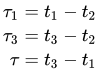
  • is the time interval
  • is the respective observation time

Step 2

[edit]
The cross product in respect to a right-handed coordinate system

Calculate cross products, take the cross products of the observational unit direction (order matters): where
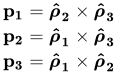
  • is the cross product of vectors
  • is the respective cross product vector
  • is the respective unit vector

Step 3

[edit]
Three vectors defining a parallelepiped. The magnitude of the triple product, , describes the volume.

Calculate common scalar quantity (scalar triple product), take the dot product of the first observational unit vector with the cross product of the second and third observational unit vector:

where

  • is the dot product of vectors and
  • is the common scalar triple product
  • is the respective cross product vector
  • is the respective unit vector

Step 4

[edit]

Calculate nine scalar quantities (similar to step 3): where

  • is the respective scalar quantity
  • is the respective observer position vector
  • is the respective cross product vector

Step 5

[edit]

Calculate scalar position coefficients:

where

  • , , and are scalar position coefficients
  • is the common scalar quantity
  • is the respective scalar quantities
  • is the time interval
  • is the respective observer position vector
  • is the respective unit vector

Step 6

[edit]

Calculate the squared scalar distance of the second observation, by taking the dot product of the position vector of the second observation: where
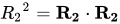
  • is the squared distance of the second observation
  • is the position vector of the second observation

Step 7

[edit]

Calculate the coefficients of the scalar distance polynomial for the second observation of the orbiting body: where
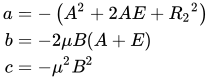
  • are coefficients of the scalar distance polynomial for the second observation of the orbiting body
  • are scalar position coefficients
  • is the gravitational parameter of the focal body of the orbiting body

Step 8

[edit]

Find the root of the scalar distance polynomial for the second observation of the orbiting body: where

  • is the scalar distance for the second observation of the orbiting body (it and its vector, r2, are in the Equatorial Coordinate System)
  • are coefficients as previously stated

Various methods can be used to find the root, a suggested method is the Newton–Raphson method. The root must be physically possible (i.e., not negative nor complex) and if multiple roots are suitable, each must be evaluated and compared to any available data to confirm their validity.

Step 9

[edit]

Calculate the slant range, the distance from the observer point to the orbiting body at their respective time: where

  • is the respective slant range (it and its vector, , are in the Topocentric Equatorial Coordinate System)
  • is the common scalar quantity
  • is the respective scalar quantities
  • is the time interval.
  • is the scalar distance for the second observation of the orbiting body
  • is the gravitational parameter of the focal body of the orbiting body

Step 10

[edit]

Calculate the orbiting body position vectors, by adding the observer position vector to the slant direction vector (which is the slant distance multiplied by the slant direction vector):

where

  • is the respective orbiting body position vector (in Equatorial Coordinate System)
  • is the respective observer position vector
  • is the respective slant range
  • is the respective unit vector

Step 11

[edit]

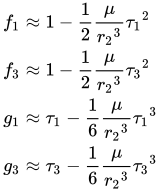
Calculate the Lagrange coefficients: where,

  • , , and are the Lagrange coefficients (these are just the first two terms of the series expression based on the assumption of small time interval)
  • is the gravitational parameter of the focal body of the orbiting body
  • is the scalar distance for the second observation of the orbiting body
  • is the time interval

Step 12

[edit]

Calculate the velocity vector for the second observation of the orbiting body:

where

  • is the velocity vector for the second observation of the orbiting body (in Equatorial Coordinate System)
  • , , and are the Lagrange coefficients
  • is the respective orbiting body position vector

Step 13

[edit]

The orbital state vectors have now been found, the position (r2) and velocity (v2) vector for the second observation of the orbiting body. With these two vectors, the orbital elements can be found and the orbit determined.

See also

[edit]

References

[edit]
Revisions and contributorsEdit on WikipediaRead on Wikipedia
from Grokipedia
Gauss's method is a technique in celestial mechanics for preliminary orbit determination of a celestial body, such as an or , using at least three positional observations ( and ) taken from Earth at different times. Developed by in 1801 to predict the position of the Ceres after its was lost beyond the horizon, the method formulates the problem geometrically and dynamically, solving a to find the body's position and vectors relative to the solar system barycenter, from which Keplerian are derived. Gauss detailed the approach in his 1809 book Theoria Motus Corporum Coelestium in Sectionibus Conicis Solem Ambientium, where he also introduced least-squares fitting to refine the from multiple observations, improving accuracy over earlier methods like those of Laplace. The method assumes a Keplerian two-body perturbed minimally by other bodies and relies on the observer's known position (e.g., from astronomical ephemerides). It remains foundational in astrodynamics for initial estimation, especially for near-Earth objects, and is implemented in modern software for space surveillance.

Historical background

Discovery of Ceres

On January 1, 1801, Italian astronomer , director of the Palermo Astronomical Observatory, discovered a faint stellar object while compiling a catalog of zodiacal stars using his Ramsden circle telescope. Initially suspecting it to be a or the long-sought missing between Mars and predicted by the Titius-Bode , Piazzi named it Ceres Ferdinandea after the Roman of and in honor of his patron, King Ferdinand IV of . This marked the first recorded observation of an , ushering in the era of discoveries in early 19th-century astronomy. At the time, astronomical observations relied entirely on manual telescopic measurements, as had not yet been invented, limiting data to visual sightings under clear skies. Piazzi tracked Ceres over the subsequent 40 days, recording 19 complete angular positions—consisting of and relative to the —on clear nights from January 1 to February 11, 1801. These measurements provided only directional information from , without any radial distance data, as contemporaneous instruments could not determine the object's range accurately. Observations ceased when Ceres approached conjunction with the Sun, its light becoming indistinguishable against the solar glare, rendering further tracking impossible until it reemerged on the opposite side of the sky months later. The sparse dataset posed a significant challenge for astronomers, who needed to extrapolate Ceres' elliptical orbit to predict its reappearance in late 1801, a task complicated by the short observational arc spanning just 3 degrees of sky and inherent measurement errors. With no established methods for orbit determination from such limited angular data, the astronomical community, including the group known as the "Celestial Police," urgently sought a rigorous mathematical approach to resolve the problem and relocate the object. This impetus led to the development of Gauss's least-squares method for precise orbital prediction.

Gauss's contributions

In 1801, at the age of 24, developed a method for determining the orbit of the asteroid Ceres while engaged in fundamental astronomical research. He applied this approach to the limited dataset of initial observations made by earlier that year. marked a significant advancement in , addressing the challenge of predicting the position of a newly discovered object with incomplete data. A key innovation in Gauss's method was his implicit use of the approximation technique to refine from observational errors, though he did not publicly disclose this until later. Additionally, he focused on just three observations to derive a preliminary , simplifying the complex problem of conic section fitting under gravitational influences. These contributions demonstrated Gauss's emphasis on probabilistic error minimization and efficient parameter estimation in astronomy. Gauss outlined his technique in detail in the 1809 publication Theoria Motus Corporum Coelestium in Sectionibus Conicis Solem Ambientium, where he formalized the principles applied to Ceres. His calculations successfully predicted Ceres' position on December 31, 1801, validating the method and enabling astronomers Heinrich Olbers and Franz von Zach to rediscover the near the forecasted location. This achievement not only confirmed the orbit but also established Gauss's reputation in practical astronomy.

Method overview

Purpose and applications

Gauss's method serves as a preliminary technique for determining the orbit of a celestial body around a central gravitational body using at least three angular observations, such as and , without requiring initial distance measurements. This approach estimates the body's position and velocity by solving for through iterative calculations based on the geometry of the observations and assumed two-body motion. The method finds primary applications in tracking asteroids and comets, where angular data from ground-based or space telescopes is abundant but radial distances are not directly measured. It is also employed in space surveillance for initial of unknown satellites, enabling real-time estimation from angle-only observations by a single . In astrodynamics software, Gauss's method provides a foundational step for setting up initial orbits before refinement with more data or perturbation models. Key advantages include its reliance solely on readily available angular measurements and its computational simplicity, which allowed for hand calculations during its development in the early 19th century. Historically, it successfully predicted the reappearance of the asteroid Ceres in 1801 after its initial observations. However, the method assumes unperturbed two-body motion, which limits its accuracy for objects influenced by significant perturbations like planetary gravity or non-gravitational forces. It performs less reliably for close Earth observations, where small errors in angular data can amplify due to the limited in the iterative process.

Inputs and outputs

Gauss's method requires as inputs three sets of topocentric angular observations of the target body, each consisting of α and δ measured at distinct observation times t1, t2, and t3. These observations are typically obtained from ground-based telescopes and provide the line-of-sight directions from the observer to the object. Additionally, the locations of the observers must be specified for each observation, including , , and height above the Earth's surface, to determine the topocentric positions. The gravitational parameter μ of the central body, such as the Sun for heliocentric orbits (μ ≈ 1.327 × 10^{20} m³/s²), is also an essential input to model the two-body dynamics. The observations are formatted in equatorial coordinates, with and expressed in degrees or hours/degrees, while the observation times are given in Julian days or to account for astronomical precision in timing. The angular inputs are used to derive vectors representing the unit vectors from the observer to the target. Key assumptions underlying the method include negligible observer motion over short observational arcs, which simplifies the geometry for brief observation spans, and a model for computing observer positions from the provided , , and height. The primary outputs of Gauss's method are the position vector r and velocity vector v of the target body relative to the central body at a reference , usually the middle observation time t2, enabling an initial two-body solution. From these state vectors, the six classical Keplerian can be computed: semi-major axis a, eccentricity e, inclination i, Ω, argument of perigee ω, and ν at the reference . These elements provide a complete preliminary description of the relative to the central body, using an appropriate reference plane (e.g., for heliocentric orbits).

Mathematical preliminaries

Two-body problem and Keplerian orbits

The in describes the motion of two point masses interacting solely through a central gravitational force that follows the , F=Gm1m2r2F = G \frac{m_1 m_2}{r^2}, where GG is the and rr is the separation distance. This system can be reduced to an equivalent one-body problem by introducing the μred=m1m2m1+m2\mu_\text{red} = \frac{m_1 m_2}{m_1 + m_2}, which orbits the center of mass under an effective central force; for cases like a orbiting a much more massive sun, μred\mu_\text{red} approximates the planet's mass, simplifying the dynamics to motion in a fixed central potential. The resulting trajectory is a conic section—, parabola, or —determined by the total energy and of the system. Key principles from Kepler's laws underpin this motion. The second law states that a line from the central body to the orbiting body sweeps out equal areas in equal times, reflecting the conservation of and constant dAdt=L2μred\frac{dA}{dt} = \frac{L}{2\mu_\text{red}}, where LL is the angular momentum magnitude. The provides the relative speed vv at any point: v2=μ(2r1a)v^2 = \mu \left( \frac{2}{r} - \frac{1}{a} \right), where μ=G(m1+m2)\mu = G (m_1 + m_2) is the gravitational parameter and aa is the semi-major axis; this relates to the orbit's size and the instantaneous distance rr, with bound elliptical orbits (v2<2μrv^2 < \frac{2\mu}{r}) yielding negative total energy. A Keplerian orbit is fully characterized by six classical orbital elements: the semi-major axis aa, which sets the orbit's scale; eccentricity ee, which defines its shape ( e<1e < 1 for ellipses, e=0e = 0 for circles); inclination ii, the angle between the orbital plane and a reference plane; longitude of the ascending node Ω\Omega, the angle locating the node in the reference plane; argument of periapsis ω\omega, the angle from the node to the closest approach point; and true anomaly ν\nu, the angle from periapsis to the current position. These elements parameterize the conic section relative to an inertial reference frame, enabling prediction of the body's position over time. The instantaneous state of the orbiting body is specified by its position vector r\mathbf{r} (from the central body) and velocity vector v\mathbf{v}, which together determine the full conic orbit, including energy, angular momentum, and orientation, without needing the orbital elements explicitly. This state-vector representation forms the basis for computing orbital parameters in methods like Gauss's, where observations inform line-of-sight constraints on r\mathbf{r} and v\mathbf{v}.

Observation geometry

In Gauss's method for preliminary orbit determination, the geometric foundation links Earth-based observations of an asteroid or comet to its heliocentric position relative to the Sun. The observer, located on Earth's surface at position vector R\mathbf{R} in heliocentric coordinates, sights the orbiting body at position r\mathbf{r} along a line-of-sight defined by the unit vector ρ^\hat{\rho}. The heliocentric range ρ\rho between the observer and the body satisfies ρ=rR\rho = |\mathbf{r} - \mathbf{R}|, yielding the vector relation r=R+ρρ^\mathbf{r} = \mathbf{R} + \rho \hat{\rho}. This setup positions the body's trajectory within the solar system frame, where R\mathbf{R} is derived from Earth's known orbital ephemeris, approximating the geocentric observer offset as negligible for distant bodies. Topocentric observations provide the angular coordinates of the body relative to the observer: right ascension α\alpha (measured eastward from the vernal equinox) and declination δ\delta (measured north from the celestial equator) in the equatorial coordinate frame. These angles are converted to direction cosines ll, mm, nn for the unit vector ρ^\hat{\rho}, given by l=cosδcosαl = \cos \delta \cos \alpha, m=cosδsinαm = \cos \delta \sin \alpha, and n=sinδn = \sin \delta. This transformation embeds the line-of-sight into a Cartesian system aligned with the equatorial frame, facilitating vector computations while accounting for the observer's local horizon and Earth's rotation via sidereal time corrections. For three such observations at distinct times t1t_1, t2t_2, t3t_3, the corresponding position vectors r1\mathbf{r}_1, r2\mathbf{r}_2, r3\mathbf{r}_3 form a triangle in the observation space, geometrically constrained by the body's motion. This triangular configuration allows the elimination of the unknown observation times from the equations by invoking areal constants, which stem from the constant areal velocity in Keplerian motion—providing a dynamical link without requiring explicit time propagation at this stage. The areas of the triangles formed by pairwise positions (e.g., areas proportional to r1×r2|\mathbf{r}_1 \times \mathbf{r}_2|, r2×r3|\mathbf{r}_2 \times \mathbf{r}_3|, r3×r1|\mathbf{r}_3 \times \mathbf{r}_1|) are proportional to the time intervals between the observations owing to the constant areal velocity, enabling the isolation of geometric parameters. Coordinate transformations bridge the geocentric observation frame to the heliocentric system essential for orbital elements. Starting from geocentric equatorial coordinates (where initial direction cosines are defined), the vectors are rotated to an Earth-centered inertial frame using the Greenwich sidereal time to remove diurnal motion effects. Further adjustment to heliocentric ecliptic coordinates incorporates Earth's orbital position R\mathbf{R}, typically obtained from planetary ephemerides, ensuring the geometry aligns with the Sun-centered two-body problem. This process preserves the relative geometry while embedding the observations in the broader solar system context.

Problem formulation

Observer position vector

In Gauss's method for preliminary orbit determination, the observer position vector Rn\mathbf{R}_n denotes the heliocentric position of the Earth-based observer at the time of the nnth observation. This vector is essential for transforming geocentric observations into the heliocentric frame, where orbital computations are performed. It combines the heliocentric position of the Earth's center—obtained from planetary ephemeris data—with the observer's position relative to the Earth's center, ensuring accuracy in accounting for the observer's location on the oblate Earth. The relative geocentric position is computed using an ellipsoidal Earth model to incorporate oblateness and the observer's altitude. The formula gives the position in Earth-Centered Earth-Fixed (ECEF) coordinates: rgeo,n=[Re1e2sin2ϕn+Hn]cosϕn(cosθnI^+sinθnJ^)+[Re(1e2)1e2sin2ϕn+Hn]sinϕnK^,\mathbf{r}_{geo,n} = \left[ \frac{R_e}{\sqrt{1 - e^2 \sin^2 \phi_n}} + H_n \right] \cos \phi_n (\cos \theta_n \hat{\mathbf{I}} + \sin \theta_n \hat{\mathbf{J}}) + \left[ \frac{R_e (1 - e^2)}{\sqrt{1 - e^2 \sin^2 \phi_n}} + H_n \right] \sin \phi_n \hat{\mathbf{K}},
Add your contribution
Related Hubs
User Avatar
No comments yet.