Hubbry Logo
Giant danioGiant danioMain
Open search
Giant danio
Community hub
Giant danio
logo
8 pages, 0 posts
0 subscribers
Be the first to start a discussion here.
Giant danio
Giant danio
from Wikipedia

Giant danio
Scientific classification Edit this classification
Kingdom: Animalia
Phylum: Chordata
Class: Actinopterygii
Order: Cypriniformes
Family: Danionidae
Subfamily: Danioninae
Genus: Devario
Species:
D. aequipinnatus
Binomial name
Devario aequipinnatus
(McClelland, 1839)
Synonyms[2]
  • Perilampus ostreographus McClelland, 1839
  • Devario ostreographus (McClelland 1839)
  • Leuciscus lineolatus Blyth, 1858
  • Devario cyanotaenia Bleeker, 1860

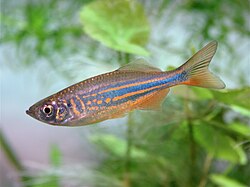
The giant danio (Devario aequipinnatus) is a species of freshwater ray-finned fish in the family Danionidae, native to parts of South and Southeast Asia. With a maximum length of about 15 cm (5.9 in), it is one of the largest species in the family. It may be found in the aquarium trade.

Taxonomy and etymology

[edit]

The giant danio belongs to the large danionin genus Devario. Its specific epithet is a combination of the Latin adjectives aequalis and pinnatus, meaning "equal" and "finned" respectively. This is a reference to the fact that the dorsal and anal fins of this species are symmetric.[3]

Several other species in the genus, including D. affinis, D. browni, D. malabaricus (the Malabar danio), and D. strigillifer, were once deemed as synonyms of the giant danio, but are now valid species. One may find fish labelled as "golden giant danio" in the aquarium trade; this is not a separate species, but merely a partial albino giant danio.

Description

[edit]

The giant danio can grow up to 10–15 cm (3.9–5.9 in), making it one of the largest danionins. It is characterized by a blue and yellow, torpedo-shaped body with gray and clear fins. Females are larger than males and possess a more rounded abdomen.[4]

Distribution and habitat

[edit]

The giant danio is native to the Indian subcontinent (including Sri Lanka) and most of Indochina,[5] with a range running from Pakistan to Cambodia.[5] Within these areas, this species is found in fast-flowing streams,[5][4] usually in hilly areas, at elevations up to 300 m (980 ft).[5][4] It prefers shaded and clear water with the following characteristics:[5][4]

  • with gravel or sand bottom;
  • pH between 6.0 and 8.0;
  • hardness between 5 and 19 dGH;
  • temperature between 22–27 °C (72–81 °F).

Diet

[edit]

As surface dwellers, the diet of the giant danio consists predominantly of exogenous insects; this is supplemented by aquatic invertebrates such as worms and crustaceans.[5] In captivity, the giant danio accepts most foods, including mosquito larvae, chironomous larvae, white worms, chopped earth worms, and commercially available pet food.[4]

Reproduction

[edit]

Males interested in spawning chase females would ram into their abdomens with their heads.[4] The giant danio is an egg scatterer, and females produce around 300 eggs in a single spawning in clumps of plants. Juveniles begin to resemble their adult form after around 65 days of development.[4]

Giant danio breeding can be induced in captivity by increasing water temperature and creating artificial rain.

In the aquarium

[edit]

The giant danio has become an extremely popular aquarium fish over the decades: its flashy coloration combined with an active swimming style has enticed many aquarists to include it in their displays. As the giant danio is a shoaling fish in its natural habitat,[5][4] having 6 or more (ideally 8-10) giant danios in a tank will bring out their most natural behaviors. It is somewhat aggressive, and may bully other fish in community tanks. It is recommended that this species be kept in a tank that is at least 1.2 m (3.9 ft) long with ample open swimming spaces and with a secure lid (since this species is known to be a jumper).[6] The average lifespan of this species in captivity is 5-7 years.[6]

As dither fish

[edit]

The giant danio may be used as dither fish in South and Central American cichlid aquaria. The larger cichlids chase and defend their territories against the giant danios, allowing them to exhibit more natural behavior.

References

[edit]

Further reading

[edit]
[edit]
Revisions and contributorsEdit on WikipediaRead on Wikipedia
from Grokipedia
The giant danio (Devario aequipinnatus) is a tropical belonging to the family Danionidae, native to , and noted for its elongated body, striking striped coloration, and active schooling behavior. Reaching a maximum length of 15 cm, it inhabits fast-flowing hill streams with clear, oxygenated water and is widely recognized in the aquarium trade for its peaceful temperament and adaptability. Characterized by a silvery or golden body accented by two to four horizontal or stripes running along the flanks, the giant danio possesses a forked caudal and transparent to yellowish unpaired fins. Males are typically slimmer with intensified colors during the breeding season, while females appear fuller-bodied. This species exhibits a deep-bodied form relative to other danios, with 35–38 lateral line scales contributing to its streamlined profile for navigating swift currents. Distributed across hill streams and upper river sections in , , and —often at elevations up to 300 m—the giant danio prefers shaded, clear waters over , , or rocky substrates with marginal . It tolerates temperatures of 18–25 °C and a pH range of 6.0–8.0, forming schools in the wild to on , small crustaceans, worms, and occasional plant . An oviparous breeder, the giant danio scatters adhesive eggs among aquatic plants or substrate during the rainy season, with occurring in 1–2 days; it displays no , and juveniles grow rapidly in well-oxygenated conditions. Though collected for international aquariums, its populations remain stable, assessed as Least Concern by the as of 2010.

Taxonomy and description

Taxonomy

The giant danio is scientifically classified as Devario aequipinnatus (McClelland, 1839), a species within the order and family Danionidae. It was originally described as Perilampus aequipinnatus from specimens collected in , . The Devario Heckel, 1843, encompasses larger-bodied danios primarily from and , distinguishing it from the smaller-bodied Danio Hamilton, 1822 (which includes species formerly placed in Brachydanio, now a junior of Danio), based on morphological differences such as body depth and fin structure, corroborated by molecular analyses. The generic name Devario derives from the Bengali vernacular "debari," a local term for these fishes that also translates to "brother-in-law." The specific epithet aequipinnatus refers to the similar length of the dorsal and anal fins. Historically, D. aequipinnatus was placed in the genus Danio following the synonymization of Devario in the late , but the genus was revived in the early through phylogenetic studies resolving the of Devario separate from Danio. The family Danionidae, to which it belongs, was elevated from the subfamily Danioninae (previously under the paraphyletic Cyprinidae sensu lato) in 2010, based on comprehensive molecular data from mitochondrial and nuclear genes that supported its distinct evolutionary lineage. Several junior synonyms have been applied to D. aequipinnatus, including Danio aequipinnatus (McClelland, 1839), Leuciscus aequipinnatus (McClelland, 1839), Pteropsarion aequipinnatus (McClelland, 1839), Danio aequipinnulus (non Günther, 1868), Danio lineolatus (non Blyth, 1860), and Leuciscus lineolatus (non Sykes, 1839). Within , Devario forms a monophyletic in the subfamily Danioninae, sister to genera such as Chela, with D. aequipinnatus closely related to species like D. regina and D. anomalus in the south Asian danio radiation.

Physical characteristics

The giant danio (Devario aequipinnatus) attains an adult length of up to 15–16 cm (6 inches), making it the largest within the danio group. Its body is elongated and cylindrical, with a rounded and a complete running along the flanks, contributing to its streamlined form suited for active swimming. It has 35–38 scales along the . This morphology supports efficient movement in groups, where the elongated shape aids in maintaining formation during schooling. The coloration of the giant danio is striking and iridescent, featuring an iridescent golden or silvery body accented by two to four horizontal stripes running along the flanks from the operculum to the base of the caudal . The fins are largely translucent, often tinged with yellow, enhancing the overall metallic sheen, while juveniles display duller, less vibrant hues that intensify with maturity. These visual traits not only provide in varied light conditions but also play a role in social signaling. Sexual dimorphism is pronounced in D. aequipinnatus, particularly during breeding periods. Males are typically slimmer and exhibit brighter coloration with more vivid stripes. In contrast, females possess a fuller-bodied profile with a rounded , reflecting their role in egg production, and they generally grow slightly larger than males. Sensory adaptations include large eyes, which facilitate vision in the clear, flowing environments where the species occurs, and the absence of an adipose fin, consistent with its family's morphology for agile navigation.

Distribution and habitat

Geographic range

The giant danio (Devario aequipinnatus) is native to South and Southeast Asia, with its native range spanning several countries including , , , , , , , and . The species was first described by John McClelland in based on specimens from in . Within this range, populations appear disjunct, with confirmed records from the western and central regions of , eastern river systems such as the Koshi in , and northeastern Indian states including and . Western records exist but may represent misidentifications of closely related species. The distribution falls within the , a region encompassing parts of , , and adjacent areas known for high freshwater fish . Occurrences are generally limited to elevations between 100 and 300 meters above . These populations inhabit flowing hill streams across the region. Introduced populations have not been widely documented; no populations are known .

Natural preferences

The giant danio (Devario aequipinnatus) prefers clear, fast-flowing hill streams and rivers with high oxygen levels, typically in shaded, mid-hill environments up to 300 m elevation. These waters exhibit a pH range of 6.6–8.2 and temperatures between 24–35°C, supporting its pelagic, surface-schooling behavior in high-gradient uplands. In terms of microhabitats, the species favors shallow riffles over or substrates, often near vegetated edges that provide cover and prey, while avoiding stagnant or slow-moving pools. Deep-bodied like other Devario species, it associates with faster currents compared to slender danionins, enhancing its adaptation to dynamic flow regimes. Seasonally, giant danios occupy free-flowing streams for most of the year but shift to still, remnant ponds during the . They tolerate minor flooding and may migrate upstream during monsoons to access breeding grounds in oxygenated riffles. The species coexists with other cyprinids, such as , in these shared stream ecosystems, where overlapping niches support diverse assemblages in moderate-clarity waters.

Biology and ecology

Diet and feeding

The giant danio (Devario aequipinnatus) exhibits an omnivorous diet with a strong carnivorous bias, primarily consisting of in its natural . Gut content analyses from multiple populations reveal that form the dominant component of its diet, including both aquatic larvae and exogenous flying that fall onto the surface, supplemented by crustaceans, worms, , and plant detritus. In the wild, juveniles primarily consume and small insect larvae, transitioning to a broader range of prey as they mature, while adults incorporate more diverse items such as small crustaceans and occasional plant material to meet nutritional needs during periods of prey scarcity. Specific prey items include chironomid larvae, nymphs, and other aquatic , reflecting its opportunistic feeding strategy in fast-flowing streams. As a surface and mid-water feeder, the giant danio forages actively throughout the , often in schools that enhance prey detection and flushing efficiency. Its diurnal activity peaks during daylight hours, aligning foraging bouts with periods of high availability near the water surface in shaded, upland .

Reproduction and life cycle

The giant danio reaches at approximately 8 cm in length, typically within 6-12 months of age, with females identifiable by their fuller abdomen and males by their slimmer build and brighter coloration. Giant danios are group spawners that reproduce during the rainy season in their native range, often triggered by increased water flow and changes associated with monsoons. involves males chasing females and displaying flaring to attract mates, culminating in the female releasing non-adhesive eggs that scatter over the substrate or vegetation. Each female can produce 200-300 eggs per spawning event, though total may exceed 1,000 eggs across multiple spawns with short intervals of 5-20 eggs per release; fertilization rates in observed conditions reach 75-80%. Eggs, measuring 0.9-1.2 mm in diameter, are transparent and demersal, within 24-48 hours at temperatures around 24-27°C. Larvae initially rely on their , which is absorbed in about 3 days, becoming free-swimming by 5-7 days post-hatch when they measure 3-4 mm and begin exogenous feeding. Juveniles grow rapidly, resembling adults by 65 days at 3 cm, with a wild lifespan of 5-7 years; there is no , leaving eggs and fry highly vulnerable to predation.

Behavior and social structure

Giant danios (Devario aequipinnatus) are schoolers, typically forming cohesive groups of at least six individuals to enhance in their fast-flowing habitats. These schools maintain consistent three-dimensional spacing, with nearest-neighbor distances around 1.2 body lengths, which facilitates and reduces predation risk through mechanisms such as the confusion effect provided by their contrasting stripes. Solitary individuals experience elevated isolation stress, leading to reduced metabolic efficiency and heightened vulnerability, underscoring the adaptive necessity of . In flowing water, school structure adapts dynamically, with fish exhibiting positive rheotaxis by orienting upstream and spreading crosswise to optimize threat detection and information transmission among group members. Vision plays a primary role in maintaining school cohesion, enabling long-distance attraction and alignment, while the lateral line system supports short-range repulsion and coordination, particularly in low-visibility conditions. Without visual input, such as in darkness, schools disintegrate into smaller, less polarized subgroups, highlighting the reliance on visual cues like body stripes and movements for social communication. No evidence of vocalizations exists; interactions are mediated entirely through visual and hydrodynamic signals. As diurnal and highly active swimmers, giant danios engage in continuous, directional locomotion at speeds up to 8 body lengths per second, transitioning to flow-oriented movement above 0.75 body lengths per second to conserve energy within the . Outside of breeding periods, they exhibit peaceful , with minimal aggression toward conspecifics or other , though groups become more territorial during reproductive phases. For predator defense, giant danios rely on their schooling behavior to increase collective vigilance, with flow conditions enhancing the probability of at least one individual detecting threats, thereby enabling rapid group escapes. Their and speed in currents allow evasion of larger , while improve aerobic performance by up to 44% and accelerate recovery from anaerobic exertion, minimizing exhaustion during prolonged chases.

Captivity and human interaction

Aquarium husbandry

Giant danios (Devario aequipinnatus) require a spacious aquarium to accommodate their active, schooling nature and preference for open swimming areas. A minimum tank size of 120 liters (30 gallons) is recommended for a group of six , with longer tanks preferred to simulate their natural stream-like habitat and provide ample horizontal space for movement. Optimal water conditions include temperatures between 22–28°C (72–82°F), a range of 6.5–7.5, and moderate up to 20 , with strong essential to maintain high oxygenation levels due to their preference for well-oxygenated environments. Weekly water changes of about 25% help sustain and prevent buildup of waste. The aquarium setup should feature a substrate of fine gravel or sand, complemented by hardy plants such as Java fern or for cover, along with or rocks to create a naturalistic environment. A moderate water current can be achieved using a powerhead filter to mimic flowing streams, and a tight-fitting is necessary to prevent these jumpy from escaping. These are peaceful and thrive in schools of at least six individuals, making them compatible with similarly sized, fast-swimming species such as other barbs or rasboras, while bottom-dwellers like catfish can coexist peacefully. They should be avoided with fin-nipping or aggressive species, as well as very small fish that may be stressed or inadvertently harmed. Common issues include susceptibility to Ich (white spot disease) under stressful conditions or poor water quality, and behavioral stress such as fin nipping or lethargy from overcrowding or inadequate schooling. Regular monitoring and maintenance mitigate these risks effectively.

Breeding in captivity

Breeding giant danios (Devario aequipinnatus) in captivity requires a dedicated setup to mimic natural spawning conditions while protecting delicate eggs and fry. A separate breeding tank of at least 75 liters is essential, equipped with a marble substrate to shield eggs from predation, fine-leaved plants or spawning mops made of green wool for egg attachment, and an airline tube to generate a gentle current that stimulates activity. Prior to breeding, condition the fish for 2-4 weeks with live foods such as mosquito larvae, chironomid larvae, or brine shrimp to enhance gonadal development and overall health. To trigger spawning, gradually increase the water temperature from 24-25°C to 26-27°C over 48 hours and perform partial water changes with cooler water (4°C below ambient) to simulate rainfall, a key wild spawning cue associated with seasons. Maintain a of 2:1 males to females in the tank, as males exhibit chasing and nipping to induce egg release. Spawning typically occurs at dawn after 20-25 minutes of pre-spawning behavior, with females releasing 15-20 eggs per batch (up to 50-60 total per female) that scatter adhesively onto the substrate or ; fertilization rates reach 75-80%. Immediately remove adults post-spawning to prevent egg consumption, and transfer eggs to a with moderate and (1-2 ppm) to inhibit fungal growth. Eggs hatch in 24-36 hours at 26°C, yielding larvae approximately 2.8 mm long that remain attached to surfaces via a cement gland for the first day. For rearing, provide or paramecia as initial food for newly hatched fry, transitioning to newly hatched nauplii after 2-3 days when they become free-swimming; with consistent feeding and stable water quality ( 6.5-7.5, 25-26°C), survival rates of 50-70% are achievable through the juvenile stage. Fry reach adult coloration and form after about 65 days. Common challenges include fungal infections (Saprolegnia spp.) on unfertilized or damaged eggs, which can be mitigated by antifungal treatments like or baths, and the risk of hybridization when cohabiting with other similar danio , potentially leading to sterile or malformed that dilute pure strains in ornamental breeding programs.

Importance to humans

The giant danio (Devario aequipinnatus) plays a notable role in the international aquarium , particularly as a hardy, schooling prized by hobbyists for its vibrant blue and yellow stripes and active swimming behavior. Exports of ornamental , including the giant danio, from —a primary source alongside and —began in the , initially on a small scale before expanding significantly in the mid-20th century. In 2024, Sri Lanka's ornamental exports reached US$24.46 million, a decrease of 7.28% from 2023, supporting rural livelihoods through wild collection and breeding operations that employ thousands in collection, processing, and export activities. About 85% of Indian exports of giant danios are wild-caught, primarily from fast-flowing hill streams, though is increasing to meet demand. This contributes to local economies in exporting countries by generating foreign exchange and fostering ancillary industries like packaging and transport. In scientific , the giant danio serves as a complementary to the (Danio rerio) in and studies, particularly for investigating patterns and muscle development. Morphometric analyses have shown that giant danios exhibit faster growth rates than zebrafish, doubling in size by adulthood, making them useful for comparative studies on growth regulation and potential applications in optimization. Pharmacokinetic on antibiotics like oxytetracycline has utilized the to determine effective dosing for treatment in ornamental fish, aiding in the management of bacterial infections common in captive populations. While not a primary alternative to zebrafish for genetic , its use in these areas highlights its value in advancing sustainable aquaculture practices focused on growth enhancement and disease resistance. Economically, the giant danio bolsters the global hobbyist market, where it is favored for community aquariums due to its peaceful nature and adaptability. Wild collection remains sustainable, as the species is classified as Least Concern by the IUCN, with stable populations in its native range, though it is subject to regulations in exporting countries like to prevent and ensure . These measures, including export permits and collection quotas, balance trade benefits with conservation, allowing the species to continue supporting a multi-million-dollar industry without significant depletion.

Conservation

Status and threats

The giant danio (Devario aequipinnatus) is classified as Least Concern on the , with the assessment conducted on 22 January 2010 and no subsequent updates as of 2025. Primary threats to wild populations include driven by , , and the construction of dams, which fragment riverine ecosystems and alter natural flow regimes. Agricultural pollution from runoff and industrial effluents further degrades , leading to reduced suitability in lowland streams. Overcollection for the international ornamental trade also poses a risk, with a significant portion of exported specimens sourced from the wild, potentially straining local stocks in accessible rivers. There are no recognized endangered subspecies, though emerging effects, such as altered stream flows and rising water temperatures, could exacerbate habitat instability across the species' range.

Protection efforts

The giant danio (Devario aequipinnatus) occurs in protected areas that provide habitat safeguards under national biodiversity laws, including in , where populations inhabit the Chitwan Valley within the , and conservation measures protect aquatic habitats from encroachment and pollution. The species is not listed under the Convention on International Trade in Endangered Species of Wild Fauna and Flora (). In Sri Lanka, export quotas for ornamental fish, including the giant danio, have been established since 2000 to regulate wild harvest, with documented exports limited to 55 specimens in 2005 and 200 in 2006. To alleviate pressure on natural stocks, government initiatives promote and programs, supported by institutions like the National Aquaculture Development Authority. Ongoing research and monitoring efforts include IUCN assessments classifying the species as Least Concern, alongside studies by local NGOs and researchers on to evaluate diversification and connectivity among Sri Lankan subpopulations. Captive breeding protocols have been successfully developed without hormones, demonstrating potential for reintroduction to bolster wild populations if needed. Community involvement plays a key role in , where eco-tourism programs around engage local residents in habitat protection to foster long-term conservation awareness.

References

Add your contribution
Related Hubs
User Avatar
No comments yet.