Hubbry Logo
Gilbert GressGilbert GressMain
Open search
Gilbert Gress
Community hub
Gilbert Gress
logo
8 pages, 0 posts
0 subscribers
Be the first to start a discussion here.
Gilbert Gress
Gilbert Gress
from Wikipedia

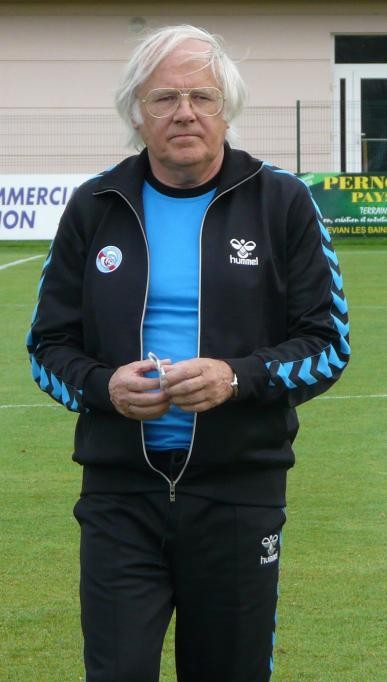
Gilbert Gress (born 17 December 1941) is a French football coach and a former player. He was the mentor of Arsène Wenger.[citation needed]

Key Information

Club career

[edit]

Gress was born in Strasbourg. He began his professional football career in the city of his birth with RC Strasbourg, where the fans soon nicknamed him the "angel of la Meinau" (L'ange de la Meinau; Engel von der Meinau, Meinau is the stadium of the club). Briefly after first playing for Strasbourg (May 1960) the team were relegated to the second division, but returned after one year to Division 1, where Gress played until 1966 and his departure to VfB Stuttgart. Strasbourg were at the time only in mid-table of the division, but won the 1966 Coupe de France.

During his time in Germany, he was called up for the first time to the France national team. During the 1970–71 season, Gress returned to his homeland and joined Olympique de Marseille, then two-time French champions. From 1973 to 1975, he came back to RC Strasbourg, before moving for one year to Neuchâtel Xamax in Switzerland and ending his playing career in 1977.

Gress completed 290 matches (201 for Strasbourg, 89 for Marseille) in France and scored 28 goals; in the federal league he came on 149 times.

International career

[edit]

In 1966, after having won the Coupe de France, Gress was not called up to the 1966 FIFA World Cup in England by France national team coach Henri Guérin because Gress refused to shorten his long hair. Under the new coach Louis Dugauguez, Gress was first called up on 27 September 1967 (a 5–1 defeat against Germany in Berlin). Altogether he played only three times in the France national team (1967, 1968 and 1971) and did not score any goals.

Managerial career

[edit]

Since 1977, Gress has worked as a football manager, receiving his first job in his home town at RC Strasbourg, where he had won the 1979 French championship, and where he returned again in 1991 for three years. His popularity is expressed also in the establishment of a Gilbert Gress Fanclub. In addition, he worked in Belgium, Austria and in Switzerland, where in 16 years (including twelve with Neuchâtel Xamax) he won two national championships and the cup. In 1998, he was appointed Swiss national football coach. A debate preceded his resignation over his wages as a national coach. In the meantime, Gress had also accepted Swiss nationality. In June 2009, he was named RC Strasbourg manager, his third stint as manager of the club.[2] and was released after only two games on 12 August 2009.

Honours

[edit]

Player

[edit]

Strasbourg

Marseille

Manager

[edit]

Strasbourg

Neuchâtel Xamax

FC Zürich

References

[edit]
[edit]
Revisions and contributorsEdit on WikipediaRead on Wikipedia
from Grokipedia
Gilbert Gress (born 17 December 1941) is a French-Swiss former professional footballer and manager, best known for his versatile midfield play in top European leagues and his coaching success across multiple countries, including winning the French Ligue 1 as both player and coach. Gress began his professional career as an attacking midfielder and winger with hometown club RC Strasbourg in 1959, where he made over 100 appearances before moving to VfB Stuttgart in 1966, contributing 24 goals in 149 Bundesliga matches. He later joined Olympique de Marseille in 1971, securing two Ligue 1 titles (1970–71 and 1971–72 seasons) and the 1972 Coupe de France during his tenure there, and ended his playing days with Neuchâtel Xamax in Switzerland from 1975 to 1977. Internationally, he earned three caps for France between 1967 and 1971, including World Cup and European Championship qualifiers. Transitioning to management in 1977, Gress returned to and led them to the 1978–79 title in his second season, marking the club's first French championship. His career highlights include the Belgian First Division with Club Brugge in 1980–81, two titles with Xamax (1986–87, 1987–88), the Swiss Super Cup in 1987 and 1988. Notably, during his first stint at Xamax, Gress mentored a young , who began his coaching journey under him as a . Gress managed various clubs across until 2009, including multiple returns to Strasbourg and Xamax, amassing a reputation for tactical acumen and developing talent.

Early life

Birth and upbringing

Gilbert Gress was born on 17 December 1941 in , which at the time was under German occupation as part of Nazi Germany's annexation of during . He came from a local Alsatian family, immersed in the region's distinctive bilingual French-German cultural heritage, shaped by centuries of shifting borders and linguistic influences in the borderland between and . Gress grew up in the Neudorf neighborhood of , specifically on Schluthfeld Street, in a working-class environment typical of post-war . His upbringing occurred amid the reconstruction of following the city's liberation in , a period marked by economic recovery and renewed community spirit in the war-ravaged region. Raised just blocks from the , home of , Gress was exposed early to the vibrant local football culture, where the club served as a symbol of Alsatian identity and resilience. From a young age, he dreamed of playing professionally, influenced by the passionate fanbase and the team's role in fostering regional pride. Physically, Gress stood at 1.72 meters tall during his youth, a compact build that later proved ideal for his versatile roles as a and forward, emphasizing agility and technical skill over raw power.

Youth career

Gilbert Gress developed his early passion for football in the Neudorf district of , particularly in the Schluthfeld area, where he grew up near the . From a young age, around six years old, he attended RC Strasbourg matches with his father and began playing informally in the neighborhood alongside local children, several of whom later became professional players for the club. This environment fostered his deep connection to Alsatian football culture, motivating him to pursue a career with his hometown team as a symbol of regional pride. At approximately 13 or 14 years old, Gress faced a significant challenge when a doctor diagnosed him with a heart anomaly during a routine medical examination, advising him to abandon competitive football to avoid health risks. Despite his parents' concerns, Gress persisted secretly, holding his hand over his chest during games to monitor his condition, while the RC club doctor dismissed the diagnosis as minor, allowing him to continue training and playing. This resilience, combined with his innovative thinking—evidenced by notebooks filled with tactical ideas to modernize the game's direct style—drew early attention from local scouts. By his mid-teens, around age 16 to 18, Gress joined RC Strasbourg's , where he honed his skills in informal and junior matches. In the youth academy, Gress transitioned into a versatile attacking midfielder and forward role, emphasizing creativity and pressing tactics that would define his later career. His local roots and determination to represent Alsace strongly influenced his commitment to RC Strasbourg, turning down potential opportunities elsewhere in favor of the club that embodied his identity. This period culminated in 1960, when, at age 18, he signed his first professional contract with RC Strasbourg just before making his senior debut on May 8, 1960, in a 2-1 victory over Bordeaux.

Playing career

Club career

Gress began his professional football career with hometown club RC in 1960, debuting in the French Division 1 at the age of 18. Over the subsequent six seasons until 1966, he established himself as a versatile attacking midfielder, known for his technical skill, vision, and ability to orchestrate play from midfield, which played a pivotal role in the team's dynamics during a period of competitive rebuilding in the league. During this stint, Gress made 156 appearances and scored 20 goals, helping Strasbourg maintain mid-table stability and reach the quarter-finals of the in 1962. In , Gress moved to in the newly formed , marking one of the early high-profile transfers of French talent to . He quickly adapted to the physical and tactical demands of the German top flight, becoming a regular starter and contributing to Stuttgart's solid defensive setups with his defensive awareness and forward surges. Between and 1970, Gress featured in 152 appearances, netting 24 goals. His performances helped Stuttgart finish as high as fourth in the 1968-69 season. Gress returned to France in 1971, signing with in January amid the club's ambition to dominate domestic football under president Marcel Leclerc. As a creative force in midfield, he provided key assists and leadership during Marseille's golden era, contributing to their back-to-back titles in the 1970–71 and 1971–72 seasons—the first such streak for the club in over a decade—and the 1972 . In his three seasons from 1971 to 1973, Gress recorded 90 appearances and 8 goals. Seeking a return to his roots, Gress rejoined RC Strasbourg in 1973 at age 31, bringing experience from abroad to mentor younger players and stabilize the squad amid inconsistent results. His veteran presence was instrumental in guiding the team through transitional challenges, emphasizing tactical discipline and set-piece execution. From 1973 to 1975, he added 69 appearances and 6 goals to his Strasbourg tally, including a crucial late winner in a 1974 derby against that boosted morale. Fans at the affectionately dubbed him the "Angel of la Meinau" during this and his earlier tenure, a originating from his elegant , precise passes, and seemingly effortless influence on home games that often turned matches in Strasbourg's favor. Gress concluded his playing career with Neuchâtel Xamax in the Swiss Nationalliga A starting in 1975, transitioning to a less demanding environment closer to retirement while adapting to the league's emphasis on technical play. He served as a and occasional , aiding Xamax's push for European spots. In his two seasons until 1977, Gress made appearances that rounded out his professional totals at 467 across all competitions and 58 goals, capping a career defined by adaptability across three countries.

International career

Gilbert Gress earned three caps for the national team between 1967 and 1971, scoring no goals. His senior debut came on 27 September 1967 in a friendly match against in , where he started as a right winger and played the full 90 minutes in a 5–1 defeat; the team was managed by Louis Dugauguez. Gress's second appearance occurred on 6 November 1968 during a qualifier against Norway at in , again under Dugauguez, where he started and played 73 minutes before being substituted in a 0–1 loss. His final cap was on 9 October 1971 in a qualifier versus at Stade Olympique Yves-du-Manoir in , managed by Georges Boulogne, entering as a substitute in the 46th minute during a 0–2 defeat. These selections took place amid France's qualifying campaigns for major tournaments, reflecting Gress's inclusion in squads rebuilding after the 1966 World Cup disappointment under transitional coaching. Gress's limited international opportunities stemmed from his commitments playing abroad for in the from 1966 to 1969, during a period when French selectors often prioritized domestic-based players amid fierce midfield competition from figures like Henri Bosquier and . Despite the modest cap total, his national team showings highlighted his technical skill and vision, bolstering his domestic reputation as a key and paving the way for his successful club career and later managerial achievements.

Managerial career

Early managerial roles

Gress began his managerial career as a player-manager at Neuchâtel Xamax in , taking on the role from 1975 to 1977 while still active on the pitch, where he focused on developing a cohesive team identity centered on disciplined play and youth integration. This transitional period laid the groundwork for his coaching philosophy, emphasizing tactical discipline and player development, though the team did not secure major honors during his playing years there. His first full-time managerial position came at RC Strasbourg from 1977 to 1980, where he transformed the club from a mid-table side into champions by implementing a robust defensive structure combined with quick counterattacks, leading them to the 1978–79 title—the club's only French top-flight championship to date. Under Gress, Strasbourg amassed 56 points from 38 matches, finishing one point ahead of , with key contributions from players like Dominique Dropsy in goal and a balanced squad that conceded just 28 goals. This success marked Gress's emergence as a tactically astute coach capable of maximizing underdog potential in a competitive league. In 1980, Gress moved to FC Brugge in for a brief stint lasting until 1981, providing him with early international coaching experience amid the challenges of adapting to a new league's physicality and cultural differences. Over 31 matches, he achieved a points-per-match average of approximately 1.13, guiding the team to a sixth-place finish in the Belgian First Division, but internal pressures and a desire to return to familiar territory prompted his departure after one season. Returning to Neuchâtel Xamax as full-time manager from 1981 to 1990, Gress built on his earlier foundations to establish the club as a Swiss powerhouse, instilling a team identity rooted in possession-based football and resilience that culminated in two consecutive titles in 1986–87 and 1987–88. The 1987–88 season also saw Xamax win the Swiss Super Cup, defeating 2–2 (5–2 on penalties), further solidifying their domestic dominance under his leadership. During this era, Gress's emphasis on strategic depth propelled Xamax to consistent top-four finishes and European qualification, transforming them from regional contenders into national champions. Gress briefly returned to Neuchâtel Xamax from 1994 to 1997, sustaining the club's success post his playing retirement by securing a third-place finish in the 1994–95 Swiss Super League and maintaining top-tier competitiveness, which helped stabilize the team during a transitional period in Swiss football.

Later managerial roles

After a successful stint at Neuchâtel Xamax, Gress took charge of Servette FC in Switzerland from July 1990 to June 1991, where the team finished mid-table in the Nationalliga A during his tenure. He then returned to his hometown club RC Strasbourg for a second spell as manager from July 1991 to June 1994, guiding the side through three seasons in Ligue 1 amid competitive challenges in French football's top flight. In 2009, Gress briefly resumed his role at Strasbourg for a third time starting in June, but was relieved of duties after just two matches into the 2009–10 Ligue 2 season due to early poor results and internal club tensions. Gress's international experience came in 1998 when he was appointed of the Switzerland national team, succeeding ; he managed 18 matches, achieving six wins, six draws, and six losses before resigning in early 1999 following a public dispute with the over his salary and contract terms. Returning to club management, he joined in April 2000, leading them to victory in the 1999–2000 , defeating 2–2 (a.e.t.) (3–0 pens.) in the final on 28 May 2000, though his overall spell ended in June 2001 by mutual agreement amid inconsistent league performances. At in , Gress assumed control in January 2002 and managed 18 matches, but the team suffered relegation to at the season's end with only four wins under his guidance. His later career featured several short-term engagements across , often marked by abrupt departures due to performance pressures or conflicts. In 2003, Gress was hired by Austrian side Sturm but was dismissed after just eight matches in September, with the club citing unsatisfactory results including five defeats. He then coached in Switzerland from August 2004 to March 2005, stabilizing the team in the before parting ways amid a mid-table finish. In May 2007, Gress took over at late in the season, managing to lift the club from the relegation zone to a safer second-from-bottom position by the end of the campaign. Throughout these roles, Gress continued to influence emerging talents, notably having mentored during his earlier Swiss periods at Xamax, a relationship that extended into advisory capacities in later Swiss engagements. This phase of his career highlighted a pattern of frequent transitions, driven by high expectations, tactical disagreements, and the demanding nature of European club football.

Honours

As player

As a player, Gilbert Gress achieved notable success with two prominent French clubs, earning major domestic honours during his career. With RC Strasbourg, Gress was part of the team that won the in 1966, defeating 1–0 in the final at the Stade Olympique Yves-du-Manoir, where he featured prominently in midfield to help secure the club's second national cup title. Later, after joining in 1971, Gress contributed to the club's dominance in the French Division 1, helping secure consecutive league titles in 1970–71 and 1971–72; as a regular attacking midfielder, his vision and playmaking supported the team's offensive efforts led by stars like . He also won the 1972 with Marseille.

As manager

As manager of RC Strasbourg, Gilbert Gress led the club to its first title in the 1978–79 season, ending a 32-year drought since their previous championship in 1947. The team amassed 56 points, scored 63 goals, and conceded just 28, boasting the league's best defense while remaining undefeated at the . This triumph not only revitalized Strasbourg as a competitive force in French football but also secured their qualification for the , where they advanced to the quarter-finals. Gress also won the Belgian First Division with Club Brugge in the 1980–81 season. During his tenure at Neuchâtel Xamax from 1981 to 1990, Gress guided the club to three titles in 1984–85, 1986–87, and 1987–88, along with the 1988 and Swiss Super Cups in 1987 and 1988. In 1986–87, Xamax finished first with 44 points from 30 matches, edging out on goal difference, and followed it up in 1987–88 by clinching the title with 31 points in a shortened 22-match . These successes elevated Xamax from a mid-tier club to a dominant presence in Swiss football during the late 1980s, enabling European campaigns including the 1987–88 , where they reached the quarter-finals before falling to .

Personal life and legacy

Family and personal details

Gilbert Gress has been married to his wife since the early , having met her in their shared neighborhood; the couple, who celebrated over 60 years together by 2024, raised their family amid the demands of his football career. They have two children—a son and a —who often stayed with grandparents during Gress's professional moves abroad, such as his time in , allowing his wife to manage family life in . Gress has four grandchildren, with whom he has developed a particularly close bond, noting that he held them more frequently than his own children due to his career commitments. Holding dual French-Swiss nationality since naturalizing in during his playing and coaching tenure there, Gress maintains residences in both countries, primarily based in while spending significant time in for professional engagements. Following his dismissal from RC Strasbourg in 2009, he retired from active coaching but remains involved in football through television commentary for Swiss channels and ambassador roles for brands and tourism initiatives. In his post-career years, Gress has engaged in charitable activities, including sponsoring a football team for individuals with mental disabilities for over two decades and participating in holiday fundraisers for underprivileged children in . His hobbies include reading daily sports news, playing cards with friends, driving extensively—covering around 40,000 kilometers annually—and maintaining social routines like visiting local eateries. Regarding health, Gress has expressed that thoughts of mortality occupy him daily, influenced by his father's early death, though he reported robust physical condition into his early 80s, routinely climbing multiple flights of stairs. Deeply rooted in Alsatian culture, Gress—born near —embraces his regional identity, affectionately nicknamed "Schilles" by locals and often highlighting his origins in interviews, which shape his distinctive accent and community ties. Despite his Swiss connections, he frequently returns to to visit family and engage with local traditions.

Impact and recognition

Gilbert Gress is revered in Strasbourg as the "Angel of la Meinau," a nickname bestowed by fans during his playing days at RC Strasbourg for his graceful style and deep connection to the club's stadium, reflecting his enduring status as a local icon born in the Neudorf neighborhood. His return as manager in 1977 marked a transformative era, where he implemented tactical innovations such as defenders advancing into attacks and forwards applying high pressing—approaches that were novel in French football at the time and contributed to the club's promotion to and their historic 1978–79 title win, the only one in club history. These strategies not only elevated Strasbourg's defensive solidity, conceding just 28 goals in 38 matches, but also influenced the development of more dynamic play in French football during the late 1970s and early 1980s. Gress's mentorship profoundly shaped Arsène Wenger's career, beginning at where he appointed the young Wenger as a for the reserve and youth teams in 1978, fostering his tactical acumen during the championship season. This relationship extended to , where Gress, as manager of Xamax, recruited Wenger as a player in 1981 and later promoted him to assistant coach, providing crucial experience that propelled Wenger toward his groundbreaking tenure at . Through Wenger, Gress indirectly influenced modern tactics, emphasizing discipline and innovation. In , Gress made significant contributions over 16 years, primarily with Xamax, securing two consecutive national championships in 1987 and 1988, which helped professionalize the league and bridge French-Swiss football exchanges. His appointment as Swiss national team coach from 1998 to 1999 further solidified his legacy, introducing structured preparation that enhanced the federation's development programs. Post-retirement, Gress remained a respected figure in media, providing expert analysis on Swiss television and participating in events honoring Strasbourg's history, including a 2025 discussion in on sport's values, public health, and municipal priorities; ensuring his influence endures in both nations' football cultures.

References

Add your contribution
Related Hubs
User Avatar
No comments yet.