


Community hub
Recent from talks
Contribute something
Nothing was collected or created yet.
Goderich, Ontario
View on Wikipedia
Goderich (/ˈɡɒdrɪtʃ, ˈɡɒdərɪtʃ/ GOD-rich or GOD-ə-rich) is a town in the Canadian province of Ontario and is the county seat of Huron County. The town was founded by John Galt and William "Tiger" Dunlop of the Canada Company in 1827.[2] First laid out in 1828, the town is named after Frederick John Robinson, 1st Viscount Goderich,[2] who was prime minister of the United Kingdom at the time. It was incorporated as a town in 1850.
Key Information


As of the Canada 2021 Census, the population is 7,881 in a land area of 8.54 square kilometres.[1]
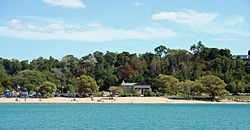
Located on the eastern shore of Lake Huron at the mouth of the Maitland River, Goderich faces the lake to the west and is notable for its sunsets. Some claim that Queen Elizabeth II once commented that Goderich was "the prettiest town in Canada" although no reigning monarch has ever visited Goderich.[3] The town indicates that tourism is among its important industries.[4] It has been named one of Ontario's best small towns by Comfort Life, a website for retirement living in Canada.[5]
The town participates yearly in the Communities in Bloom competition; and has won awards in many categories. In 2012, Goderich was a National Finalist in the competition,[6] and was also part of the Circle of excellence.[7]
History
[edit]
According to the historic plaques erected by the Province, the Canada Company acquired the vast amount of land called the Huron Tract in 1826 and in 1827, under Superintendent John Galt, established its base in what would become Goderich. Development was under way by 1829. In 1850, with a population of about 1,000, the community was incorporated as a town. In addition to Galt, another important individual was Dr. William "Tiger" Dunlop who was Warden of the Forests for the Canada Company, and helped develop the Huron Tract and later, to found Goderich. Also noteworthy, Thomas Mercer Jones administered much of the million acre Tract and built a richly furnished mansion, Park House, in Goderich in about 1839.[2]
Town records indicate that the Huron Tract had been acquired by the government from the Chippewa First Nation and that the location of the community was based on coastal surveys completed in 1824 by Captain Bayfield. A log cabin was erected, at the top of the hill overlooking the harbour in 1827; this building, the home of Dr. William "Tiger" Dunlop, was later referred to as "The Castle".[8]
An 1846 Gazette indicated that a harbour was operating, but the docks were not in a good state of repair. A light house was being erected. Roads were available to Wilmot Township, Ontario and to the town of London, Ontario. Shipbuilding was already underway. A fishing company had started but did not succeed and closed down. There were five churches in Goderich, four Protestant and one Roman Catholic.[9] By 1869 the population was 4,500; a railway station and steamship docks were in operation. Wheat was the primary crop shipped from this area.[10]
Research by the University of Waterloo indicates that the Canada Company built piers to protect ships in the harbour between 1830 and 1850 and in 1872 the first modern harbour was created. The railway arrived in June 1858 and a grain elevator was erected in 1859. Harbour Hill was graded in 1850. Fishing became an important part of the community, and the pier was lined with fish shanties. A modern rail station was built near the harbour and the building still stands today. Goderich became a very busy rail shipping location by the 1940s and had a roadhouse and turntable until the 1960s. Salt mining, which eventually became a major industry, was started in 1866 when Samuel Platt began opening salt mines beside his flour mill on the Maitland River. The harbour at Goderich was also the home of large flour mills starting in the 1870s.[11]
The Smith's Canadian Gazetteer of 1846 describes Goderich as follows:
It was laid out in 1827 by Mr. Galt ... the town is rather exposed to north and north west winds from the lake, in consequence of which the weather is occasionally wintry, even in the middle of summer ... Owing to its remote situation ... Goderich has not increased as fast as many other places of the same age. A harbour has been constructed but the piers are now getting out of repair. This is the only harbour between Port Sarnia and the Saugeen Islands. A light house is just about being erected .... A steamboat and several schooners have been built here. Stages run twice a week from Goderich to London and Galt, and during the last season the steamboat Goderich called here on her weekly trips ... A fishing company was established here, some years since, but from some mismanagement did not succeed very-well, and is now broken up. Goderich contains five churches and chapels, ... there is also a stone jail and court house, and the Canada Company's offices... Post Office, post four times a week. Population, 659."[9]
The Goderich lighthouse, the first on the Canadian side of Lake Huron, opened in 1847 with a tower and the keeper's house. After the 1913 storm it was remodelled.[11] A severe storm on Lake Huron in November 1913 caused the loss of 19 ships and 244 lives. A great deal of wreckage floated to the Goderich area shore. The bodies of the sailors were identified and collected by a Lake Carriers' Association committee based at Goderich.[12]
In 1866, four artesian wells began providing the town's water and also attracted tourists who had heard about the water's medicinal properties. The Ocean House Hotel, built in the 1850s, housed many tourists. From about 1910, the sandy beach near town were also used heavily by locals and by visitors who appreciated the shallow, warm water. In 1930, a "bathing house" was built with lockers, restrooms and a small store.[11]
Early in World War II, what is now the Goderich Airport became the site of one of Canada's air training facilities; it opened in December 1939, at Sky Harbour. The school operated until March 1945. A Lancaster X airplane, FM 213, was donated in the 1960s by Branch 109 Royal Canadian Legion in honour of those who died or went missing during the war.[2]
Goderich has many historically designated buildings, listed on a map published by the Town.[13][14][15]
In 2018, a strike involving over 350 salt mine workers broke out in Goderich, following labour disputes between the Unifor Local 16-0 union and the American-owned company Compass Minerals, which owns the mine, over a new contract.[16][17] The strike ended in July 2018 having lasted for 12 weeks.[18]
On August 9, 2022, the at-the-time Mayor, John Grace, died in a boating accident in Northwestern Ontario.[19] The Deputy Mayor, Myles Murdock, took over as the acting Mayor for the remainder of the 2022 term of council. Myles Murdock was elected as the Mayor of Goderich for the 2022-2026 term of council during the 2022 Ontario Municipal Election.[20]
The Square
[edit].jpg)

Goderich's downtown has an octagonal roundabout known as 'The Square'. The county courthouse stands in the middle of The Square. This is where, in 1959, Steven Truscott was convicted of murdering Lynne Harper. The conviction was overturned in 2007.[21]
The Square was formally listed in the Register of Historic Place by the Government of Canada in May 2007. The Town had already recognized the value of the area in 1982, under the Ontario Heritage Act.
The Square was designed and developed between 1840 and the mid 1890s and in its early days, contained the main office of the Canada Company which helped to develop much of the county. The design of the square — a "radial composition" — is attributed to John Galt of the Company, inspired by ancient Roman city plans. Over the years it was called "Market Square", "The Square" or "Courthouse Square" by locals. The original courthouse was located here but was destroyed in a fire and replaced by a modern structure in the 1950s.[22]
Contrary to a popularly held belief, plans for The Square were not intended for Guelph. It is thought this rumour started when Goderich was founded, as town planners the Canada Company originally wanted their community to be called Guelph after the Royal Family; the Company eventually resigned to accepting the decisions of Superintendent John Galt to keep the name Goderich.[23]

2011 tornado
[edit]
On the afternoon of 21 August 2011, an F3[24] tornado touched down in the area, after coming ashore as a waterspout, with the mesocyclone thunderstorm cell moving across Lake Huron. It was the strongest tornado that had hit Ontario since the Arthur, Ontario tornado of April 20, 1996, though on average, F3 tornadoes occur in Ontario every eight years. The devastating storm downed power lines, tore roofs from houses, and left cars and trees scattered along city streets. Hundred-year-old trees surrounding the Goderich Courthouse were uprooted in seconds. The tornado killed one person: Norman Laberge, 61, of Lucknow, who was working on a dock associated with a salt mine on the coast of Lake Huron when the storm hit. 37 people were injured. The Environment Canada weather forecast office in Toronto issued a tornado warning for Goderich and southern Huron County 12 minutes before the tornado struck.[25] The town did not have a tornado siren unlike some other Ontario cities.
News reports later indicated that one hundred houses, 25 buildings and thousands of 150-plus-year-old trees were seriously damaged or destroyed.[26]
Rebuilding The Square area
[edit]After the tornado, the roofs of several buildings around the square had been destroyed, and the trees in the green space around the courthouse had been damaged or uprooted.[27]
A year later, 152 of the 170 downtown businesses had reopened but reconstruction of the courthouse, some historic buildings and the trees in the area took much longer.
By 2015, the park had re-opened with a new band shell. New trees, greenery, a statue and a water feature had been installed in front of the court house. Much of the area around the park had been reconstructed including commercial building on Kingston Street and The Square. The last work to be completed was the Kingston block of commercial buildings on Kingston Street and The Square. Although the farmers' market and flea market had closed before the tornado, it re-opened.[28]
Climate
[edit]| Climate data for Goderich, Ontario (Goderich Airport) 1991–2020, extremes 1866–present[note 1] | |||||||||||||
|---|---|---|---|---|---|---|---|---|---|---|---|---|---|
| Month | Jan | Feb | Mar | Apr | May | Jun | Jul | Aug | Sep | Oct | Nov | Dec | Year |
| Record high °C (°F) | 17.2 (63.0) |
18.5 (65.3) |
25.1 (77.2) |
28.9 (84.0) |
32.0 (89.6) |
35.0 (95.0) |
37.2 (99.0) |
37.2 (99.0) |
35.0 (95.0) |
28.9 (84.0) |
23.1 (73.6) |
16.7 (62.1) |
37.2 (99.0) |
| Mean daily maximum °C (°F) | −1.3 (29.7) |
−0.6 (30.9) |
3.8 (38.8) |
10.6 (51.1) |
17.4 (63.3) |
22.4 (72.3) |
24.4 (75.9) |
24.0 (75.2) |
21.0 (69.8) |
14.3 (57.7) |
7.3 (45.1) |
1.7 (35.1) |
12.1 (53.8) |
| Daily mean °C (°F) | −4.6 (23.7) |
−4.3 (24.3) |
−0.3 (31.5) |
5.9 (42.6) |
12.3 (54.1) |
17.4 (63.3) |
19.6 (67.3) |
19.3 (66.7) |
16.1 (61.0) |
10.2 (50.4) |
4.1 (39.4) |
−1.1 (30.0) |
7.9 (46.2) |
| Mean daily minimum °C (°F) | −7.8 (18.0) |
−8 (18) |
−4.4 (24.1) |
1.1 (34.0) |
7.1 (44.8) |
12.4 (54.3) |
14.8 (58.6) |
14.5 (58.1) |
11.2 (52.2) |
6.0 (42.8) |
0.8 (33.4) |
−3.9 (25.0) |
3.7 (38.7) |
| Record low °C (°F) | −29.4 (−20.9) |
−32.8 (−27.0) |
−26.1 (−15.0) |
−17.8 (0.0) |
−7.8 (18.0) |
−5.0 (23.0) |
1.1 (34.0) |
1.1 (34.0) |
−3.9 (25.0) |
−11.1 (12.0) |
−24.4 (−11.9) |
−27.8 (−18.0) |
−32.8 (−27.0) |
| Average precipitation mm (inches) | 72.2 (2.84) |
54.9 (2.16) |
74.1 (2.92) |
77.4 (3.05) |
65.2 (2.57) |
76.4 (3.01) |
65.1 (2.56) |
80.9 (3.19) |
90.7 (3.57) |
80.0 (3.15) |
87.4 (3.44) |
101.4 (3.99) |
925.7 (36.44) |
| Average rainfall mm (inches) | 17.9 (0.70) |
20.8 (0.82) |
36.6 (1.44) |
67.1 (2.64) |
64.8 (2.55) |
76.4 (3.01) |
65.1 (2.56) |
80.9 (3.19) |
90.7 (3.57) |
74.5 (2.93) |
61.9 (2.44) |
41.3 (1.63) |
698.0 (27.48) |
| Average snowfall cm (inches) | 65.4 (25.7) |
48.6 (19.1) |
41.1 (16.2) |
11.8 (4.6) |
0.2 (0.1) |
0.0 (0.0) |
0.0 (0.0) |
0.0 (0.0) |
0.0 (0.0) |
9.2 (3.6) |
28.6 (11.3) |
72.3 (28.5) |
277.2 (109.1) |
| Average precipitation days (≥ 0.2 mm) | 19 | 15 | 16 | 13 | 12 | 11 | 10 | 10 | 12 | 13 | 17 | 20 | 168 |
| Average rainy days (≥ 0.2 mm) | 5 | 4 | 7 | 11 | 11 | 11 | 10 | 10 | 12 | 12 | 11 | 8 | 112 |
| Average snowy days (≥ 0.2 cm) | 17 | 14 | 11 | 5 | 0 | 0 | 0 | 0 | 0 | 4 | 8 | 16 | 75 |
| Source: Environment Canada (precipitation/rainfall/snowfall 1951–1980)[29][30][31][32] | |||||||||||||
Demographics
[edit]| Year | Pop. | ±% |
|---|---|---|
| 1841 | 659 | — |
| 1871 | 3,954 | +500.0% |
| 1881 | 4,564 | +15.4% |
| 1891 | 3,839 | −15.9% |
| 1901 | 4,158 | +8.3% |
| 1911 | 4,522 | +8.8% |
| 1921 | 4,107 | −9.2% |
| 1931 | 4,491 | +9.3% |
| 1941 | 4,557 | +1.5% |
| 1951 | 4,934 | +8.3% |
| 1961 | 6,411 | +29.9% |
| 1971 | 6,813 | +6.3% |
| 1981 | 7,322 | +7.5% |
| 1991 | 7,452 | +1.8% |
| 2001 | 7,604 | +2.0% |
| 2006 | 7,563 | −0.5% |
| 2011 | 7,521 | −0.6% |
| 2016 | 7,628 | +1.4% |
| 2021 | 7,881 | +3.3% |
In the 2021 Census of Population conducted by Statistics Canada, Goderich had a population of 7,881 living in 3,667 of its 3,899 total private dwellings, a change of 3.3% from its 2016 population of 7,628. With a land area of 8.54 km2 (3.30 sq mi), it had a population density of 922.8/km2 (2,390.1/sq mi) in 2021.[1]
| 0-9 | 10-19 | 20-29 | 30-39 | 40-49 | 50-59 | 60-69 | 70-79 | 80+ | Total | % of population | ||||
|---|---|---|---|---|---|---|---|---|---|---|---|---|---|---|
| Male | 400 | 445 | 365 | 385 | 500 | 595 | 360 | 305 | 195 | 3,555 | 47 | |||
| Female | 335 | 485 | 405 | 375 | 585 | 630 | 435 | 400 | 360 | 4,010 | 53 | |||
| Total | 735 | 930 | 770 | 765 | 1,085 | 1,220 | 795 | 710 | 550 | 7,565 | 100 | |||
| Source: Stats Canada[33] | ||||||||||||||
Economy
[edit]
Goderich is in Huron County which is primarily agricultural. In fact, the Official Plan indicates that "Huron leads all counties and regions in Ontario in total value of production; and it also exceeds the production totals of several provinces."[34] However, the town does have some manufacturing with companies such as Compass Minerals and Vestas.[35]
The salt mining industry in Goderich is one of the oldest in Ontario. In 1866, petroleum exploration crews found a massive ancient salt deposit about 300 metres (980 feet) under the surface.[36][37]
To date, 150 million tons of salt has been produced from the mine and by 2012, after recent investments, it will be able to produce 9 million tons a year.[38] This all started in 1866 when prospector Sam Platt was searching for oil and instead discovered rock salt 300 metres beneath Goderich Harbour. Just over 50 years ago harvesting of the salt began, and continues today by Sifto Canada. The mine is 530 metres (1,750 feet) below surface,[39] extending 7 km2 (2.7 sq mi) under Lake Huron — roughly the size of the town. It is the largest underground salt mine in the world.[38]
The salt deposits at Goderich are from an ancient sea bed of Silurian age, part of the Salina Formation. The halite rock salt is also found in Windsor, Ontario, both located on the eastern periphery of the Michigan Basin, on the southeastern shores of Lake Huron.[40]
The town currently lists Canadian Salt Co./ Windsor Salt Warehouse and the Compass Minerals Evaporator and its Goderich Mine as businesses involved in this industry.[41]
Volvo once operated a road grader manufacturing plant in Goderich. The plant, originally operated by locally owned Champion Road Machinery, was one of the world's oldest manufacturers of road equipment. It was acquired by Volvo in 1997.[42] In September 2008, Volvo announced plans to close all operations in Goderich and move operations to Shippensburg, Pennsylvania.[43] Production in Goderich ceased in 2009.
Tourism
[edit]
Tourism is also significant because many visitors spend time on the Lake Huron shore, including three beaches near Goderich, and may shop or stay overnight in town. Goderich has festivals and events each year that appeal to some visitors as well as local attractions.[44][45]

The Huron Historic Gaol is a National Historic Site of Canada. It served as the region's gaol (old English form of jail) from its opening in 1842 until 1972.[46] It is open to the public between April and October. This is the site of the last public hanging in Canada. James Donnelly Sr. of the Black Donnellys also spent time here before his trial. As well, Steven Truscott was held here for some time.

The Huron County Museum is a community museum which offers modern exhibition galleries. Permanent exhibits depict the early settlement and development of Huron County, including a full-size locomotive, a World War II Sherman tank, an extensive military collection, and an exhibit related to salt mining in the area. The museum also collects and maintains the Huron County Archives.
Goderich features three public-use beaches which can be reached by car following signage in town to the beach hill, also known as West Street. After parking, beach users can also walk along a wooden boardwalk over a mile in length (in late 2019, the boardwalk was damaged by strong waves, and it has been under repairs through 2020[47]). The main beach, at the north end of the walkway is a sand and fine gravel beach where swimmers and sunbathers can watch lake freighters loading up with salt on the other side of the pier. Further south is St. Christopher's beach and at the far end of the boardwalk is "Rotary Cove", a family-friendly sand beach with lifeguards and playground equipment. Of interest as well, are the man-made groynes along the beach, put in place to control sand migration from the action of water currents.
Aside from annual festivals and events, Goderich hosts occasional special events, such as during Goderich's 150 year celebration — Jubilee 3 — there was a Skydiving Jamboree at the Goderich Airport. This event attracted hundreds of parachutists from all over the United States and Canada.
Arts and culture
[edit]Flag
[edit]Goderich has its own official flag, which was adopted in 1977 for the town's 150th birthday celebration.[48] A contest was held, open to all Goderich schools and residents. It was won by Goderich resident Judge Carter from St. Vincent St. The flag shows the royal crown centred in an octagon (representing the 1/4 mile octagonal 3-lane town square) with 3 waves at the bottom on a blue background representing Lake Huron and the Port of Goderich.[49] The Town also has a full town crest.[50]
Sports
[edit]Besides school teams, during the winter season, hockey is prevalent in most Canadian small towns, Goderich being no exception. The town supports the Jr. C Goderich Flyers, much of the talent on the Flyers being of local origin.
Government
[edit]The Goderich municipal council includes a Mayor, Deputy Mayor and five Councillors. The Mayor and the Deputy Mayor are also members of the County Council.
The Huron County Council consists of fifteen members from the nine area municipalities. Each is represented on this Council. Each year, a Warden is elected from the group and chairs meetings and represents the County at various functions. In 2022, the Warden was Glen McNeil, also Reeve of Ashfield-Colborne- Wawanosh Township.[51]
Infrastructure
[edit]Ports
[edit]
Goderich Airport (known unofficially as Sky Harbour Airport)[52] is a community airport with three runways: two are paved, with runway lighting, and one is grass.[53] It is located directly north of the town, and is accessible via the Bluewater Highway north of the community. During WWII, The airport was the site of an Elementary Flying Training School as part of the British Commonwealth Air Training Plan.[52] In addition to flight services, several industries are located in the immediate area of the airport to provide the full range of services that aviation requires, including interior and exterior re-finishing, and mechanical repairs.
Goderich Harbour is owned by the town, but is operated under contract by Goderich Port Management Corporation.[54] It is an industrial harbour, used primarily to load salt from the Sifto salt mines onto lake and ocean freighters.
Snug Harbour is a marina located within the industrial harbour basin; Maitland Valley Marina is also located near Goderich.
Railways
[edit]
The Goderich-Exeter Railway currently operates freight service to Goderich. The line was built by the Buffalo and Lake Huron Railway in 1859.[55] The railway was soon taken over by the Grand Trunk Railway, later CN. In 1992, the line was sold to the GEXR.
The Canadian Pacific Railway built its own line, the Guelph and Goderich Railway, into Goderich in 1907.[56] Passenger service ran until the 1960s. The entire line was abandoned in 1989.[57] The trestle crossing over the Maitland River was converted through public fund-raising into a public walkway, offering views of the harbour, Maitland Valley golf course and the river valley itself. The Ontario West Shore Railway started to build a railway from Goderich to Kincardine in 1909, but it was never completely opened.[58]
Education
[edit]Public education in Goderich is managed by the Avon Maitland District School Board, with Goderich District Collegiate Institute (GDCI) and Goderich Public School (grades from junior Kindergarten to grade 6) in the town. GDCI was founded in 1841, and stood at the corner of Waterloo St. and Britannia Road, until the present building was completed.[citation needed] Goderich Public School is an amalgamation of Victoria Public School and Robertson Memorial Public School.[59]
Catholic schools are managed by the Huron-Perth Catholic District School Board, which has St. Mary's Catholic School in town. The nearest Catholic high school is located in Clinton.
Media
[edit]Newspaper
[edit]- The local newspaper is the Goderich Signal Star, owned by Quebecor/Sun Media Corporation through Bowes Publishers.
Radio stations
[edit]FM
[edit]Notable people
[edit]- Albert Dewsbury (1926–2006) former NHL defenceman
- Gary Doak (1946-2017) former NHL defenceman
- William "Tiger" Dunlop (1792–1846) Founding father of Goderich associated with Canada Company
- Brock Dykxhoorn (born 1994) Professional baseball player, inducted into the Canadian Baseball Hall of Fame as a member of the 2015 Pan American Games gold medal winning baseball team
- Brenda Elliott (born 1950) Former Ontario cabinet minister
- Larry Jeffrey (1940 - 2022) former NHL forward, won the Stanley Cup in 1967 with the Toronto Maple Leafs
- C. E. McIntosh member of the Wisconsin State Assembly
- Ted Nasmith fantasy illustrator, best known for his illustrations of the works of J. R. R. Tolkien
- Jack Price (1932–2011) former NHL defenceman
- Jennifer Robinson (born 1976) former six-time Canadian national figure skating champion
- Tim Sale (born 1942), retired cabinet Minister in the province of Manitoba, Canada
- Dick Treleaven (born 1934) Ontario politician
- Steven Truscott, wrongfully convicted of murder in 1959 and sentenced to hang but sentence was commuted to life in prison. Released in 1969.
- Ron Van Horne (1932–2017) Ontario politician
See also
[edit]
Notes
[edit]- ^ Long term records have been recorded at various climate stations in or nearby Goderich since 1866
References
[edit]- ^ a b c d "Population and dwelling counts: Canada, provinces and territories, census divisions and census subdivisions (municipalities), Ontario". Statistics Canada. 9 February 2022. Retrieved 30 March 2022.
- ^ a b c d "The Founding of Goderich". ontarioplaques.com. Retrieved 26 November 2018.
- ^ "Huron Stewardship Council". Stewardship Network of Ontario. Archived from the original on 9 May 2008. Retrieved 26 August 2015.
- ^ "Statistics on Goderich". Town of Goderich. Archived from the original on 30 April 2008. Retrieved 4 May 2008.
- ^ "Best Small Towns, Ontario".
- ^ "Communities in Bloom 2012 Winners". Communities In Bloom. Archived from the original on 10 April 2013.
- ^ "Enhancing Green Spaces in Communities 2012". Communities In Bloom. Archived from the original on 27 July 2013.
- ^ "The History of the Town of Goderich". Goderich. Town of Goderich. 2015. Archived from the original on 24 March 2014. Retrieved 9 March 2017.
The Town of Goderich came into being as an indirect result of the war of 1812-14. During that war the settlers in the vicinity of Lakes Ontario and Erie had suffered much loss, both from the soldiers billeted on them and from invaders. In an attempt to recompense them, John Galt and a group of investors in England formed the Canada Company. The British government granted the company 1,100,000 acres of the land it had recently acquired from the Chippewa First Nation. The plan was that the land would be sold to settlers and part of the profits used to settle the war claims. As it turned out, the claimants received nothing.
- ^ a b Smith, Wm. H. (1846). Smith's Canadian Gazetteer - Statistical and General Information Respecting all Parts of The Upper Province, or Canada West. Toronto: H. & W. Rowsell. p. 64-65.
- ^ McEvoy, Henry (1869). The Province of Ontario Gazetteer and Directory. Robertson & Cook. p. 174. ISBN 9780665094125.
{{cite book}}: ISBN / Date incompatibility (help) - ^ a b c "Goderich Harbour Cultural Heritage Landscape Study" (PDF). University of Waterloo Heritage Resources. 4 May 2010. Retrieved 3 October 2025.
- ^ "The Great Storm of 1913". OntarioPlaques.com. Alan L. Brown. Retrieved 26 April 2019.
- ^ "Heritage Map". Goderich. Town of Goderich. 2015. Archived from the original on 12 March 2017. Retrieved 9 March 2017.
- ^ "Heritage Property Photos". Goderich. Town of Goderich. 2015. Archived from the original on 26 March 2017. Retrieved 9 March 2017.
- ^ "Heritage Publications". www.goderich.ca. 26 June 2023. Retrieved 3 October 2025.
- ^ "'Unless they bring a tank down here, I ain't going anywhere,' vows striking miner | CBC News". CBC. Retrieved 5 July 2018.
- ^ "Striking workers at Goderich salt mine ramp up fight in week 10 | CBC News". CBC. Retrieved 5 July 2018.
- ^ "'A huge toll': Goderich salt mine strike ends, but anger lingers | London Free Press". LFP. Retrieved 17 July 2018.
- ^ Trevithick, Matthew (10 August 2022). "Boating accident in northwestern Ontario claims life of Goderich, Ont. Mayor John Grace". Global News. Retrieved 12 August 2022.
- ^ "2022 Municipal Election Results: Huron County". BlackburnNews.com. 24 October 2022. Retrieved 29 October 2022.
- ^ CBC.ca, Court acquits Truscott, calling conviction 'miscarriage of justice', August 28, 2008
- ^ "The Square". Historic Places. Parks Canada. 2011. Retrieved 9 March 2017.
Sources: Town of Goderich by-law 1982-02, 1993-26; The Square, Goderich: A Heritage Conservation District Plan (Nicholas Hill, 1977)
- ^ Heritage Goderich Archived February 2, 2006, at the Wayback Machine
- ^ Pope, Alexandra; Andrea Stockton (23 August 2011). "F3 tornado aftermath in Goderich: Like a war zone". The Weather Network News. Retrieved 23 August 2011.
- ^ "Goderich residents had 12 minutes warning before tornado struck". The Globe and Mail. Toronto. Archived from the original on 22 August 2011.
- ^ O'Connor, Joe (6 April 2012). "Goderich: The town Queen Elizabeth once described as the prettiest in Canada weathers on after devastating tornado". National Post. Toronto. Retrieved 9 March 2017.
- ^ Miner, John (22 August 2011). "Tornado slams Goderich". Sun Times. Owen Sound. Archived from the original on 12 March 2017. Retrieved 9 March 2017.
- ^ "A whole new look - Goderich's downtown gets new features after tornado damage". North Huron. April 2015. Archived from the original on 12 March 2017. Retrieved 8 March 2017.
- ^ "Goderich, Ontario". Canadian Climate Normals 1991–2020. Environment and Climate Change Canada. Retrieved 11 September 2024.
- ^ "Canadian Climate Normals 1951–1980 Volume 2: Temperature". Environment Canada. Retrieved 22 September 2020.
- ^ "Canadian Climate Normals 1951–1980 Volume 3: Precipitation". Environment Canada. Retrieved 22 September 2020.
- ^ "Long Term Climate Extremes for Goderich Area (Virtual Station ID: VSON160)". Daily climate records (LTCE). Environment Canada. Archived from the original on 10 November 2021. Retrieved 10 November 2021.
- ^ "Goderich community profile". 2006 Census data. Statistics Canada. Archived from the original on 7 September 2012. Retrieved 1 February 2011.
- ^ "Official Plan" (PDF). Huron County. 2015. Archived from the original (PDF) on 12 March 2017. Retrieved 9 March 2017.
- ^ "2016 Economic Overview". Goderich. Town of Goderich. 2016. Retrieved 9 March 2017.
- ^ CBC-TV, Canada. "The Great Lakes: Goderich, Ontario". CBC Radio Canada. Geologic Journey. Retrieved 14 December 2012.
- ^ "Goderich Salt Mine Tragedies". goderichsignalstar. Archived from the original on 22 October 2021. Retrieved 3 October 2025.
- ^ a b Boa, Heather (23 October 2012). "Feature: Goderich's salt mine positioned for the future". Huron News Now. Archived from the original on 15 January 2013. Retrieved 14 December 2012.
- ^ "Sifto's Goderich Mine". Sifto Canada Corp. Archived from the original on 28 September 2012. Retrieved 29 September 2012.
- ^ Geology Ontario, MNDMF (2000). "Ontario Geological Survey Open File Report 6029. Mines and Wines: Industrial Minerals, Geology and Wineries of the Niagara Region - Field Trip Guidebook" (PDF). Queen's Printer for Ontario. Ontario Ministry of Northern Development and Mines. p. 22. Retrieved 20 October 2012.
- ^ "Industries in Goderich". Town of Goderich. 2019. Retrieved 26 April 2019.[dead link]
- ^ "Get in touch with us". Volvo Construction Equipment - North American. Retrieved 25 March 2008.
- ^ "Volvo says to move grader business, cost $45 mln". Reuters. 30 September 2008. Retrieved 26 April 2019.
- ^ "Festivals & Events". Goderich. Town of Goderich. 2016. Archived from the original on 7 April 2017. Retrieved 9 March 2017.
- ^ "Attractions". Goderich. Town of Goderich. 2016. Retrieved 9 March 2017.
- ^ "Welcome to the Huron Historic Gaol". Huron County Museum. Retrieved 26 April 2019.
- ^ Smith, Kathleen (18 October 2019). "Significant damage to the boardwalk". The Brantford Expositor. Retrieved 17 November 2020.
- ^ "Goderich, Ontario (Canada)". flagspot.net.
- ^ "Goderich Flag". www.goderich.ca. Archived from the original on 7 October 2010. Retrieved 26 August 2010.
- ^ "Town of Goderich Crest - Goderich". www.goderich.ca. Archived from the original on 6 October 2010. Retrieved 26 August 2010.
- ^ "Council". Huron County. 2017. Archived from the original on 17 November 2016. Retrieved 9 March 2017.
- ^ a b "The British Commonwealth Air Training Plan". Waymarking.com. Retrieved 5 May 2008.
- ^ "entry on Nav Canada site". Nav Canada. Archived from the original on 11 April 2008. Retrieved 5 May 2008.
- ^ "Statistics about Goderich". Town of Goderich site. Archived from the original on 30 April 2008. Retrieved 5 May 2008.
- ^ "The B&LHR". Archived from the original on 17 May 2007. Retrieved 24 April 2007.
- ^ "Stops along Lake Huron". Archived from the original on 19 December 2006. Retrieved 24 April 2007.
- ^ Informational plaque along the Goderich to Auburn Rail Trail.
- ^ The Signal (Goderich), January 4, 1912.
- ^ Howe, Steve. "Goderich Public School Celebrates Official Opening". iAM Education. Archived from the original on 26 December 2012. Retrieved 30 March 2013.
Further reading
[edit]External links
[edit]

Places adjacent to Goderich, Ontario | |
|---|---|


| International | |
|---|---|
| National | |
| Geographic | |
| Other | |

Goderich, Ontario
View on GrokipediaGeography
Location and topography
Goderich is located on the eastern shore of Lake Huron in Huron County, Ontario, Canada, at the mouth of the Maitland River.[6][7] The town lies approximately 109 kilometres north of London, Ontario.[8] The town's layout features a distinctive octagonal central square, planned in 1829 by John Galt, with eight primary streets radiating outward to form the historic core.[9][10] Goderich covers a land area of 8.54 square kilometres.[3] Its topography includes sandy beaches and dunes along the Lake Huron waterfront, with the Maitland River valley providing a natural eastern boundary amid surrounding agricultural plains.[11][12] The area is proximate to Point Farms Provincial Park, situated just north along the shoreline.[13]Climate
Goderich has a humid continental climate (Köppen Dfb), featuring cold, snowy winters and mild, humid summers moderated somewhat by Lake Huron's proximity.[14] Average daily high temperatures exceed 19°C from late May to late September, while the cold season spans November to April with average lows below 3°C; January records a mean high of -1.7°C and low of -7.8°C.[15] July averages a high of 25°C and low of 15.6°C, with humidity contributing to muggy conditions during peak summer.[15] Annual precipitation measures approximately 1,190 mm, distributed relatively evenly but with peaks in summer thunderstorms and winter snow. Snowfall totals average 120-150 cm per year, elevated by frequent lake-effect events from Lake Huron, which generates intense squalls and enhanced seasonal accumulation compared to inland areas.[16] These events can deposit 20-50 cm in 24-48 hours during outbreaks of cold air over the unfrozen lake, as documented in regional records from Environment and Climate Change Canada stations.[17] Climate normals from 1991-2020 indicate stable patterns with no statistically significant local shifts in temperature or precipitation extremes through 2025, though episodic lake-effect snow has intensified in variability, including a December 2024 storm yielding over 140 cm in nearby Huron County areas.[18][19]History
Founding and early settlement (1820s–1860s)
Goderich was established in 1827 by John Galt, superintendent of the Canada Company, and William "Tiger" Dunlop, the company's warden of the woods, at the mouth of the Maitland River on Lake Huron.[20] The Canada Company, chartered in 1826 to develop and sell Crown lands in Upper Canada, acquired the 1.1 million-acre Huron Tract to facilitate British settlement and resource extraction.[21] The town was named for Frederick John Robinson, 1st Viscount Goderich, who served as British Secretary of State for War and the Colonies from 1827 to 1828.[4] Planned as a central hub for the tract's colonization, Goderich was positioned to serve as an export point for timber and agricultural products, leveraging its lakeshore location.[20] By 1829, the Canada Company had surveyed the octagonal town plot, featuring a central courthouse square radiating eight streets, and opened the Huron Road connecting Goderich to Guelph for settler access.[21] Early settlement was spurred by land sales to immigrants, primarily from Britain and Ireland, attracted by affordable tracts and the promise of timber resources in the surrounding forests.[4] The timber trade, fueled by British demand for oak and pine, drove initial economic activity, with logs floated down the Maitland River to rudimentary harbor facilities for shipment across Lake Huron.[22] Goderich was incorporated as a town in 1850, coinciding with a population of about 1,000 residents.[23] By 1861, the community had grown modestly through continued land grants and farming expansion, though harbor improvements remained limited, relying on basic wharves for grain and lumber exports that laid groundwork for future trade.[6] Huron County was formally organized in 1841, with Goderich designated as its administrative seat to centralize governance over the tract's townships.[24]Salt discovery and industrial boom (1860s–1900)
In May 1866, Samuel Platt, a local flour mill owner drilling for oil, and driller Peter McEwan discovered extensive salt deposits at approximately 960 feet beneath the Maitland River flats near Goderich.[25][26] This accidental find, yielding brine of exceptional purity and concentration, marked the first major salt well in North America and prompted the rapid setup of evaporation works by 1867, where pumped brine was boiled to crystallize salt.[27][28] The deposits' proximity to Lake Huron facilitated exports, transforming Goderich from a modest port into a burgeoning industrial center tied to salt extraction.[29] The discovery fueled a production boom through the late 1860s and 1870s, with numerous companies establishing works to capitalize on demand for salt in food preservation, manufacturing, and agriculture, primarily supplying Toronto and Chicago markets.[28][30] However, cutthroat competition and price volatility led producers to form combines—agreements to fix output quotas and prices—beginning in the early 1870s, reflecting practical responses to resource overexploitation risks in a nascent industry. In 1871, the Ontario Court of Chancery ruled in Ontario Salt Co. v. Merchants Salt Co. to enforce one such cartel among Goderich firms, validating these arrangements as legitimate contracts absent fraud or public harm, which temporarily stabilized operations amid fluctuating yields from brine wells.[30] Efforts to shift from brine evaporation to direct underground mining emerged in the 1870s, with at least one shaft attempt abandoned due to flooding from the high water table near Lake Huron, preserving reliance on solution-based methods into the late 19th century.[28] By 1900, consolidation had reduced active works to two, yet Goderich's output had cemented its role as a key North American salt hub, with harbor shipments underscoring the causal link between geological fortune and economic expansion through efficient resource logistics.[31][30]20th-century developments and challenges
In 1959, Sifto Canada initiated underground rock salt mining operations in Goderich by completing a shaft extending 1,800 feet beneath Lake Huron, marking a transition from 19th-century brine well evaporation to mechanized extraction of the vast A2 salt deposit.[32][27] This private enterprise-driven development enabled annual production exceeding 6 million tonnes, establishing the facility as the world's largest underground salt mine and providing stable employment for over 500 workers by the late 20th century.[33][34] Rail infrastructure, bolstered by the Canadian Pacific Railway's 1907 extension to the harbor and subsequent Canadian National integrations after 1923, complemented harbor dredging and expansions that accommodated larger Great Lakes freighters for salt exports.[35][36] These enhancements tied Goderich's growth to resource shipment demands, with post-World War II economic booms in Ontario amplifying local industrial consolidation.[33] The 1950s brought challenges from agricultural mechanization, including the adoption of combine harvesters that reduced rural labor needs amid broader farm consolidation, prompting workforce shifts toward mining efficiency gains.[28] Salt operations faced initial risks like structural hazards during early tunneling, yet private innovations in ventilation and machinery minimized disruptions and scaled output.[37] Population stability reflected this resource-dependent economy, peaking with mine-related influxes before late-century commodity fluctuations.[32]2011 tornado and post-disaster recovery
On August 21, 2011, an F3 tornado with peak winds of 280 km/h struck Goderich, Ontario, at approximately 3:53 p.m., following a 20-kilometer path from Lake Huron through the town's core.[38] The tornado, lasting about 15 minutes and causing damage up to 1.5 kilometers wide, demolished 54 buildings, severely impacted the historic town square and county courthouse, and inflicted widespread destruction on homes and infrastructure, including the local salt mine.[39] One person, salt mine supervisor Normand Laberge, was killed, and 37 others were injured, with total damages estimated between $100 million and $130 million.[40][41] Local emergency measures activated swiftly, with the first Emergency Control Group meeting held within three hours of the event, coordinating power restoration and utility services; the entire town lost electricity initially, but Union Gas restored service to all customers within two weeks using 50 on-site employees.[39] Federal and provincial aid supplemented local efforts, enabling the reopening of the central square just three weeks later despite debates over preservation versus modernization in the heritage districts.[42] By the one-year anniversary in 2012, community-led rebuilding had progressed significantly, supported by insurance payouts and private investments that facilitated rapid structural repairs.[43][44] Reconstruction emphasized resilient designs, restoring the town square and courthouse while incorporating enhanced building standards to mitigate future risks; by 2013, two years post-event, recovery neared completion, with most homes and businesses operational.[45] Economic rebound was expedited through decentralized decision-making, where local authorities and private stakeholders prioritized practical timelines over prolonged regulatory delays, underscoring the effectiveness of insurance-driven incentives in fostering quick revitalization without substantial long-term economic contraction.[46][47] The absence of extended fiscal dependency on government subsidies highlighted the role of pre-existing community infrastructure and individual initiative in achieving sustained post-disaster stability.[44]Demographics
Population trends and composition
According to the 2021 Census of Population conducted by Statistics Canada, Goderich recorded a total population of 7,881 residents, marking a 3.3% increase from the 7,628 residents enumerated in the 2016 census.[48] This modest growth reflects broader rural Ontario patterns, where natural increase is offset by selective in-migration, though the town has shown resilience compared to some neighboring areas experiencing stagnation.[49] The population exhibits a pronounced aging profile, with 32% of residents aged 65 and over in 2021, up from approximately 27.5% in 2016, driven by longer life expectancies and retiree inflows.[50][51] The median age stands at 48.5 years, exceeding Ontario's provincial median of 40.4 years, with youth (under 15) comprising just 13% of the total.[52] This demographic shift underscores net out-migration of younger working-age individuals seeking opportunities elsewhere, partially counterbalanced by retirees drawn to the area's coastal amenities and lower cost of living.[49] Ethnocultural composition remains overwhelmingly of European descent, with 92% of residents Canadian-born and only 7.6% foreign-born as of 2021.[53] Visible minorities account for under 3% of the population, aligning with low-diversity trends in rural southwestern Ontario communities historically settled by British, German, and other European groups.[50] Recent projections indicate continued stability or slight expansion to around 8,000 by 2025, contingent on sustained retiree migration and limited industrial expansion, though youth outflows pose long-term risks without targeted retention strategies.[54][55]Housing and income statistics
According to the 2021 Census, the median total household income in Goderich was $69,500 in 2020 dollars, while the average total household income stood at $88,400.[3] [3] The median after-tax household income was $62,800, reflecting a 7.5% increase from 2015.[56] Among recipients aged 15 and over, average government transfers in 2020 totaled approximately $14,000 per person, with 1,800 such recipients in private households, underscoring patterns of income supplementation in a community with a significant retiree population.[3] Housing stock in Goderich comprised 3,899 private dwellings in 2021, with 3,665 occupied and a homeownership rate of 65.2%, down 2.8 percentage points from 2016.[3] [57] Single-detached houses predominated at about 65% of occupied dwellings, consistent with the town's established residential character.[3] Median sold home prices reached $481,000 in September 2025, while average prices hovered around $468,000 as of 2024, indicating moderate appreciation amid regional market dynamics.[58] [59] Recent initiatives have targeted affordability, including the 2023 development of two triplexes on Bennett Street by Huron County, adding six units (four one-bedroom and two two-bedroom) on an existing site using provincial and federal funds.[60] [61] These projects aim to expand low-cost rental options without altering broader ownership trends.[62]| Metric | Value (2021 Census unless noted) | Source |
|---|---|---|
| Median household income (2020) | $69,500 | Statistics Canada[3] |
| Average household income (2020) | $88,400 | Statistics Canada[3] |
| Homeownership rate | 65.2% | Statistics Canada[57] |
| Single-detached dwellings (% of occupied) | ~65% | Statistics Canada[3] |
| Average home price (2024) | $468,000 | Town of Goderich[59] |