


Community hub
Recent from talks
Contribute something
Nothing was collected or created yet.
Pencil
View on Wikipedia


A pencil (/ˈpɛnsəl/ ⓘ) is a writing or drawing implement with a solid pigment core in a protective casing that reduces the risk of core breakage and keeps it from marking the user's hand.
Pencils create marks by physical abrasion, leaving a trail of solid core material that adheres to a sheet of paper or other surface. They are distinct from pens, which dispense liquid or gel ink onto the marked surface.
Most pencil cores are made of graphite powder mixed with a clay binder. Graphite pencils (traditionally known as "lead pencils") produce grey or black marks that are easily erased, but otherwise resistant to moisture, most solvents, ultraviolet radiation and natural aging. Other types of pencil cores, such as those of charcoal, are mainly used for drawing and sketching. Coloured pencils are sometimes used by teachers or editors to correct submitted texts, but are typically regarded as art supplies, especially those with cores made from wax-based binders that tend to smear when erasers are applied to them. Grease pencils have a softer, oily core that can leave marks on smooth surfaces such as glass or porcelain.
The most common pencil casing is thin wood, usually hexagonal in section, but sometimes cylindrical or triangular, permanently bonded to the core. Casings may be of other materials, such as plastic or paper. To use the pencil, the casing must be carved or peeled off to expose the working end of the core as a sharp point. Mechanical pencils have more elaborate casings which are not bonded to the core; instead, they support separate, mobile pigment cores that can be extended or retracted (usually through the casing's tip) as needed. These casings can be reloaded with new cores (usually graphite) as the previous ones are exhausted.
History
[edit]
Camel hair
[edit]Pencil, from Old French pincel, from late Latin penicillus a "little tail" (see penis; pincellus)[1] originally referred to an artist's fine brush of camel hair, also used for writing before modern lead or chalk pencils.[2]
Though the archetypal pencil was an artist's brush, the stylus, a thin metal stick used for scratching in papyrus or wax tablets, was used extensively by the Romans[3] and for palm-leaf manuscripts.
Graphite deposit discoveries
[edit]As a technique for drawing, the closest predecessor to the pencil was silverpoint or leadpoint until, in 1565 (some sources say as early as 1500), a large deposit of graphite was discovered on the approach to Grey Knotts from the hamlet of Seathwaite in Borrowdale parish, Cumbria, England.[4][5][6][7] This particular deposit of graphite was extremely pure and solid, and it could easily be sawn into sticks. It remains the only large-scale deposit of graphite ever found in this solid form.[8] Chemistry was in its infancy and the substance was thought to be a form of lead.[citation needed] Consequently, it was called plumbago (Latin for "lead ore").[9][10] Because the pencil core is still referred to as "lead", or "a lead", many people have the misconception that the graphite in the pencil is lead,[11] and the black core of pencils is still referred to as lead, even though it never contained the element lead.[12][13][14][15][16] The words for pencil in German (Bleistift), Irish (peann luaidhe), Arabic (قلم رصاص qalam raṣāṣ), and some other languages literally mean lead pen.
The value of graphite would soon be realised to be enormous, mainly because it could be used to line the moulds for cannonballs; the mines were taken over by the Crown and were guarded. When sufficient stores of graphite had been accumulated, the mines were flooded to prevent theft until more was required.[citation needed]
The usefulness of graphite for pencils was discovered as well, but initially graphite for pencils had to be smuggled out of England.[citation needed] Because graphite is soft, it requires some form of encasement. Graphite sticks were initially wrapped in string or sheepskin for stability. England would enjoy a monopoly on the production of pencils until a method of reconstituting the graphite powder was found in 1662 in Germany. However, the distinctively square English pencils continued to be made with sticks cut from natural graphite into the 1860s. The town of Keswick, near the original findings of block graphite, still manufactures pencils, the factory also being the location of the Derwent Pencil Museum.[17] The meaning of "graphite writing implement" apparently evolved late in the 16th century.[18]
Wood encasement
[edit]
Around 1560,[19] an Italian couple named Simonio and Lyndiana Bernacotti made what are likely the first blueprints for the modern, wood-encased carpentry pencil. Their version was a flat, oval, more compact type of pencil. Their concept involved the hollowing out of a stick of juniper wood. Shortly thereafter, a superior technique was discovered: two wooden halves were carved, a graphite stick inserted, and the halves then glued together—essentially the same method in use to this day.[20][additional citation(s) needed]
Graphite powder and clay
[edit]The first attempt to manufacture graphite sticks from powdered graphite was in Nuremberg, Germany, in 1662. It used a mixture of graphite, sulphur, and antimony.[21][22][23]
English and German pencils were not available to the French during the Napoleonic Wars; France, under naval blockade imposed by Great Britain, was unable to import the pure graphite sticks from the British Grey Knotts mines – the only known source in the world. France was also unable to import the inferior German graphite pencil substitute. It took the efforts of an officer in Napoleon's army to change this. In 1795, Nicolas-Jacques Conté discovered a method of mixing powdered graphite with clay and forming the mixture into rods that were then fired in a kiln. By varying the ratio of graphite to clay, the hardness of the graphite rod could also be varied. This method of manufacture, which had been earlier discovered by the Austrian Joseph Hardtmuth, the founder of Vienna's Koh-I-Noor company in 1790, remains in use. In 1802, the production of graphite leads from graphite and clay was patented by Koh-I-Noor.[24]
In England, pencils continued to be made from whole sawn graphite. Henry Bessemer's first successful invention (1838) was a method of compressing graphite powder into solid graphite thus allowing the waste from sawing to be reused.[25]
United States
[edit]

American colonists imported pencils from Europe until after the American Revolution. Benjamin Franklin advertised pencils for sale in The Pennsylvania Gazette in 1729, and George Washington used a three-inch (7.5 cm) pencil when he surveyed the Ohio Country in 1762.[26][better source needed] William Munroe, a cabinetmaker in Concord, Massachusetts, made the first American wood pencils in 1812. This was not the only pencil-making occurring in Concord. According to Henry Petroski, transcendentalist philosopher Henry David Thoreau discovered how to make a good pencil out of inferior graphite using clay as the binder; this invention was prompted by his father's pencil factory in Concord, which employed graphite found in New Hampshire in 1821 by Charles Dunbar.[7]
Munroe's method of making pencils was painstakingly slow, and in the neighbouring town of Acton, a pencil mill owner named Ebenezer Wood set out to automate the process at his own pencil mill located at Nashoba Brook. He used the first circular saw in pencil production. He constructed the first of the hexagon- and octagon-shaped wooden casings. Ebenezer did not patent his invention and shared his techniques with anyone. One of those was Eberhard Faber, which built a factory in New York and became the leader in pencil production.[27]
Joseph Dixon, an inventor and entrepreneur involved with the Tantiusques graphite mine in Sturbridge, Massachusetts, developed a means to mass-produce pencils. By 1870, The Joseph Dixon Crucible Company was the world's largest dealer and consumer of graphite and later became the contemporary Dixon Ticonderoga pencil and art supplies company.[28][29]
By the end of the nineteenth century, over 240,000 pencils were used each day in the US. The favoured timber for pencils was Red Cedar as it was aromatic and did not splinter when sharpened. In the early twentieth century supplies of Red Cedar were dwindling so that pencil manufacturers were forced to recycle the wood from cedar fences and barns to maintain supply.[citation needed]
One effect of this was that "during World War II rotary pencil sharpeners were outlawed in Britain because they wasted so much scarce lead and wood, and pencils had to be sharpened in the more conservative manner – with knives."[30]
It was soon discovered that incense cedar, when dyed and perfumed to resemble Red Cedar, was a suitable alternative. Most pencils today are made from this timber, which is grown in managed forests. Over 14 billion pencils are manufactured worldwide annually.[31] Less popular alternatives to cedar include basswood and alder.[30]
In Southeast Asia, the wood Jelutong may be used to create pencils (though the use of this rainforest species is controversial).[32] Environmentalists prefer the use of Pulai – another wood native to the region in pencil manufacturing.[33][34]
Eraser attachment
[edit]
On 30 March 1858, Hymen Lipman received the first patent for attaching an eraser to the end of a pencil.[35] In 1862, Lipman sold his patent to Joseph Reckendorfer for $100,000, who went on to sue pencil manufacturer Faber-Castell for infringement.[36] In Reckendorfer v. Faber (1875), the Supreme Court of the United States ruled against Reckendorfer, declaring the patent invalid.[37]
Extenders
[edit]Historian Henry Petroski notes that while ever more efficient means of mass production of pencils had driven the replacement costs down, people for some time continued to use even the stub of a pencil. For those who did not feel comfortable using a stub, pencil extenders were sold. These devices function something like a porte-crayon...the pencil stub can be inserted into the end of a shaft...Extenders were especially common among engineers and draftsmen, whose favorite pencils were priced dearly. The use of an extender also has the advantage that the pencil does not appreciably change its heft as it wears down.[30] Artists use extenders to maximize the use of their colored pencils.
Types
[edit]By marking material
[edit]

.JPG)
Graphite
[edit]Graphite pencils are the most common types of pencil, and are encased in wood. They are made of a mixture of clay and graphite and their darkness varies from light grey to black. Their composition allows for the smoothest strokes.
Solid
[edit]Solid graphite pencils are solid sticks of graphite and clay composite (as found in a 'graphite pencil'), about the diameter of a common pencil, which have no casing other than a wrapper or label. They are often called "woodless" pencils. They are used primarily for art purposes as the lack of casing allows for covering larger spaces more easily, creating different effects, and providing greater economy as the entirety of the pencil is used. They are available in the same darkness range as wood-encased graphite pencils.
Liquid
[edit]Liquid graphite pencils are pencils that write like pens. The technology was first invented in 1955 by Scripto and Parker Pens. Scripto's liquid graphite formula came out about three months before Parker's liquid lead formula. To avoid a lengthy patent fight the two companies agreed to share their formulas.[38]
Charcoal
[edit]Charcoal pencils are made of charcoal and provide fuller blacks than graphite pencils, but tend to smudge easily and are more abrasive than graphite. Sepia-toned and white pencils are also available for duotone techniques.
Carbon pencils
[edit]Carbon pencils are generally made of a mixture of clay and lamp black, but are sometimes blended with charcoal or graphite depending on the darkness and manufacturer. They produce a fuller black than graphite pencils, are smoother than charcoal, and have minimal dust and smudging. They also blend very well, much like charcoal.
Colored
[edit]Colored pencils, or pencil crayons, have wax-like cores with pigment and other fillers. Several colors are sometimes blended together.[39]
Grease
[edit]Grease pencils can write on virtually any surface (including glass, plastic, metal and photographs). The most commonly found grease pencils are encased in paper (Berol and Sanford Peel-off), but they can also be encased in wood (Staedtler Omnichrom).[39]
Watercolor
[edit]Watercolor pencils are designed for use with watercolor techniques. Their cores can be diluted by water. The pencils can be used by themselves for sharp, bold lines. Strokes made by the pencil can also be saturated with water and spread with brushes.[39]
By use
[edit]Carpentry
[edit]Carpenter's pencils are pencils that have two main properties: their shape prevents them from rolling, and their graphite is strong.[40] The oldest surviving pencil is a German carpenter's pencil dating from the 17th century and now in the Faber-Castell collection.[41][42]
Copying
[edit]
Copying pencils (or indelible pencils) are graphite pencils with an added dye that creates an indelible mark. They were invented in the late 19th century for press copying and as a practical substitute for fountain pens. Their markings are often visually indistinguishable from those of standard graphite pencils, but when moistened their markings dissolve into a coloured ink, which is then pressed into another piece of paper. They were widely used until the mid-20th century when ball pens slowly replaced them. In Italy their use is still mandated by law for voting paper ballots in elections and referendums.[43]
Eyeliner
[edit]Eye liner pencils are used for make-up. Unlike traditional copying pencils, eyeliner pencils usually contain non-toxic dyes.[44]
Erasable coloring
[edit]Unlike wax-based colored pencils, the erasable variants can be easily erased. Their main use is in sketching, where the objective is to create an outline using the same color that other media (such as wax pencils, or watercolor paints) would fill[45] or when the objective is to scan the color sketch.[46] Some animators prefer erasable color pencils as opposed to graphite pencils because they do not smudge as easily, and the different colors allow for better separation of objects in the sketch.[47] Copy-editors find them useful too as markings stand out more than those of graphite, but can be erased.
Non-reproduction
[edit]Also known as non-photo blue pencils, the non-reproducing types make marks that are not reproducible by photocopiers[48] (examples include "Copy-not" by Sanford and "Mars Non-photo" by Staedtler) or by whiteprint copiers (such as "Mars Non-Print" by Staedtler).
Stenography
[edit]Stenographer's pencils, also known as a steno pencil, are expected to be very reliable, and their lead is break-proof. Nevertheless, steno pencils are sometimes sharpened at both ends to enhance reliability. They are round to avoid pressure pain during long texts.[49]
Golf
[edit]Golf pencils are usually short (a common length is 9 cm or 3.5 in) and very cheap. They are also known as library pencils, as many libraries offer them as disposable writing instruments with scratch paper to make notes, such as looking up materials in the card catalog to note their location.
By shape
[edit]- Triangular (more accurately a Reuleaux triangle)
- Hexagonal (hex and semi-hex)
- Round
- Bendable (flexible plastic)
By size
[edit]Typical
[edit]A standard, hexagonal, "#2 pencil" is cut to a hexagonal height of 6 mm (1⁄4 in), but the outer diameter is slightly larger (about 7 mm or 9⁄32 in) A standard, "#2", hexagonal pencil is 19 cm (7.5 in) long.
Biggest
[edit]On 3 September 2007, Ashrita Furman unveiled his giant US$20,000 pencil – 23 metres (76 ft) long, 8,200 kilograms (18,000 lb) with over 2,000 kilograms (4,500 lb) for the graphite centre – after three weeks of creation in August 2007 as a birthday gift for teacher Sri Chinmoy. It is longer than the 20-metre (65 ft) pencil outside the Malaysia HQ of stationers Faber-Castell.[50][51][52]
By manufacture
[edit]Mechanical
[edit]
.jpg)
Mechanical pencils use mechanical methods to push lead through a hole at the end. These can be divided into two groups: with propelling pencils an internal mechanism is employed to push the lead out from an internal compartment, while clutch pencils merely hold the lead in place (the lead is extended by releasing it and allowing some external force, usually gravity, to pull it out of the body). The erasers (sometimes replaced by a sharpener on pencils with larger lead sizes) are also removable (and thus replaceable), and usually cover a place to store replacement leads. Mechanical pencils are popular for their longevity and the fact that they may never need sharpening. Lead types are based on grade and size; with standard sizes being 2.00 mm (0.079 in), 1.40 mm (0.055 in), 1.00 mm (0.039 in), 0.70 mm (0.028 in), 0.50 mm (0.020 in), 0.35 mm (0.014 in), 0.25 mm (0.0098 in), 0.18 mm (0.0071 in), and 0.13 mm (0.0051 in) (ISO 9175-1)—the 0.90 mm (0.035 in) size is available, but is not considered a standard ISO size.[citation needed]
Pop a Point
[edit]Pioneered by Taiwanese stationery manufacturer Bensia Pioneer Industrial Corporation in the early 1970s, Pop a Point Pencils are also known as Bensia Pencils, stackable pencils or non-sharpening pencils. It is a type of pencil where many short pencil tips are housed in a cartridge-style plastic holder. A blunt tip is removed by pulling it from the writing end of the body and re-inserting it into the open-ended bottom of the body, thereby pushing a new tip to the top.
Plastic
[edit]Invented by Harold Grossman[53] for the Empire Pencil Company in 1967, plastic pencils were subsequently improved upon by Arthur D. Little for Empire from 1969 through the early 1970s; the plastic pencil was commercialised by Empire as the "EPCON" Pencil. These pencils were co-extruded, extruding a plasticised graphite mix within a wood-composite core.[54]
Other aspects
[edit]- By factory state: sharpened, unsharpened
- By casing material: wood, paper, plastic
- The P&P Office Waste Paper Processor recycles paper into pencils[55]
Health
[edit]Residual graphite from a pencil stick is not poisonous, and graphite is harmless if consumed.
Although lead has not been used for writing since antiquity, such as in Roman styli, lead poisoning from pencils was not uncommon. Until the middle of the 20th century the paint used for the outer coating could contain high concentrations of lead, and this could be ingested when the pencil was sucked or chewed.[56][additional citation(s) needed]
Manufacture
[edit]The lead of the pencil is a mix of finely ground graphite and clay powders. Before the two substances are mixed, they are separately cleaned of foreign matter and dried in a manner that creates large square cakes. Once the cakes have fully dried, the graphite and the clay squares are mixed together using water. The amount of clay content added to the graphite depends on the intended pencil hardness (lower proportions of clay makes the core softer),[57] and the amount of time spent on grinding the mixture determines the quality of the lead. The mixture is then shaped into long spaghetti-like strings, straightened, dried, cut, and then tempered in a kiln. The resulting strings are dipped in oil or molten wax, which seeps into the tiny holes of the material and allows for the smooth writing ability of the pencil. A juniper or incense-cedar plank with several long parallel grooves is cut to fashion a "slat," and the graphite/clay strings are inserted into the grooves. Another grooved plank is glued on top, and the whole assembly is then cut into individual pencils, which are then varnished or painted. Many pencils feature an eraser on the top and so the process is usually still considered incomplete at this point. Each pencil has a shoulder cut on one end of the pencil to allow for a metal ferrule to be secured onto the wood. A rubber plug is then inserted into the ferrule for a functioning eraser on the end of the pencil.[58]
Grading and classification
[edit]

Graphite pencils are made of a mixture of clay and graphite and their darkness varies from black to light grey. A higher amount of clay added to the pencil makes it harder, leaving lighter marks.[59][60][61] There is a wide range of grades available, mainly for artists who are interested in creating a full range of tones from light grey to black. Engineers prefer harder pencils which allow for a greater control in the shape of the lead.
Manufacturers distinguish their pencils by grading them, but there is no common standard.[62] Two pencils of the same grade but different manufacturers will not necessarily make a mark of identical tone nor have the same hardness.[a]
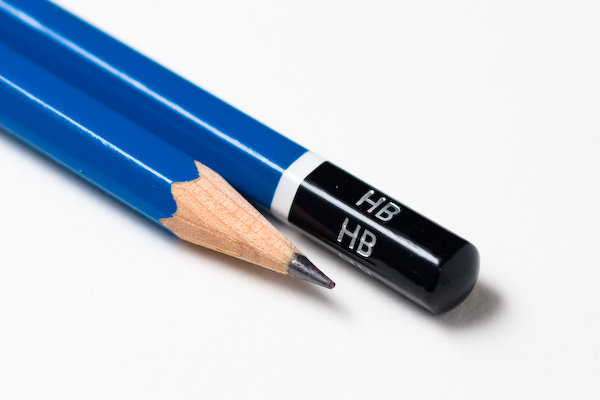
Most manufacturers, and almost all in Europe, designate their pencils with the letters H (commonly interpreted as "hardness") to B (commonly "blackness"), as well as F (usually taken to mean "fineness", although F pencils are no more fine or more easily sharpened than any other grade. Also referred to as "firm" by many manufacturers[63][64][65]). The standard writing pencil is graded HB.[66][b] This designation, in the form "H. B.", was in use at least as early as 1814.[67] Softer or harder pencil grades were described by a sequence or successive Bs or Hs such as BB and BBB for successively softer leads, and HH and HHH for successively harder ones.[68] The Koh-i-Noor Hardtmuth pencil manufacturers claim to have first used the HB designations, with H standing for Hardtmuth, B for the company's location of Budějovice, and F for Franz Hardtmuth, who was responsible for technological improvements in pencil manufacture.[69][70]
As of 2021[update], a set of pencils ranging from a very soft, black-marking pencil to a very hard, light-marking pencil usually ranges from softest to hardest as follows:
| Tone and grade designations | Character | Application examples | ||
|---|---|---|---|---|
| Europe | US | RUS | ||
| 9B | – | – | extremely soft, black |
for artistic purposes:
|
| 8B | – | – | ||
| 7B | – | – | ||
| 6B | – | – | ||
| 5B | – | – | ||
| 4B | – | – | ||
| 3B | – | 3M | soft |
|
| 2B | #0 | 2М | ||
| B | #1 | M | ||
| HB | #2 | TM | medium |
|
| F | #2½* | – | ||
| H | #3 | T | hard |
|
| 2H | #4 | 2T | ||
| 3H | – | 3T | very hard |
|
| 4H | – | – | ||
| 5H | – | – | ||
| 6H | – | – | extremely hard, light grey |
for special purposes: |
| 7H | – | – | ||
| 8H | – | – | ||
| 9H | – | – | ||
| *Also seen as 22/4, 24/8, 2.5, 25/10 | ||||
Koh-i-noor offers twenty grades from 10H to 8B for its 1500 series.[71] Mitsubishi Pencil offers twenty-two grades from 10H to 10B for its Hi-uni range.[72] Derwent produces twenty grades from 9H to 9B for its graphic pencils.[73] Staedtler produces 24 from 10H to 12B for its Mars Lumograph pencils.[74]
Numbers as designation were first used by Conté and later by John Thoreau, father of Henry David Thoreau, in the 19th century.[c] Although Conté/Thoreau's equivalence table is widely accepted,[75][76] not all manufacturers follow it; for example, Faber-Castell uses a different equivalence table in its Grip 2001 pencils: 1 = 2B, 2 = B, 2½ = HB, 3 = H, 4 = 2H.
Hardness test
[edit]Graded pencils can be used for a rapid test that provides relative ratings for a series of coated panels but cannot be used to compare the pencil hardness of different coatings. This test defines a "pencil hardness" of a coating as the grade of the hardest pencil that does not permanently mark the coating when pressed firmly against it at a 45 degree angle.[d][77] For standardized measurements, there are Mohs hardness testing pencils on the market.
External colour and shape
[edit]
The majority of pencils made in the US are painted yellow.[e] According to Henry Petroski,[78] this tradition began in 1890 when the L. & C. Hardtmuth Company of Austria-Hungary introduced their Koh-I-Noor brand, named after the famous diamond. It was intended to be the world's best and most expensive pencil, as the end of the pencil was dipped in 14-carat gold;[79] and at a time when most pencils were either painted in dark colours or not painted at all, the Koh-I-Noor was yellow. As well as simply being distinctive, the colour may have been inspired by the Austro-Hungarian flag; it was also suggestive of the Orient at a time when the best-quality graphite came from Siberia. Other companies then copied the yellow colour so that their pencils would be associated with this high-quality brand, and chose brand names with explicit Oriental references, such as Mikado (renamed Mirado)[f][g] and Mongol.[80][h]
Not all countries use yellow pencils. German and Brazilian pencils, for example, are often green, blue or black, based on the trademark colours of Faber-Castell, a major German stationery company which has plants in those countries. In southern European countries, pencils tend to be dark red or black with yellow lines, while in Australia, they are red with black bands at one end.[81] In India, the most common pencil colour scheme was dark red with black lines, and pencils with a large number of colour schemes are produced.[82]
Pencils are commonly round, hexagonal, or sometimes triangular in section. Carpenters' pencils are typically oval or rectangular, so they cannot easily roll away during work.
Manufacturers
[edit] |

Prominent global manufacturers of wood-cased (including wood-free) pencils:
| Manufacturer | Country of origin | Remark |
|---|---|---|
| Caran d'Ache | Switzerland | |
| China First Pencil Co. | China | Chung Hwa and Great Wall brands |
| Cretacolor Bleistiftfabrik | Austria | |
| Derwent Cumberland Pencil Company | UK | Derwent brand |
| Dixon Ticonderoga | USA | Dixon, Oriole, Ticonderoga brands (manufactured in Mexico, China) |
| Faber-Castell AG | Germany | Plants in Germany, Indonesia, Costa Rica, Brazil, Malaysia |
| FILA Group | Italy | Temagraph, Lyra, Dixon, Ticonderoga, DOMS brands |
| General Pencil Co. | USA | General's, Kimberly brands |
| Hindustan Pencils | India | Apsara, Nataraj brands |
| Koh-i-Noor Hardtmuth | Czech Republic | Koh-i-Noor brand |
| Lyra Bleistift-Fabrik | Germany | Parent: FILA Group |
| Mitsubishi Pencil Company | Japan | Mitsubishi, Uni brands |
| Musgrave Pencil Company | USA | |
| Newell Brands | USA | Paper Mate brand |
| Palomino | USA | Division of California Cedar Products |
| Staedtler Mars GmbH & Co. | Germany | Staedtler brand |
| Tombow Pencil Co. | Japan | Includes MONO brand |
| Viarco | Portugal |
In New Zealand Faber-Castell is pretty popular.
In Australia the most popular is either Faber-Castell or Staedtler
See also
[edit]Notes
[edit]- ^ Pencil grades vary "depending upon the manufacturer, when the pencils are made, and the source of graphite and clay. One analyst found that graphitic carbon content, for example, to vary from about 30 to about 65 in a variety of different pencils bearing the same designation." Petroski 1990, p. 229
- ^ This is not related to the Brinell scale hardness unit HB.
- ^ Conté used integer numbers that started at 1, with higher numbers indicating softer leads, while Thoreau used higher numbers to designate harder leads (Petroski 1990, p. 157). It is believed that Thoreau developed independently his method of mixing clay and graphite, and his use of numbers to designate grades is evidence that he was at least aware of Conté methods and tried to reverse engineer them. Thoreau offered pencils graduated from 1 to 4 in the mid-1800s (Petroski 1990, p. 119), see also John H. Lienhard (1989). "Thoreau's Pencils". The Engines of Our Ingenuity. Episode 339. NPR. KUHF-FM Houston. Transcript. uh.edu
- ^ This testing method is approved by the ISO as standard ISO 15184:1998 Paints and varnishes – Determination of film hardness by pencil test ISO.org Archived 26 October 2017 at the Wayback Machine. See pra-world.com Archived 29 September 2007 at the Wayback Machine for a description of the test. However, the hardness of pencils is not standardised. For this reason, the standard specifies various brands of pencils that are to be used in this test.
- ^ 75% of the 2.8 billion pencils made in the US are painted yellow (Steve Ritter "Pencils & Pencil Lead", Chemical & Engineering News, Volume 79, Number 42 page 35, 15 October 2001). Pubs.acs.org
- ^ Eagle Pencil Company applied for the trademark Mirado in 1947 (US Trademark 71515261). It is common belief that this was an attempt to disassociate the pencil brand from Japan, as one of the meanings of Mikado is emperor of Japan.
- ^ Mikado/Mirado pencils were originally made by Eagle Pencil Company – today Berol – but can also be found today under the trademark Papermate and Sanford as Sanford owns Berol and the trademark Papermate Brandnamepencils.com Archived 29 September 2007 at the Wayback Machine Mirado Pencil
- ^ Originally made by Eberhard Faber the Mongol trademark is now owned by Sanford Timberlines.blogspot.com Archived 4 March 2016 at the Wayback Machine Timberlines Blog "Mongolized" 31 August 2005. Retrieved 23 August 2007.
References
[edit]- ^ "pencil, n". Oxford English Dictionary (3 ed.). Oxford University Press. 2005.
- ^ Notes and Queries. 3. Vol. 12. Oxford University Press. 1868. p. 419. Archived from the original on 17 January 2018.
- ^ Zumdahl, Steven S. & Zumdahl, Susan A. (2008). "No lead pencils". Chemistry. Belmont, CA: Cengage Learning. p. 343. ISBN 978-0-547-12532-9.
- ^ Norgate, Martin; Norgate, Jean (2008). "Old Cumbria Gazetteer, black lead mine, Seathwaite". Portsmouth University: Geography Department. Archived from the original on 7 January 2009. Retrieved 19 May 2008.
- ^ Wainwright, Alfred (2005). A Pictorial Guide to the Lakeland Fells, Western Fells. Frances Lincoln. ISBN 0-7112-2460-9.
- ^ "Graphite from the Plumbago Mine, Borrowdale, England". Department of Physics at Michigan Technological University. Archived from the original on 14 March 2008. Retrieved 27 March 2008.
- ^ a b Petroski, 1990, pp. 168, 358
- ^ "Lakeland's Mining Heritage". cumbria-industries.org.uk. Archived from the original on 15 March 2008. Retrieved 27 March 2008.
- ^ "Definition of Plumbago". Answers.com. Archived from the original on 13 August 2007. Retrieved 21 April 2007.
- ^ "Definition of Plumbago". Thefreedictionary.com. Retrieved 21 April 2007.
- ^ The big book of questions and answers, Publications International LTD, (1989), p.189, ISBN 0-88176-670-4.
- ^ "Have pencils ever contained lead?". BBC Science Focus Magazine. March 2019. Retrieved 27 August 2020.
- ^ Bennett, Howard J. (26 November 2014). "Ever wondered about the lead in pencils?". The Washington Post. ISSN 0190-8286. Archived from the original on 6 November 2015. Retrieved 5 October 2015.
- ^ "Pencil swallowing: MedlinePlus Medical Encyclopedia". www.nlm.nih.gov. Archived from the original on 6 October 2015. Retrieved 5 October 2015.
- ^ "graphite pencils | The Weekend Historian". umeshmadan.wordpress.com. Archived from the original on 7 October 2015. Retrieved 5 October 2015.
- ^ "Lead Facts - Uses, Properties, Element Pb, Plumbing, Pipes, Weights". www.sciencekids.co.nz. Archived from the original on 30 October 2016. Retrieved 29 October 2016.
- ^ "Keswick Pencil Museum". Pencilmuseum.co.uk. Archived from the original on 3 August 2009. Retrieved 23 July 2009.
- ^ Harper, Douglas (27 June 2012). "pencil". Online Etymology Dictionary. Archived from the original on 23 August 2012. Retrieved 27 June 2012.
- ^ "Who invented the pencil?". Rocket City Space Pioneers. Archived from the original on 22 October 2011.
- ^ "Timeline Outline ViewEra: 1500 - 1550". Historyofscience.com. Archived from the original on 31 December 2010. Retrieved 18 August 2012.
- ^ "Pencil". www.fact-index.com. Archived from the original on 24 May 2012. Retrieved 23 November 2015.
- ^ "Pencils". Borrowdale Points. 10 February 2015. Archived from the original on 23 November 2015. Retrieved 23 November 2015.
- ^ "Gyaat:The weapon we use from adolescence". www.gyaat.com. Archived from the original on 23 November 2015. Retrieved 23 November 2015.
- ^ "History of Koh-i-noor Hardmuth company". Koh-i-noor Hardmuth company. Archived from the original on 10 September 2015. Retrieved 11 September 2015.
- ^ Bessemer, Henry (1905) Sir Henry Bessemer, F.R.S: An Autobiography, London, Offices of "Engineering," Chapter 3.
- ^ "Famous Pencil Users - Pencils.com". Archived from the original on 9 October 2016. Retrieved 8 September 2016.
- ^ "Acton Conservation Lands, Pencil Factory". Actontrails.org. 16 December 2015. Archived from the original on 27 February 2024. Retrieved 27 February 2024.
- ^ "Joseph Dixon 1799–1869". Dixon Ticonderoga Company. Archived from the original on 13 October 2007. Retrieved 23 July 2009.
- ^ "Tantiusques Graphite Mine". Thetrustees.org. Archived from the original on 18 April 2009. Retrieved 23 July 2009.
- ^ a b c Petroski, Henry (2010). The Pencil: A History of Design and Circumstance. New York: Random House LLC. ISBN 978-0-307-77243-5.
- ^ Franco, Michael. "Famous Pencil Pushers". The Point of it All – History of the Pencil. Archived from the original on 17 June 2009.
- ^ Poe, Janita (1 September 1993). "In World Of Politically Right, Pencils Can Be Wrong Stuff". Chicago Tribune. Archived from the original on 22 February 2014.
- ^ "Forest Management Public Summary for: PT Xylo Indah Pratama" (PDF). Rainforest Alliance. 15 March 2000. Archived from the original (PDF) on 29 December 2009.
- ^ "Fantasia – The Quality Pencil Company – About Us". Archived from the original on 25 August 2013.
- ^ Lipman, L. (30 March 1858). "US Patent 19783 Combination of Lead-Pencil and Eraser". Patft.uspto.gov. Archived from the original on 2 May 2017. Retrieved 23 July 2009.
- ^ Petroski 1990, p. 171
- ^ "Reckendorfer v. Faber 92 U.S. 347 (1875)". Supreme.justia.com. Archived from the original on 8 June 2009. Retrieved 23 July 2009.
- ^ "Vintage Pen Blog". GoPens.com. Archived from the original on 6 September 2017.
- ^ a b c Categories of Wax-Based Drawing Media, palimpsest.stanford.edu
- ^ Martin, Doug (2000). "Carpenter's Pencils". Pencilpages.com. Archived from the original on 27 February 2009. Retrieved 23 July 2009.
- ^ "History Pencils & Historic Packaging". Faber Castell Australia
- ^ "Oldest Known Pencil in Existence". Pencilpages.com. Archived from the original on 20 February 2009. Retrieved 23 July 2009.
- ^ "L. 6 febbraio 1948, n. 29". Archived from the original on 9 October 2012. Retrieved 1 August 2011.
- ^ "Gel Eyeliner Pencil by ULTA". Archived from the original on 17 November 2017. Retrieved 15 November 2017.
- ^ "Art Supplies". Mccannas.com. Archived from the original on 28 January 2013. Retrieved 23 July 2009.
- ^ "Sketch to Paint in Photoshop". Digitalartsonline.co.uk. Archived from the original on 27 February 2009. Retrieved 23 July 2009.
- ^ "Tools of the Trade Papers Pencils and Erases". smackjeeves.com. Archived from the original on 8 July 2007. Retrieved 23 July 2009.
- ^ "Sanford Col-Erase Copy Not Pencils-You Can't Copy This Baby!". Epinions.com. Archived from the original on 24 May 2008. Retrieved 23 July 2009.
- ^ "Paper and Pencil Blog 'Reporter Pencils'". Penciltalk.org. Archived from the original on 28 July 2014. Retrieved 23 July 2009.
- ^ World's largest pencil Archived 29 December 2008 at the Wayback Machine. The Pencil Pages.
- ^ World's largest pencil unveiled in New York Archived 17 May 2017 at the Wayback Machine. Sri Chinmoy News.
- ^ World's largest pencil Archived 5 January 2009 at the Wayback Machine (video). Metacafe.com.
- ^ Grossman, Harold. US Patent 3,360,489 Archived 28 July 2017 at the Wayback Machine, issued 26 December 1967
- ^ The Epcon Plastic Pencil Archived 8 July 2011 at the Wayback Machine, adlittlechronicles.blogspot.com, for information about this invention.
- ^ "P&P Office Waste Processor". Dynamic Inventions. 11 March 2013. Archived from the original on 13 January 2014. Retrieved 12 January 2014.
- ^ "Pencils, paint and pottery can give you lead poisoning". Life. Vol. 73, no. 1. 7 July 1972. p. 46.
- ^ "The HB Graphite Grading Scale". Pencils.com. Archived from the original on 21 March 2012. Retrieved 14 March 2012.
- ^ Petroski 1990, "Appendix A
- ^ "Staedtler Pencil, video". Archived from the original on 21 January 2013. Retrieved 23 July 2009. Staedtler.com
- ^ Petroski 1990
- ^ "Derwent Manufacturing Process". Pencils.co.uk. Archived from the original on 17 May 2013. Retrieved 23 July 2009.
- ^ "Graphite Grading Scales Explained". 8 November 2014. Archived from the original on 6 February 2017. Retrieved 5 February 2017.
- ^ えんぴつのナゾを解く Archived 3 October 2015 at the Wayback Machine. Mitsubishi Pencil Company (in Japanese).
- ^ "KOH-I-NOOR HARDTMUTH HISTORY". Koh-I-Noor Hardtmuth. Retrieved 5 July 2024.
- ^ "Castell 9000 brochure". Faber-Castell. Retrieved 5 July 2024.
- ^ "Graphite Grading Scales Explained" Archived 6 February 2017 at the Wayback Machine. Pencils.com.
- ^ Stothard, Charles (1823). Memoirs, Including Original Journals, Letters, Papers, and Antiquarian Tracts, of the Late Charles Alfred Stothard, F.S.A. (letter dated 1814). Longman.
- ^ Petroski 1990, p. 157
- ^ "Interesting information about the company". Koh-I-Noor Hardtmuth. Archived from the original on 13 October 2016. Retrieved 12 October 2016.
- ^ Norris, Mary (28 April 2016). "Comma Queen: On "Impact"" (Video). The New Yorker. Condé Nast. p. 2:35. Archived from the original on 5 June 2016. Retrieved 14 May 2016.
- ^ Koh-i-noor Catalog: Graphite Pencis, koh-i-noor.cz
- ^ コード表, mpuni.co.jp (Japanese)
- ^ "Derwent Graphic". Pencils.co.uk. Archived from the original on 19 June 2009. Retrieved 23 July 2009.
- ^ Staedtler Mars Lumograph Pencils Staedtler.com. Retrieved 25 August 2019.
- ^ "Pencil Grades". www.pencilpages.com. Retrieved 18 September 2025.
- ^ CecelyV (28 February 2021). "The Pencil Grading Scale Explained 2025: A Comprehensive Guide to Graphite Drawing Pencils". Retrieved 18 September 2025.
- ^ Simmons, Mac (April 2000). "The Pencil Hardness Test". Woodwork: 76. Archived from the original on 28 September 2007. Retrieved 13 September 2007.
- ^ Petroski 1990, pp. 162–163
- ^ Weaver, Caroline (3 November 2018). Why the pencil is perfect | Small Thing Big Idea, a TED series.
- ^ "Eberhard Faber Pencil Gallery". Pencilpages.com. Archived from the original on 8 April 2009. Retrieved 23 July 2009.
- ^ O'Shaughnessy, Lynn (22 July 2010). "Why Are Pencils Yellow?". CBS News MoneyWatch. Retrieved 24 July 2021.
- ^ Khatabook. "List Of Top Rated Pencil Brands In India". Khatabook. Retrieved 28 December 2023.
Bibliography
[edit]- Petroski, Henry (1990). The Pencil: A History of Design and Circumstance. New York: Alfred A. Knopf. ISBN 0-394-57422-2.
Further reading
[edit]- Petroski, Henry (1991). "H. D. Thoreau, Engineer". American Heritage of Invention and Technology. 5 (2): 8–16. doi:10.1215/00382876-90-1-39. ISSN 0038-2876. S2CID 257782890. Retrieved 3 June 2023.
External links
[edit] Definitions from Wiktionary
 Media from Commons


- History of Pencils
- Payne, Christopher; Anderson, Sam (12 January 2018). "Inside one of America's last pencil factories". The New York Times.
- How A Pencil Is Made on YouTube
| Types | |
|---|---|
| Accesories | |
| Branded models | |
| People | |
| Related topics | |

| International | |
|---|---|
| National | |
| Other | |

Pencil
View on GrokipediaHistory
Origins in Ancient Writing Tools
The origins of the pencil as a writing instrument trace back to ancient tools that allowed for marking without ink, serving as conceptual precursors to later graphite-based devices. In ancient Greece and Rome, styluses crafted from materials such as bone, bronze, lead, silver, and wood were commonly used to inscribe text on wax-coated wooden tablets, which provided a reusable surface for notes, accounts, and correspondence. These styluses featured a pointed end for etching into the softened wax and a flattened opposite end for smoothing or erasing marks, enabling efficient daily writing practices. A notable example is a Roman iron stylus dating to approximately 70 CE, discovered in London, which exemplifies the portability and durability of these tools in urban settings.[6][7] In parallel, early inkless marking methods emerged in Asia around the 3rd century BCE. In ancient China, during the Warring States period (circa 475–221 BCE), scribes incised characters onto thin bamboo slips using a sharp knife or stylus, creating durable records without pigments; these slips were then bound with cords to form scrolls for administrative and literary purposes. Similarly, in ancient India around 200 BCE, writers employed ink on prepared cloth such as cotton or silk, or incised characters on palm leaves with styluses, facilitating portable notations in trade and religious contexts. These techniques highlighted the versatility of dry marking for ephemeral or semi-permanent writing on organic materials.[8][9] These ancient implements laid the groundwork for more refined drawing tools during the European Renaissance, particularly metal-point techniques that bridged inkless marking and artistic precision. Silverpoint, involving a silver stylus dragged across specially prepared paper coated with bone ash or gesso, produced fine, indelible lines that tarnished over time to enhance visibility; this method was favored for its subtlety in preparatory sketches. Artists like Leonardo da Vinci employed silverpoint extensively in the late 1470s, as seen in works such as his Bust of a Warrior, where the medium's precision captured anatomical details and drapery folds with exceptional clarity. This evolution from utilitarian styluses to artistic metal points set the stage for the integration of graphite, which would later transform such tools into the modern pencil.[10][11][12]Graphite Discoveries and Early European Use
The discovery of a large deposit of pure graphite in Borrowdale, England, around 1564 marked a pivotal moment in the evolution of writing and drawing tools. Local shepherds stumbled upon the material after a storm uprooted trees, exposing the soft, black substance, which they initially used to mark their sheep due to its ability to leave a clear, dark trace on surfaces. Recognizing its potential beyond livestock marking, the graphite was sawn into sticks and wrapped in string or sheepskin to prevent breakage and facilitate handling as a rudimentary writing implement.[13][14] By the mid-16th century, knowledge of this Borrowdale graphite—known then as "plumbago" or "black lead"—spread across Europe, where it gained traction as a superior alternative to earlier metalpoint styluses for its darker, more versatile marks. In 1565, Swiss naturalist Conrad Gesner documented one of the earliest known uses of graphite sticks for writing in his treatise De Fossilium Lapidum, describing them as enclosed in wood or other materials to form portable tools for notation and sketching. This account, published in Zurich, highlighted the substance's utility in producing fine lines on paper, bridging practical and artistic applications.[3][15] The adoption of graphite extended to Continental European artists in the late 16th century, who employed it for preliminary sketches and detailed studies, valuing its erasability and tonal range over brittle alternatives. Surviving examples of graphite marks on paper from this period, often termed "plumbago drawings," demonstrate its integration into Renaissance artistic practice, with the medium enabling more fluid and expressive line work in preparatory compositions.[16][17]Development of Modern Wooden Pencils
The transition from loose graphite sticks to encased wooden pencils represented a key evolution in writing instruments during the 17th century, addressing the fragility of pure graphite while improving usability. In 1662, craftsmen in Nuremberg, Germany—the emerging center of pencil production—began mass-manufacturing the first wooden pencils by embedding graphite leads into holders made from juniper wood, which provided a durable and easily sharpenable casing.[18][19] This method involved grooving two halves of wood, inserting the graphite, and gluing them together, marking the birth of the modern wooden pencil design.[20] By the 18th century, Nuremberg's pencil industry refined these techniques, leading to more consistent quality and output. Around 1761, carpenter Kaspar Faber established a dedicated manufactory in the nearby village of Stein, initiating systematic mass production of wooden pencils that built on Nuremberg's traditions.[21] This shift toward specialized factories laid the groundwork for the pencil's widespread adoption as a reliable everyday tool. The Napoleonic Wars (1799–1815) profoundly impacted pencil production in Europe, as Britain's naval blockade and graphite export embargoes cut off supplies of high-quality English graphite to France and its allies, forcing innovation amid shortages.[22] In response, French inventor Nicolas-Jacques Conté developed an alternative in 1795 by mixing powdered graphite with clay and firing the mixture into durable leads, reducing dependency on imported pure graphite and enabling continued wooden pencil manufacturing despite the disruptions.[22] These wartime adaptations not only sustained production but also influenced global standards for pencil leads, emphasizing the wooden casing's role in protecting the core material.19th and 20th Century Innovations
In 1795, French inventor Nicolas-Jacques Conté developed the graphite-clay mixture for pencil cores in response to a British embargo on graphite exports during the Napoleonic Wars, which had created severe shortages for French pencil makers.[22] This innovation involved grinding graphite into powder, mixing it with clay in varying proportions—such as 4 parts graphite to 1 part clay for softer leads—and forming the paste into rods that were then baked at high temperatures in a kiln to harden them.[23] The process not only conserved scarce graphite but also allowed control over the lead's hardness and darkness by adjusting the ratio, establishing the foundation for modern pencil grading systems.[24] The technique quickly spread beyond France, influencing early American production. In 1812, cabinetmaker William Munroe of Concord, Massachusetts, adapted Conté's method to create the first wooden pencils manufactured in the United States, using locally sourced materials amid wartime import restrictions.[25] Although Munroe did not hold a formal patent, his operations marked the beginning of a domestic pencil industry, which grew rapidly as demand increased for reliable writing tools in education, commerce, and engineering.[24] Mid-19th-century advancements focused on usability enhancements. In 1858, Hymen L. Lipman received U.S. Patent No. 19,783 for attaching a small eraser to the end of a pencil, solving the inconvenience of separate tools and streamlining corrections for writers and artists. Around the same time, in the 1860s, pencil extenders emerged as simple metal or wooden holders designed to grip short pencil stubs, extending their usable length and reducing waste, particularly among professionals like draftsmen who valued precision.[1] The 20th century brought further refinements in pencil design and variety. Mechanical pencils, featuring retractable leads to eliminate sharpening, gained popularity in the 1910s with innovations like Tokuji Hayakawa's 1915 twist-mechanism model, which offered consistent line width for technical drawing and everyday use.[26] Simultaneously, in 1908, Faber-Castell introduced Polychromos colored pencils, using high-quality pigments mixed with binders for vibrant, lightfast colors that resisted fading, revolutionizing artistic applications and expanding pencils beyond monochrome writing.[27]Anatomy and Components
The Core: Graphite-Clay Mixture
The core of a pencil, often referred to as the "lead," consists primarily of a homogeneous mixture of powdered graphite—a crystalline form of carbon—and kaolin clay, typically in varying proportions to achieve desired writing characteristics.[28] The graphite provides the dark, transferable marking substance due to its layered structure, which allows layers to shear off easily onto paper, while the clay acts as a binder to impart strength and control the mark's intensity.[29] The ratio of graphite to clay is critical: a higher graphite content (e.g., up to 80% in soft leads) results in softer, darker marks that deposit more material, whereas increasing the clay proportion (e.g., up to 70% in hard leads) produces harder, lighter lines with greater durability and less smudging.[30] This mixture is prepared by grinding both components to fine powders and blending them with water to form a plastic paste, which is then extruded through dies to shape thin rods matching the pencil's diameter.[31] Following extrusion, the rods undergo a drying phase to remove excess moisture, after which they are baked in a kiln to fuse into durable, solid cores. The baking, or firing, process occurs at temperatures between 1000°C and 1200°C for several hours under controlled conditions, often in an inert atmosphere to prevent oxidation of the graphite.[32] During this sintering, the clay particles partially vitrify, dehydrate, and form a ceramic matrix that physically binds the inert graphite flakes, creating a composite rod with enhanced mechanical integrity without altering the graphite's core properties.[30] This heat treatment ensures the core resists breakage while maintaining the ability to produce consistent marks, with the final hardness grade (e.g., from 9H to 9B) directly tied to the initial mixture ratio.[31] While natural graphite, mined from deposits like those in Sri Lanka or China, has been the traditional choice for its cost-effectiveness and natural lubricity, synthetic graphite—produced by graphitizing petroleum coke at over 2500°C—offers higher purity (often >99% carbon) and uniformity in particle size.[33] In pencil production, synthetic variants can enhance smoothness by reducing impurities that cause scratching, and improve durability through more consistent bonding with clay, though they are less common due to higher costs and are typically reserved for premium or specialized leads.[34] Natural graphite, despite potential variations in flake quality, provides adequate performance for most applications and contributes to the core's erasability via weak van der Waals forces between layers.[28]Casing Materials and Construction
The casing of a wooden pencil primarily consists of two slats made from softwood, designed to encase and protect the graphite core while providing a comfortable grip and ease of use. The preferred material is incense-cedar (Calocedrus decurrens), sourced from sustainable forests in California, valued for its straight, fine grain, lightweight nature, and superior machinability that allows for smooth sharpening without splintering.[35] This wood's aromatic properties and dimensional stability also contribute to its durability during manufacturing and everyday handling.[36] Alternatives to incense-cedar include basswood (Tilia spp.), commonly used in Chinese pencil production for its availability and adequate technical properties, though it is denser and less smooth-finishing than cedar.[37] Jelutong (Dyera costulata), harvested from Southeast Asian rainforests, serves as another option due to its softness and sharpenability, but environmental concerns regarding sourcing have limited its adoption in premium products.[36] In construction, the process begins with wooden slats that are milled and grooved lengthwise to accommodate the core; a second grooved slat is then glued atop the first to form a "sandwich" structure, which is clamped to ensure a secure bond.[38] The assembled slats are cut into individual pencil blanks and shaped—typically into a hexagonal cross-section for better grip and reduced rolling, though round forms are also produced—resulting in a standard length of 7 to 7.5 inches (175 to 190 mm) and a diameter of approximately 7 mm.[39] A protective lacquer or paint coating is applied to the exterior, enhancing resistance to wear and providing a smooth, colorful finish.[40]Attachments: Erasers and Extenders
Pencils often incorporate an eraser at one end to allow users to remove graphite marks without needing a separate tool. This attachment consists of a small block of eraser material secured by a metal ferrule that is crimped around the pencil's wooden casing. The eraser is typically made from synthetic rubber compounds, such as vinyl or a styrene-butadiene mixture, which provide effective abrasion resistance and durability while being non-smearing on paper.[41][42] These materials replaced earlier natural rubber options, offering better longevity and consistency in performance.[43] The concept of an integrated eraser originated with a patent granted to Hymen L. Lipman on March 30, 1858, for a wooden pencil with an embedded rubber plug at one end, revolutionizing writing instruments by combining marking and correction in a single device.[44] This design quickly became standard, with the eraser protruding slightly from the ferrule for easy access. Modern erasers maintain this basic form but use refined synthetic formulations to minimize residue and enhance erasability on various paper types.[41] Pencil extenders serve as auxiliary holders designed to prolong the usability of shortened pencils, gripping the remaining length to prevent waste and maintain a comfortable writing grip. These devices are commonly constructed from metal, such as aluminum or brass, or durable plastics, with mechanisms that securely clamp onto the pencil's body.[45] Examples include sliding ring designs that expand a slit to insert the pencil stub, or clutch-style grips with a tightening ring for firm hold.[46] Such extenders accommodate pencils as short as 1-2 inches, allowing continued use until nearly all material is consumed.[47] The ferrule that attaches the eraser to the pencil is typically made from aluminum or tin-plated steel, materials chosen for their malleability and corrosion resistance.[48] This thin metal band is rolled around the pencil end and crimped tightly, embedding small serrations into the wood to ensure a secure bond without splintering the casing.[49] In some designs, the ferrule also supports extender attachments, providing a reinforced grip point for compatibility with holder mechanisms.[45]Types and Variations
By Marking Substance
Pencils are classified by the marking substance in their core, which influences the color, erasability, texture, and suitability for various surfaces and techniques. The core's composition determines how the pencil interacts with paper or other media, ranging from standard erasable marks to specialized applications on non-absorbent materials. Graphite pencils, the most widely used type, feature a core composed of finely ground graphite mixed with clay in varying ratios to achieve different hardness levels. A higher graphite content produces softer, darker leads suitable for shading, while more clay results in harder, lighter leads ideal for precise lines; this mixture is extruded into rods and encased in wood. These pencils create shiny, gray-to-black marks that are easily erasable using rubber or vinyl erasers, allowing for corrections and highlighting by lifting the medium to reveal the paper beneath. A variation, water-soluble graphite pencils, incorporate binders that dissolve in water, enabling the creation of wash effects similar to ink when brushed over dry applications.[16][29][50] Colored pencils employ pigment particles bound with either wax or oil, suspended in a core that delivers vibrant, non-black hues for artistic rendering. Wax-based versions, common in many professional lines, offer a softer texture that facilitates layering multiple colors to build opacity and depth, though they may develop wax bloom—a hazy surface film—over time. Oil-based colored pencils, in contrast, provide a harder lead that resists crumbling and excels in smooth blending with solvents, yielding cleaner transitions without the buildup associated with wax. A variant, watercolor pencils (or water-soluble colored pencils), use binders that allow the pigment to dissolve in water, creating fluid, translucent effects similar to traditional watercolors when brushed. Both types exhibit improved lightfastness in high-quality formulations but can bleed if exposed to solvents.[50][51][52] Specialty pencils cater to specific effects or surfaces beyond standard drawing. Charcoal pencils consist of compressed powdered charcoal derived from willow or vine, producing matte, intensely black lines with a dusty texture that suits bold, expressive sketches and broad tonal contrasts. Grease pencils use a hardened wax core, often colored, that adheres to non-porous surfaces like glass or metal without smudging or fading in moist conditions, making them ideal for temporary markings that resist water. Carbon pencils, made from lampblack (a form of carbon) blended with clay, generate a deeper, non-reflective black than graphite, offering smooth application for technical illustrations requiring precise, matte shading.[53][54][55]By Shape and Size
Pencils vary in shape to enhance grip, prevent rolling, and accommodate different users, with hexagonal, round, and triangular forms being the most common. Hexagonal pencils, featuring six flat sides, provide a secure grip during extended writing sessions and resist rolling off surfaces, making them suitable for everyday and professional use. Round pencils, by contrast, offer a smoother feel but are more prone to rolling, often preferred in artistic applications where rotation in the hand is beneficial. Triangular pencils, with their ergonomic three-sided design, are particularly advantageous for beginners and children, as they promote a natural finger position and reduce hand fatigue.[56][57][58] Size variations in pencils address portability, usability, and specialized needs, ranging from compact minis to oversized jumbos. Standard wooden pencils typically measure 17.5 to 19 centimeters (about 7 inches) in length and 7 to 8 millimeters in diameter, balancing comfort for adult hands with practical sharpening. Mini pencils, often 3.5 to 9 centimeters (1.4 to 3.5 inches) long, are designed for pockets or travel, such as golf scorecards or quick notes, and usually maintain a slimmer 4-millimeter diameter for easy handling. Jumbo pencils, with diameters up to 10 millimeters, cater to young learners or those with larger grips, featuring thicker cores for durability and broader strokes.[59][60][61][62][63] For example, the longest colouring pencil, produced by STAEDTLER in 2015, measures 459.97 meters (1,509 feet) in length, demonstrating extreme scaling for promotional purposes while highlighting manufacturing capabilities. Proportions between pencil body diameter and internal lead size influence marking precision; narrower leads, such as 0.5 millimeters in diameter, produce fine lines ideal for detailed technical drawing, whereas standard 2-millimeter leads in larger bodies yield broader, bolder marks suitable for sketching. These dimensions, often encased in wood or composite materials, directly affect overall balance and line consistency during use.[64][65]By Mechanism and Durability
Mechanical pencils differ from traditional wooden pencils by employing internal mechanisms to propel replaceable graphite leads, eliminating the need for sharpening and ensuring consistent line widths. These devices typically use leads ranging from 0.3 mm to 2 mm in diameter, suitable for precise writing, drafting, and technical applications. The core innovation lies in propulsion systems that advance the lead incrementally, such as ratchet-based designs where pressing a button engages jaws to push the lead forward while a rubber clutch holds it in place.[66][67] Common mechanisms include twist-based systems, which extend the lead by rotating a screw or knob to move a slider along the barrel, allowing for adjustable positioning and often used in models holding a single lead piece. Clutch mechanisms, prevalent in lead holders, feature jaws that open upon button activation to insert or advance thicker leads (2–5.6 mm), providing a firm grip without incremental feeding. Shaker variants incorporate a weighted internal component that advances lead through motion, combining reliability with ergonomic convenience for extended use.[66][68] For enhanced durability in demanding environments like construction or fieldwork, pencils are constructed with rugged materials such as high-impact ABS plastic or aluminum casings, resisting breakage and wear under rough handling. Carpenter pencils exemplify this design, featuring flat, rectangular cross-sections that prevent rolling on inclined surfaces like roofs or workbenches, while their robust graphite cores withstand pressure without snapping. These variants maintain functionality across prolonged use, often incorporating mechanical elements for lead replacement in professional settings.[67][69] Advancements in the 1970s introduced specialized models like pop-a-point pencils, which house multiple short graphite segments in a plastic cartridge; a dull tip is ejected from the front and cycled to the rear via a simple push mechanism, automatically advancing a fresh point without tools. Similarly, twist-erase models, building on mid-20th-century innovations, integrate a retractable eraser advanced by twisting the top, enhancing usability in mechanical pencils with internal lead propulsion for seamless correction during extended writing sessions.[70][67][71]Manufacturing Process
Sourcing and Preparing Raw Materials
The production of pencils begins with the careful sourcing of raw materials, primarily graphite for the core, kaolin clay as a binder, and wood for the casing. Natural graphite, essential for the marking substance, is predominantly mined in China, which accounted for approximately 77% of global natural graphite production as of 2023 (totaling about 1.3 million metric tons out of 1.7 million metric tons worldwide), and Sri Lanka, a key producer of high-quality lump and chippy varieties.[72][73][74] Synthetic graphite, an alternative used in some modern formulations, is manufactured from petroleum coke through high-temperature processing, offering consistent purity for industrial applications including pencil leads.[75] Kaolin clay, which determines the hardness of the pencil core when mixed with graphite, is primarily sourced from extensive deposits in Georgia, USA, where the region's unique geological conditions yield high-purity white kaolin suitable for fine-particle blending.[76] This kaolin is valued for its low iron content and brightness, making it ideal for achieving the desired lead properties without discoloration. For the pencil casing, incense-cedar (Calocedrus decurrens) from sustainable forests in California and Oregon is the preferred wood due to its straight grain, light weight, and sharp-sharpening qualities. Harvesting practices emphasize sustainability, with major suppliers adopting Forest Stewardship Council (FSC) certification standards in the late 1990s to ensure responsible forestry and biodiversity protection.[77][78] Preparation of these materials involves precise processing to ensure uniformity. Graphite is purified and ground into fine particles, typically less than 10 microns in size, using milling equipment to facilitate smooth mixing and extrusion.[79] Kaolin clay undergoes purification through sedimentation in hydro-classifiers, where slurried clay settles based on particle density, removing coarser impurities like quartz and iron minerals to achieve the required fineness and whiteness.[80] These steps prepare the inputs for subsequent mixing, ensuring the raw materials meet quality standards for pencil production.Forming the Pencil Body
The formation of the pencil body begins with the production of the graphite core, a critical step that determines the pencil's marking properties. Graphite powder is mixed with clay and water in precise proportions to create a malleable paste; the ratio of graphite to clay influences the core's hardness, with higher clay content yielding harder leads. This paste is then extruded through a die to form long, thin rods resembling spaghetti strands, typically with a diameter of about 2 mm. The extruded rods are dried to remove moisture and subsequently fired in kilns at approximately 1000°C, a process that hardens the mixture into brittle, durable cores suitable for writing.[81] Once the cores are prepared, wooden slats are processed to encase them. Softwoods like incense cedar are cut into rectangular slats measuring 7 inches in length, 3 inches in width, and about 1/4 inch thick to minimize waste and ensure uniformity. A groover machine then mills semi-circular grooves along one side of each slat, with each groove precisely half the diameter of the core to provide a secure fit. The graphite cores are laid into these grooves on one slat, coated with adhesive, and a second grooved slat is aligned atop it to form a laminated "sandwich"; this assembly is clamped under pressure in a vise until the glue sets, typically for several hours.[81][82][38] The final stage involves shaping the laminated slats into individual pencils. The sandwiched slats are fed into a profiling machine that trims the edges and cuts them into pencil-length segments, usually 7.5 inches to allow for finishing, producing eight pencils per slat. These rough pencils are then machined on a shaper to achieve the desired cross-section, such as the standard hexagonal profile that prevents rolling or a round shape for certain variants, ensuring ergonomic handling and structural integrity.[81][83][38]Finishing and Quality Control
After the pencil body has been shaped, the finishing process begins with the application of a protective and decorative lacquer coating. Pencils are typically dipped multiple times in lacquer baths to achieve a smooth, durable surface that resists wear and moisture; for instance, high-quality production may involve up to seven coats to ensure even coverage and a glossy finish.[84] Following each dip, the pencils are dried, often through a combination of natural air drying and controlled oven heating to accelerate the process without compromising the coating's integrity.[84] This multi-layer lacquering not only enhances aesthetics but also seals the wood, preventing splintering during use.[85] Once the lacquer has fully cured, branding and grade information—such as the manufacturer's logo, pencil hardness (e.g., HB or 2B), and other identifiers—are applied via silk-screen printing or foil stamping. Silk-screen methods allow for precise, multi-color imprints on the hexagonal or round surfaces, ensuring legibility and durability against erasing or sharpening.[86] These markings are heat-set or cured to bond with the lacquer, providing a professional appearance that distinguishes the product in the market.[87] For pencils equipped with erasers, a metal ferrule—typically made of aluminum or brass—is first attached to the end of the pencil body, often by gluing or mechanical fitting into a pre-cut groove. The ferrule is then crimped to secure it firmly, followed by the insertion and compression of a rubber or synthetic eraser plug into the ferrule's open end.[88] This crimping process ensures a tight, long-lasting bond that withstands repeated use without loosening.[89] Quality control occurs throughout finishing but intensifies at this stage to verify usability and consistency. Visual inspections check for defects in lacquer uniformity, stamping alignment, and ferrule attachment, while functional tests assess lead strength through bending or drop simulations to ensure it does not break prematurely during writing.[89] Additional checks include sharpening trials to confirm smooth point formation and eraser adhesion tests to prevent detachment. Pencils failing these criteria are rejected, with manufacturers aiming for low defect rates through automated and manual oversight, often resulting in less than 5% overall rejection in key production phases.[90] This rigorous evaluation guarantees that only reliable products reach consumers.[85]Grading and Classification
Hardness and Darkness Scales
The hardness and darkness of a pencil's graphite core are rated using standardized scales that indicate the lead's resistance to wear and the intensity of its mark. The most widely used system internationally is the HB scale, where "H" denotes hardness (producing lighter lines with greater durability) and "B" denotes blackness (yielding darker lines with more softness). Grades range from 9H (the hardest and lightest) through progressively softer marks to 9B (the softest and darkest), with HB serving as the balanced middle grade equivalent to a standard writing pencil.[91][92] This grading system traces its roots to the late 18th century innovations of Nicolas-Jacques Conté, who in 1795 patented a method of mixing powdered graphite with clay to form controllable leads, initially using a simple numeric designation from 1 (hardest) to 4 (softest). The modern HB nomenclature, however, emerged in the early 19th century among English pencil manufacturers, who introduced "H" for hard and "B" for black to differentiate qualities beyond basic numbers. By the early 20th century, the combined alphanumeric scale (e.g., 2H, 3B) became prevalent for precision in artistic and technical applications.[93][91] In the United States, a numeric system prevails for common writing pencils, ranging from #1 (equivalent to B, the softest) to #4 (equivalent to 2H, the hardest), with #2 corresponding to HB as the everyday standard. This approach, refined in the 19th century by figures like Henry David Thoreau at his family's pencil factory, prioritizes simplicity for office and school use but aligns roughly with the HB scale. European variations largely adhere to the HB system, though some manufacturers like those in Japan emphasize softer grades around HB for finer control in drawing.[2][91] The key to these scales lies in the empirical adjustment of the core's composition, a mixture of graphite (for darkness and smoothness) and kaolin clay (for hardness and strength), baked at high temperatures to form the rod. Increasing the clay ratio relative to graphite produces harder, lighter leads that resist smudging but require more pressure for visibility, while higher graphite content results in softer, darker marks that lay down easily but wear faster. There is no universal formula for ratios across brands, as formulations are proprietary and refined through testing to meet specific grade targets.[93][91]Testing Methods for Quality
Quality testing for pencils involves standardized procedures to evaluate the performance of the lead, ensuring consistency in hardness, marking density, and mechanical strength. These tests are essential for verifying that pencils meet grading specifications, such as those on the HB to 9H or 9B scales, without overlapping with production quality control measures. While methods are similar, specific standards like ISO 20318-2 and ISO 9177-3 apply primarily to leads for mechanical pencils. The hardness of pencil leads is assessed through a qualitative writing test where the lead is stroked across standardized paper to observe the mark's behavior relative to reference samples. Softer leads (e.g., B grades) tend to produce smudgy, broader marks due to higher graphite content and easier deformation, while harder leads (e.g., H grades) may cause scratching or minimal deposition if too brittle, allowing comparison to calibrated references for accurate classification. This method, outlined in ISO 20318-2 for mechanical pencil leads, confirms the lead's position on the hardness scale by evaluating line smoothness and resistance to paper abrasion.[94][95] Darkness, or blackness, is quantitatively measured using a densitometer to record the optical density of lines drawn by the lead on uniform paper, adhering to ISO 5-3 for diffuse transmission density evaluation. For instance, an HB lead must achieve an optical density between 0.15 and 0.30 units when drawn with a line-drawing device at a speed of 1 m/s, ensuring consistent pigmentation across batches; deviations indicate formulation inconsistencies. This densitometric approach, specified in ISO 20318-2 for mechanical leads, provides objective metrics for grading, with softer leads generally yielding higher densities due to greater graphite transfer.[94] Durability is evaluated via a flexural strength test, where the lead is subjected to three-point bending between fixed anvils until breakage, measuring the maximum load to calculate bending strength in megapascals (MPa). For example, a 0.5 mm HB lead requires a minimum strength of 190 MPa, determined by applying a load at 0.1 N/s over a 20-40 mm span, using the formula σ = (8 × F × l) / (π × d³), where F is the breaking load, l the span, and d the diameter; this ensures the lead withstands typical writing stresses without premature snapping. In practice, leads are bent manually or mechanically to assess resistance up to a 30-degree deflection without fracture, aligning with ISO 9177-3 requirements for HB-grade leads in mechanical pencils for technical applications.[96][97]Regional and Specialized Standards
Pencil grading standards vary regionally, reflecting differences in manufacturing traditions and market preferences. In the United States, the numeric scale (#1 to #4) is commonly used, particularly for school and office supplies, where #2 corresponds to HB on the international scale, offering a balance of hardness and darkness suitable for general writing. This system simplifies selection for consumers and emphasizes durability for everyday use.[92] In contrast, the Japanese Industrial Standards align with the international HB grading system, employing designations from 9H (hardest) through F, HB, and up to 9B (softest) for graphite leads. This scale is widely adopted in Asia and Europe, allowing for finer gradations in professional applications.[98] Specialized standards distinguish pencils for artistic versus technical purposes based on lead composition and performance. For artistic drawing, softer grades such as 6B to 8B are preferred, as they produce rich, dark marks ideal for shading and blending in sketches and illustrations. These grades, often certified under manufacturer-specific quality controls, prioritize smudgeability and tonal range over precision. Conversely, technical and drafting pencils utilize harder grades like 4H to 6H, which yield light, fine lines that resist smearing and facilitate clean erasures in engineering diagrams and architectural plans.[29] Certifications ensure safety in specialized products like colored pencils, which are often used by children. The ASTM F963 standard, mandated by the U.S. Consumer Product Safety Commission for toys and child-oriented art supplies, requires non-toxic pigments and limits on heavy metals such as lead and cadmium to prevent health risks during use. Compliance involves rigorous testing for solubility and migration of substances, making it essential for manufacturers targeting educational markets.[99]Uses and Applications
Everyday Writing and Sketching
The pencil serves as a staple tool for everyday writing, particularly in educational and note-taking contexts, where the HB grade—equivalent to the American #2 pencil—is favored for its balanced hardness and darkness, ensuring legible marks on paper while allowing for easy erasure of errors.[100] This grade strikes an optimal compromise between the lighter lines of harder H pencils, which resist smudging but may require more pressure for visibility, and the darker B grades, which can blur if not handled carefully.[101] Globally, pencils underpin education systems, with an estimated 15 to 20 billion units produced annually to meet demand for school supplies, notebooks, and journals.[102] In casual sketching, pencils enable quick ideation and personal expression, often using a range of B-grade leads (such as 2B or 4B) to achieve varying degrees of shading and depth through techniques like hatching, where parallel lines build tonal values in drawings.[103] These softer grades deposit more graphite, facilitating smooth transitions in sketches captured in everyday mediums like sketchbooks or scrap paper, without the need for specialized equipment.[104] Pencils offer practical advantages for routine tasks, including high portability due to their compact size—typically 7 to 8 inches long and 7.5 mm in diameter—and the absence of ink drying issues that plague pens, ensuring reliability during extended use.[105] Additionally, their affordability, averaging around $0.10 per basic unit, makes them accessible for widespread daily application.[106]Professional and Artistic Applications
In professional drafting and engineering, mechanical pencils with 0.5 mm leads, often in H hardness grades, are preferred for creating precise blueprints and technical drawings due to their fine line width and adherence to international standards such as ISO 9177, which specifies tolerances for lead diameter and performance to ensure consistency in professional applications.[107] These tools allow engineers to produce clean, accurate lines that meet exacting requirements for architectural plans and mechanical schematics, where even minor deviations could impact project outcomes.[108] In fine art, colored pencils enable photorealistic renderings by layering pigments to achieve depth, texture, and luminosity, as demonstrated in artist Veronica Winters' techniques that emphasize burnishing and color harmony for lifelike portraits and still lifes.[109] Charcoal pencils, valued for their bold, expressive marks and erasability, are widely used in life drawing sessions to capture dynamic human forms, allowing artists to build tonal values and contours quickly during short poses.[110] These applications leverage pencil hardness scales, where softer grades like 2B provide rich shading while harder ones like 4H offer sharp details.[111] In animation, graphite pencils serve as a foundational tool for storyboarding, facilitating rapid sketching of scenes, character actions, and camera angles to visualize narrative flow before production.[112] Walt Disney Studios pioneered this practice in the 1930s, relying on pencils for iterative development of films like Snow White and the Seven Dwarfs, where artists used them to refine story sequences on large boards.[113] This method's enduring use underscores the pencil's role in bridging conceptual ideation and animated storytelling.[114]Niche and Industrial Uses
In carpentry and construction, specialized pencils known as carpenter pencils feature a flat or rectangular cross-section to prevent rolling on uneven surfaces such as sawhorses or workbenches. These pencils are equipped with hard, thick graphite leads that provide durable markings on rough materials like wood, concrete, and metal, enabling precise lines for cuts, measurements, and assembly without frequent breakage. [115] [116] Golfers rely on compact, short pencils with thick #2 HB leads for recording scores on scorecards during rounds, where the robust construction resists snapping in pockets or bags and allows writing on paper exposed to outdoor elements, including light moisture from rain or dew. These teeing pencils, often pre-sharpened and eraserless, facilitate quick notations in variable weather without smudging, unlike inks that may run when damp. [117] In medical and forensic contexts, grease pencils—also called china markers—with wax-based cores are employed for temporary labeling of laboratory samples, glassware, and non-porous surfaces, as the marks adhere well yet wipe off cleanly with a cloth or solvent. For X-ray films, dedicated wax marking pencils in black or red provide non-scratching annotations that can be removed without damaging the emulsion. Non-reproductive blue leads, designed not to appear on photocopies or scans, support forensic documentation and preliminary medical sketches by allowing under-markings that do not interfere with final reproductions. [118] [119] [120]Health, Safety, and Environmental Impact
Material Toxicity and Allergens
The graphite and clay core of pencils is generally inert and non-toxic during normal use, as graphite—a form of carbon—is relatively nonpoisonous if ingested in small quantities, such as from accidental swallowing during writing or sketching.[121] The clay binder, typically kaolin, is also considered safe for contact and incidental ingestion, with no significant acute toxicity risks for users.[122] However, in artistic or professional applications involving frequent sharpening or grinding, fine dust from the core may be generated; chronic inhalation of graphite dust has been associated with pneumoconiosis, a lung disease, though such exposure levels are rare and typically occur in industrial settings rather than everyday pencil handling. Similarly, kaolin clay may contain trace amounts of crystalline silica, and prolonged inhalation of high dust concentrations could contribute to silicosis, but this risk is minimal for pencil users and more relevant to clay processing industries.[123] Colored pencils incorporate pigments into the graphite-clay core using wax or oil binders, which historically raised concerns for toxicity prior to the 2000s due to potential phthalate content in some waxes and lead in certain pigments, possibly leading to endocrine disruption or neurodevelopmental risks if ingested by children.[124] These issues prompted stricter regulations under the Consumer Product Safety Improvement Act (CPSIA) of 2008, which mandates that children's products, including art supplies like colored pencils, contain no more than 100 parts per million (ppm) of lead in substrates and prohibits eight specified phthalates in toys and child care articles.[125][126] Modern colored pencils comply with these standards through third-party testing, minimizing exposure risks from pigments, though users should avoid excessive inhalation of dust during intensive artistic work.[127] Pencil erasers, commonly attached to the end of pencils, are primarily composed of synthetic rubber or vinyl (polyvinyl chloride) rather than natural latex to reduce allergy risks, as natural latex can trigger type I hypersensitivity reactions in sensitized individuals.[128] However, synthetic rubber erasers may contain chemical accelerators like thiurams or mercaptobenzothiazole, which can cause allergic contact dermatitis—a type IV hypersensitivity—in approximately 1-2% of the general population, manifesting as itchy, red rashes on the hands or face after prolonged contact.[129] This prevalence is higher among frequent users, such as artists, but can be mitigated by choosing hypoallergenic vinyl erasers or using barriers like gloves.[130]Ergonomic Design Considerations
Ergonomic design in pencils focuses on minimizing physical strain during extended use, with grip shapes playing a central role in promoting comfort and control. Hexagonal cross-sections, common in standard wooden pencils, provide flat sides that enhance grip stability and reduce slippage compared to round designs, allowing users to maintain consistent pressure without frequent readjustments. [58] Triangular grips, often featured in pencils for younger users, align with the natural tripod finger position, facilitating easier handling and decreasing muscle tension in the hand. [131] Weight balance is another key consideration, as lighter pencils help alleviate hand cramps associated with prolonged writing. Standard wooden pencils typically weigh between 5 and 7 grams, but designs optimized for ergonomics, such as certain mechanical models with plastic bodies, can be as light as 3-5 grams, distributing less overall load on the fingers and wrist to support endurance without fatigue. [132] [131] Accessibility features have evolved to accommodate users with conditions like arthritis, incorporating oversized or cushioned grips that offer broader contact areas for reduced joint pressure. These adaptations, endorsed by the Arthritis Foundation for ease of use, emerged prominently in the 1990s following the Americans with Disabilities Act, ensuring pencils meet inclusive design standards for individuals with limited dexterity. [133]Sustainability in Production and Disposal
The production of pencils emphasizes sustainable wood sourcing to mitigate deforestation risks. Major manufacturers, such as Faber-Castell, obtain over 90% of their wood from FSC-certified sustainably managed forests, including their own plantations in Brazil and Ecuador that supply a significant portion of global needs.[134] Similarly, Staedtler sources all its wood from PEFC- or FSC-certified origins, with a company-owned FSC-certified plantation in Ecuador covering up to 70% of requirements since 2022.[135] These practices ensure reforestation and biodiversity preservation, contrasting with historical reliance on unmanaged harvesting that contributed to habitat loss. To further reduce wood consumption, some pencils incorporate recycled paper composites in their casings. Producers like GreenO Tech in India manufacture eco-friendly pencils by rolling recycled newspaper or waste paper around the graphite core, bonded with non-toxic adhesives, thereby diverting paper waste from landfills while maintaining durability comparable to traditional wooden models.[136] This approach lowers the environmental footprint by repurposing up to 50% of global waste paper that might otherwise be incinerated or landfilled. Graphite extraction for pencil cores, historically tied to sensitive sites like Borrowdale in England, poses risks of habitat disruption and soil contamination. In response, the industry increasingly explores synthetic graphite alternatives, produced from petroleum by-products, to minimize mining impacts on natural deposits.[137] Synthetic options offer higher purity and reduced ecological disturbance, though natural graphite from regulated mines in regions like China remains predominant for cost reasons.[138] Regarding disposal, wooden pencils are largely biodegradable, with cores and casings breaking down naturally, but plastic erasers and metal ferrules complicate end-of-life management. Staedtler has advanced recycling and upcycling since the early 2010s, producing pencils from wood scraps via a proprietary process certified by TÜV Rheinland for environmental benefits, and incorporating erasers with at least 56% renewable materials.[139] Industry-wide programs, such as those by TerraCycle, facilitate collection and recycling of writing instruments, helping to prevent billions of such items from ending up in landfills annually in the U.S..[140] However, plastic erasers raise concerns over microplastic release during use, as abrasion generates particles transferable to environments via dust or water, potentially harming aquatic ecosystems.[141]Manufacturers and Industry
Major Global Producers
Faber-Castell, headquartered in Stein, Germany, stands as the world's largest pencil manufacturer, boasting a global production capacity exceeding 2 billion wooden-cased pencils annually across its facilities in 10 countries.[142] Founded in 1761 by Kaspar Faber, the company remains family-owned and operated into its ninth generation, emphasizing sustainable sourcing of wood from responsibly managed forests and high-quality graphite leads for both everyday and professional use. Staedtler, also based in Germany and established in 1835 by Johann Sebastian Staedtler, is recognized as Europe's leading producer of writing, drawing, and modeling instruments, with six production sites worldwide, including four in Germany and two in Peru.[143] The company specializes in precision-engineered products, particularly its Mars Lumograph series, which features premium graphite leads offering metallic luster, high break resistance, and a wide range of hardness grades for professional sketching and shading.[144] In the United States, Dixon Ticonderoga serves as a prominent producer, owned since 2005 by the Italian-based F.I.L.A. Group, one of the world's largest art and education supply conglomerates with 23 production facilities globally.[145] Renowned for its iconic yellow No. 2 HB pencils, the brand emphasizes the use of reforested American cedar wood for durable, smooth-writing casings, alongside a special graphite core formula that ensures consistent performance and minimal smudging in school, office, and artistic settings.[146]Historical and Innovative Companies
Koh-I-Noor Hardtmuth, a Czech company, traces its origins to 1790 when Joseph Hardtmuth, an architect for the Princely House of Liechtenstein, established an earthenware factory in Vienna that evolved into a pioneering pencil manufacturer. In 1802, Hardtmuth patented a method for producing graphite lead from a mixture of graphite and clay, building on earlier innovations and revolutionizing pencil consistency and durability. The company relocated to České Budějovice in 1848, where it grew into one of Europe's largest pencil producers by the early 20th century, and it began industrial production of colored pencils in 1906, enabling widespread access to vibrant, artist-grade tools. By 1888, under Franz Hardtmuth, it introduced the iconic yellow KOH-I-NOOR 1500 graphite pencil in 17 gradations, setting a standard for quality that influenced global manufacturing.[147][148] The Derwent brand, rooted in the Cumberland Pencil Company founded in 1832 in Keswick, UK, by Banks, Son & Co., emerged from the region's rich graphite deposits in the Lake District and quickly became a leader in fine art materials. Initially focused on graphite pencils, the company expanded into colored pencils in 1916, blending traditional craftsmanship with innovative formulations to meet artists' needs. Derwent innovated in watercolor pencils with the launch of its water-soluble line in 1953, allowing dry sketching that could be activated with water for painterly effects, a breakthrough that expanded creative possibilities for professional and amateur artists alike. Over nearly two centuries, Derwent has maintained production in Cumbria, emphasizing sustainable sourcing and high-performance cores that blend smoothly without wax bloom.[149][150] Blackwing pencils, originally produced by the Eberhard Faber Pencil Company starting in the 1930s, gained cult status among writers and artists for their smooth graphite and distinctive rectangular eraser, which featured a unique sliding mechanism for precise, residue-free corrections—the 602 model, introduced in 1934, became particularly renowned for its firm yet dark lead ideal for detailed work. Discontinued in 1998 amid corporate changes, the brand was revived in 2010 by California Cedar Products (under the Palomino line), leveraging over a century of pencil expertise to recreate the originals using premium incense cedar and Japanese graphite while enhancing the eraser's extendable design for better usability. This revival not only restored Blackwing's legacy but also introduced limited editions that celebrate its cultural impact, from John Steinbeck's novels to Walt Disney animators' sketches.[151]Market Trends and Economics
The global pencil market was valued at USD 14.5 billion in 2023 and is projected to reach USD 31.9 billion by 2030, expanding at a compound annual growth rate (CAGR) of 7.7% during the forecast period.[152] As of 2024, the market size is estimated at approximately USD 15.5 billion.[153] This growth is primarily driven by rising demand in educational and artistic applications, particularly in the Asia-Pacific region, where expanding school enrollments and infrastructure investments in countries like India and Indonesia have boosted consumption.[154] The region's large student population and emphasis on affordable writing tools further contribute to this trend, with Asia-Pacific accounting for a dominant share of global demand.[155] Key trends in the industry include a shift toward mechanical pencils, which offer convenience and reusability, with the mechanical pencil segment valued at USD 491.7 million in 2023 and expected to grow at a CAGR of 4.5% through 2031.[156] Additionally, there is increasing adoption of eco-friendly products, such as pencils made from recycled materials or sustainably sourced wood, reflecting consumer preferences for environmentally responsible options amid broader sustainability movements.[157] However, the market faces competition from digital alternatives like tablet styluses, which are gaining traction in professional and educational settings for their integration with electronic devices.[158] Economically, the pencil industry features low entry barriers due to straightforward manufacturing processes and accessible raw materials, allowing for a fragmented market with many small-scale producers.[159] China dominates global supply, producing approximately 52% of the world's pencils, supported by cost-effective labor and vast production capacity.[160] Pricing varies widely, from about $0.05 per unit for bulk, standard wooden pencils to over $2 for premium, artist-grade or specialized variants, enabling accessibility across consumer segments while premium lines capture higher margins.[106]References
- https://en.wiktionary.org/wiki/Bleistift