Hubbry Logo
Group homomorphismGroup homomorphismMain
Open search
Group homomorphism
Community hub
Group homomorphism
logo
8 pages, 0 posts
0 subscribers
Be the first to start a discussion here.
Group homomorphism
Group homomorphism
from Wikipedia
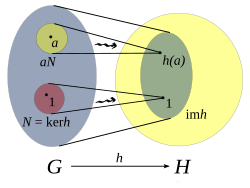
Depiction of a group homomorphism (h) from G (left) to H (right). The oval inside H is the image of h. N is the kernel of h and aN is a coset of N.

In mathematics, given two groups, (G,∗) and (H, ·), a group homomorphism from (G,∗) to (H, ·) is a function h : GH such that for all u and v in G it holds that

where the group operation on the left side of the equation is that of G and on the right side that of H.

From this property, one can deduce that h maps the identity element eG of G to the identity element eH of H,

and it also maps inverses to inverses in the sense that

Hence one can say that h "is compatible with the group structure".

In areas of mathematics where one considers groups endowed with additional structure, a homomorphism sometimes means a map which respects not only the group structure (as above) but also the extra structure. For example, a homomorphism of topological groups is often required to be continuous.

Properties

[edit]

Let be the identity element of the (H, ·) group and , then

Now by multiplying for the inverse of (or applying the cancellation rule) we obtain

Similarly,

Therefore for the uniqueness of the inverse: .

Types

[edit]
Monomorphism
A group homomorphism that is injective (or, one-to-one); i.e., preserves distinctness.
Epimorphism
A group homomorphism that is surjective (or, onto); i.e., reaches every point in the codomain.
Isomorphism
A group homomorphism that is bijective; i.e., injective and surjective. Its inverse is also a group homomorphism. In this case, the groups G and H are called isomorphic; they differ only in the notation of their elements (except of identity element) and are identical for all practical purposes. I.e. we re-label all elements except identity.
Endomorphism
A group homomorphism, h: GG; the domain and codomain are the same. Also called an endomorphism of G.
Automorphism
A group endomorphism that is bijective, and hence an isomorphism. The set of all automorphisms of a group G, with functional composition as operation, itself forms a group, the automorphism group of G. It is denoted by Aut(G). As an example, the automorphism group of (Z, +) contains only two elements, the identity transformation and multiplication with −1; it is isomorphic to (Z/2Z, +).

Image and kernel

[edit]

We define the kernel of h to be the set of elements in G which are mapped to the identity in H

and the image of h to be

The kernel and image of a homomorphism can be interpreted as measuring how close it is to being an isomorphism. The first isomorphism theorem states that the image of a group homomorphism, h(G) is isomorphic to the quotient group G/ker h.

The kernel of h is a normal subgroup of G. Assume and show for arbitrary :

The image of h is a subgroup of H.

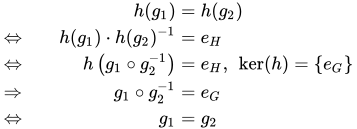
The homomorphism, h, is a group monomorphism; i.e., h is injective (one-to-one) if and only if ker(h) = {eG}. Injection directly gives that there is a unique element in the kernel, and, conversely, a unique element in the kernel gives injection:
Examples

[edit]
  • Consider the cyclic group Z3 = (Z/3Z, +) = ({0, 1, 2}, +) and the group of integers (Z, +). The map h : ZZ/3Z with h(u) = u mod 3 is a group homomorphism. It is surjective and its kernel consists of all integers which are divisible by 3.
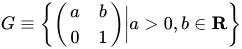
  • The set

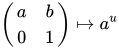
    forms a group under matrix multiplication. For any complex number u the function fu : GC* defined by

    is a group homomorphism.
  • Consider a multiplicative group of positive real numbers (R+, ⋅) for any complex number u. Then the function fu : R+C defined by
    is a group homomorphism.
  • The exponential map yields a group homomorphism from the group of real numbers R with addition to the group of non-zero real numbers R* with multiplication. The kernel is {0} and the image consists of the positive real numbers.
  • The exponential map also yields a group homomorphism from the group of complex numbers C with addition to the group of non-zero complex numbers C* with multiplication. This map is surjective and has the kernel {2πki : kZ}, as can be seen from Euler's formula. Fields like R and C that have homomorphisms from their additive group to their multiplicative group are thus called exponential fields.
  • The function , defined by is a homomorphism.
  • Consider the two groups and , represented respectively by and , where is the positive real numbers. Then, the function defined by the logarithm function is a homomorphism.

Category of groups

[edit]

If h : GH and k : HK are group homomorphisms, then so is kh : GK. This shows that the class of all groups, together with group homomorphisms as morphisms, forms a category (specifically the category of groups).

Homomorphisms of abelian groups

[edit]

If G and H are abelian (i.e., commutative) groups, then the set Hom(G, H) of all group homomorphisms from G to H is itself an abelian group: the sum h + k of two homomorphisms is defined by

(h + k)(u) = h(u) + k(u)    for all u in G.

The commutativity of H is needed to prove that h + k is again a group homomorphism.

The addition of homomorphisms is compatible with the composition of homomorphisms in the following sense: if f is in Hom(K, G), h, k are elements of Hom(G, H), and g is in Hom(H, L), then

(h + k) ∘ f = (hf) + (kf)    and    g ∘ (h + k) = (gh) + (gk).

Since the composition is associative, this shows that the set End(G) of all endomorphisms of an abelian group forms a ring, the endomorphism ring of G. For example, the endomorphism ring of the abelian group consisting of the direct sum of m copies of Z/nZ is isomorphic to the ring of m-by-m matrices with entries in Z/nZ. The above compatibility also shows that the category of all abelian groups with group homomorphisms forms a preadditive category; the existence of direct sums and well-behaved kernels makes this category the prototypical example of an abelian category.

See also

[edit]

References

[edit]
[edit]
Revisions and contributorsEdit on WikipediaRead on Wikipedia
from Grokipedia
In abstract algebra, a group homomorphism is a function ϕ:GH\phi: G \to H between two groups (G,)(G, \cdot) and (H,)(H, *) that preserves the group operation, meaning ϕ(ab)=ϕ(a)ϕ(b)\phi(a \cdot b) = \phi(a) * \phi(b) for all a,bGa, b \in G. This preservation implies that ϕ\phi also maps the identity element of GG to the identity of HH and the inverse of any element in GG to the inverse of its image in HH. Key properties of group homomorphisms include the kernel and image. The kernel of ϕ\phi, denoted ker(ϕ)\ker(\phi), is the set {gGϕ(g)=eH}\{g \in G \mid \phi(g) = e_H\}, where eHe_H is the identity in HH; it forms a of GG. The image of ϕ\phi, denoted im(ϕ)\operatorname{im}(\phi), is the subgroup {ϕ(g)gG}\{\phi(g) \mid g \in G\} of HH. A homomorphism is injective if and only if its kernel is trivial (i.e., ker(ϕ)={eG}\ker(\phi) = \{e_G\}), and surjective if the image equals HH. If a homomorphism is bijective, it is called an isomorphism, establishing that the two groups have identical algebraic structures. The first isomorphism theorem asserts that for any group homomorphism ϕ:GH\phi: G \to H, the quotient group G/ker(ϕ)G / \ker(\phi) is isomorphic to im(ϕ)\operatorname{im}(\phi). This theorem, along with the second and third isomorphism theorems, provides foundational tools for classifying groups and understanding their quotients and subgroups through homomorphic images.

Definition and Fundamentals

Definition

In , a group homomorphism is a function that preserves the algebraic structure of groups by respecting their binary operations. It provides a way to map elements from one group to another while maintaining the relational properties defined by the group operation, allowing for the study of similarities and relationships between different group structures. Formally, let (G,)(G, \cdot) and (H,)(H, *) be groups with binary operations \cdot and * respectively. A homomorphism ϕ:GH\phi: G \to H is a function satisfying ϕ(ab)=ϕ(a)ϕ(b)\phi(a \cdot b) = \phi(a) * \phi(b) for all a,bGa, b \in G. This condition ensures that the image under ϕ\phi of the product in GG equals the product in HH of the images, thereby transferring the multiplicative structure from GG to a of HH. The foundations of , including the use of mappings between permutation groups, were laid by during the 1830s in his analysis of of polynomial roots and solvability by radicals. The formal notion of a group homomorphism was introduced by Camille Jordan in 1870. Unlike arbitrary functions between sets, group homomorphisms are constrained to preserve the group operation and thus do not need to be bijective; they may fail to be injective or surjective while still maintaining structural integrity.

Notation and Conventions

In discussions of group homomorphisms, a mapping from a group GG to a group HH is standardly denoted by ϕ:GH\phi: G \to H, where ϕ\phi preserves the group operation. The collection of all such homomorphisms between GG and HH forms a set, conventionally symbolized as Hom(G,H)\mathrm{Hom}(G, H). Standard conventions for notation distinguish between multiplicative and additive forms based on the group's commutativity. For non-abelian groups, multiplicative notation is typically used, denoting the operation by juxtaposition or \cdot, the identity by ee or 11, and inverses by superscripts like g1g^{-1}. In contrast, abelian groups often employ additive notation, with the operation as ++, identity 00, and inverses as g-g. These choices are notational preferences that facilitate clarity but do not alter the underlying structure. Homomorphisms are defined with GG as the domain and HH as the , applicable to groups of any —finite or infinite—unless additional constraints like finiteness are imposed in specific contexts. A particular case is the trivial homomorphism, which sends every element of the domain to the identity of the ; in multiplicative notation, this is ϕ(g)=eH\phi(g) = e_H for all gGg \in G, while in additive notation it is the zero map ϕ(g)=0H\phi(g) = 0_H.

Core Properties

Preservation Properties

A group homomorphism ϕ:GH\phi: G \to H between groups GG and HH preserves the of GG, mapping it to the of HH. Specifically, if eGe_G denotes the identity in GG and eHe_H the identity in HH, then ϕ(eG)=eH\phi(e_G) = e_H. This follows directly from the homomorphism property: ϕ(eG)=ϕ(eGeG)=ϕ(eG)ϕ(eG)\phi(e_G) = \phi(e_G \cdot e_G) = \phi(e_G) \cdot \phi(e_G), which implies that ϕ(eG)\phi(e_G) is idempotent in HH and thus equals eHe_H, as the identity is the unique element satisfying this condition. Homomorphisms also preserve inverses. For any gGg \in G, ϕ(g1)=ϕ(g)1\phi(g^{-1}) = \phi(g)^{-1}. To see this, apply ϕ\phi to the equation gg1=eGg \cdot g^{-1} = e_G, yielding ϕ(g)ϕ(g1)=ϕ(eG)=eH\phi(g) \cdot \phi(g^{-1}) = \phi(e_G) = e_H, so ϕ(g1)\phi(g^{-1}) is the right inverse of ϕ(g)\phi(g); since inverses in groups are unique, it is the two-sided inverse. Furthermore, homomorphisms preserve powers of elements for all integers. That is, for any gGg \in G and nZn \in \mathbb{Z}, ϕ(gn)=ϕ(g)n\phi(g^n) = \phi(g)^n. For n=0n = 0, this reduces to the preservation of the identity, ϕ(eG)=eH\phi(e_G) = e_H. For positive nn, proceed by induction: the base case n=1n=1 holds by definition, and assuming it for nn, then ϕ(gn+1)=ϕ(gng)=ϕ(gn)ϕ(g)=ϕ(g)nϕ(g)=ϕ(g)n+1\phi(g^{n+1}) = \phi(g^n \cdot g) = \phi(g^n) \cdot \phi(g) = \phi(g)^n \cdot \phi(g) = \phi(g)^{n+1}. For negative n=mn = -m with m>0m > 0, use the inverse preservation: ϕ(gm)=ϕ((gm)1)=ϕ(gm)1=ϕ(g)m\phi(g^{-m}) = \phi((g^m)^{-1}) = \phi(g^m)^{-1} = \phi(g)^{-m}.

Subgroup Relations

A group homomorphism ϕ:GH\phi: G \to H between groups GG and HH relates subgroups of the domain GG to subgroups of the codomain HH through images and preimages. Specifically, for any subgroup HGH' \leq G, the image ϕ(H)\phi(H') forms a subgroup of HH. This follows from the fact that ϕ\phi restricted to HH' is itself a homomorphism, and the image of a group under a homomorphism is always a subgroup. Conversely, for any KHK \leq H, the preimage ϕ1(K)\phi^{-1}(K) is a of GG. This property arises because ϕ\phi preserves the group operation, ensuring that the preimage inherits the necessary closure, identity, and inverse conditions from KK. Homomorphisms also interact seamlessly with inclusions. Let ι:HG\iota: H' \to G denote the of a HGH' \leq G, which is itself a homomorphism. The composition ϕι:HH\phi \circ \iota: H' \to H then defines a homomorphism from HH' to HH, effectively restricting ϕ\phi to the HH' while preserving the group structure. Furthermore, homomorphisms preserve the cyclic nature of subgroups. If HGH' \leq G is cyclic, generated by some element gGg \in G, then ϕ(H)\phi(H') is cyclic, generated by ϕ(g)\phi(g). For instance, the canonical projection ZZ/nZ\mathbb{Z} \to \mathbb{Z}/n\mathbb{Z} maps the cyclic subgroup generated by 1 in Z\mathbb{Z} to the entire cyclic group Z/nZ\mathbb{Z}/n\mathbb{Z}. This preservation stems from the homomorphism property, which maps generators to generators of the image.

Kernel and Image

The Kernel

The kernel of a group homomorphism ϕ:GH\phi: G \to H, where GG and HH are groups with respective identity elements eGe_G and eHe_H, is defined as the set kerϕ={gGϕ(g)=eH}\ker \phi = \{ g \in G \mid \phi(g) = e_H \}. This set consists of all elements in the domain GG that map to the identity in the codomain HH. The kernel kerϕ\ker \phi forms a of GG. It contains the identity eGe_G because ϕ(eG)=eH\phi(e_G) = e_H. For closure under the group operation and inverses, if g,kkerϕg, k \in \ker \phi, then ϕ(gk)=ϕ(g)ϕ(k)=eHeH=eH\phi(g k) = \phi(g) \phi(k) = e_H e_H = e_H, so gkkerϕg k \in \ker \phi; similarly, ϕ(g1)=ϕ(g)1=eH1=eH\phi(g^{-1}) = \phi(g)^{-1} = e_H^{-1} = e_H, so g1kerϕg^{-1} \in \ker \phi. Moreover, kerϕ\ker \phi is a of GG. For any gGg \in G and hkerϕh \in \ker \phi, consider ϕ(ghg1)=ϕ(g)ϕ(h)ϕ(g)1=ϕ(g)eHϕ(g)1=eH\phi(g h g^{-1}) = \phi(g) \phi(h) \phi(g)^{-1} = \phi(g) e_H \phi(g)^{-1} = e_H, which implies ghg1kerϕg h g^{-1} \in \ker \phi. Thus, kerϕ\ker \phi is invariant under conjugation by elements of GG. The homomorphism ϕ\phi is injective kerϕ={eG}\ker \phi = \{e_G\}. If kerϕ={eG}\ker \phi = \{e_G\}, then for g,kGg, k \in G with ϕ(g)=ϕ(k)\phi(g) = \phi(k), it follows that ϕ(g1k)=eH\phi(g^{-1} k) = e_H, so g1k=eGg^{-1} k = e_G and g=kg = k. Conversely, if ϕ\phi is injective, then ϕ(g)=eH\phi(g) = e_H implies g=eGg = e_G, so the kernel is trivial.

The Image

The image of a group homomorphism ϕ:GH\phi: G \to H, denoted imϕ\operatorname{im} \phi or ϕ(G)\phi(G), is the subset {ϕ(g)gG}\{ \phi(g) \mid g \in G \} of the codomain HH, consisting of all elements attained as outputs of ϕ\phi. To verify that imϕ\operatorname{im} \phi is a of HH, note first that it contains the identity: ϕ(eG)=eH\phi(e_G) = e_H, where eGe_G and eHe_H are the identities of GG and HH, respectively, so eHimϕe_H \in \operatorname{im} \phi. For closure under the operation of HH, take arbitrary ϕ(g),ϕ(g)imϕ\phi(g), \phi(g') \in \operatorname{im} \phi with g,gGg, g' \in G; then ϕ(g)Hϕ(g)=ϕ(gg)imϕ\phi(g) \cdot_H \phi(g') = \phi(g g') \in \operatorname{im} \phi, since ggGg g' \in G. For inverses, the inverse of ϕ(g)imϕ\phi(g) \in \operatorname{im} \phi is ϕ(g)1=ϕ(g1)\phi(g)^{-1} = \phi(g^{-1}), and g1Gg^{-1} \in G implies ϕ(g1)imϕ\phi(g^{-1}) \in \operatorname{im} \phi. Thus, imϕ\operatorname{im} \phi satisfies the subgroup axioms in HH. The homomorphism ϕ\phi is surjective imϕ=H\operatorname{im} \phi = H. Any group ϕ:GH\phi: G \to H factors through its image via the corestriction: ϕ=ιπ\phi = \iota \circ \pi, where π:Gimϕ\pi: G \to \operatorname{im} \phi is the surjective homomorphism defined by π(g)=ϕ(g)\pi(g) = \phi(g) for all gGg \in G, and ι:imϕH\iota: \operatorname{im} \phi \to H is the .

Isomorphism Theorems

First Isomorphism Theorem

The first isomorphism theorem, also known as the fundamental homomorphism theorem for groups, asserts that for any group homomorphism ϕ:GH\phi: G \to H, the quotient group G/kerϕG / \ker \phi is isomorphic to the image imϕ\operatorname{im} \phi of ϕ\phi. Specifically, there exists a group isomorphism ψ:G/kerϕimϕ\psi: G / \ker \phi \to \operatorname{im} \phi induced by ϕ\phi, given by ψ(gkerϕ)=ϕ(g)\psi(g \ker \phi) = \phi(g) for all gGg \in G. To prove this, first note that kerϕ\ker \phi is a of GG, as established in the discussion of kernels. Define ψ:G/kerϕimϕ\psi: G / \ker \phi \to \operatorname{im} \phi by ψ(gkerϕ)=ϕ(g)\psi(g \ker \phi) = \phi(g). This map is well-defined because if gkerϕ=gkerϕg \ker \phi = g' \ker \phi, then g1gkerϕg^{-1} g' \in \ker \phi, so ϕ(g1g)=eH\phi(g^{-1} g') = e_H, implying ϕ(g)=ϕ(g)\phi(g') = \phi(g) via the homomorphism property. Next, ψ\psi preserves the group operation: for cosets gkerϕg \ker \phi and gkerϕg' \ker \phi, ψ((gkerϕ)(gkerϕ))=ψ(ggkerϕ)=ϕ(gg)=ϕ(g)ϕ(g)=ψ(gkerϕ)ψ(gkerϕ),\psi((g \ker \phi)(g' \ker \phi)) = \psi(gg' \ker \phi) = \phi(gg') = \phi(g) \phi(g') = \psi(g \ker \phi) \psi(g' \ker \phi), confirming ψ\psi is a . For bijectivity, ψ\psi is surjective since every element in imϕ\operatorname{im} \phi is ϕ(g)\phi(g) for some gGg \in G, so ψ(gkerϕ)=ϕ(g)\psi(g \ker \phi) = \phi(g). It is injective because if ψ(gkerϕ)=eH\psi(g \ker \phi) = e_H, then ϕ(g)=eH\phi(g) = e_H, so gkerϕg \in \ker \phi, hence gkerϕ=kerϕg \ker \phi = \ker \phi, the identity in the quotient. Thus, ψ\psi is an . The theorem also provides a factorization of ϕ\phi. Let π:GG/kerϕ\pi: G \to G / \ker \phi be the canonical projection homomorphism, and let ι:imϕH\iota: \operatorname{im} \phi \to H be the inclusion map. Then ϕ=ιψπ\phi = \iota \circ \psi \circ \pi. This decomposition highlights how ϕ\phi factors through the quotient by its kernel. As an application, the first isomorphism theorem classifies group homomorphisms up to isomorphism: two homomorphisms ϕ1:GH1\phi_1: G \to H_1 and ϕ2:GH2\phi_2: G \to H_2 have isomorphic images if and only if G/kerϕ1G/kerϕ2G / \ker \phi_1 \cong G / \ker \phi_2, allowing the structure of images to be understood via familiar quotients.

Second and Third Isomorphism Theorems

The second isomorphism theorem states that if GG is a group, HGH \leq G is a , and NGN \trianglelefteq G is a , then HN={hnhH,nN}HN = \{hn \mid h \in H, n \in N\} is a of GG, HNH \cap N is normal in HH, and there is a H/(HN)HN/NH / (H \cap N) \cong HN / N. This theorem refines the correspondence between by relating quotients involving a to products of . To prove this, first verify that HNHN is a subgroup: it is closed under multiplication since NN is normal: (h1n1)(h2n2)=h1(n1h2)n2=h1h2(h21n1h2)n2(h_1 n_1)(h_2 n_2) = h_1 (n_1 h_2) n_2 = h_1 h_2 (h_2^{-1} n_1 h_2) n_2, where h21n1h2Nh_2^{-1} n_1 h_2 \in N, so the product is in HNHN; and under inverses ((hn)1=n1h1=hn(hn)^{-1} = n^{-1} h^{-1} = h' n' for some hH,nNh' \in H, n' \in N by normality). The map ϕ:HHN/N\phi: H \to HN/N defined by ϕ(h)=hN\phi(h) = hN is a surjective homomorphism (every coset hnN=hNh'n'N = h'N for nNn' \in N). Its kernel is HNH \cap N, so by the first isomorphism theorem, H/(HN)HN/NH / (H \cap N) \cong HN / N. The third isomorphism theorem states that if NKGN \trianglelefteq K \trianglelefteq G are normal subgroups of GG, then K/NG/NK/N \trianglelefteq G/N and (G/N)/(K/N)G/K(G/N) / (K/N) \cong G/K. This result describes how successive s by nested normal subgroups simplify to a single . For the proof, consider the natural projection π:GG/K\pi: G \to G/K with kernel KK. This induces a π:G/NG/K\overline{\pi}: G/N \to G/K by π(gN)=π(g)=gK\overline{\pi}(gN) = \pi(g) = gK, which is well-defined since if gN=gNgN = g'N, then g1gNKg^{-1}g' \in N \subseteq K, so gK=gKgK = g'K. The map is surjective, and its kernel is {gNgK}=K/N\{gN \mid g \in K\} = K/N. Thus, by the first isomorphism theorem, (G/N)/(K/N)G/K(G/N) / (K/N) \cong G/K. These theorems, along with the first, were formulated in their general form by in 1927 as part of her abstract development of ideal theory, generalizing earlier results from theory in the early .

Types of Homomorphisms

Injective and Surjective Homomorphisms

A group homomorphism ϕ:GH\phi: G \to H is injective its kernel is the trivial kerϕ={eG}\ker \phi = \{e_G\}, where eGe_G denotes the of GG. In this case, ϕ\phi embeds GG as a of HH, meaning GG is to its image ϕ(G)\phi(G) under ϕ\phi. Such injective homomorphisms correspond to quotients of GG by the trivial kernel, yielding an isomorphism G/{eG}GG / \{e_G\} \cong G. In the category of groups, monomorphisms are precisely the injective homomorphisms, as the left-cancellative property aligns with one-to-one mappings between groups. This contrasts with more general categories, where monomorphisms may not coincide with injections, but in , the structure ensures this equivalence. A group homomorphism ϕ:GH\phi: G \to H is surjective if and only if its image equals HH, that is, imϕ=H\operatorname{im} \phi = H. In this scenario, HH is isomorphic to the G/kerϕG / \ker \phi, establishing HH as a quotient of GG by the normal subgroup kerϕ\ker \phi. Surjective homomorphisms thus characterize full-image mappings, where every element of HH arises from some element in GG via ϕ\phi. In the category of groups, epimorphisms are exactly the surjective homomorphisms, reflecting the right-cancellative nature of onto mappings in this setting. This identification holds due to the concrete nature of group homomorphisms, differing from categories where epimorphisms need not be surjections.

Isomorphisms, Endomorphisms, and Automorphisms

An isomorphism between two groups GG and HH is a bijective homomorphism ϕ:GH\phi: G \to H such that its inverse ϕ1:HG\phi^{-1}: H \to G is also a homomorphism. In the context of groups, bijectivity of a homomorphism automatically ensures that the inverse preserves the group operation, making isomorphisms structure-preserving bijections. Two groups GG and HH are isomorphic, denoted GHG \cong H, if there exists an isomorphism ϕ:GH\phi: G \to H between them; this equivalence relation implies that isomorphic groups share all intrinsic properties, such as order, subgroup structure, and solvability. An endomorphism of a group GG is a homomorphism ϕ:GG\phi: G \to G from the group to itself. The set End(G)\operatorname{End}(G) of all endomorphisms of GG, equipped with composition as the operation, forms a monoid, where the identity map serves as the identity element. An automorphism of a group GG is an isomorphism ϕ:GG\phi: G \to G from the group to itself. The set Aut(G)\operatorname{Aut}(G) of all automorphisms of GG, under composition, forms a group, reflecting the invertible nature of these self-maps. Automorphisms capture the symmetries of GG, as each one relabels elements while preserving the group structure. A special class consists of inner automorphisms, which are those induced by conjugation: for gGg \in G, the map ϕg:xgxg1\phi_g: x \mapsto gxg^{-1} is an automorphism, and the subgroup Inn(G)\operatorname{Inn}(G) generated by these forms a normal subgroup of Aut(G)\operatorname{Aut}(G). The order of Aut(G)\operatorname{Aut}(G), denoted Aut(G)|\operatorname{Aut}(G)| for finite GG, quantifies the number of distinct symmetries of the group. For a finite group GG, every injective of GG is necessarily an , since injectivity implies surjectivity by finiteness.

Examples

Introductory Examples

One of the simplest examples of a is the trivial homomorphism from any group GG to another group HH, which maps every element of GG to the eHe_H of HH. This constant map preserves the group operation because eHeH=eHe_H \cdot e_H = e_H for all elements. The kernel of the trivial homomorphism is the entire domain group GG, while its is the trivial {eH}\{e_H\}. A fundamental injective homomorphism is the inclusion map ι:HG\iota: H \to G, where HH is a of the group GG, defined by ι(h)=h\iota(h) = h for each hHh \in H. This map respects the group operation since the multiplication in HH coincides with that in GG. The kernel of the inclusion map is the trivial subgroup {e}\{e\}, confirming its injectivity, and its is precisely HH. In the context of direct products, the projection map πG:G×KG\pi_G: G \times K \to G defined by πG(g,k)=g\pi_G(g, k) = g for gGg \in G and k[K](/page/K)k \in [K](/page/K) provides a surjective homomorphism onto GG. This follows because πG((g1,k1)(g2,k2))=πG(g1g2,k1k2)=g1g2=πG(g1,k1)πG(g2,k2)\pi_G((g_1, k_1)(g_2, k_2)) = \pi_G(g_1 g_2, k_1 k_2) = g_1 g_2 = \pi_G(g_1, k_1) \pi_G(g_2, k_2), and every element of GG is hit by pairs of the form (g,eK)(g, e_K). The kernel is {(eG,k)k[K](/page/K)}\{ (e_G, k) \mid k \in [K](/page/K) \}, which is isomorphic to [K](/page/K)[K](/page/K). An illustrative surjective homomorphism involving permutation groups is the sign homomorphism sgn:Sn{±1}\operatorname{sgn}: S_n \to \{ \pm 1 \}, where SnS_n is the on nn elements under composition and {±1}\{ \pm 1 \} is the of order two. For a permutation σSn\sigma \in S_n, sgn(σ)=(1)m\operatorname{sgn}(\sigma) = (-1)^m, with mm the number of inversions in σ\sigma (pairs i<ji < j such that σ(i)>σ(j)\sigma(i) > \sigma(j)). This is a homomorphism because the parity of inversions in a product equals the sum of the parities in each factor, so sgn(στ)=sgn(σ)sgn(τ)\operatorname{sgn}(\sigma \tau) = \operatorname{sgn}(\sigma) \operatorname{sgn}(\tau). The kernel is the AnA_n, the of even permutations.

Advanced Examples

One advanced example of a group homomorphism arises in the context of Lie groups, where the exponential map exp:RS1\exp: \mathbb{R} \to S^1, defined by te2πitt \mapsto e^{2\pi i t}, provides a surjective homomorphism from the additive group of real numbers to the circle group, with kernel Z\mathbb{Z}. This illustrates the first isomorphism theorem, as the R/Z\mathbb{R}/\mathbb{Z} is isomorphic to S1S^1. Another significant homomorphism is the determinant map det:GLn(R)R\det: \mathrm{GL}_n(\mathbb{R}) \to \mathbb{R}^*, where R=R{0}\mathbb{R}^* = \mathbb{R} \setminus \{0\} denotes the multiplicative group of nonzero reals, sending a matrix AA to its determinant det(A)\det(A); this map is surjective with kernel the special linear group SLn(R)\mathrm{SL}_n(\mathbb{R}). In non-abelian settings, consider the Heisenberg group HH, consisting of upper triangular 3×33 \times 3 real matrices with ones on the diagonal under matrix multiplication; the projection homomorphism from HH onto the quotient H/ZH/Z by its center ZZ (the subgroup of matrices with nonzero entries only in the (1,3)-position) yields an isomorphism to the additive group R2\mathbb{R}^2, highlighting quotients in nilpotent groups. Homomorphisms from s demonstrate their universal role: for a FSF_S on a set SS and any group GG, any assignment of images to the generators in SS extends uniquely to a FSGF_S \to G, reflecting the 's .

Categorical Perspective

The Category of Groups

In , the category of groups, commonly denoted Grp\mathbf{Grp}, consists of all groups as objects and as between them. This structure captures the algebraic relationships between groups in a way that respects their binary operations and identities. Specifically, a f:GHf: G \to H in Grp\mathbf{Grp} is a function that satisfies f(gh)=f(g)f(h)f(gh) = f(g)f(h) for all g,hGg, h \in G, ensuring that the group structure is preserved. Composition of morphisms in Grp\mathbf{Grp} is defined by the standard composition of functions: for homomorphisms f:GHf: G \to H and k:HKk: H \to K, the composite kf:GKk \circ f: G \to K is given by (kf)(g)=k(f(g))(k \circ f)(g) = k(f(g)) for all gGg \in G. This operation is associative because function composition is associative, and it yields another group homomorphism since the preservation of the group operation holds under successive applications. The identity morphism for any object GG is the identity homomorphism idG:GG\mathrm{id}_G: G \to G defined by idG(g)=g\mathrm{id}_G(g) = g for all gGg \in G, which trivially preserves the group structure and serves as the unit for composition. These axioms—associativity of composition and the existence of identity morphisms—follow directly from those of the category of sets with functions, but restricted to the structure-preserving maps that define Grp\mathbf{Grp}. Within Grp\mathbf{Grp}, the are exactly the invertible morphisms, which coincide with the bijective group known as group . A f:GHf: G \to H is an if there exists an inverse f1:HGf^{-1}: H \to G such that ff1=idHf \circ f^{-1} = \mathrm{id}_H and f1f=idGf^{-1} \circ f = \mathrm{id}_G. This categorical notion aligns precisely with the algebraic definition, emphasizing that Grp\mathbf{Grp} faithfully represents the equivalences between groups.

Hom-Sets and Functors

In the category \Grp\Grp of groups, for any two groups GG and HH, the hom-set \Hom\Grp(G,H)\Hom_{\Grp}(G, H) consists of all group homomorphisms from GG to HH. These hom-sets form the morphisms of \Grp\Grp, and when G=HG = H, the endomorphism monoid \End\Grp(G)=\Hom\Grp(G,G)\End_{\Grp}(G) = \Hom_{\Grp}(G, G) is equipped with a monoid structure under composition of homomorphisms, where the identity map serves as the unit element. A key functor involving these hom-sets is the forgetful functor U: \Grp \to \Set, which maps each group to its underlying set and each homomorphism to its underlying function between sets. This functor has a left adjoint, the free group functor F:{}\GrpF: \Set \to \Grp, which sends a set SS to the free group F(S)F(S) generated by SS; the unit of the adjunction corresponds to the inclusion of generators. The category \Grp\Grp is both complete and cocomplete, meaning it admits all small limits and colimits. The categorical product of a family of groups is their , while the coproduct is their free product. Limits in \Grp\Grp, such as kernels of homomorphisms, arise as equalizer diagrams: the kernel of a homomorphism ϕ:GH\phi: G \to H is the equalizer of ϕ\phi and the zero map in the appropriate diagram.

Special Cases

Homomorphisms of Abelian Groups

Homomorphisms between abelian groups are structure-preserving maps that respect the group operation. Given abelian groups AA and BB, a homomorphism ϕ:AB\phi: A \to B satisfies ϕ(a+b)=ϕ(a)+ϕ(b)\phi(a + b) = \phi(a) + \phi(b) for all a,bAa, b \in A, where additive notation emphasizes the commutative nature of the operation. Such homomorphisms are precisely the Z\mathbb{Z}-linear maps, viewing abelian groups as modules over the integers Z\mathbb{Z}, since the group operation aligns with scalar multiplication by integers via repeated addition or inversion. This linearity follows from the universal property of Z\mathbb{Z} as the initial ring, ensuring that any group homomorphism from Z\mathbb{Z} to BB extends uniquely to abelian groups generated by integers. Since the operation in an is commutative, any ϕ:AB\phi: A \to B automatically preserves commutativity in the image: for a,bAa, b \in A, ϕ(a)+ϕ(b)=ϕ(a+b)=ϕ(b+a)=ϕ(b)+ϕ(a)\phi(a) + \phi(b) = \phi(a + b) = \phi(b + a) = \phi(b) + \phi(a), as AA is abelian. This property holds without additional conditions, distinguishing abelian cases from non-abelian ones where images may not preserve relations like normality. The set Hom(A,B)\operatorname{Hom}(A, B) of all homomorphisms from AA to BB itself forms an under pointwise addition: (ϕ+ψ)(a)=ϕ(a)+ψ(a)(\phi + \psi)(a) = \phi(a) + \psi(a) for ϕ,ψHom(A,B)\phi, \psi \in \operatorname{Hom}(A, B) and aAa \in A, with the zero homomorphism sending every element to the identity in BB. This structure makes Hom(,B)\operatorname{Hom}(-, B) a contravariant functor and Hom(A,)\operatorname{Hom}(A, -) a covariant functor from the category of s to itself, preserving exactness in certain sequences. In , derived functors provide deeper insights into homomorphisms of abelian groups. The functors Exti(A,B)\operatorname{Ext}^i(A, B) and Tori(A,B)\operatorname{Tor}_i(A, B) measure deviations from exactness in sequences involving Hom\operatorname{Hom} and tensor products, respectively. In particular, Ext1(A,B)\operatorname{Ext}^1(A, B) classifies extensions of BB by AA, i.e., short exact sequences 0BEA00 \to B \to E \to A \to 0 up to equivalence, where the trivial extension corresponds to the in Ext1(A,B)\operatorname{Ext}^1(A, B). These functors arise from projective or injective resolutions and are central to understanding the homological properties unique to abelian groups.

Homomorphisms Involving Free Groups

The FSF_S on a set SS satisfies the following : for any group GG and any function f:SGf: S \to G, there exists a unique group homomorphism ϕ:FSG\phi: F_S \to G extending ff, meaning ϕ(s)=f(s)\phi(s) = f(s) for all sSs \in S. This property underscores the "freest" nature of FSF_S, where elements are formal reduced words in SS1S \cup S^{-1} under concatenation, with no relations imposed beyond the group axioms. Consequently, homomorphisms from FSF_S to any group GG are in one-to-one correspondence with functions from SS to GG, providing a foundational tool for constructing and studying group extensions. To establish this universal property, consider the construction of FSF_S as the set of reduced words. The existence of ϕ\phi follows by defining it on generators via ff and extending multiplicatively to words, preserving the since GG satisfies the group relations automatically. is proved by induction on the length of reduced words: for the base case of length one (generators), it holds by ; for longer words w=uvw = u v where uu and vv are reduced and do not cancel at the junction, ϕ(w)=ϕ(u)ϕ(v)\phi(w) = \phi(u) \phi(v) by the property, and the inductive hypothesis applies to uu and vv. This induction ensures that no additional relations are forced, confirming the respects the free structure without kernel beyond the trivial one for the identity map. Homomorphisms into a free group FTF_T on set TT are specified by assigning to each generator of the domain group arbitrary elements of FTF_T (i.e., reduced words in TT1T \cup T^{-1}), then extending via the domain's relations. For a finitely generated group HH with generating set {hi}\{ h_i \}, such a homomorphism ψ:HFT\psi: H \to F_T is thus determined by the tuple (ψ(h1),,ψ(hk))(\psi(h_1), \dots, \psi(h_k)), subject to the relations of HH holding in FTF_T. The homomorphism is injective precisely when the images ψ(hi)\psi(h_i) freely generate a subgroup of FTF_T isomorphic to HH, meaning they form a free basis for that subgroup without imposing extra relations. This framework has key applications in classifying groups through presentations: every group GG admits a presentation SR\langle S \mid R \rangle, where GFS/NG \cong F_S / N and NN is the normal closure of the relations RR, reducing isomorphism problems to comparing such quotients of free groups. Algorithmically, Nielsen transformations—elementary operations on generating sets, such as replacing a generator by its inverse, product with another, or cyclic permutation—enable normalization of bases in free groups and their quotients, facilitating computational verification of presentations since developments in the 1970s.

References

Add your contribution
Related Hubs
User Avatar
No comments yet.