Hubbry Logo
search
logo

Group ring

logo
Community Hub0 Subscribers
Read side by side
from Wikipedia

In algebra, a group ring is a free module and at the same time a ring, constructed in a natural way from any given ring and any given group. As a free module, its ring of scalars is the given ring, and its basis is the set of elements of the given group. As a ring, its addition law is that of the free module and its multiplication extends "by linearity" the given group law on the basis. Less formally, a group ring is a generalization of a given group, by attaching to each element of the group a "weighting factor" from a given ring.

If the ring is commutative then the group ring is also referred to as a group algebra, for it is indeed an algebra over the given ring. A group algebra over a field has a further structure of a Hopf algebra; in this case, it is thus called a group Hopf algebra.

The apparatus of group rings is especially useful in the theory of group representations.

Definition

[edit]

Let be a group, written multiplicatively, and let be a ring. The group ring of over , which we will denote by , or simply , is the set of mappings of finite support ( is nonzero for only finitely many elements ), where the module scalar product of a scalar in and a mapping is defined as the mapping , and the module group sum of two mappings and is defined as the mapping . To turn the additive group into a ring, we define the product of and to be the mapping

The summation is legitimate because and are of finite support, and the ring axioms are readily verified.

Some variations in the notation and terminology are in use. In particular, the mappings such as are sometimes[1] written as what are called "formal linear combinations of elements of with coefficients in ":

or simply

[2]

Note that if the ring is in fact a field, then the module structure of the group ring is in fact a vector space over .

Examples

[edit]

1. Let G = C3, the cyclic group of order 3, with generator and identity element 1G. An element r of C[G] can be written as


where z0, z1 and z2 are in C, the complex numbers. This is the same thing as a polynomial ring in variable such that i.e. C[G] is isomorphic to the ring C[]/.

Writing a different element s as , their sum is

and their product is

Notice that the identity element 1G of G induces a canonical embedding of the coefficient ring (in this case C) into C[G]; however strictly speaking the multiplicative identity element of C[G] is 1⋅1G where the first 1 comes from C and the second from G. The additive identity element is zero.

When G is a non-commutative group, one must be careful to preserve the order of the group elements (and not accidentally commute them) when multiplying the terms.

2. The ring of Laurent polynomials over a ring R is the group ring of the infinite cyclic group Z over R.

3. Let Q be the quaternion group with elements . Consider the group ring RQ, where R is the set of real numbers. An arbitrary element of this group ring is of the form


where is a real number.

Multiplication, as in any other group ring, is defined based on the group operation. For example,
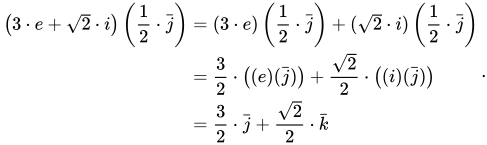
Note that RQ is not the same as the skew field of quaternions over R. This is because the skew field of quaternions satisfies additional relations in the ring, such as , whereas in the group ring RQ, is not equal to . To be more specific, the group ring RQ has dimension 8 as a real vector space, while the skew field of quaternions has dimension 4 as a real vector space.

4. Another example of a non-abelian group ring is where is the symmetric group on 3 letters. This is not an integral domain since we have where the element is the transposition that swaps 1 and 2. Therefore the group ring need not be an integral domain even when the underlying ring is an integral domain.

Some basic properties

[edit]

Using 1 to denote the multiplicative identity of the ring R, and denoting the group unit by 1G, the ring R[G] contains a subring isomorphic to R, and its group of invertible elements contains a subgroup isomorphic to G. For considering the indicator function of {1G}, which is the vector f defined by

the set of all scalar multiples of f is a subring of R[G] isomorphic to R. And if we map each element s of G to the indicator function of {s}, which is the vector f defined by

the resulting mapping is an injective group homomorphism (with respect to multiplication, not addition, in R[G]).

If R and G are both commutative (i.e., R is commutative and G is an abelian group), R[G] is commutative.

If H is a subgroup of G, then R[H] is a subring of R[G]. Similarly, if S is a subring of R, S[G] is a subring of R[G].

If G is a finite group of order greater than 1, then R[G] always has zero divisors. For example, consider an element g of G of order |g| = m > 1. Then 1 − g is a zero divisor:

For example, consider the group ring Z[S3] and the element of order 3 g = (123). In this case, A related result: If the group ring is prime, then G has no nonidentity finite normal subgroup (in particular, G must be infinite).

Proof: Considering the contrapositive, suppose is a nonidentity finite normal subgroup of . Take . Since for any , we know , therefore . Taking , we have . By normality of , commutes with a basis of , and therefore

.

And we see that are not zero, which shows is not prime. This shows the original statement.

Group algebra over a finite group

[edit]

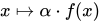
Group algebras occur naturally in the theory of group representations of finite groups. The group algebra K[G] over a field K is essentially the group ring, with the field K taking the place of the ring. As a set and vector space, it is the free vector space on G over the field K. That is, for x in K[G],

The algebra structure on the vector space is defined using the multiplication in the group:

where on the left, g and h indicate elements of the group algebra, while the multiplication on the right is the group operation (denoted by juxtaposition).

Because the above multiplication can be confusing, one can also write the basis vectors of K[G] as eg (instead of g), in which case the multiplication is written as:

Interpretation as functions

[edit]

Thinking of the free vector space as K-valued functions on G, the algebra multiplication is convolution of functions.

While the group algebra of a finite group can be identified with the space of functions on the group, for an infinite group these are different. The group algebra, consisting of finite sums, corresponds to functions on the group that vanish for cofinitely many points; topologically (using the discrete topology), these correspond to functions with compact support.

However, the group algebra K[G] and the space of functions KG := Hom(G, K) are dual: given an element of the group algebra

and a function on the group f : GK these pair to give an element of K via
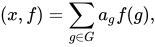
which is a well-defined sum because it is finite.

Representations of a group algebra

[edit]

Taking K[G] to be an abstract algebra, one may ask for representations of the algebra acting on a K-vector space V of dimension d. Such a representation

is an algebra homomorphism from the group algebra to the algebra of endomorphisms of V, which is isomorphic to the ring of d × d matrices: . Equivalently, this is a left K[G]-module over the abelian group V.

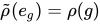
Correspondingly, a group representation

is a group homomorphism from G to the group of linear automorphisms of V, which is isomorphic to the general linear group of invertible matrices: . Any such representation induces an algebra representation

simply by letting and extending linearly. Thus, representations of the group correspond exactly to representations of the algebra, and the two theories are essentially equivalent.
Regular representation

[edit]

The group algebra is an algebra over itself; under the correspondence of representations over R and R[G] modules, it is the regular representation of the group.

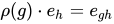
Written as a representation, it is the representation gρg with the action given by , or

Semisimple decomposition

[edit]

The dimension of the vector space K[G] is just equal to the number of elements in the group. The field K is commonly taken to be the complex numbers C or the reals R, so that one discusses the group algebras C[G] or R[G].

The group algebra C[G] of a finite group over the complex numbers is a semisimple ring. This result, Maschke's theorem, allows us to understand C[G] as a finite product of matrix rings with entries in C. Indeed, if we list the complex irreducible representations of G as Vk for k = 1, . . . , m, these correspond to group homomorphisms and hence to algebra homomorphisms . Assembling these mappings gives an algebra isomorphism

where dk is the dimension of Vk. The subalgebra of C[G] corresponding to End(Vk) is the two-sided ideal generated by the idempotent
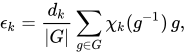
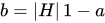
where is the character of Vk. These form a complete system of orthogonal idempotents, so that , for j ≠ k, and . The isomorphism is closely related to Fourier transform on finite groups.

For a more general field K, whenever the characteristic of K does not divide the order of the group G, then K[G] is semisimple. When G is a finite abelian group, the group ring K[G] is commutative, and its structure is easy to express in terms of roots of unity.

When K is a field of characteristic p which divides the order of G, the group ring is not semisimple: it has a non-zero Jacobson radical, and this gives the corresponding subject of modular representation theory its own, deeper character.

Center of a group algebra

[edit]

The center of the group algebra is the set of elements that commute with all elements of the group algebra:

The center is equal to the set of class functions, that is the set of elements that are constant on each conjugacy class

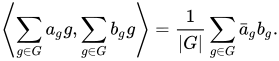
If K = C, the set of irreducible characters of G forms an orthonormal basis of Z(K[G]) with respect to the inner product
Group rings over an infinite group

[edit]

Much less is known in the case where G is countably infinite, or uncountable, and this is an area of active research.[3] The case where R is the field of complex numbers is probably the one best studied. In this case, Irving Kaplansky proved that if a and b are elements of C[G] with ab = 1, then ba = 1. Whether this is true if R is a field of positive characteristic remains unknown.

A long-standing conjecture of Kaplansky (~1940) says that if G is a torsion-free group, and K is a field, then the group ring K[G] has no non-trivial zero divisors. This conjecture is equivalent to K[G] having no non-trivial nilpotents under the same hypotheses for K and G.

In fact, the condition that K is a field can be relaxed to any ring that can be embedded into an integral domain.

The conjecture remains open in full generality, however some special cases of torsion-free groups have been shown to satisfy the zero divisor conjecture. These include:

The case where G is a topological group is discussed in greater detail in the article Group algebra of a locally compact group.

Category theory

[edit]

Adjoint

[edit]

Categorically, the group ring construction is left adjoint to "group of units"; the following functors are an adjoint pair: where takes a group to its group ring over R, and takes an R-algebra to its group of units.

When R = Z, this gives an adjunction between the category of groups and the category of rings, and the unit of the adjunction takes a group G to a group that contains trivial units: G × {±1} = {±g}. In general, group rings contain nontrivial units. If G contains elements a and b such that and b does not normalize then the square of

is zero, hence . The element 1 + x is a unit of infinite order.

Universal property

[edit]

The above adjunction expresses a universal property of group rings.[2][4] Let R be a (commutative) ring, let G be a group, and let S be an R-algebra. For any group homomorphism , there exists a unique R-algebra homomorphism such that where i is the inclusion

In other words, is the unique homomorphism making the following diagram commute:

Any other ring satisfying this property is canonically isomorphic to the group ring.

Hopf algebra

[edit]

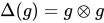
The group algebra K[G] has a natural structure of a Hopf algebra. The comultiplication is defined by , extended linearly, and the antipode is , again extended linearly.
Generalizations

[edit]

The group algebra generalizes to the monoid ring and thence to the category algebra, of which another example is the incidence algebra.

Filtration

[edit]

If a group has a length function – for example, if there is a choice of generators and one takes the word metric, as in Coxeter groups – then the group ring becomes a filtered algebra.

See also

[edit]

Notes

[edit]

References

[edit]
Revisions and contributorsEdit on WikipediaRead on Wikipedia
from Grokipedia
In algebra, a group ring (or group algebra when the coefficient ring is a field) is a mathematical structure constructed from a ring $ R $ and a group $ G $, consisting of all formal finite sums $ \sum_{i=1}^n r_i g_i $ where $ r_i \in R $ and $ g_i \in G $ are distinct group elements, with addition defined componentwise and multiplication defined by extending the group operation distributively: $ (r g)(s h) = (r s)(g h) $.[1] This makes the group ring $ R[G] $ both a free $ R $-module with basis $ G $ and an associative ring with identity $ 1_R \cdot 1_G $ if $ R $ has one.[2] The concept originates from early 19th-century work by William Rowan Hamilton on quaternions, an early example of a non-commutative algebra, and was first explicitly defined by Arthur Cayley in 1854 for group algebras over the reals or complexes, with further formalization in the late 19th and early 20th centuries by mathematicians including Theodor Molien, Ferdinand Georg Frobenius, Heinrich Maschke, and Emmy Noether.[3][1] Group rings generalize both group algebras over fields (where $ R = k $) and the integer group ring $ \mathbb{Z}[G] $, which encodes the group's structure into a ring-theoretic framework.[4] For finite groups $ G $, $ k[G] $ is a finite-dimensional $ k $-algebra of dimension $ |G| $, with elements as linear combinations $ \sum_{g \in G} a_g g $ and $ a_g \in k $.[2] Key properties include the augmentation map $ \phi: R[G] \to R $ sending $ \sum r_i g_i \mapsto \sum r_i $, whose kernel is the augmentation ideal $ \Delta(G) $, which constitutes a nontrivial proper two-sided ideal whenever |G| > 1 (generated by nonzero elements g - 1 for g ≠ e in G, due to the free R-module structure on basis G). Consequently, the group ring R[G] is not a simple ring in such cases and, in particular, cannot be a division ring (as division rings are simple). This holds generally for nontrivial groups, with the only exception being the trivial group (|G| = 1), where R[G] ≅ R.[5] and Maschke's theorem, which states that if $ |G| $ is invertible in $ R $ and $ R $ is semisimple, then $ R[G] $ is semisimple.[1] Group rings play a central role in representation theory, where modules over $ k[G] $ correspond exactly to representations of $ G $ on vector spaces over $ k $, via the regular representation that embeds $ G $ into automorphisms of $ k[G] $ itself.[6] More generally, modules over $ R[G] $ correspond to representations of $ G $ on R-modules; in particular, when $ R = \mathbb{Z} $, these are G-modules on abelian groups, equivalent to modules over the integer group ring $ \mathbb{Z}[G] $.[7] They also arise in applications to topology, number theory, and coding theory, such as studying units in $ \mathbb{Z}[G] $ or decomposing $ R[G] $ into matrix rings over division rings by Artin-Wedderburn theory.[1] If $ G $ is abelian, $ R[G] $ is commutative; otherwise, it is typically noncommutative, reflecting the group's structure.[4]

Fundamentals

Definition

In abstract algebra, given a commutative ring RR with multiplicative identity and a group GG (multiplicative, finite or infinite), the group ring R[G]R[G] is defined as the set of all formal finite sums gGrgg\sum_{g \in G} r_g g, where rgRr_g \in R and only finitely many coefficients rgr_g are nonzero. Addition in R[G]R[G] is defined componentwise: (rgg)+(shh)=(rg+sg)g\left( \sum r_g g \right) + \left( \sum s_h h \right) = \sum (r_g + s_g) g, where the sum is taken over all gGg \in G with the understanding that rg=0r_g = 0 or sg=0s_g = 0 if not specified. Multiplication in R[G]R[G] is defined by extending the group operation bilinearly: (rgg)(shh)=g,hG(rgsh)(gh)\left( \sum r_g g \right) \left( \sum s_h h \right) = \sum_{g,h \in G} (r_g s_h) (g h), where the product ghg h is the group multiplication in GG, and like terms are collected using the ring addition in RR. This makes R[G]R[G] into an associative ring with identity 1e1 \cdot e, where ee is the identity element of GG.[8] As an RR-module, R[G]R[G] is free with basis {ggG}\{ g \mid g \in G \}, meaning every element has a unique expression as such a linear combination and the module operations are compatible with the ring structure on RR. When RR has a multiplicative identity, this construction of R[G]R[G] is unique up to isomorphism of rings. If R=kR = k is a field, the group ring is often denoted kGkG and called the group algebra over kk.[9] Common instances include the integer group ring Z[G]\mathbb{Z}[G] and the complex group algebra C[G]\mathbb{C}[G].

Historical Context

The origins of group rings trace back to early 19th-century work by William Rowan Hamilton on quaternions, which can be interpreted as the group ring R[C2×C2]\mathbb{R}[C_2 \times C_2]. The concept was formalized in the late 19th and early 20th centuries by mathematicians such as Arthur Cayley, Theodor Molien, Ferdinand Georg Frobenius, Heinrich Maschke, and Emmy Noether, integrating group theory with ring structures in the context of representation theory.[1] The concept of group rings emerged prominently in the late 19th century within the developing field of representation theory, with Heinrich Maschke establishing a foundational result in 1898 by proving the semisimplicity of group algebras over fields of characteristic not dividing the group order, which laid the groundwork for understanding their module structure.[10] This work built on earlier ideas in group representations and influenced subsequent algebraic developments. In the 1920s and 1930s, key advancements came from Issai Schur, Richard Brauer, and Emil Artin, who extended the theory of group algebras over fields, focusing on their connections to irreducible representations and the structure of associative algebras. Schur's earlier contributions to group characters in the 1900s were formalized through algebraic frameworks, while Brauer developed modular representation theory and analyzed division algebras relevant to group rings starting in the mid-1920s.[11] Artin, collaborating with these figures, generalized Wedderburn's theorems to non-commutative settings, emphasizing ideals in group algebras.[12] Concurrently, Emmy Noether advanced the field by interpreting group representations as modules over group rings and applying ideal theory, notably in her 1929 paper "Hyperkomplexe Größen und Darstellungstheorie," which unified character theory with ring ideals.[12] Post-World War II, Henri Cartan and Samuel Eilenberg revitalized the area through their 1956 monograph Homological Algebra, which provided axiomatic tools for computing homology in group rings and linked them to broader homological methods in algebra.[13] The 1960s saw a revival with Michael Atiyah's applications of group representation rings to topology, including completion theorems that connected algebraic K-theory to cohomological structures.[14] Influential texts like Charles W. Curtis and Irving Reiner's 1962 book Representation Theory of Finite Groups and Associative Algebras synthesized these developments, offering a comprehensive treatment that spurred further research. Since the 2000s, ongoing investigations have emphasized infinite group rings, exploring their non-semisimple properties and applications in geometric group theory.[15]

Basic Examples

The group ring of the trivial group G={e}G = \{e\} over a ring RR is simply isomorphic to RR itself, as the only basis element is the identity ee, and elements are of the form rer e with multiplication (re)(se)=(rs)e(r e)(s e) = (r s) e.[16] For the cyclic group C3=ωω3=1C_3 = \langle \omega \mid \omega^3 = 1 \rangle over the integers Z\mathbb{Z}, the group ring Z[C3]\mathbb{Z}[C_3] is a free Z\mathbb{Z}-module with basis {1,ω,ω2}\{1, \omega, \omega^2\}, where multiplication follows the group law, such as ωω2=ω3=1\omega \cdot \omega^2 = \omega^3 = 1. This ring is isomorphic to the quotient ring Z[x]/(x31)\mathbb{Z}[x]/(x^3 - 1), via the map sending ω\omega to xx. Explicit elements include linear combinations like 2ω+3ω22 - \omega + 3\omega^2, and the element 1+ω+ω21 + \omega + \omega^2 satisfies (1+ω+ω2)(1ω)=0(1 + \omega + \omega^2)(1 - \omega) = 0, illustrating a zero divisor.[17] The group ring R[Z]R[\mathbb{Z}] of the infinite cyclic group Z\mathbb{Z} (under addition) over a unital ring RR is isomorphic to the ring of Laurent polynomials R[x,x1]R[x, x^{-1}], consisting of all finite formal sums i=nmaixi\sum_{i=n}^{m} a_i x^i where n,mZn, m \in \mathbb{Z} and aiRa_i \in R. The isomorphism sends the generator 1Z1 \in \mathbb{Z} to xx and thus each kZk \in \mathbb{Z} to xkx^k (with xkx^{-k} for negative kk). This example illustrates a basic case of an infinite group ring and shows how group rings extend polynomial constructions to include negative degrees.[18] In the group ring Q[S3]\mathbb{Q}[S_3] over the rationals, where S3S_3 is the symmetric group on three letters with six elements (three transpositions and two 3-cycles, plus the identity), the basis consists of these group elements. Let σ=(12)\sigma = (1\,2) and τ=(13)\tau = (1\,3) be transpositions; then (1+σ)(1+τ)=1+σ+τ+στ(1 + \sigma)(1 + \tau) = 1 + \sigma + \tau + \sigma\tau, where στ=(132)\sigma\tau = (1\,3\,2) is a 3-cycle. For the order-3 element ρ=(123)\rho = (1\,2\,3), the elements 1ρ1 - \rho and 1+ρ+ρ21 + \rho + \rho^2 are nonzero but satisfy (1ρ)(1+ρ+ρ2)=0(1 - \rho)(1 + \rho + \rho^2) = 0, providing a concrete zero divisor.[19] The real group ring R[Q8]\mathbb{R}[Q_8] of the quaternion group Q8={±1,±i,±j,±k}Q_8 = \{\pm 1, \pm i, \pm j, \pm k\} with relations i2=j2=k2=1i^2 = j^2 = k^2 = -1, ij=kij = k, jk=ijk = i, ki=jki = j, is an 8-dimensional vector space over R\mathbb{R} with basis {1,1,i,i,j,j,k,k}\{1, -1, i, -i, j, -j, k, -k\}. Multiplication is non-commutative, as seen in ij=ki \cdot j = k and ji=kj \cdot i = -k, highlighting the ring's structure beyond commutative examples.[20]

Elementary Properties

The group ring $ R[G] $ is commutative if and only if the coefficient ring $ R $ is commutative and the group $ G $ is abelian.[21] This follows from the multiplication rule in $ R[G] $, where the product of two basis elements $ g_1 g_2 = g_1 g_2 $ and $ g_2 g_1 = g_2 g_1 $, requiring $ g_1 g_2 = g_2 g_1 $ for all $ g_1, g_2 \in G $ alongside the commutativity of $ R $.[22] As an $ R $-module, $ R[G] $ is free with basis $ { g \mid g \in G } $, so if $ G $ is finite, it has rank $ |G| $.[23] Elements of $ R[G] $ are formal finite linear combinations $ \sum_{g \in G} r_g g $ with $ r_g \in R $, and the module structure is componentwise over $ R $. For infinite $ G $, the finite support condition ensures $ R[G] $ remains a free $ R $-module, though without a well-defined rank in the usual sense.[24] A key homomorphism is the augmentation map $ \varepsilon: R[G] \to R $, defined by $ \varepsilon\left( \sum r_g g \right) = \sum r_g $.[23] This map is an $ R $-algebra homomorphism, satisfying $ \varepsilon(ab) = \varepsilon(a) \varepsilon(b) $ for all $ a, b \in R[G] $, since it sends every group element to 1 and preserves the ring operations.[23] The kernel of $ \varepsilon $, known as the augmentation ideal, consists of elements with coefficient sum zero and is generated by $ { g - e \mid g \in G } $, where $ e $ is the identity of $ G $.[23] Unless G is the trivial group, R[G] is never a simple ring, as the augmentation ideal provides a nontrivial proper ideal when |G| > 1. This precludes group rings from being division rings when |G| > 1.[25] The units of $ R[G] $ include the trivial units of the form $ u g $, where $ u $ is a unit in $ R $ and $ g \in G $; the inverse is $ u^{-1} g^{-1} $, and the support of such an element is the singleton $ { g } $, which generates the cyclic subgroup $ \langle g \rangle $.[1] In general, the full unit group $ U(R[G]) $ may contain additional nontrivial units depending on $ R $ and $ G $, but the trivial units form a subgroup isomorphic to $ U(R) \times G $.[1]

Finite Group Rings

Functional Interpretation

For a finite group GG and a field kk, the group ring k[G]k[G] is isomorphic as an algebra to the space of all functions kGk^G from GG to kk, equipped with pointwise addition and a convolution product defined by
(fg)(h)=uv=hf(u)g(v) (f * g)(h) = \sum_{uv = h} f(u) g(v)
for all f,gkGf, g \in k^G and hGh \in G.[26][27] This isomorphism identifies the standard basis {ggG}\{g \mid g \in G\} of k[G]k[G] with the set of delta functions {δggG}\{\delta_g \mid g \in G\} in kGk^G, where δg(h)=1\delta_g(h) = 1 if h=gh = g and 00 otherwise.[26][27] Under this identification, an arbitrary element gGaggk[G]\sum_{g \in G} a_g g \in k[G] with agka_g \in k corresponds to the function fkGf \in k^G given by f(h)=ahf(h) = a_h.[26] This functional perspective bridges group rings to harmonic analysis on finite groups, where the convolution product mirrors the structure of signals or measures on GG.[26] Specifically, the irreducible characters of GG—the traces of irreducible representations—provide an orthogonal basis for the subspace of class functions on GG, enabling a decomposition of elements in k[G]k[G] analogous to the Fourier transform.[26] In this analogy, the characters diagonalize the convolution algebra, transforming it into pointwise multiplication in the spectral domain, much like the classical Fourier transform on the circle or integers.[26] This connection is foundational for applications in representation theory, where the character table of GG encodes the necessary data for such decompositions.[26]

Representations and Modules

In the context of group rings, a left module over R[G]R[G], where RR is a commutative ring and GG is a finite group, is an RR-module MM equipped with a compatible action of GG that extends to an action of the entire ring R[G]R[G]. Specifically, this means there is a ring homomorphism ρ:R[G]EndR(M)\rho: R[G] \to \operatorname{End}_R(M) such that the action of group elements gGg \in G on MM is RR-linear (i.e., g(rm)=r(gm)g \cdot (r m) = r (g \cdot m) for rRr \in R, mMm \in M) and satisfies the group law via the embedding of GG into R[G]R[G]. This structure captures representations of GG on RR-modules, where the module action distributes over addition and scalar multiplication, making R[G]R[G]-modules a natural framework for studying group actions in linear algebra. For instance, if R=kR = k is a field, then finite-dimensional left k[G]k[G]-modules are precisely the representations of GG over kk.[26][16] When the coefficient ring is the ring of integers ℤ, the modules over ℤ[G] are known as (left) G-modules. These consist of an abelian group M equipped with a group action of G that is distributive over the addition in M (satisfying g · (m + n) = g · m + g · n, (gh) · m = g · (h · m), and e · m = m for the identity e) and compatible with the abelian group structure. This is precisely equivalent to endowing M with the structure of a left module over the integer group ring ℤ[G]. In contrast, an R-module for a general ring R is an abelian group with scalar multiplication by elements of R satisfying the associative, distributive, and unital laws of the ring. G-modules thus provide a generalization of linear representations (which are k[G]-modules for a field k) to actions on abelian groups without requiring linearity over a field. When kk is an algebraically closed field whose characteristic does not divide G|G|, the group algebra k[G]k[G] is semisimple, and every finite-dimensional left k[G]k[G]-module (i.e., every representation of GG) decomposes as a direct sum of irreducible submodules. Irreducible representations correspond to simple k[G]k[G]-modules, which have no nontrivial invariant subspaces under the GG-action. The number of such irreducible representations equals the number of conjugacy classes in GG, and their dimensions divide G|G| by Frobenius's theorem. These irreducibles form the building blocks of representation theory over such fields, with characters providing a complete set of invariants via orthogonality relations.[26][16] The Artin-Wedderburn theorem applies directly to k[G]k[G] under these conditions, decomposing the semisimple artinian algebra as k[G]iMni(Di)k[G] \cong \bigoplus_i M_{n_i}(D_i), where each DiD_i is a finite-dimensional division algebra over kk and the nin_i are the dimensions of the corresponding simple modules divided by those of the endomorphism division rings.[16] If kk is algebraically closed, the DiD_i are all kk, simplifying to
k[G]iMni(k), k[G] \cong \bigoplus_i M_{n_i}(k),
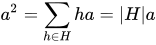
with the summands corresponding to the isotypic components of the regular representation.[16] Each simple module is the standard module of column vectors over knik^{n_i}, unique up to isomorphism, and the decomposition reflects the block structure of representations. The regular representation of GG, which is k[G]k[G] as a left module over itself, provides an example: it decomposes as iniVi\bigoplus_i n_i V_i, where ViV_i are the irreducibles.[26][16] A key consequence is the dimension formula: the sum of the squares of the dimensions of the irreducible representations equals the order of the group, ini2=G\sum_i n_i^2 = |G|. This follows from the decomposition of the regular representation and the semisimplicity of k[G]k[G], equating the dimension of the algebra to the sum of the dimensions of the matrix blocks. The formula underscores the finite nature of the representation theory for finite groups over such fields and constrains possible representation dimensions.[26][16]

Regular Representation

The regular module of the group ring $ R[G] $ is the left $ R[G] $-module $ {}_{R[G]} R[G] $, where the action is defined by left multiplication. Specifically, for any $ a, b \in R[G] $, the module action is given by
ρ(a)(b)=ab. \rho(a)(b) = ab.
This construction endows $ R[G] $ with a canonical module structure over itself, and when $ R $ is a field (such as $ \mathbb{Q} $ or $ \mathbb{C} $), it yields the regular representation of the underlying group $ G $ on the vector space $ R[G] $, which has basis $ { g \mid g \in G } $ and dimension $ |G| $ if $ G $ is finite.[28] For a finite group $ G $, when $ R = \mathbb{C} $, the regular representation provides a faithful representation of $ G $ whose character $ \chi_{\mathrm{reg}} $ is particularly simple:
χreg(g)={Gif g=1,0otherwise. \chi_{\mathrm{reg}}(g) = \begin{cases} |G| & \text{if } g = 1, \\ 0 & \text{otherwise}. \end{cases}
This character formula arises from the trace of the action of $ g $ on the basis $ { e_h \mid h \in G } $, where only the identity element fixes any basis vectors, each contributing 1 to the trace.[29] In the semisimple case over $ \mathbb{C} $, the regular representation decomposes as a direct sum of all distinct irreducible representations of $ G $, with each irreducible representation $ V $ appearing with multiplicity equal to $ \dim V $. This multiplicity follows from the orthogonality of characters, as the inner product $ \langle \chi_{\mathrm{reg}}, \chi_V \rangle = \dim V $, confirming that the regular representation contains every irreducible exactly $ \dim V $ times and serves as a building block for the Artin-Wedderburn decomposition of $ \mathbb{C}[G] $.[30]

Semisimplicity and Decomposition

A group algebra k[G]k[G] over a field kk and finite group GG is semisimple if every short exact sequence of k[G]k[G]-modules splits, or equivalently, if every module is a direct sum of simple modules.[16] Maschke's theorem establishes semisimplicity precisely when the characteristic of kk does not divide G|G|: in this case, every k[G]k[G]-module is semisimple.[31] The theorem implies that the Jacobson radical of k[G]k[G] is zero, ensuring the algebra has no nonzero nilpotent ideals.[16] The proof of Maschke's theorem proceeds by constructing invariant complements to submodules. Given a k[G]k[G]-module VV and a submodule WVW \subseteq V, choose any kk-linear projection π:VW\pi: V \to W. Define the averaged operator
P=1GgGgπg1, P = \frac{1}{|G|} \sum_{g \in G} g \pi g^{-1},
which is a k[G]k[G]-equivariant projection onto WW since G|G| is invertible in kk. The kernel of PP then provides a complementary submodule, and iterating this process yields a complete decomposition into simples.[31][16] Under these conditions, the Artin–Wedderburn theorem decomposes the semisimple algebra k[G]k[G] as a direct sum of matrix rings over division algebras:
k[G]iMni(Di), k[G] \cong \bigoplus_i M_{n_i}(D_i),
where each DiD_i is a finite-dimensional division algebra over kk and the nin_i are the dimensions of the corresponding simple modules divided by those of the endomorphism division rings.[16] If kk is algebraically closed, the DiD_i are all kk, simplifying to
k[G]iMni(k), k[G] \cong \bigoplus_i M_{n_i}(k),
with the summands corresponding to the isotypic components of the regular representation.[16] The primitive central idempotents projecting onto these components are given by
ei=dimSiGgGχi(g)g, e_i = \frac{\dim S_i}{|G|} \sum_{g \in G} \overline{\chi_i(g)} g,
where χi\chi_i is the character of the simple module SiS_i.[16] In positive characteristic pp dividing G|G|, k[G]k[G] is no longer semisimple, as Maschke's theorem fails and the radical is nontrivial.[16] Nonetheless, the Brauer–Nesbitt theorem provides a decomposition insight: over a splitting field of characteristic pp, the number of isomorphism classes of simple k[G]k[G]-modules equals the number of pp-regular conjugacy classes in GG (those consisting of elements whose orders are coprime to pp).[16] This counts the simple summands in the semisimple quotient k[G]/Rad(k[G])k[G]/\mathrm{Rad}(k[G]), facilitating block decompositions in modular representation theory.[16]

Center and Idempotents

The center of the group ring k[G]k[G], where GG is a finite group and kk is a field (typically of characteristic not dividing G|G|), consists of all elements gGagg\sum_{g \in G} a_g g such that the coefficients satisfy ahgh1=aga_{hgh^{-1}} = a_g for all h,gGh, g \in G.[32] This condition ensures that these elements commute with every element of k[G]k[G], forming a commutative subalgebra Z(k[G])Z(k[G]).[32] A basis for Z(k[G])Z(k[G]) is given by the class sums EC=gCgE_C = \sum_{g \in C} g, where CC runs over the conjugacy classes of GG.[32] Consequently, the dimension of Z(k[G])Z(k[G]) equals the number of conjugacy classes in GG.[32] In the semisimple case, the primitive central idempotents of k[G]k[G] play a key role in decomposing the algebra into simple components. For each irreducible character χ\chi of GG, the element
eχ=dimχGgGχ(g1)g e_\chi = \frac{\dim \chi}{|G|} \sum_{g \in G} \chi(g^{-1}) g
is a primitive central idempotent.[32] This idempotent eχe_\chi projects the regular representation onto the isotypic component corresponding to the irreducible representation with character χ\chi.[32] These primitive central idempotents satisfy the orthogonality relation eχeψ=δχψeχe_\chi e_\psi = \delta_{\chi \psi} e_\chi for distinct irreducible characters χ\chi and ψ\psi, where δχψ\delta_{\chi \psi} is the Kronecker delta.[33] Moreover, they sum to the identity element: χeχ=1\sum_\chi e_\chi = 1, providing a complete orthogonal decomposition of the center that mirrors the decomposition of k[G]k[G] into matrix algebras over division rings.[32]

Infinite Group Rings

Distinct Properties

Unlike the case of finite groups, where the group ring over a field of characteristic not dividing the group order is semisimple by Maschke's theorem, group rings over infinite groups lack such a general semisimplicity result.[34] For infinite groups GG, there is no direct analog of Maschke's theorem, meaning that representations or modules over k[G]k[G] (with kk a field) need not decompose into direct sums of irreducibles, even when the characteristic of kk imposes no obvious obstruction. This failure arises because the averaging technique central to Maschke's proof relies on finite sums over the group elements, which cannot be applied when GG is infinite. Consequently, the Jacobson radical J(k[G])J(k[G]) of the group ring may be nonzero, reflecting indecomposable structures or nilpotent elements that persist in infinite dimensions.[34] A defining feature of group rings R[G]R[G] for any ring RR and infinite group GG is that elements must have finite support, meaning only finitely many group elements receive nonzero coefficients in the formal linear combinations gGrgg\sum_{g \in G} r_g g with rgRr_g \in R.[9] This restriction ensures the ring operations—addition and multiplication via the group law—are well-defined, avoiding convergence issues that would arise with arbitrary supports as in the space of all functions from GG to RR. In contrast to finite GG, where every element automatically has full support over the group, the finite support condition for infinite GG limits the ring to a proper subring of the full function space, impacting properties like dimensionality and the behavior of ideals such as the augmentation ideal.[9] For the specific case of the integral group ring Z[G]\mathbb{Z}[G], Z[G]\mathbb{Z}[G] is torsion-free as an abelian group under addition, as it is a free abelian group on the basis GG. A concrete illustration is the group ring Z[Z]\mathbb{Z}[\mathbb{Z}], which is isomorphic to the ring of Laurent polynomials Z[t,t1]\mathbb{Z}[t, t^{-1}], consisting of finite sums i=nmaiti\sum_{i=-n}^m a_i t^i with aiZa_i \in \mathbb{Z}.[9] This isomorphism highlights the infinite, non-polynomial nature of such rings, where multiplication corresponds to the group operation of addition in Z\mathbb{Z}. For infinite groups like G=ZG = \mathbb{Z}, there are multiple ring homomorphisms from Z[G]\mathbb{Z}[G] to Z\mathbb{Z}, specifically two: the augmentation map sending t1t \mapsto 1 and another sending t1t \mapsto -1.

Zero Divisors and Ideals

In the group ring $ R[G] $ over a commutative ring $ R $ and infinite group $ G $, the augmentation ideal $ I $ is the kernel of the augmentation homomorphism $ \varepsilon: R[G] \to R $, which maps $ \sum r_g g \mapsto \sum r_g $, and is generated as an ideal by the set $ { g - 1 \mid g \in G } $.[18] When |G| > 1, this ideal is nontrivial (since g - 1 ≠ 0 for g ≠ e) and proper (as the augmentation homomorphism is surjective onto R), serving as a nontrivial proper two-sided ideal. This demonstrates that R[G] is not a simple ring for nontrivial groups G and hence not a division ring.[35] This ideal plays a central role in the structure of infinite group rings, distinguishing them from finite cases through its behavior under powers and interactions with zero divisors.[18] The higher powers of the augmentation ideal are given by $ I^n = \langle (g_1 - 1) \cdots (g_n - 1) \mid g_i \in G \rangle_{R[G]} $, the ideal generated by all products of $ n $ factors from $ { g - 1 \mid g \in G } $. For infinite $ G $, these powers do not nilpotize in general, unlike in finite group rings, and their structure reflects the infinitude of $ G $, often leading to complicated ideal decompositions.[2] Zero divisors in infinite group rings $ R[G] $ arise prominently when $ G $ contains torsion elements. If $ G $ has an element $ g $ of finite order $ n \geq 2 $, then $ 1 - g $ and $ \sum_{k=0}^{n-1} g^k $ are nonzero elements whose product is zero, yielding explicit zero divisors, provided the characteristic of $ R $ does not divide $ n $.[18][36] In contrast, for torsion-free infinite groups like the infinite cyclic group $ C_\infty \cong \mathbb{Z} $, the group ring $ \mathbb{Z}[C_\infty] \cong \mathbb{Z}[t, t^{-1}] $ is an integral domain with no zero divisors.[18] In analytic settings, elements of the algebraic group ring can act as zero multipliers on $ L^p(G) $ for $ p > 2 $ even for torsion-free groups such as free groups $ F_k $ ($ k \geq 2 $); for instance, for even $ k > 3 $, the sum of the free generators annihilates a nonzero element in $ L^p(F_k) $.[37] The ideal structure of infinite group rings is rich but non-principal in general. The augmentation ideal $ I $ is rarely principal; for example, in $ \mathbb{Z}[\mathbb{Z}^2] $, $ I = (x-1, y-1) $ requires two generators and cannot be generated by a single element.[18] Cohen's theorem establishes flatness properties for certain ideals in these rings, linking the flatness of modules over group rings to the absence of torsion in $ G $, which aids in understanding non-principal behavior.[38] These features relate to Kaplansky's conjectures, which posit no zero divisors for torsion-free infinite groups over fields.[18]

Kaplansky's Conjectures

Kaplansky's conjectures comprise three prominent open problems regarding the algebraic structure of group rings associated with torsion-free groups, originally posed in the 1940s and extensively studied since. These conjectures address the absence of certain pathological elements—zero divisors, non-trivial units, and idempotents—in such rings, reflecting deeper properties of infinite group rings over integral domains or fields. While partial affirmative results exist for specific classes of groups, the general cases remain unresolved, with notable counterexamples appearing in characteristic-positive settings. As of 2025, computational searches have verified the zero-divisor conjecture for certain small torsion-free groups of rank up to 13, and no counterexamples are known for CAT(0) groups, though the general case remains open.[39] The zero divisor conjecture asserts that for a torsion-free group GG and a field KK, the group ring K[G]K[G] contains no zero divisors, meaning it is an integral domain.[39] This conjecture, which implies that torsion in GG is necessary and sufficient for zero divisors in K[G]K[G], has been verified for various subclasses of torsion-free groups, including free groups via connections to L2L^2-invariants, and torsion-free abelian groups through classical results on Laurent polynomials. However, it remains open in general, with ongoing efforts focusing on groups acting on trees or CAT(0) spaces.[39] The unit conjecture posits that the units in the integral group ring Z[G]\mathbb{Z}[G] for torsion-free GG are precisely the elements of the form ±g\pm g where gGg \in G, i.e., the trivial units arising from the units of Z\mathbb{Z} and the group elements themselves.[40] This has been established for free groups and torsion-free abelian groups, among others, but the general case is unresolved. Notably, while the analogous conjecture over fields KK (where units are K×GK^\times G) has been disproven by a counterexample involving a torsion-free group of cohomological dimension 2, the integer coefficient version persists as open.[41] The idempotent conjecture states that the only idempotents in Z[G]\mathbb{Z}[G] for torsion-free GG are the trivial ones, 0 and 1. Like the others, it holds for free and torsion-free abelian groups, following from the domain property or unit structure in these cases. Counterexamples to idempotent-related questions arise in modular group rings, such as over finite fields where non-trivial idempotents can appear even for torsion-free GG, highlighting the role of characteristic. The conjecture implies the zero divisor one in certain contexts, as non-trivial idempotents would yield zero divisors.[39]

Categorical Perspectives

Universal Property

The group ring $ R[G] $, where $ R $ is a ring and $ G $ is a group, satisfies a universal property that characterizes it up to isomorphism as the free $ R $-algebra generated by $ G $. Specifically, $ R[G] $ freely adjoins the elements of $ G $ to $ R $, subject to the relations that the elements corresponding to group elements multiply according to the group law in $ G $ and commute with elements of $ R $. This means that any $ R $-algebra $ S $ together with a group homomorphism $ \psi: G \to U(S) $, where $ U(S) $ denotes the multiplicative group of units in $ S $, determines a unique $ R $-algebra homomorphism $ \tilde{\psi}: R[G] \to S $ such that $ \tilde{\psi}(rg) = r \cdot \psi(g) $ for all $ r \in R $ and $ g \in G $, where the structure map $ R \to S $ is understood. Equivalently, this property establishes a natural isomorphism of sets
\HomR-alg(R[G],S)\HomGrp(G,U(S)) \Hom_{R\text{-alg}}(R[G], S) \cong \Hom_{\text{Grp}}(G, U(S))
for any $ R $-algebra $ S $.[42][43] This universal property extends to the bifunctoriality of the construction. Given a ring homomorphism $ \phi: R \to S $ and a group homomorphism $ \psi: G \to H $, there exists a unique ring homomorphism $ \tilde{\phi,\psi}: R[G] \to S[H] $ extending both, such that $ \tilde{\phi,\psi}(r) = \phi(r) $ for $ r \in R $ and $ \tilde{\phi,\psi}(g) = \psi(g) $ for $ g \in G $. In other words, the assignment $ (r g) \mapsto \phi(r) \psi(g) $ defines the unique extension to the entire group ring. This reflects the covariant nature of the group ring functor in both the base ring and the group variables.[44] Categorically, the group ring $ R[G] $ can be understood as the coproduct in the category of rings equipped with a compatible $ G $-action, where $ R $ carries the trivial $ G $-action and the construction freely incorporates the group structure. This perspective aligns with the adjunction between the forgetful functor from $ R $-algebras to rings and the group ring formation, though the details of such adjunctions are elaborated elsewhere.[6]

Adjunctions

In category theory, the group ring construction arises as the left adjoint in an adjunction involving the category of groups and the category of rings. Specifically, for the integers Z\mathbb{Z} as coefficients, the functor from the category of groups to the category of rings that sends a group GG to its group ring Z[G]\mathbb{Z}[G] is left adjoint to the functor that sends a ring RR to its group of units R×R^\times.[45] More generally, considering the product category Grp×CommRing\mathbf{Grp} \times \mathbf{CommRing} and the category of rings, the functor sending a pair (G,R)(G, R) to the group ring R[G]R[G] (viewed as an RR-algebra) is left adjoint to the forgetful functor that extracts the group of units (playing the role of GG) and the underlying coefficient ring (playing the role of RR).[45] This adjunction captures the "free" nature of the group ring, where ring homomorphisms from R[G]R[G] to another ring SS over RR correspond bijectively to group homomorphisms from GG to the units of SS. A key application of adjunctions in the context of group rings appears in the study of modules. For a commutative ring RR and group GG, the group ring R[G]R[G] defines an RR-algebra structure. The induction functor (or extension of scalars) from the category of RR-modules to the category of R[G]R[G]-modules sends an RR-module MM to R[G]RMR[G] \otimes_R M, endowing it with a natural GG-action via the group ring. This functor is left adjoint to the restriction of scalars functor, which forgets the R[G]R[G]-action on an R[G]R[G]-module NN to yield an RR-module. The adjunction is realized by the natural isomorphism
\HomR[G]-Mod(R[G]RM,N)\HomR-Mod(M,\ResN), \Hom_{R[G]\text{-}\mathrm{Mod}}(R[G] \otimes_R M, N) \cong \Hom_{R\text{-}\mathrm{Mod}}(M, \Res N),
where \Res\Res denotes restriction, holding for any RR-module MM and R[G]R[G]-module NN. This is a instance of the general tensor-hom adjunction for modules over a ring extension. These adjunctions generalize to monads in category theory. The adjunction between the group ring functor and the forgetful functor to units induces a monad on the category of commutative rings, whose algebras correspond to structures incorporating group-like units. Similarly, the induction-restriction adjunction induces a monad on the category of RR-modules given by T(M)=R[G]RMT(M) = R[G] \otimes_R M, and the category of TT-algebras is equivalent to the category of R[G]R[G]-modules. The universal property of the group ring, which characterizes homomorphisms out of R[G]R[G], emerges as a special case of these adjoint relationships.

Hopf Algebra Structure

The group algebra $ k[G] $ over a field $ k $ for a finite group $ G $ carries a natural Hopf algebra structure. The algebra multiplication is the extension of the group multiplication, while the coalgebra structure is defined by declaring the basis elements $ g \in G $ to be group-like, meaning $ \Delta(g) = g \otimes g $ for all $ g \in G $, with the counit $ \varepsilon(g) = 1 $ and the antipode $ S(g) = g^{-1} $. These maps extend linearly to the entire algebra, so for a general element $ \sum_{g \in G} r_g g $ with only finitely many nonzero coefficients $ r_g \in k $, the coproduct is given by
Δ(gGrgg)=gGrg(gg). \Delta\left( \sum_{g \in G} r_g g \right) = \sum_{g \in G} r_g (g \otimes g).
This structure makes $ k[G] $ a cocommutative Hopf algebra, with the comultiplication reflecting the group multiplication in the tensor product.[46][47] Hopf subalgebras of $ k[G] $ correspond precisely to subgroups of $ G $. Specifically, for a subgroup $ H \leq G $, the subalgebra $ k[H] $ inherits the Hopf structure from $ k[G] $, with induced coproduct, counit, and antipode, forming a Hopf subalgebra. Conversely, any Hopf subalgebra generated by group-like elements arises in this manner from the subgroup they form under the algebra multiplication. This correspondence highlights the intimate link between the algebraic structure of $ k[G] $ and the combinatorial properties of $ G $.[46][47] For infinite groups $ G $, the algebraic group algebra $ k[G] $ still admits the same formal Hopf algebra structure, with the maps defined analogously on finite-support linear combinations. However, to handle infinite sums or convergence issues in applications, completed versions are often considered, such as completions with respect to certain topologies or dual constructions like the algebra of representative functions on $ G $, which form Hopf algebras capturing the group's symmetries in a topological setting. These completions, for instance, arise in the study of dual Hopf algebras associated to infinite discrete groups.[47]

Generalizations to Monoids

The monoid ring $ R[M] $, where $ R $ is a ring and $ M $ is a monoid, is constructed analogously to the group ring by taking the free $ R $-module with basis the elements of $ M $ and extending the multiplication from $ M $ by $ R $-linearity: for basis elements $ m, n \in M $, the product $ m \cdot n $ is defined by the monoid operation, and for general elements $ \sum r_i m_i $ and $ \sum s_j n_j $ (with finite support), the product is $ \sum_{i,j} r_i s_j (m_i n_j) $.[48] This construction yields an associative ring multiplication whenever the monoid operation in $ M $ is associative. If $ M $ is commutative, then $ R[M] $ is commutative whenever $ R $ is. monoid rings $ R[M] $ can exhibit zero divisors even when $ M $ is finite and $ R $ is an integral domain.[49] For instance, certain finite commutative monoids lead to $ R[M] $ with nontrivial zero-divisor sets, as analyzed through semigroup-theoretic factorizations that reveal nonunique decompositions not present in domain cases.[49] An illustrative infinite case is the monoid $ (\mathbb{N}, +) $, where $ R[\mathbb{N}] \cong R[x] $ (the polynomial ring) inherits zero-divisor properties from $ R $ but otherwise behaves like a domain if $ R $ does; however, more general non-cancellative monoids introduce zero divisors independently of $ R $. Incidence algebras arise as special instances of monoid rings in specific combinatorial settings. For a poset $ P $, the incidence algebra over a field $ k $ consists of functions supported on comparable pairs with convolution multiplication, and certain such algebras are isomorphic to monoid rings $ k[M] $ for monoids $ M $ derived from projection functors or parking functions on $ P $.[50] This connection highlights how incidence structures encode monoid actions, enabling explicit isomorphisms that preserve algebraic properties like dimension and basis.[50] For example, the monoid algebra of non-decreasing parking functions on a poset is isomorphic to the incidence algebra of that poset, facilitating computations in enumerative combinatorics.[50] Semigroup algebras extend the monoid ring construction to semigroups $ S $ (possibly without identity), forming the free $ R $-module on $ S $ with convolution multiplication $ (\sum r_i s_i)(\sum t_j u_j) = \sum_{i,j} r_i t_j (s_i u_j) $, assuming associativity in $ S $.[51] In non-cancellative cases, where $ s t = s u $ for distinct $ t, u \in S $, the resulting algebra $ R[S] $ often exhibits richer zero-divisor structures and altered homological properties compared to cancellative semigroups.[52] For instance, weakly cancellative semigroups yield modules over $ R[S] $ with injectivity conditions tied to Banach space properties, while non-cancellative ones lead to non-injective behaviors and more complex ideal lattices, diverging from the semisimple nature of finite group algebras.[52] These differences underscore how non-cancellativity introduces annihilators and torsion elements not prominent in group or cancellative monoid settings.[51]

Advanced Structures

Augmentation Filtration

The augmentation filtration on the group ring R[G]R[G], where RR is a commutative ring and GG is a group, is defined using the augmentation ideal I=kerεI = \ker \varepsilon. Here, ε:R[G]R\varepsilon: R[G] \to R is the augmentation homomorphism sending gGrgggGrg\sum_{g \in G} r_g g \mapsto \sum_{g \in G} r_g. The filtration is given by the descending chain Fn=InF_n = I^n for n1n \geq 1, with F0=R[G]F_0 = R[G], so that Fn+1FnF_{n+1} \subseteq F_n and nFn={0}\bigcap_n F_n = \{0\} under suitable conditions on RR and GG. The associated graded ring is gr(R[G])=n=0In/In+1\mathrm{gr}(R[G]) = \bigoplus_{n=0}^\infty I^n / I^{n+1}, equipped with the induced multiplication. In general, this graded ring is isomorphic to the universal enveloping algebra U(L)U(L) of the graded Lie RR-algebra LL associated to the lower central series of GG. For abelian GG, it is the symmetric algebra SymR(M)\mathrm{Sym}_R(M), where M=I/I2g1R(g1)M = I / I^2 \cong \bigoplus_{g \neq 1} R \cdot (g - 1) as RR-modules, reflecting the free presentation of II generated by the elements g1g - 1 for gG{1}g \in G \setminus \{1\}.[53] This filtration plays a key role in homological algebra, particularly in computing group homology and cohomology. The powers InI^n are related to the bar resolution of the trivial module RR, linking aspects of the graded pieces to the structure of Hn(G,R)H_n(G, R). When GG is finite, the RR-module II is free of rank G1|G| - 1, so the first graded piece gr1(R[G])=I/I2\mathrm{gr}_1(R[G]) = I / I^2 has dimension G1|G| - 1 over RR (assuming RR is a field), determining the initial length scale of the filtration before higher powers contribute.[54]

Applications in Representation Theory

In representation theory of finite groups, the center of the group algebra C[G]\mathbb{C}[G] plays a crucial role in constructing character tables. The center Z(C[G])Z(\mathbb{C}[G]) is spanned by the class sums eC=gCge_C = \sum_{g \in C} g over conjugacy classes CC of GG, and its dimension equals the number of irreducible representations, which matches the number of conjugacy classes by a fundamental theorem.[55] This basis allows the character table to be derived from the eigenvalues of central elements acting on irreducible representations, where the entries are traces of these actions restricted to conjugacy classes. For instance, the orthogonality relations of characters follow directly from the decomposition of C[G]\mathbb{C}[G] into a direct sum of matrix algebras over C\mathbb{C}, with central idempotents projecting onto these components.[55] A seminal application is Burnside's theorem on the solvability of groups of order paqbp^a q^b, proved using characters of the group algebra. The proof relies on analyzing the action of conjugacy classes on irreducible representations: if a non-identity class KK has order a power of pp, its character values must vanish or be scalar multiples on certain representations, leading to a contradiction for non-abelian simple groups of such order.[56] Specifically, for a character χ\chi with gcd(K,χ(1))=1\gcd(|K|, \chi(1)) = 1, elements in KK act as scalar multiples of the identity, implying the group cannot be simple unless abelian, thus forcing solvability. This representation-theoretic approach, originally due to Burnside in 1904, highlights how the structure of C[G]\mathbb{C}[G] detects solvability via character sums over algebraic integers.[56] In modular representation theory, the group algebra k[G]k[G] over a field kk of characteristic pp dividing G|G| decomposes into a direct sum of indecomposable blocks, each corresponding to a subset of simple modules. Unlike the semisimple case in characteristic zero, k[G]k[G] is not semisimple, but the number of simple k[G]k[G]-modules equals the number of pp-regular conjugacy classes, with a bijection given by the irreducible Brauer characters; the algebra decomposes as a sum of matrix rings over division rings within each block.[57] The decomposition matrix relates ordinary characters to modular Brauer characters, capturing how characteristic-zero irreducibles reduce modulo pp into sums of simple k[G]k[G]-modules, essential for understanding projectivity and block structure in p-local theory.[57] Computational tools like the GAP system facilitate the study of representations over group rings R[G]R[G], where RR is a coefficient ring such as the rationals or finite fields. GAP's packages, including LAGUNA and Wedderga, compute the Wedderburn decomposition of R[G]R[G] into simple components, yielding explicit matrix representations for irreducible modules; for example, for the dihedral group of order 16 over F2\mathbb{F}_2, it determines the unit group and symmetric elements.[58] Additionally, the Repsn package constructs characteristic-zero representations from character tables, while modular representations are handled via Brauer tables and condensation methods, enabling verification of decomposition numbers for groups up to moderate order.[59][58] Quantum groups arise as deformations of group algebras k[G]k[G] for finite groups GG, generalizing the Hopf algebra structure through twisting or Rieffel-type quantization. A discrete deformation replaces the multiplication in k[G]k[G] via an action of a finite abelian group HH on the algebra, using a skew-symmetric automorphism to define a new product that preserves the coalgebra, yielding a non-commutative Hopf algebra of the same dimension.[60] For instance, deforming the algebra of (Z/3Z)2Z/2Z(\mathbb{Z}/3\mathbb{Z})^2 \rtimes \mathbb{Z}/2\mathbb{Z} produces a finite quantum group of order 18 that is not a crossed product by classical groups, illustrating how such deformations capture quantum symmetries beyond ordinary representations.[60]

Connections to Topology and Number Theory

Group rings play a significant role in algebraic topology, particularly through their completed versions in equivariant K-theory. In Atiyah's KR-theory, which extends equivariant K-theory to Real representations, completed group rings arise naturally when studying the K-theory of classifying spaces for groups with involutions. Specifically, the completion of the representation ring R(G)R(G) with respect to the augmentation ideal is isomorphic to the KR-theory of the classifying space BGBG, providing a bridge between algebraic structures and topological invariants.[61] This completion theorem, established by Atiyah and Segal, highlights how the topology of BGBG captures the analytic completion of group ring elements under the hat topology.[62] The Baum-Connes conjecture further connects group rings to topology by relating the K-theory of the reduced group C*-algebra Cr(G)C^*_r(G)—the completion of the complex group ring C[G]\mathbb{C}[G]—to the K-homology of the classifying space for proper actions, EG\overline{EG}. The conjecture posits an assembly map μ:K(EG)K(Cr(G))\mu: K^*_*(\overline{EG}) \to K_*(C^*_r(G)) that is an isomorphism for a wide class of discrete groups, linking topological K-homology cycles to algebraic K-theory classes in the group ring completion.[63] This has profound implications for understanding the Novikov conjecture and index theory, as verified for groups satisfying certain cohomological dimension conditions.[64] In equivariant topology, the homotopy groups of the Borel construction π(EG×GX)\pi_*(EG \times_G X), where EGEG is the universal GG-space and XX is a GG-space, relate to the derived category of R[G]R[G]-modules through stable homotopy theory. For RR a commutative ring, these homotopy groups encode equivariant cohomology theories that classify R[G]R[G]-module spectra, facilitating computations of fixed-point homotopies in the context of equivariant spectra.[65] Turning to number theory, group rings appear in class field theory through the structure of idèle groups. The idèle group JKJ_K of a number field KK, consisting of units in the adele ring AK\mathbb{A}_K, can be analyzed via its associated group ring, which encodes the multiplicative structure relevant to abelian extensions. The idele class group CK=JK/K×C_K = J_K / K^\times surjects onto the Galois group Gal(Kab/K)\mathrm{Gal}(K^{\mathrm{ab}}/K) via the Artin reciprocity map, and the group ring Z[CK]\mathbb{Z}[C_K] captures ray class group relations that describe unramified extensions.[66] This framework unifies local and global class field axioms, with the group ring providing a algebraic tool for computing conductor-discriminant formulas.[67] Stickelberger's theorem exemplifies the role of group rings in cyclotomic number theory, particularly for Gauss sums in the ring Z[μn]\mathbb{Z}[\mu_n], where μn\mu_n denotes the n-th roots of unity group. For the cyclotomic field Q(μn)\mathbb{Q}(\mu_n), the theorem states that the Stickelberger ideal, generated by elements θ(σ)=χ(σ)1\theta(\sigma) = \sum_{\chi(\sigma) \neq 1} (Gauss sum factors) in the group ring Z[G]\mathbb{Z}[G] with G=Gal(Q(μn)/Q)(Z/nZ)×G = \mathrm{Gal}(\mathbb{Q}(\mu_n)/\mathbb{Q}) \cong (\mathbb{Z}/n\mathbb{Z})^\times, annihilates the class group Cl(Q(μn))\mathrm{Cl}(\mathbb{Q}(\mu_n)). This annihilation implies that the class number is divisible by certain norms, with explicit computations for prime n yielding bounds on irregular primes.[68] The theorem relies on the factorization of Gauss sums τ(χ)=k=1n1χ(k)ζnk\tau(\chi) = \sum_{k=1}^{n-1} \chi(k) \zeta_n^k in Z[μn]\mathbb{Z}[\mu_n], connecting additive group ring structure to multiplicative characters.[69] In cryptography, group rings have been incorporated into code-based schemes as variants of the McEliece cryptosystem since the 2010s, leveraging their algebraic structure for efficient encoding. Quasi-cyclic codes, which are ideals in the group ring Fq[Z/mZ]F_q[\mathbb{Z}/m\mathbb{Z}] for finite fields FqF_q, serve as the underlying code family in these variants, offering compact public keys while maintaining security against decoding attacks. For instance, moderate density parity-check (MDPC) codes over group rings provide IND-CCA secure encryption with key sizes around 1 MB for 128-bit security, resistant to algebraic cryptanalysis due to the non-commutative nature of the ring.[70] These constructions exploit the convolutional algebra of group rings to generate error-correcting codes indistinguishable from random linear codes, enhancing post-quantum viability.[71]

References

User Avatar
No comments yet.