


Community hub
Recent from talks
Contribute something
Nothing was collected or created yet.
| Inga | |
|---|---|

| |
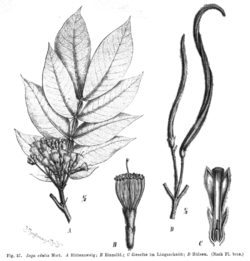
| Ice-cream-bean (Inga edulis) parts drawing | |
Scientific classification 
| |
| Kingdom: | Plantae |
| Clade: | Tracheophytes |
| Clade: | Angiosperms |
| Clade: | Eudicots |
| Clade: | Rosids |
| Order: | Fabales |
| Family: | Fabaceae |
| Subfamily: | Caesalpinioideae |
| Clade: | Mimosoid clade |
| Genus: | Inga Mill. |
| Type species | |
| Inga vera Willd.
| |
| Species | |
|
Hundreds, see List of Inga species | |
| Synonyms[1] | |
| |

Inga is a genus of small tropical, tough-leaved, nitrogen-fixing trees[2] and shrubs, subfamily Mimosoideae. Inga's leaves are pinnate, and flowers are generally white. Many of the hundreds of species are used ornamentally.
Several related plants have been placed into this genus at one time, for example Yopo (Cohoba, Mopo, Nopo or Parica – Anadenanthera peregrina – as Inga niopo).[3]
The seeds are covered with sweet white powder. The pulp covering the seeds is lightly fibrous and sweet, and rich in minerals; it is edible in the raw state. The tree's name originates from the Tupi word in-gá meaning "soaked", due to the fruit powder consistency.[4] The tree usually blooms twice a year.
Within the Inga genus there are around 300 species, most of them native and growing in the Amazon forest region although some species are also found in Mexico, Greater and Lesser Antilles and other countries in South America, being an exclusively neotropical genus. The trees are usually found by river and lake edges because their seeds are carried there by floods.


All Inga species produce their seeds in "bean-like" pods and some can reach up to 1 m long, in general the pods are 10–30 cm long.
Trees can reach up to 15 metres and they are widely used for producing shade over coffee plants. The plant benefits from well drained soil. The flowers are white with some green and the tree can produce fruits almost all year long.
Inga species, most notably Inga edulis (commonly known as "ice-cream-bean" or, in Spanish, guama, guaba, guaba de bejuco or paterna depending on the country or region) often have edible pulp. The name derives from the fact that those of I. edulis resembles vanilla ice cream in flavour.
In Ecuador, Inga edulis is known as guaba de bejuco and, the other popular species there, Inga spectabilis , as guaba de machete.[5]
Use in agroforestry
[edit]Alley cropping techniques using species of Inga have been developed to restore soil fertility, and thereby stem the tide of continual slashing and burning of the rainforest.[6][7] Species which have proven effective for alley cropping include Inga edulis and Inga oerstediana. Much of the research was done by Mike Hands at Cambridge University over a 20-year period.[2] Inga species are also commonly used as shade trees for coffee, cocoa, and tea.[8]
Other uses
[edit]It is often used as lumber in construction and furniture making.[9]
See also
[edit]References
[edit]- ^ Inga Mill. Plants of the World Online. Retrieved 2 September 2023.
- ^ a b Elkan, Daniel. "Slash-and-burn farming has become a major threat to the world's rainforest" The Guardian 21 April 2004
- ^ "USDA GRIN taxonomy:GRIN Species Records of Inga". Archived from the original on 14 October 2008. Retrieved 23 October 2011.
- ^ "Significado de ingá (dicionário inFormal)" (in Portuguese).
- ^ Sotomayor, Ignacio and Duicela, Luis (1995) "Control Integrado de las Principales Enfermedades Foliares del Cafeto en el Ecuador" (preview in Spanish)
- ^ Haugen, C., Revelo, N. "Amazon Rainforest Restoration and Conservation in Ecuador: Inga spp.". Retrieved 18 September 2006.
- ^ Elkan, D. (2005, February). "The Rainforest Saver." The Ecologist, 35 (1), 56–63.
- ^ Valle, Guillermo (2010). "Inga Alley Cropping Manual". Rainforest Saver.
- ^ "Guatemalan Mora". Archived from the original on 24 December 2015. Retrieved 23 December 2015.
External links
[edit] Media related to Inga (Fabaceae) at Wikimedia Commons
 Data related to Inga (Fabaceae) at Wikispecies
- I. Edulis at FACT Net plain text[permanent dead link] HTML
- Lost Crops of the Incas: Little-Known Plants of the Andes with Promise for Worldwide Cultivation
- Mark Kinver (28 October 2019). "'Green gold' tree offers Brazil deforestation hope". BBC News.


Taxonomy
Classification and etymology
Inga is a genus within the legume family Fabaceae, placed in the subfamily Mimosoideae and tribe Ingeae.[11][12] The genus was established by Philip Miller in 1754.[11] It encompasses approximately 300 species, the majority distributed across neotropical regions.[4][13] The name Inga originates from the Tupi indigenous term ingá, which refers to the soaked or powdery consistency of the fruit pulp in many species.[14][15] This etymology reflects early observations by European botanists of the genus's characteristic indehiscent pods filled with sweet, arillate seeds.[14] Recent molecular phylogenetic analyses have prompted taxonomic refinements to achieve monophyly within Inga and related genera. For instance, in 2024, the species formerly known as Inga inundata (previously in Zygia) was reclassified into the newly described genus Ingopsis based on distinct morphological and genetic traits, ensuring coherent boundaries for Inga.[16] Similarly, Zygia sabatieri was transferred to the new genus Pseudocojoba.[17] These adjustments address historical misplacements driven by reliance on superficial traits like pinnate leaves.[16]Species diversity and phylogeny
The genus Inga encompasses approximately 300 species of trees, exhibiting its greatest diversity in the Amazonian region of tropical moist forests across the Neotropics.[18] [19] Species such as Inga edulis and Inga ingoides serve as focal points in ecological and genetic research due to their abundance, morphological variation, and utility in agroforestry studies.[20] Taxonomic challenges persist owing to morphological similarity among closely related species, leading to overlooked or newly described taxa even in hyper-diverse areas.[9] Phylogenetic analyses, including targeted enrichment of nuclear genes and phylogenomic data from over 1,300 loci across 189 of approximately 288 species, indicate a crown age for the genus ranging from 2 to 10 million years, consistent with a recent and rapid radiation.[21] [22] This diversification is marked by high speciation rates, potentially driven by ecological specialization in understory niches, though resolving deep relationships remains complicated by incomplete lineage sorting and reticulate evolution.[23] Hybridization contributes to taxonomic ambiguity, with evidence of widespread introgression blurring species boundaries; for instance, genetic studies in Peruvian Amazon contact zones reveal strong interspecific gene flow between I. ingoides and I. edulis, facilitating adaptive introgression for traits like flood tolerance.[20] [23] Such reticulation, documented across broader phylogenomic sampling, underscores ongoing evolutionary dynamics that challenge traditional morphological delimitation in this hyperdiverse lineage.[23]Morphology
Vegetative structure
Inga species are primarily evergreen trees growing to heights of 10 to 40 meters, though some reach only shrub-like forms under certain conditions, with a broad, spreading crown that often branches low on the trunk, sometimes from below 3 meters.[1][24] The bark is characteristically smooth and pale gray, occasionally featuring elongated lenticels, contributing to the genus's morphological uniformity that complicates species identification.[1][25] The leaves are alternate and paripinnate, typically 10 to 30 cm long, with 4 to 6 pairs of opposite, elliptic to lanceolate leaflets that measure 5 to 16 cm in length and exhibit raised veins on the lower surface.[1][26] Extrafloral nectaries, small glandular structures, are consistently present on the petioles, rachises, and sometimes leaflet bases, aiding in distinguishing Inga from related genera.[27][28] The root system is extensive and branching, often forming numerous nodules that integrate with soil structure, supporting the tree's anchorage and resource uptake in tropical environments; variations exist, with some species developing shallower roots adapted to specific soil conditions.[7][28] While most species lack prominent thorns, certain Inga exhibit spinose stipules or branch modifications for structural defense, varying by taxon and habitat.[1]Reproductive features
Inga species produce axillary spike-like inflorescences bearing small, tubular flowers typically white or whitish, featuring fused petals and numerous long, exserted stamens—often 10 or more—united at the base into an androphore, which distinguishes the genus within Fabaceae.[29][30] These flowers are primarily adapted for insect pollination, with many species exhibiting self-incompatibility and obligate outcrossing, requiring cross-pollination for fruit and seed set.[20] Flowering phenology varies across species and habitats; some display continuous or semi-continuous blooming, while others show synchronized peaks lasting weeks to months, often correlating with wet seasons to enhance pollinator activity and subsequent fruit development.[31] For instance, Inga edulis requires approximately 155 days from flowering to fruit harvest, accumulating 497 thermal units.[32] Fruiting yields indehiscent or dehiscing legume pods, linear to falcate and 1.5–65 cm long, containing 2–21 seeds embedded in a sweet, white, pulpy sarcotesta derived from the endocarp rather than a true aril.[4][3] Seeds of Inga are recalcitrant, characterized by high water content, desiccation sensitivity, and viviparous tendencies, germinating rapidly—often within days of dispersal via rotting pods or animal ingestion of the edible pulp— with low storage longevity limiting ex situ conservation.[33][34] Recent 2024 analysis of Inga edulis seeds confirms their short viability post-harvest but underscores high protein and carbohydrate levels, enabling biotechnological uses and supporting propagation in genetic diversity studies despite challenges posed by recalcitrance.[35][36]Distribution and habitat
Native range
The genus Inga, comprising approximately 300 species, is endemic to the Neotropics and occurs naturally from southern Mexico through Central America to northern Argentina, with extensions into southern Brazil and Uruguay.[37] Species distributions span countries including Belize, Costa Rica, Panama, Colombia, Venezuela, Ecuador, Peru, Bolivia, and Brazil, reflecting a core presence in tropical regions without any verified native occurrences in Africa, Asia, or other continents.[37] [3] The highest species diversity is found in the Amazon basin, where over 180 species have been documented, particularly in northern Brazil, Peru, and Colombia.[38] Concentrations also occur in Andean foothills and montane zones, such as in Ecuador and Peru, contributing to regional hotspots of endemism.[28] Phylogenetic analyses, based on nuclear gene sequences from over 100 species, reveal a rapid radiation originating 2–10 million years ago, with no evidence of historical range expansions beyond the tropical Americas, implying relative stability tied to Neotropical forest persistence.[22]Environmental adaptations
Inga species thrive in humid tropical climates, with most requiring annual rainfall exceeding 1,500 mm to support their fast growth and reproductive cycles, though some, like Inga edulis, can tolerate minima as low as 1,200 mm while enduring brief seasonal dry periods of up to five months.[39][36] Certain taxa adapt to high-precipitation regimes up to 5,000 mm annually, reflecting their prevalence in lowland rainforests where consistent moisture prevents physiological stress.[40] The genus exhibits notable tolerance to nutrient-poor, acidic soils (pH as low as 4.5) prevalent in weathered tropical oxisols and ultisols, enabling persistence in habitats degraded by leaching and erosion without external amendments.[41][42] This adaptation stems from inherent physiological mechanisms, including efficient nutrient recycling, allowing Inga to occupy infertile substrates across Amazonian and Central American lowlands where few competitors survive.[28] Altitudinally, Inga spans from sea level to elevations exceeding 2,000 m in montane forests, with species like I. edulis documented up to 2,200 m, where cooler temperatures and variable fog regimes test thermal limits but are mitigated by shade tolerance in understory positions.[43][40] At higher altitudes, reduced atmospheric pressure and periodic frosts impose constraints, yet pioneer species regenerate post-disturbance in these gradients.[44] In Central American trials, Inga alley systems have demonstrated resilience to abiotic extremes, including short-term droughts and intense storms delivering over 195 mm of rain in single events, with deep root systems and mulch layers preserving soil structure and moisture during Hurricane Mitch remnants in 1998 and subsequent events.[45][46][47] This durability contrasts with annual crops, as Inga's woody architecture withstands wind shear up to 150 km/h, reducing erosion on slopes exceeding 30% incline.[42]Ecology
Nitrogen fixation and symbiosis
Inga species, such as Inga edulis, establish symbiotic relationships with nitrogen-fixing bacteria, predominantly fast-growing strains of Bradyrhizobium (related to B. japonicum and B. liaoningense), within specialized root nodules.[48] These bacteria, housed in nodules formed through plant-bacteria signaling and infection threads, express nitrogenase enzymes to reduce atmospheric dinitrogen (N₂) to ammonia (NH₃), which the plant assimilates into amino acids and proteins in exchange for photosynthates.[48] This mutualism enables Inga to thrive in nitrogen-limited, acidic soils where non-symbiotic plants struggle, as the process bypasses dependence on mineralized soil nitrogen, directly accessing the abundant but inert atmospheric pool.[49] Field studies quantify nitrogen fixation efficiency, with I. edulis deriving 74–81% of its nitrogen from atmospheric sources (%Ndfa) under natural conditions.[50] In shaded coffee agroforestry systems with 205–250 Inga trees per hectare, symbiotic fixation contributes approximately 45 kg N ha⁻¹ year⁻¹, while broader estimates in similar setups range from 41–50 kg N ha⁻¹ year⁻¹ based on biomass accumulation and isotope dilution methods using non-fixing references like Vochysia guatemalensis.[51][52] Nodule nitrogenase activity, measured via acetylene reduction assays, confirms functional symbiosis, though rates vary with soil phosphorus availability and rhizobial strain compatibility, with Bradyrhizobium ingae strains showing high effectiveness in low-fertility environments.[48][49] The fixed nitrogen integrates into Inga's biomass, enhancing soil dynamics through eventual litterfall and decomposition. Leaf litter from I. edulis exhibits slow breakdown, with only 33% mass loss and 36% nitrogen release after 20 weeks in humid tropical conditions (half-life of labile N ≈24 weeks), due to a recalcitrant fraction rich in lignin and cellulose that resists rapid microbial decay.[53] This gradual release—equating to ≈52 kg N ha⁻¹ from 5 Mg ha⁻¹ mulch over that period—promotes sustained soil nitrogen retention and carbon sequestration, contrasting with faster-decomposing non-legume litters that risk nutrient leaching.[53] Symbiotically, this efficiency stems from the energetic trade-off: the plant allocates 10–20% of photosynthates to nodules for fixation, yielding a net gain in nutrient-poor ecosystems where soil N mineralization alone cannot support comparable growth.[48]Herbivore defenses and species coexistence
Inga species exhibit a suite of antiherbivore defenses, including chemical compounds such as cyanogenic glycosides, physical barriers like trichomes, and indirect protections through extrafloral nectaries (EFNs) that attract predatory ants.[54] [19] Young expanding leaves, which are particularly vulnerable, allocate substantial resources to these mechanisms, with chemical defenses comprising up to 50% of leaf dry weight in some species.[54] EFNs, located between leaflets, secrete nectar rich in sugars but do not increase production in response to herbivore damage, indicating a constitutive rather than induced strategy.[55] This multi-faceted approach deters folivores and limits damage, as evidenced by lower herbivory rates on defended tissues across Neotropical populations. The evolution of these defenses has proceeded rapidly within Inga, a genus encompassing over 300 species that diverged within the last 2–10 million years.[19] Phylogenetic analyses of 43 species reveal that antiherbivore traits, particularly chemical profiles, exhibit high lability, with shifts in metabolite classes (e.g., from cyanogenic glycosides to alkaloids or phenolics) correlating with speciation events.[56] [57] Quantitative and qualitative variations in defenses, measured via high-performance liquid chromatography in six focal species, define distinct defense syndromes that diverge early in cladogenesis, potentially driving reproductive isolation through herbivore-mediated selection.[57] Such evolutionary dynamics suggest defenses act as key innovations facilitating the genus's hyperdiversity in tropical forests.[19] These defense differences contribute to species coexistence by promoting niche partitioning in diverse communities. In field surveys across Panama (12 species) and Peru (31 species), conspecific Inga individuals co-occurring as spatial neighbors displayed greater divergence in defense traits than expected by chance, reducing overlap in herbivore susceptibility and interspecific competition for safe microsites.[19] This pattern aligns with enemy-free space hypotheses, where varied defenses minimize shared natural enemies, enhancing local persistence amid high herbivore pressure. Empirical herbivory data from these sites confirm that defense heterogeneity lowers overall damage and supports stable multispecies assemblages, underscoring causal links between trait disparity and community structure.[19] [58]Hybridization and genetic diversity
Studies using microsatellite markers have documented strong introgression between Inga ingoides and I. edulis in contact zones within the Peruvian Amazon, where populations exhibit weak overall genetic differentiation despite geographic separation across river tributaries.[20] This hybridization results in admixed individuals, with genetic variation levels comparable between the two species (expected heterozygosity around 0.70-0.75), suggesting ongoing gene flow that enhances local resilience but challenges species delimitation based on morphology alone.[20] [59] Phylogenetic analyses across the genus reveal rampant reticulation, with gene tree incongruence indicating widespread interspecific hybridization during the rapid radiation of Inga species, accounting for approximately 20% of shared genetic variation among sampled taxa.[60] Targeted enrichment of nuclear genes has highlighted low divergence in plastid markers relative to morphological and chemical trait diversity, underscoring hybridization's role in blurring lineage boundaries while potentially driving adaptive evolution, such as in antiherbivore defenses.[22] [61] Recent research from 2023-2024 emphasizes hybridization's contributions to genetic diversity, including introgression at loci linked to secondary metabolism, which may facilitate breeding programs for agroforestry by combining traits like drought tolerance from I. ingoides with pod productivity from I. edulis.[20] However, such reticulation risks diluting species-specific adaptations in natural populations, complicating conservation efforts in fragmented habitats.[62]Human uses
Agroforestry systems
Inga species are integrated into alley cropping systems by planting them in contour-aligned hedgerows spaced 4 to 6 meters apart, allowing intercropping with annual staples such as maize, beans, and squash in the resulting alleys. Trees are pruned two to three times annually to a height of about 2 meters, with the fresh green prunings laid directly onto the soil surface as mulch to cover the ground and facilitate nutrient recycling. This technique draws on the trees' rapid growth and leguminous properties, requiring initial establishment from seedlings or cuttings spaced 1 to 2 meters within rows.[63][40] The Inga Foundation has advanced this alley cropping approach since its founding in 2012, building on field trials conducted in Honduras during the 1980s and 1990s that identified Inga as suitable for replacing slash-and-burn practices. Implementation involves community nurseries for propagating species like Inga edulis and Inga vera, followed by farmer training in site preparation, planting on degraded slopes, and ongoing maintenance to maintain alley widths for machinery or manual cultivation. Adoption has spread among subsistence farmers in tropical regions, with over 5 million trees established by more than 600 families in Honduras as of 2024.[64][65][66] In Honduras and parts of Central America, Inga alley cropping forms the core of the Guama Model, an integrated framework that positions hedgerows on steep, eroded lands to enable continuous cropping without forest clearance. This model emphasizes contour planting to minimize soil erosion, with prunings applied in layers up to 20-30 cm thick post-harvest to prepare fields for the next season. Historical rollout began with pilot sites in the 1990s, evolving into broader programs that train farmers in combining Inga rows with perimeter live fences and fruit tree interplanting for diversified land use.[47][67]Empirical benefits and evidence
Studies on Inga edulis in agroforestry systems indicate nitrogen fixation rates of approximately 35 to 100 kg N ha⁻¹ year⁻¹, primarily through symbiosis with rhizobial bacteria, enabling nutrient recycling via leaf prunings and litterfall that replenish soil fertility on degraded tropical lands.[68][69] This process supports sustained maize and bean yields in alley-cropping trials, where crops interplanted between Inga hedgerows achieved harvests comparable to or exceeding those on freshly cleared slash-and-burn plots, without requiring multi-year fallows, as demonstrated in long-term experiments in humid tropics.[67][70] In multi-strata agroforestry incorporating Inga species, soil organic matter increases over time due to persistent mulch layers from pruned biomass, correlating with elevated soil carbon accumulation and improved understory plant diversity in aging stands of Inga punctata.[71][72] Erosion control is enhanced by the contour-planted hedgerows and deep root systems, which stabilize slopes and reduce runoff on acidic, nutrient-poor soils typical of rainforest zones.[39] Field observations in Honduras reveal Inga alley-cropping systems' resilience to extreme weather, with plots withstanding tropical storms and droughts in 2021 while maintaining productivity on restored lands, outperforming traditional methods vulnerable to soil degradation post-disturbance.[45] For associated crops like cocoa, yields under Inga shade reached up to 1,000 kg ha⁻¹ by year eight in Peruvian trials, reflecting fertility gains from nutrient release without synthetic inputs.[40]Economic and social impacts
Adoption of Inga alley cropping has enhanced household food security for subsistence farmers by enabling sustained maize and bean production without soil degradation, with reports of yields 5-10 times higher than slash-and-burn methods.[65] In Honduras, implementation across over 300 families has resulted in 100% food security, allowing surplus production for market sales and reducing hunger periods previously lasting up to eight months annually.[73] [74] Intercropping Inga alleys with cash crops such as vanilla, rambutan, and coffee has diversified income sources, with farmers generating revenue from organic products sold locally or exported, often without incurring debt for inputs.[75] This approach, scaled primarily through private initiatives like those of the Inga Foundation in Honduras since the early 2000s, emphasizes farmer-provided labor for tree pruning and planting, yielding positive long-term returns on investment after 2-3 years of establishment.[76] Economic analyses of Inga integration in tropical agroforestry systems show high net present values compared to fallow or monocrop alternatives, driven by reduced fertilizer costs and improved land productivity over decades.[77] Socially, the model frees family labor from intensive weeding—cutting it by up to 80%—enabling education, off-farm work, and community stability, while promoting self-reliance over aid dependency through replicable, low-external-input techniques.[78][79]Limitations and criticisms
Establishment of Inga alley cropping systems demands substantial initial labor, including site preparation, manual grass removal, and planting hedgerows at spacings of 4-6 meters, often requiring 20-24 months before first pruning.[80][42] Direct seeding proves unreliable without consistent rainfall to prevent desiccation, favoring bare-root seedlings instead, while short seed viability—lasting up to two weeks—necessitates local collection and limits propagation scalability.[42] Ongoing management, such as annual pruning to chest height for mulch production, adds labor intensity, particularly in commercial settings where mechanization lags.[80] Inga edulis requires a minimum of 1200 mm annual rainfall for optimal growth, rendering it unsuitable for drier regions without supplemental irrigation, as mature trees tolerate only short droughts and young plants are more vulnerable.[42][81] Efficacy varies in non-optimal conditions; field trials in the Peruvian Amazon showed Inga edulis tree fallows yielding no crop improvements over natural fallows and significantly lower outputs in some cases, underscoring dependence on precise management like timely pruning and soil adaptation.[77] Transition periods often involve reduced short-term crop yields due to shade from establishing trees and mulch decomposition delays, with leaves breaking down slowly compared to faster-cycling alternatives.[42][80] Scalability faces barriers beyond subsistence farming, including high upfront investments, land tenure insecurities, and cultural resistance to labor shifts, limiting replacement of monocultures in commercial operations.[80] While no widespread invasiveness occurs in native Neotropical ranges, localized pests like mistletoe in Ecuador highlight monitoring needs in agroforestry deployments.[42]Cultivation
Propagation methods
Seed propagation is the primary method for cultivating Inga species, including Inga edulis, due to the ready availability of seeds and their capacity to produce genetically diverse seedlings. Seeds exhibit recalcitrant storage physiology, rapidly losing viability post-harvest—often within weeks—requiring fresh collection and immediate sowing to achieve optimal results.[34] Fresh seeds from ripe pods germinate readily without pretreatment, frequently initiating while still within the pod, with rates exceeding 80% under suitable conditions such as moist, shaded nursery beds at 25–30°C.[82] [83] For seeds with physical dormancy or those stored briefly, mechanical scarification—such as nicking the seed coat with sandpaper or a file—breaks the impermeable layer, enhancing water uptake and germination, though this is less critical for orthodox species like I. edulis.[84] Vegetative propagation via stem cuttings is less commonly employed across the Inga genus owing to challenges in rooting mature tissues, but it offers potential for clonal multiplication of superior genotypes. Semi-hardwood cuttings from juvenile stock plants, treated with auxins like indole-3-butyric acid (IBA), show variable success, with rooting rates improved under high humidity and mist systems.[85] Mini-cuttings derived from orthotropic shoots in clonal mini-gardens have demonstrated higher efficacy for I. edulis, achieving over 85% rooting and survival regardless of IBA concentrations up to 3000 mg/L, when propagated in shaded greenhouses.[86] Air layering provides an alternative for larger branches but yields lower propagation efficiency compared to seeds. Nursery protocols for Inga emphasize early inoculation with compatible rhizobia to establish nitrogen-fixing symbioses, as native soil strains may be ineffective in new sites. Seeds or young seedlings are inoculated by soaking in a suspension of crushed root nodules from mature Inga plants mixed with water overnight, or using commercial Bradyrhizobium strains specific to the genus, promoting nodulation within 4–6 weeks.[87] [88] This step, combined with sterile media to prevent fungal contamination, supports vigorous seedling growth in polybags or raised beds under 50–70% shade, prior to outplanting at 20–30 cm height.[88]Management practices
In cultivated Inga systems, particularly alley cropping, trees are pruned after 20 to 24 months of growth to a height of approximately 1.5 meters via pollarding, with subsequent annual prunings to maintain productivity and alley access.[89] Prunings, including branches and stripped leaves, are chopped and applied as mulch directly in the crop alleys to suppress weeds, retain moisture, and release nutrients upon decomposition, typically six weeks prior to crop planting to allow integration.[81] Hedgerows are established with 4- to 6-meter alley widths to accommodate associated crops and facilitate mulch distribution, while trees within rows are spaced 1 to 2 meters apart for optimal canopy coverage post-pruning.[63] Established Inga trees, benefiting from nitrogen-fixing root nodules, require no supplemental nitrogen fertilizers, relying instead on symbiotic bacteria for soil nitrogen replenishment and demonstrating independence from routine fertilization after initial rooting.[90] Soil tests may guide occasional applications of phosphorus or potassium if deficiencies arise, but over-fertilization risks disrupting microbial symbioses. Pest management emphasizes monitoring for common threats like leaf-cutting ants or borers, leveraging Inga's inherent chemical defenses—such as alkaloids and tannins in foliage—that deter herbivores, alongside promotion of natural enemies via extrafloral nectaries.[91] Biological controls and cultural practices, including mulch layers to disrupt pest cycles, are prioritized over chemical interventions to preserve ecosystem services.[92] For climate resilience, 2024 guidelines recommend adaptive pruning to reduce wind exposure in variable rainfall areas and selection of locally adapted Inga variants to withstand droughts, with mulch retention enhancing soil moisture conservation during dry spells.[89] Regular canopy thinning prevents overcrowding and improves light penetration for understory crops, sustaining long-term yields without external inputs.References
- https://commons.wikimedia.org/wiki/Category:Inga_%28Fabaceae%29